DMADOV
(Define, Measure, Analyze, Design, Optimize, Verify)
Presented By
Dr. Niraj Chaudahri
Assistant Professor,
Sanjivani College of Engineering ,
Dept.of MBA,
Kopargaon
DMADOV (Define, Measure, Analyze, Design, Optimize, Verify)
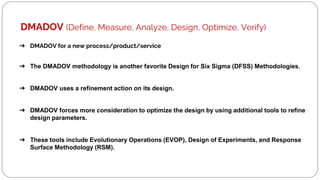
➔ DMADOV for a new process/product/service
➔ The DMADOV methodology is another favorite Design for Six Sigma (DFSS) Methodologies.
➔ DMADOV uses a refinement action on its design.
➔ DMADOV forces more consideration to optimize the design by using additional tools to refine
design parameters.
➔ These tools include Evolutionary Operations (EVOP), Design of Experiments, and Response
Surface Methodology (RSM).
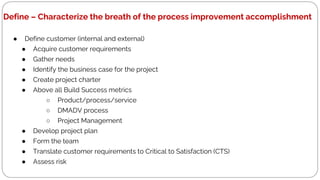
Define – Characterize the breath of the process improvement accomplishment
● Define customer (internal and external)
● Acquire customer requirements
● Gather needs
● Identify the business case for the project
● Create project charter
● Above all Build Success metrics
○ Product/process/service
○ DMADV process
○ Project Management
● Develop project plan
● Form the team
● Translate customer requirements to Critical to Satisfaction (CTS)
● Assess risk
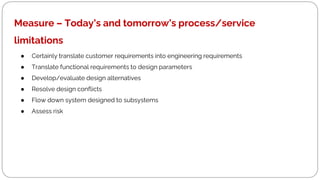
Measure – Today’s and tomorrow’s process/service
limitations
● Certainly translate customer requirements into engineering requirements
● Translate functional requirements to design parameters
● Develop/evaluate design alternatives
● Resolve design conflicts
● Flow down system designed to subsystems
● Assess risk
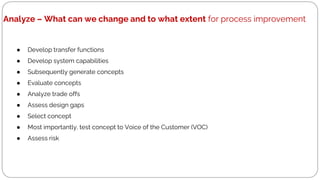
Analyze – What can we change and to what extent for process improvement
● Develop transfer functions
● Develop system capabilities
● Subsequently generate concepts
● Evaluate concepts
● Analyze trade offs
● Assess design gaps
● Select concept
● Most importantly, test concept to Voice of the Customer (VOC)
● Assess risk
Design & Optimize – Generate solution and iterate to improve
● Compare product/process/service capability vs. VOC
● Moreover design solution
● Optimize the product/process/service design for:
○ Robustness
○ Manufacturability
○ Assemblability
○ Serviceability
○ Reliability
○ Testability
● Optimize tolerances
● Certainly design process control plan
● Mistake proof design
● Assess risk
Verify – Finalize and control
● Verify product/process/service performance
● Monitor system capability
● Implement design and process control plans
● Develop transition plans

5.2 DMADOV Phase.pptx

  • 1.
    DMADOV (Define, Measure, Analyze,Design, Optimize, Verify) Presented By Dr. Niraj Chaudahri Assistant Professor, Sanjivani College of Engineering , Dept.of MBA, Kopargaon
  • 2.
    DMADOV (Define, Measure,Analyze, Design, Optimize, Verify) ➔ DMADOV for a new process/product/service ➔ The DMADOV methodology is another favorite Design for Six Sigma (DFSS) Methodologies. ➔ DMADOV uses a refinement action on its design. ➔ DMADOV forces more consideration to optimize the design by using additional tools to refine design parameters. ➔ These tools include Evolutionary Operations (EVOP), Design of Experiments, and Response Surface Methodology (RSM).
  • 3.
    Define – Characterizethe breath of the process improvement accomplishment ● Define customer (internal and external) ● Acquire customer requirements ● Gather needs ● Identify the business case for the project ● Create project charter ● Above all Build Success metrics ○ Product/process/service ○ DMADV process ○ Project Management ● Develop project plan ● Form the team ● Translate customer requirements to Critical to Satisfaction (CTS) ● Assess risk
  • 4.
    Measure – Today’sand tomorrow’s process/service limitations ● Certainly translate customer requirements into engineering requirements ● Translate functional requirements to design parameters ● Develop/evaluate design alternatives ● Resolve design conflicts ● Flow down system designed to subsystems ● Assess risk
  • 5.
    Analyze – Whatcan we change and to what extent for process improvement ● Develop transfer functions ● Develop system capabilities ● Subsequently generate concepts ● Evaluate concepts ● Analyze trade offs ● Assess design gaps ● Select concept ● Most importantly, test concept to Voice of the Customer (VOC) ● Assess risk
  • 6.
    Design & Optimize– Generate solution and iterate to improve ● Compare product/process/service capability vs. VOC ● Moreover design solution ● Optimize the product/process/service design for: ○ Robustness ○ Manufacturability ○ Assemblability ○ Serviceability ○ Reliability ○ Testability ● Optimize tolerances ● Certainly design process control plan ● Mistake proof design ● Assess risk
  • 7.
    Verify – Finalizeand control ● Verify product/process/service performance ● Monitor system capability ● Implement design and process control plans ● Develop transition plans