
cenapt.pharm.uic.edu UIC
CENAPT Workshop
Application of NMR beyond
Structure Elucidation
Hands-on Practice
qHNMR for
Purity Determination
asp 2017 portland 1
cenapt.pharm.uic.edu UIC
Applications of NMR....
The ultimate use of NMR data
• ...to elucidate structures
– What is it? 1D/2D/nD
• ...to determine composition
– How complex is it? One vs. many
• ...to quantify
– How much of what is there?
– Relative composition
– Absolute content
2
cenapt.pharm.uic.edu UIC
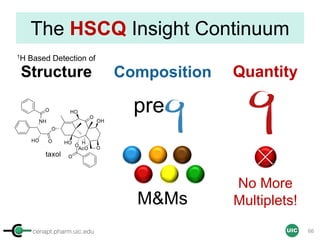
The HSCQ Insight Continuum
Structure
pre
Composition Quantity
M&Ms
No More
Multiplets!
1H Based Detection of
3
cenapt.pharm.uic.edu UIC
Why HSCQ to Go Beyond Structure?
• Residual Complexity is inherent to NPs
• Hydrogen is universal atom in NPs
• Hydrogen is most sensitive NMR nucleus
• No More Multiplets! enhances rigor and
reproducibility
• CQ enforces thinking beyond HS - innovate
• No weighing error in 100% qHNMR
• Q is Free - as in beer!
4
cenapt.pharm.uic.edu UIC
Goals of Workshop
• Q&A: Why go beyond structure?
– Provide rationales
– Perspectives of q-experts
– Recognize innovation
• Q&A: How to go beyond structure?
– The q-workflow
• Q&A: When to go beyond structure?
– Enable: go q-today!
5
cenapt.pharm.uic.edu UIC
Quantitative NMR Conditions
• Structure & Quantity Concurrently
– Simultaneous
– All-in-one data sets
• No magic but routine!
– Go quantitative
– No excuses
• Focus in 1D qNMR
– 2DqNMR feasible
• Q is Free - as in beer!
6
cenapt.pharm.uic.edu UIC
The qNMR Workflow
• Working towards the q
– Be aware of opportunity
– Adjust routine workflow
– Acquire new skills
Sample
Preparation
Acquisition Processing
Assignment &
Integration
Calculation
1 2 3 4
7
cenapt.pharm.uic.edu UIC
Sample Preparation
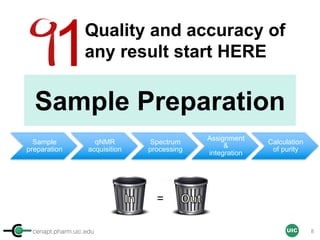
Quality and accuracy of
any result start HERE
Sample
preparation
qNMR
acquisition
Spectrum
processing
Assignment
&
integration
Calculation
of purity
1
8
cenapt.pharm.uic.edu UIC
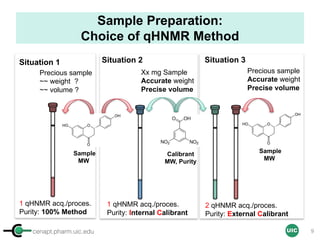
Sample Preparation:
Choice of qHNMR Method
Precious sample
~~ weight ?
~~ volume ?
Situation 1
1 qHNMR acq./proces.
Purity: 100% Method
Xx mg Sample
Accurate weight
Precise volume
Precious sample
Accurate weight
Precise volume
Situation 2 Situation 3
Sample
MW
Calibrant
MW, Purity
1 qHNMR acq./proces.
Purity: Internal Calibrant
Sample
MW
2 qHNMR acq./proces.
Purity: External Calibrant
9
cenapt.pharm.uic.edu UIC
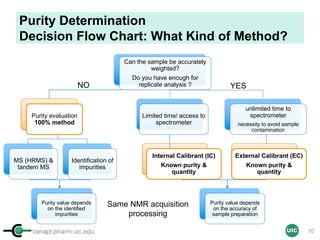
Purity Determination
Decision Flow Chart: What Kind of Method?
Can the sample be accurately
weighted?
Do you have enough for
replicate analysis ?
Purity evaluation
100% method
MS (HRMS) &
tandem MS
Identification of
impurities
Purity value depends
on the identified
impurities
Limited time/ access to
spectrometer
Internal Calibrant (IC)
Known purity &
quantity
unlimited time to
spectrometer
necessity to avoid sample
contamination
External Calibrant (EC)
Known purity &
quantity
Purity value depends
on the accuracy of
sample preparation
YESNO
Same NMR acquisition
processing
10
cenapt.pharm.uic.edu UIC
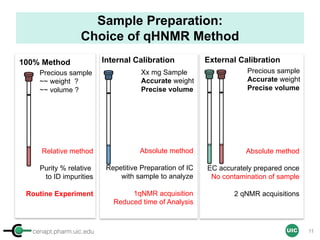
Sample Preparation:
Choice of qHNMR Method
Precious sample
~~ weight ?
~~ volume ?
100% Method
Relative method
Purity % relative
to ID impurities
Routine Experiment
Xx mg Sample
Accurate weight
Precise volume
Precious sample
Accurate weight
Precise volume
Internal Calibration External Calibration
Absolute method
Repetitive Preparation of IC
with sample to analyze
1qNMR acquisition
Reduced time of Analysis
Absolute method
EC accurately prepared once
No contamination of sample
2 qNMR acquisitions
11
cenapt.pharm.uic.edu UIC
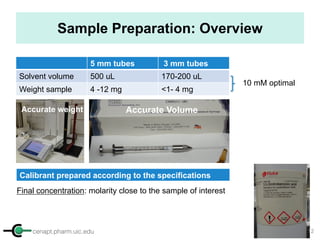
Calibrant prepared according to the specifications
Sample Preparation: Overview
Final concentration: molarity close to the sample of interest
Accurate Volume
5 mm tubes 3 mm tubes
Solvent volume 500 uL 170-200 uL
Weight sample 4 -12 mg <1- 4 mg
Accurate weight
10 mM optimal
12
cenapt.pharm.uic.edu UIC
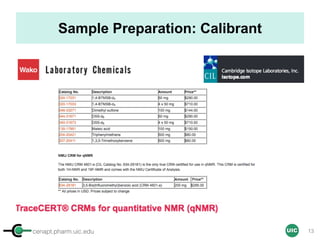
Sample Preparation: Calibrant
13
cenapt.pharm.uic.edu UIC
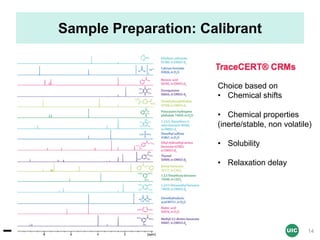
Sample Preparation: Calibrant
Choice based on
• Chemical shifts
• Chemical properties
(inerte/stable, non volatile)
• Solubility
• Relaxation delay
14
cenapt.pharm.uic.edu UIC
Sample Preparation with IC
(Example 1 = Several Precious Samples)
Sample
Calibrant (IC)
STEP 5STEP 1
Qty
[IC] ≈ [Sample]
stock solution
(commercial)
STEP 2 STEP 3
STEP 4
ID, MW
ID, MW,
Purity
Qty
Max 500 µL (5 mm)
Max 200 µL (3 mm)
Tared vial
+ dried cpd
15
cenapt.pharm.uic.edu UIC
Sample Preparation with IC
(Example 2 = Non-precious Powder Sample)
Sample
STEP 4STEP 1 STEP 3
ID, MW
ID, MW, Purity, [IC]
[IC] ≈ [Sample]
In mM
OR
Commercial IC
stock solution
Adjust the concentration
STEP 2
Calibrant
Qty
Max 500 µL (5 mm)
Max 200 µL (3 mm)
16
cenapt.pharm.uic.edu UIC
Sample Preparation with EC
Sample
STEP 1 STEP 2
ID, MW
ID, MW, Purity, [EC]
[EC] ∝ [Sample]
In mM
OR
Commercial solution
Calibrant
Qty Max 500 µL (5 mm)
Max 200 µL (3 mm)
STEP 3 STEP 4 STEP 4
17
cenapt.pharm.uic.edu UIC
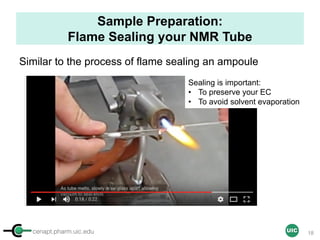
Sample Preparation:
Flame Sealing your NMR Tube
Similar to the process of flame sealing an ampoule
Sealing is important:
• To preserve your EC
• To avoid solvent evaporation
18
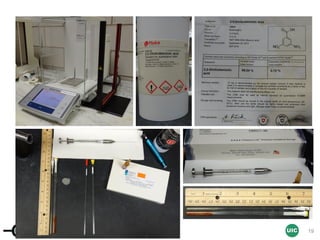
cenapt.pharm.uic.edu UIC 19
cenapt.pharm.uic.edu UIC
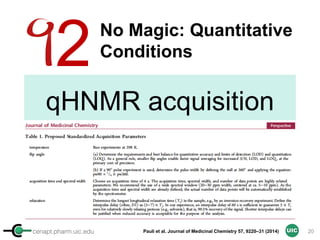
qHNMR acquisition
Pauli et al. Journal of Medicinal Chemistry 57, 9220–31 (2014)
2No Magic: Quantitative
Conditions
20
cenapt.pharm.uic.edu UIC
Key Parameters for Acquisition
Parameters Value Remarks
Relaxation delay
(D1)
Theory: 5 X T1 of compounds
Practice: 60 sec (if T1 unknown)
Accuracy of the integral
values
Pulse width
(90 pulse: P1)
to be determined using the 360
null
Function of solvent
nucleus, sample
Acquisition time
(AQ)
4 sec
Optimization of digital
resolution
Spectral window
(SW)
transmitter offset
(O1P)
SW: 30 ppm – O1P:7.5 ppm
SW: 20 ppm – O1P: 4.5 ppm
For an optimal baseline
correction (edge
effects), and digital
resolution
FID size (TD) 32 K-64 K For better resolution
AQ = (TD/[2x SW])
Number of Data Points (TD) = 2 x Spectral Width (SW in ppm X field strength) x Acquisition Time (AQ)
21
cenapt.pharm.uic.edu UIC
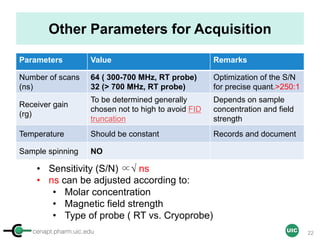
Other Parameters for Acquisition
Parameters Value Remarks
Number of scans
(ns)
64 ( 300-700 MHz, RT probe)
32 (> 700 MHz, RT probe)
Optimization of the S/N
for precise quant.>250:1
Receiver gain
(rg)
To be determined generally
chosen not to high to avoid FID
truncation
Depends on sample
concentration and field
strength
Temperature Should be constant Records and document
Sample spinning NO
• Sensitivity (S/N) ∝√ ns
• ns can be adjusted according to:
• Molar concentration
• Magnetic field strength
• Type of probe ( RT vs. Cryoprobe)
22
cenapt.pharm.uic.edu UIC
Example: Adjustment of NS
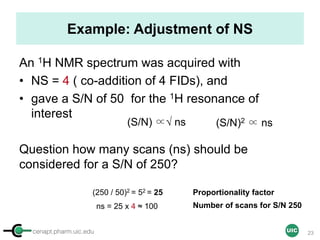
An 1H NMR spectrum was acquired with
• NS = 4 ( co-addition of 4 FIDs), and
• gave a S/N of 50 for the 1H resonance of
interest
Question how many scans (ns) should be
considered for a S/N of 250?
(S/N) ∝√ ns
(250 / 50)2 = 52 = 25
(S/N)2 ∝ ns
ns = 25 x 4 ≈ 100
Proportionality factor
Number of scans for S/N 250
23
cenapt.pharm.uic.edu UIC
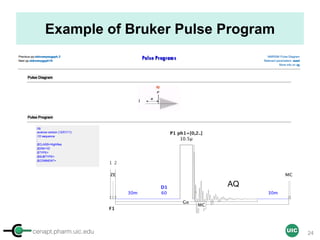
Example of Bruker Pulse Program
AQ
24
cenapt.pharm.uic.edu UIC
Bruker/Topspin Acquisition Parameters
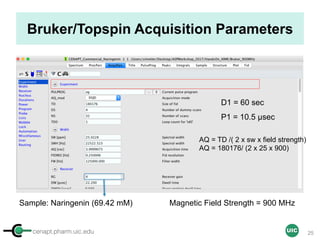
Sample: Naringenin (69.42 mM) Magnetic Field Strength = 900 MHz
D1 = 60 sec
P1 = 10.5 µsec
AQ = TD /( 2 x sw x field strength)
AQ = 180176/ (2 x 25 x 900)
25
cenapt.pharm.uic.edu UIC
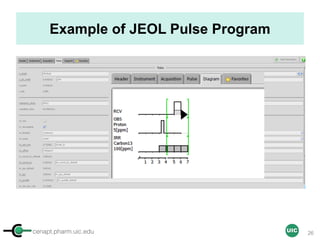
Example of JEOL Pulse Program
26
cenapt.pharm.uic.edu UIC
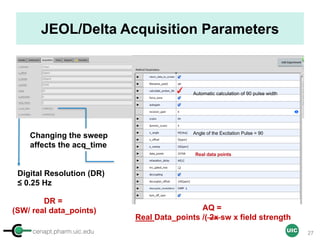
JEOL/Delta Acquisition Parameters
✓
Changing the sweep
affects the acq_time
Automatic calculation of 90 pulse width
Angle of the Excitation Pulse = 90
Digital Resolution (DR)
≤ 0.25 Hz
DR =
(SW/ real data_points)
Real data points
AQ =
Real Data_points /( 2x sw x field strength
27
cenapt.pharm.uic.edu UIC
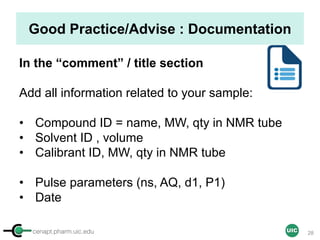
Good Practice/Advise : Documentation
In the “comment” / title section
Add all information related to your sample:
• Compound ID = name, MW, qty in NMR tube
• Solvent ID , volume
• Calibrant ID, MW, qty in NMR tube
• Pulse parameters (ns, AQ, d1, P1)
• Date
28
cenapt.pharm.uic.edu UIC
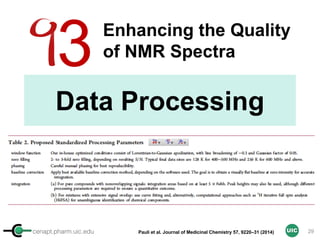
Data Processing
Pauli et al. Journal of Medicinal Chemistry 57, 9220–31 (2014)
3 Enhancing the Quality
of NMR Spectra
29
cenapt.pharm.uic.edu UIC
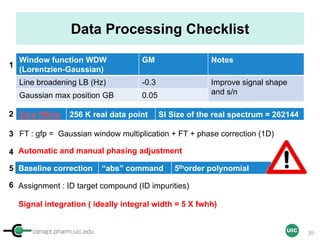
Data Processing Checklist
Window function WDW
(Lorentzien-Gaussian)
GM Notes
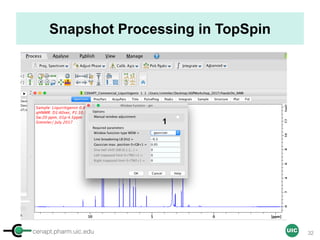
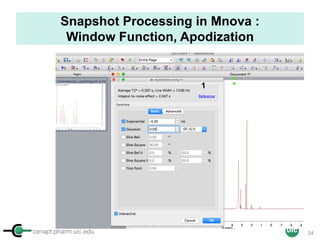
Line broadening LB (Hz) -0.3 Improve signal shape
and s/nGaussian max position GB 0.05
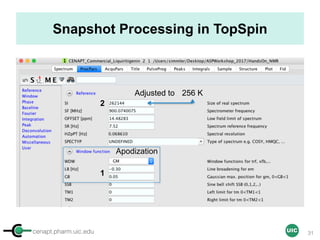
Zero filling 256 K real data point SI Size of the real spectrum = 262144
Baseline correction “abs” command 5thorder polynomial
FT : gfp = Gaussian window multiplication + FT + phase correction (1D)
Automatic and manual phasing adjustment
Assignment : ID target compound (ID impurities)
Signal integration ( ideally integral width = 5 X fwhh)
1
2
3
4
5
6
30
cenapt.pharm.uic.edu UIC
Snapshot Processing in TopSpin
256 KAdjusted to
Apodization
1
2
31
cenapt.pharm.uic.edu UIC
Snapshot Processing in TopSpin
1
32
cenapt.pharm.uic.edu UIC
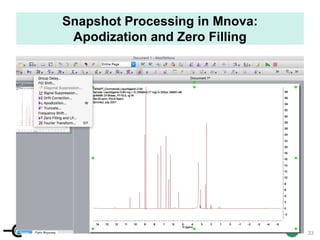
Snapshot Processing in Mnova:
Apodization and Zero Filling
33
cenapt.pharm.uic.edu UIC
Snapshot Processing in Mnova :
Window Function, Apodization
1
34
cenapt.pharm.uic.edu UIC
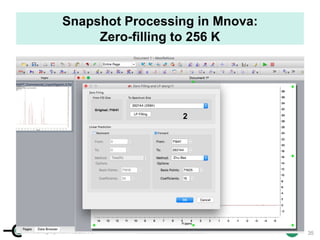
Snapshot Processing in Mnova:
Zero-filling to 256 K
2
35
cenapt.pharm.uic.edu UIC
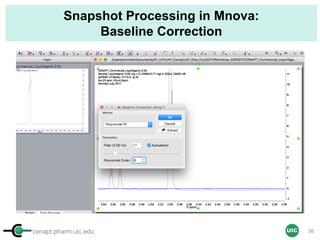
Snapshot Processing in Mnova:
Baseline Correction
36
cenapt.pharm.uic.edu UIC
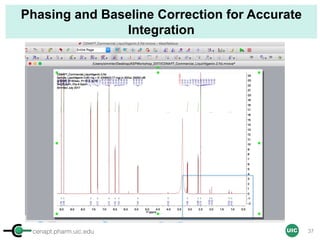
Phasing and Baseline Correction for Accurate
Integration
37
cenapt.pharm.uic.edu UIC
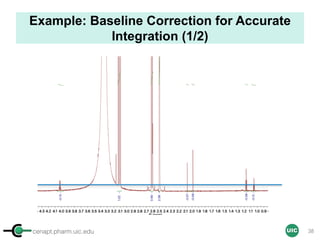
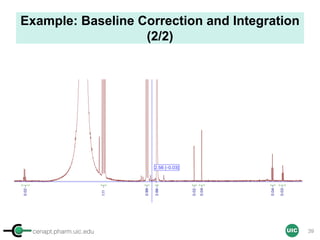
Example: Baseline Correction for Accurate
Integration (1/2)
38
cenapt.pharm.uic.edu UIC
Example: Baseline Correction and Integration
(2/2)
39
cenapt.pharm.uic.edu UIC
Data Analysis
4Turn NMR Spectra into
Quantity Numbers
40
cenapt.pharm.uic.edu UIC
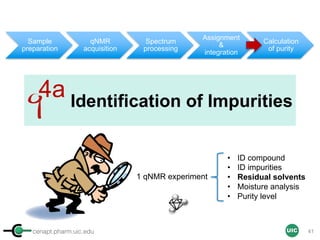
Identification of Impurities
1 qNMR experiment
• ID compound
• ID impurities
• Residual solvents
• Moisture analysis
• Purity level
Sample
preparation
qNMR
acquisition
Spectrum
processing
Assignment
&
integration
Calculation
of purity
4a
41
cenapt.pharm.uic.edu UIC
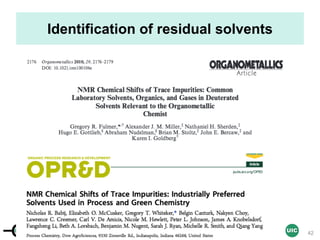
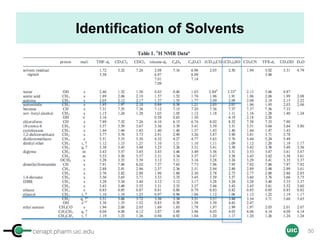
Identification of residual solvents
42
cenapt.pharm.uic.edu UIC
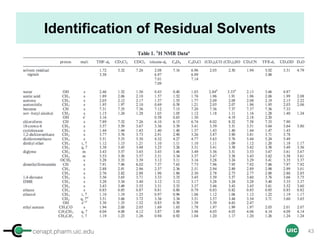
Identification of Residual Solvents
43
cenapt.pharm.uic.edu UIC
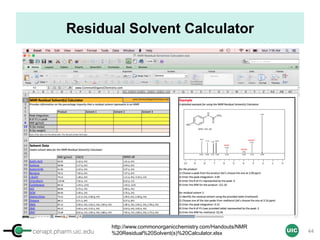
Residual Solvent Calculator
http://www.commonorganicchemistry.com/Handouts/NMR
%20Residual%20Solvent(s)%20Calculator.xlsx 44
cenapt.pharm.uic.edu UIC
Calculation of Purity
Pauli et al. Journal of Medicinal Chemistry 57, 9220–31 (2014)
Concentration (molarity) α [integral Area/ Number of nuclei]
1 qNMR experiment
• ID compound
• ID impurities
• Residual solvent
• Moisture analysis
• Purity
4b
45
cenapt.pharm.uic.edu UIC
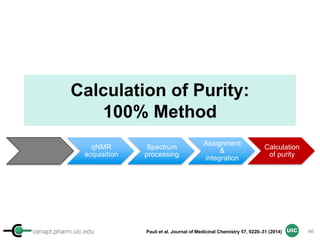
Calculation of Purity:
100% Method
Pauli et al. Journal of Medicinal Chemistry 57, 9220–31 (2014)
Sample
preparation
qNMR
acquisition
Spectrum
processing
Assignment
&
integration
Calculation
of purity
46
cenapt.pharm.uic.edu UIC
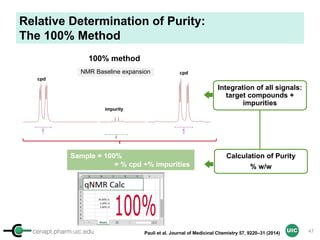
Sample = 100%
= % cpd +% impurities
Integration of all signals:
target compounds +
impurities
Calculation of Purity
% w/w
Relative Determination of Purity:
The 100% Method
47
100% method
Pauli et al. Journal of Medicinal Chemistry 57, 9220–31 (2014)
impurity
cpd
cpdNMR Baseline expansion
cenapt.pharm.uic.edu UIC
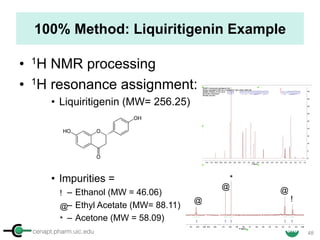
100% Method: Liquiritigenin Example
• 1H NMR processing
• 1H resonance assignment:
• Liquiritigenin (MW= 256.25)
• Impurities =
– Ethanol (MW = 46.06)
– Ethyl Acetate (MW= 88.11)
– Acetone (MW = 58.09)
@
@@
@
!
!
*
*
48
cenapt.pharm.uic.edu UIC
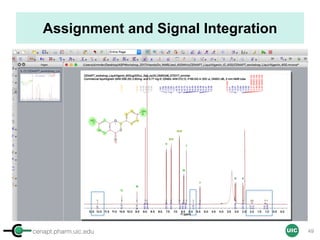
Assignment and Signal Integration
49
cenapt.pharm.uic.edu UIC
Identification of Solvents
50
cenapt.pharm.uic.edu UIC
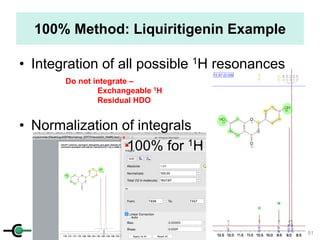
100% Method: Liquiritigenin Example
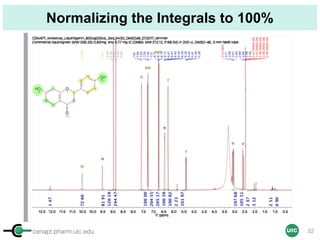
• Integration of all possible 1H resonances
• Normalization of integrals
100% for 1H
Do not integrate –
Exchangeable 1H
Residual HDO
51
cenapt.pharm.uic.edu UIC
Normalizing the Integrals to 100%
52
cenapt.pharm.uic.edu UIC
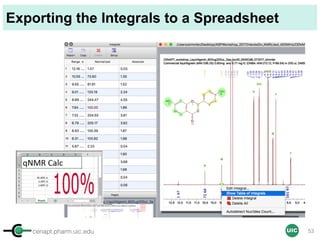
Exporting the Integrals to a Spreadsheet
53
cenapt.pharm.uic.edu UIC
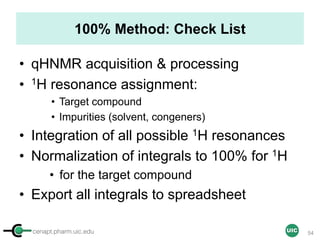
100% Method: Check List
• qHNMR acquisition & processing
• 1H resonance assignment:
• Target compound
• Impurities (solvent, congeners)
• Integration of all possible 1H resonances
• Normalization of integrals to 100% for 1H
• for the target compound
• Export all integrals to spreadsheet
54
cenapt.pharm.uic.edu UIC
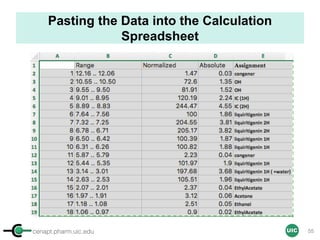
Pasting the Data into the Calculation
Spreadsheet
55
cenapt.pharm.uic.edu UIC
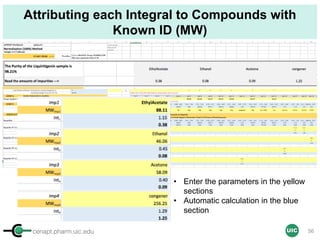
Attributing each Integral to Compounds with
Known ID (MW)
• Enter the parameters in the yellow
sections
• Automatic calculation in the blue
section
56
cenapt.pharm.uic.edu UIC
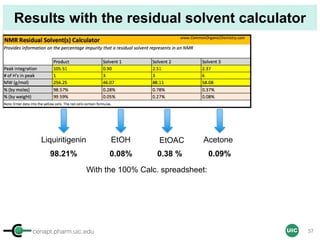
Results with the residual solvent calculator
57
Liquiritigenin EtOACEtOH Acetone
With the 100% Calc. spreadsheet:
98.21% 0.08% 0.38 % 0.09%
cenapt.pharm.uic.edu UIC
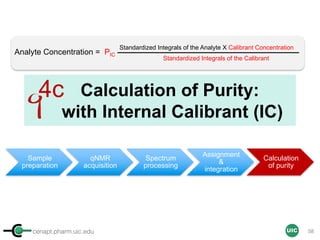
Calculation of Purity:
with Internal Calibrant (IC)
Analyte Concentration = PIC
Standardized Integrals of the Analyte X Calibrant Concentration
Standardized Integrals of the Calibrant
Sample
preparation
qNMR
acquisition
Spectrum
processing
Assignment
&
integration
Calculation
of purity
4c
58
cenapt.pharm.uic.edu UIC
Purity Determination with IC: Overview
Sample: Liquiritigenin
MW : 256.25
Qty: 0.80 mg
Calibrant (IC)
MW: 212.12
Qty: 0.77 mg
Purity:99.54
IC : 1H
target : 1H
𝑃	[%] =
𝑛𝐼𝐶 ∙ 𝐼𝑛𝑡𝑡 ∙ 𝑀𝑊𝑡 ∙ 𝑚𝐼𝐶
𝑛𝑡 ∙ 𝐼𝑛𝑡𝐼𝐶 ∙ 𝑀𝑊𝐼𝐶 ∙ 𝑚 𝑠
∙ 𝑃𝐼𝐶	 =
1 x 100
t = target compound = liquiritigenin
256.25 0.77
99.54
1 x 120.19 212.12 0.80x x
x x
= 96.30% w/w
59
Qty (mic) = n/MW → Intic
→ InttTrue Qty (mt) = n/MW??
cenapt.pharm.uic.edu UIC
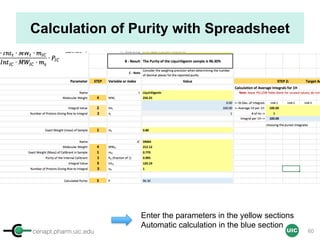
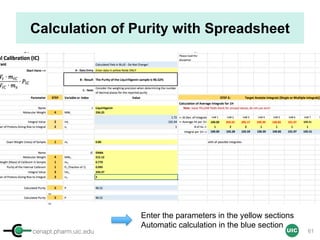
Calculation of Purity with Spreadsheet
Enter the parameters in the yellow sections
Automatic calculation in the blue section
60
cenapt.pharm.uic.edu UIC
Calculation of Purity with Spreadsheet
Enter the parameters in the yellow sections
Automatic calculation in the blue section
61
cenapt.pharm.uic.edu UIC
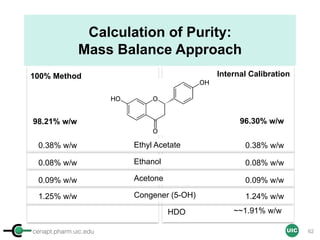
Calculation of Purity:
Mass Balance Approach
98.21% w/w 96.30% w/w
Ethyl Acetate
Ethanol
Acetone
Congener (5-OH)
HDO
0.38% w/w
0.08% w/w
0.09% w/w
1.25% w/w
0.38% w/w
0.08% w/w
0.09% w/w
1.24% w/w
~~1.91% w/w
Internal Calibration100% Method
62
cenapt.pharm.uic.edu UIC
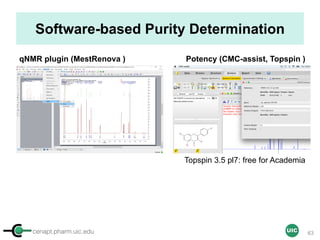
Software-based Purity Determination
qNMR plugin (MestRenova ) Potency (CMC-assist, Topspin )
Topspin 3.5 pl7: free for Academia
63
cenapt.pharm.uic.edu UIC
Educative Blogs and Website
http://u-of-o-nmr-facility.blogspot.ca
http://cbc.arizona.edu/rss/nmr/pdfs/params.pdf
http://nmr-analysis.blogspot.com Mnova related Blog
Parameters of NMR acq.
Ottawa University NMR blog
http://www.nmr.ucdavis.edu/useful-links/
90 pulse width calibration
(Bruker)
http://web.mit.edu/speclab/www/PDF/DCIF-90pulse-Bruker-j07.pdf
http://www.asdlib.org/onlineArticles/ecourseware/Larive/qnmr4.htm
Practical aspects of qNMR
64
http://nmr-analysis.blogspot.com/2009/11/basis-on-qnmr-integration-rudiments.html
http://pubs.acs.org/paragonplus/submission/jmcmar/jmcmar_purity_instructions
cenapt.pharm.uic.edu UIC
CENAPT Workshop
Application of NMR beyond
Structure Elucidation
Hands-on Practice
qHNMR for
Purity Determination
asp 2017 portland 65
cenapt.pharm.uic.edu UIC
The HSCQ Insight Continuum
Structure
pre
Composition Quantity
M&Ms
No More
Multiplets!
1H Based Detection of
66
cenapt.pharm.uic.edu UIC
Why HSCQ to Go Beyond Structure?
• Residual Complexity is inherent to NPs
• Hydrogen is universal atom in NPs
• Hydrogen is most sensitive NMR nucleus
• No More Multiplets! enhances rigor and
reproducibility
• CQ enforces thinking beyond HS - innovate
• No weighing error in 100% qHNMR
• Q is Free - as in beer!
67
cenapt.pharm.uic.edu UIC
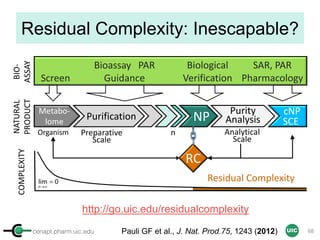
Residual Complexity: Inescapable?
68
Screen
Bioassay			PAR
Guidance
Biological
Verification
SAR,	PAR
Pharmacology
BIO-
ASSAY
Metabo-
lome
Purification NP Purity
Analysis
Organism Preparative
Scale
n
NATURAL
PRODUCT
cNP
SCE
Residual	Complexity0lim
n
=
¥®
COMPLEXITY
Analytical
Scale
RC
Pauli GF et al., J. Nat. Prod.75, 1243 (2012)
http://go.uic.edu/residualcomplexity
cenapt.pharm.uic.edu UIC
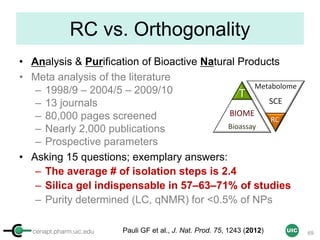
RC vs. Orthogonality
• Analysis & Purification of Bioactive Natural Products
• Meta analysis of the literature
– 1998/9 – 2004/5 – 2009/10
– 13 journals
– 80,000 pages screened
– Nearly 2,000 publications
– Prospective parameters
• Asking 15 questions; exemplary answers:
– The average # of isolation steps is 2.4
– Silica gel indispensable in 57–63–71% of studies
– Purity determined (LC, qNMR) for <0.5% of NPs
69Pauli GF et al., J. Nat. Prod. 75, 1243 (2012)
z
BIOME
Bioassay
Metabolome
SCE
RC
T
cenapt.pharm.uic.edu UIC
Why HSCQ to Go Beyond Structure?
• Residual Complexity is inherent to NPs
• Hydrogen is universal atom in NPs
• Hydrogen is most sensitive NMR nucleus
• No More Multiplets! enhances rigor and
reproducibility
• CQ enforces thinking beyond HS - innovate
• No weighing error in 100% qHNMR
• Q is Free - as in beer!
70
cenapt.pharm.uic.edu UIC
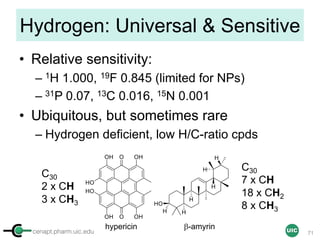
Hydrogen: Universal & Sensitive
• Relative sensitivity:
– 1H 1.000, 19F 0.845 (limited for NPs)
– 31P 0.07, 13C 0.016, 15N 0.001
• Ubiquitous, but sometimes rare
– Hydrogen deficient, low H/C-ratio cpds
71
hypericin b-amyrin
C30
2 x CH
3 x CH3
C30
7 x CH
18 x CH2
8 x CH3
cenapt.pharm.uic.edu UIC
Why HSCQ to Go Beyond Structure?
• Residual Complexity is inherent to NPs
• Hydrogen is universal atom in NPs
• Hydrogen is most sensitive NMR nucleus
• No More Multiplets! enhances rigor and
reproducibility
• CQ enforces thinking beyond HS - innovate
• No weighing error in 100% qHNMR
• Q is Free - as in beer!
72
cenapt.pharm.uic.edu UIC
No More Multiplets
• Multiplicity makes first order assumption
– d t q dd dt ddt dq ddq ddd dddd......m!
• What is a multiplet?
– Signal with much structural information
• Are all multiplets the same?
– Type I: first order, but uninterpreted
ØFull 1D/2D interpretation to understand!
– Type II: second or higher order
ØFull spin analysis to understand!
• General trend: information loss/ignorance
73
cenapt.pharm.uic.edu UIC
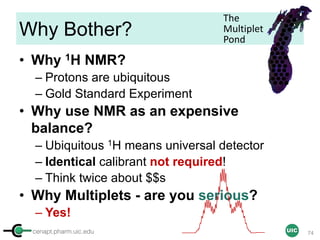
Why Bother?
• Why 1H NMR?
– Protons are ubiquitous
– Gold Standard Experiment
• Why use NMR as an expensive
balance?
– Ubiquitous 1H means universal detector
– Identical calibrant not required!
– Think twice about $$s
• Why Multiplets - are you serious?
– Yes!
74
The	
Multiplet
Pond
cenapt.pharm.uic.edu UIC
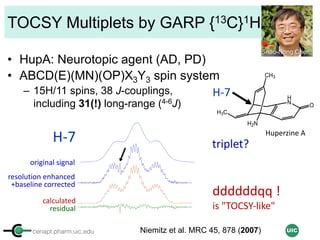
TOCSY Multiplets by GARP {13C}1H
• HupA: Neurotopic agent (AD, PD)
• ABCD(E)(MN)(OP)X3Y3 spin system
– 15H/11 spins, 38 J-couplings,
including 31(!) long-range (4-6J)
+baseline	corrected
resolution	enhanced
original	signal
H-7 triplet?
calculated
residual
ddddddqq !
is	"TOCSY-like"
Huperzine	A
H-7 H
N
H3C
CH3
O
H2N
Niemitz et al. MRC 45, 878 (2007)
Shao-Nong Chen
cenapt.pharm.uic.edu UIC
Why HSCQ to Go Beyond Structure?
• Residual Complexity is inherent to NPs
• Hydrogen is universal atom in NPs
• Hydrogen is most sensitive NMR nucleus
• No More Multiplets! enhances rigor and
reproducibility
• CQ enforces thinking beyond HS - innovate
• No weighing error in 100% qHNMR
• Q is Free - as in beer!
76
cenapt.pharm.uic.edu UIC
Think It Over!
• HS:1H-detected NMR experiments are the
modern workhorses of structural analysis
– 1D, COSY, TOCSY, (ed-)HSQC, HMBC
• Why not use all 1H information?
– H,H couplings
– H,C couplings (13C satellites anybody?)
• Why not use all NMR information?
– Composition, Analogues
– Quantitative composition, purity
77
cenapt.pharm.uic.edu UIC
Why HSCQ to Go Beyond Structure?
• Residual Complexity is inherent to NPs
• Hydrogen is universal atom in NPs
• Hydrogen is most sensitive NMR nucleus
• No More Multiplets! enhances rigor and
reproducibility
• CQ enforces thinking beyond HS - innovate
• No weighing error in 100% qHNMR
• Q is Free - as in beer!
78
cenapt.pharm.uic.edu UIC
Universal qHNMR
The Calibration Q: 100% - EC - IC - ECIC
• Four principal qHNMR methods
– Internal Calibration Absolute Method (IC Abs-qHNMR)
– External Calibration Absolute Method (EC Abs-qHNMR)
– Combined External & Internal Calibration Absolute
Method (ECIC Abs-qHNMR)
• Required instrument validation and calibration
• qNMR beats (our) balances?!
– Uncalibrated Relative (100%) Method (Rel-qHNMR)
• No weighing involved, no weighing error
• Requires detailed interpretation of NMR data (education)
79Pauli et al. J. Med. Chem. 57, 9220-9231 (2014)
cenapt.pharm.uic.edu UIC
Why HSCQ to Go Beyond Structure?
• Residual Complexity is inherent to NPs
• Hydrogen is universal atom in NPs
• Hydrogen is most sensitive NMR nucleus
• No More Multiplets! enhances rigor and
reproducibility
• CQ enforces thinking beyond HS - innovate
• No weighing error in 100% qHNMR
• Q is Free - as in beer!
80
cenapt.pharm.uic.edu UIC
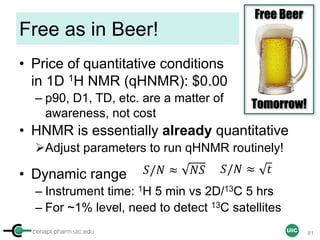
Free as in Beer!
• Price of quantitative conditions
in 1D 1H NMR (qHNMR): $0.00
– p90, D1, TD, etc. are a matter of
awareness, not cost
• HNMR is essentially already quantitative
ØAdjust parameters to run qHNMR routinely!
• Dynamic range
– Instrument time: 1H 5 min vs 2D/13C 5 hrs
– For ~1% level, need to detect 13C satellites
81
Free Beer
Tomorrow!
𝑆/𝑁 ≈ 𝑁𝑆 𝑆/𝑁 ≈ 𝑡
cenapt.pharm.uic.edu UIC
Purity Activity-Relationship (PAR)
• Is ursolic acid (MIC 32-128 µg/mL) a viable anti-TB lead?
– Eight UA accessions: declared vs. found 1-16 % differences
• qNMR Answer: Inverse correlation between purity and activity
• qNMR Net Outcome Pure UA is essentially inactive
82
O
OH
CH3
CH3
CH3
CH3
CH3
HO
H
H
H
1
4 6
9
10
12
19
14
20
17
24 23
25
26
27
28
29
30
CH3H3C
Purity [%]
65 70 75 80 85 90 95 100 105
Anti-TBMIC[ug/ml]
0
50
100
150
200
250
300
SI=IC50/MIC[ug/ml]
0.0
0.1
0.2
0.3
0.4
0.5
IC50VERO
0
5
10
15
20
25
30
% purity vs MIC H37Rv
% purity vs MIC H37gfp
% purity vs SI
% purity vs IC50 VERO
Jaki et al. J. Nat. Prod. 71, 1742-8 (2008)
cenapt.pharm.uic.edu UIC
HSCQ Applications in NP Research
• Purity determination enhances research
integrity and significance
• Drug discovery
– Bioactive impurities or degradation products
– Purity Activity Relationships (PAR) & qPAR*
– Isolation yield prediction
• Product Quality Control
– Botanical Standardization
• Reaction control
83*Qiu et al., J. Nat. Prod. 76, 413-9 (2013)

qHNMR for purity determination

  • 1.
    cenapt.pharm.uic.edu UIC CENAPT Workshop Applicationof NMR beyond Structure Elucidation Hands-on Practice qHNMR for Purity Determination asp 2017 portland 1
  • 2.
    cenapt.pharm.uic.edu UIC Applications ofNMR.... The ultimate use of NMR data • ...to elucidate structures – What is it? 1D/2D/nD • ...to determine composition – How complex is it? One vs. many • ...to quantify – How much of what is there? – Relative composition – Absolute content 2
  • 3.
    cenapt.pharm.uic.edu UIC The HSCQInsight Continuum Structure pre Composition Quantity M&Ms No More Multiplets! 1H Based Detection of 3
  • 4.
    cenapt.pharm.uic.edu UIC Why HSCQto Go Beyond Structure? • Residual Complexity is inherent to NPs • Hydrogen is universal atom in NPs • Hydrogen is most sensitive NMR nucleus • No More Multiplets! enhances rigor and reproducibility • CQ enforces thinking beyond HS - innovate • No weighing error in 100% qHNMR • Q is Free - as in beer! 4
  • 5.
    cenapt.pharm.uic.edu UIC Goals ofWorkshop • Q&A: Why go beyond structure? – Provide rationales – Perspectives of q-experts – Recognize innovation • Q&A: How to go beyond structure? – The q-workflow • Q&A: When to go beyond structure? – Enable: go q-today! 5
  • 6.
    cenapt.pharm.uic.edu UIC Quantitative NMRConditions • Structure & Quantity Concurrently – Simultaneous – All-in-one data sets • No magic but routine! – Go quantitative – No excuses • Focus in 1D qNMR – 2DqNMR feasible • Q is Free - as in beer! 6
  • 7.
    cenapt.pharm.uic.edu UIC The qNMRWorkflow • Working towards the q – Be aware of opportunity – Adjust routine workflow – Acquire new skills Sample Preparation Acquisition Processing Assignment & Integration Calculation 1 2 3 4 7
  • 8.
    cenapt.pharm.uic.edu UIC Sample Preparation Qualityand accuracy of any result start HERE Sample preparation qNMR acquisition Spectrum processing Assignment & integration Calculation of purity 1 8
  • 9.
    cenapt.pharm.uic.edu UIC Sample Preparation: Choiceof qHNMR Method Precious sample ~~ weight ? ~~ volume ? Situation 1 1 qHNMR acq./proces. Purity: 100% Method Xx mg Sample Accurate weight Precise volume Precious sample Accurate weight Precise volume Situation 2 Situation 3 Sample MW Calibrant MW, Purity 1 qHNMR acq./proces. Purity: Internal Calibrant Sample MW 2 qHNMR acq./proces. Purity: External Calibrant 9
  • 10.
    cenapt.pharm.uic.edu UIC Purity Determination DecisionFlow Chart: What Kind of Method? Can the sample be accurately weighted? Do you have enough for replicate analysis ? Purity evaluation 100% method MS (HRMS) & tandem MS Identification of impurities Purity value depends on the identified impurities Limited time/ access to spectrometer Internal Calibrant (IC) Known purity & quantity unlimited time to spectrometer necessity to avoid sample contamination External Calibrant (EC) Known purity & quantity Purity value depends on the accuracy of sample preparation YESNO Same NMR acquisition processing 10
  • 11.
    cenapt.pharm.uic.edu UIC Sample Preparation: Choiceof qHNMR Method Precious sample ~~ weight ? ~~ volume ? 100% Method Relative method Purity % relative to ID impurities Routine Experiment Xx mg Sample Accurate weight Precise volume Precious sample Accurate weight Precise volume Internal Calibration External Calibration Absolute method Repetitive Preparation of IC with sample to analyze 1qNMR acquisition Reduced time of Analysis Absolute method EC accurately prepared once No contamination of sample 2 qNMR acquisitions 11
  • 12.
    cenapt.pharm.uic.edu UIC Calibrant preparedaccording to the specifications Sample Preparation: Overview Final concentration: molarity close to the sample of interest Accurate Volume 5 mm tubes 3 mm tubes Solvent volume 500 uL 170-200 uL Weight sample 4 -12 mg <1- 4 mg Accurate weight 10 mM optimal 12
  • 13.
  • 14.
    cenapt.pharm.uic.edu UIC Sample Preparation:Calibrant Choice based on • Chemical shifts • Chemical properties (inerte/stable, non volatile) • Solubility • Relaxation delay 14
  • 15.
    cenapt.pharm.uic.edu UIC Sample Preparationwith IC (Example 1 = Several Precious Samples) Sample Calibrant (IC) STEP 5STEP 1 Qty [IC] ≈ [Sample] stock solution (commercial) STEP 2 STEP 3 STEP 4 ID, MW ID, MW, Purity Qty Max 500 µL (5 mm) Max 200 µL (3 mm) Tared vial + dried cpd 15
  • 16.
    cenapt.pharm.uic.edu UIC Sample Preparationwith IC (Example 2 = Non-precious Powder Sample) Sample STEP 4STEP 1 STEP 3 ID, MW ID, MW, Purity, [IC] [IC] ≈ [Sample] In mM OR Commercial IC stock solution Adjust the concentration STEP 2 Calibrant Qty Max 500 µL (5 mm) Max 200 µL (3 mm) 16
  • 17.
    cenapt.pharm.uic.edu UIC Sample Preparationwith EC Sample STEP 1 STEP 2 ID, MW ID, MW, Purity, [EC] [EC] ∝ [Sample] In mM OR Commercial solution Calibrant Qty Max 500 µL (5 mm) Max 200 µL (3 mm) STEP 3 STEP 4 STEP 4 17
  • 18.
    cenapt.pharm.uic.edu UIC Sample Preparation: FlameSealing your NMR Tube Similar to the process of flame sealing an ampoule Sealing is important: • To preserve your EC • To avoid solvent evaporation 18
  • 19.
  • 20.
    cenapt.pharm.uic.edu UIC qHNMR acquisition Pauliet al. Journal of Medicinal Chemistry 57, 9220–31 (2014) 2No Magic: Quantitative Conditions 20
  • 21.
    cenapt.pharm.uic.edu UIC Key Parametersfor Acquisition Parameters Value Remarks Relaxation delay (D1) Theory: 5 X T1 of compounds Practice: 60 sec (if T1 unknown) Accuracy of the integral values Pulse width (90 pulse: P1) to be determined using the 360 null Function of solvent nucleus, sample Acquisition time (AQ) 4 sec Optimization of digital resolution Spectral window (SW) transmitter offset (O1P) SW: 30 ppm – O1P:7.5 ppm SW: 20 ppm – O1P: 4.5 ppm For an optimal baseline correction (edge effects), and digital resolution FID size (TD) 32 K-64 K For better resolution AQ = (TD/[2x SW]) Number of Data Points (TD) = 2 x Spectral Width (SW in ppm X field strength) x Acquisition Time (AQ) 21
  • 22.
    cenapt.pharm.uic.edu UIC Other Parametersfor Acquisition Parameters Value Remarks Number of scans (ns) 64 ( 300-700 MHz, RT probe) 32 (> 700 MHz, RT probe) Optimization of the S/N for precise quant.>250:1 Receiver gain (rg) To be determined generally chosen not to high to avoid FID truncation Depends on sample concentration and field strength Temperature Should be constant Records and document Sample spinning NO • Sensitivity (S/N) ∝√ ns • ns can be adjusted according to: • Molar concentration • Magnetic field strength • Type of probe ( RT vs. Cryoprobe) 22
  • 23.
    cenapt.pharm.uic.edu UIC Example: Adjustmentof NS An 1H NMR spectrum was acquired with • NS = 4 ( co-addition of 4 FIDs), and • gave a S/N of 50 for the 1H resonance of interest Question how many scans (ns) should be considered for a S/N of 250? (S/N) ∝√ ns (250 / 50)2 = 52 = 25 (S/N)2 ∝ ns ns = 25 x 4 ≈ 100 Proportionality factor Number of scans for S/N 250 23
  • 24.
    cenapt.pharm.uic.edu UIC Example ofBruker Pulse Program AQ 24
  • 25.
    cenapt.pharm.uic.edu UIC Bruker/Topspin AcquisitionParameters Sample: Naringenin (69.42 mM) Magnetic Field Strength = 900 MHz D1 = 60 sec P1 = 10.5 µsec AQ = TD /( 2 x sw x field strength) AQ = 180176/ (2 x 25 x 900) 25
  • 26.
  • 27.
    cenapt.pharm.uic.edu UIC JEOL/Delta AcquisitionParameters ✓ Changing the sweep affects the acq_time Automatic calculation of 90 pulse width Angle of the Excitation Pulse = 90 Digital Resolution (DR) ≤ 0.25 Hz DR = (SW/ real data_points) Real data points AQ = Real Data_points /( 2x sw x field strength 27
  • 28.
    cenapt.pharm.uic.edu UIC Good Practice/Advise: Documentation In the “comment” / title section Add all information related to your sample: • Compound ID = name, MW, qty in NMR tube • Solvent ID , volume • Calibrant ID, MW, qty in NMR tube • Pulse parameters (ns, AQ, d1, P1) • Date 28
  • 29.
    cenapt.pharm.uic.edu UIC Data Processing Pauliet al. Journal of Medicinal Chemistry 57, 9220–31 (2014) 3 Enhancing the Quality of NMR Spectra 29
  • 30.
    cenapt.pharm.uic.edu UIC Data ProcessingChecklist Window function WDW (Lorentzien-Gaussian) GM Notes Line broadening LB (Hz) -0.3 Improve signal shape and s/nGaussian max position GB 0.05 Zero filling 256 K real data point SI Size of the real spectrum = 262144 Baseline correction “abs” command 5thorder polynomial FT : gfp = Gaussian window multiplication + FT + phase correction (1D) Automatic and manual phasing adjustment Assignment : ID target compound (ID impurities) Signal integration ( ideally integral width = 5 X fwhh) 1 2 3 4 5 6 30
  • 31.
    cenapt.pharm.uic.edu UIC Snapshot Processingin TopSpin 256 KAdjusted to Apodization 1 2 31
  • 32.
  • 33.
    cenapt.pharm.uic.edu UIC Snapshot Processingin Mnova: Apodization and Zero Filling 33
  • 34.
    cenapt.pharm.uic.edu UIC Snapshot Processingin Mnova : Window Function, Apodization 1 34
  • 35.
    cenapt.pharm.uic.edu UIC Snapshot Processingin Mnova: Zero-filling to 256 K 2 35
  • 36.
    cenapt.pharm.uic.edu UIC Snapshot Processingin Mnova: Baseline Correction 36
  • 37.
    cenapt.pharm.uic.edu UIC Phasing andBaseline Correction for Accurate Integration 37
  • 38.
    cenapt.pharm.uic.edu UIC Example: BaselineCorrection for Accurate Integration (1/2) 38
  • 39.
    cenapt.pharm.uic.edu UIC Example: BaselineCorrection and Integration (2/2) 39
  • 40.
    cenapt.pharm.uic.edu UIC Data Analysis 4TurnNMR Spectra into Quantity Numbers 40
  • 41.
    cenapt.pharm.uic.edu UIC Identification ofImpurities 1 qNMR experiment • ID compound • ID impurities • Residual solvents • Moisture analysis • Purity level Sample preparation qNMR acquisition Spectrum processing Assignment & integration Calculation of purity 4a 41
  • 42.
  • 43.
  • 44.
    cenapt.pharm.uic.edu UIC Residual SolventCalculator http://www.commonorganicchemistry.com/Handouts/NMR %20Residual%20Solvent(s)%20Calculator.xlsx 44
  • 45.
    cenapt.pharm.uic.edu UIC Calculation ofPurity Pauli et al. Journal of Medicinal Chemistry 57, 9220–31 (2014) Concentration (molarity) α [integral Area/ Number of nuclei] 1 qNMR experiment • ID compound • ID impurities • Residual solvent • Moisture analysis • Purity 4b 45
  • 46.
    cenapt.pharm.uic.edu UIC Calculation ofPurity: 100% Method Pauli et al. Journal of Medicinal Chemistry 57, 9220–31 (2014) Sample preparation qNMR acquisition Spectrum processing Assignment & integration Calculation of purity 46
  • 47.
    cenapt.pharm.uic.edu UIC Sample =100% = % cpd +% impurities Integration of all signals: target compounds + impurities Calculation of Purity % w/w Relative Determination of Purity: The 100% Method 47 100% method Pauli et al. Journal of Medicinal Chemistry 57, 9220–31 (2014) impurity cpd cpdNMR Baseline expansion
  • 48.
    cenapt.pharm.uic.edu UIC 100% Method:Liquiritigenin Example • 1H NMR processing • 1H resonance assignment: • Liquiritigenin (MW= 256.25) • Impurities = – Ethanol (MW = 46.06) – Ethyl Acetate (MW= 88.11) – Acetone (MW = 58.09) @ @@ @ ! ! * * 48
  • 49.
  • 50.
  • 51.
    cenapt.pharm.uic.edu UIC 100% Method:Liquiritigenin Example • Integration of all possible 1H resonances • Normalization of integrals 100% for 1H Do not integrate – Exchangeable 1H Residual HDO 51
  • 52.
  • 53.
    cenapt.pharm.uic.edu UIC Exporting theIntegrals to a Spreadsheet 53
  • 54.
    cenapt.pharm.uic.edu UIC 100% Method:Check List • qHNMR acquisition & processing • 1H resonance assignment: • Target compound • Impurities (solvent, congeners) • Integration of all possible 1H resonances • Normalization of integrals to 100% for 1H • for the target compound • Export all integrals to spreadsheet 54
  • 55.
    cenapt.pharm.uic.edu UIC Pasting theData into the Calculation Spreadsheet 55
  • 56.
    cenapt.pharm.uic.edu UIC Attributing eachIntegral to Compounds with Known ID (MW) • Enter the parameters in the yellow sections • Automatic calculation in the blue section 56
  • 57.
    cenapt.pharm.uic.edu UIC Results withthe residual solvent calculator 57 Liquiritigenin EtOACEtOH Acetone With the 100% Calc. spreadsheet: 98.21% 0.08% 0.38 % 0.09%
  • 58.
    cenapt.pharm.uic.edu UIC Calculation ofPurity: with Internal Calibrant (IC) Analyte Concentration = PIC Standardized Integrals of the Analyte X Calibrant Concentration Standardized Integrals of the Calibrant Sample preparation qNMR acquisition Spectrum processing Assignment & integration Calculation of purity 4c 58
  • 59.
    cenapt.pharm.uic.edu UIC Purity Determinationwith IC: Overview Sample: Liquiritigenin MW : 256.25 Qty: 0.80 mg Calibrant (IC) MW: 212.12 Qty: 0.77 mg Purity:99.54 IC : 1H target : 1H 𝑃 [%] = 𝑛𝐼𝐶 ∙ 𝐼𝑛𝑡𝑡 ∙ 𝑀𝑊𝑡 ∙ 𝑚𝐼𝐶 𝑛𝑡 ∙ 𝐼𝑛𝑡𝐼𝐶 ∙ 𝑀𝑊𝐼𝐶 ∙ 𝑚 𝑠 ∙ 𝑃𝐼𝐶 = 1 x 100 t = target compound = liquiritigenin 256.25 0.77 99.54 1 x 120.19 212.12 0.80x x x x = 96.30% w/w 59 Qty (mic) = n/MW → Intic → InttTrue Qty (mt) = n/MW??
  • 60.
    cenapt.pharm.uic.edu UIC Calculation ofPurity with Spreadsheet Enter the parameters in the yellow sections Automatic calculation in the blue section 60
  • 61.
    cenapt.pharm.uic.edu UIC Calculation ofPurity with Spreadsheet Enter the parameters in the yellow sections Automatic calculation in the blue section 61
  • 62.
    cenapt.pharm.uic.edu UIC Calculation ofPurity: Mass Balance Approach 98.21% w/w 96.30% w/w Ethyl Acetate Ethanol Acetone Congener (5-OH) HDO 0.38% w/w 0.08% w/w 0.09% w/w 1.25% w/w 0.38% w/w 0.08% w/w 0.09% w/w 1.24% w/w ~~1.91% w/w Internal Calibration100% Method 62
  • 63.
    cenapt.pharm.uic.edu UIC Software-based PurityDetermination qNMR plugin (MestRenova ) Potency (CMC-assist, Topspin ) Topspin 3.5 pl7: free for Academia 63
  • 64.
    cenapt.pharm.uic.edu UIC Educative Blogsand Website http://u-of-o-nmr-facility.blogspot.ca http://cbc.arizona.edu/rss/nmr/pdfs/params.pdf http://nmr-analysis.blogspot.com Mnova related Blog Parameters of NMR acq. Ottawa University NMR blog http://www.nmr.ucdavis.edu/useful-links/ 90 pulse width calibration (Bruker) http://web.mit.edu/speclab/www/PDF/DCIF-90pulse-Bruker-j07.pdf http://www.asdlib.org/onlineArticles/ecourseware/Larive/qnmr4.htm Practical aspects of qNMR 64 http://nmr-analysis.blogspot.com/2009/11/basis-on-qnmr-integration-rudiments.html http://pubs.acs.org/paragonplus/submission/jmcmar/jmcmar_purity_instructions
  • 65.
    cenapt.pharm.uic.edu UIC CENAPT Workshop Applicationof NMR beyond Structure Elucidation Hands-on Practice qHNMR for Purity Determination asp 2017 portland 65
  • 66.
    cenapt.pharm.uic.edu UIC The HSCQInsight Continuum Structure pre Composition Quantity M&Ms No More Multiplets! 1H Based Detection of 66
  • 67.
    cenapt.pharm.uic.edu UIC Why HSCQto Go Beyond Structure? • Residual Complexity is inherent to NPs • Hydrogen is universal atom in NPs • Hydrogen is most sensitive NMR nucleus • No More Multiplets! enhances rigor and reproducibility • CQ enforces thinking beyond HS - innovate • No weighing error in 100% qHNMR • Q is Free - as in beer! 67
  • 68.
    cenapt.pharm.uic.edu UIC Residual Complexity:Inescapable? 68 Screen Bioassay PAR Guidance Biological Verification SAR, PAR Pharmacology BIO- ASSAY Metabo- lome Purification NP Purity Analysis Organism Preparative Scale n NATURAL PRODUCT cNP SCE Residual Complexity0lim n = ¥® COMPLEXITY Analytical Scale RC Pauli GF et al., J. Nat. Prod.75, 1243 (2012) http://go.uic.edu/residualcomplexity
  • 69.
    cenapt.pharm.uic.edu UIC RC vs.Orthogonality • Analysis & Purification of Bioactive Natural Products • Meta analysis of the literature – 1998/9 – 2004/5 – 2009/10 – 13 journals – 80,000 pages screened – Nearly 2,000 publications – Prospective parameters • Asking 15 questions; exemplary answers: – The average # of isolation steps is 2.4 – Silica gel indispensable in 57–63–71% of studies – Purity determined (LC, qNMR) for <0.5% of NPs 69Pauli GF et al., J. Nat. Prod. 75, 1243 (2012) z BIOME Bioassay Metabolome SCE RC T
  • 70.
    cenapt.pharm.uic.edu UIC Why HSCQto Go Beyond Structure? • Residual Complexity is inherent to NPs • Hydrogen is universal atom in NPs • Hydrogen is most sensitive NMR nucleus • No More Multiplets! enhances rigor and reproducibility • CQ enforces thinking beyond HS - innovate • No weighing error in 100% qHNMR • Q is Free - as in beer! 70
  • 71.
    cenapt.pharm.uic.edu UIC Hydrogen: Universal& Sensitive • Relative sensitivity: – 1H 1.000, 19F 0.845 (limited for NPs) – 31P 0.07, 13C 0.016, 15N 0.001 • Ubiquitous, but sometimes rare – Hydrogen deficient, low H/C-ratio cpds 71 hypericin b-amyrin C30 2 x CH 3 x CH3 C30 7 x CH 18 x CH2 8 x CH3
  • 72.
    cenapt.pharm.uic.edu UIC Why HSCQto Go Beyond Structure? • Residual Complexity is inherent to NPs • Hydrogen is universal atom in NPs • Hydrogen is most sensitive NMR nucleus • No More Multiplets! enhances rigor and reproducibility • CQ enforces thinking beyond HS - innovate • No weighing error in 100% qHNMR • Q is Free - as in beer! 72
  • 73.
    cenapt.pharm.uic.edu UIC No MoreMultiplets • Multiplicity makes first order assumption – d t q dd dt ddt dq ddq ddd dddd......m! • What is a multiplet? – Signal with much structural information • Are all multiplets the same? – Type I: first order, but uninterpreted ØFull 1D/2D interpretation to understand! – Type II: second or higher order ØFull spin analysis to understand! • General trend: information loss/ignorance 73
  • 74.
    cenapt.pharm.uic.edu UIC Why Bother? •Why 1H NMR? – Protons are ubiquitous – Gold Standard Experiment • Why use NMR as an expensive balance? – Ubiquitous 1H means universal detector – Identical calibrant not required! – Think twice about $$s • Why Multiplets - are you serious? – Yes! 74 The Multiplet Pond
  • 75.
    cenapt.pharm.uic.edu UIC TOCSY Multipletsby GARP {13C}1H • HupA: Neurotopic agent (AD, PD) • ABCD(E)(MN)(OP)X3Y3 spin system – 15H/11 spins, 38 J-couplings, including 31(!) long-range (4-6J) +baseline corrected resolution enhanced original signal H-7 triplet? calculated residual ddddddqq ! is "TOCSY-like" Huperzine A H-7 H N H3C CH3 O H2N Niemitz et al. MRC 45, 878 (2007) Shao-Nong Chen
  • 76.
    cenapt.pharm.uic.edu UIC Why HSCQto Go Beyond Structure? • Residual Complexity is inherent to NPs • Hydrogen is universal atom in NPs • Hydrogen is most sensitive NMR nucleus • No More Multiplets! enhances rigor and reproducibility • CQ enforces thinking beyond HS - innovate • No weighing error in 100% qHNMR • Q is Free - as in beer! 76
  • 77.
    cenapt.pharm.uic.edu UIC Think ItOver! • HS:1H-detected NMR experiments are the modern workhorses of structural analysis – 1D, COSY, TOCSY, (ed-)HSQC, HMBC • Why not use all 1H information? – H,H couplings – H,C couplings (13C satellites anybody?) • Why not use all NMR information? – Composition, Analogues – Quantitative composition, purity 77
  • 78.
    cenapt.pharm.uic.edu UIC Why HSCQto Go Beyond Structure? • Residual Complexity is inherent to NPs • Hydrogen is universal atom in NPs • Hydrogen is most sensitive NMR nucleus • No More Multiplets! enhances rigor and reproducibility • CQ enforces thinking beyond HS - innovate • No weighing error in 100% qHNMR • Q is Free - as in beer! 78
  • 79.
    cenapt.pharm.uic.edu UIC Universal qHNMR TheCalibration Q: 100% - EC - IC - ECIC • Four principal qHNMR methods – Internal Calibration Absolute Method (IC Abs-qHNMR) – External Calibration Absolute Method (EC Abs-qHNMR) – Combined External & Internal Calibration Absolute Method (ECIC Abs-qHNMR) • Required instrument validation and calibration • qNMR beats (our) balances?! – Uncalibrated Relative (100%) Method (Rel-qHNMR) • No weighing involved, no weighing error • Requires detailed interpretation of NMR data (education) 79Pauli et al. J. Med. Chem. 57, 9220-9231 (2014)
  • 80.
    cenapt.pharm.uic.edu UIC Why HSCQto Go Beyond Structure? • Residual Complexity is inherent to NPs • Hydrogen is universal atom in NPs • Hydrogen is most sensitive NMR nucleus • No More Multiplets! enhances rigor and reproducibility • CQ enforces thinking beyond HS - innovate • No weighing error in 100% qHNMR • Q is Free - as in beer! 80
  • 81.
    cenapt.pharm.uic.edu UIC Free asin Beer! • Price of quantitative conditions in 1D 1H NMR (qHNMR): $0.00 – p90, D1, TD, etc. are a matter of awareness, not cost • HNMR is essentially already quantitative ØAdjust parameters to run qHNMR routinely! • Dynamic range – Instrument time: 1H 5 min vs 2D/13C 5 hrs – For ~1% level, need to detect 13C satellites 81 Free Beer Tomorrow! 𝑆/𝑁 ≈ 𝑁𝑆 𝑆/𝑁 ≈ 𝑡
  • 82.
    cenapt.pharm.uic.edu UIC Purity Activity-Relationship(PAR) • Is ursolic acid (MIC 32-128 µg/mL) a viable anti-TB lead? – Eight UA accessions: declared vs. found 1-16 % differences • qNMR Answer: Inverse correlation between purity and activity • qNMR Net Outcome Pure UA is essentially inactive 82 O OH CH3 CH3 CH3 CH3 CH3 HO H H H 1 4 6 9 10 12 19 14 20 17 24 23 25 26 27 28 29 30 CH3H3C Purity [%] 65 70 75 80 85 90 95 100 105 Anti-TBMIC[ug/ml] 0 50 100 150 200 250 300 SI=IC50/MIC[ug/ml] 0.0 0.1 0.2 0.3 0.4 0.5 IC50VERO 0 5 10 15 20 25 30 % purity vs MIC H37Rv % purity vs MIC H37gfp % purity vs SI % purity vs IC50 VERO Jaki et al. J. Nat. Prod. 71, 1742-8 (2008)
  • 83.
    cenapt.pharm.uic.edu UIC HSCQ Applicationsin NP Research • Purity determination enhances research integrity and significance • Drug discovery – Bioactive impurities or degradation products – Purity Activity Relationships (PAR) & qPAR* – Isolation yield prediction • Product Quality Control – Botanical Standardization • Reaction control 83*Qiu et al., J. Nat. Prod. 76, 413-9 (2013)