 INTRODUCTION
 TERMINOLOGY
 MEDIVAL TIME
 INDUSTRIAL REVOLUTION
 TYPES OF ENGINES
 HEAT ENGINE
 COMBUSTION ENGINE
 NON-COMBUSTION ENGINE
 ELECTRIC ENGINE
 TWO STROKE ENGINE
 INTRODUCTION
 WORKING
 FOUR STROKE ENGINE
 INTRODUCTION
 WORKING
 A COMPARISON- FERRARI VS. LAMBORGHINI
 An engine or a motor is a
machine designed to convert
energy into useful mechanical
motion.
 Heat engines including internal
and external combustion engines
burn a fuel to create heat, which
then creates motion.
 Electrical engines convert
electrical energy into mechanical
motion. In biological systems,
molecular motors like myosins in
muscles use chemical energy to
create motion.
 Engine was originally a term for any
mechanical device used to convert
force into motion. Hence pre-industrial
weapons such as catapults and
battering rams were called siege
engines.
 It is basically derived from Latin term
“ingenium”. Most of the inventions
during the industrial revolution were
known as engine, example- steam
engine.
 In modern usage, the
term engine typically describes
devices, like steam engines and
internal combustion engines, that burn
or otherwise consume fuel to
perform mechanical work
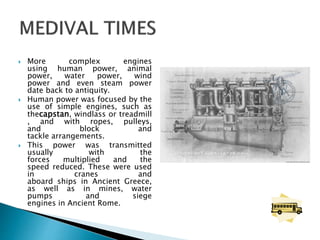
 More complex engines
using human power, animal
power, water power, wind
power and even steam power
date back to antiquity.
 Human power was focused by the
use of simple engines, such as
thecapstan, windlass or treadmill
, and with ropes, pulleys,
and block and
tackle arrangements.
 This power was transmitted
usually with the
forces multiplied and the
speed reduced. These were used
in cranes and
aboard ships in Ancient Greece,
as well as in mines, water
pumps and siege
engines in Ancient Rome.
 The Watt steam engine was the first
type of steam engine to make use of
steam at a pressure just
above atmospheric to drive the piston
helped by a partial vacuum.
 Improving on the design of the
1712 Newcomen steam engine, the
Watt steam engine, developed
sporadically from 1763 to 1775, was a
great step in the development of the
steam engine.
 Later development led to steam
locomotives and great expansion
of railway transportation.
In this presentation basically, two
types of engines are being
discussed-
 Heat engine=in thermodynamics,
the heat engine performs the work
of converting heat into mechanical
energy. It does this by lowering
down the temperature of a
working substance
 Electric engine= An electric
motor uses electrical energy to
produce mechanical energy,
usually through the interaction
of magnetic fields and current-
carrying conductors. The reverse
process is accomplished by
a generator or dynamo.
Heat engines are basically of two types-
 Combustion engine= Combustion engines are heat engines
driven by the heat of a combustion process. They are further divided
into two types- internal and external combustion engines.
 Non-combustion engine=Some engines convert heat from
non combustive processes into mechanical work, for example a
nuclear power plant uses the heat from the nuclear reaction to
produce steam and drive a steam engine, or a gas turbine in a rocket
engine may be driven by decomposing hydrogen peroxide.
 It is an engine which generates
mechanical power by
combustion of fuel.
 They are basically of two
types-
Internal combustion engines- In
this engine, the fuel occurs with
an oxidizer(air) in a chamber i.e.
an internal part of the working
fluid flow. E.g.-petrol engine-
Specifically two stroke and four
stroke
External combustion engine-it is
an engine where working fluid is
heated by combustion through an
external source. E.g.- steam
engine
 In this type of engine, the
power is not generated by
combustion of fuel.
 In solar engine there are
solar cells which creates
power.
 The electric engine is
based on electromagnetic
induction and creates
power.eg- windmills
electric engines.
 An electric motor/engine uses electrical
energy to produce mechanical energy,
usually through the interaction
of magnetic fields and current-carrying
conductors.
 Electric motors are found in
applications as diverse as industrial
fans, blowers and pumps, machine
tools, household appliances, power
tools, and disk drives.
 The smallest motors may be found in
electric wristwatches. Medium-size
motors of highly standardized
dimensions and characteristics provide
convenient mechanical power for
industrial uses. The very largest electric
motors are used for propulsion of large
ships,
 Two-stroke, two-cycle, or two-cycle
engine is a type of internal combustion
engine which completes a power cycle in
only one crankshaft revolution and with
two strokes, or up and down movements,
of the piston
 Two-stroke engines often provide
high power-to-weight ratio, usually in a
narrow range of rotational speeds called
the "power band“.
 compared to 4-stroke engines, two
strokes have a greatly reduced number of
moving parts, are more compact and
significantly lighter.
 The first commercial two-stroke engine
involving in-cylinder compression is
attributed to Scottish engineer Dugald
Clerk, who in 1881 patented his design,
his engine having a separate charging
cylinder
1ST STEP 2ND STEP 3RD STEP
Animation showing the four stages of
the four-stroke combustion engine
cycle:
1. Induction (Fuel enters)
2. Compression
3. Ignition (Fuel is burnt)
4. Emission (Exhaust out)
 A four-stroke engine (also known as four-cycle) is
an internal combustion engine in which
the piston completes four separate strokes—intake,
compression, power, and exhaust—during two
separate revolutions of the engine's crankshaft, and
one single thermodynamic cycle.
 There are two common types of four-stroke engines.
 The earliest of these to be developed is the Otto
cycle engine developed in 1876 by Nikolaus August
Otto in Cologne, Germany, after the operation
principle described by Alphonse Beau de Rochas.
 The second type of four-stroke engine is the Diesel
engine developed in 1893 by Rudolph Diesel. Diesel
created his engine to improve efficiency compared
with the Otto engine The diesel engine is made in
both a two-stroke and a four-stroke version. Otto's
company, Deutz AG, now primarily produces diesel
engines.
Starting position, intake stroke, and compression stroke.
Ignition of fuel, power stroke, and exhaust stroke.
The big showdown
VS
Engines - a brief report

Engines - a brief report

  • 2.
     INTRODUCTION  TERMINOLOGY MEDIVAL TIME  INDUSTRIAL REVOLUTION  TYPES OF ENGINES  HEAT ENGINE  COMBUSTION ENGINE  NON-COMBUSTION ENGINE  ELECTRIC ENGINE  TWO STROKE ENGINE  INTRODUCTION  WORKING  FOUR STROKE ENGINE  INTRODUCTION  WORKING  A COMPARISON- FERRARI VS. LAMBORGHINI
  • 3.
     An engineor a motor is a machine designed to convert energy into useful mechanical motion.  Heat engines including internal and external combustion engines burn a fuel to create heat, which then creates motion.  Electrical engines convert electrical energy into mechanical motion. In biological systems, molecular motors like myosins in muscles use chemical energy to create motion.
  • 4.
     Engine wasoriginally a term for any mechanical device used to convert force into motion. Hence pre-industrial weapons such as catapults and battering rams were called siege engines.  It is basically derived from Latin term “ingenium”. Most of the inventions during the industrial revolution were known as engine, example- steam engine.  In modern usage, the term engine typically describes devices, like steam engines and internal combustion engines, that burn or otherwise consume fuel to perform mechanical work
  • 5.
     More complexengines using human power, animal power, water power, wind power and even steam power date back to antiquity.  Human power was focused by the use of simple engines, such as thecapstan, windlass or treadmill , and with ropes, pulleys, and block and tackle arrangements.  This power was transmitted usually with the forces multiplied and the speed reduced. These were used in cranes and aboard ships in Ancient Greece, as well as in mines, water pumps and siege engines in Ancient Rome.
  • 6.
     The Wattsteam engine was the first type of steam engine to make use of steam at a pressure just above atmospheric to drive the piston helped by a partial vacuum.  Improving on the design of the 1712 Newcomen steam engine, the Watt steam engine, developed sporadically from 1763 to 1775, was a great step in the development of the steam engine.  Later development led to steam locomotives and great expansion of railway transportation.
  • 7.
    In this presentationbasically, two types of engines are being discussed-  Heat engine=in thermodynamics, the heat engine performs the work of converting heat into mechanical energy. It does this by lowering down the temperature of a working substance  Electric engine= An electric motor uses electrical energy to produce mechanical energy, usually through the interaction of magnetic fields and current- carrying conductors. The reverse process is accomplished by a generator or dynamo.
  • 8.
    Heat engines arebasically of two types-  Combustion engine= Combustion engines are heat engines driven by the heat of a combustion process. They are further divided into two types- internal and external combustion engines.  Non-combustion engine=Some engines convert heat from non combustive processes into mechanical work, for example a nuclear power plant uses the heat from the nuclear reaction to produce steam and drive a steam engine, or a gas turbine in a rocket engine may be driven by decomposing hydrogen peroxide.
  • 9.
     It isan engine which generates mechanical power by combustion of fuel.  They are basically of two types- Internal combustion engines- In this engine, the fuel occurs with an oxidizer(air) in a chamber i.e. an internal part of the working fluid flow. E.g.-petrol engine- Specifically two stroke and four stroke External combustion engine-it is an engine where working fluid is heated by combustion through an external source. E.g.- steam engine
  • 10.
     In thistype of engine, the power is not generated by combustion of fuel.  In solar engine there are solar cells which creates power.  The electric engine is based on electromagnetic induction and creates power.eg- windmills electric engines.
  • 11.
     An electricmotor/engine uses electrical energy to produce mechanical energy, usually through the interaction of magnetic fields and current-carrying conductors.  Electric motors are found in applications as diverse as industrial fans, blowers and pumps, machine tools, household appliances, power tools, and disk drives.  The smallest motors may be found in electric wristwatches. Medium-size motors of highly standardized dimensions and characteristics provide convenient mechanical power for industrial uses. The very largest electric motors are used for propulsion of large ships,
  • 13.
     Two-stroke, two-cycle,or two-cycle engine is a type of internal combustion engine which completes a power cycle in only one crankshaft revolution and with two strokes, or up and down movements, of the piston  Two-stroke engines often provide high power-to-weight ratio, usually in a narrow range of rotational speeds called the "power band“.  compared to 4-stroke engines, two strokes have a greatly reduced number of moving parts, are more compact and significantly lighter.  The first commercial two-stroke engine involving in-cylinder compression is attributed to Scottish engineer Dugald Clerk, who in 1881 patented his design, his engine having a separate charging cylinder
  • 14.
    1ST STEP 2NDSTEP 3RD STEP
  • 15.
    Animation showing thefour stages of the four-stroke combustion engine cycle: 1. Induction (Fuel enters) 2. Compression 3. Ignition (Fuel is burnt) 4. Emission (Exhaust out)
  • 16.
     A four-strokeengine (also known as four-cycle) is an internal combustion engine in which the piston completes four separate strokes—intake, compression, power, and exhaust—during two separate revolutions of the engine's crankshaft, and one single thermodynamic cycle.  There are two common types of four-stroke engines.  The earliest of these to be developed is the Otto cycle engine developed in 1876 by Nikolaus August Otto in Cologne, Germany, after the operation principle described by Alphonse Beau de Rochas.  The second type of four-stroke engine is the Diesel engine developed in 1893 by Rudolph Diesel. Diesel created his engine to improve efficiency compared with the Otto engine The diesel engine is made in both a two-stroke and a four-stroke version. Otto's company, Deutz AG, now primarily produces diesel engines.
  • 17.
    Starting position, intakestroke, and compression stroke. Ignition of fuel, power stroke, and exhaust stroke.
  • 18.
  • 19.