GENDER IDENTITY
Gender IdentityRequires the ability to label oneself or others as a boy/girl or man/woman
SOME DEFINITIONS…
SEXSEX is BIOLOGICAL and refers to the functional differences between males and females and their reproductive potential Sex is determined by genes in chromosomesMale and female are biological terms
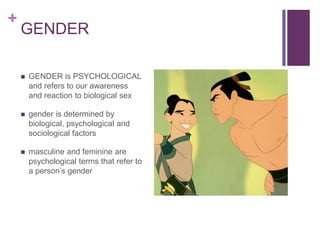
GENDERGENDER is PSYCHOLOGICAL and refers to our awareness and reaction to biological sexgender is determined by biological, psychological and sociological factorsmasculine and feminine are psychological terms that refer to a person’s gender
Gender identity, roles and typingGENDER IDENTITY: An image of oneself as masculine or feminine in characteristicsGENDER ROLES: The culture’s expectations for behaviour of a person who is perceived as either male or female, including attitudes, actions and personality traits associated with a particular gender within that cultureGENDER TYPING: The process by which people learn about their culture’s preferences and expectations for proper masculine or feminine behaviour
HOW DO GENDER TYPED BEHAVIOURS COME INTO BEING?
Several theories…Biology and genderKohlberg’s cognitive theorySocial-cognitive theoryGender schema theoryPsychoanalytical theory
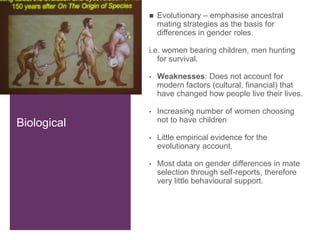
BiologicalEvolutionary – emphasise ancestral mating strategies as the basis for differences in gender roles.i.e. women bearing children, men hunting for survival.Weaknesses: Does not account for modern factors (cultural, financial) that have changed how people live their lives.
Increasing number of women choosing not to have children
Little empirical evidence for the evolutionary account.
Most data on gender differences in mate selection through self-reports, therefore very little behavioural support. Kohlberg’s gender constancyKohlberg – cognitive developmental approach.Argues gender identity is the basic organiser of children’s gender learning.
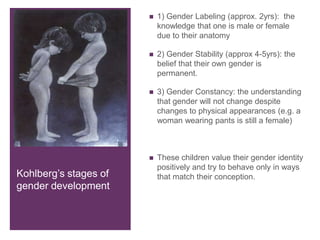
Kohlberg’s stages of gender development1) Gender Labeling (approx. 2yrs):  the knowledge that one is male or female due to their anatomy2) Gender Stability (approx 4-5yrs): the belief that their own gender is permanent.3) Gender Constancy: the understanding that gender will not change despite changes to physical appearances (e.g. a woman wearing pants is still a female)These children value their gender identity positively and try to behave only in ways that match their conception.
Example of Kohlberg’s Gender Constancy in action
Social Cognitive TheoryConsiders:roles of rewards and punishments (reinforcement) in gender typing  the ways in which children learn from observing others and deciding which behaviours are appropriate for them
Believes:Children learn what is ‘masculine’ or ‘feminine’ by observing and imitating models of the same sex.Socialisation provides children with information about gender-typed behaviours expected of them
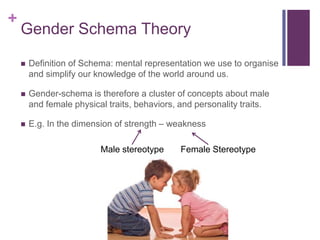
Gender Schema TheoryDefinition of Schema: mental representation we use to organise and simplify our knowledge of the world around us.Gender-schema is therefore a cluster of concepts about male and female physical traits, behaviors, and personality traits.E.g. In the dimension of strength – weaknessMale stereotype	Female Stereotype
From the Gender Schema Viewpoint:Gender identity can inspire ‘gender-appropriate’ behaviour (Ruble et al., 2006)Children seek information concerning gender-typed traits and live up to its expectations. E.g. a boy may fight back as they are expected to do so. Girls may be gentle and kind because that is expected of girls.Self-esteem will depend on how they measure up to the gender schema
StudiesStudies show children organise information according to a gender schemaE.g. boys show better memory for ‘masculine’ toys, activities and occupations, whereas girls show better memory for ‘feminine’ toys, activities and occupations (Martin & Ruble, 2004).
Psychoanalytic theoriesFreud’s perspective is known as identification theoryStages of Psychosexual Development: Oral, Anal, Phallic, Latency, Genital.Around the age of four, children become aware of their own genitals and the fact that genitals of boys and girls differ  onset of the phallic stage.During the phallic stage, identification takes place; children begin to unconsciously model their behavior after their same-sex parent, thus learning gender appropriate behavior.
Identification for boys:For boys, identification is motivated by what Freud called castration anxiety.A boy’s love for his mother becomes more sexual and tends to view his father as his rival (the Oedipus complex).Fears castration for competing with father boy now tries to emulate his father
Identification for girls:Girl’s identification with mother is motivated by what Freud called penis envy.Penis envy occurs when girls first see male genitals, she sees the male’s “far superior equipment” (Freud’s words…) and thinks she has been castrated.Overwhelmed by sense of incompleteness, jealous of boys, and her contempt for mother and all women since they all share her “deformity.”Switches her love to her father and begins to identify with her mother as a means to win him.Eventually the girl realises that she can have penis in two ways: briefly through intercourse and symbolically by having a baby (especially a baby boy).Her desire for a penis leads her to love and desire men (initially in the person of her father), since they have a penis and can provide a baby.
Criticisms:Verifying the unconscious… how?Explicit anti-female bias in Freud’s work.Females are defined as inadequate; they are jealous, passive, and masochistic.  “an inferior departure from the male standard.”
Recent StudiesMiller et al., (2006) found that boys are encouraged to be independent, whereas girls are more likely to be restricted. Boys are allowed to roam farther from home at an earlier age and more likely to be left unsupervised after school.Powlishta (2004) found primary schoolchildren show less stereotyping if their mothers often engage in ‘masculine tasks’ (e.g. washing the car, taking children to ball games, assembling toys)

Q201 - Gender Identity

  • 1.
  • 2.
    Gender IdentityRequires theability to label oneself or others as a boy/girl or man/woman
  • 3.
  • 4.
    SEXSEX is BIOLOGICALand refers to the functional differences between males and females and their reproductive potential Sex is determined by genes in chromosomesMale and female are biological terms
  • 5.
    GENDERGENDER is PSYCHOLOGICALand refers to our awareness and reaction to biological sexgender is determined by biological, psychological and sociological factorsmasculine and feminine are psychological terms that refer to a person’s gender
  • 6.
    Gender identity, rolesand typingGENDER IDENTITY: An image of oneself as masculine or feminine in characteristicsGENDER ROLES: The culture’s expectations for behaviour of a person who is perceived as either male or female, including attitudes, actions and personality traits associated with a particular gender within that cultureGENDER TYPING: The process by which people learn about their culture’s preferences and expectations for proper masculine or feminine behaviour
  • 7.
    HOW DO GENDERTYPED BEHAVIOURS COME INTO BEING?
  • 8.
    Several theories…Biology andgenderKohlberg’s cognitive theorySocial-cognitive theoryGender schema theoryPsychoanalytical theory
  • 9.
    BiologicalEvolutionary – emphasiseancestral mating strategies as the basis for differences in gender roles.i.e. women bearing children, men hunting for survival.Weaknesses: Does not account for modern factors (cultural, financial) that have changed how people live their lives.
  • 10.
    Increasing number ofwomen choosing not to have children
  • 11.
    Little empirical evidencefor the evolutionary account.
  • 12.
    Most data ongender differences in mate selection through self-reports, therefore very little behavioural support. Kohlberg’s gender constancyKohlberg – cognitive developmental approach.Argues gender identity is the basic organiser of children’s gender learning.
  • 13.
    Kohlberg’s stages ofgender development1) Gender Labeling (approx. 2yrs): the knowledge that one is male or female due to their anatomy2) Gender Stability (approx 4-5yrs): the belief that their own gender is permanent.3) Gender Constancy: the understanding that gender will not change despite changes to physical appearances (e.g. a woman wearing pants is still a female)These children value their gender identity positively and try to behave only in ways that match their conception.
  • 14.
    Example of Kohlberg’sGender Constancy in action
  • 15.
    Social Cognitive TheoryConsiders:rolesof rewards and punishments (reinforcement) in gender typing the ways in which children learn from observing others and deciding which behaviours are appropriate for them
  • 16.
    Believes:Children learn whatis ‘masculine’ or ‘feminine’ by observing and imitating models of the same sex.Socialisation provides children with information about gender-typed behaviours expected of them
  • 17.
    Gender Schema TheoryDefinitionof Schema: mental representation we use to organise and simplify our knowledge of the world around us.Gender-schema is therefore a cluster of concepts about male and female physical traits, behaviors, and personality traits.E.g. In the dimension of strength – weaknessMale stereotype Female Stereotype
  • 18.
    From the GenderSchema Viewpoint:Gender identity can inspire ‘gender-appropriate’ behaviour (Ruble et al., 2006)Children seek information concerning gender-typed traits and live up to its expectations. E.g. a boy may fight back as they are expected to do so. Girls may be gentle and kind because that is expected of girls.Self-esteem will depend on how they measure up to the gender schema
  • 19.
    StudiesStudies show childrenorganise information according to a gender schemaE.g. boys show better memory for ‘masculine’ toys, activities and occupations, whereas girls show better memory for ‘feminine’ toys, activities and occupations (Martin & Ruble, 2004).
  • 20.
    Psychoanalytic theoriesFreud’s perspectiveis known as identification theoryStages of Psychosexual Development: Oral, Anal, Phallic, Latency, Genital.Around the age of four, children become aware of their own genitals and the fact that genitals of boys and girls differ  onset of the phallic stage.During the phallic stage, identification takes place; children begin to unconsciously model their behavior after their same-sex parent, thus learning gender appropriate behavior.
  • 21.
    Identification for boys:Forboys, identification is motivated by what Freud called castration anxiety.A boy’s love for his mother becomes more sexual and tends to view his father as his rival (the Oedipus complex).Fears castration for competing with father boy now tries to emulate his father
  • 22.
    Identification for girls:Girl’sidentification with mother is motivated by what Freud called penis envy.Penis envy occurs when girls first see male genitals, she sees the male’s “far superior equipment” (Freud’s words…) and thinks she has been castrated.Overwhelmed by sense of incompleteness, jealous of boys, and her contempt for mother and all women since they all share her “deformity.”Switches her love to her father and begins to identify with her mother as a means to win him.Eventually the girl realises that she can have penis in two ways: briefly through intercourse and symbolically by having a baby (especially a baby boy).Her desire for a penis leads her to love and desire men (initially in the person of her father), since they have a penis and can provide a baby.
  • 23.
    Criticisms:Verifying the unconscious…how?Explicit anti-female bias in Freud’s work.Females are defined as inadequate; they are jealous, passive, and masochistic. “an inferior departure from the male standard.”
  • 24.
    Recent StudiesMiller etal., (2006) found that boys are encouraged to be independent, whereas girls are more likely to be restricted. Boys are allowed to roam farther from home at an earlier age and more likely to be left unsupervised after school.Powlishta (2004) found primary schoolchildren show less stereotyping if their mothers often engage in ‘masculine tasks’ (e.g. washing the car, taking children to ball games, assembling toys)