REQUIRES THE ABILITY
TO LABEL ONESELF OR
OTHERS AS BOY/GIRL
OR MAN/WOMAN
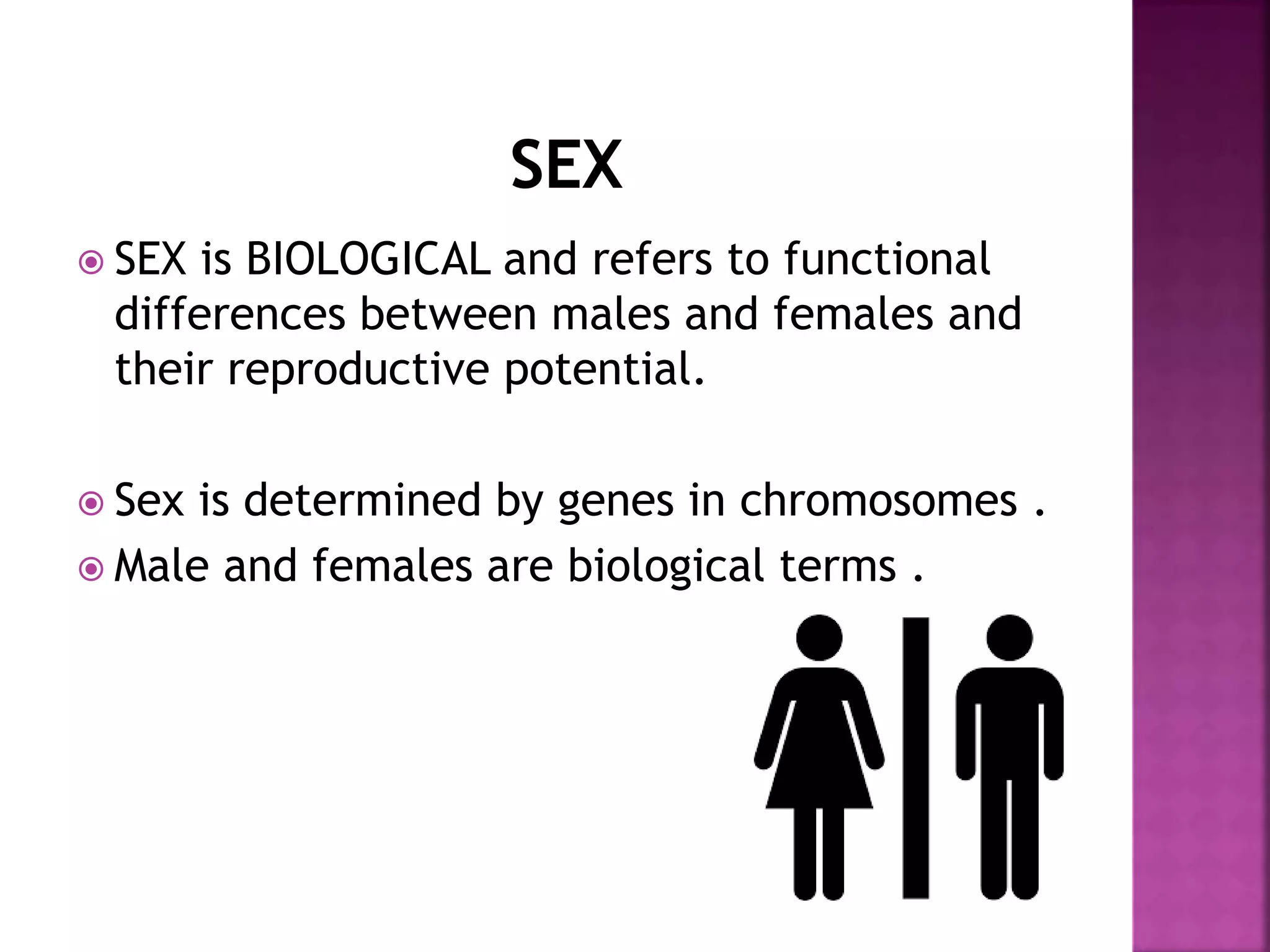
 SEX is BIOLOGICAL and refers to functional
differences between males and females and
their reproductive potential.
 Sex is determined by genes in chromosomes .
 Male and females are biological terms .
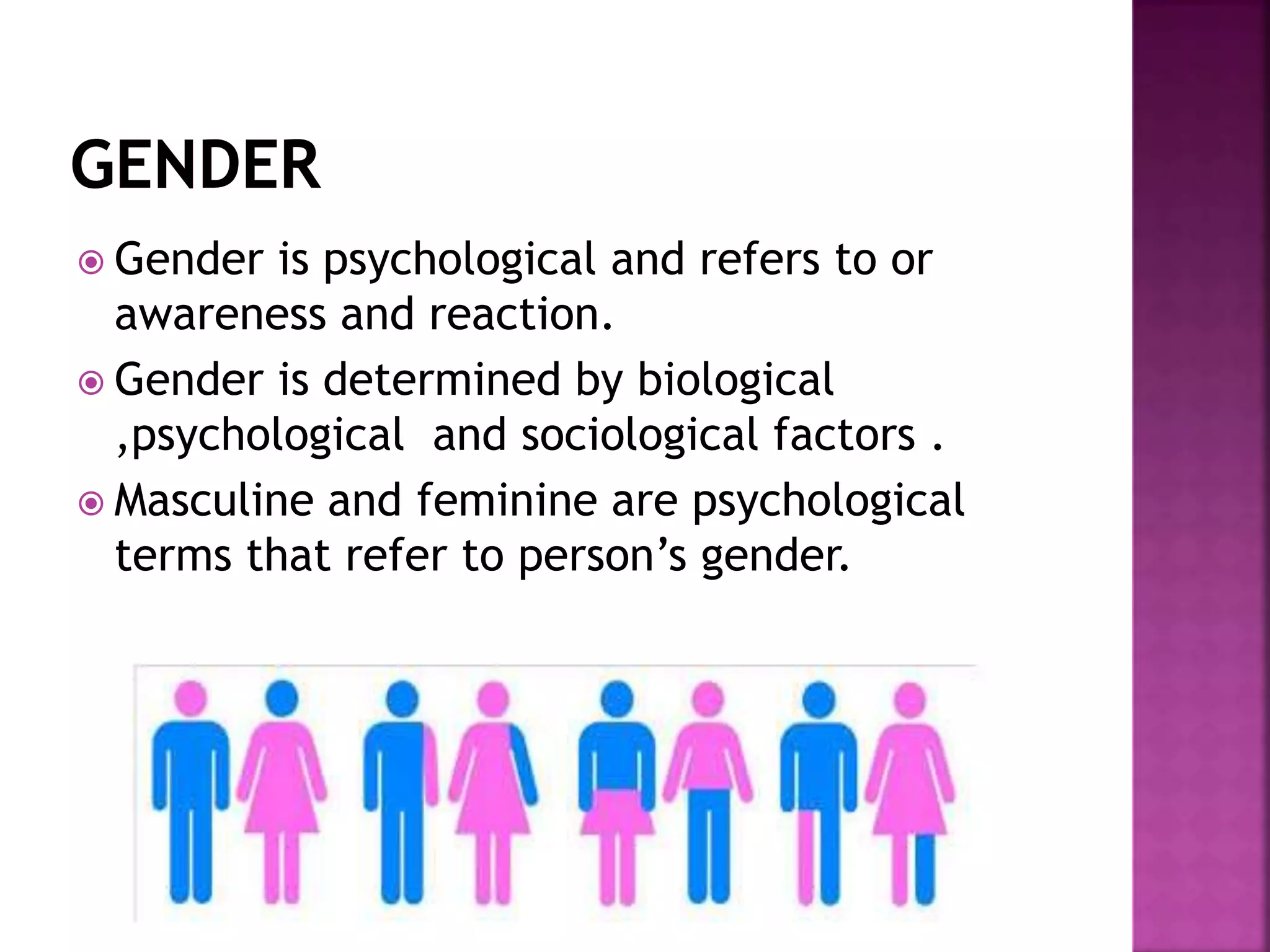
 Gender is psychological and refers to or
awareness and reaction.
 Gender is determined by biological
,psychological and sociological factors .
 Masculine and feminine are psychological
terms that refer to person’s gender.
 Gender-neutral pronouns are words that don't specify whether the subject of the sentence
is female or male. 'They', for instance, is a third-person pronoun that is gender neutral.
traditional gender neutral pronouns can be used to introduce in everyday conversation,
regardless of the individual. These include "Them", "They", "Their",
"Everyone", and "That Person".
 "He" has often been used as an automatic fill-in for generic individuals. By using
gender-neutral language, ensures sentences are inclusive for everyone.
 "he and she" are two extreme binaries that don't leave room for other gender identities.
This can be hurtful for individuals, such as transgender or gender queer communities,
who don't identify with "he" or "she".
 Other gender-neutral pronouns include 'them', 'this person', 'everyone', 'Ze', or 'Hir'. If
one is not sure which pronoun to use, one can also use that person's name.
 For eg., list of gender-neutral pronouns:
 He/She -- Zie, Sie, Ey, Ve, Tey, E
 Him/Her -- Zim, Sie, Em, Ver, Ter, Em
 His/Her -- Zir, Hir, Eir, Vis, Tem, Eir
 His/Hers -- Zis, Hirs, Eirs, Vers, Ters, Eirs
 Himself/Herself -- Zieself, Hirself, Eirself, Verself, Terself, Emself
 Biological difference
 Difficult to change.
 Throughout history
and across cultures sex
differences exists .
 Policies respond to se
differences in areas to
do with the physical
body.
 Social difference
 can be changed since
gender identity is
determined by society.
 Gender roles are
different in different
societies and history.
 Policies can respond to
gender stereotype and
traditional gender
roles.
Transgender
 Transgender are born with
reproductive organs
typically regarded as male
or female ones , and are
gendered by society
according to existing
gender roles which may
differ from their own
gender identity.
Intersex
 An intersex person is
someone born with a
combination of typical
male and female
biological characteristics
or none at all
 it is difficult for doctors
to assign their sex as
distinctive male or female
Trans* asterisk
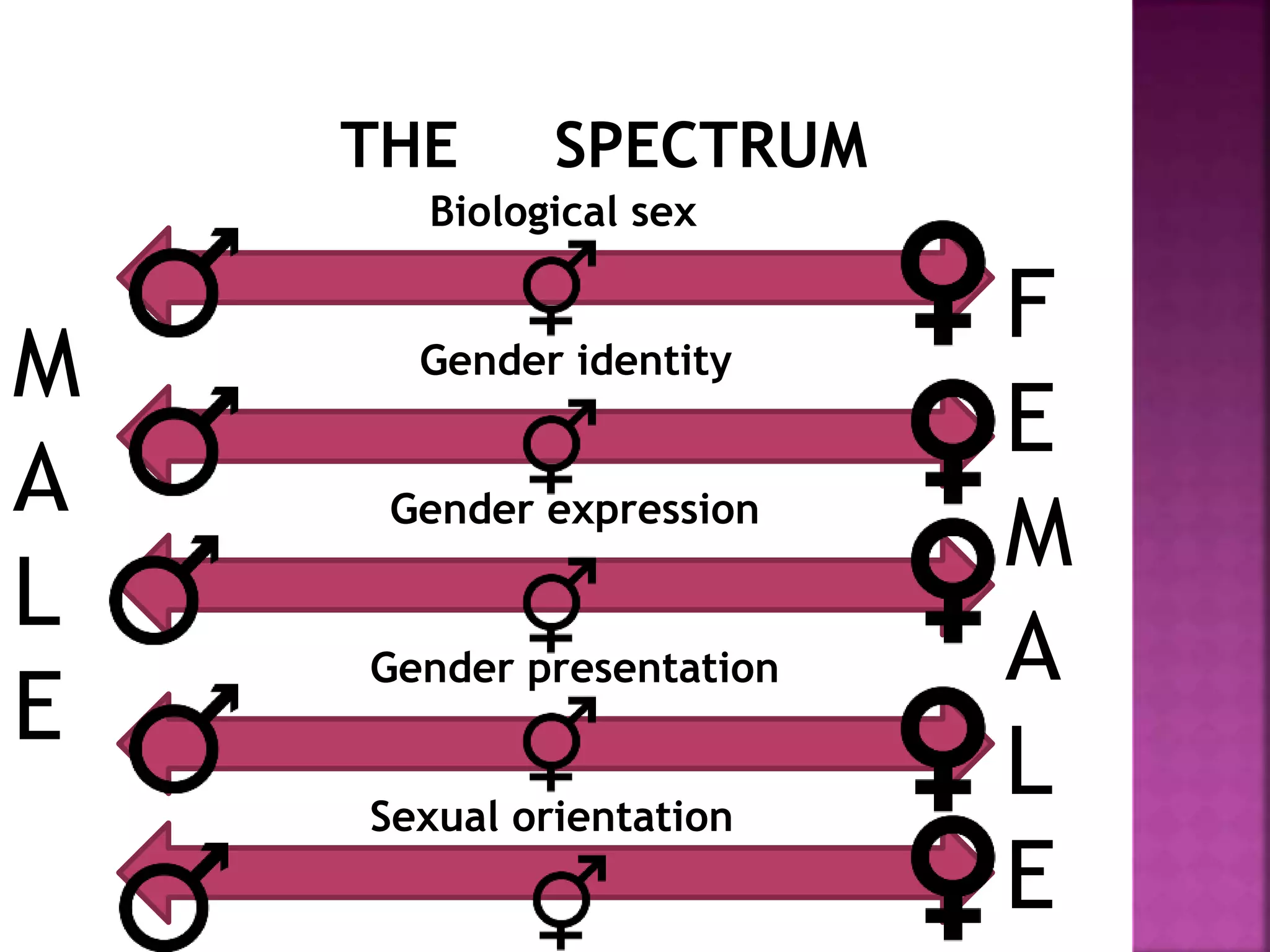
THE SPECTRUM
M
A
L
E
F
E
M
A
L
E
Biological sex
Gender identity
Gender expression
Gender presentation
Sexual orientation
Biological sex- it is assigned at birth
Gender identity- how one feels on the
inside
Gender expression- it is how one
present itself to others
Gender presentation- it suggests how
the world looks at the person.
Social Orientation- it defines the likes
or dislikes of a person.
Discomfort with
presenting social self as
birth gender
Discomfort with
body being a
different
gender
Discomfort with mind
and emotions not lining
up with gender identity
"Dysphasia is a feeling of dissatisfaction where a person feels anxiety,
and restlessness.
gender dysphoria is the discomfort with male or female body ., that can be
so intense that it interferes with ones normal life.
Types
Of
D
Y
S
P
H
O
R
I
A
Treatment in
public
 Trans bashing is the act of victimizing a person
emotionally, physically, sexually, or verbally
because they are transgender.
 Trans and non-binary gender adolescents can
experience bashing in the form
of bullying and harassment.
 Discrimination, including physical or sexual
violence against trans people due
to transphobia or homophobia, is a common
occurrence for trans people.
RIGHTS AND ENTITLEMENTS
• Equality and non-discrimination.
•. Transgender children.
•. Right to life and personal liberty.
•. Right to live in the community.
•. Right to integrity.
•. Protection from torture or cruel, inhuman or degrading treatment
or punishment.
EDUCATION
•. Duty of educational institutions to provide inclusive education to
transgender students.
Adult education for transgender persons.
SKILL DEVELOPMENT AND EMPLOYMENT
• Vocational training and self-employment.
• Non-discrimination in employment.
SOCIAL SECURITY, HEALTH, REHABILITATION AND RECREATION
• Social security.
• Healthcare facilities.
Rights for TRANSGENDER
SOCIAL SECURITY, HEALTH, REHABILITATION AND RECREATION
• Social security.
• Healthcare facilities.
•AS INTRODUCED IN THE RAJYA SABHA ON 12TH DECEMBER, 2014
CLAUSES
• Rehabilitation of transgenders.
• Leisure, culture and recreation.
• Reservation in primary, secondary and higher educational institutions.
• Reservation of posts for transgender persons.
• Incentive to employers in the private sector.
• Special employment exchange.
Umbrella scheme
Government launched umbrella scheme for transgender
community.
The umbrella scheme provides monetary benefit to families
with transgender children and encourage them not to abandon
them.
The umbrella scheme would have five components –
• pre-matric
• post-matric scholarship for transgender children
• support for vocational
•training of transgenders
•pension for out-of-work transgenders
(age group of 40 to 60 years and monthly monetary support for families
with transgender children).
SWEEKRUTI (A Scheme for Promotion of Transgender Equality & Justice)
The Social Security and Empowerment of Persons with Disabilities (SSEPD)Department,
Government of Odisha recognizes that Transgender Persons are valuable human resource for
the society and seeks to create an environment that provides them equal opportunities,
protection of their rights and full participation in society. As part of an integrated initiative
for Transgender Equality & Justice the Departmenthas launched this new
umbrella scheme “SWEEKRUTI”to be operated in a mission mode with
manifold objectives.
To ensure equitable justice for transgender persons the Sweekruti scheme focuses on the
following broad objectives:
1. To create an enabling environment to ensure equal opportunities,
equity, social justice & empowerment of transgender persons of the state
. 2. To encourage voluntary action and participation of all stake holders
for ensuring effective social integration of transgender persons.
3. To expand outreach activities for protection of rights and entitlements
of transgender persons in the state.
4. To promote individual and group
endeavour by transgender persons for employment, self-employment
and other socio-educational services.
5. To strengthen the existing
implementation machinery and create facilities for coverage of all
transgender persons of the state.
Sahodari Foundation
Mission
The Foundation's main objective is to promote social, political,
and economic equity and campaign for civil and legal rights of Transgender people.
Sahodari Foundation is an Indian organisation providing counselling and
support services for underprivileged transgender women.
The organization was founded by transgender activist and artist
Kalki Subramaniam in July 2008 to provide opportunities for
•education,
•counselling services
•education scholarships and supporting livelihood
•creative skills training and development.
The organisation is based in Tamil Nadu state in India. The organization
uses art, literature, films and theatre to advocate for social, economic, and
political justice for transgender people and gender nonconforming people.
Gender Identity
display at
social
awareness stall
during canviar
Thank you

Gender Identity

  • 2.
    REQUIRES THE ABILITY TOLABEL ONESELF OR OTHERS AS BOY/GIRL OR MAN/WOMAN
  • 3.
     SEX isBIOLOGICAL and refers to functional differences between males and females and their reproductive potential.  Sex is determined by genes in chromosomes .  Male and females are biological terms .
  • 4.
     Gender ispsychological and refers to or awareness and reaction.  Gender is determined by biological ,psychological and sociological factors .  Masculine and feminine are psychological terms that refer to person’s gender.
  • 5.
     Gender-neutral pronounsare words that don't specify whether the subject of the sentence is female or male. 'They', for instance, is a third-person pronoun that is gender neutral. traditional gender neutral pronouns can be used to introduce in everyday conversation, regardless of the individual. These include "Them", "They", "Their", "Everyone", and "That Person".  "He" has often been used as an automatic fill-in for generic individuals. By using gender-neutral language, ensures sentences are inclusive for everyone.  "he and she" are two extreme binaries that don't leave room for other gender identities. This can be hurtful for individuals, such as transgender or gender queer communities, who don't identify with "he" or "she".  Other gender-neutral pronouns include 'them', 'this person', 'everyone', 'Ze', or 'Hir'. If one is not sure which pronoun to use, one can also use that person's name.  For eg., list of gender-neutral pronouns:  He/She -- Zie, Sie, Ey, Ve, Tey, E  Him/Her -- Zim, Sie, Em, Ver, Ter, Em  His/Her -- Zir, Hir, Eir, Vis, Tem, Eir  His/Hers -- Zis, Hirs, Eirs, Vers, Ters, Eirs  Himself/Herself -- Zieself, Hirself, Eirself, Verself, Terself, Emself
  • 7.
     Biological difference Difficult to change.  Throughout history and across cultures sex differences exists .  Policies respond to se differences in areas to do with the physical body.  Social difference  can be changed since gender identity is determined by society.  Gender roles are different in different societies and history.  Policies can respond to gender stereotype and traditional gender roles.
  • 8.
    Transgender  Transgender areborn with reproductive organs typically regarded as male or female ones , and are gendered by society according to existing gender roles which may differ from their own gender identity. Intersex  An intersex person is someone born with a combination of typical male and female biological characteristics or none at all  it is difficult for doctors to assign their sex as distinctive male or female
  • 9.
  • 10.
    THE SPECTRUM M A L E F E M A L E Biological sex Genderidentity Gender expression Gender presentation Sexual orientation
  • 11.
    Biological sex- itis assigned at birth Gender identity- how one feels on the inside Gender expression- it is how one present itself to others Gender presentation- it suggests how the world looks at the person. Social Orientation- it defines the likes or dislikes of a person.
  • 12.
    Discomfort with presenting socialself as birth gender Discomfort with body being a different gender Discomfort with mind and emotions not lining up with gender identity "Dysphasia is a feeling of dissatisfaction where a person feels anxiety, and restlessness. gender dysphoria is the discomfort with male or female body ., that can be so intense that it interferes with ones normal life. Types Of D Y S P H O R I A
  • 13.
  • 14.
     Trans bashingis the act of victimizing a person emotionally, physically, sexually, or verbally because they are transgender.  Trans and non-binary gender adolescents can experience bashing in the form of bullying and harassment.  Discrimination, including physical or sexual violence against trans people due to transphobia or homophobia, is a common occurrence for trans people.
  • 15.
    RIGHTS AND ENTITLEMENTS •Equality and non-discrimination. •. Transgender children. •. Right to life and personal liberty. •. Right to live in the community. •. Right to integrity. •. Protection from torture or cruel, inhuman or degrading treatment or punishment. EDUCATION •. Duty of educational institutions to provide inclusive education to transgender students. Adult education for transgender persons. SKILL DEVELOPMENT AND EMPLOYMENT • Vocational training and self-employment. • Non-discrimination in employment. SOCIAL SECURITY, HEALTH, REHABILITATION AND RECREATION • Social security. • Healthcare facilities. Rights for TRANSGENDER
  • 16.
    SOCIAL SECURITY, HEALTH,REHABILITATION AND RECREATION • Social security. • Healthcare facilities. •AS INTRODUCED IN THE RAJYA SABHA ON 12TH DECEMBER, 2014 CLAUSES • Rehabilitation of transgenders. • Leisure, culture and recreation. • Reservation in primary, secondary and higher educational institutions. • Reservation of posts for transgender persons. • Incentive to employers in the private sector. • Special employment exchange.
  • 18.
    Umbrella scheme Government launchedumbrella scheme for transgender community. The umbrella scheme provides monetary benefit to families with transgender children and encourage them not to abandon them. The umbrella scheme would have five components – • pre-matric • post-matric scholarship for transgender children • support for vocational •training of transgenders •pension for out-of-work transgenders (age group of 40 to 60 years and monthly monetary support for families with transgender children).
  • 19.
    SWEEKRUTI (A Schemefor Promotion of Transgender Equality & Justice) The Social Security and Empowerment of Persons with Disabilities (SSEPD)Department, Government of Odisha recognizes that Transgender Persons are valuable human resource for the society and seeks to create an environment that provides them equal opportunities, protection of their rights and full participation in society. As part of an integrated initiative for Transgender Equality & Justice the Departmenthas launched this new umbrella scheme “SWEEKRUTI”to be operated in a mission mode with manifold objectives. To ensure equitable justice for transgender persons the Sweekruti scheme focuses on the following broad objectives: 1. To create an enabling environment to ensure equal opportunities, equity, social justice & empowerment of transgender persons of the state . 2. To encourage voluntary action and participation of all stake holders for ensuring effective social integration of transgender persons. 3. To expand outreach activities for protection of rights and entitlements of transgender persons in the state. 4. To promote individual and group endeavour by transgender persons for employment, self-employment and other socio-educational services. 5. To strengthen the existing implementation machinery and create facilities for coverage of all transgender persons of the state.
  • 20.
    Sahodari Foundation Mission The Foundation'smain objective is to promote social, political, and economic equity and campaign for civil and legal rights of Transgender people. Sahodari Foundation is an Indian organisation providing counselling and support services for underprivileged transgender women. The organization was founded by transgender activist and artist Kalki Subramaniam in July 2008 to provide opportunities for •education, •counselling services •education scholarships and supporting livelihood •creative skills training and development. The organisation is based in Tamil Nadu state in India. The organization uses art, literature, films and theatre to advocate for social, economic, and political justice for transgender people and gender nonconforming people.
  • 21.
  • 23.