GENDER AS A SOCIAL CONSTRUCT
        GENDER ROLES
 GENDER BIAS & EDUCATIONAL
          PRACTICE

                 PRESENTED BY
               Ms. GURKIRAT KAUR
                   ASST. PROF.
              CHITKARA UNIVERSITY
Group 1
 – List differences between women and men and
   consider:
    • On what are these perceived differences based?
      (e.g. biological, social, cultural or religious
      beliefs)
Group 2
 – List similarities between women and men and
   consider:
    • On what are the perceived similarities based?
      (e.g. biological, social, cultural or religious
      beliefs)
                                                        2
All participants to consider together:
  –To what extent do assumptions
   about biologically determined sex
   differences between women and
   men influence popular culture,
   sayings or beliefs in your cultural
   setting?

                                         3
Definitions
• Write down your own definitions of
  the terms sex and gender

• Compare your definitions with those
  of the person next to you

• Each pair to report back to whole
  group
•                                       4
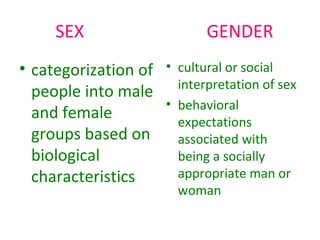
SEX                     GENDER
• categorization of • cultural or social
                      interpretation of sex
  people into male
                    • behavioral
  and female          expectations
  groups based on     associated with
  biological          being a socially
  characteristics     appropriate man or
                        woman
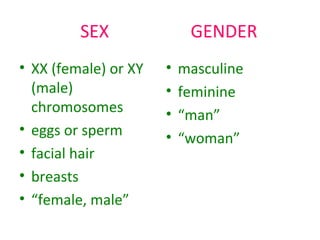
SEX               GENDER
• XX (female) or XY   •   masculine
  (male)              •   feminine
  chromosomes         •   “man”
• eggs or sperm       •   “woman”
• facial hair
• breasts
• “female, male”
Sex
• Sex refers to the physical and biological
  attributes of men and women
• Sex includes the chromosomal, hormonal,
  and anatomical components of males and
  females.
Gender and Gender Identity
• Gender refers to the social, psychological and
  cultural attributes of masculinity and femininity,
  many of which are based on biological distinctions
   – Gender includes people’s self image and
     expectations for behavior among other things
• Gender describes societal attitudes and behaviors
  expected of and associated with the two sexes.
• Gender identity refers to the degree to which an
  individual sees herself or himself as feminine or
  masculine based on society’s definitions of
  appropriate gender roles.
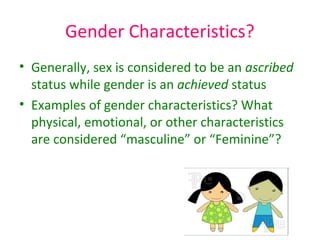
Gender Characteristics?
• Generally, sex is considered to be an ascribed
  status while gender is an achieved status
• Examples of gender characteristics? What
  physical, emotional, or other characteristics
  are considered “masculine” or “Feminine”?
• Sheena and Jaye are sister and brother.
  Sheena is invited by a neighbor to an all girl
  birthday party. Jaye wishes to go, but the
  neighbor said that he can’t go because he’s a
  boy. What would you tell Jaye if you were his
  parent?

• Now, reflect on what the different ways say
  about your assumptions of gender.
Gender as a Social Construction
• Gender is a process, stratification system
  and structure;
• Process = day to day interactions reinforce gender as
  opposites. For examples, conversations, rituals of daily life,
  sayings, etc

• Stratification = Men as a group have more status and power
  than women as a group. Women are treated as “other,” and
  compared to men.

• Structure = Gender divides work in the home and economic
  production. It legitimates those in authority and organizes
  sexuality and emotional life.
Gender as a Social Construction
• What is necessary for society’s perpetuation?

• Rules for allocating goods
• Assigned responsibility for children and others who can’t care
  for themselves
• Common values and the transmission of them.
• Legitimate leadership.
• Expression of the above through arts, music, stories, etc.

• What social categories influence the way the above exist?
Gender as a Social Construction
• What is work?

• Any activity that creates goods and services
  for one’s own use or for exchange or pay.
  There is paid work (market); coerced work
  (slavery) and domestic work.
Gender as a Social Construction
• Industrialization reduced work
  to pay. Why?
• Most domestic work is
  devalued or invisible.
• For example: babysitter
  versus lawnwork. Also,
  domestic work not included in
  the economy
Gender as a Social Construction
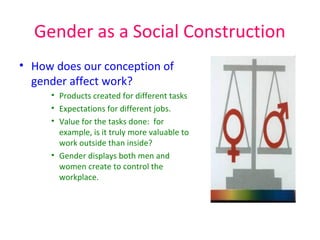
• How does our conception of
  gender affect work?
     • Products created for different tasks
     • Expectations for different jobs.
     • Value for the tasks done: for
       example, is it truly more valuable to
       work outside than inside?
     • Gender displays both men and
       women create to control the
       workplace.
The Social Construction
              of Gender
• Gender Roles
    – Expectations regarding proper behavior,
      attitudes, and activities of males and
      females
    – Gender roles evident in work and in how
      we react to others
Gender Roles in the society are
         gendered in nature.

Gender roles are cultural and personal.

They determine how males and females
should think, speak, dress, and interact
    within the context of society.
A gender role is a set of social and behavioral
    norms that are generally considered
 appropriate for either a man or a woman in a
    social or interpersonal relationship.
Gender roles adopted during
  childhood normally continue into
             adulthood.
  Traditionally, fathers teach boys how to fix and
build things; mothers teach girls how to cook, sew,
  and keep house. Children then receive parental
       approval when they conform to gender
  expectations and adopt culturally accepted and
   conventional roles. All of this is reinforced by
 additional socializing agents, such as the media.
Gender Bias
   Society produces bias that is structured on the
 basis of gender identities. Patriarchy strengthens
  the gender bias and recognises the society as a
male dominated space. Thus, women face bias from
         the dominant patriarchal society.
   Gender bias is the construction of socialization
     process and it is the extension of patriarchal
ideology. Gender bias is commonly considered to be
 discrimination and/or hatred towards people based
on their gender rather than their individual merits, but
can also refer to any and all systemic differentiations
       based on the gender of the individuals.
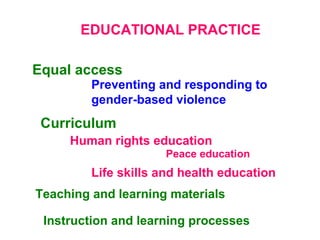
EDUCATIONAL PRACTICE

Equal access
         Preventing and responding to
         gender-based violence
 Curriculum
     Human rights education
                     Peace education
         Life skills and health education
Teaching and learning materials

 Instruction and learning processes

GENDER AS A SOCIAL CONSTRUCT

  • 1.
    GENDER AS ASOCIAL CONSTRUCT GENDER ROLES GENDER BIAS & EDUCATIONAL PRACTICE PRESENTED BY Ms. GURKIRAT KAUR ASST. PROF. CHITKARA UNIVERSITY
  • 2.
    Group 1 –List differences between women and men and consider: • On what are these perceived differences based? (e.g. biological, social, cultural or religious beliefs) Group 2 – List similarities between women and men and consider: • On what are the perceived similarities based? (e.g. biological, social, cultural or religious beliefs) 2
  • 3.
    All participants toconsider together: –To what extent do assumptions about biologically determined sex differences between women and men influence popular culture, sayings or beliefs in your cultural setting? 3
  • 4.
    Definitions • Write downyour own definitions of the terms sex and gender • Compare your definitions with those of the person next to you • Each pair to report back to whole group • 4
  • 5.
    SEX GENDER • categorization of • cultural or social interpretation of sex people into male • behavioral and female expectations groups based on associated with biological being a socially characteristics appropriate man or woman
  • 6.
    SEX GENDER • XX (female) or XY • masculine (male) • feminine chromosomes • “man” • eggs or sperm • “woman” • facial hair • breasts • “female, male”
  • 7.
    Sex • Sex refersto the physical and biological attributes of men and women • Sex includes the chromosomal, hormonal, and anatomical components of males and females.
  • 8.
    Gender and GenderIdentity • Gender refers to the social, psychological and cultural attributes of masculinity and femininity, many of which are based on biological distinctions – Gender includes people’s self image and expectations for behavior among other things • Gender describes societal attitudes and behaviors expected of and associated with the two sexes. • Gender identity refers to the degree to which an individual sees herself or himself as feminine or masculine based on society’s definitions of appropriate gender roles.
  • 9.
    Gender Characteristics? • Generally,sex is considered to be an ascribed status while gender is an achieved status • Examples of gender characteristics? What physical, emotional, or other characteristics are considered “masculine” or “Feminine”?
  • 10.
    • Sheena andJaye are sister and brother. Sheena is invited by a neighbor to an all girl birthday party. Jaye wishes to go, but the neighbor said that he can’t go because he’s a boy. What would you tell Jaye if you were his parent? • Now, reflect on what the different ways say about your assumptions of gender.
  • 11.
    Gender as aSocial Construction • Gender is a process, stratification system and structure; • Process = day to day interactions reinforce gender as opposites. For examples, conversations, rituals of daily life, sayings, etc • Stratification = Men as a group have more status and power than women as a group. Women are treated as “other,” and compared to men. • Structure = Gender divides work in the home and economic production. It legitimates those in authority and organizes sexuality and emotional life.
  • 12.
    Gender as aSocial Construction • What is necessary for society’s perpetuation? • Rules for allocating goods • Assigned responsibility for children and others who can’t care for themselves • Common values and the transmission of them. • Legitimate leadership. • Expression of the above through arts, music, stories, etc. • What social categories influence the way the above exist?
  • 13.
    Gender as aSocial Construction • What is work? • Any activity that creates goods and services for one’s own use or for exchange or pay. There is paid work (market); coerced work (slavery) and domestic work.
  • 14.
    Gender as aSocial Construction • Industrialization reduced work to pay. Why? • Most domestic work is devalued or invisible. • For example: babysitter versus lawnwork. Also, domestic work not included in the economy
  • 15.
    Gender as aSocial Construction • How does our conception of gender affect work? • Products created for different tasks • Expectations for different jobs. • Value for the tasks done: for example, is it truly more valuable to work outside than inside? • Gender displays both men and women create to control the workplace.
  • 16.
    The Social Construction of Gender • Gender Roles – Expectations regarding proper behavior, attitudes, and activities of males and females – Gender roles evident in work and in how we react to others
  • 17.
    Gender Roles inthe society are gendered in nature. Gender roles are cultural and personal. They determine how males and females should think, speak, dress, and interact within the context of society. A gender role is a set of social and behavioral norms that are generally considered appropriate for either a man or a woman in a social or interpersonal relationship.
  • 18.
    Gender roles adoptedduring childhood normally continue into adulthood. Traditionally, fathers teach boys how to fix and build things; mothers teach girls how to cook, sew, and keep house. Children then receive parental approval when they conform to gender expectations and adopt culturally accepted and conventional roles. All of this is reinforced by additional socializing agents, such as the media.
  • 19.
    Gender Bias Society produces bias that is structured on the basis of gender identities. Patriarchy strengthens the gender bias and recognises the society as a male dominated space. Thus, women face bias from the dominant patriarchal society. Gender bias is the construction of socialization process and it is the extension of patriarchal ideology. Gender bias is commonly considered to be discrimination and/or hatred towards people based on their gender rather than their individual merits, but can also refer to any and all systemic differentiations based on the gender of the individuals.
  • 20.
    EDUCATIONAL PRACTICE Equal access Preventing and responding to gender-based violence Curriculum Human rights education Peace education Life skills and health education Teaching and learning materials Instruction and learning processes

Editor's Notes

  • #3 Divide participants into two groups and provide each group with flipchart paper. Ask one group to list differences between women and men on the flipchart paper, and the other to list similarities. (10 mins) Ask each group to provide feedback. (10 mins)
  • #4 Bring the whole group together to discuss the following questions (on slide): What are the effects of highlighting differences rather than similarities between men and women? To what extent do you think assumptions about biologically determined sex differences between women and men influence popular culture, sayings or beliefs in your cultural setting? (10 mins) Look for opportunities in the discussion to point out that: The variation within each sex is often as significant as the variation between the sexes Men and women are more like each other than they are like rocks, water, trees, or most animals Often, characteristics deemed traditionally ‘male’ are given more value within society than characteristics deemed ‘female’, e.g. strength vs. sensitivity. There is a socially constructed hierarchy within sexual difference.
  • #5 Ask each participant to write down her or his own working definitions of the terms sex, sexuality, and gender. (5 mins) Combine participants into pairs to compare their definitions and develop definitions on which they both agree. (5 mins) Make three columns, either on a whiteboard or flipchart paper, and head the columns Sex, Sexuality and Gender respectively. Ask one pair to volunteer to report back on their definition of the term sex to the whole group. Note key aspects of the definition on your whiteboard or flipchart paper under the relevant heading. Ask for a second pair to volunteer to report back on their definition of the term sexuality and, again, note key terms. Ask for a third pair to volunteer to report back on their definition of the term gender and, again, note key terms. Ask the remaining groups to call out any additional key terms they may have. (10 mins) Facilitate a brief group discussion on the definitions, paying particular attention to any inconsistencies or overlap between the definitions. (10 mins) If possible, leave the definitions where they can be seen throughout the rest of the module.