QUIZ 8
Remember to write your first and last
name!
QUIZ 8
1.) _______ is behavior whose purpose is to harm
another.
a. Aggression
b. Prejudice
c. Altruism
d. Discrimination
2.) True or false? Deindividuation is when immersion in
a group causes people to become less aware of their
individual values.
QUIZ 8
3.) Being more attracted to someone the longer you
are around them is due to what concept?
a. Frustration-aggression hypothesis
b. Cooperation
c. Mere-exposure effect
d. Attraction
4.) True of false? Men are more picky when choosing
long term mates.
QUIZ 8
5.) Positive or negative behavior toward another
person based on their group membership is…
a. Discrimination
b. Altruism
c. Aggression
d. Prejudice
Extra Credit!!
Which kind of love tends to fade over time?
a. Passionate
b. Companionate
APPROVAL MOTIVE
• Acceptance is better than rejection
• Norm: a customary standard for behavior that is
widely shared by members of a culture
• Normative influence: another person’s behavior
suggests what is appropriate
• Elevator
• Norm of reciprocity: the unwritten rule that people
should benefit those who have benefited them
APPROVAL MOTIVE
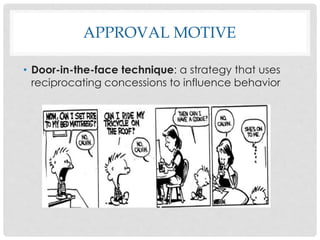
• Door-in-the-face technique: a strategy that uses
reciprocating concessions to influence behavior
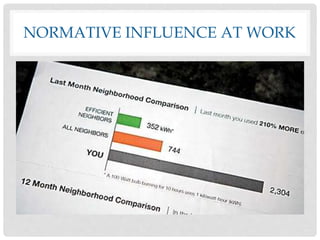
NORMATIVE INFLUENCE AT WORK
CONFORMITY AND OBEDIENCE
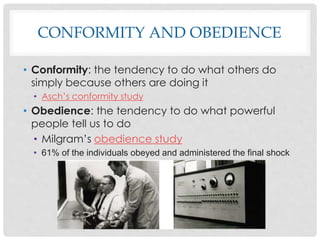
• Conformity: the tendency to do what others do
simply because others are doing it
• Asch’s conformity study
• Obedience: the tendency to do what powerful
people tell us to do
• Milgram’s obedience study
• 61% of the individuals obeyed and administered the final shock
MILGRAM’S OBEDIENCE STUDY
• Normative influence and its role
in obedience and conformity
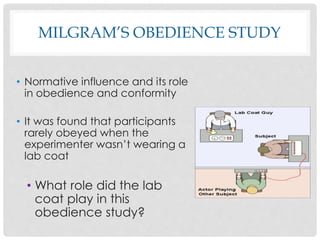
• It was found that participants
rarely obeyed when the
experimenter wasn’t wearing a
lab coat
• What role did the lab
coat play in this
obedience study?
PERSUASION AND CONSISTENCY
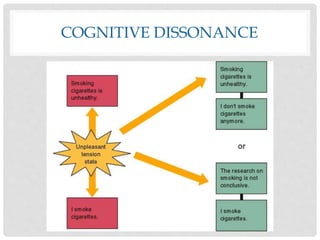
• Cognitive dissonance: unpleasant state that
arises when one recognizes the
inconsistency of actions, attitudes, or beliefs
• Naturally try to alleviate anxiety
• Small inconsistencies can be justified (little white
lies)
• http://youtu.be/korGK0yGIDo
COGNITIVE DISSONANCE
ATTRIBUTION: DRAWING
INFERENCES FROM ACTIONS
• Correspondence bias: the tendency to make a
dispositional attribution when a person’s
behavior was caused by the situation (AKA:
fundamental attribution error)
• Situational causes may be invisible, more complex
• Actor-observer effect: the tendency to make
situational attributions for our own behaviors
CORRESPONDENCE BIAS
ATTRIBUTION:
DRAWING INFERENCES FROM
ACTIONS
• Think of the last time somebody cut you off
• How would you describe that person?
• Actor-observer effect: the tendency to
make situational attributions for our own
behaviors
CORRESPONDENCE VS. ACTOR-
OBSERVER
• Correspondence bias
• Making a judgment about someone else
• Actor-Observer effect
• Making a judgment about yourself
K R I S T I N H I X S O N
GENDER DEVELOPMENT
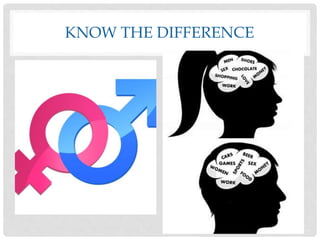
KNOW THE DIFFERENCE
• : The biological status of being male or female
• Genitalia
• : Characteristics (associated with masculinity
or femininity) that pertain to the sexes
• Man/Woman; Boy/Girl
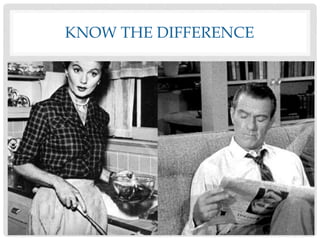
• : Societal norms and behaviors that are
considered socially “appropriate” for the designated
gender
• Based on gender :
• Girls wear pink and giggle
• Boys are rough and play football
• : An individual’s psychological
association with a certain gender
KNOW THE DIFFERENCE
KNOW THE DIFFERENCE
HOW, WHEN, WHY?
Four Major Theories
• Psychoanalytic Theory
• Freud
• Erikson
• Cognitive-Development Theory
• Social Learning Theory
• Gender Schema Theory
PSYCHOANALYTIC THEORY
• Freud
• Explained gender development through his psychosexual theory
• Ages 3 to 5, children feel sexually attracted to their other-
sex parent
• Ages 5 to 6, children feel guilt ad anxiety over their
attraction
• Connection with same sex parent is crucial to long-term
mental health and sex drive.
• Erikson
• An extension of Freud’s Theory
• Based on sexual differences between men and women to
explain psychological differences
• Due to differing genital structures, males more intrusive and
aggressive, and females more inclusive and passive
COGNITIVE DEVELOPMENT THEORY
• Children’s own cognitions are primarily responsible for gender
role development
• Kohlberg
• children identify with and imitate same-sex parents, and
others of their same gender
• after children label themselves as male or female, the
development of gender related interests and behavior
quickly follow
• Rewarded/punished for appropriate/inappropriate behavior
• Stages:
• Gender Identity: children develop a concept of what sex
category they belong to
• Gender Consistency: children realize that their sex and that of
others do not change with age, dress, or behavior
SOCIAL LEARNING THEORY
• Emphasis on the power of the immediate situation and
observable behaviors
• Two ways children learn their gender roles:
• They receive rewards or punishments for specific
gender role behaviors
• They watch and imitate the behavior of others
• Belief that children imitate the same-sex parent
• Does not believe that child feels guilt or anxiety over a
supposed attraction to the other-sex parent
of children is one of the major causes
of gender differences between boys and girls.
SOCIAL LEARNING THEORY
• Children are encouraged to do the appropriate
sex-typed activities by the following:
• Parents
• traditional roles fed to children in traditional families
• Media
• portrays traditional roles for females and males; female is still
placed in the traditional domestic role
• Schools
• transmit the information of gender role stereotypes to children
SOCIALIZATION
• Socialization from Birth
GENDER-SCHEMA THEORY
• Theory suggests that children:
• use gender as a schema to organize and guide their view of
the world
• acquire gender-specific behaviors through social-learning
• own thought processes encourage gender development
• A combination of the social-learning and
cognitive-developmental approaches
THE WHEN
• Children usually have identified with their gender by
the age of 3
• Gender Roles
HOW?
• Does that mean they physically express that gender
at 3?
• Although gender identity is normally established at that
time, the expression of that association can happen at any
time
• I.e.: a little boy might know that he associates himself with the
other gender (girl) at 3, but due to societal
pressures/consequences, does not express physical
characteristics until later on
• the external display of gender, through a combination of
dress, demeanor, social behavior, and other factors.
• What happens when someone’s gender/sex
does not fit into society's categories?
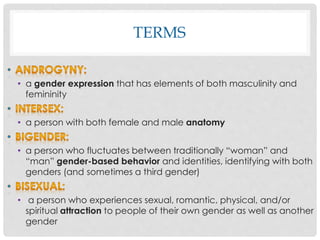
TERMS
• a gender expression that has elements of both masculinity and
femininity
• a person with both female and male anatomy
• a person who fluctuates between traditionally “woman” and
“man” gender-based behavior and identities, identifying with both
genders (and sometimes a third gender)
• a person who experiences sexual, romantic, physical, and/or
spiritual attraction to people of their own gender as well as another
gender
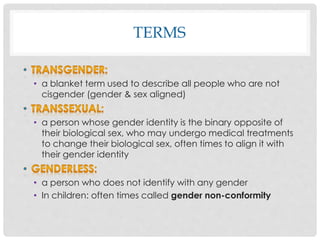
TERMS
• a blanket term used to describe all people who are not
cisgender (gender & sex aligned)
• a person whose gender identity is the binary opposite of
their biological sex, who may undergo medical treatments
to change their biological sex, often times to align it with
their gender identity
• a person who does not identify with any gender
• In children: often times called gender non-conformity
GENDER NON-CONFORMITY
• Conform:
• To comply with norms, standards or laws
Gender Creative
GENDER TODAY
• Although gender/sex research is often times seen as
concrete, the field and knowledge continue to
grow and change over time.

Gender Development Presentation

  • 1.
    QUIZ 8 Remember towrite your first and last name!
  • 2.
    QUIZ 8 1.) _______is behavior whose purpose is to harm another. a. Aggression b. Prejudice c. Altruism d. Discrimination 2.) True or false? Deindividuation is when immersion in a group causes people to become less aware of their individual values.
  • 3.
    QUIZ 8 3.) Beingmore attracted to someone the longer you are around them is due to what concept? a. Frustration-aggression hypothesis b. Cooperation c. Mere-exposure effect d. Attraction 4.) True of false? Men are more picky when choosing long term mates.
  • 4.
    QUIZ 8 5.) Positiveor negative behavior toward another person based on their group membership is… a. Discrimination b. Altruism c. Aggression d. Prejudice Extra Credit!! Which kind of love tends to fade over time? a. Passionate b. Companionate
  • 5.
    APPROVAL MOTIVE • Acceptanceis better than rejection • Norm: a customary standard for behavior that is widely shared by members of a culture • Normative influence: another person’s behavior suggests what is appropriate • Elevator • Norm of reciprocity: the unwritten rule that people should benefit those who have benefited them
  • 6.
    APPROVAL MOTIVE • Door-in-the-facetechnique: a strategy that uses reciprocating concessions to influence behavior
  • 7.
  • 8.
    CONFORMITY AND OBEDIENCE •Conformity: the tendency to do what others do simply because others are doing it • Asch’s conformity study • Obedience: the tendency to do what powerful people tell us to do • Milgram’s obedience study • 61% of the individuals obeyed and administered the final shock
  • 9.
    MILGRAM’S OBEDIENCE STUDY •Normative influence and its role in obedience and conformity • It was found that participants rarely obeyed when the experimenter wasn’t wearing a lab coat • What role did the lab coat play in this obedience study?
  • 10.
    PERSUASION AND CONSISTENCY •Cognitive dissonance: unpleasant state that arises when one recognizes the inconsistency of actions, attitudes, or beliefs • Naturally try to alleviate anxiety • Small inconsistencies can be justified (little white lies) • http://youtu.be/korGK0yGIDo
  • 11.
  • 12.
    ATTRIBUTION: DRAWING INFERENCES FROMACTIONS • Correspondence bias: the tendency to make a dispositional attribution when a person’s behavior was caused by the situation (AKA: fundamental attribution error) • Situational causes may be invisible, more complex • Actor-observer effect: the tendency to make situational attributions for our own behaviors
  • 13.
  • 14.
    ATTRIBUTION: DRAWING INFERENCES FROM ACTIONS •Think of the last time somebody cut you off • How would you describe that person? • Actor-observer effect: the tendency to make situational attributions for our own behaviors
  • 15.
    CORRESPONDENCE VS. ACTOR- OBSERVER •Correspondence bias • Making a judgment about someone else • Actor-Observer effect • Making a judgment about yourself
  • 16.
    K R IS T I N H I X S O N GENDER DEVELOPMENT
  • 17.
    KNOW THE DIFFERENCE •: The biological status of being male or female • Genitalia • : Characteristics (associated with masculinity or femininity) that pertain to the sexes • Man/Woman; Boy/Girl • : Societal norms and behaviors that are considered socially “appropriate” for the designated gender • Based on gender : • Girls wear pink and giggle • Boys are rough and play football • : An individual’s psychological association with a certain gender
  • 18.
  • 19.
  • 20.
    HOW, WHEN, WHY? FourMajor Theories • Psychoanalytic Theory • Freud • Erikson • Cognitive-Development Theory • Social Learning Theory • Gender Schema Theory
  • 21.
    PSYCHOANALYTIC THEORY • Freud •Explained gender development through his psychosexual theory • Ages 3 to 5, children feel sexually attracted to their other- sex parent • Ages 5 to 6, children feel guilt ad anxiety over their attraction • Connection with same sex parent is crucial to long-term mental health and sex drive. • Erikson • An extension of Freud’s Theory • Based on sexual differences between men and women to explain psychological differences • Due to differing genital structures, males more intrusive and aggressive, and females more inclusive and passive
  • 22.
    COGNITIVE DEVELOPMENT THEORY •Children’s own cognitions are primarily responsible for gender role development • Kohlberg • children identify with and imitate same-sex parents, and others of their same gender • after children label themselves as male or female, the development of gender related interests and behavior quickly follow • Rewarded/punished for appropriate/inappropriate behavior • Stages: • Gender Identity: children develop a concept of what sex category they belong to • Gender Consistency: children realize that their sex and that of others do not change with age, dress, or behavior
  • 23.
    SOCIAL LEARNING THEORY •Emphasis on the power of the immediate situation and observable behaviors • Two ways children learn their gender roles: • They receive rewards or punishments for specific gender role behaviors • They watch and imitate the behavior of others • Belief that children imitate the same-sex parent • Does not believe that child feels guilt or anxiety over a supposed attraction to the other-sex parent of children is one of the major causes of gender differences between boys and girls.
  • 24.
    SOCIAL LEARNING THEORY •Children are encouraged to do the appropriate sex-typed activities by the following: • Parents • traditional roles fed to children in traditional families • Media • portrays traditional roles for females and males; female is still placed in the traditional domestic role • Schools • transmit the information of gender role stereotypes to children
  • 25.
  • 26.
    GENDER-SCHEMA THEORY • Theorysuggests that children: • use gender as a schema to organize and guide their view of the world • acquire gender-specific behaviors through social-learning • own thought processes encourage gender development • A combination of the social-learning and cognitive-developmental approaches
  • 27.
    THE WHEN • Childrenusually have identified with their gender by the age of 3 • Gender Roles
  • 28.
    HOW? • Does thatmean they physically express that gender at 3? • Although gender identity is normally established at that time, the expression of that association can happen at any time • I.e.: a little boy might know that he associates himself with the other gender (girl) at 3, but due to societal pressures/consequences, does not express physical characteristics until later on • the external display of gender, through a combination of dress, demeanor, social behavior, and other factors. • What happens when someone’s gender/sex does not fit into society's categories?
  • 29.
    TERMS • a genderexpression that has elements of both masculinity and femininity • a person with both female and male anatomy • a person who fluctuates between traditionally “woman” and “man” gender-based behavior and identities, identifying with both genders (and sometimes a third gender) • a person who experiences sexual, romantic, physical, and/or spiritual attraction to people of their own gender as well as another gender
  • 30.
    TERMS • a blanketterm used to describe all people who are not cisgender (gender & sex aligned) • a person whose gender identity is the binary opposite of their biological sex, who may undergo medical treatments to change their biological sex, often times to align it with their gender identity • a person who does not identify with any gender • In children: often times called gender non-conformity
  • 31.
    GENDER NON-CONFORMITY • Conform: •To comply with norms, standards or laws Gender Creative
  • 32.
    GENDER TODAY • Althoughgender/sex research is often times seen as concrete, the field and knowledge continue to grow and change over time.

Editor's Notes

  • #3 1.) A 2.) True
  • #4 3.) C 4.) False
  • #5 5.) A 6.) A
  • #6 Approval- people are motivated to be accepted and to avoid being rejected <RS-1> Whether we are accepted or not is shaped by norms, and since we like acceptance, we will follow norms <RS-2> What do you do in an elevator full of strangers? How did you learn that? <RS-3> Norms aren’t usually explicitly taught (unwritten rules)– we learn them quickly and obey them almost all the time. Norm of reciprocity: Christmas card example. Sending a bunch of Christmas cards and you receiving a lot of Christmas cards back. Buying lunch and repaying the other person
  • #7 Another example is the Door-in-the-face technique which is used as a marketing tactic all the time. It is where the car salesman quotes you a high price for the vehicle you want to purchase knowing that you will refuse or “slam the door in their face” after which he will quote you a price that he really wanted to purchase leading you to behave in a way that you will meet him because he is willing to bring down the price. You ask something more valuable than you really want, you wait for that person to refuse (to “slam the door in your face”), and then you ask the person for what you really want.
  • #8 Normative influence-Sacramento Utility district randomly selected 35,000 customers and sent them electric bills showing how their energy consumption compared to that of their neighbors, consumption fell by 2%. Normative influence can be a good thing.
  • #9 Milgram’s study (min 2:45-4:52) Solomon Asch (1907-1996) So only 37% of people did this. But the fact that this effect happens AT ALL is an extremely powerful finding. Stanley Milgram (1933-1984) 61% of the individuals obeyed and administered the final shock If we have time, http://youtu.be/sZwfNs1pqG0
  • #11 They felt cognitive dissonance –they showed they agreed with the cause, but then they didn’t want to be inconsistent by not putting the sign outside - We usually think that people pay for things that they value, but this shows us that people value things they pay for as well
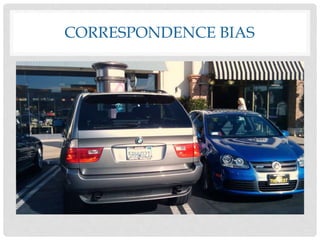
  • #14 Why did the silver car park like this? (because he’s a dick) What if the person parked in the next spot was over the line too?