Cross-Cultural Education;
Gender Roles in Different
Cultures
Paul Wiegand, Brandon Patten, Emma Robinson,
Rachel Hubby, Richard Pelletier, Paul Lucas
Australia’s Gender Roles
●Men dominate the population
●Men usually provide for the families
●Women spend twice as much time with
children
●Social Status has really changed in the past
50 years.
●Educated women are not as desirable
Changing formation of gender roles
●Past male failings have deprived the new
generation
●Male teacher population is declining
●Males underachieve in english compared to
girls
●since 1989 more women have attended
college and 30 percent of them devote
themselves to those career paths
Differences in Health
Suicide is 4 times more likely in men than in
women. 16.7 in every 100,000 men commit
suicide
It is 6.4 for women
Because of this it is concluded that men have
a lower life expectancy
Asia
Japan - Both men and women believe that women
should be stay at home parents while men bring the
actual income. The Prime Minister, however, is
pushing for changes to be made.
China - In the traditional Chinese family, the man is
responsible for maintaining, providing for and
protecting his family. Chinese mothers usually stay in
the home to take care of the home, the children, and
the rest of the family.
Asia - Cont.
Russia- Russian men also expect that wife will take care
of children and do most of housework. Also many Russian
women think that the life is ideal if they live for the
family.
India- The women are expected to take care of the
children while the men provide financially.
South American Gender Roles
Men:Traditional
Men take leadership roles in the family.
Men are the ones who work.
Men are responsible to managing the family's affairs.
Men are expected to be aggressive and confident.
South America
Women:Tradtional
Take the role of caretaker
Are expected to have and raise children
Are expected to be chaste until marriage.
Family sizes are expected to be large
South America
Changing roles:
In the last decade there has been a mass incorporation
of women into the formal workforce in Latin America.
We are seeing more women in positions of power and as
heads of households.
Some Stuff
Women earn between 60 percent and 90
percent of men’s average income. At the same
time, the percentage of women heads of
households grew from 22 percent in 1990 to 31
percent in 2008, according to the United
Nations.
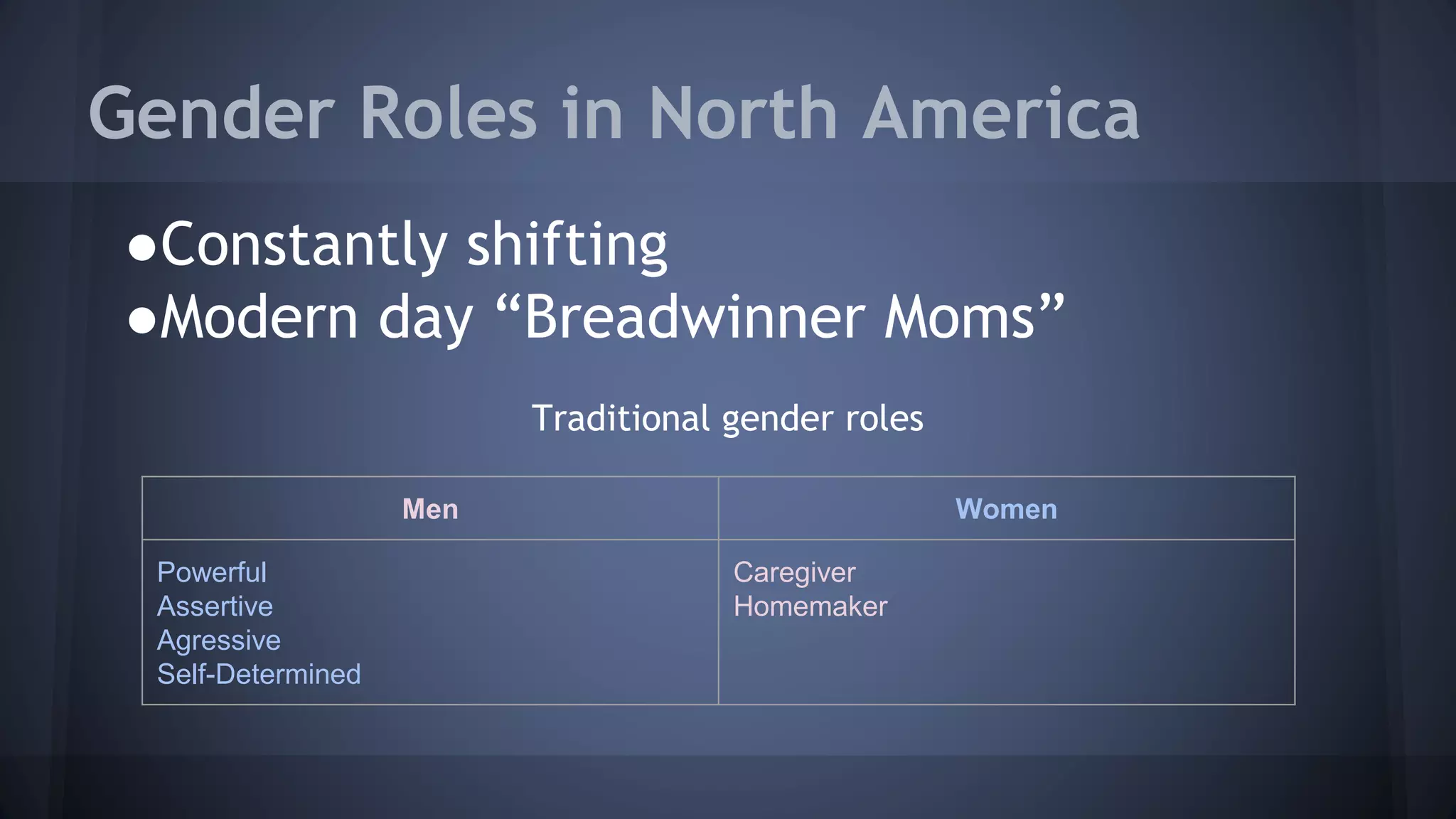
Gender Roles in North America
●Constantly shifting
●Modern day “Breadwinner Moms”
Traditional gender roles
Men Women
Powerful
Assertive
Agressive
Self-Determined
Caregiver
Homemaker
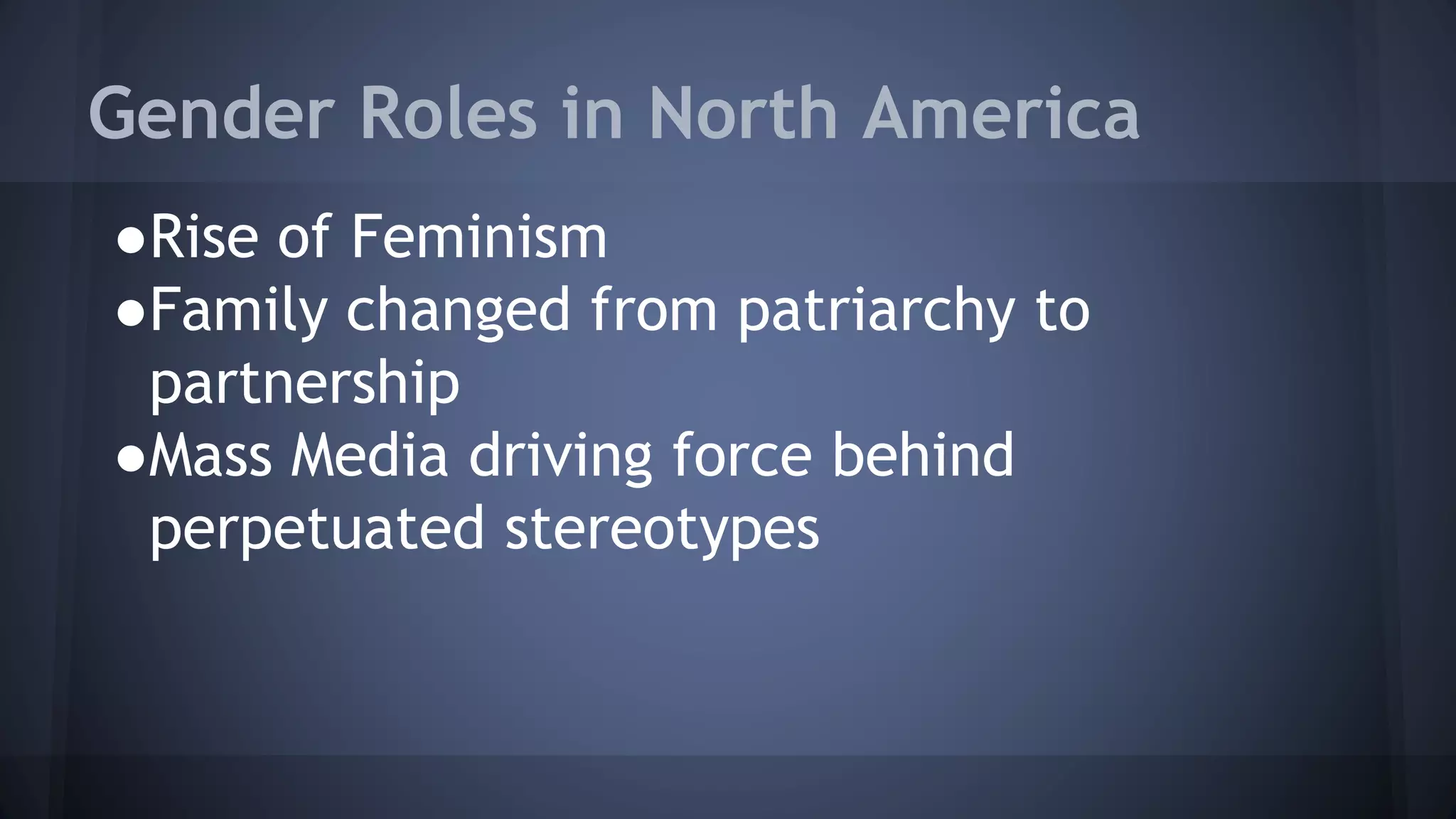
Gender Roles in North America
●Rise of Feminism
●Family changed from patriarchy to
partnership
●Mass Media driving force behind
perpetuated stereotypes
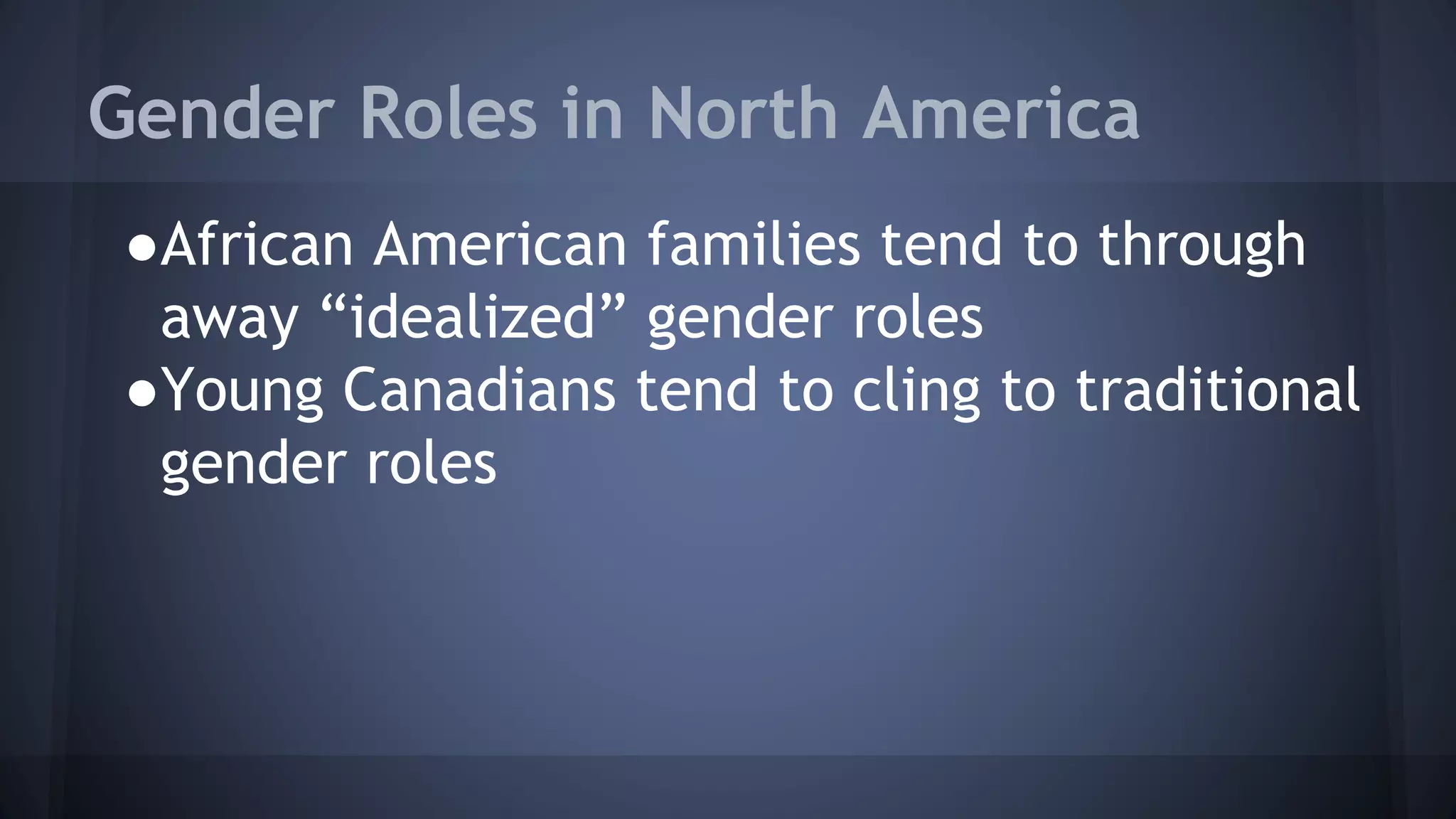
Gender Roles in North America
●African American families tend to through
away “idealized” gender roles
●Young Canadians tend to cling to traditional
gender roles
African Culture
Female
•Under father’s then husband’s
authority
•Usually home-makers and child-bearers
•Liberia has female president since 2006
•Education cut short in some cases
•Not admitted into the Defense
Academy in Nigeria
Male
•31% of societies based on
male lineages
•Sons are highly prized
•Exercise power over female
•Hunting, crop cultivation,
animal rearing, fishing
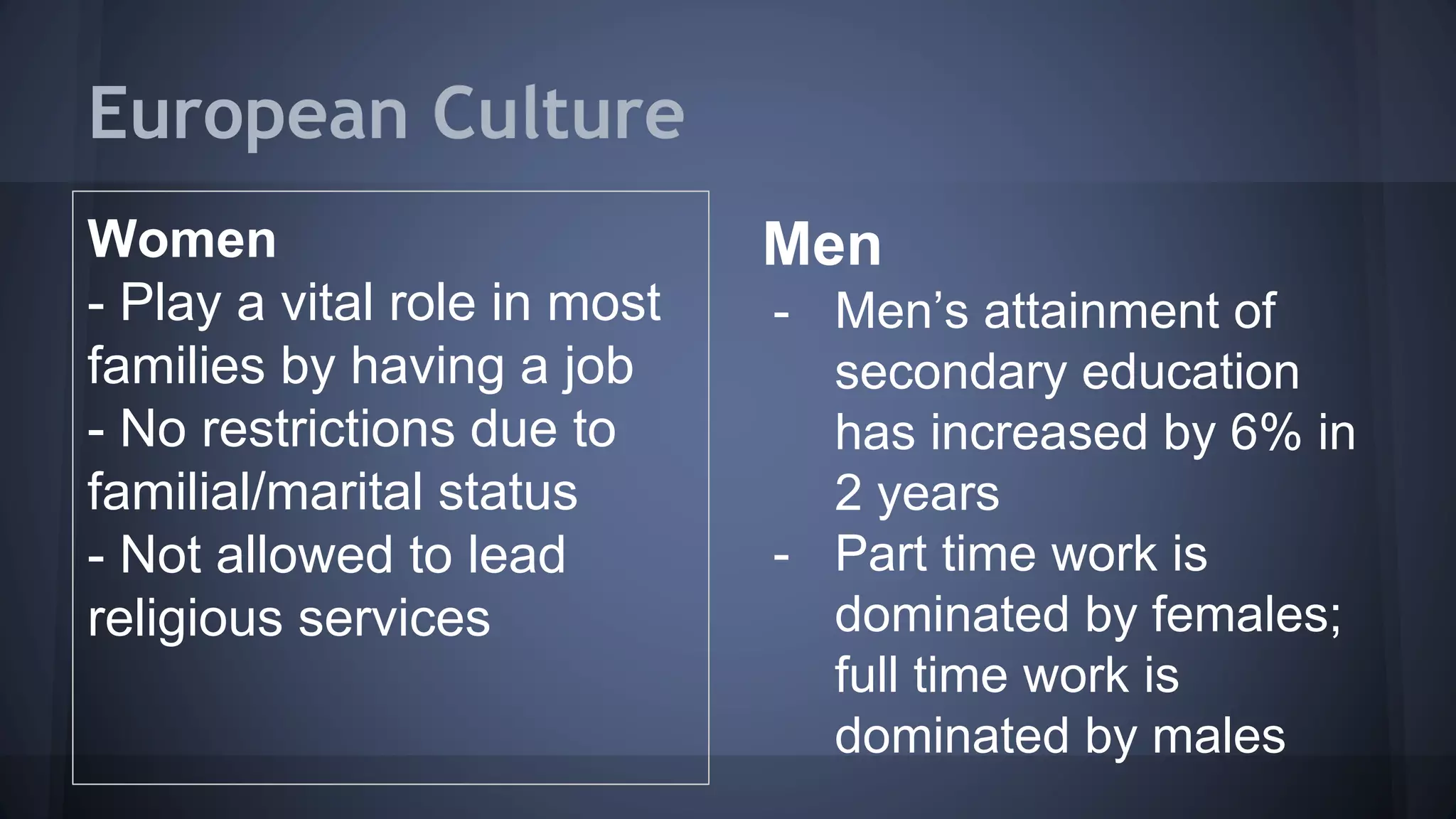
European Culture
Women
- Play a vital role in most
families by having a job
- No restrictions due to
familial/marital status
- Not allowed to lead
religious services
Men
- Men’s attainment of
secondary education
has increased by 6% in
2 years
- Part time work is
dominated by females;
full time work is
dominated by males
Australia Sources
●NSW HSC Online
●State of South Wales Department of
Communities and Charles Sturt University
Asia Sources
http://www.japantimes.co.jp/opinion/2014/07/19/editorials/
ingrained-ideas-gender-roles/
http://family.lovetoknow.com/chinese-family-values
http://countrystudies.us/russia/51.htm
https://sites.google.com/site/welcometoindianculture/hom
e/family-life/gender-roles--tradition-vs-modern
More Stuff
https://docs.google.com/presentation/u/0/d/1eO-
rx00mRWr72YFIXCF1FM7kaI1yRDJhLBOubn0ooKY/edit?usp=drive_web#slide=id.g9d00d72f4_2_17
http://www.jstor.org/discover/10.2307/20672132?uid=380875131&uid=3739800&uid=2129&uid=2&uid=70&uid=3&uid=67&uid=30
783&uid=62&uid=3739256&sid=21106305030531
http://www.cepal.org/de/publicaciones/xml/5/46825/2012-282-eclac-oit_6_web.pdf
http://encyclopediaoflatinamericanandcaribbeananthropology.wikispaces.com/Gender+Roles
North America Sources
http://krytyka.org/gender-stereotypes-in-mass-media-case-study-analysis-of-the-gender-stereotyping-phenomenon-in-tv-commercials/
http://www.lesley.edu/journal-pedagogy-pluralism-practice/safiya-jardine-arlene-dallalfar/sex-gender-roles/
http://www.pewsocialtrends.org/files/2013/05/Breadwinner_moms_final.pdf
The Unfinished Revolution: How a New Generation Is Reshaping Family, Work, and Gender in America Medved, Caryn E Journal of Marriage
and Family; Feb 2011; 73, 1; ProQuest Social Science Journals pg. 312
http://geert-hofstede.com/united-states.html
https://becauseiamagirl.ca/document.doc?id=250
Changing gender roles in prime-time commercials in Malaysia, Japan, Taiwan, and the United States Mary Jiang Bresnahan;Inoue,
Yasuhiro;Liu, Wen Ying;Nishida, Tsukasa Sex Roles; Jul 2001; 45, 1/2; ProQuest Social Science Journals pg. 117
References
•Archibong, E. P., Bassey, A. O., Bassey, U. A., & Ojua, T. A.
(2012). Gender and occupation in traditional African setting: a
study of Ikot Effanga Mkpa community Nigeria. American
International Journal of Contemporary Research, 2 (3), 238-245.
•Constanza, G. (2011). The state of gender relations in Africa: an
assessment of the multifaceted issue of gender in Africa. Think
Africa Press, 1. Retrieved from
http://thinkafricapress.com/article/state-gender-relations-africa
European Source
http://ec.europa.eu/justice/gender-
equality/files/gender_pay_gap/130424_final_re
port_role_of_men_en.pdf

Gender roles in different cultures