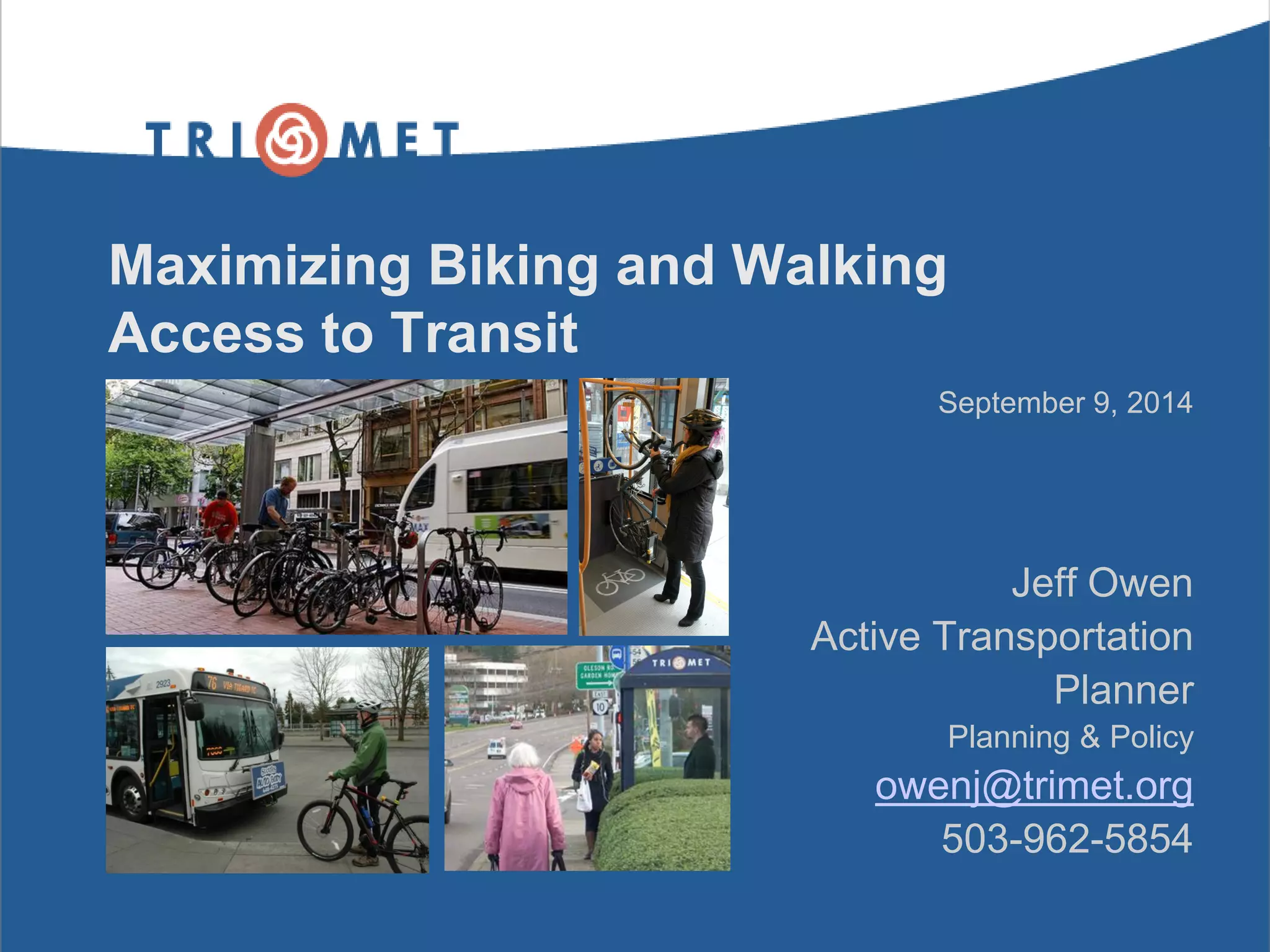
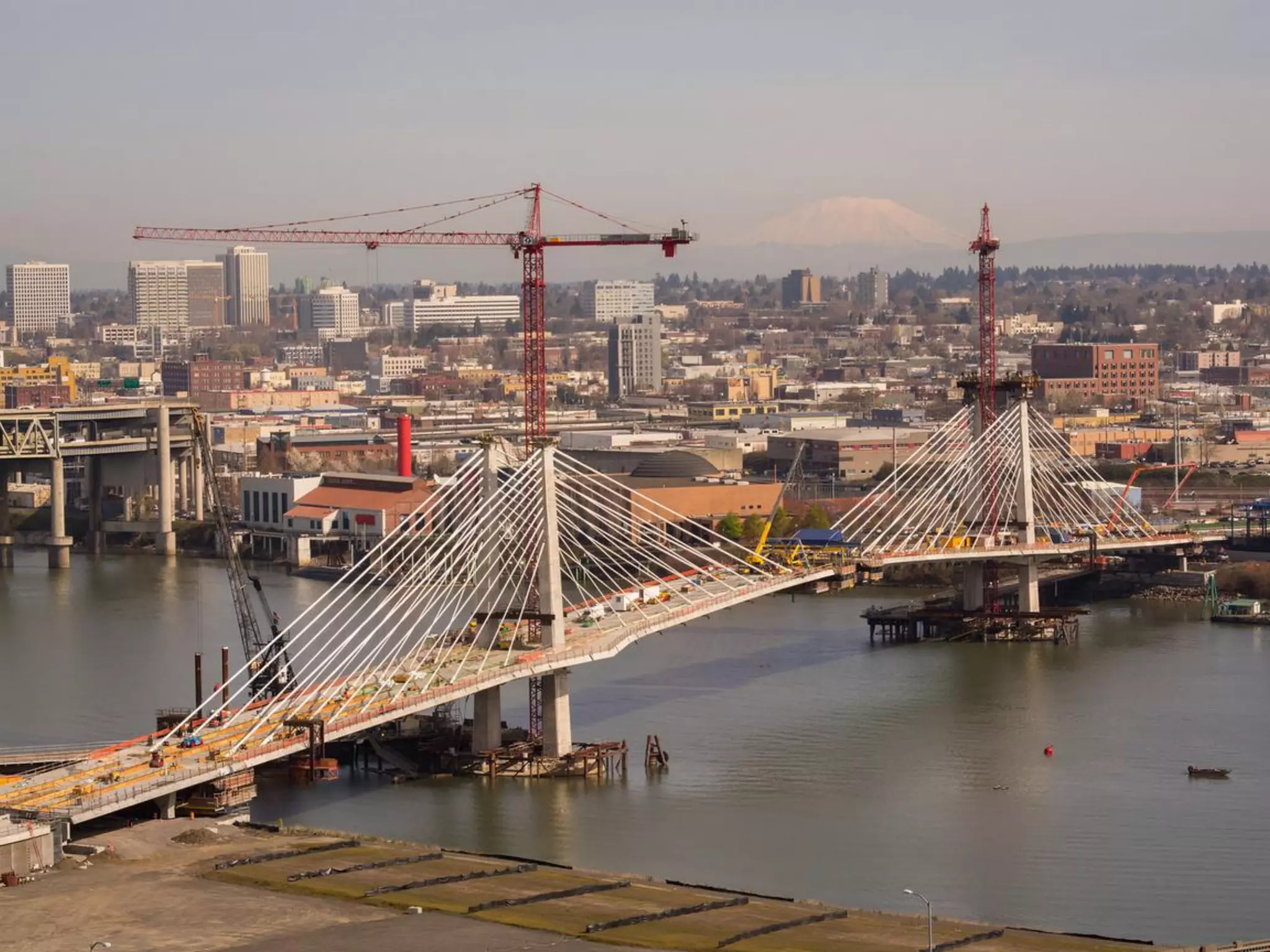
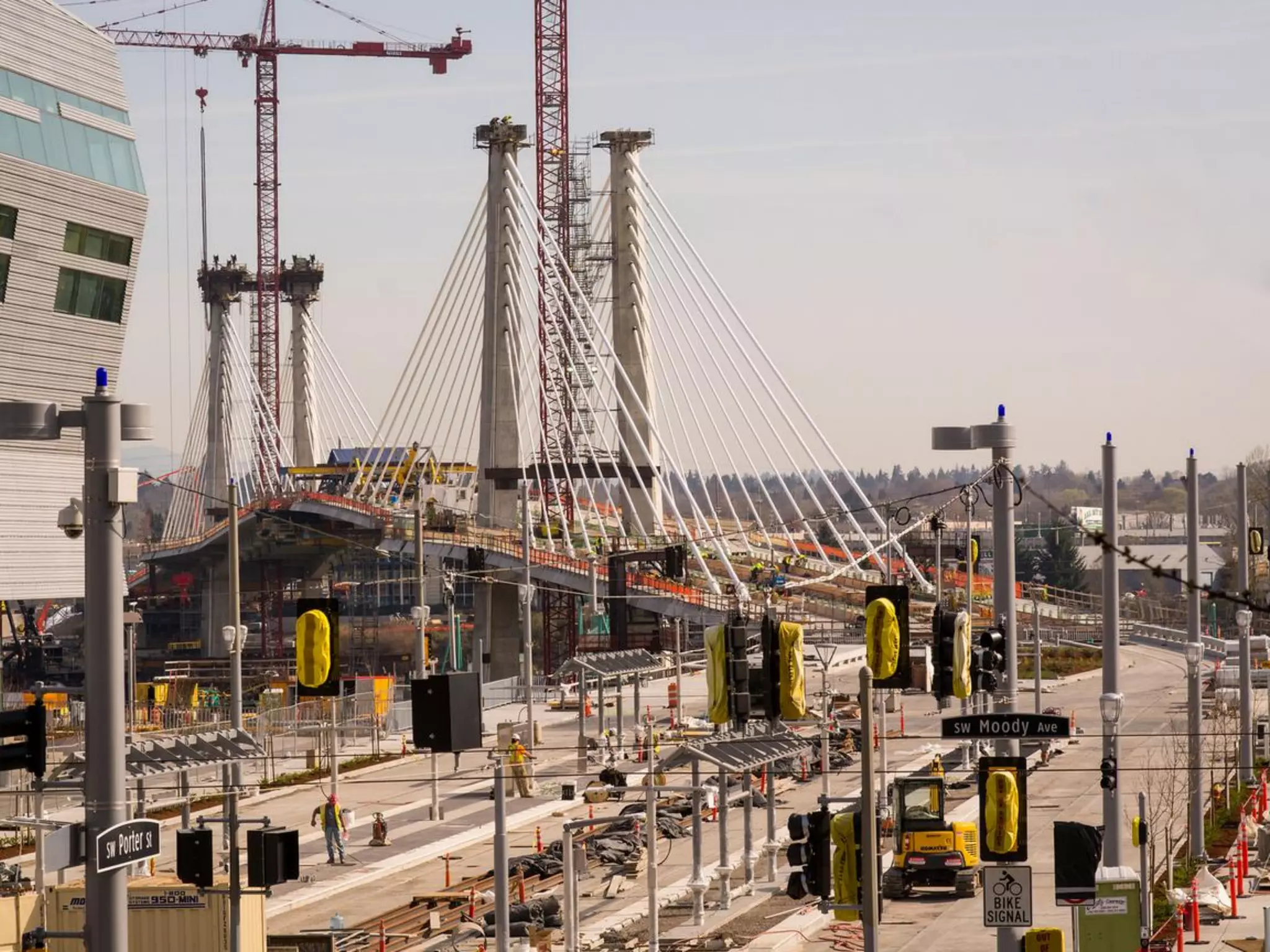
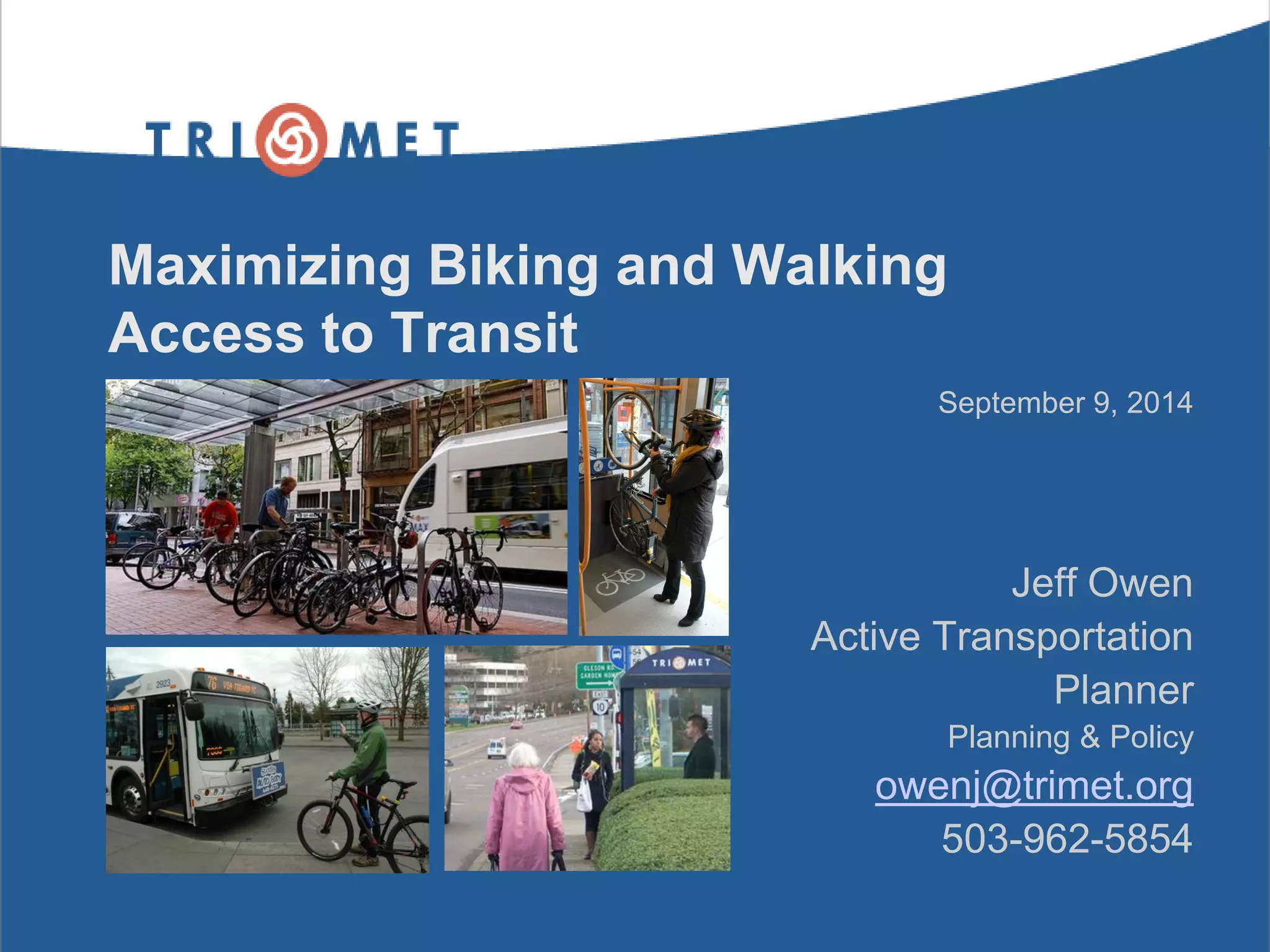
Maximizing Biking and Walking Access to Transit 
September 9, 2014 
Jeff Owen 
Active Transportation 
Planner 
Planning & Policy 
owenj@trimet.org 
503-962-5854
Agency Overview 
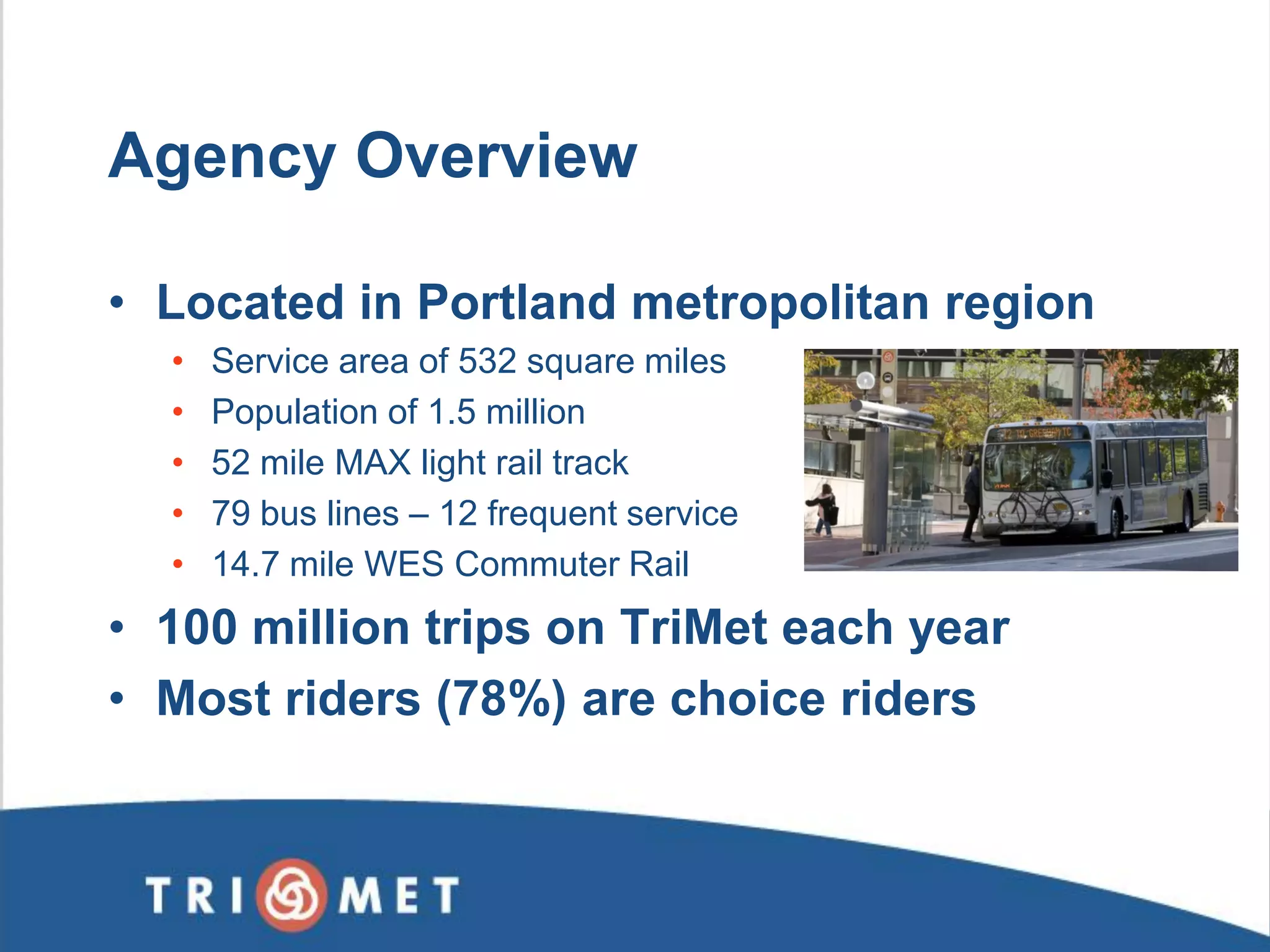
•Located in Portland metropolitan region 
•Service area of 532 square miles 
•Population of 1.5 million 
•52 mile MAX light rail track 
•79 bus lines – 12 frequent service 
•14.7 mile WES Commuter Rail 
•100 million trips on TriMet each year 
•Most riders (78%) are choice riders
Transit + Active Transportation 
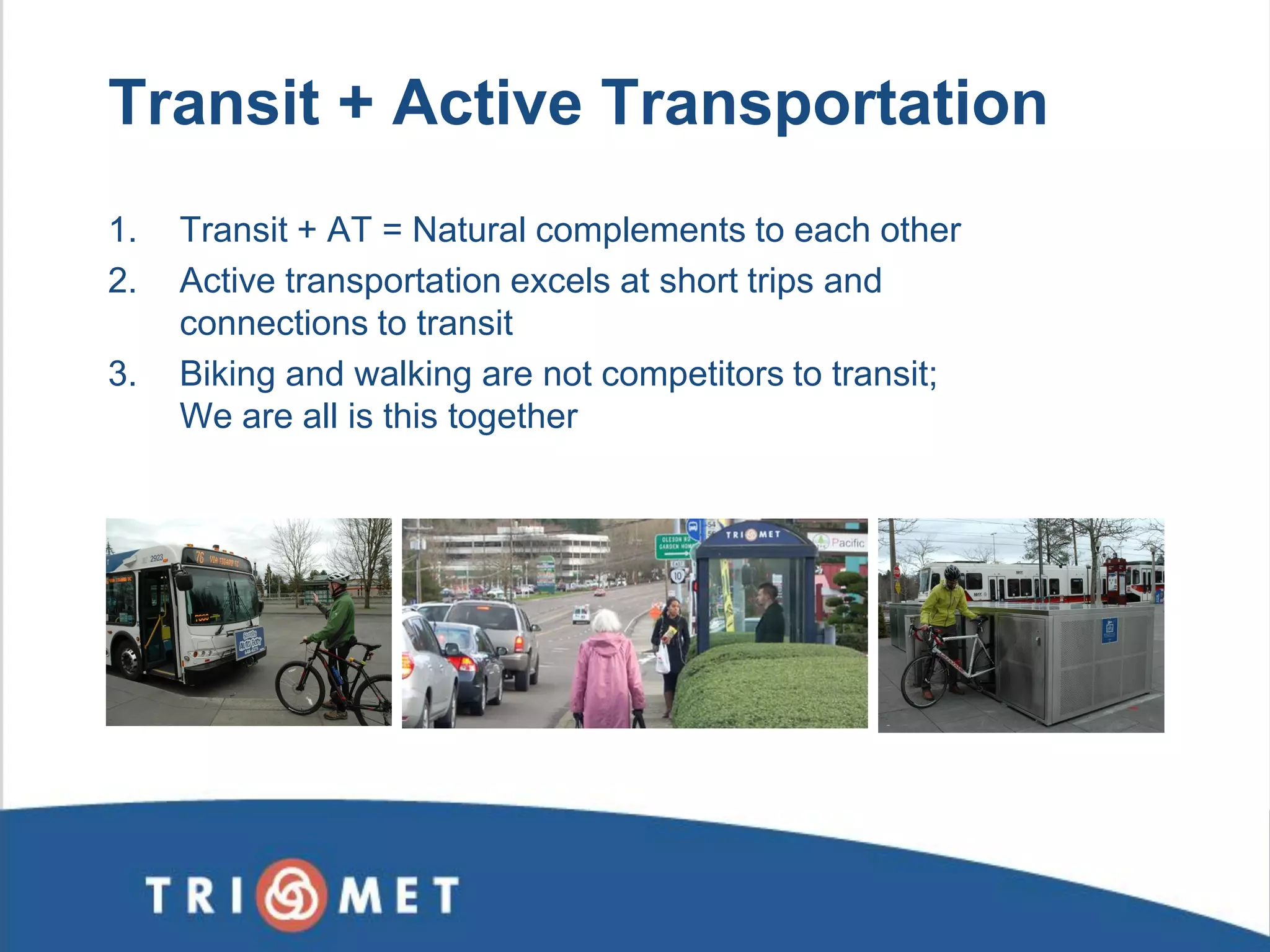
1.Transit + AT = Natural complements to each other 
2.Active transportation excels at short trips and connections to transit 
3.Biking and walking are not competitors to transit; We are all is this together
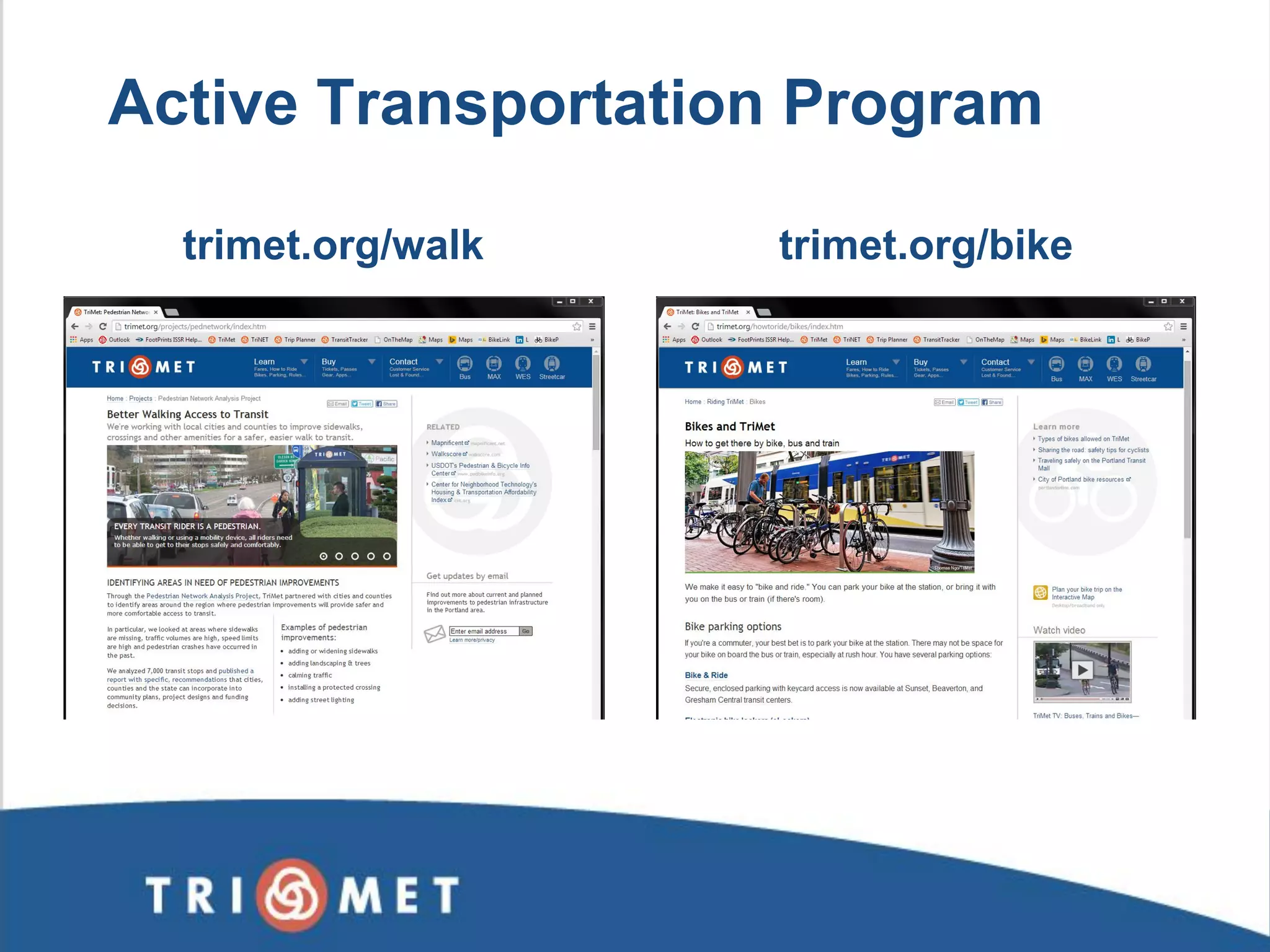
trimet.org/bike 
trimet.org/walk 
Active Transportation Program
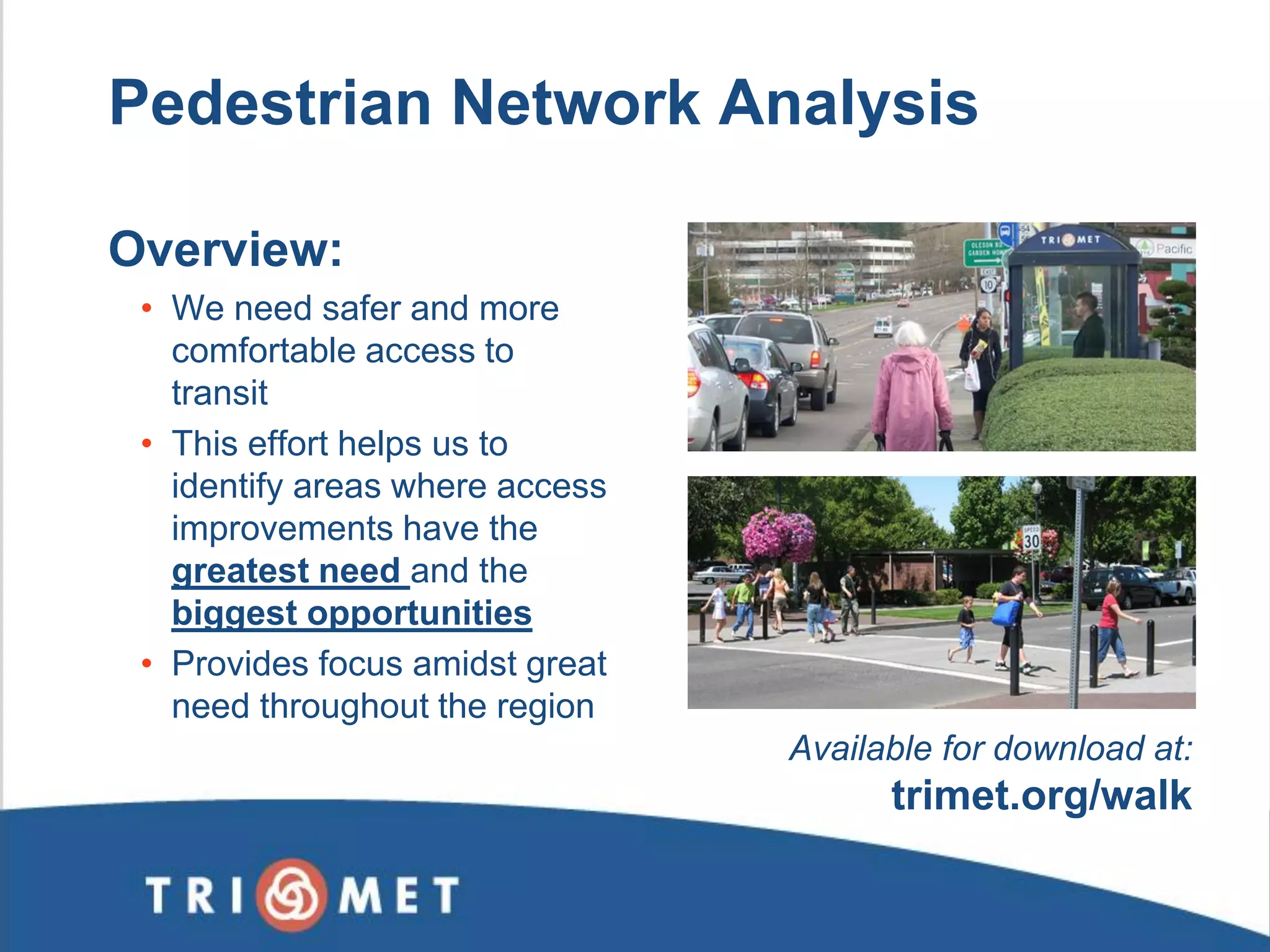
Overview: 
•We need safer and more comfortable access to transit 
•This effort helps us to identify areas where access improvements have the greatest need and the biggest opportunities 
•Provides focus amidst great need throughout the region 
Available for download at: trimet.org/walk 
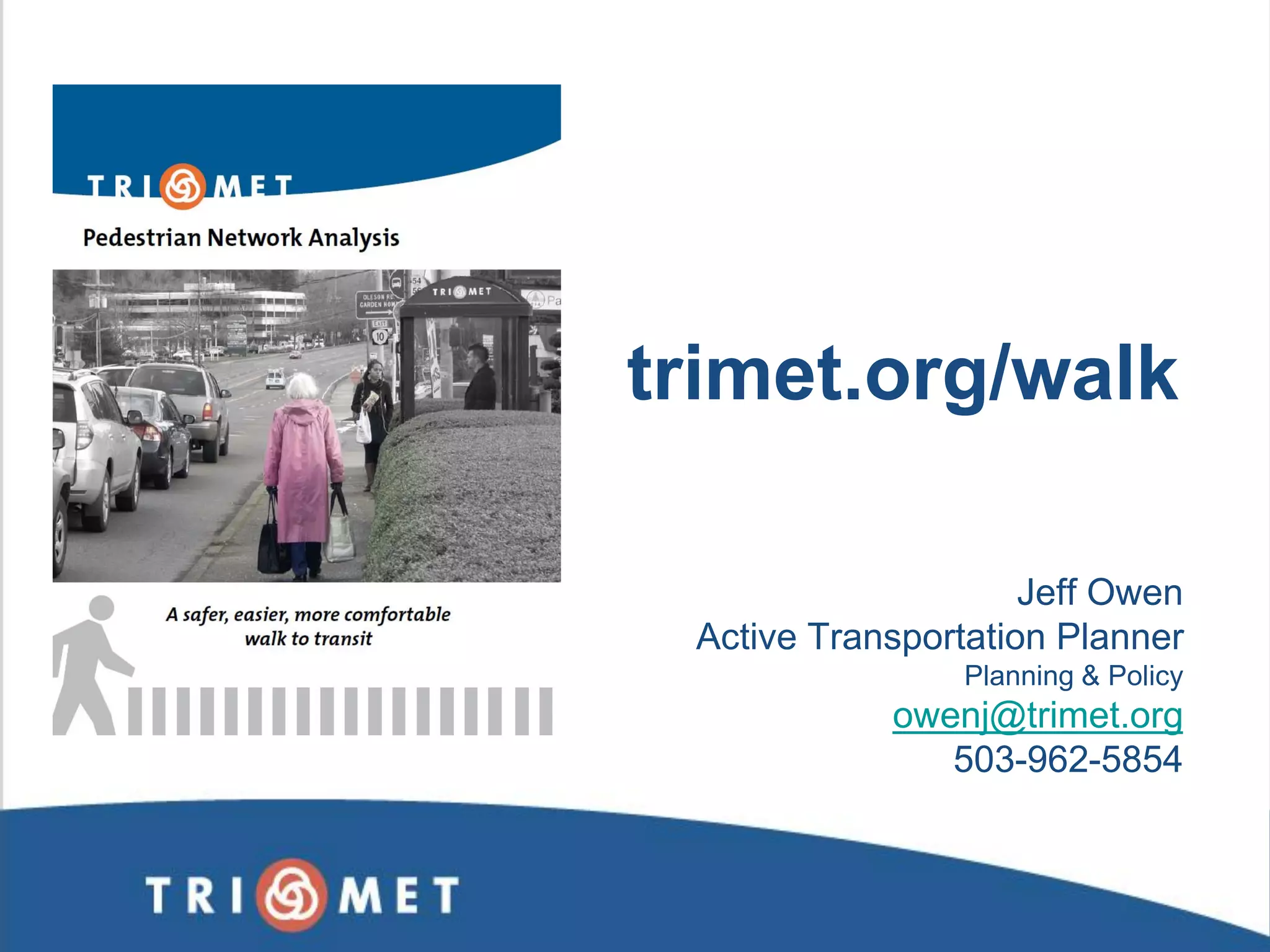
Pedestrian Network Analysis
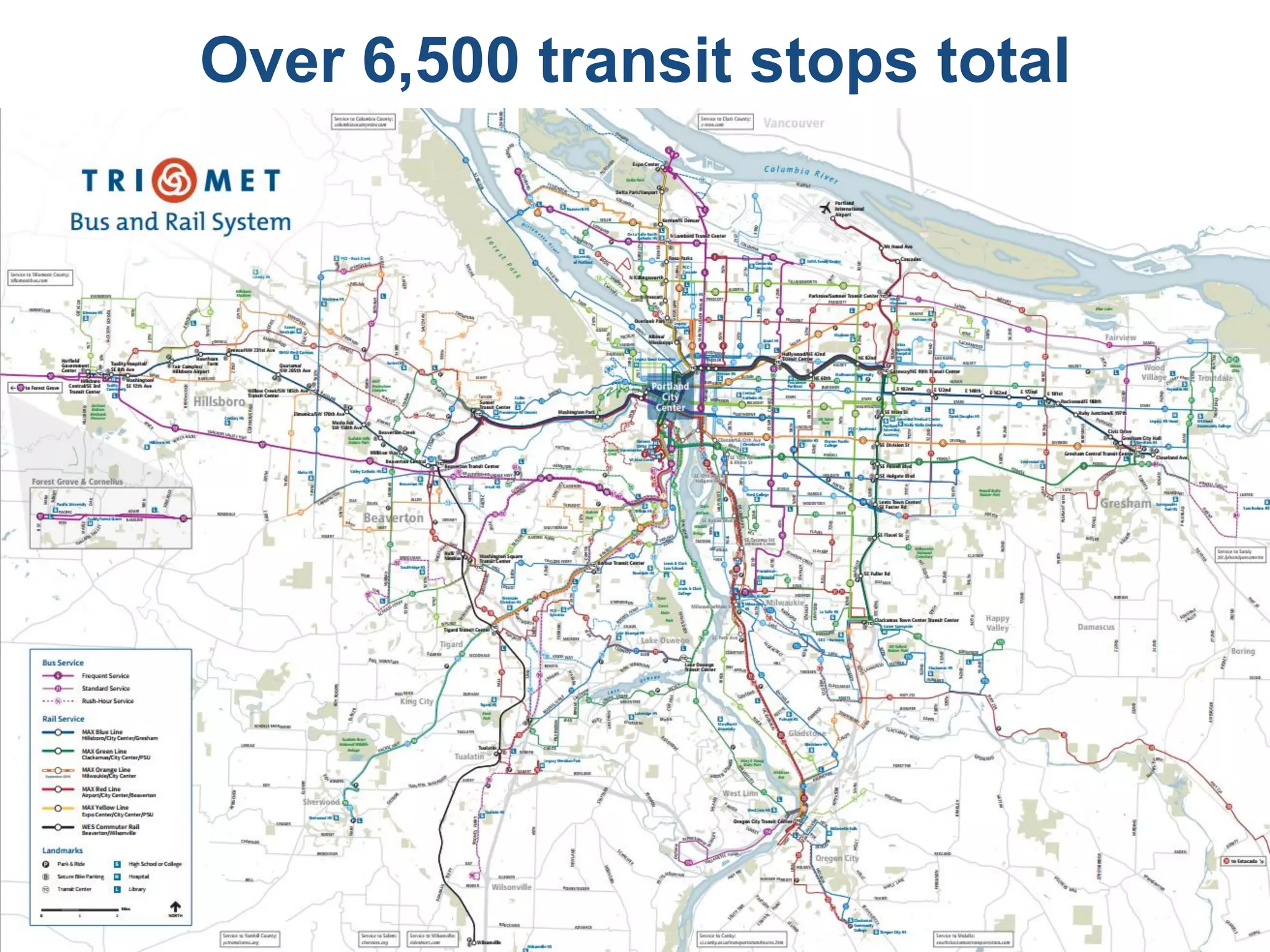
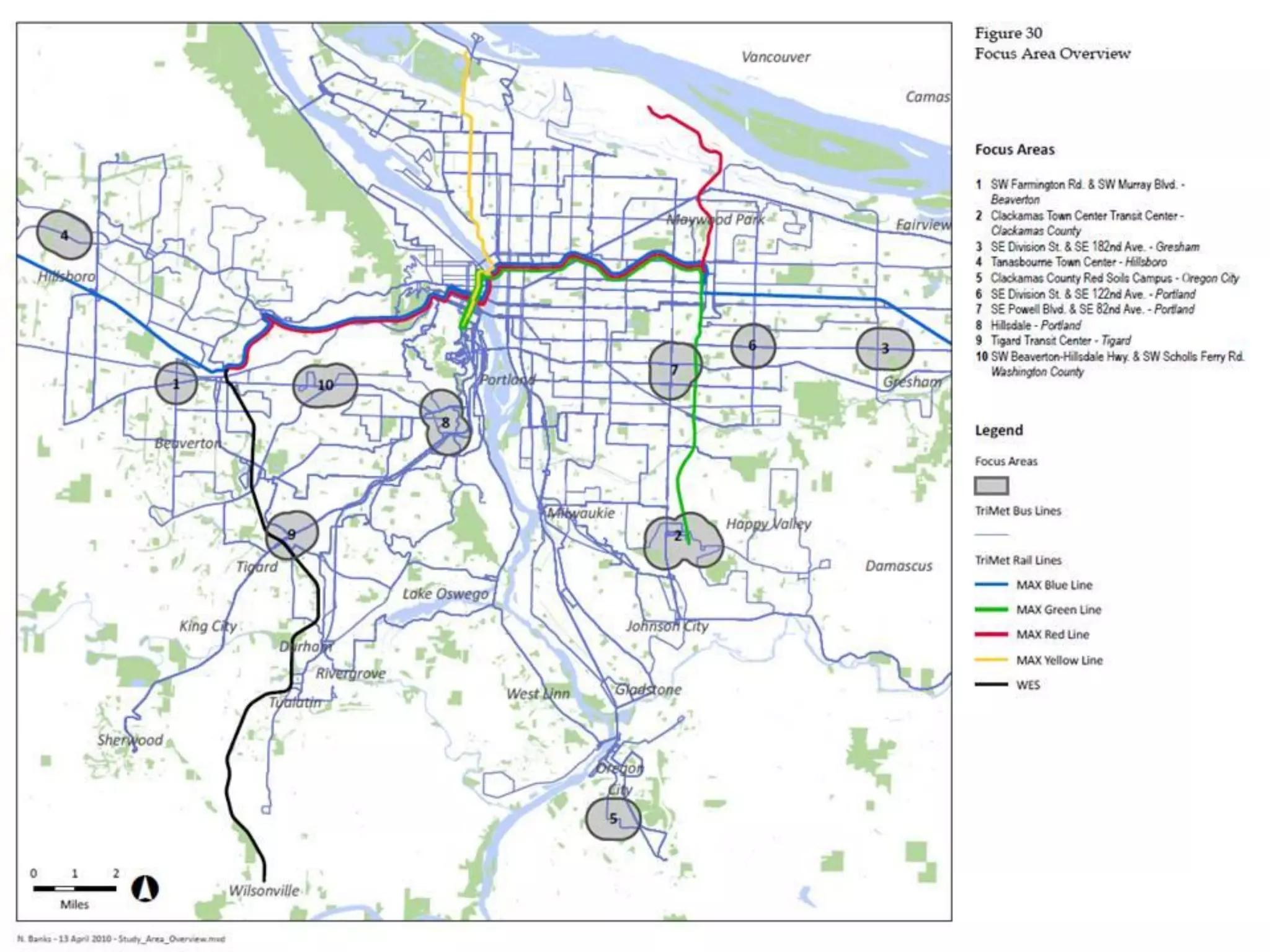
Over 6,500 transit stops total
Pedestrian Network Analysis 
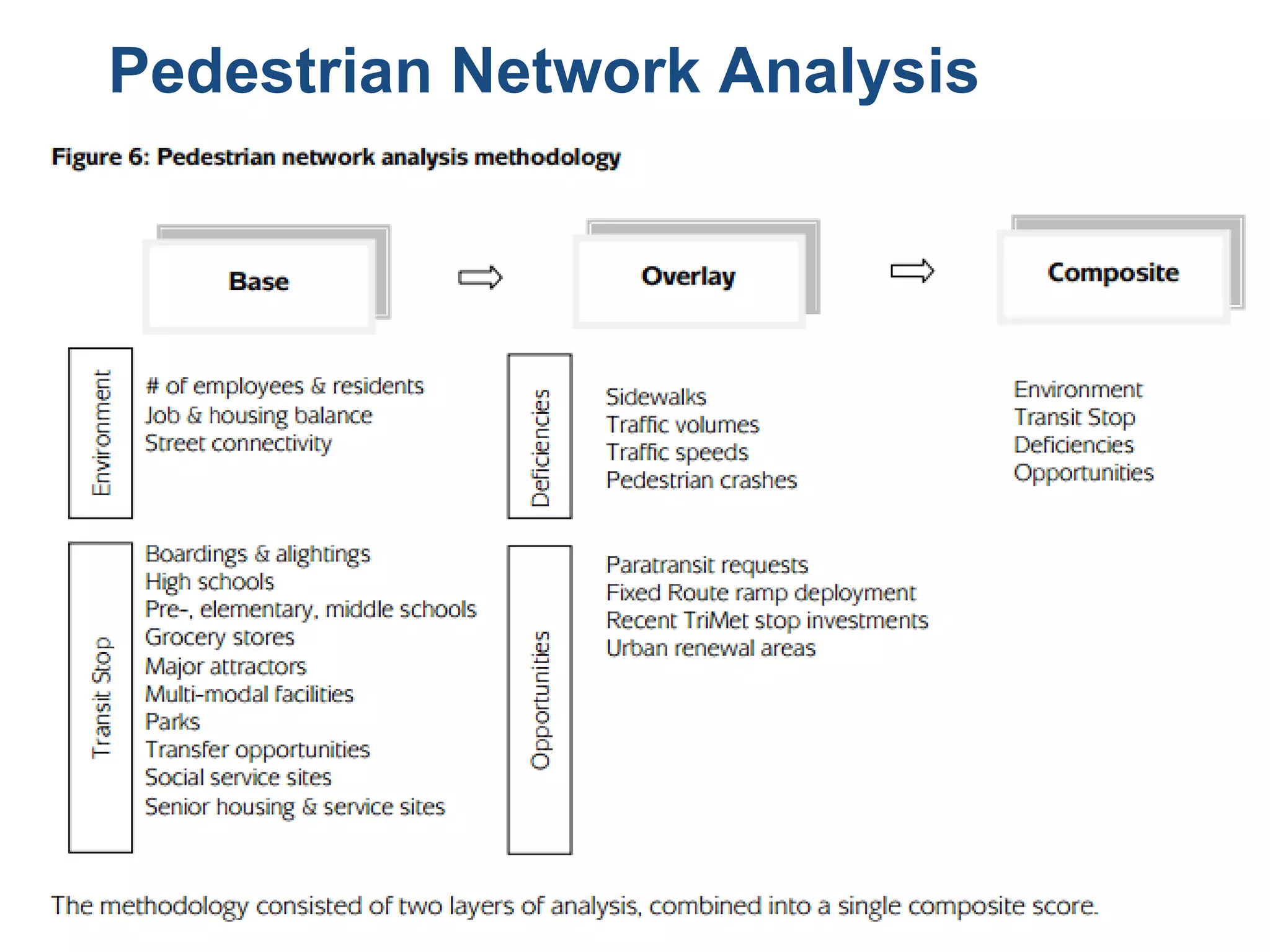
Overview of Process: 
•Big service area with lots of transit stops 
1.Base Analysis (land use, ridership, destinations) 
2.Overlay Analysis (deficiencies and opportunities) 
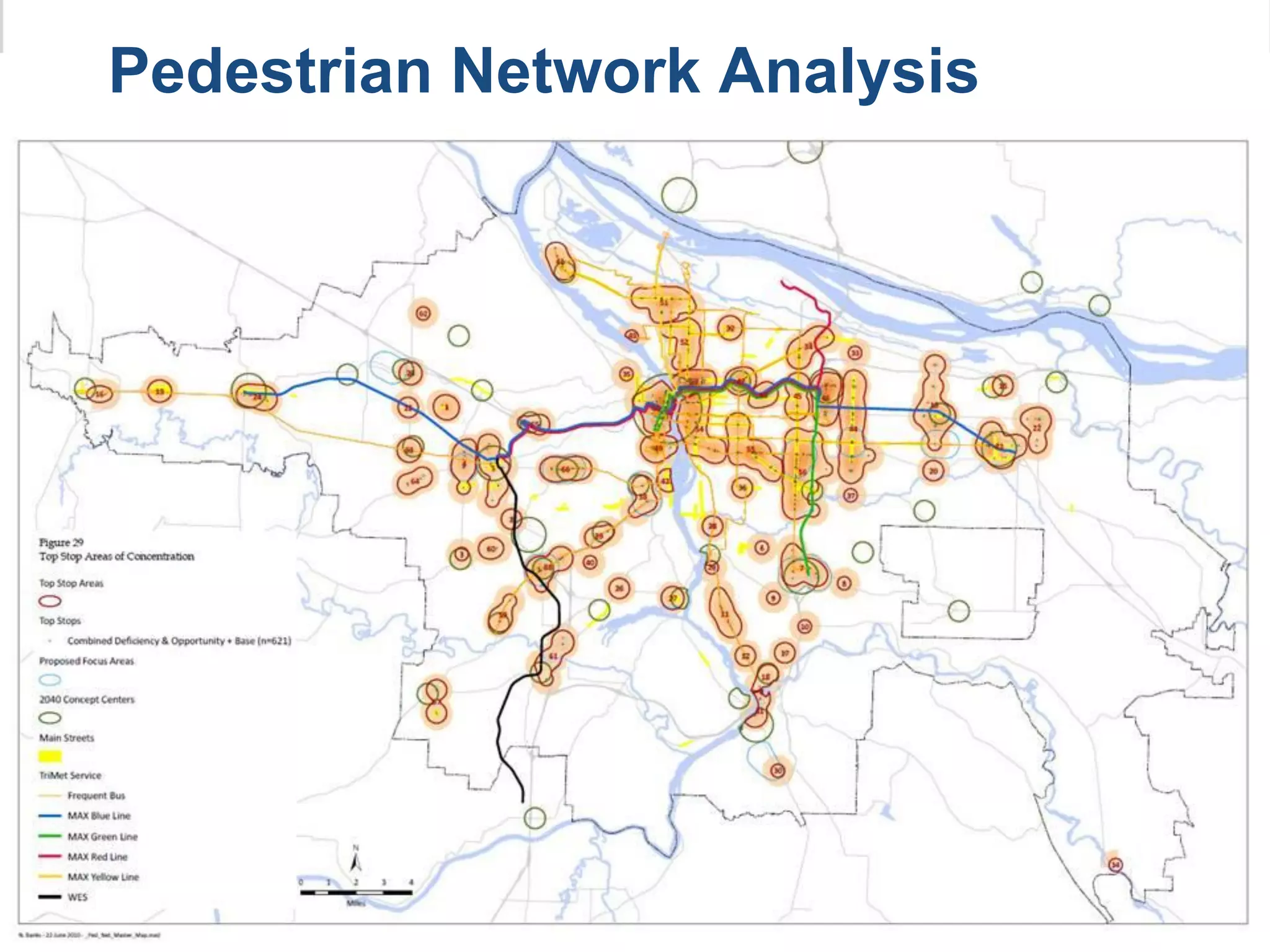
3.Composite Scores (look for clusters, then focus areas)
Pedestrian Network Analysis
Pedestrian Network Analysis 
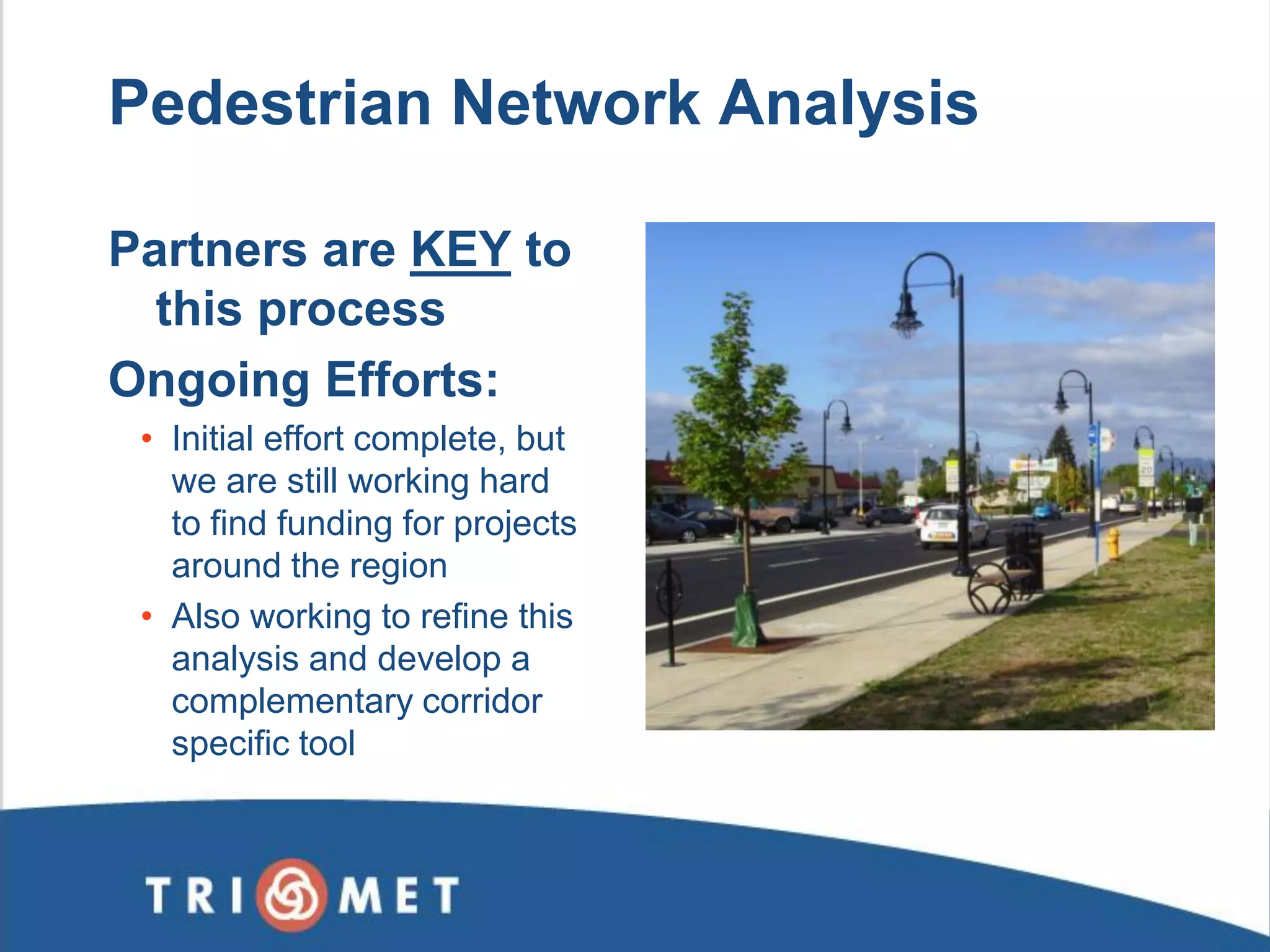
Partners are KEY to this process Ongoing Efforts: 
•Initial effort complete, but we are still working hard to find funding for projects around the region 
•Also working to refine this analysis and develop a complementary corridor specific tool
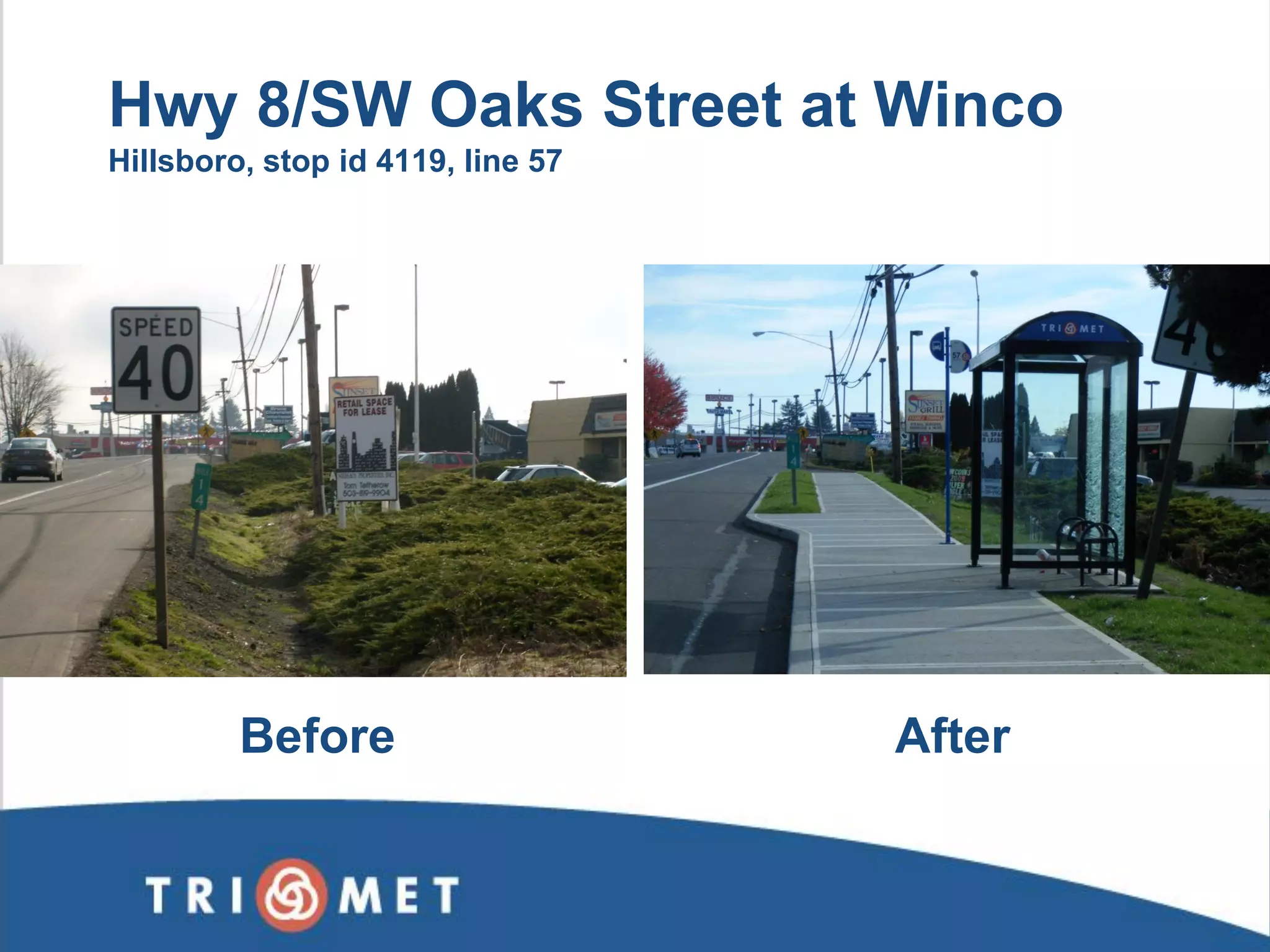
Hwy 8/SW Oaks Street at Winco Hillsboro, stop id 4119, line 57 
Before 
After
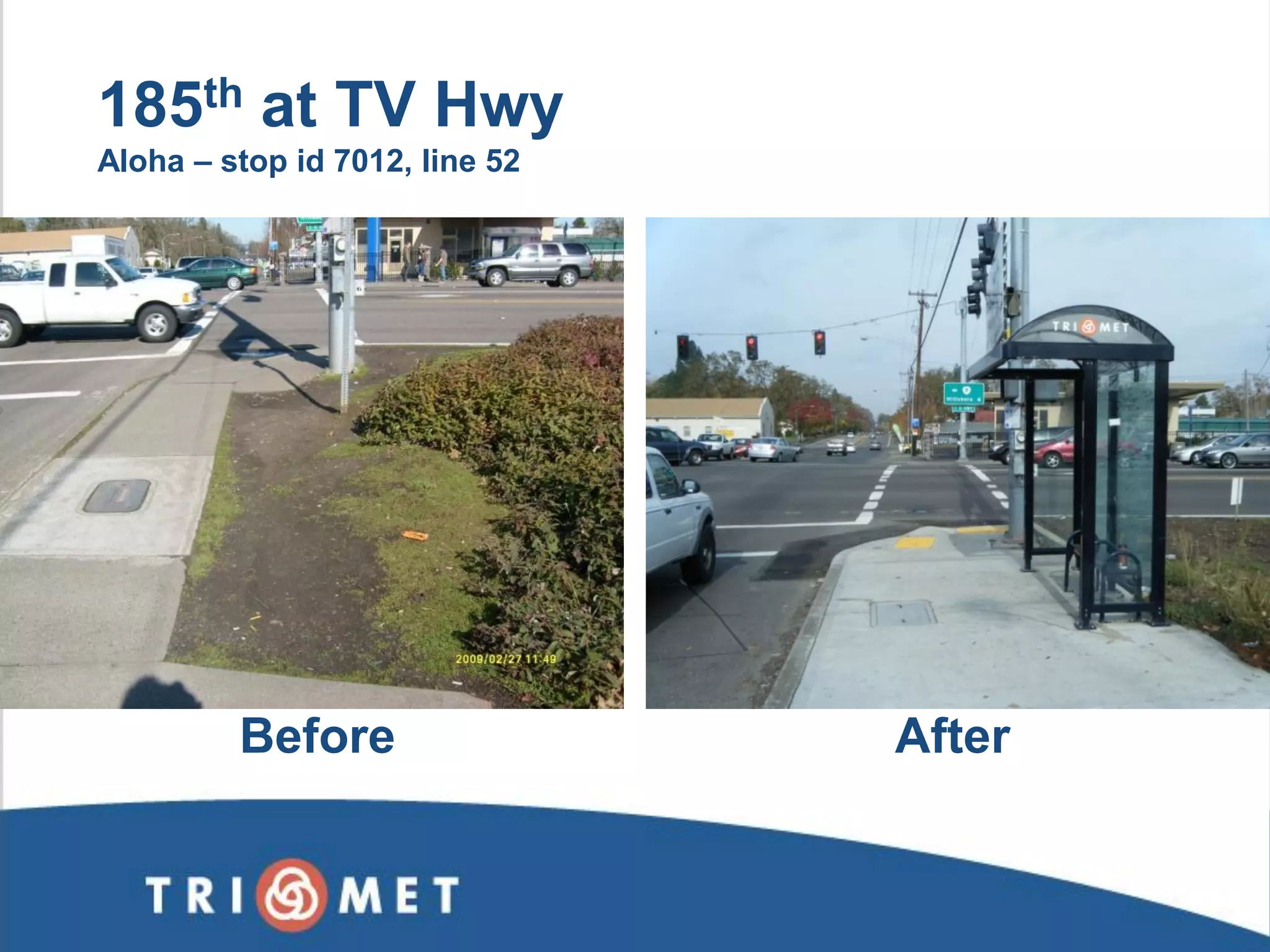
185th at TV Hwy 
Aloha – stop id 7012, line 52 
Before 
After
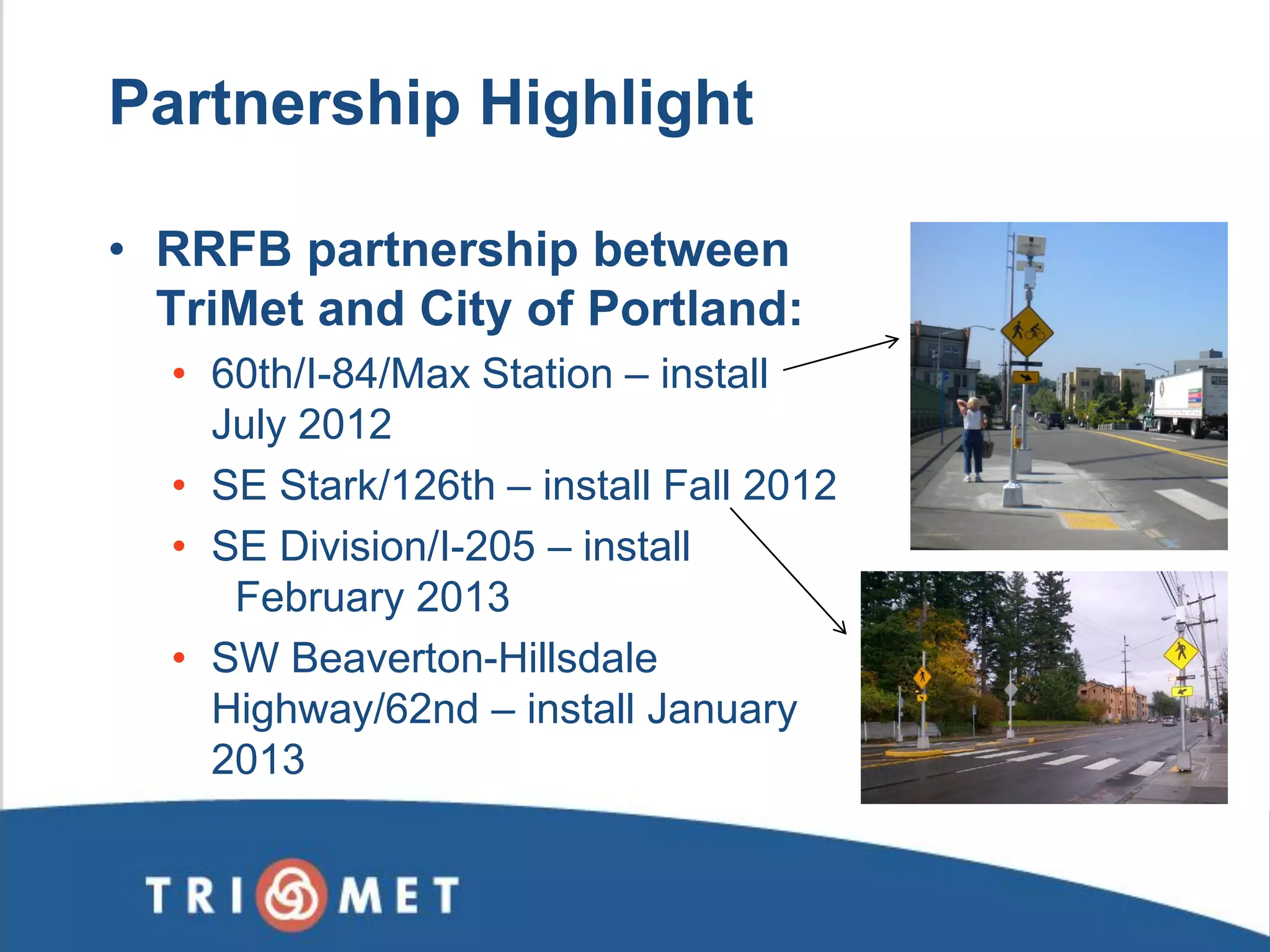
Partnership Highlight 
•RRFB partnership between TriMet and City of Portland: 
•60th/I-84/Max Station – install July 2012 
•SE Stark/126th – install Fall 2012 
•SE Division/I-205 – install February 2013 
•SW Beaverton-Hillsdale Highway/62nd – install January 2013
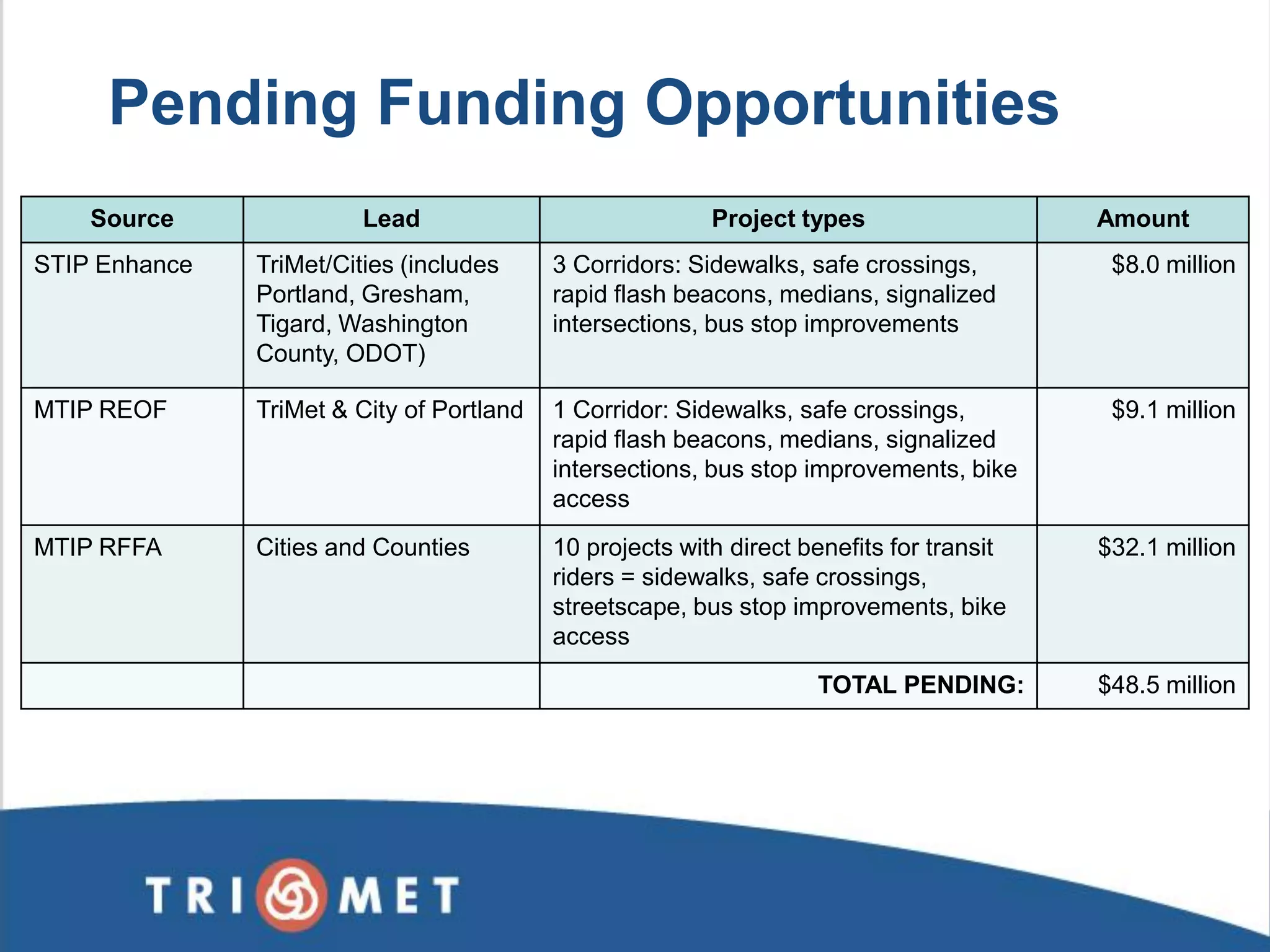
Pending Funding Opportunities 
Source 
Lead 
Project types 
Amount 
STIP Enhance 
TriMet/Cities (includes Portland, Gresham, Tigard, Washington County, ODOT) 
3 Corridors: Sidewalks, safe crossings, rapid flash beacons, medians, signalized intersections, bus stop improvements 
$8.0 million 
MTIP REOF 
TriMet & City of Portland 
1 Corridor: Sidewalks, safe crossings, rapid flash beacons, medians, signalized intersections, bus stop improvements, bike access 
$9.1 million 
MTIP RFFA 
Cities and Counties 
10 projects with direct benefits for transit riders = sidewalks, safe crossings, streetscape, bus stop improvements, bike access 
$32.1 million 
TOTAL PENDING: 
$48.5 million
trimet.org/walk 
Jeff Owen 
Active Transportation Planner 
Planning & Policy 
owenj@trimet.org 
503-962-5854
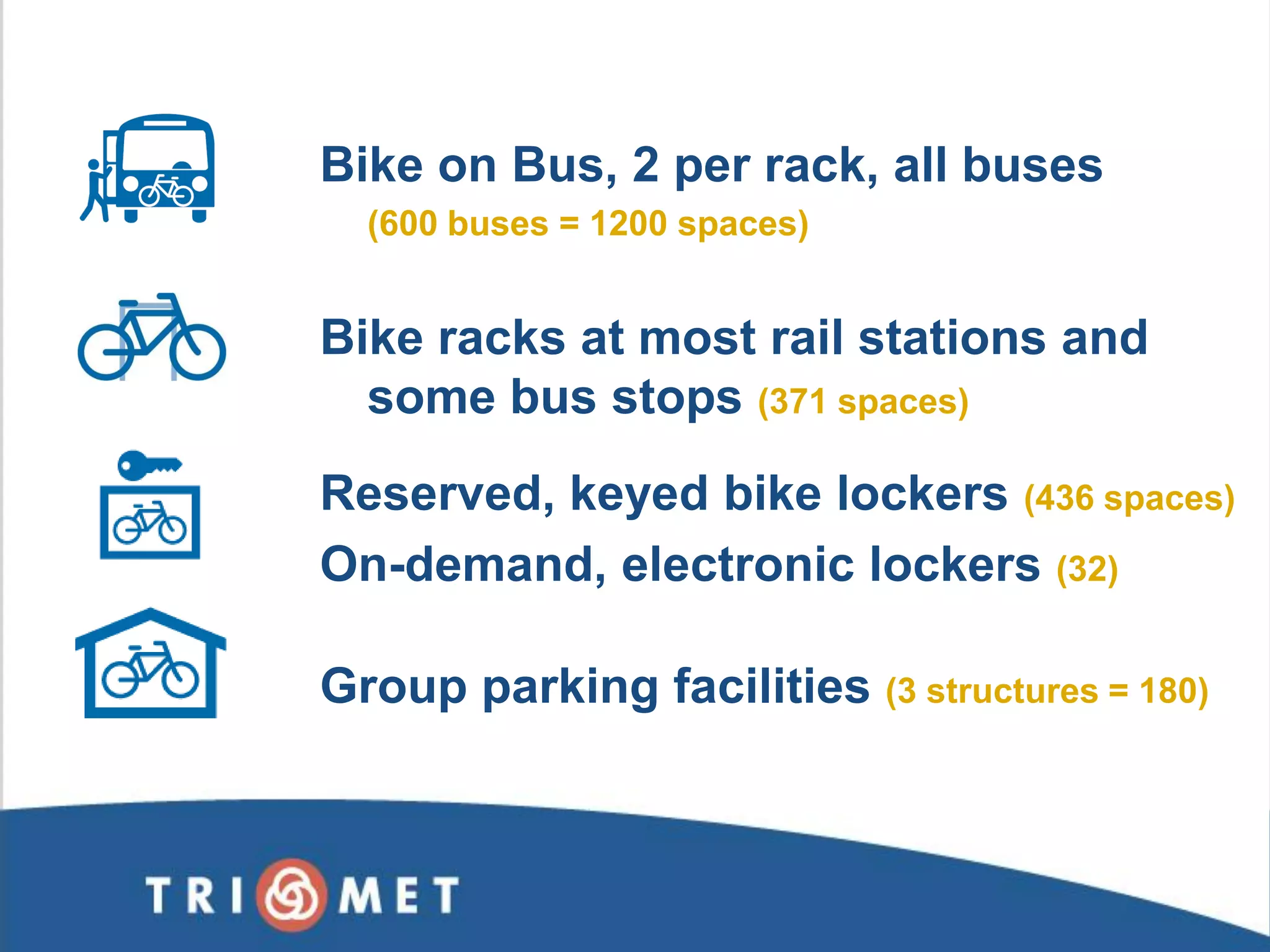
Bike on Bus, 2 per rack, all buses 
(600 buses = 1200 spaces) 
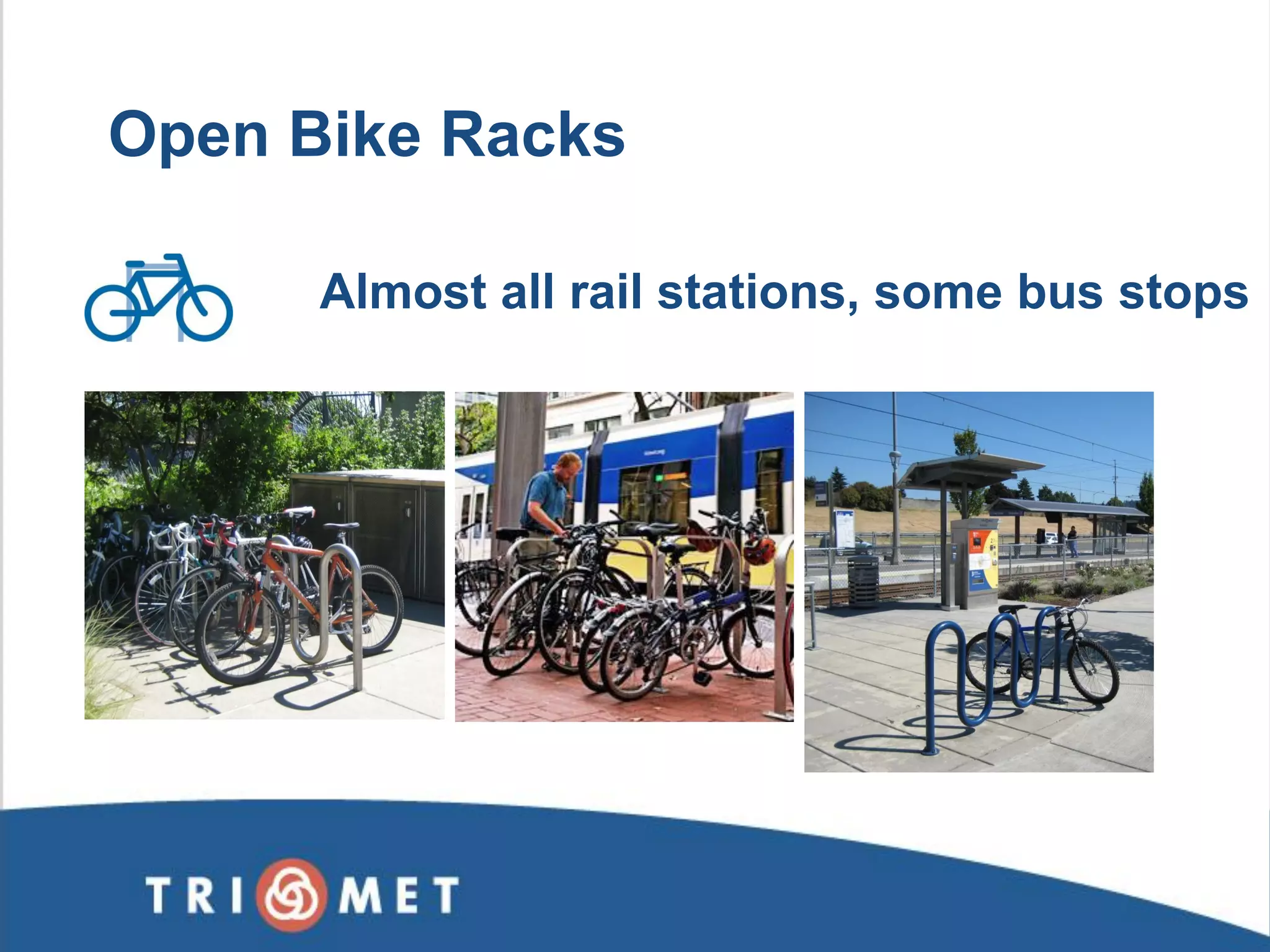
Bike racks at most rail stations and some bus stops (371 spaces) 
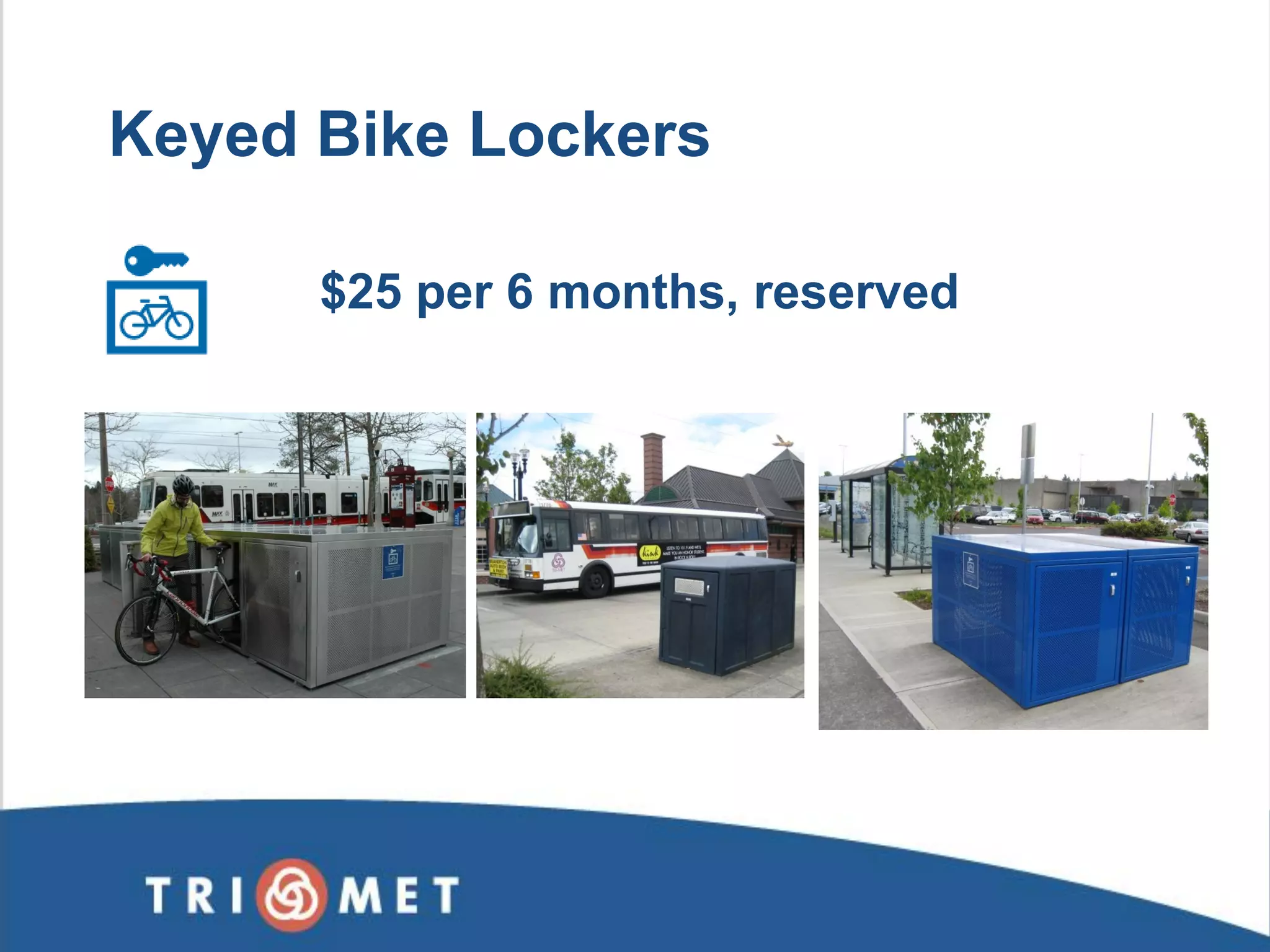
Reserved, keyed bike lockers (436 spaces) 
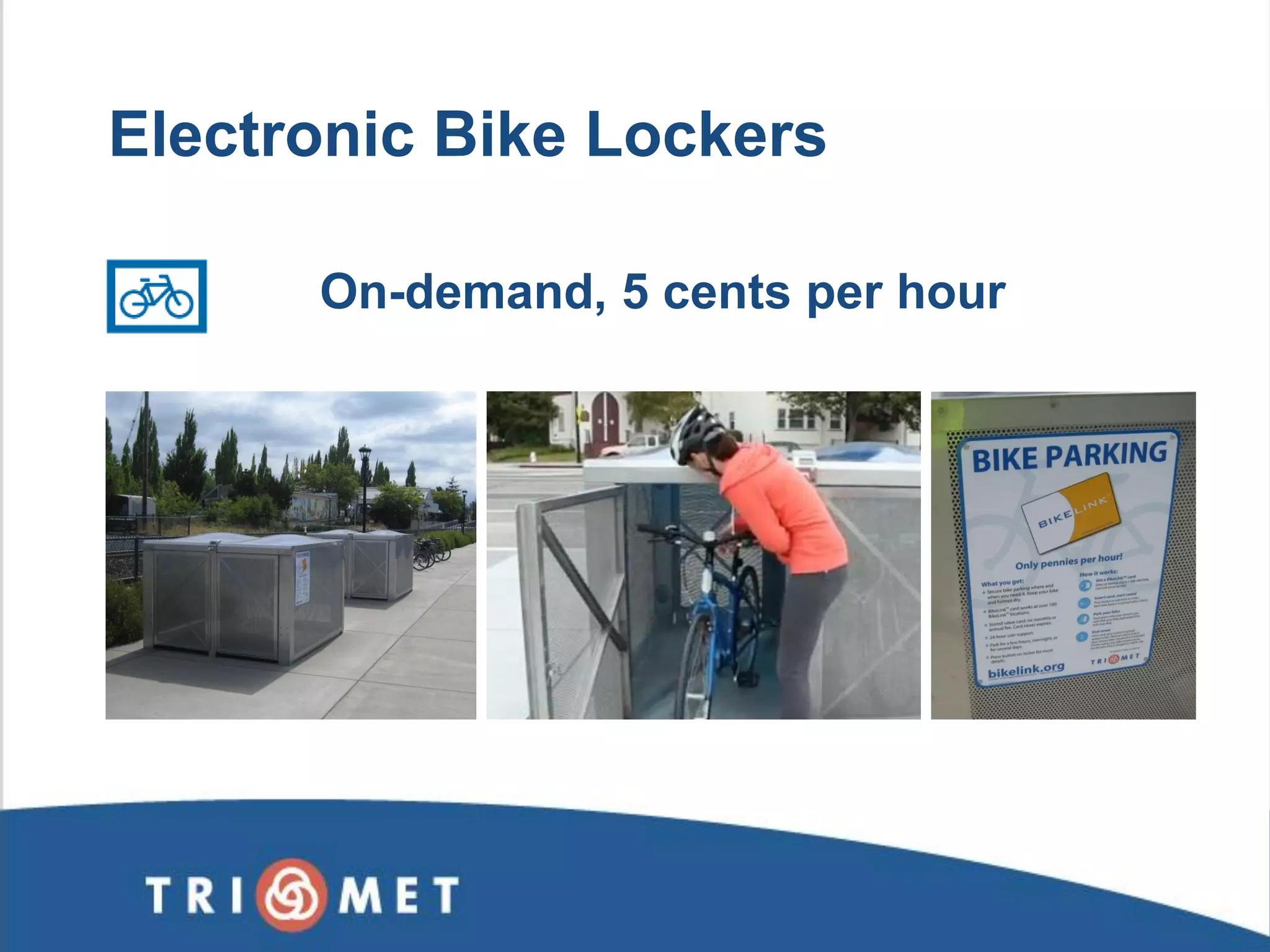
On-demand, electronic lockers (32) 
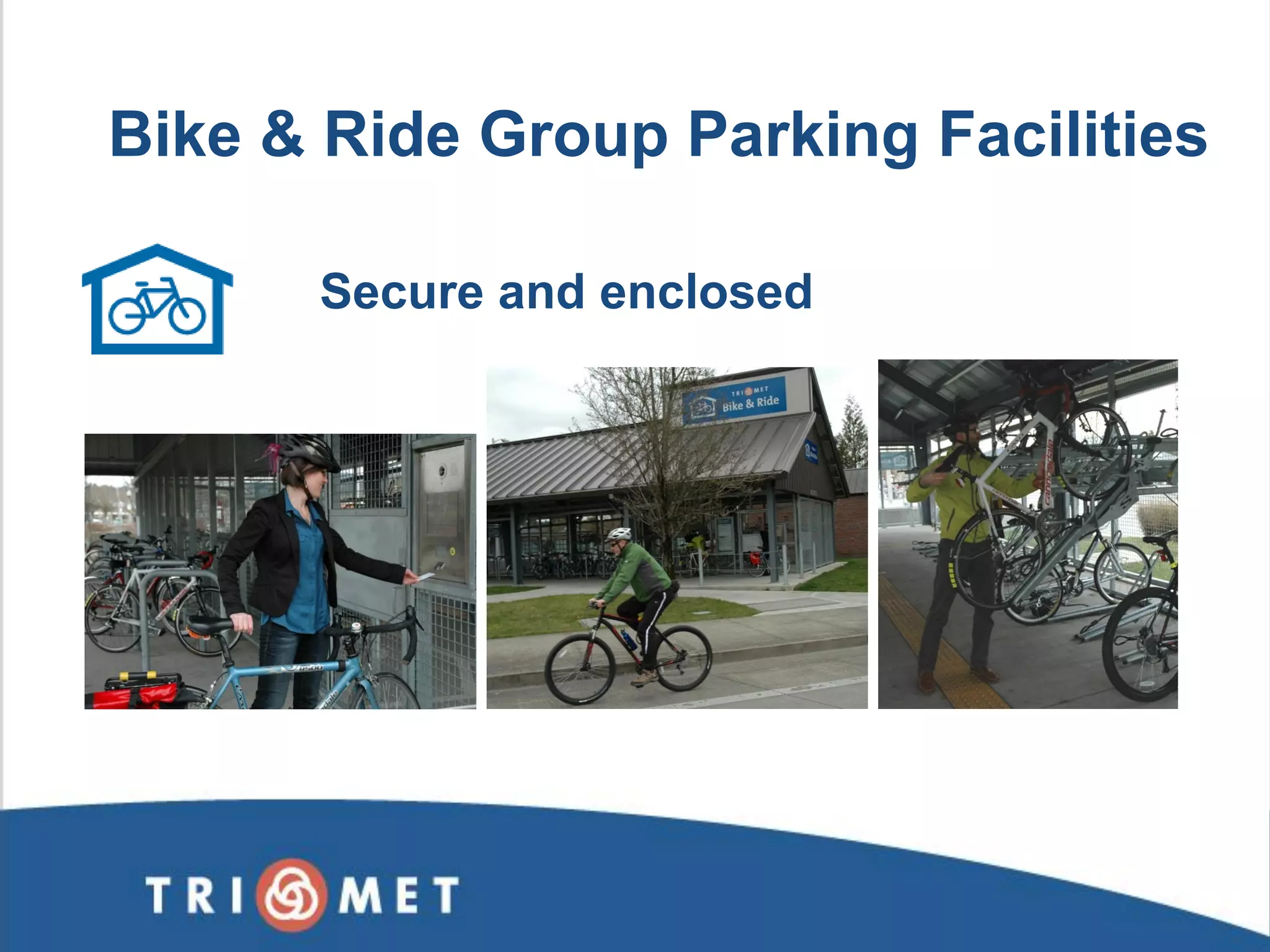
Group parking facilities (3 structures = 180)
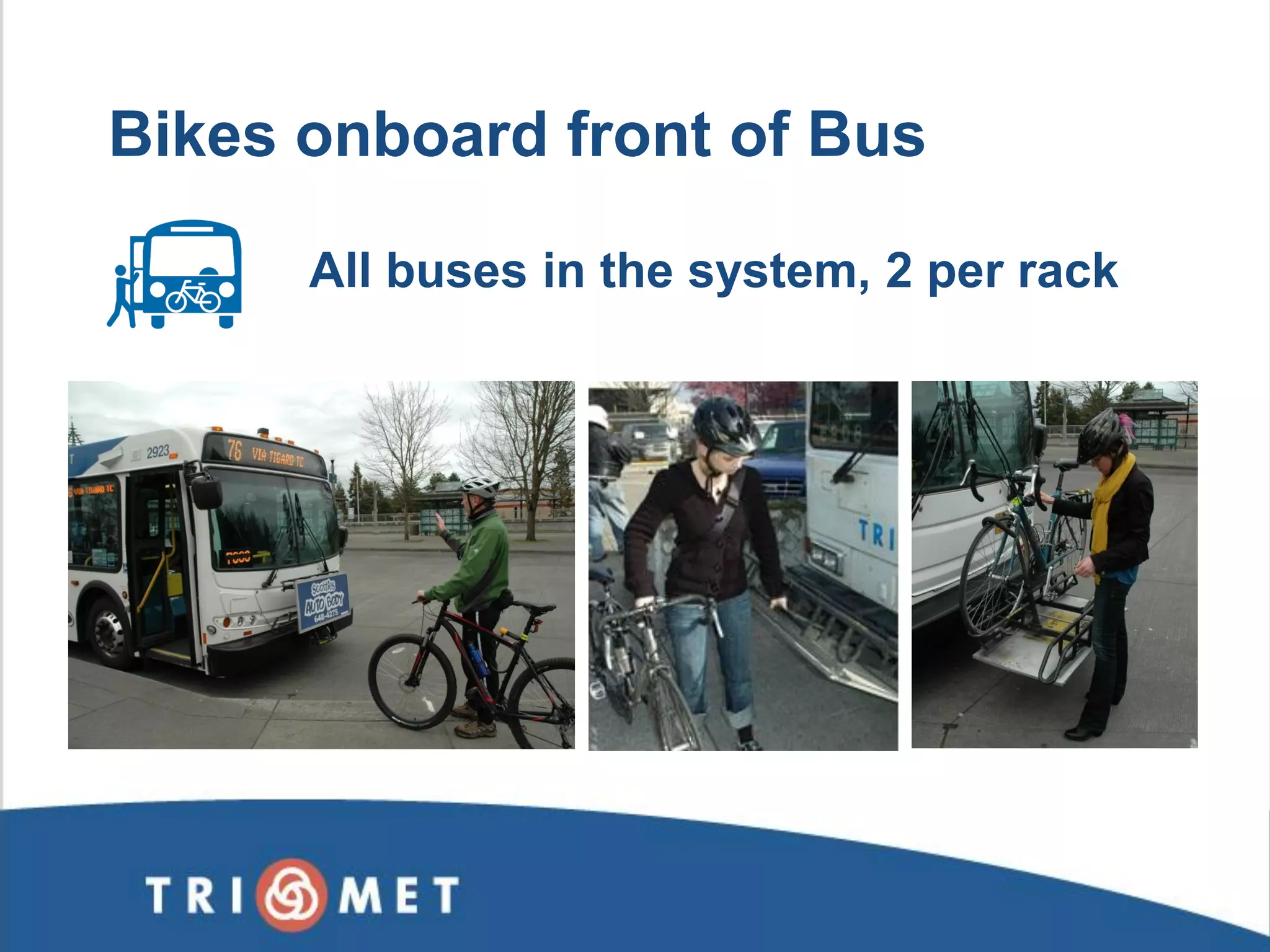
All buses in the system, 2 per rack 
Bikes onboard front of Bus
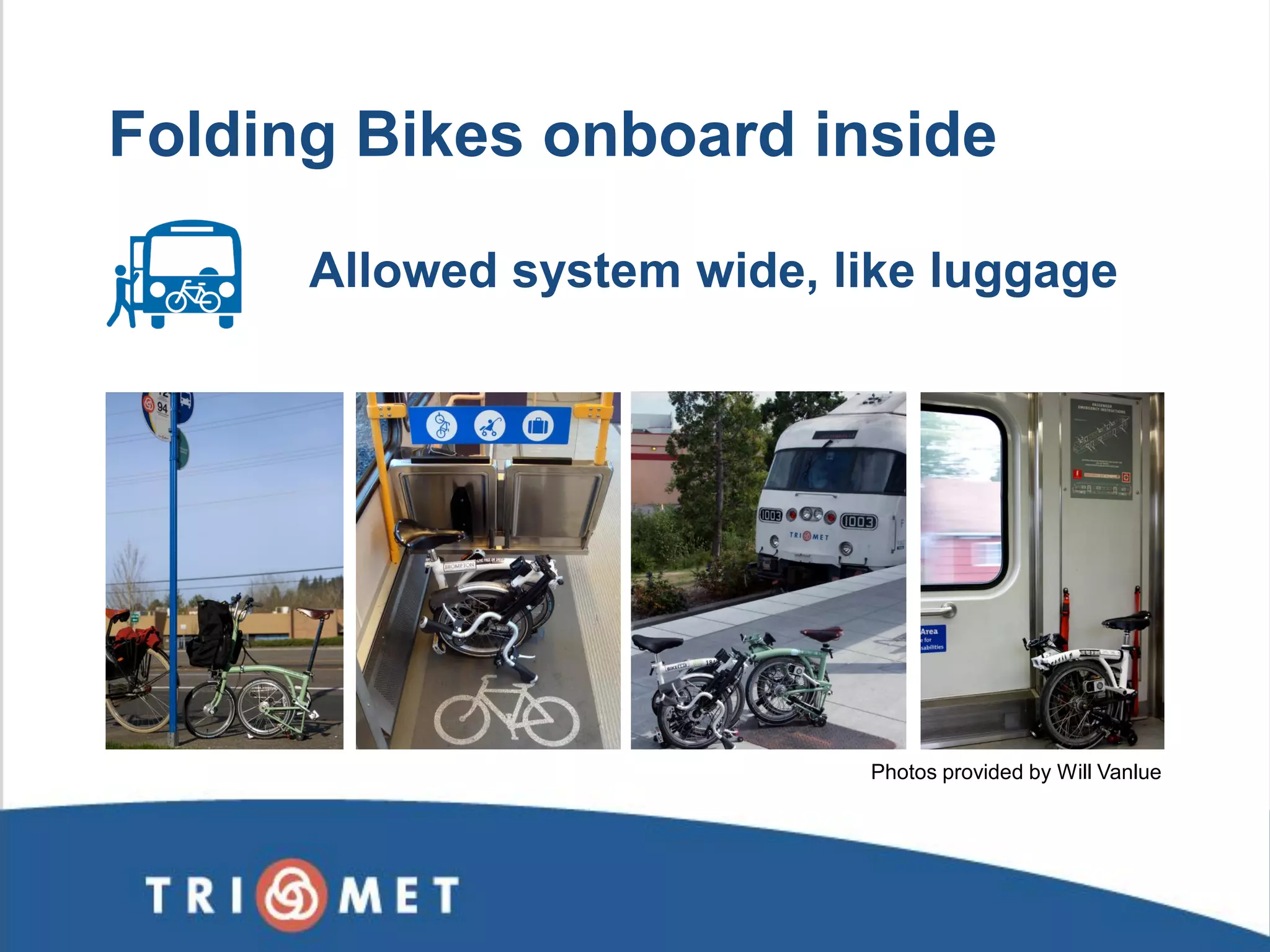
Allowed system wide, like luggage 
Folding Bikes onboard inside 
Photos provided by Will Vanlue
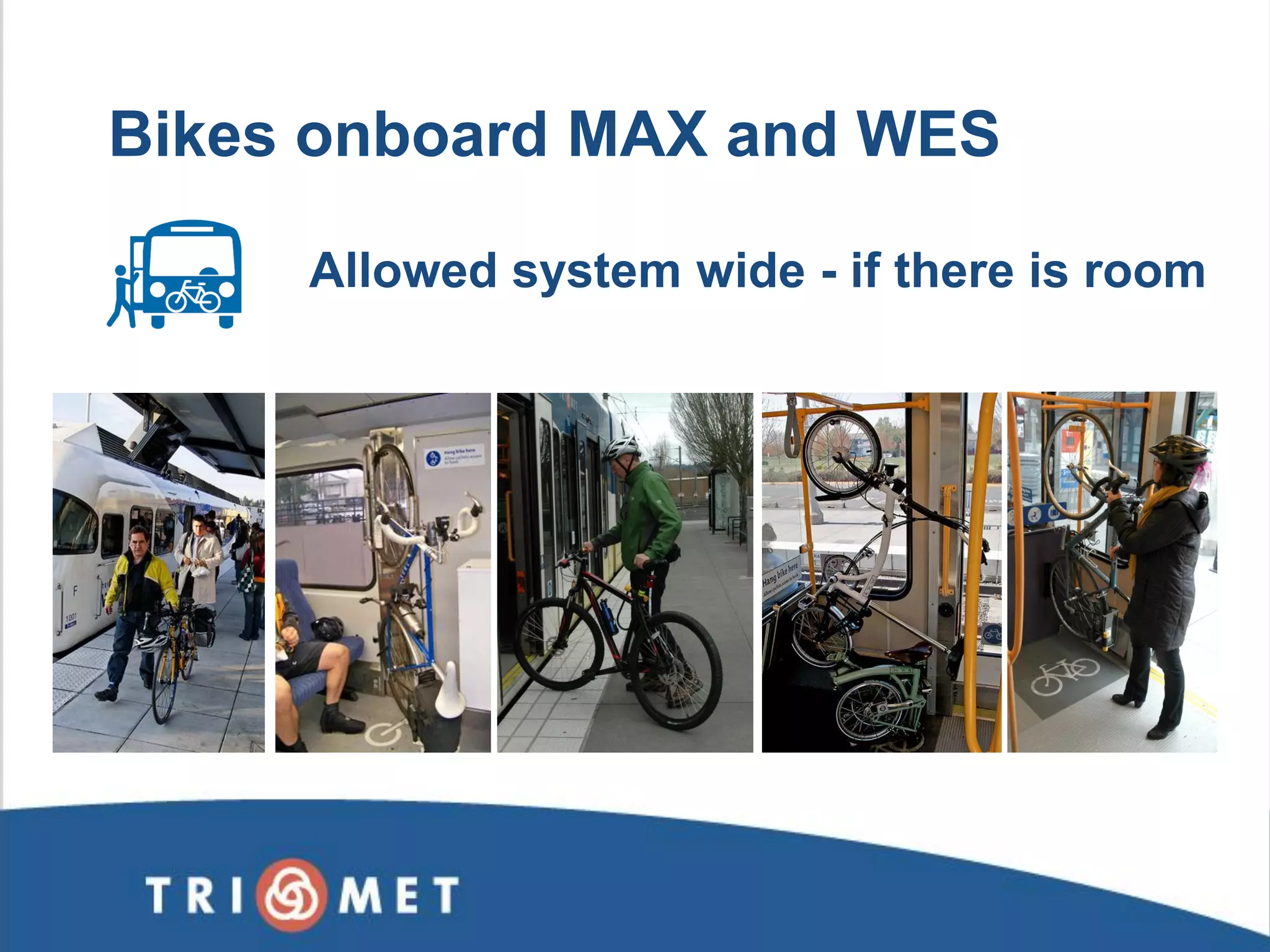
Allowed system wide - if there is room 
Bikes onboard MAX and WES
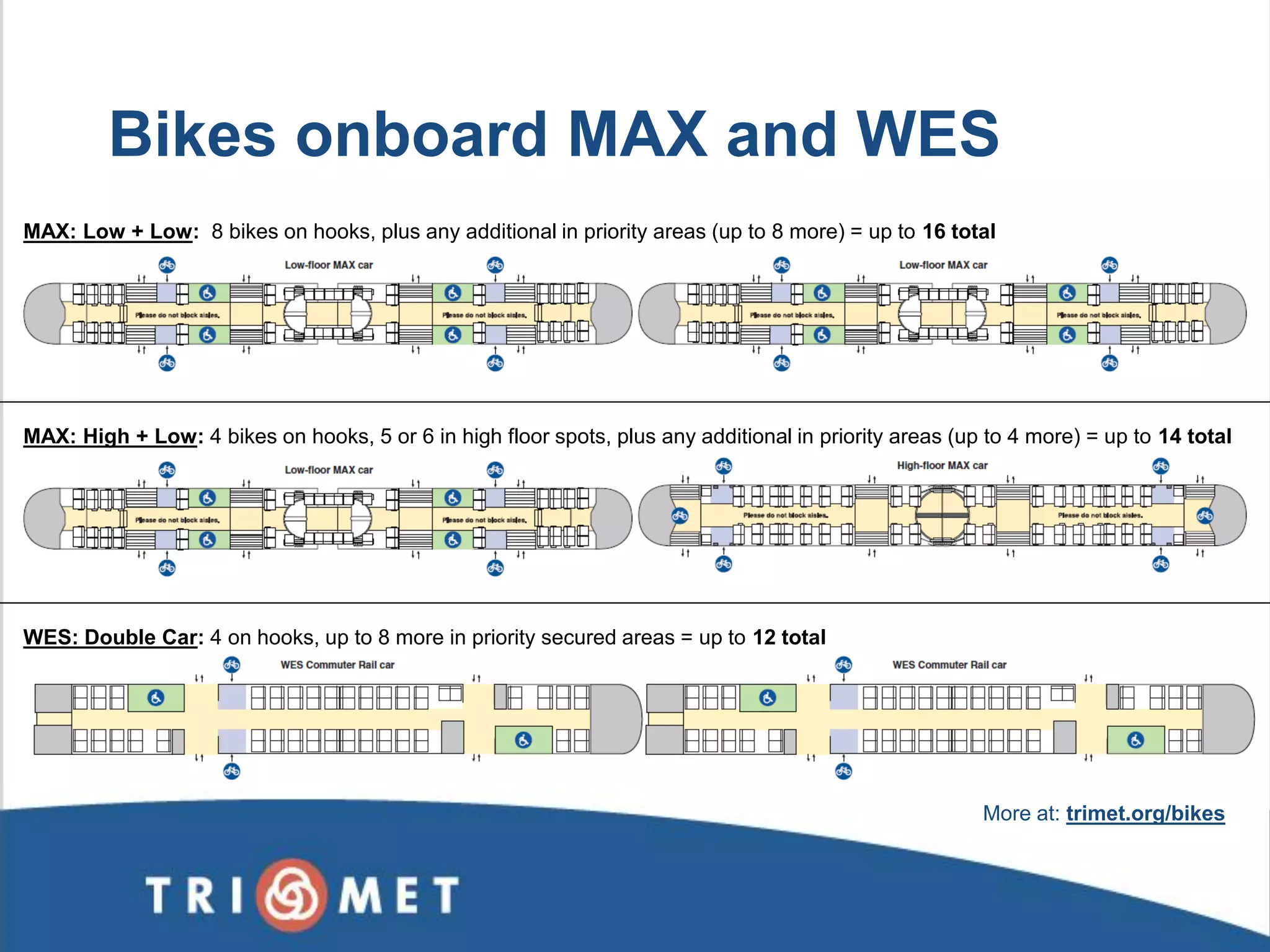
Bikes onboard MAX and WES 
MAX: Low + Low: 8 bikes on hooks, plus any additional in priority areas (up to 8 more) = up to 16 total 
MAX: High + Low: 4 bikes on hooks, 5 or 6 in high floor spots, plus any additional in priority areas (up to 4 more) = up to 14 total 
WES: Double Car: 4 on hooks, up to 8 more in priority secured areas = up to 12 total 
More at: trimet.org/bikes
Almost all rail stations, some bus stops 
Open Bike Racks
$25 per 6 months, reserved 
Keyed Bike Lockers
On-demand, 5 cents per hour 
Electronic Bike Lockers
Secure and enclosed 
Bike & Ride Group Parking Facilities
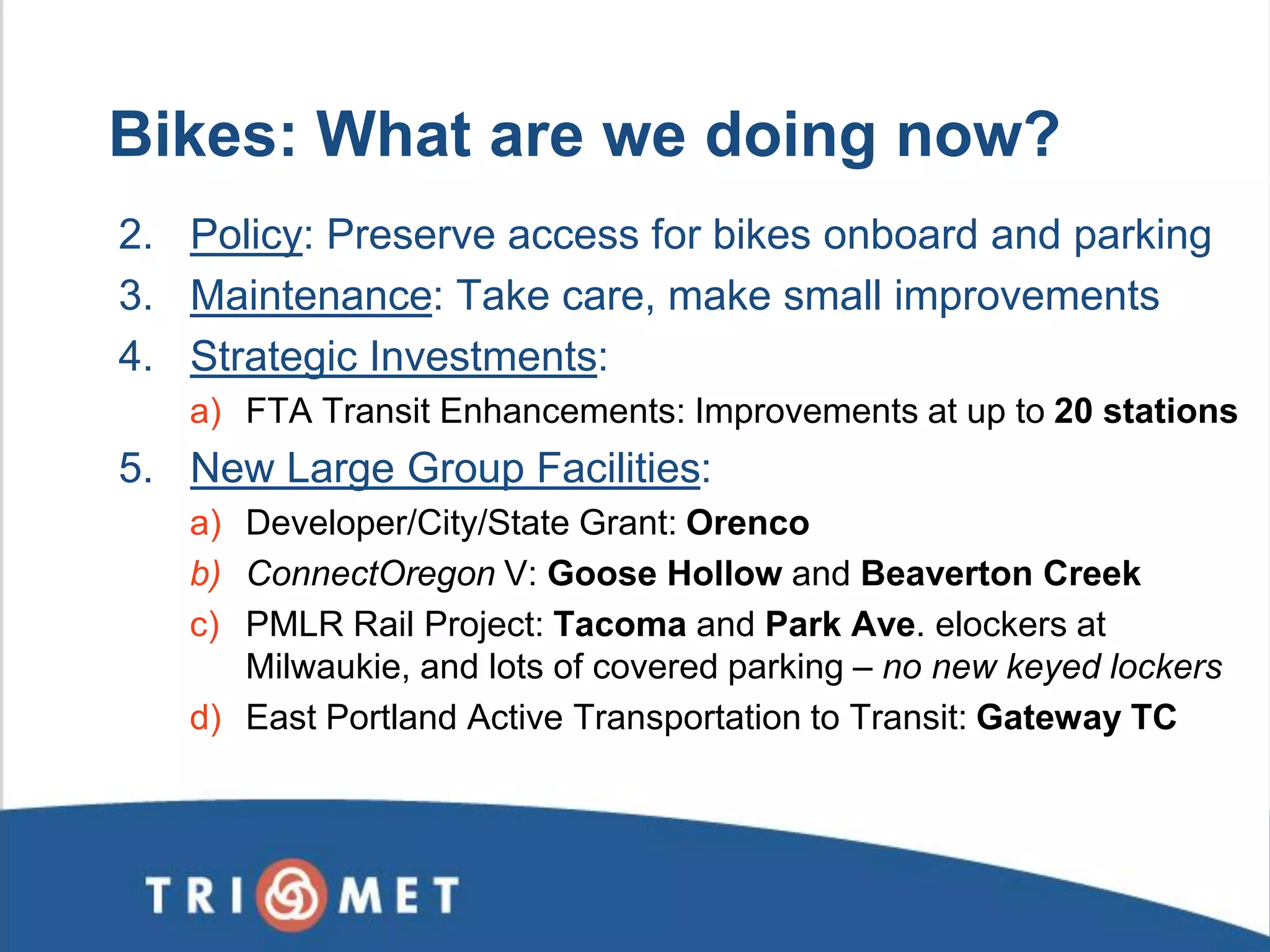
1. Just awarded a state funded TGM Grant for creation of a TriMet Bicycle Plan. Expected July ’15 – June ‘16. Project Summary: The TriMet Bicycle Plan would result in a final document providing guidance to agency policy and planning efforts regarding bicycle accommodation on-board transit vehicles; appropriate bicycle parking types and quantities at stations and stops; and innovative marketing strategies to ensure usage and acceptance. Process would include public involvement, jurisdictional coordination, and private sector partner outreach. 
Bikes: What are we doing now? 
More at: http://www.oregon.gov/LCD/TGM/pages/grants.aspx
2. Policy: Preserve access for bikes onboard and parking 3. Maintenance: Take care, make small improvements 4. Strategic Investments: 
a)FTA Transit Enhancements: Improvements at up to 20 stations 5. New Large Group Facilities: 
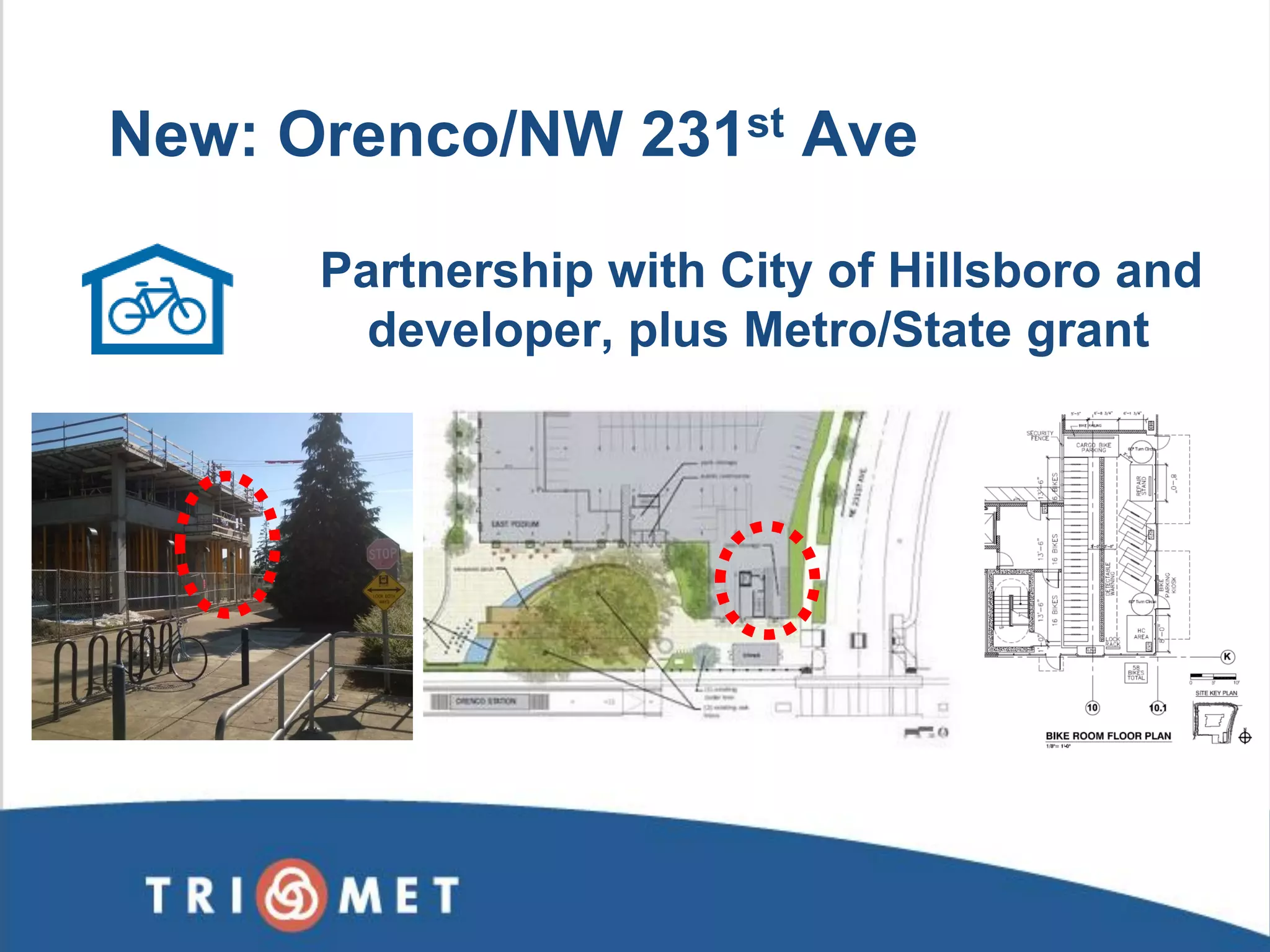
a)Developer/City/State Grant: Orenco 
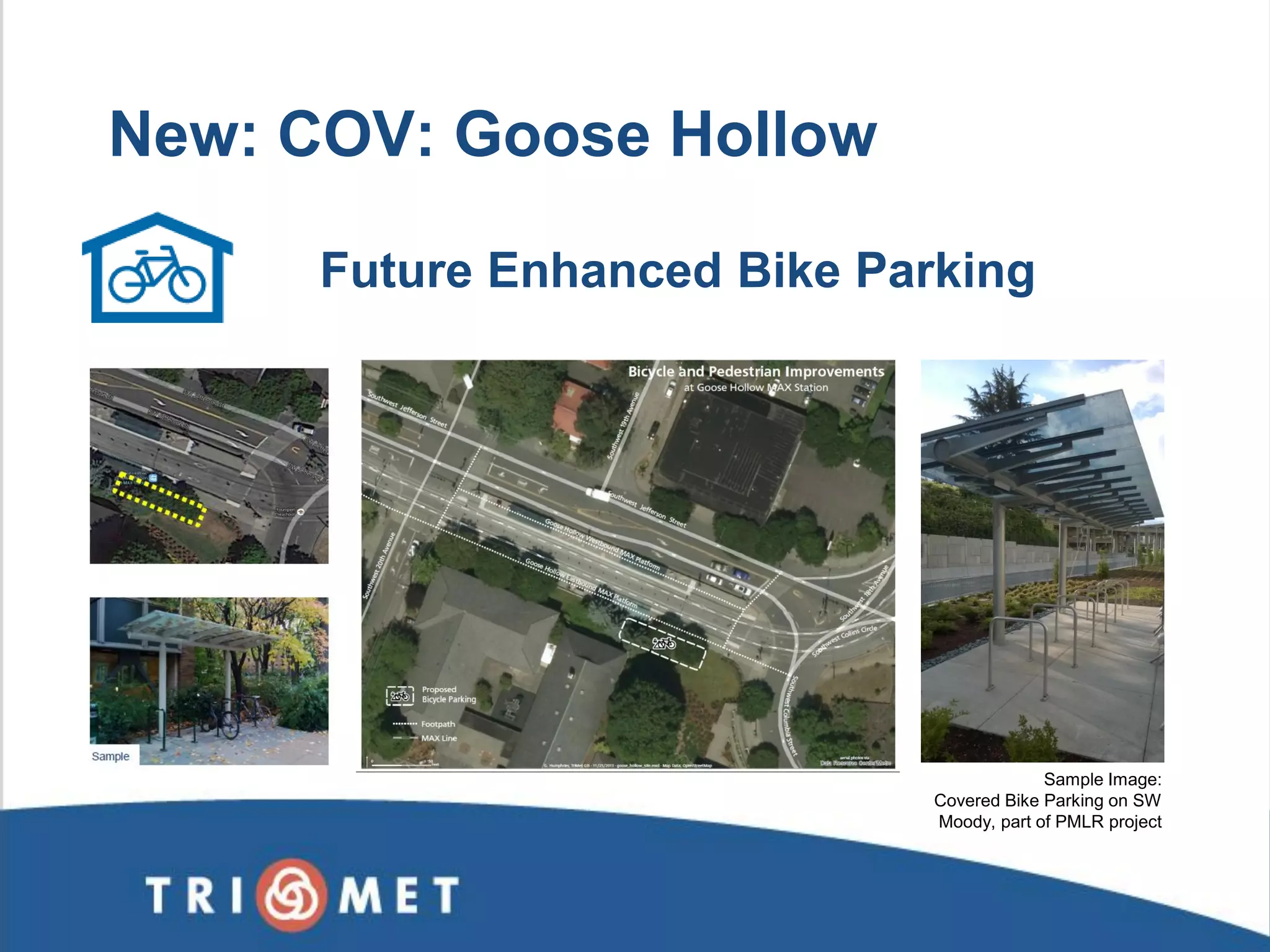
b)ConnectOregon V: Goose Hollow and Beaverton Creek 
c)PMLR Rail Project: Tacoma and Park Ave. elockers at Milwaukie, and lots of covered parking – no new keyed lockers 
d)East Portland Active Transportation to Transit: Gateway TC 
Bikes: What are we doing now?
Partnership with City of Hillsboro and developer, plus Metro/State grant 
New: Orenco/NW 231st Ave
Future Enhanced Bike Parking 
New: COV: Goose Hollow 
Sample Image: Covered Bike Parking on SW Moody, part of PMLR project
Future Enhanced Bike Parking 
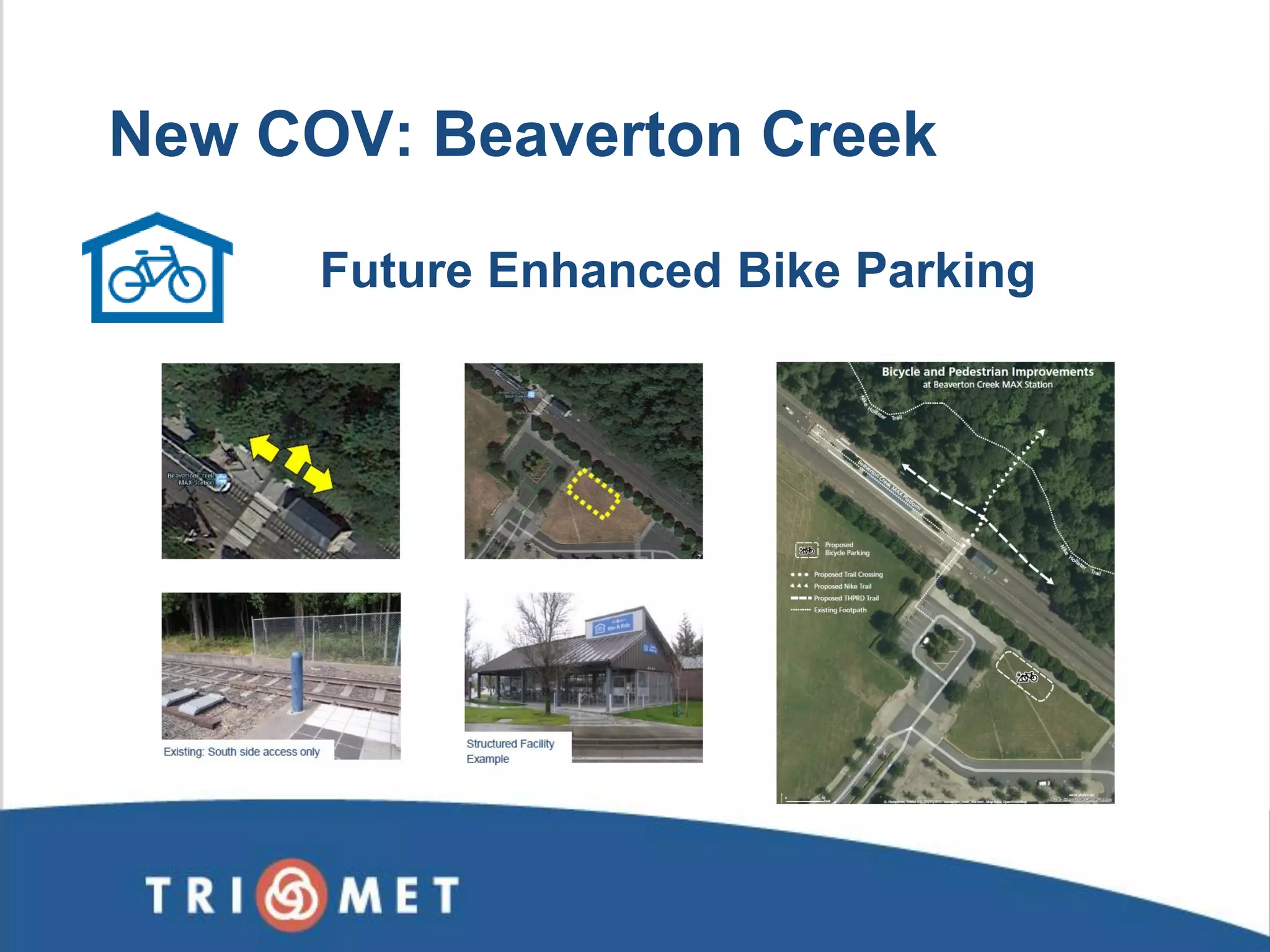
New COV: Beaverton Creek
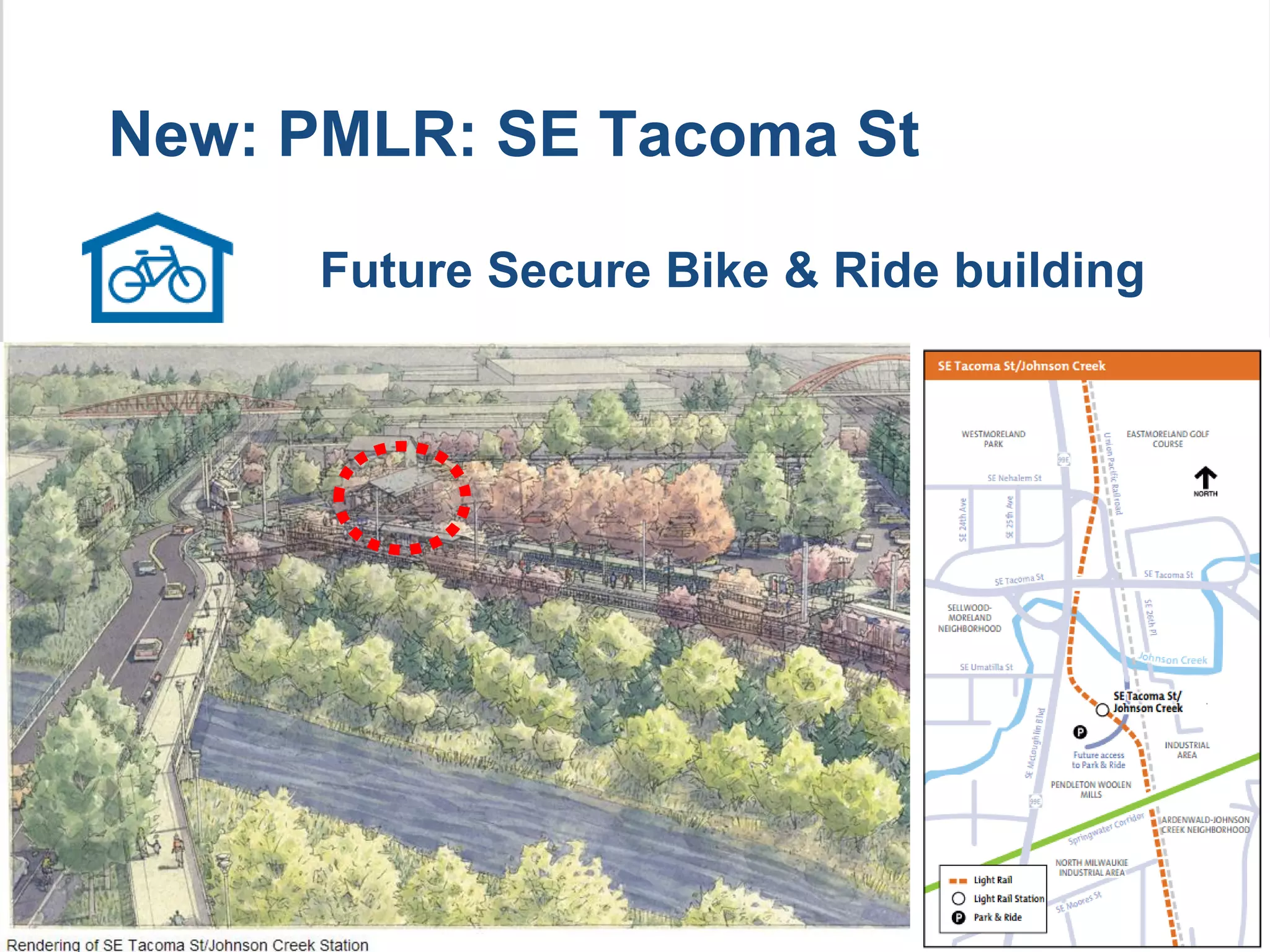
Future Secure Bike & Ride building 
New: PMLR: SE Tacoma St
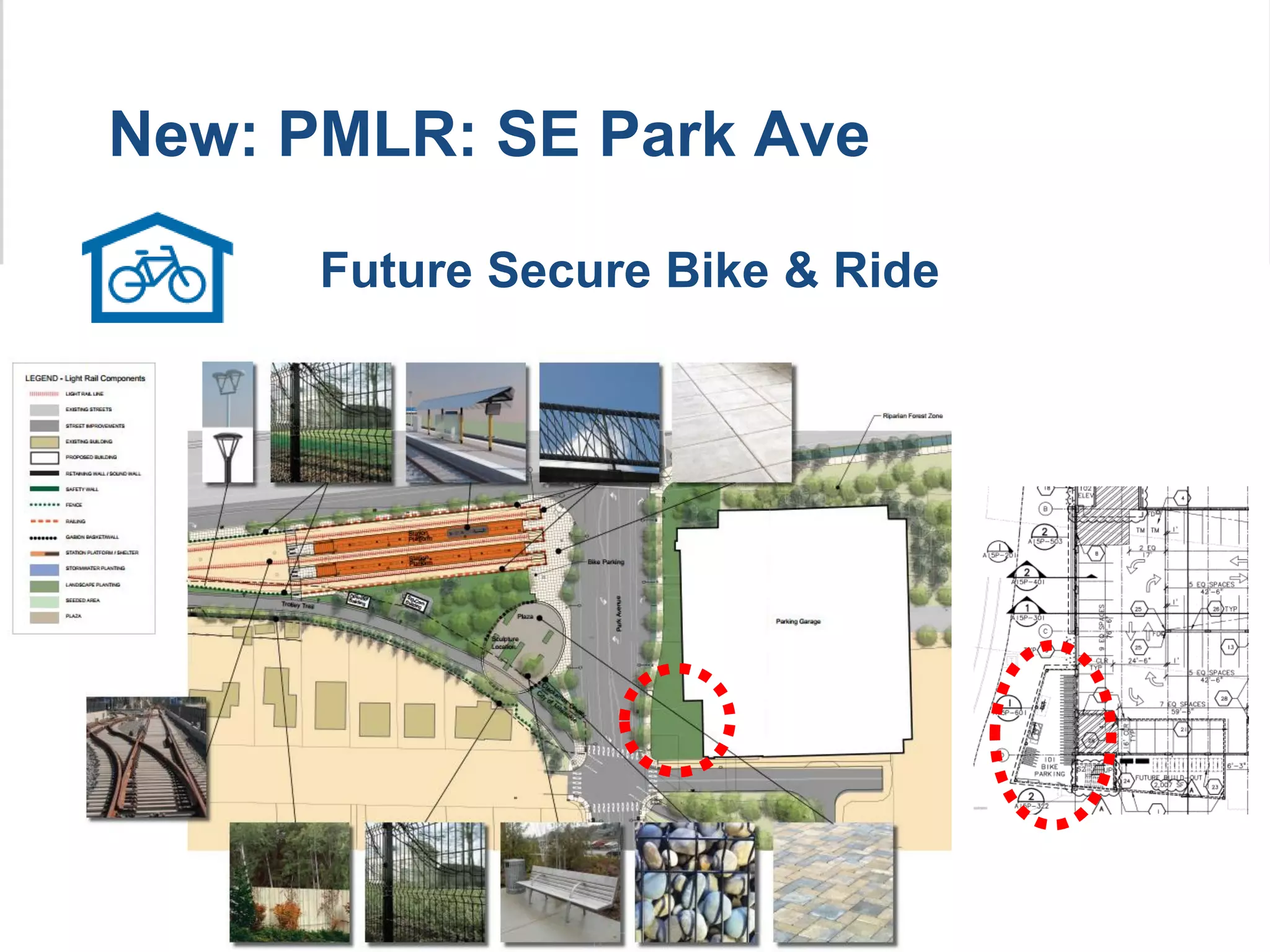
Future Secure Bike & Ride 
New: PMLR: SE Park Ave
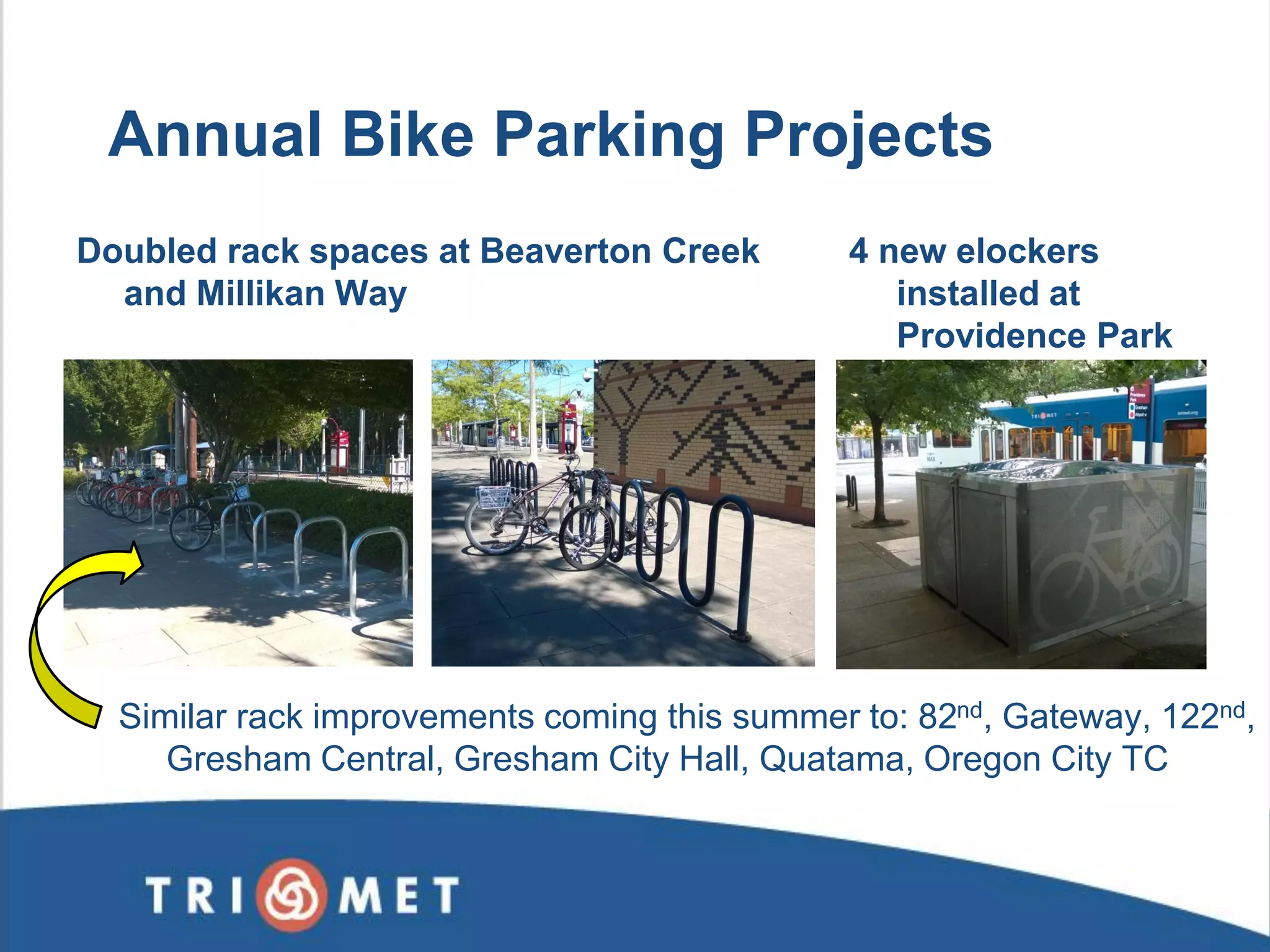
4 new elockers installed at Providence Park 
Annual Bike Parking Projects 
Doubled rack spaces at Beaverton Creek and Millikan Way 
Similar rack improvements coming this summer to: 82nd, Gateway, 122nd, Gresham Central, Gresham City Hall, Quatama, Oregon City TC
PMLR Snapshot
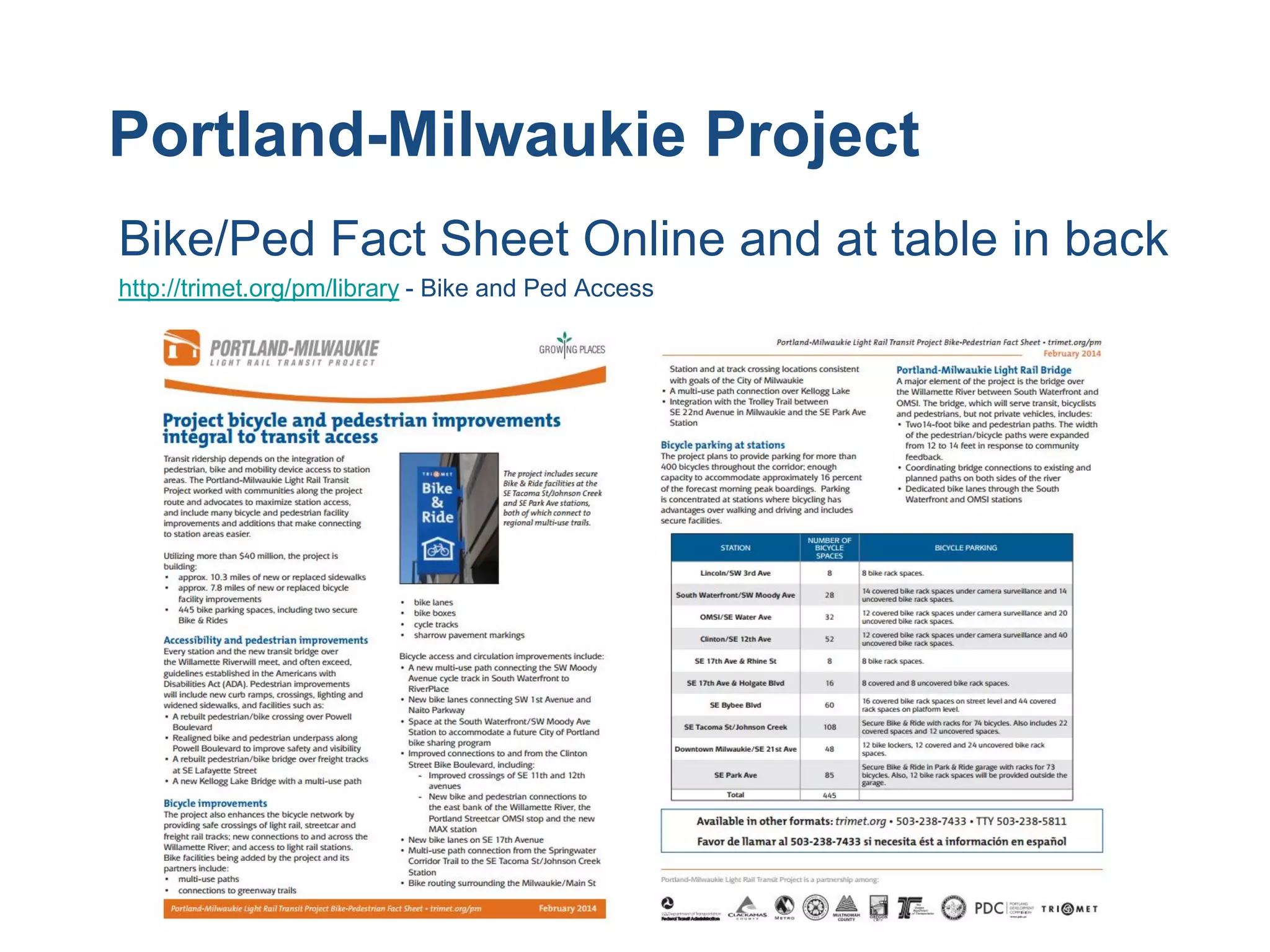
Portland-Milwaukie Project 
Bike/Ped Fact Sheet Online and at table in back http://trimet.org/pm/library - Bike and Ped Access
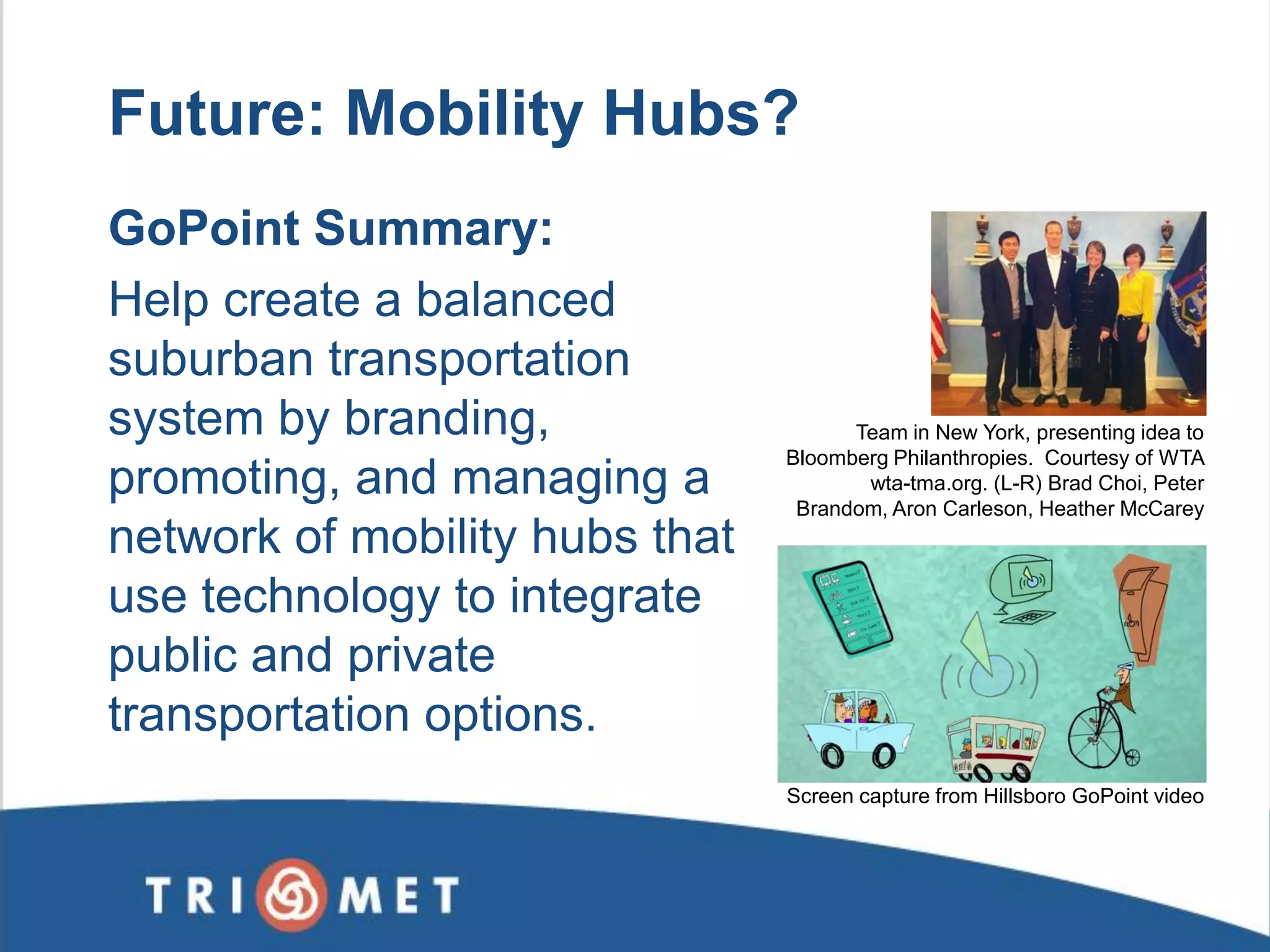
Future: Mobility Hubs? 
Screen capture from Hillsboro GoPoint video 
Team in New York, presenting idea to Bloomberg Philanthropies. Courtesy of WTA wta-tma.org. (L-R) Brad Choi, Peter Brandom, Aron Carleson, Heather McCarey 
GoPoint Summary: 
Help create a balanced suburban transportation system by branding, promoting, and managing a network of mobility hubs that use technology to integrate public and private transportation options.
1. Municipal (ex: Portland Bike Share, pdxbikeshare.com) 
•City/Region wide 
•Large kiosks 
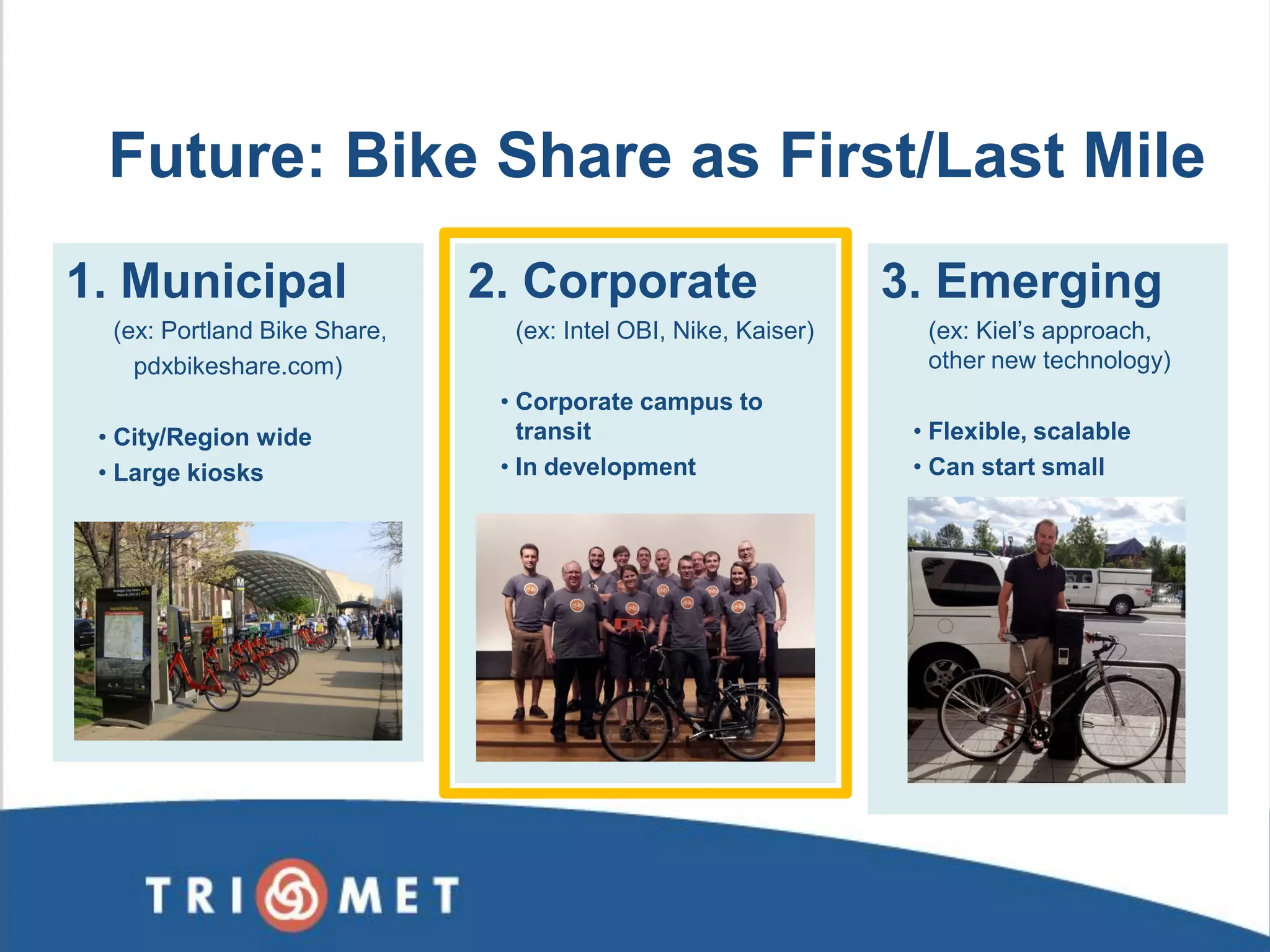
Future: Bike Share as First/Last Mile 
2. Corporate 
(ex: Intel OBI, Nike, Kaiser) 
•Corporate campus to transit 
•In development 
3. Emerging 
(ex: Kiel’s approach, other new technology) 
•Flexible, scalable 
•Can start small
Future: Corporate Bike Share 
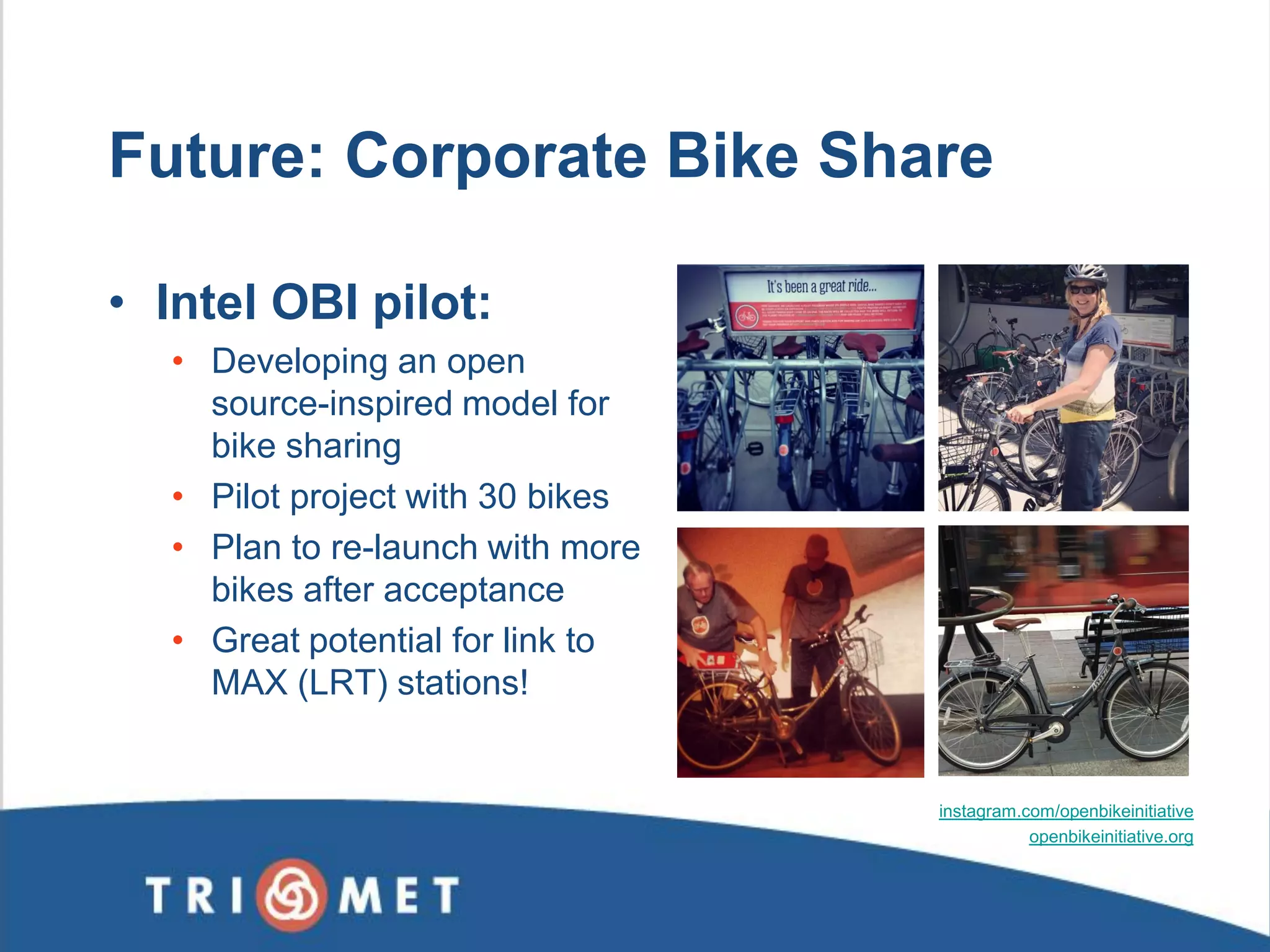
•Intel OBI pilot: 
•Developing an open source-inspired model for bike sharing 
•Pilot project with 30 bikes 
•Plan to re-launch with more bikes after acceptance 
•Great potential for link to MAX (LRT) stations! 
instagram.com/openbikeinitiative 
openbikeinitiative.org
Future: Corporate Bike Share 
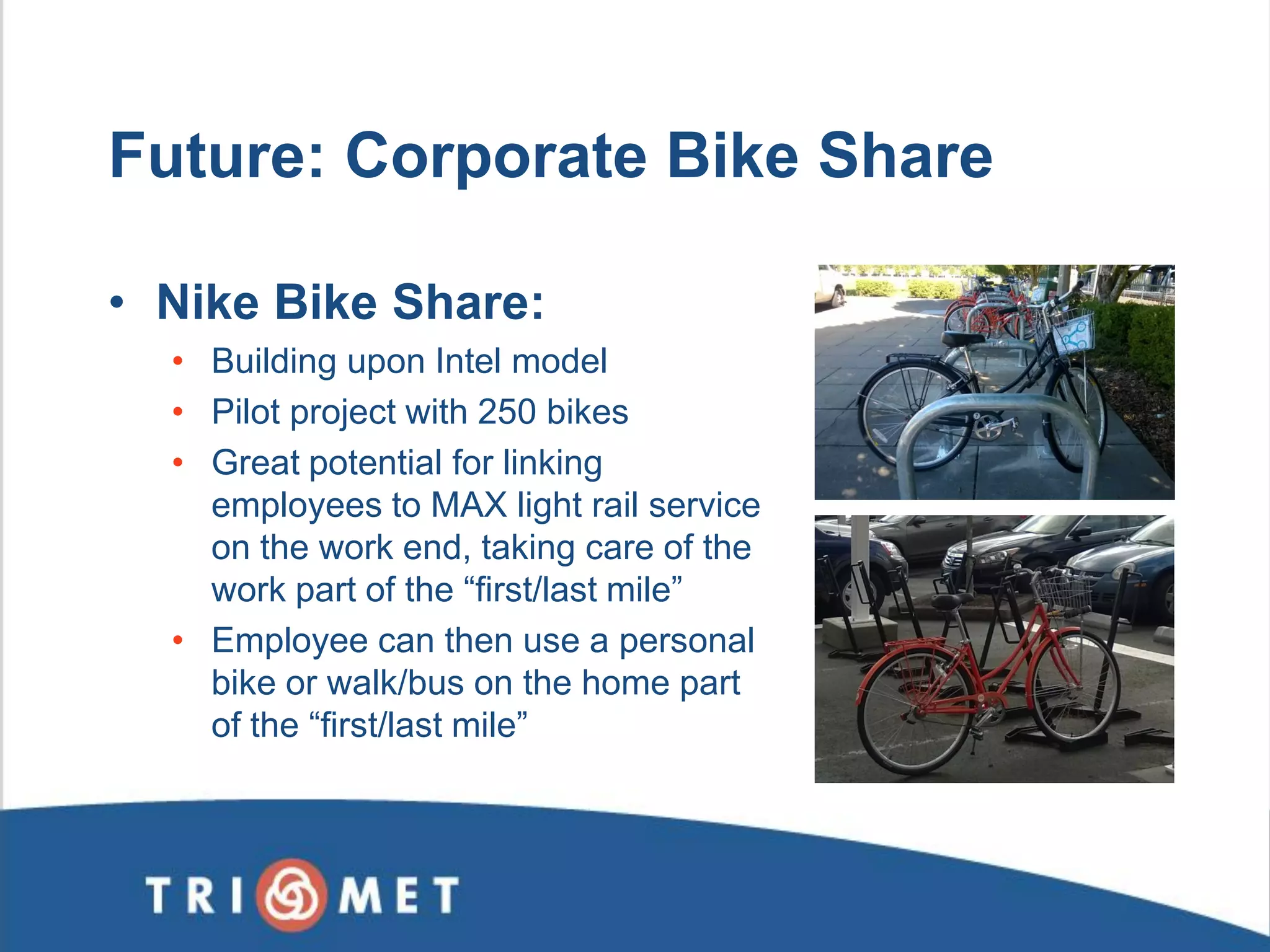
•Nike Bike Share: 
•Building upon Intel model 
•Pilot project with 250 bikes 
•Great potential for linking employees to MAX light rail service on the work end, taking care of the work part of the “first/last mile” 
•Employee can then use a personal bike or walk/bus on the home part of the “first/last mile”
Future: Corporate Bike Share 
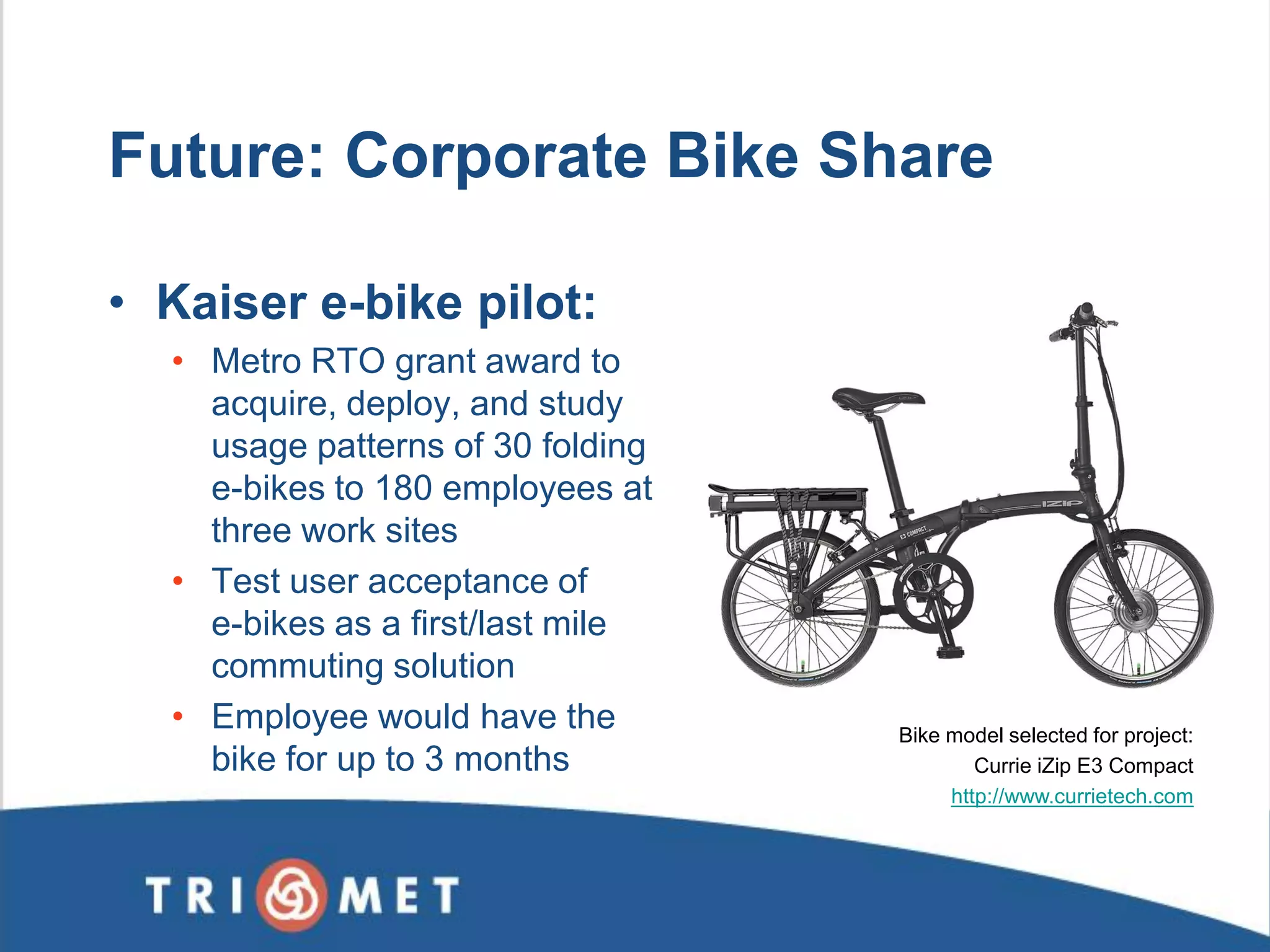
•Kaiser e-bike pilot: 
•Metro RTO grant award to acquire, deploy, and study usage patterns of 30 folding e-bikes to 180 employees at three work sites 
•Test user acceptance of e-bikes as a first/last mile commuting solution 
•Employee would have the bike for up to 3 months 
Bike model selected for project: 
Currie iZip E3 Compact 
http://www.currietech.com
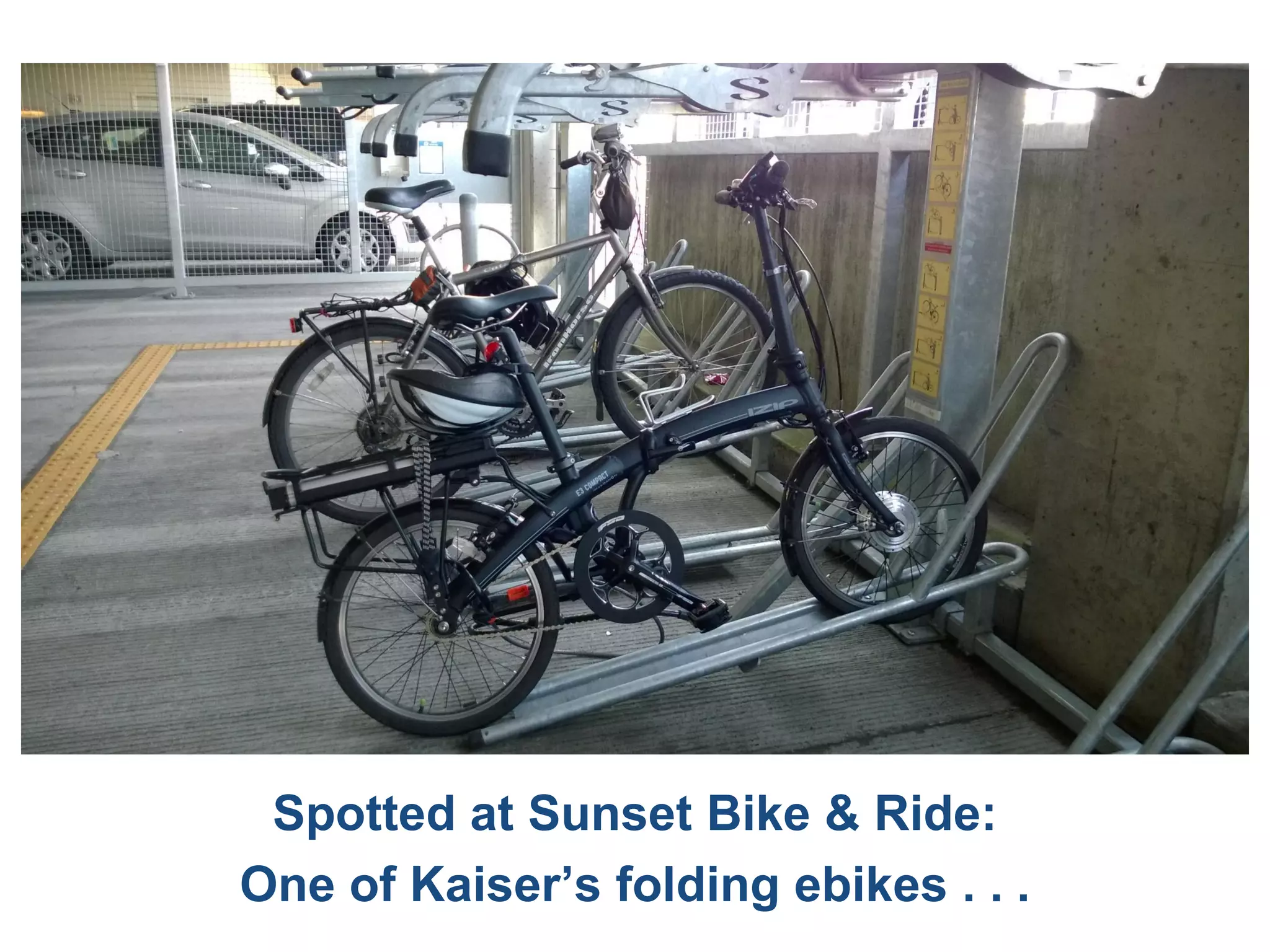
Spotted at Sunset Bike & Ride: 
One of Kaiser’s folding ebikes . . .
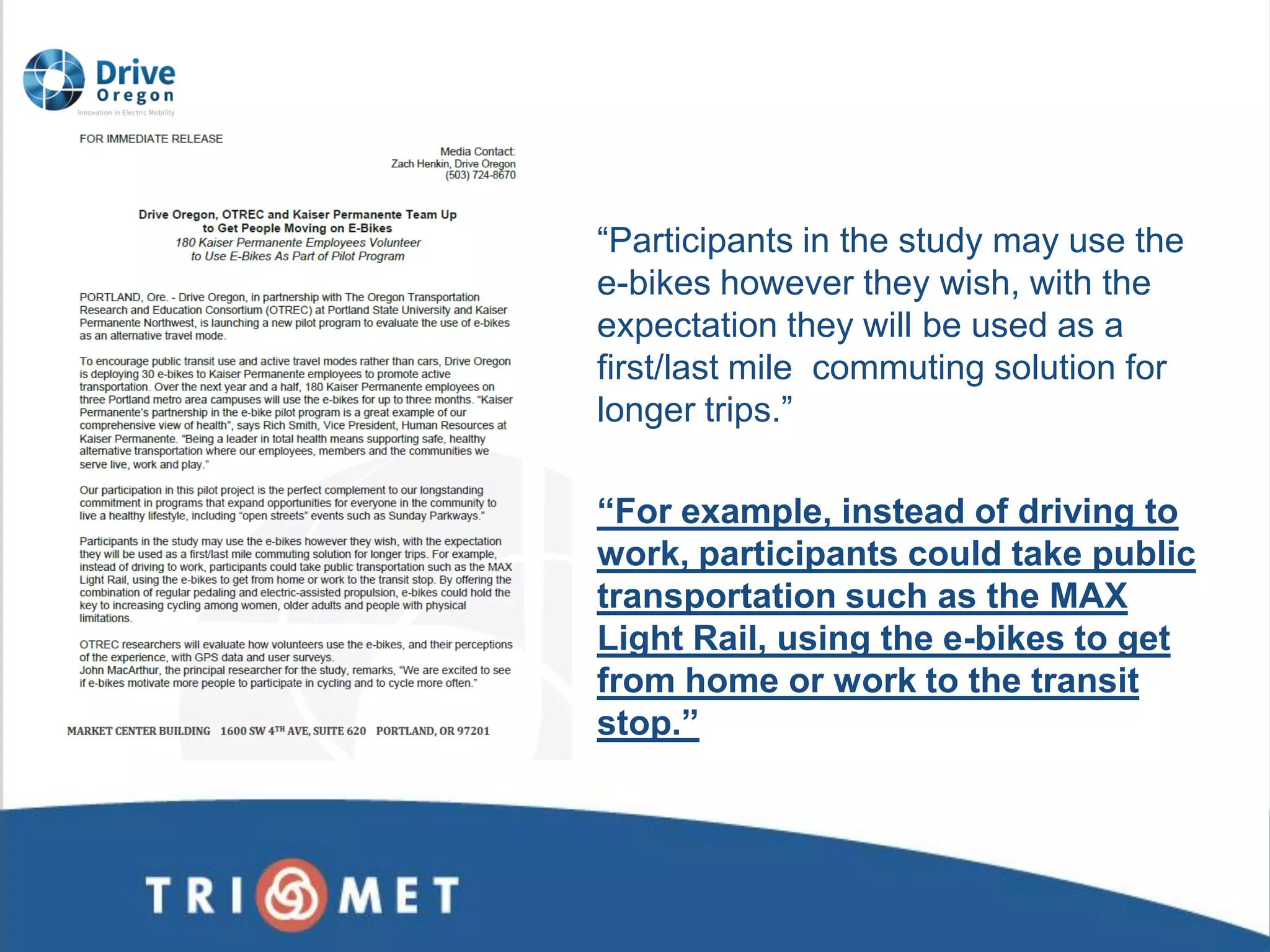
“Participants in the study may use the e-bikes however they wish, with the expectation they will be used as a first/last mile commuting solution for longer trips.” “For example, instead of driving to work, participants could take public transportation such as the MAX Light Rail, using the e-bikes to get from home or work to the transit stop.”
Maximizing Biking and Walking Access to Transit 
September 9, 2014 
Jeff Owen 
Active Transportation 
Planner 
Planning & Policy 
owenj@trimet.org 
503-962-5854

Maximizing Biking and Walking Access to Transit

  • 1.
    Maximizing Biking andWalking Access to Transit September 9, 2014 Jeff Owen Active Transportation Planner Planning & Policy owenj@trimet.org 503-962-5854
  • 2.
    Agency Overview •Locatedin Portland metropolitan region •Service area of 532 square miles •Population of 1.5 million •52 mile MAX light rail track •79 bus lines – 12 frequent service •14.7 mile WES Commuter Rail •100 million trips on TriMet each year •Most riders (78%) are choice riders
  • 3.
    Transit + ActiveTransportation 1.Transit + AT = Natural complements to each other 2.Active transportation excels at short trips and connections to transit 3.Biking and walking are not competitors to transit; We are all is this together
  • 4.
  • 5.
    Overview: •We needsafer and more comfortable access to transit •This effort helps us to identify areas where access improvements have the greatest need and the biggest opportunities •Provides focus amidst great need throughout the region Available for download at: trimet.org/walk Pedestrian Network Analysis
  • 6.
    Over 6,500 transitstops total
  • 7.
    Pedestrian Network Analysis Overview of Process: •Big service area with lots of transit stops 1.Base Analysis (land use, ridership, destinations) 2.Overlay Analysis (deficiencies and opportunities) 3.Composite Scores (look for clusters, then focus areas)
  • 8.
  • 10.
    Pedestrian Network Analysis Partners are KEY to this process Ongoing Efforts: •Initial effort complete, but we are still working hard to find funding for projects around the region •Also working to refine this analysis and develop a complementary corridor specific tool
  • 11.
    Hwy 8/SW OaksStreet at Winco Hillsboro, stop id 4119, line 57 Before After
  • 12.
    185th at TVHwy Aloha – stop id 7012, line 52 Before After
  • 13.
    Partnership Highlight •RRFBpartnership between TriMet and City of Portland: •60th/I-84/Max Station – install July 2012 •SE Stark/126th – install Fall 2012 •SE Division/I-205 – install February 2013 •SW Beaverton-Hillsdale Highway/62nd – install January 2013
  • 14.
    Pending Funding Opportunities Source Lead Project types Amount STIP Enhance TriMet/Cities (includes Portland, Gresham, Tigard, Washington County, ODOT) 3 Corridors: Sidewalks, safe crossings, rapid flash beacons, medians, signalized intersections, bus stop improvements $8.0 million MTIP REOF TriMet & City of Portland 1 Corridor: Sidewalks, safe crossings, rapid flash beacons, medians, signalized intersections, bus stop improvements, bike access $9.1 million MTIP RFFA Cities and Counties 10 projects with direct benefits for transit riders = sidewalks, safe crossings, streetscape, bus stop improvements, bike access $32.1 million TOTAL PENDING: $48.5 million
  • 15.
    trimet.org/walk Jeff Owen Active Transportation Planner Planning & Policy owenj@trimet.org 503-962-5854
  • 16.
    Bike on Bus,2 per rack, all buses (600 buses = 1200 spaces) Bike racks at most rail stations and some bus stops (371 spaces) Reserved, keyed bike lockers (436 spaces) On-demand, electronic lockers (32) Group parking facilities (3 structures = 180)
  • 17.
    All buses inthe system, 2 per rack Bikes onboard front of Bus
  • 18.
    Allowed system wide,like luggage Folding Bikes onboard inside Photos provided by Will Vanlue
  • 19.
    Allowed system wide- if there is room Bikes onboard MAX and WES
  • 20.
    Bikes onboard MAXand WES MAX: Low + Low: 8 bikes on hooks, plus any additional in priority areas (up to 8 more) = up to 16 total MAX: High + Low: 4 bikes on hooks, 5 or 6 in high floor spots, plus any additional in priority areas (up to 4 more) = up to 14 total WES: Double Car: 4 on hooks, up to 8 more in priority secured areas = up to 12 total More at: trimet.org/bikes
  • 21.
    Almost all railstations, some bus stops Open Bike Racks
  • 22.
    $25 per 6months, reserved Keyed Bike Lockers
  • 23.
    On-demand, 5 centsper hour Electronic Bike Lockers
  • 24.
    Secure and enclosed Bike & Ride Group Parking Facilities
  • 25.
    1. Just awardeda state funded TGM Grant for creation of a TriMet Bicycle Plan. Expected July ’15 – June ‘16. Project Summary: The TriMet Bicycle Plan would result in a final document providing guidance to agency policy and planning efforts regarding bicycle accommodation on-board transit vehicles; appropriate bicycle parking types and quantities at stations and stops; and innovative marketing strategies to ensure usage and acceptance. Process would include public involvement, jurisdictional coordination, and private sector partner outreach. Bikes: What are we doing now? More at: http://www.oregon.gov/LCD/TGM/pages/grants.aspx
  • 26.
    2. Policy: Preserveaccess for bikes onboard and parking 3. Maintenance: Take care, make small improvements 4. Strategic Investments: a)FTA Transit Enhancements: Improvements at up to 20 stations 5. New Large Group Facilities: a)Developer/City/State Grant: Orenco b)ConnectOregon V: Goose Hollow and Beaverton Creek c)PMLR Rail Project: Tacoma and Park Ave. elockers at Milwaukie, and lots of covered parking – no new keyed lockers d)East Portland Active Transportation to Transit: Gateway TC Bikes: What are we doing now?
  • 27.
    Partnership with Cityof Hillsboro and developer, plus Metro/State grant New: Orenco/NW 231st Ave
  • 28.
    Future Enhanced BikeParking New: COV: Goose Hollow Sample Image: Covered Bike Parking on SW Moody, part of PMLR project
  • 29.
    Future Enhanced BikeParking New COV: Beaverton Creek
  • 30.
    Future Secure Bike& Ride building New: PMLR: SE Tacoma St
  • 31.
    Future Secure Bike& Ride New: PMLR: SE Park Ave
  • 32.
    4 new elockersinstalled at Providence Park Annual Bike Parking Projects Doubled rack spaces at Beaverton Creek and Millikan Way Similar rack improvements coming this summer to: 82nd, Gateway, 122nd, Gresham Central, Gresham City Hall, Quatama, Oregon City TC
  • 34.
  • 35.
    Portland-Milwaukie Project Bike/PedFact Sheet Online and at table in back http://trimet.org/pm/library - Bike and Ped Access
  • 36.
    Future: Mobility Hubs? Screen capture from Hillsboro GoPoint video Team in New York, presenting idea to Bloomberg Philanthropies. Courtesy of WTA wta-tma.org. (L-R) Brad Choi, Peter Brandom, Aron Carleson, Heather McCarey GoPoint Summary: Help create a balanced suburban transportation system by branding, promoting, and managing a network of mobility hubs that use technology to integrate public and private transportation options.
  • 37.
    1. Municipal (ex:Portland Bike Share, pdxbikeshare.com) •City/Region wide •Large kiosks Future: Bike Share as First/Last Mile 2. Corporate (ex: Intel OBI, Nike, Kaiser) •Corporate campus to transit •In development 3. Emerging (ex: Kiel’s approach, other new technology) •Flexible, scalable •Can start small
  • 38.
    Future: Corporate BikeShare •Intel OBI pilot: •Developing an open source-inspired model for bike sharing •Pilot project with 30 bikes •Plan to re-launch with more bikes after acceptance •Great potential for link to MAX (LRT) stations! instagram.com/openbikeinitiative openbikeinitiative.org
  • 39.
    Future: Corporate BikeShare •Nike Bike Share: •Building upon Intel model •Pilot project with 250 bikes •Great potential for linking employees to MAX light rail service on the work end, taking care of the work part of the “first/last mile” •Employee can then use a personal bike or walk/bus on the home part of the “first/last mile”
  • 40.
    Future: Corporate BikeShare •Kaiser e-bike pilot: •Metro RTO grant award to acquire, deploy, and study usage patterns of 30 folding e-bikes to 180 employees at three work sites •Test user acceptance of e-bikes as a first/last mile commuting solution •Employee would have the bike for up to 3 months Bike model selected for project: Currie iZip E3 Compact http://www.currietech.com
  • 41.
    Spotted at SunsetBike & Ride: One of Kaiser’s folding ebikes . . .
  • 42.
    “Participants in thestudy may use the e-bikes however they wish, with the expectation they will be used as a first/last mile commuting solution for longer trips.” “For example, instead of driving to work, participants could take public transportation such as the MAX Light Rail, using the e-bikes to get from home or work to the transit stop.”
  • 43.
    Maximizing Biking andWalking Access to Transit September 9, 2014 Jeff Owen Active Transportation Planner Planning & Policy owenj@trimet.org 503-962-5854