PET (Polyethylene terephthalate) Bottles Nathan Parker DJ Bernat Justin Cole Gina DiGennaro Luke Hill
Thesis Water bottles have recently had a huge impact on our culture and environment.  Recycling PET materials is positive for the environment and safe for reuse. Reusing bottles for personal use can be safe as long as they are reused moderately and held at a safe temperature.
Main Points Water bottles are safe to reuse Water bottles do contain some dangerous materials, but most studies suggest that they are only dangerous in high concentrations over time Water bottles have had a major cultural impact
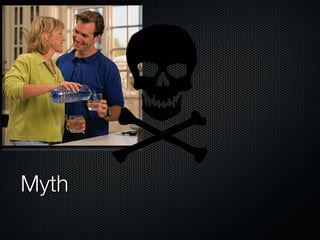
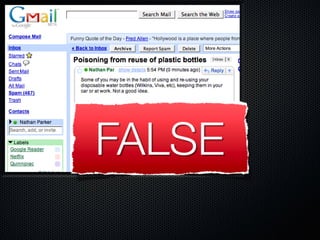
Myth
 
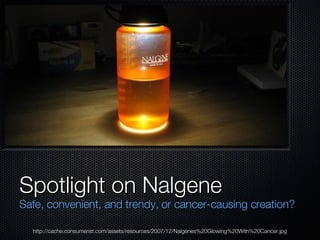
http://cache.consumerist.com/assets/resources/2007/12/Nalgenes%20Glowing%20With%20Cancer.jpg Safe, convenient, and trendy, or cancer-causing creation? Spotlight on Nalgene
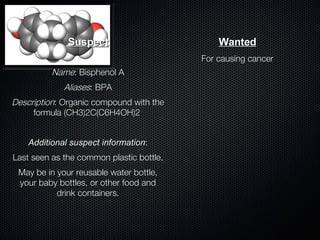
Suspect Name : Bisphenol A Aliases : BPA Description : Organic compound with the formula (CH3)2C(C6H4OH)2  Additional suspect information : Last seen as the common plastic bottle. May be in your reusable water bottle, your baby bottles, or other food and drink containers. Wanted For causing cancer
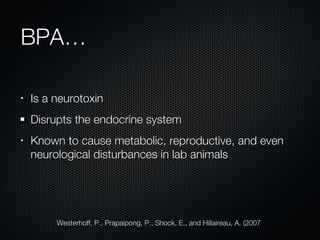
BPA… Is a neurotoxin Disrupts the endocrine system Known to cause metabolic, reproductive, and even neurological disturbances in lab animals Westerhoff, P., Prapaipong, P., Shock, E., and Hillaireau, A. (2007
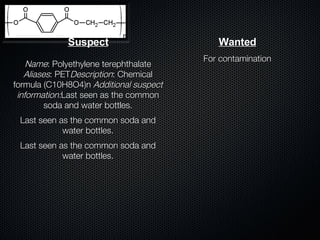
Suspect Name : Polyethylene terephthalate  Aliases : PET Description : Chemical formula (C10H8O4)n  Additional suspect information: Last seen as the common soda and water bottles. Last seen as the common soda and water bottles. Last seen as the common soda and water bottles. Wanted For contamination
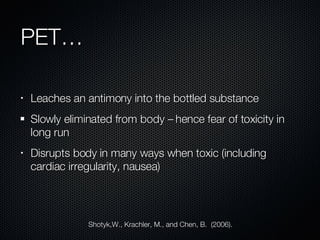
PET… Leaches an antimony into the bottled substance Slowly eliminated from body – hence fear of toxicity in long run Disrupts body in many ways when toxic (including cardiac irregularity, nausea) Shotyk,W., Krachler, M., and Chen, B.  (2006).
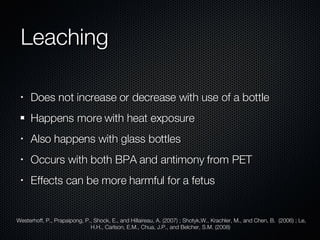
Leaching Does not increase or decrease with use of a bottle Happens more with heat exposure Also happens with glass bottles Occurs with both BPA and antimony from PET Effects can be more harmful for a fetus Westerhoff, P., Prapaipong, P., Shock, E., and Hillaireau, A. (2007) ; Shotyk,W., Krachler, M., and Chen, B.  (2006) ; Le, H.H., Carlson, E.M., Chua, J.P., and Belcher, S.M. (2008)
Exposure to Bisphenol A -What is Bisphenol A?  “Bisphenol A is the monomer used to make polycarbonate plastic products” i.e. Baby bottles, lining of food and beverage cans, etc. - Is similar to estrogen (“estrogen mimicking”) and therefore can interfere with estrogen levels
Effects of Bisphenol A On Mice In low, prenatal doses: Increase in prostate size and decrease sperm production in males Premature puberty in females 600% increase in infant mortality rate in litters Increased birth weight/growth Males 10% heavier, females 22% heavier at time of weaning May contribute to increases in obesity and sexual maturation in humans in recent decades
Phthalates  “Phthalates…are industrial chemicals commonly found in many consumer products regularly used by humans, such as soap, shampoo, cosmetics, and hairspray. They are also used in flexible plastics, such as blood transfusion bags, children's toys, and food containers. Di-(2-ethylhexyl) phthalate (DEHP) is one of the most abundant phthalates produced in the United States. ”
DEHP & MEHP When metabolized, DEHP is changed to MEHP (mono ethylhexyl phthalate) Neonatal damage will affect adult development Induces testicular toxicity in rodents Not covalent bonds (leeching is possible) Linked to decreased sperm production, undescended testes (risk factor for cancer), and damage to Sertoli cells May also contribute to testicular cancer When metabolized, DEHP is changed to MEHP (mono ethylhexyl phthalate)Neonatal damage will affect adult developmentInduces testicular toxicity in rodentsNot covalent bonds (leeching is possible)Linked to decreased sperm production, undescended testes (risk factor for cancer), and damage to Sertoli cellsMay also contribute to testicular cancer
Exposure to PVC in Workers PVC (Polyvinyl Chloride) is one of the most commonly used phthalates Study focused on exposure to high levels over a long period of time PVC contains high levels of DEHP PVC workers had increased seminoma Seminoma is a type of tumor which occurs mostly in older age
Benzene While not related to plastics, it is often present in bottled water and other beverages FDA guidelines allow for no more than 5 ppb (parts per billion) in bottled water High levels of benzene exposure in factory workers has been linked to cancer Benzoates+ Vitamin C + Heat = benzene
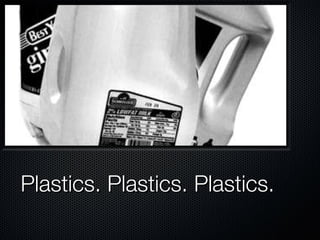
Plastics. Plastics. Plastics.
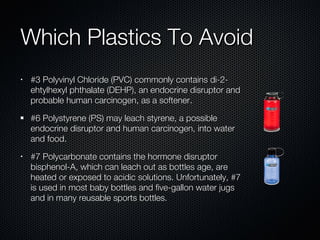
Which Plastics To Avoid #3 Polyvinyl Chloride (PVC) commonly contains di-2-ehtylhexyl phthalate (DEHP), an endocrine disruptor and probable human carcinogen, as a softener.  #6 Polystyrene (PS) may leach styrene, a possible endocrine disruptor and human carcinogen, into water and food.  #7 Polycarbonate contains the hormone disruptor bisphenol-A, which can leach out as bottles age, are heated or exposed to acidic solutions. Unfortunately, #7 is used in most baby bottles and five-gallon water jugs and in many reusable sports bottles.
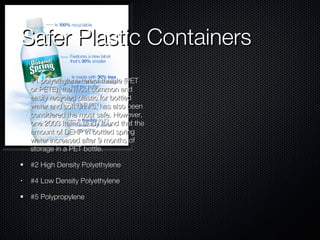
Safer Plastic Containers #1 polyethylene terephthalate (PET or PETE), the most common and easily recycled plastic for bottled water and soft drinks, has also been considered the most safe. However, one 2003 Italian study found that the amount of DEHP in bottled spring water increased after 9 months of storage in a PET bottle.  #2 High Density Polyethylene  #4 Low Density Polyethylene  #5 Polypropylene
Safety Tips for Safe Use Sniff and Taste: If there's a hint of plastic in your water, don't drink it.  Keep bottled water away from heat, which promotes leaching of chemicals.  Use bottled water quickly, as chemicals may migrate from plastic during storage. Ask retailers how long water has been on their shelves, and don't buy if it's been months.  Do not reuse bottles intended for single use. Reused water bottles also make good breeding grounds for bacteria.  Choose rigid, reusable containers or, for hot/acidic liquids, thermoses with stainless steel or ceramic interiors.
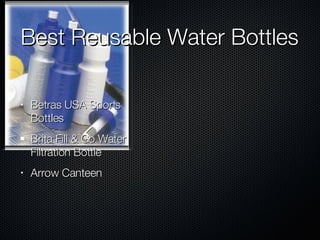
Best Reusable Water Bottles Betras USA Sports Bottles  Brita Fill & Go Water Filtration Bottle  Arrow Canteen
Effects on Our Society Water bottles have had a major impact on our culture and generation. Effected our ecosystem, economy, and daily life habits.  Effected dentition - Flouride
Canadian Study Elementary classroom – 76 samples of bottled water taken from students, as well as from drinking fountains Both heterotrophic bacteria and coliform bacteria in 64.4% of the bottled water samples, exceeding those of the drinking water guidelines. Origin of contamination could not be determined, the scientists believed that over exposure to room temperature could be the cause for the heightened levels of bacteria present.
Cultural Relativism Third World Countries Many water sources are from watering holes and wells where infection is a constant threat. A study on solar heat proved to eliminate Escherichia coli in isolated quantities. (McOughlin et al) America According to the California Department of Conservation, more than one billion plastic water bottles wind up in the trash every year.  The concern is not only in recycling rates, which are at 16% in CA, but in the possible air pollution from incinerating the bottles with normal trash.
Impact Water bottles have played into the “throw away” mentality attached to our generation. Increased pollution can lead to further deprivation of our ozone layer. Recyclable plastics can improve our economy and if exported can lead to safer water in developing countries
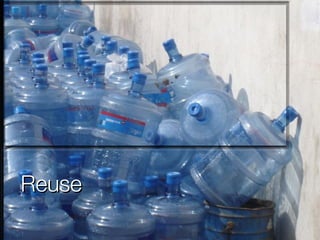
Reuse
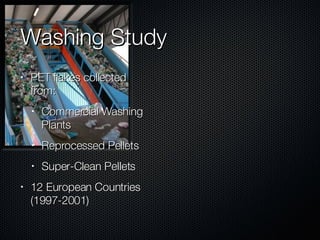
Washing Study PET flakes collected from: Commercial Washing Plants Reprocessed Pellets Super-Clean Pellets 12 European Countries (1997-2001)
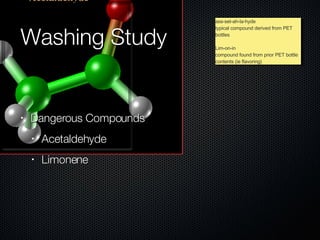
Washing Study Dangerous Compounds Acetaldehyde Limonene ass-set-ah-la-hyde typical compound derived from PET bottles Lim-on-in compound found from prior PET bottle contents (ie flavoring)
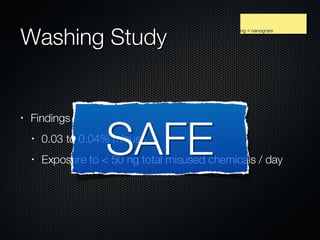
Washing Study Findings 0.03 to 0.04% misuse Exposure to < 50 ng total misused chemicals / day ng = nanogram
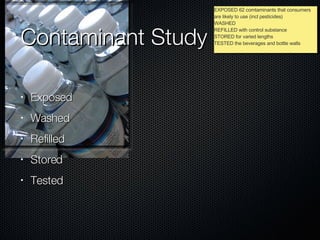
Contaminant Study Exposed Washed Refilled Stored Tested EXPOSED 62 comtaminants that consumers are likely to use (incl pesticides) WASHED REFILLED with control substance STORED for varied lengths TESTED the beverages and bottle walls
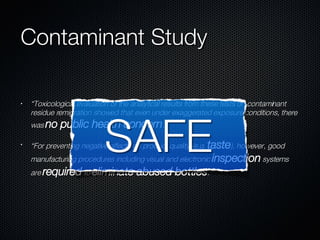
Contaminant Study “ Toxicological evaluation of the analytical results from these tests on contaminant residue remigration showed that even under exaggerated exposure conditions, there was  no   public   health   concern .” “ For preventing negative effects on product quality (e.g.  taste ), however, good manufacturing procedures including visual and electronic  inspection  systems are  required  to  eliminate   abused   bottles .”
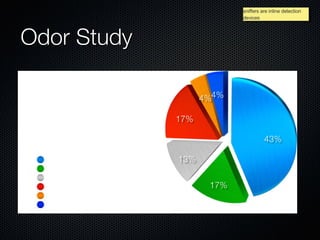
Odor Study Bad smelling PET bottles analyzed Suspected contaminants not detected by ‘sniffers’ sniffers are inline detection devices
Odor Study Odors Caused by: Misuse of food products Licorice-flavored alcohol Home-made alcohol containing fusel oil Non-food products  Cleaning products Petroleum products Oral moist snuff
Summary Water bottles have recently had a huge  impact  on our culture and environment.  Recycling  PET materials is positive for the environment and  safe  for reuse. Reusing bottles for personal use can be safe as long as they are reused  moderately  and held at a safe  temperature .
Sources Dobbin, B.  (2007, December 26).  Health concerns ripple over hard-plastic water bottles. Retrieved March 6, 2008, from The Boston Globe website:  http://www.boston.com/news/nation/articles/2007/12/26/health_concerns_ripple_over_hard_plastic_water_bottles/ Feron, Vj., Jetten, J., De Kruijf, N., and Van Den Berg, F. (1994).  Polyethylene Terephthalate Bottles (PRBs): a Health and Safety Assessment. TNO Nutrition and Food Research, 11(5), 571-594.  Howdeshell, K. L. and vom Saal, F. S. (2000).  Developmental Exposure to    Bisphenol A: Interaction with Endogenous Estradiol During Pregnancy in Mice.    American Zoologist, 40,(3), 429-437. Le, H.H., Carlson, E.M., Chua, J.P., and Belcher, S.M. (2008).  Bisphenol A is released from  polycarbonate drinking bottles and mimics the neurotoxic actions of estrogen in  developing cerebellar neurons.  Toxicology Letters, 176, 149-156. Li, H. and Kim, H. K. Effects of Mono-(2-Ethylhexyl) Phthalates on Fetal and    Neonatal Rat Testis Organ Cultures. Biology of Reproduction, 69(6), 1964-1972. Meadows, M. (2007, October 19).  Plastics and the Microwave.  FDA Consumer magazine.  Ohlson, C. and Harddell, L. (2000).  Testicular Cancer and Occupational    Exposures with a Focus on Xenoestrogens in Polyvinyl Chloride Plastics.    Chemosphere, 40(9-11) Issues 9-11, 1277-1282. Shotyk,W., Krachler, M., and Chen, B.  (2006).  Contamination of Canadian and European  bottled waters with antimony from PET containers.  Journal of Environmental  Monitoring, 8, 288-292. Westerhoff, P., Prapaipong, P., Shock, E., and Hillaireau, A. (2007).  Antimony leaching from  polyethylene terephthalate (PET) plastic used for bottled drinking water.  Water Research, 42, 551-556. Widén, H., Leufvén, A., and Nielsen, T. (2005).  Identification of Chemicals, Possibly Originating From Misuse of Refillable PET Bottles, Responsible for Consumer Complaints About Off- Odours in Water and Soft Drinks. SIK, the Swedish Institute for Food and  Biotechnology, 22(7) (2005).
For More Information http://www.plasticsmythbuster.org /

Pet Bottles

  • 1.
    PET (Polyethylene terephthalate)Bottles Nathan Parker DJ Bernat Justin Cole Gina DiGennaro Luke Hill
  • 2.
    Thesis Water bottleshave recently had a huge impact on our culture and environment. Recycling PET materials is positive for the environment and safe for reuse. Reusing bottles for personal use can be safe as long as they are reused moderately and held at a safe temperature.
  • 3.
    Main Points Waterbottles are safe to reuse Water bottles do contain some dangerous materials, but most studies suggest that they are only dangerous in high concentrations over time Water bottles have had a major cultural impact
  • 4.
  • 5.
  • 6.
  • 7.
    Suspect Name :Bisphenol A Aliases : BPA Description : Organic compound with the formula (CH3)2C(C6H4OH)2 Additional suspect information : Last seen as the common plastic bottle. May be in your reusable water bottle, your baby bottles, or other food and drink containers. Wanted For causing cancer
  • 8.
    BPA… Is aneurotoxin Disrupts the endocrine system Known to cause metabolic, reproductive, and even neurological disturbances in lab animals Westerhoff, P., Prapaipong, P., Shock, E., and Hillaireau, A. (2007
  • 9.
    Suspect Name :Polyethylene terephthalate Aliases : PET Description : Chemical formula (C10H8O4)n Additional suspect information: Last seen as the common soda and water bottles. Last seen as the common soda and water bottles. Last seen as the common soda and water bottles. Wanted For contamination
  • 10.
    PET… Leaches anantimony into the bottled substance Slowly eliminated from body – hence fear of toxicity in long run Disrupts body in many ways when toxic (including cardiac irregularity, nausea) Shotyk,W., Krachler, M., and Chen, B. (2006).
  • 11.
    Leaching Does notincrease or decrease with use of a bottle Happens more with heat exposure Also happens with glass bottles Occurs with both BPA and antimony from PET Effects can be more harmful for a fetus Westerhoff, P., Prapaipong, P., Shock, E., and Hillaireau, A. (2007) ; Shotyk,W., Krachler, M., and Chen, B. (2006) ; Le, H.H., Carlson, E.M., Chua, J.P., and Belcher, S.M. (2008)
  • 12.
    Exposure to BisphenolA -What is Bisphenol A? “Bisphenol A is the monomer used to make polycarbonate plastic products” i.e. Baby bottles, lining of food and beverage cans, etc. - Is similar to estrogen (“estrogen mimicking”) and therefore can interfere with estrogen levels
  • 13.
    Effects of BisphenolA On Mice In low, prenatal doses: Increase in prostate size and decrease sperm production in males Premature puberty in females 600% increase in infant mortality rate in litters Increased birth weight/growth Males 10% heavier, females 22% heavier at time of weaning May contribute to increases in obesity and sexual maturation in humans in recent decades
  • 14.
    Phthalates “Phthalates…areindustrial chemicals commonly found in many consumer products regularly used by humans, such as soap, shampoo, cosmetics, and hairspray. They are also used in flexible plastics, such as blood transfusion bags, children's toys, and food containers. Di-(2-ethylhexyl) phthalate (DEHP) is one of the most abundant phthalates produced in the United States. ”
  • 15.
    DEHP & MEHPWhen metabolized, DEHP is changed to MEHP (mono ethylhexyl phthalate) Neonatal damage will affect adult development Induces testicular toxicity in rodents Not covalent bonds (leeching is possible) Linked to decreased sperm production, undescended testes (risk factor for cancer), and damage to Sertoli cells May also contribute to testicular cancer When metabolized, DEHP is changed to MEHP (mono ethylhexyl phthalate)Neonatal damage will affect adult developmentInduces testicular toxicity in rodentsNot covalent bonds (leeching is possible)Linked to decreased sperm production, undescended testes (risk factor for cancer), and damage to Sertoli cellsMay also contribute to testicular cancer
  • 16.
    Exposure to PVCin Workers PVC (Polyvinyl Chloride) is one of the most commonly used phthalates Study focused on exposure to high levels over a long period of time PVC contains high levels of DEHP PVC workers had increased seminoma Seminoma is a type of tumor which occurs mostly in older age
  • 17.
    Benzene While notrelated to plastics, it is often present in bottled water and other beverages FDA guidelines allow for no more than 5 ppb (parts per billion) in bottled water High levels of benzene exposure in factory workers has been linked to cancer Benzoates+ Vitamin C + Heat = benzene
  • 18.
  • 19.
    Which Plastics ToAvoid #3 Polyvinyl Chloride (PVC) commonly contains di-2-ehtylhexyl phthalate (DEHP), an endocrine disruptor and probable human carcinogen, as a softener. #6 Polystyrene (PS) may leach styrene, a possible endocrine disruptor and human carcinogen, into water and food. #7 Polycarbonate contains the hormone disruptor bisphenol-A, which can leach out as bottles age, are heated or exposed to acidic solutions. Unfortunately, #7 is used in most baby bottles and five-gallon water jugs and in many reusable sports bottles.
  • 20.
    Safer Plastic Containers#1 polyethylene terephthalate (PET or PETE), the most common and easily recycled plastic for bottled water and soft drinks, has also been considered the most safe. However, one 2003 Italian study found that the amount of DEHP in bottled spring water increased after 9 months of storage in a PET bottle. #2 High Density Polyethylene #4 Low Density Polyethylene #5 Polypropylene
  • 21.
    Safety Tips forSafe Use Sniff and Taste: If there's a hint of plastic in your water, don't drink it. Keep bottled water away from heat, which promotes leaching of chemicals. Use bottled water quickly, as chemicals may migrate from plastic during storage. Ask retailers how long water has been on their shelves, and don't buy if it's been months. Do not reuse bottles intended for single use. Reused water bottles also make good breeding grounds for bacteria. Choose rigid, reusable containers or, for hot/acidic liquids, thermoses with stainless steel or ceramic interiors.
  • 22.
    Best Reusable WaterBottles Betras USA Sports Bottles Brita Fill & Go Water Filtration Bottle Arrow Canteen
  • 23.
    Effects on OurSociety Water bottles have had a major impact on our culture and generation. Effected our ecosystem, economy, and daily life habits. Effected dentition - Flouride
  • 24.
    Canadian Study Elementaryclassroom – 76 samples of bottled water taken from students, as well as from drinking fountains Both heterotrophic bacteria and coliform bacteria in 64.4% of the bottled water samples, exceeding those of the drinking water guidelines. Origin of contamination could not be determined, the scientists believed that over exposure to room temperature could be the cause for the heightened levels of bacteria present.
  • 25.
    Cultural Relativism ThirdWorld Countries Many water sources are from watering holes and wells where infection is a constant threat. A study on solar heat proved to eliminate Escherichia coli in isolated quantities. (McOughlin et al) America According to the California Department of Conservation, more than one billion plastic water bottles wind up in the trash every year. The concern is not only in recycling rates, which are at 16% in CA, but in the possible air pollution from incinerating the bottles with normal trash.
  • 26.
    Impact Water bottleshave played into the “throw away” mentality attached to our generation. Increased pollution can lead to further deprivation of our ozone layer. Recyclable plastics can improve our economy and if exported can lead to safer water in developing countries
  • 27.
  • 28.
    Washing Study PETflakes collected from: Commercial Washing Plants Reprocessed Pellets Super-Clean Pellets 12 European Countries (1997-2001)
  • 29.
    Washing Study DangerousCompounds Acetaldehyde Limonene ass-set-ah-la-hyde typical compound derived from PET bottles Lim-on-in compound found from prior PET bottle contents (ie flavoring)
  • 30.
    Washing Study Findings0.03 to 0.04% misuse Exposure to < 50 ng total misused chemicals / day ng = nanogram
  • 31.
    Contaminant Study ExposedWashed Refilled Stored Tested EXPOSED 62 comtaminants that consumers are likely to use (incl pesticides) WASHED REFILLED with control substance STORED for varied lengths TESTED the beverages and bottle walls
  • 32.
    Contaminant Study “Toxicological evaluation of the analytical results from these tests on contaminant residue remigration showed that even under exaggerated exposure conditions, there was no public health concern .” “ For preventing negative effects on product quality (e.g. taste ), however, good manufacturing procedures including visual and electronic inspection systems are required to eliminate abused bottles .”
  • 33.
    Odor Study Badsmelling PET bottles analyzed Suspected contaminants not detected by ‘sniffers’ sniffers are inline detection devices
  • 34.
    Odor Study OdorsCaused by: Misuse of food products Licorice-flavored alcohol Home-made alcohol containing fusel oil Non-food products Cleaning products Petroleum products Oral moist snuff
  • 35.
    Summary Water bottleshave recently had a huge impact on our culture and environment. Recycling PET materials is positive for the environment and safe for reuse. Reusing bottles for personal use can be safe as long as they are reused moderately and held at a safe temperature .
  • 36.
    Sources Dobbin, B. (2007, December 26). Health concerns ripple over hard-plastic water bottles. Retrieved March 6, 2008, from The Boston Globe website: http://www.boston.com/news/nation/articles/2007/12/26/health_concerns_ripple_over_hard_plastic_water_bottles/ Feron, Vj., Jetten, J., De Kruijf, N., and Van Den Berg, F. (1994). Polyethylene Terephthalate Bottles (PRBs): a Health and Safety Assessment. TNO Nutrition and Food Research, 11(5), 571-594. Howdeshell, K. L. and vom Saal, F. S. (2000). Developmental Exposure to Bisphenol A: Interaction with Endogenous Estradiol During Pregnancy in Mice. American Zoologist, 40,(3), 429-437. Le, H.H., Carlson, E.M., Chua, J.P., and Belcher, S.M. (2008). Bisphenol A is released from polycarbonate drinking bottles and mimics the neurotoxic actions of estrogen in developing cerebellar neurons. Toxicology Letters, 176, 149-156. Li, H. and Kim, H. K. Effects of Mono-(2-Ethylhexyl) Phthalates on Fetal and Neonatal Rat Testis Organ Cultures. Biology of Reproduction, 69(6), 1964-1972. Meadows, M. (2007, October 19). Plastics and the Microwave. FDA Consumer magazine. Ohlson, C. and Harddell, L. (2000). Testicular Cancer and Occupational Exposures with a Focus on Xenoestrogens in Polyvinyl Chloride Plastics. Chemosphere, 40(9-11) Issues 9-11, 1277-1282. Shotyk,W., Krachler, M., and Chen, B. (2006). Contamination of Canadian and European bottled waters with antimony from PET containers. Journal of Environmental Monitoring, 8, 288-292. Westerhoff, P., Prapaipong, P., Shock, E., and Hillaireau, A. (2007). Antimony leaching from polyethylene terephthalate (PET) plastic used for bottled drinking water. Water Research, 42, 551-556. Widén, H., Leufvén, A., and Nielsen, T. (2005). Identification of Chemicals, Possibly Originating From Misuse of Refillable PET Bottles, Responsible for Consumer Complaints About Off- Odours in Water and Soft Drinks. SIK, the Swedish Institute for Food and Biotechnology, 22(7) (2005).
  • 37.
    For More Informationhttp://www.plasticsmythbuster.org /