Introduction
Properties of plastics
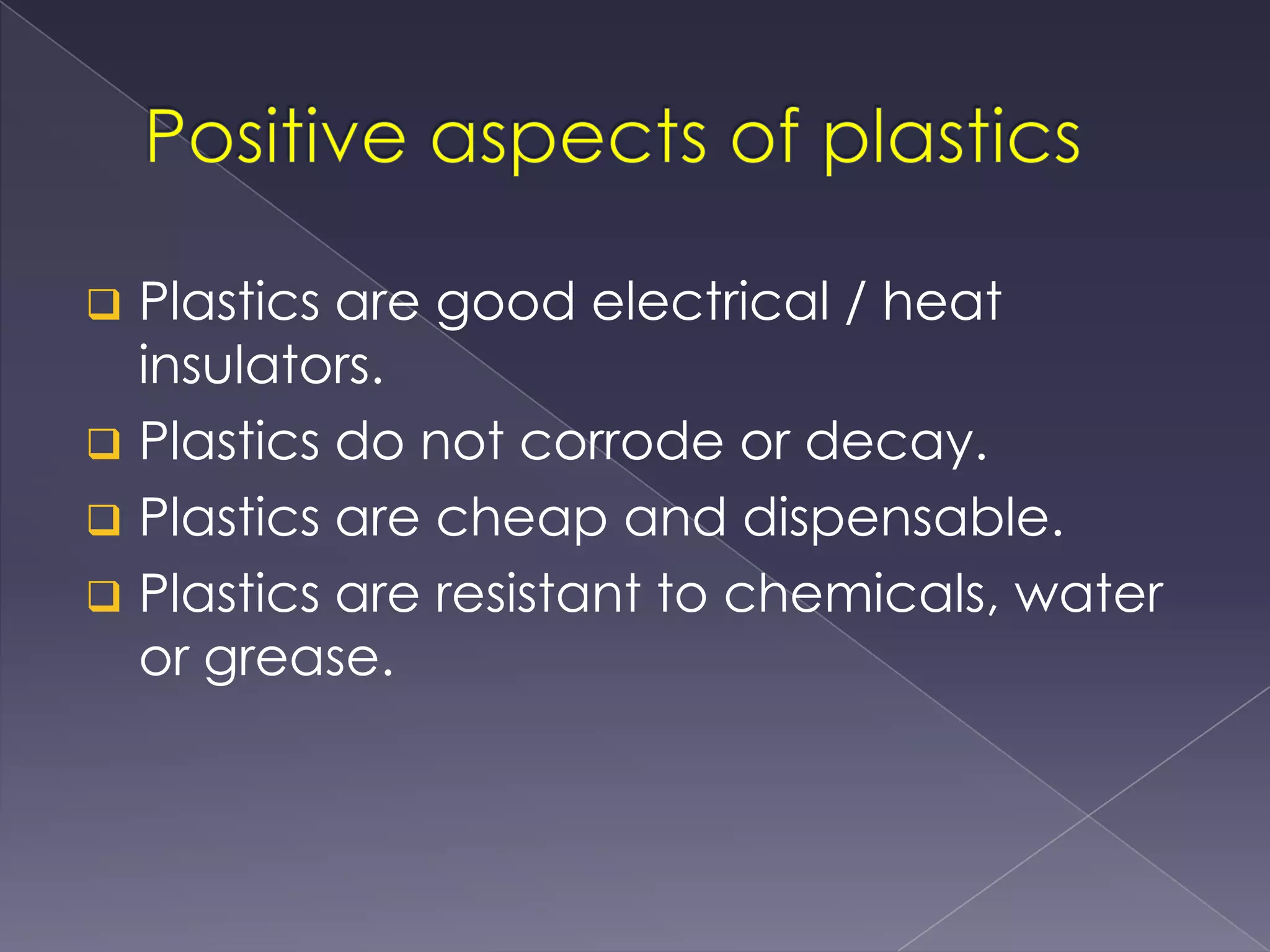
Positive aspects of plastics
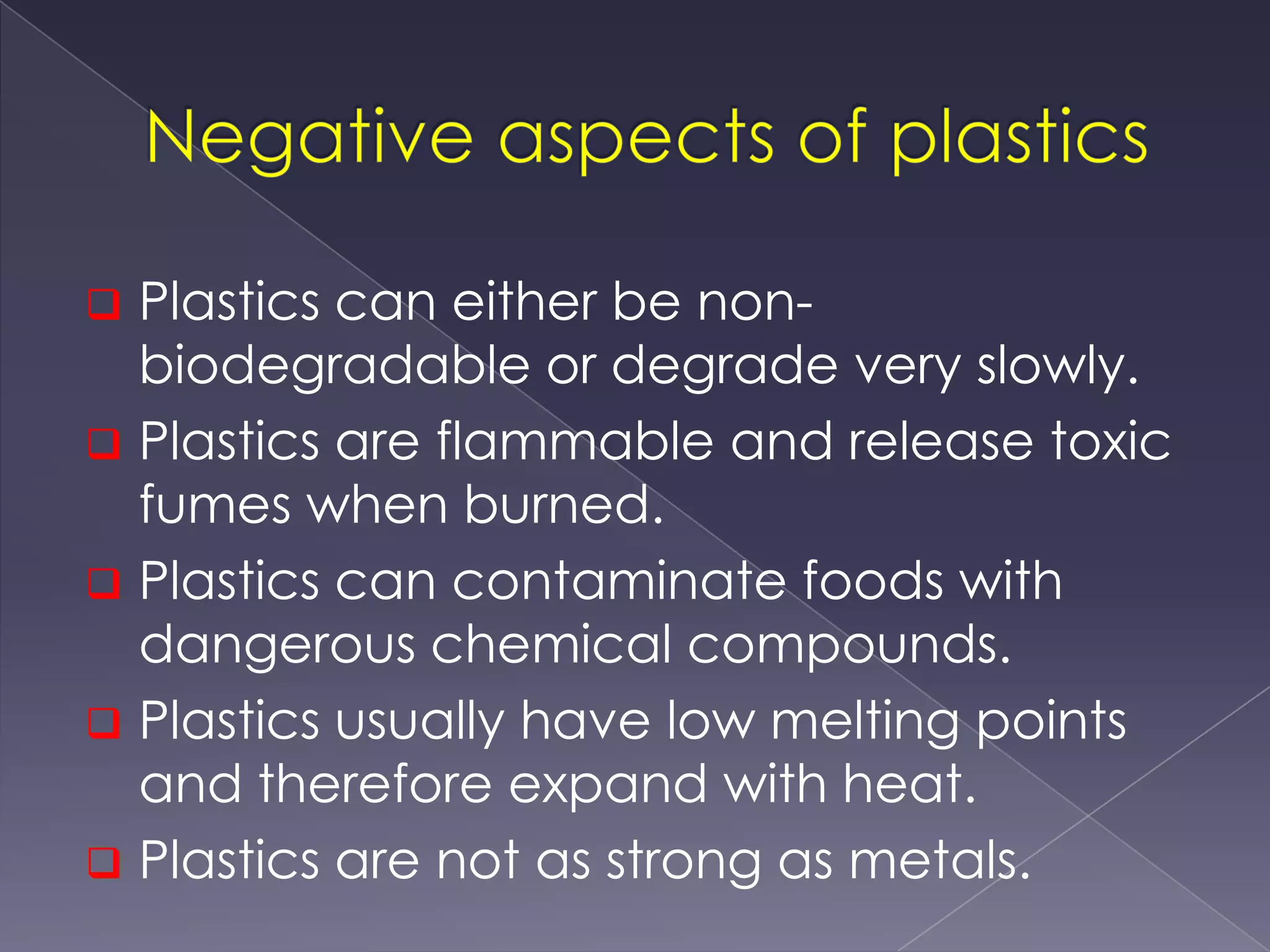
Negative aspects of plastics.
types, categories and
families of plastics.
Land plastic pollution
Air plastic pollution
Water plastic pollution.
Ocean plastic pollution
Human health hazards
Pollution prevention
 The word plastic was derived from the
  words plasticus(Latin for ‘capable of
  moulding’) and plastikos (Greek for ‘fit
  for moulding’).
 Plastics are organic polymers (synthetic
  or natural) of high molecular weight.
 The plastic is basically formless material
  which can be moulded under heat and
  pressure.
   Most of the plastics are made from three
    raw materials
                 • Non-renewable
       petroleum • Natural resource

                    • Non-renewable
          Coal      • Natural resource

                    • Renewable
        cellulose   • Natural resource
 Plastic is a long, chain like molecules
  (polymers) made from petroleum capable
  being molded, extruded or cast into various
  shapes.
 The first plastic was invented in 1862 by
  Alexander Parkes.
 At first plastics could only be made in brown
  or black (Bakelite) color.
 In 1930’s, ‘Amino Plastics’ had been
  invented which could be made in lots of
  bright colours.
 Plastics are strong, light weight, flexible
  and durable.
 Plastics show superior optical properties
  ( clarity, gloss and color).
 Plastics can be easily moulded into a
  variety of shapes and sizes.
 Plastics have excellent mechanical
  strength ( tensile properties, tear
  resistance and impact resistance ).
 Plastics are relatively cheap compared
  to tin, glass and steel.
 Plastics are reusable and recyclable.
 Plastics have long use life.
 Plastics are good electrical / heat
  insulators.
 Plastics do not corrode or decay.
 Plastics are cheap and dispensable.
 Plastics are resistant to chemicals, water
  or grease.
 Plastics can either be non-
  biodegradable or degrade very slowly.
 Plastics are flammable and release toxic
  fumes when burned.
 Plastics can contaminate foods with
  dangerous chemical compounds.
 Plastics usually have low melting points
  and therefore expand with heat.
 Plastics are not as strong as metals.
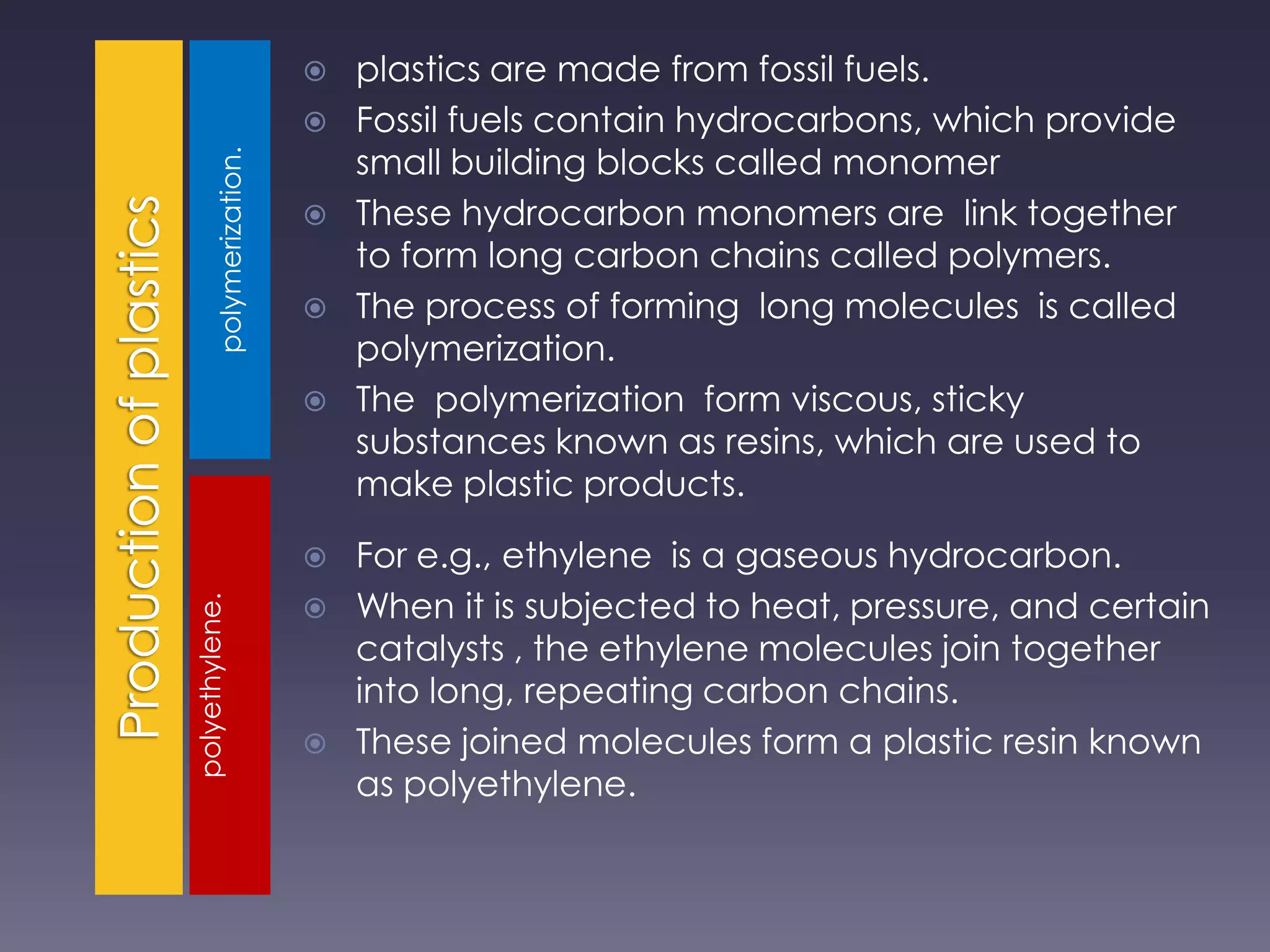
   plastics are made from fossil fuels.
                            Fossil fuels contain hydrocarbons, which provide
                             small building blocks called monomer
       polymerization.
                            These hydrocarbon monomers are link together
                             to form long carbon chains called polymers.
                            The process of forming long molecules is called
                             polymerization.
                            The polymerization form viscous, sticky
                             substances known as resins, which are used to
                             make plastic products.

                            For e.g., ethylene is a gaseous hydrocarbon.
                             When it is subjected to heat, pressure, and certain
polyethylene.


                         
                             catalysts , the ethylene molecules join together
                             into long, repeating carbon chains.
                            These joined molecules form a plastic resin known
                             as polyethylene.
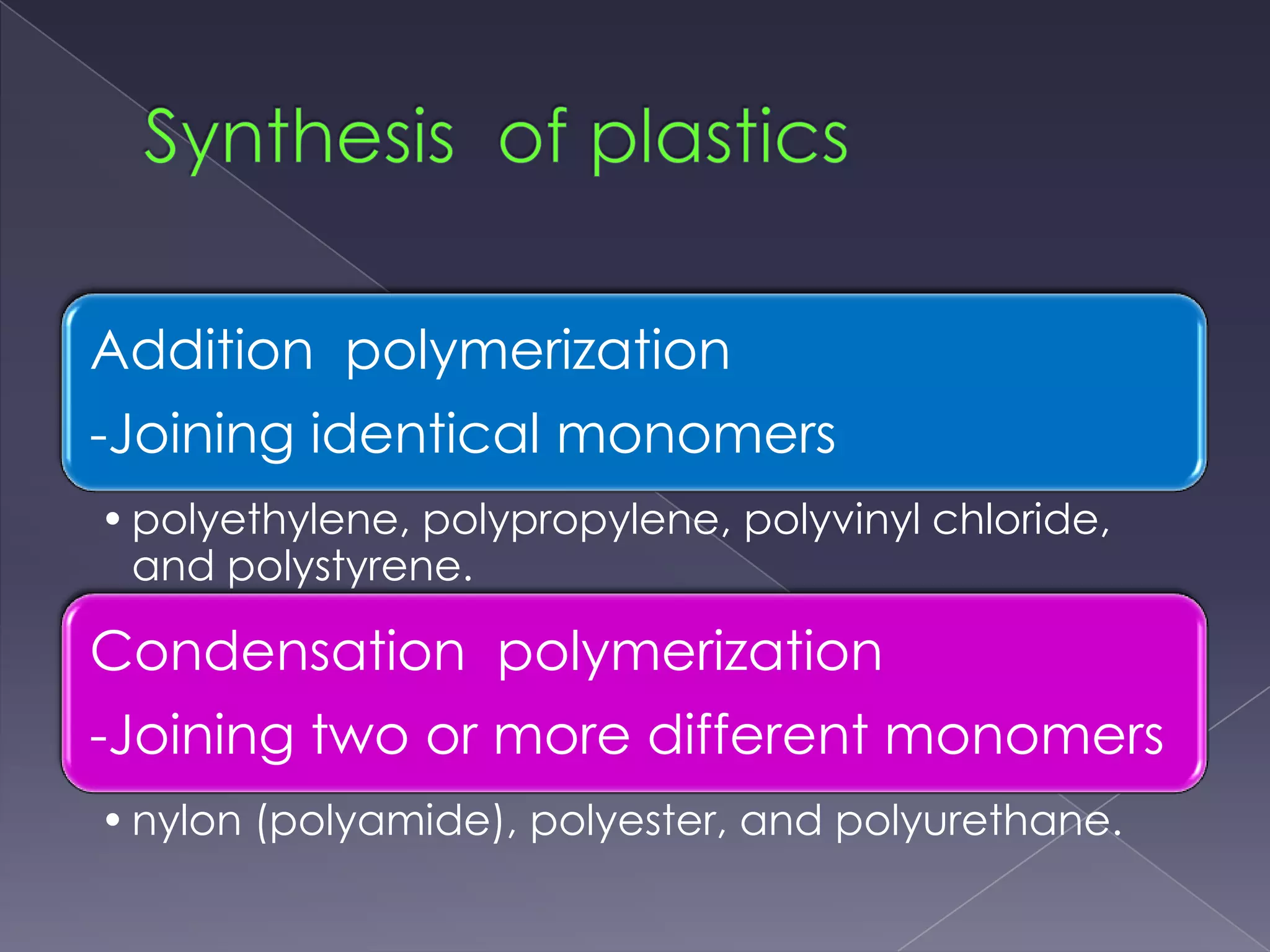
Addition polymerization
-Joining identical monomers
• polyethylene, polypropylene, polyvinyl chloride,
  and polystyrene.

Condensation polymerization
-Joining two or more different monomers
• nylon (polyamide), polyester, and polyurethane.
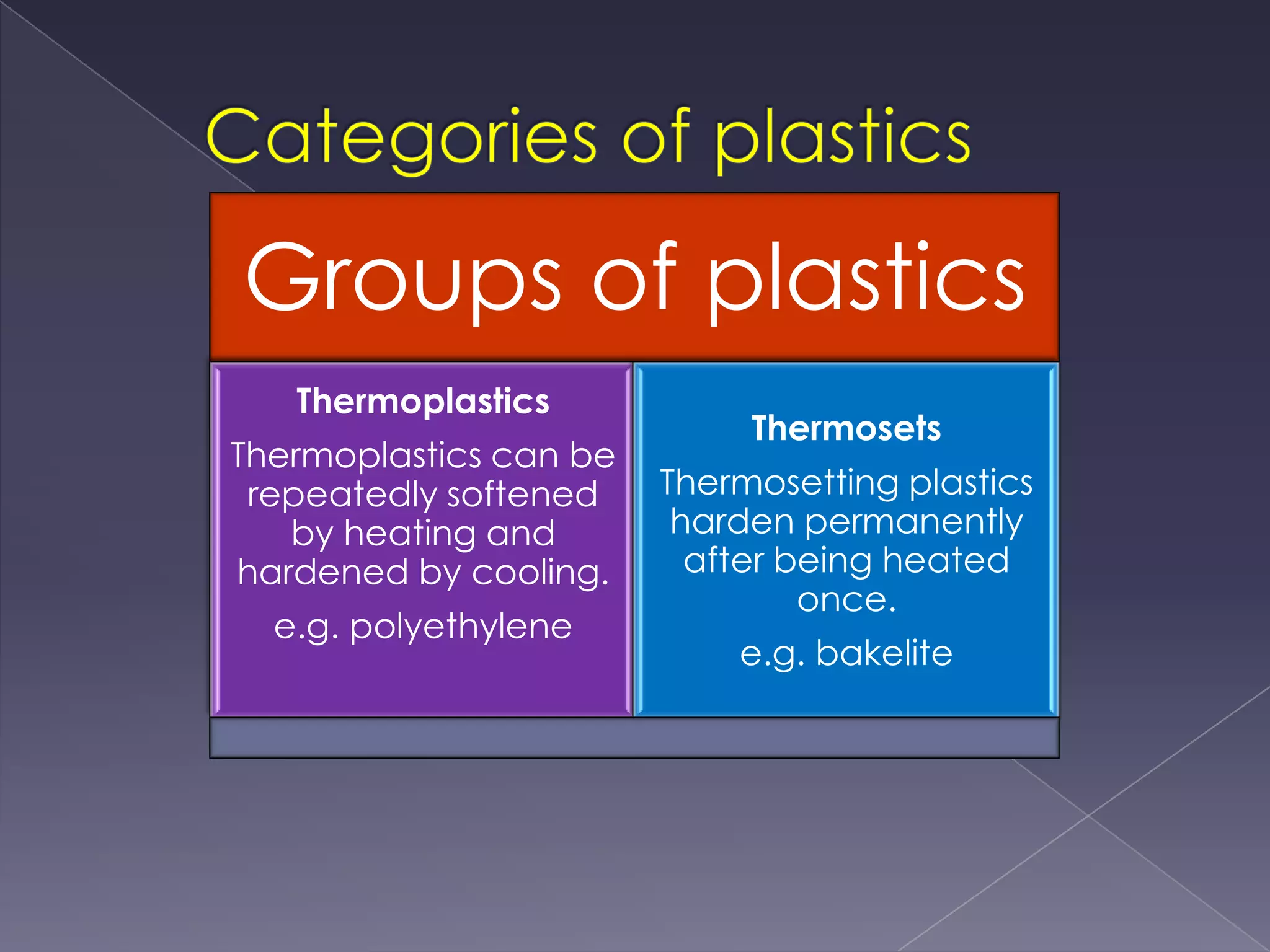
Groups of plastics
   Thermoplastics
                             Thermosets
Thermoplastics can be
 repeatedly softened    Thermosetting plastics
   by heating and        harden permanently
hardened by cooling.      after being heated
                                 once.
  e.g. polyethylene
                            e.g. bakelite
No.   type   Chemical name                        usage                     precautions


1     PET       Polyethylene       Single use bottles-water, soft drinks,    Use with
               terephthalate                       juice                     caution

               High density               Milk/detergentbottles              Appears
2     HDPE     polyethylene                                                   safe
3     PVC    Poly vinyl chloride         Meat wraps, shampoo                  Avoid
                                              containers                      More
                                                                            hazardous
4     LDPE      Low density                   Bread bags,                    Appears
               polyethylene                  Sandwich bags                    safe
5      PP     polypropylene          Medicine bottles, cereal liners         Appears
                                                                              safe
6      PS       polystyrene            Take-out containers, foam              avoid
                                              packaging
7      O           others              Baby bottles, sauce bottles           Use with
                                                                             caution
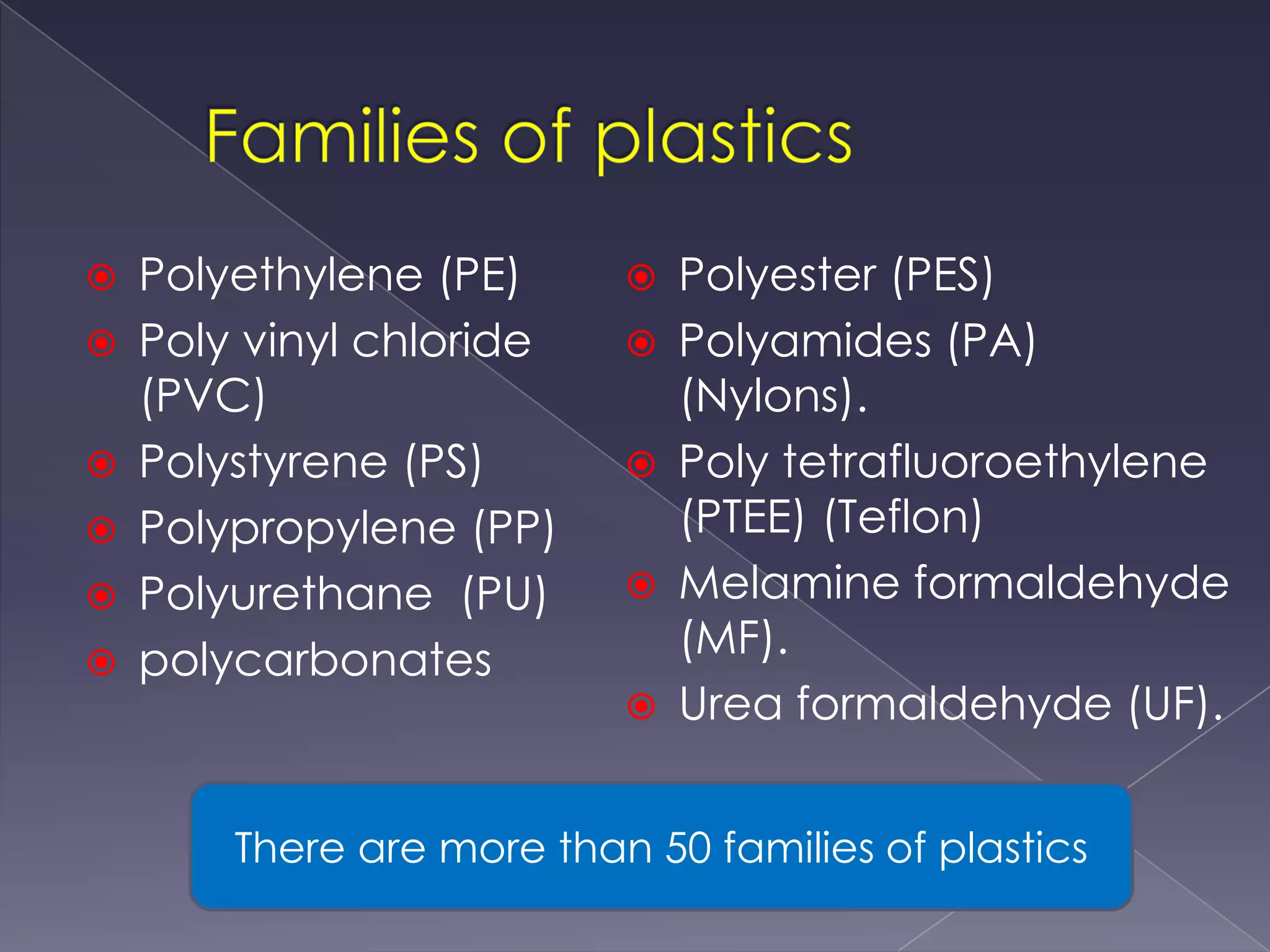
   Polyethylene (PE)         Polyester (PES)
   Poly vinyl chloride       Polyamides (PA)
    (PVC)                      (Nylons).
   Polystyrene (PS)          Poly tetrafluoroethylene
   Polypropylene (PP)         (PTEE) (Teflon)
   Polyurethane (PU)         Melamine formaldehyde
   polycarbonates             (MF).
                              Urea formaldehyde (UF).


        There are more than 50 families of plastics
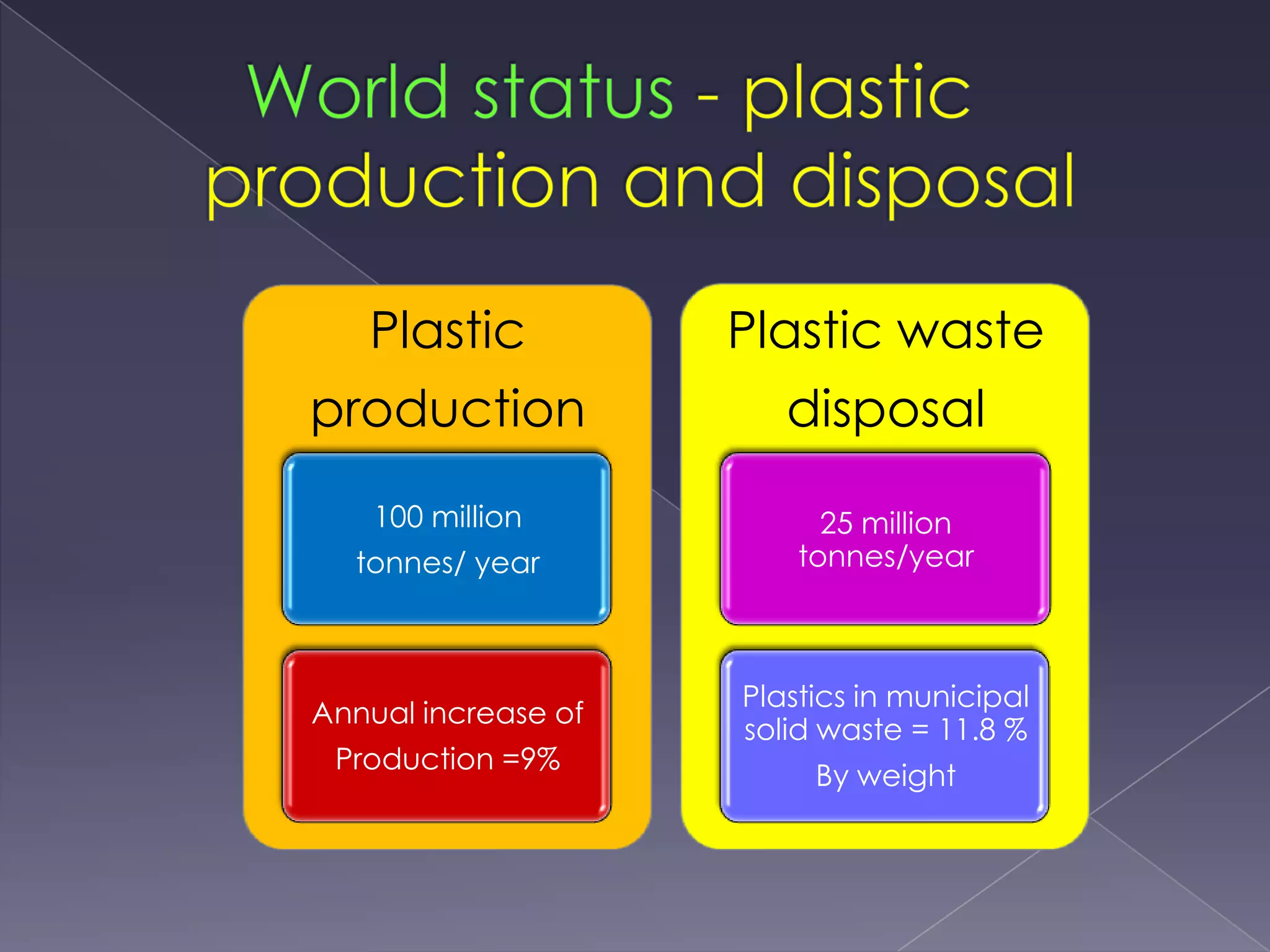
Plastic           Plastic waste
production              disposal
    100 million            25 million
  tonnes/ year           tonnes/year


                     Plastics in municipal
Annual increase of
                     solid waste = 11.8 %
 Production =9%
                          By weight
Polyethylene (PE) is a milky white, translucent
substance derived from ethylene.
Polyethylene (PE) is made in low- and high-density
forms.
Low-density polyethylene (LDPE) is the most widely used
of all plastics, because it is
inexpensive, flexible, extremely tough, and chemical-
resistant.
 LDPE is molded into bottles, garment bags, frozen food
packages, and plastic toys.
High-density polyethylene (HDPE) is stiffer,
stronger, and less translucent.
 HDPE is formed into grocery bags, car fuel
tanks, packaging, and piping.
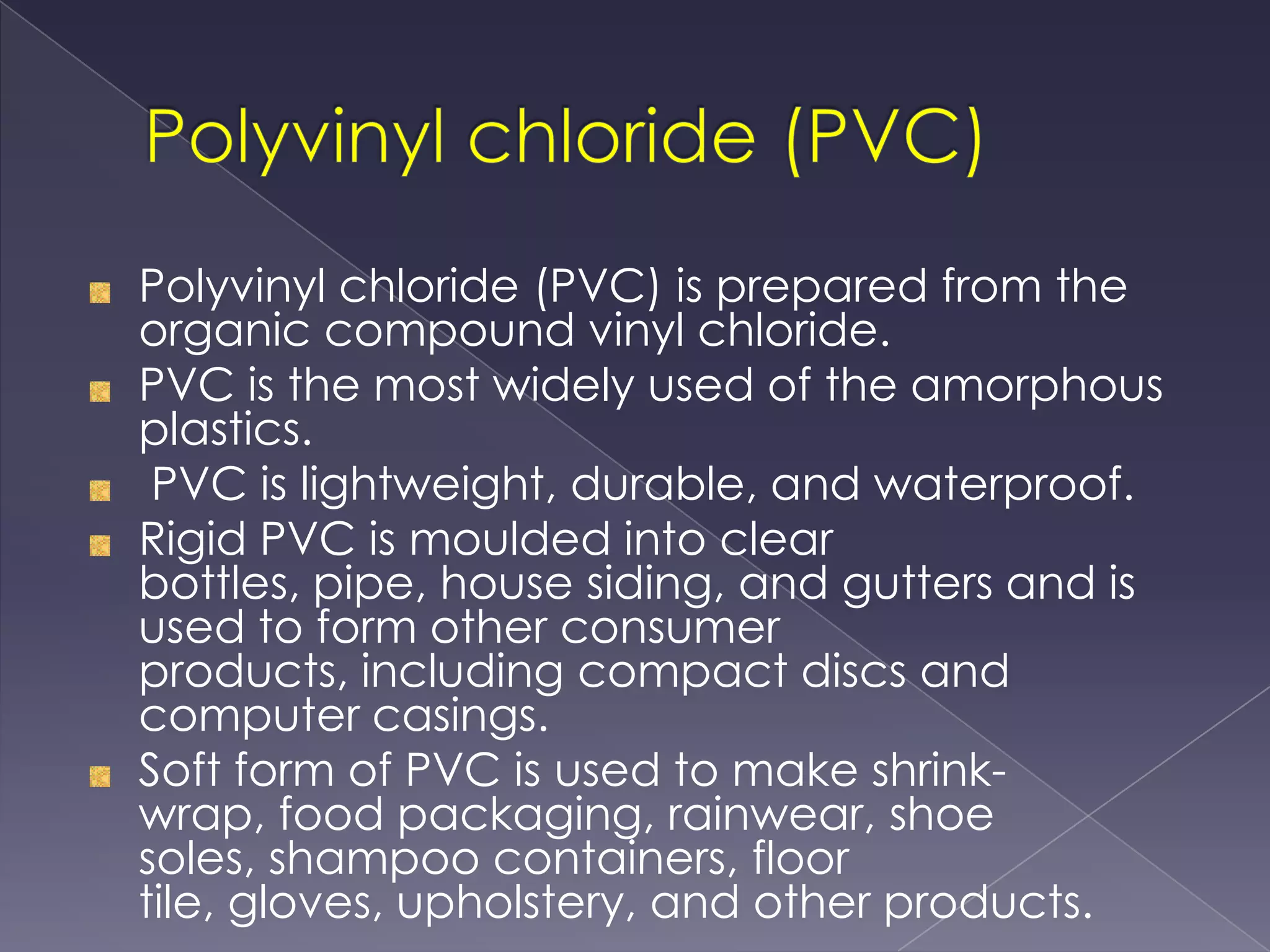
Polyvinyl chloride (PVC) is prepared from the
organic compound vinyl chloride.
PVC is the most widely used of the amorphous
plastics.
 PVC is lightweight, durable, and waterproof.
Rigid PVC is moulded into clear
bottles, pipe, house siding, and gutters and is
used to form other consumer
products, including compact discs and
computer casings.
Soft form of PVC is used to make shrink-
wrap, food packaging, rainwear, shoe
soles, shampoo containers, floor
tile, gloves, upholstery, and other products.
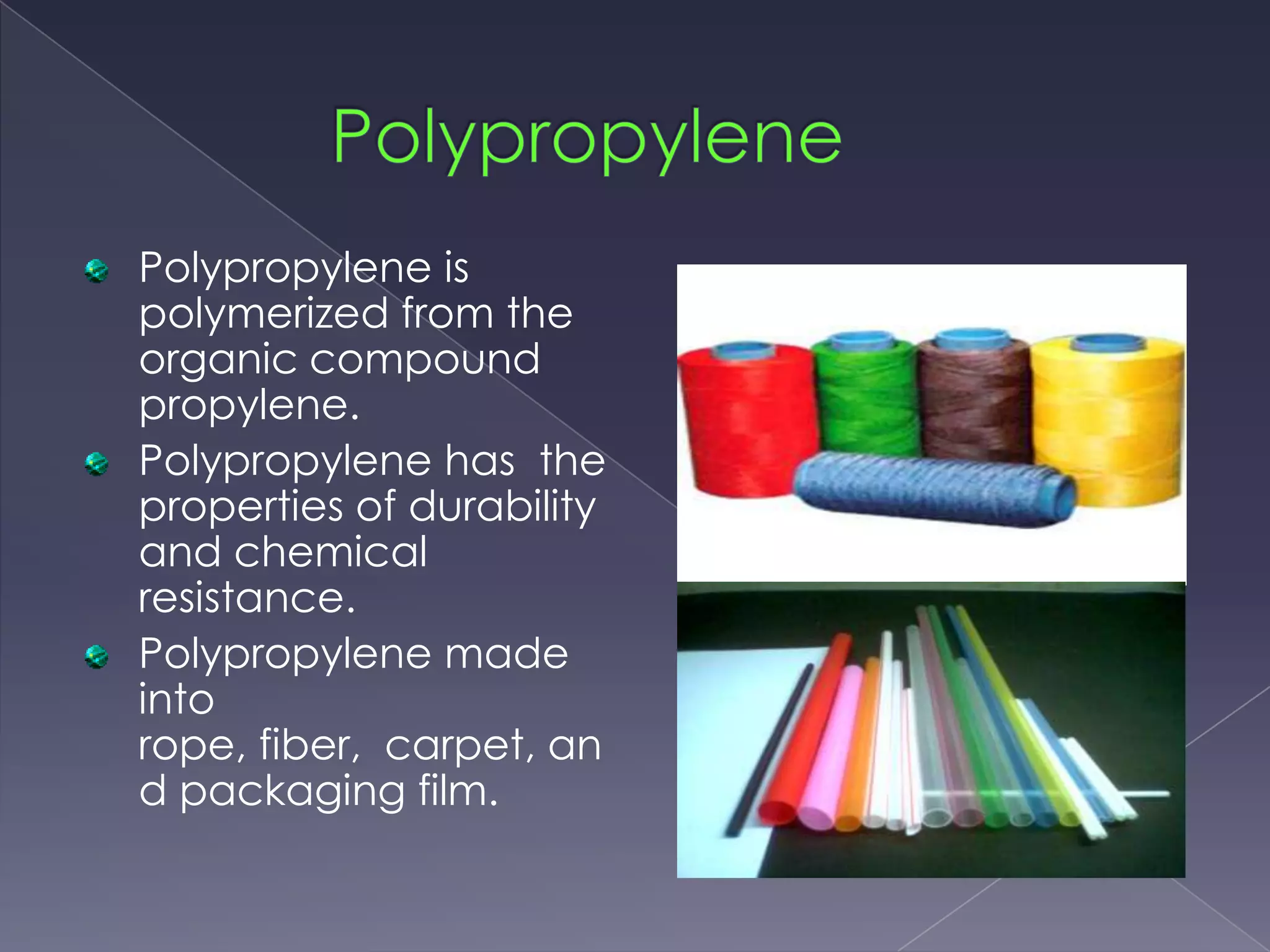
Polypropylene is
polymerized from the
organic compound
propylene.
Polypropylene has the
properties of durability
and chemical
resistance.
Polypropylene made
into
rope, fiber, carpet, an
d packaging film.
Polystyrene is
produced from
styrene.
polystyrene is an
amorphous, transpare
nt, and somewhat
brittle plastic.
Polystyrene is made
into products such as
toys, utensils, display
boxes, model aircraft
kits, and ballpoint pen
barrels.
 Polyethylene terephthalate (PET) is
  formed from the reaction of terephthalic
  acid and ethylene glycol.
 PET molecules are strong and abrasion-
  resistant material that is used to produce
  films and polyester fibers.
 PET is injection molded into windshield
  wiper arms, sunroof
  frames, gears, pulleys, and food trays.
80% of
thermoplastics,
 and 20% of thermoset
plastic wastes are
generated in India.
  The use of plastics in
India is 3 kg per
person per year.
  The total
consumption of
plastics in India is
about 4 million tonnes
and the waste
generated is about 2
million tonnes.
  About 20% of solid
municipal wastes are
plastics in India.
   Plastic is one of the toxic non-biodegradable
    pollutants, which pollutes land, air and water.
   Plastics cause serious damage to the
    environment both during its manufacture and
    disposal.
   The manufacture of plastics in industries
    releases huge quantity of carbon
    monoxide, dioxin, hydrogen cyanide and
    VOCs.
   These gases pollute air seriously.
   Being a non-biodegradable material, land
    filling with plastics preserves the poisons for
    ever.
 Plastic is a part of our lives.
 People use plastics in a variety of ways
  ranging from household appliances to
  industrial and commercial products.
 The production of plastics is growing
  about 9% annually.
 According to an estimate about 100
  million tonnes of plastics is produced
  every year all over the world.
   The major chemicals used in the manufacture
    of plastics are highly toxic.
   Plastic which is made from petroleum, is a
    material that the earth cannot digest.
   These toxic chemicals( benzene, vinyl
    chloride, xylems and bisphenol A ) pose serious
    threat to living beings of all species on earth.
   Benzene and vinyl chloride are confirmed
    carcinogens.
   In the environment, plastic breaks down into
    smaller and smaller particles, that absorb toxic
    chemicals, are ingested by wildlife on land and
    in the ocean and enter human food chain.
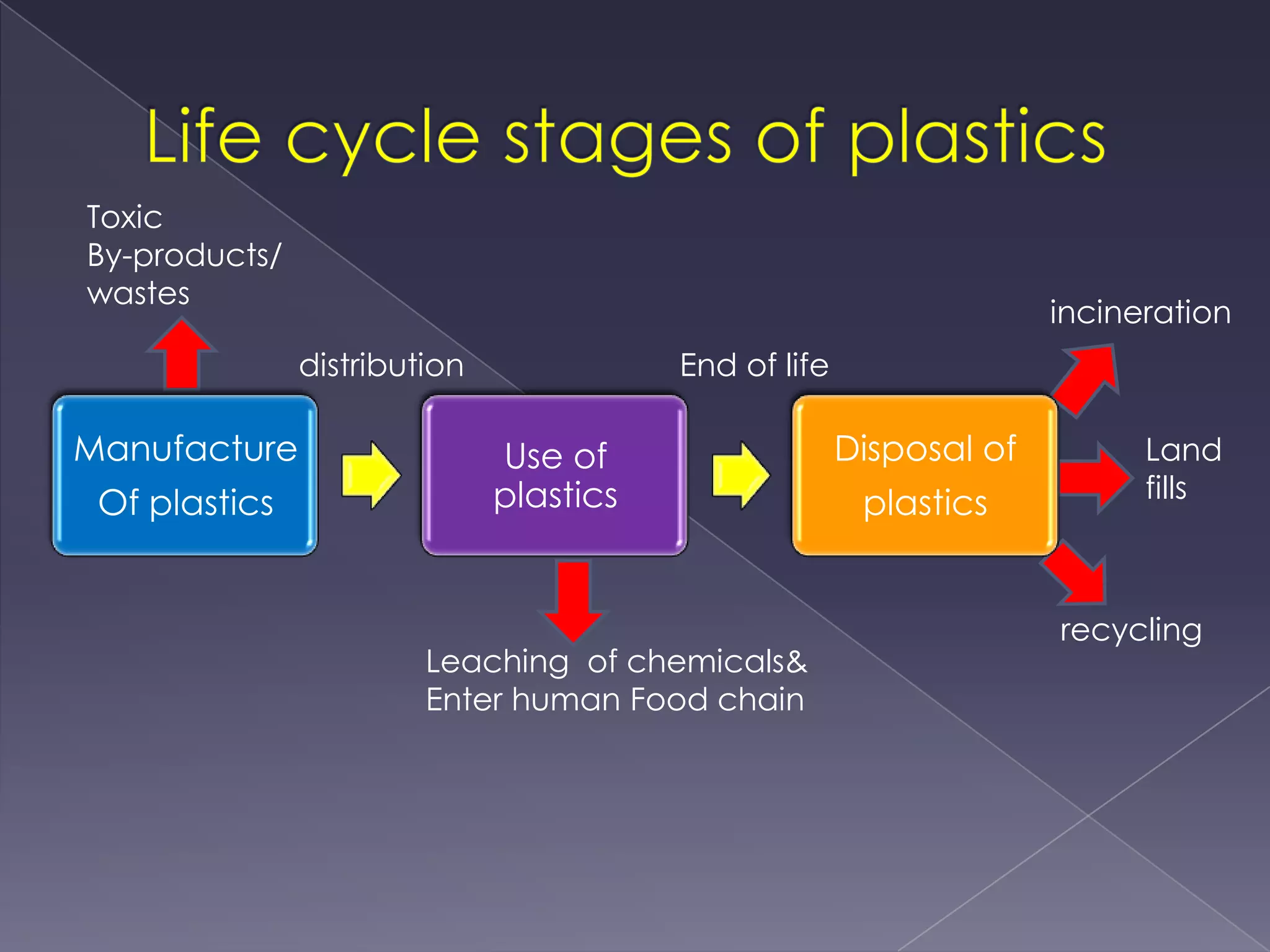
Toxic
By-products/
wastes
                                                                     incineration
               distribution              End of life

Manufacture                   Use of                   Disposal of         Land
                              plastics                                     fills
 Of plastics                                            plastics


                                                                     recycling
                        Leaching of chemicals&
                        Enter human Food chain
 Plastic resins are made by using non-
  renewable natural resources.
 Approximately 8 % 0f world’s oil
  production is used to make plastics.
 Over exploitation results in depletion of
  natural resources
Plastic pollution on land is both physical and
chemical.
Plastic reduces soil fertility by forming the part
of manure for years.
Plastic spoils environmental aesthetics and
hygiene.
Plastics in landfills emit hazardous VOCs during
incineration.
Plastics in soil can lessen the growth of plants
and trees by blocking the absorption of
minerals, water and other nutrients.
Plastics can cause land slides.
Industries emit large amounts of carbon
monoxide, dioxin and hydrogen
cyanide.
These gaseous pollutants contaminate
air and cause respiratory
diseases, nervous system disorders and
immune suppression in human beings.
 Plastics wastes dumped in water courses
  contaminate and poisons freshwater life.
 On leaching in water, plastic can easily
  enter the human food chain and harm
  human health.
 Plastic debrises clog the sewage drains and
  create stagnant water which will be an
  ideal habitat for mosquitoes and other
  parasites.
 Chocked drains cause flooding during
  monsoons.
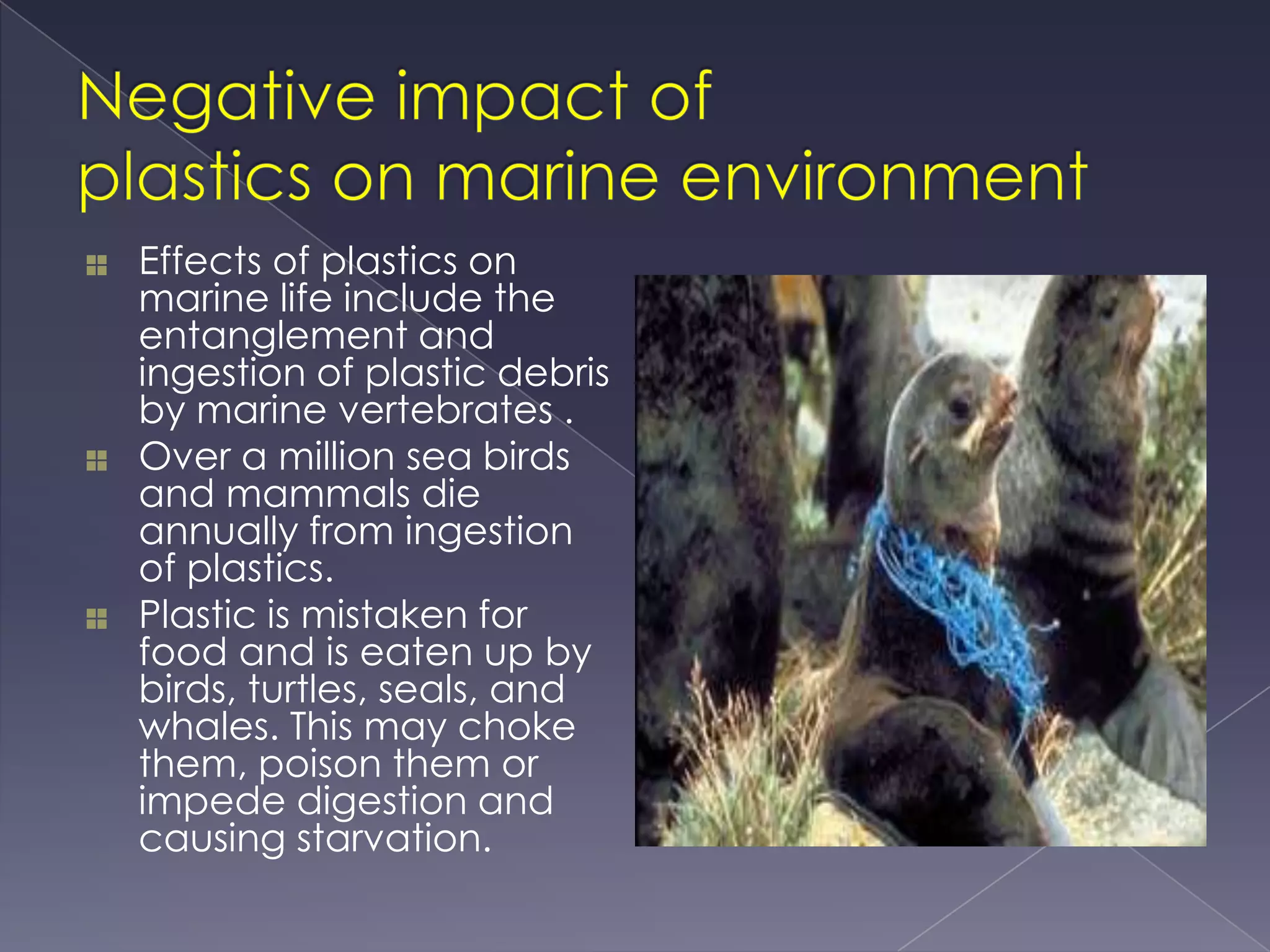
Effects of plastics on
marine life include the
entanglement and
ingestion of plastic debris
by marine vertebrates .
Over a million sea birds
and mammals die
annually from ingestion
of plastics.
Plastic is mistaken for
food and is eaten up by
birds, turtles, seals, and
whales. This may choke
them, poison them or
impede digestion and
causing starvation.
Marine turtles become
entangled in discarded
nets and were found
dead with plastic
garbage bags in the
stomach.
Some marine mammals
swallow plastic
bags, which resemble
jelly fish in sea water.
About 44% of sea birds
eat plastics mistaken for
food leading to
suffocation or blockage
of digestive tracts and
eventually death.
Toxic chemicals contained in plastics cause
neurological problems, cancer, birth defects, hormonal
changes gastric ulcer, thyroid problems and
cardiovascular disease.
The endocrine disrupting chemicals(EDCs) in plastics
have been contributing to obesity and diabetes.
The plastic bottles may leach cancer-causing
chemicals such as phthalates (a component makes
plastic pliable) and Bis-phenol A ( a component harden
plastic).
Bis-phenol A(BPA) a synthetic estrogen, can affect the
hearts of women and can permanently damage DNA
of mice.
The raw material for plastic bags are petroleum
and natural gas (manufacture take 4% of world’s
oil production).
The plastic grocery bags are made from ethylene,
a non-renewable resource.
The plastic bags take 100s of years to break down.

                     HDPE      Chemical barrels


    polyethylene     LDPE       Thin filmy bags


                     LLDPE     Thick glossy bags
Prevention strategies
  REFUSE –     REDUCE –               RECYCLE –
   refuse                  REUSE –
                Choose                Recycling is
plastic carry
               products   Reuse non-     not a
bags at the
                 with       toxic     sustainable
  grocer’s
               minimum    containers    solution.
 shop. Use
natural fiber   plastic   and goods. -can be last
   bags.      packaging                option.
   Dr.B.Victor is a highly experienced postgraduate
    biology teacher, recently retired from the reputed
    educational institution - St. Xavier’ s
    College, Palayamkottai, India-627001.
   He was the dean of sciences and assistant controller
    of examinations.
   He has more than 32 years of teaching and research
    experience
   He has taught a diversity of courses ranging from
    pre- university to post graduate classes.
   Send your comments to : bonfiliusvictor@gmail.com
Thanks a lot

Plastic impacts on the natural Environment

  • 2.
    Introduction Properties of plastics Positiveaspects of plastics Negative aspects of plastics. types, categories and families of plastics. Land plastic pollution Air plastic pollution Water plastic pollution. Ocean plastic pollution Human health hazards Pollution prevention
  • 3.
     The wordplastic was derived from the words plasticus(Latin for ‘capable of moulding’) and plastikos (Greek for ‘fit for moulding’).  Plastics are organic polymers (synthetic or natural) of high molecular weight.  The plastic is basically formless material which can be moulded under heat and pressure.
  • 4.
    Most of the plastics are made from three raw materials • Non-renewable petroleum • Natural resource • Non-renewable Coal • Natural resource • Renewable cellulose • Natural resource
  • 5.
     Plastic isa long, chain like molecules (polymers) made from petroleum capable being molded, extruded or cast into various shapes.  The first plastic was invented in 1862 by Alexander Parkes.  At first plastics could only be made in brown or black (Bakelite) color.  In 1930’s, ‘Amino Plastics’ had been invented which could be made in lots of bright colours.
  • 6.
     Plastics arestrong, light weight, flexible and durable.  Plastics show superior optical properties ( clarity, gloss and color).  Plastics can be easily moulded into a variety of shapes and sizes.  Plastics have excellent mechanical strength ( tensile properties, tear resistance and impact resistance ).
  • 7.
     Plastics arerelatively cheap compared to tin, glass and steel.  Plastics are reusable and recyclable.  Plastics have long use life.
  • 8.
     Plastics aregood electrical / heat insulators.  Plastics do not corrode or decay.  Plastics are cheap and dispensable.  Plastics are resistant to chemicals, water or grease.
  • 9.
     Plastics caneither be non- biodegradable or degrade very slowly.  Plastics are flammable and release toxic fumes when burned.  Plastics can contaminate foods with dangerous chemical compounds.  Plastics usually have low melting points and therefore expand with heat.  Plastics are not as strong as metals.
  • 10.
    plastics are made from fossil fuels.  Fossil fuels contain hydrocarbons, which provide small building blocks called monomer polymerization.  These hydrocarbon monomers are link together to form long carbon chains called polymers.  The process of forming long molecules is called polymerization.  The polymerization form viscous, sticky substances known as resins, which are used to make plastic products.  For e.g., ethylene is a gaseous hydrocarbon. When it is subjected to heat, pressure, and certain polyethylene.  catalysts , the ethylene molecules join together into long, repeating carbon chains.  These joined molecules form a plastic resin known as polyethylene.
  • 11.
    Addition polymerization -Joining identicalmonomers • polyethylene, polypropylene, polyvinyl chloride, and polystyrene. Condensation polymerization -Joining two or more different monomers • nylon (polyamide), polyester, and polyurethane.
  • 12.
    Groups of plastics Thermoplastics Thermosets Thermoplastics can be repeatedly softened Thermosetting plastics by heating and harden permanently hardened by cooling. after being heated once. e.g. polyethylene e.g. bakelite
  • 14.
    No. type Chemical name usage precautions 1 PET Polyethylene Single use bottles-water, soft drinks, Use with terephthalate juice caution High density Milk/detergentbottles Appears 2 HDPE polyethylene safe 3 PVC Poly vinyl chloride Meat wraps, shampoo Avoid containers More hazardous 4 LDPE Low density Bread bags, Appears polyethylene Sandwich bags safe 5 PP polypropylene Medicine bottles, cereal liners Appears safe 6 PS polystyrene Take-out containers, foam avoid packaging 7 O others Baby bottles, sauce bottles Use with caution
  • 15.
    Polyethylene (PE)  Polyester (PES)  Poly vinyl chloride  Polyamides (PA) (PVC) (Nylons).  Polystyrene (PS)  Poly tetrafluoroethylene  Polypropylene (PP) (PTEE) (Teflon)  Polyurethane (PU)  Melamine formaldehyde  polycarbonates (MF).  Urea formaldehyde (UF). There are more than 50 families of plastics
  • 16.
    Plastic Plastic waste production disposal 100 million 25 million tonnes/ year tonnes/year Plastics in municipal Annual increase of solid waste = 11.8 % Production =9% By weight
  • 17.
    Polyethylene (PE) isa milky white, translucent substance derived from ethylene. Polyethylene (PE) is made in low- and high-density forms. Low-density polyethylene (LDPE) is the most widely used of all plastics, because it is inexpensive, flexible, extremely tough, and chemical- resistant. LDPE is molded into bottles, garment bags, frozen food packages, and plastic toys. High-density polyethylene (HDPE) is stiffer, stronger, and less translucent. HDPE is formed into grocery bags, car fuel tanks, packaging, and piping.
  • 18.
    Polyvinyl chloride (PVC)is prepared from the organic compound vinyl chloride. PVC is the most widely used of the amorphous plastics. PVC is lightweight, durable, and waterproof. Rigid PVC is moulded into clear bottles, pipe, house siding, and gutters and is used to form other consumer products, including compact discs and computer casings. Soft form of PVC is used to make shrink- wrap, food packaging, rainwear, shoe soles, shampoo containers, floor tile, gloves, upholstery, and other products.
  • 19.
    Polypropylene is polymerized fromthe organic compound propylene. Polypropylene has the properties of durability and chemical resistance. Polypropylene made into rope, fiber, carpet, an d packaging film.
  • 20.
    Polystyrene is produced from styrene. polystyreneis an amorphous, transpare nt, and somewhat brittle plastic. Polystyrene is made into products such as toys, utensils, display boxes, model aircraft kits, and ballpoint pen barrels.
  • 21.
     Polyethylene terephthalate(PET) is formed from the reaction of terephthalic acid and ethylene glycol.  PET molecules are strong and abrasion- resistant material that is used to produce films and polyester fibers.  PET is injection molded into windshield wiper arms, sunroof frames, gears, pulleys, and food trays.
  • 22.
    80% of thermoplastics, and20% of thermoset plastic wastes are generated in India. The use of plastics in India is 3 kg per person per year. The total consumption of plastics in India is about 4 million tonnes and the waste generated is about 2 million tonnes. About 20% of solid municipal wastes are plastics in India.
  • 23.
    Plastic is one of the toxic non-biodegradable pollutants, which pollutes land, air and water.  Plastics cause serious damage to the environment both during its manufacture and disposal.  The manufacture of plastics in industries releases huge quantity of carbon monoxide, dioxin, hydrogen cyanide and VOCs.  These gases pollute air seriously.  Being a non-biodegradable material, land filling with plastics preserves the poisons for ever.
  • 24.
     Plastic isa part of our lives.  People use plastics in a variety of ways ranging from household appliances to industrial and commercial products.  The production of plastics is growing about 9% annually.  According to an estimate about 100 million tonnes of plastics is produced every year all over the world.
  • 25.
    The major chemicals used in the manufacture of plastics are highly toxic.  Plastic which is made from petroleum, is a material that the earth cannot digest.  These toxic chemicals( benzene, vinyl chloride, xylems and bisphenol A ) pose serious threat to living beings of all species on earth.  Benzene and vinyl chloride are confirmed carcinogens.  In the environment, plastic breaks down into smaller and smaller particles, that absorb toxic chemicals, are ingested by wildlife on land and in the ocean and enter human food chain.
  • 26.
    Toxic By-products/ wastes incineration distribution End of life Manufacture Use of Disposal of Land plastics fills Of plastics plastics recycling Leaching of chemicals& Enter human Food chain
  • 27.
     Plastic resinsare made by using non- renewable natural resources.  Approximately 8 % 0f world’s oil production is used to make plastics.  Over exploitation results in depletion of natural resources
  • 28.
    Plastic pollution onland is both physical and chemical. Plastic reduces soil fertility by forming the part of manure for years. Plastic spoils environmental aesthetics and hygiene. Plastics in landfills emit hazardous VOCs during incineration. Plastics in soil can lessen the growth of plants and trees by blocking the absorption of minerals, water and other nutrients. Plastics can cause land slides.
  • 29.
    Industries emit largeamounts of carbon monoxide, dioxin and hydrogen cyanide. These gaseous pollutants contaminate air and cause respiratory diseases, nervous system disorders and immune suppression in human beings.
  • 30.
     Plastics wastesdumped in water courses contaminate and poisons freshwater life.  On leaching in water, plastic can easily enter the human food chain and harm human health.  Plastic debrises clog the sewage drains and create stagnant water which will be an ideal habitat for mosquitoes and other parasites.  Chocked drains cause flooding during monsoons.
  • 31.
    Effects of plasticson marine life include the entanglement and ingestion of plastic debris by marine vertebrates . Over a million sea birds and mammals die annually from ingestion of plastics. Plastic is mistaken for food and is eaten up by birds, turtles, seals, and whales. This may choke them, poison them or impede digestion and causing starvation.
  • 32.
    Marine turtles become entangledin discarded nets and were found dead with plastic garbage bags in the stomach. Some marine mammals swallow plastic bags, which resemble jelly fish in sea water. About 44% of sea birds eat plastics mistaken for food leading to suffocation or blockage of digestive tracts and eventually death.
  • 33.
    Toxic chemicals containedin plastics cause neurological problems, cancer, birth defects, hormonal changes gastric ulcer, thyroid problems and cardiovascular disease. The endocrine disrupting chemicals(EDCs) in plastics have been contributing to obesity and diabetes. The plastic bottles may leach cancer-causing chemicals such as phthalates (a component makes plastic pliable) and Bis-phenol A ( a component harden plastic). Bis-phenol A(BPA) a synthetic estrogen, can affect the hearts of women and can permanently damage DNA of mice.
  • 34.
    The raw materialfor plastic bags are petroleum and natural gas (manufacture take 4% of world’s oil production). The plastic grocery bags are made from ethylene, a non-renewable resource. The plastic bags take 100s of years to break down. HDPE Chemical barrels polyethylene LDPE Thin filmy bags LLDPE Thick glossy bags
  • 35.
    Prevention strategies REFUSE – REDUCE – RECYCLE – refuse REUSE – Choose Recycling is plastic carry products Reuse non- not a bags at the with toxic sustainable grocer’s minimum containers solution. shop. Use natural fiber plastic and goods. -can be last bags. packaging option.
  • 36.
    Dr.B.Victor is a highly experienced postgraduate biology teacher, recently retired from the reputed educational institution - St. Xavier’ s College, Palayamkottai, India-627001.  He was the dean of sciences and assistant controller of examinations.  He has more than 32 years of teaching and research experience  He has taught a diversity of courses ranging from pre- university to post graduate classes.  Send your comments to : bonfiliusvictor@gmail.com
  • 37.