Putting the supporter’s
online experience first
Why Planning, Testing & Focusing on the User Experience
Creates Great Nonprofit Websites
Online, if you put your
customer’s needs first,
  you will achieve your
 business goals as well.
Being customer focused online means

• Really knowing who your customers are
  Did you know that your online audience may be different to
  your traditional audience?


• Understanding what your customers needs and
  expectations are
  WHY did they join/ visit your website, mobile app or
  Facebook page?


• Planning & building your online content to meet
  your customers needs
  Make it easy for your visitors to achieve their goal.
User experience (UX) is the way a
  person feels about using a product, system or
                  service and
             how easy it is to use.

  User experience is subjective because it is
 measuring an individual’s feelings and thoughts
              about the system.

User experience is dynamic, because technology
and thus our human behaviour, changes over time.
Why you should put your
supporters first?
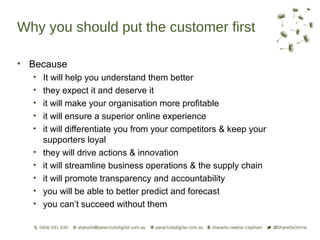
Why you should put the supporter first?

• Because
  •   It will help you understand them better
  •   they expect it and deserve it
  •   it will make your organisation more profitable
  •   it will ensure a superior online experience
  •   it will differentiate you from your competitors & keep your
      supporters loyal
  •   they will drive actions & innovation
  •   it will streamline business operations & the supply chain
  •   it will promote transparency and accountability
  •   you will be able to better predict and forecast
  •   you can’t succeed without them
How to implement a good
User Experience?
Planning your digital strategy around
giving your user the best possible
user experience.
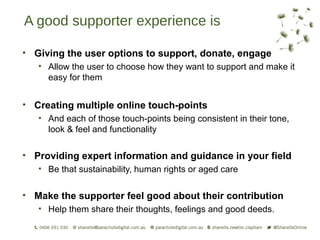
A good supporter experience is

• Giving the user options to support, donate, engage
   • Allow the user to choose how they want to support and make it
     easy for them


• Creating multiple online touch-points
   • And each of those touch-points being consistent in their tone,
     look & feel and functionality

• Providing expert information and guidance in your field
   • Be that sustainability, human rights or aged care


• Make the supporter feel good about their contribution
   • Help them share their thoughts, feelings and good deeds.
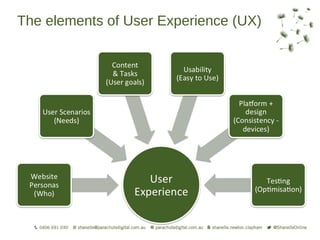
The elements of User Experience (UX)
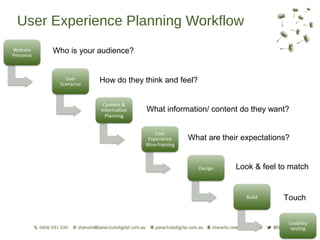
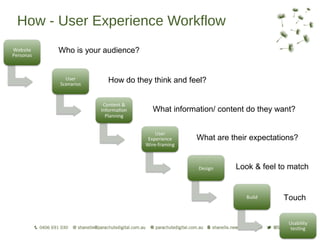
User Experience Planning Workflow
     Who is your audience?


                 How do they think and feel?


                             What information/ content do they want?


                                         What are their expectations?


                                                      Look & feel to match


                                                                   Touch
Who is your audience, really?
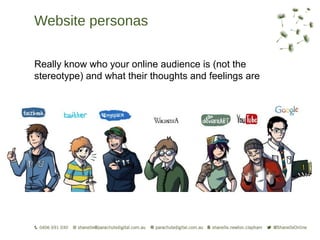
Website personas

Really know who your online audience is (not the
stereotype) and what their thoughts and feelings are
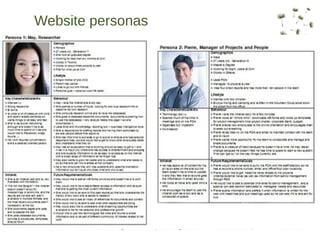
Website personas
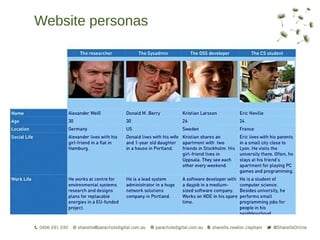
Website personas
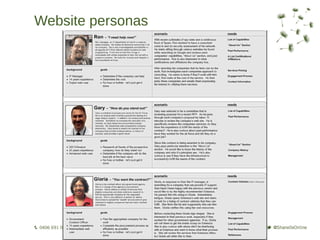
Website personas
A useful process - audience personas

By going through the process of identifying your primary
target audience and then understanding if they are in-fact
the same people online (because they might be different),
your organisation will learn how your supporters think, feel
and behave online.

This puts you in a better position to provide a superior
online experience as well as excellent supporter programs
and services.

And you now have a documented target audience for your
knowledge bank.
What are your visitor’s needs
& expectations?
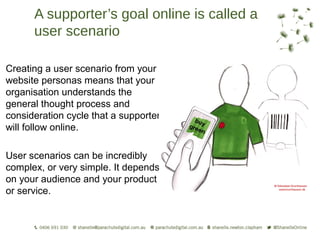
A supporter’s goal online is called a
      user scenario

Creating a user scenario from your
website personas means that your
organisation understands the
general thought process and
consideration cycle that a supporter
will follow online.

User scenarios can be incredibly
complex, or very simple. It depends
on your audience and your product
or service.
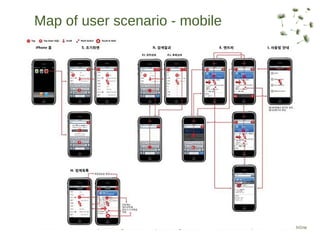
Map of user scenario - mobile
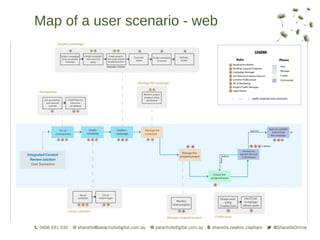
Map of a user scenario - web
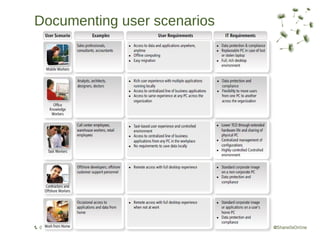
Documenting user scenarios
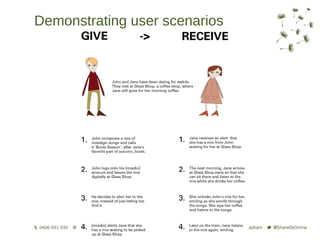
Demonstrating user scenarios
How user scenarios help guide us

Your supporter user scenarios will help guide the website
requirements, functionality spec & technology choices.

Once your audience user scenarios are mapped out in
theory, you are able to then test & refine them in practice.

Documented user scenarios are incredibly important for
bench-marketing our assumptions of user behaviour & how
they change over time.
What are they looking for?

What do your supporters want to do
online?
Your business determines their needs

Online users are finding your organisation through search or
social media or because they know and trust your brand.
When they arrive on your website, mobile site or application
or social networking profile, they already have an idea of
what they want to do because they understand what your
organisation is about.

Your job is to meet and exceed their expectations.
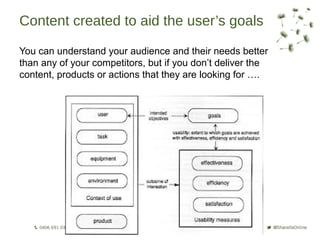
Content created to aid the user’s goals

You can understand your audience and their needs better
than any of your competitors, but if you don’t deliver the
content, products or actions that they are looking for ….
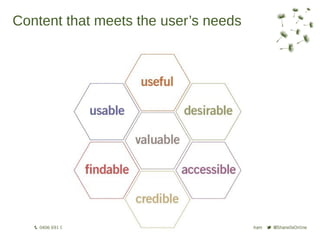
Content that meets the user’s needs
UX, Content & website navigation
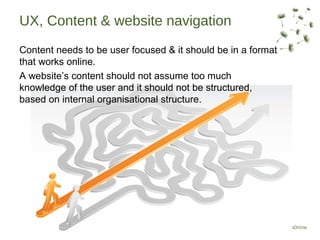
Content needs to be user focused & it should be in a format
that works online.
A website’s content should not assume too much
knowledge of the user and it should not be structured,
based on internal organisational structure.
e.g. A user’s expectations of online content
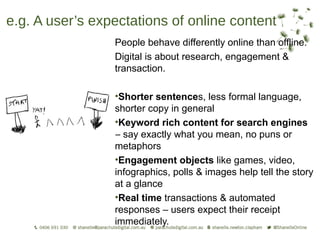
                 People behave differently online than offline.
                 Digital is about research, engagement &
                 transaction.

                 •Shorter sentences, less formal language,
                 shorter copy in general
                 •Keyword rich content for search engines
                 – say exactly what you mean, no puns or
                 metaphors
                 •Engagement objects like games, video,
                 infographics, polls & images help tell the story
                 at a glance
                 •Real time transactions & automated
                 responses – users expect their receipt
                 immediately.
How easy it is for your supporters to
find what they’re looking for/
do what they came to do?
Usability makes the world work better
Usability – how easy is it to use?


                    • It should just make sense

                    • The user’s goals should be quick
                      & easy to achieve

                    • The design & user experience
                      must match the channel & device

                    • It is more important for your
                      website, mobile site/ application or
                      social media profile to be
                      user-friendly, than beautiful.
What kind of things do your
supporters want to do online?
When a supporter visits your brand online, they have a goal
in mind.
Some supporter goals might be
   •   Sign a petition
   •   Make an enquiry
   •   Find information
   •   Make a donation
   •   Use a calculator
   •   Watch a video
   •   Subscribe to a newsletter
   •   Buy a goat
A well designed site will make it quick & easy for the user to
complete their task.
Does your website meet the
supporter’s needs?

Is the design and functionality intuitive?
User experience design

A User Experience Architect takes the website personas &
user scenarios developed and combines this your
organisation’s product & service and their knowledge of how
users behave online to design a website that;

•Can predict the user journey and workflow
•Is intuitive and easy of use
•Is accessible to all people
•Maximises the technology
•Compliments the content
•And doesn’t hinder the aesthetic design.
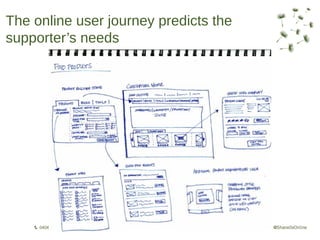
The online user journey predicts the
supporter’s needs
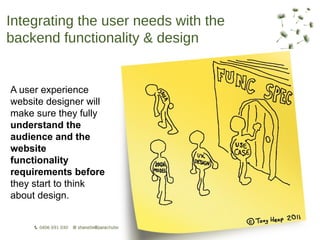
Integrating the user needs with the
backend functionality & design


A user experience
website designer will
make sure they fully
understand the
audience and the
website
functionality
requirements before
they start to think
about design.
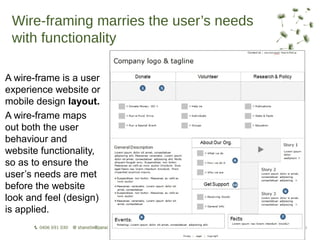
Wire-framing marries the user’s needs
 with functionality

A wire-frame is a user
experience website or
mobile design layout.
A wire-frame maps
out both the user
behaviour and
website functionality,
so as to ensure the
user’s needs are met
before the website
look and feel (design)
is applied.
User experience wire-frames

Wire-frames are the practical interpretation of your
organisations mission aligned to the website personas, user
scenarios and functionality.

Wire-frames provide an excellent tool to reflect against
when your website has been designed and then built. Your
wire-frames form the blueprint of your website.

Wire-frames are not always literally translated into design
and then built. Like all things, sometimes functionality
planned in theory doesn’t work in practice. However, they
still act as an excellent guide.
Now you have to put theory into practice
and bring it to life.
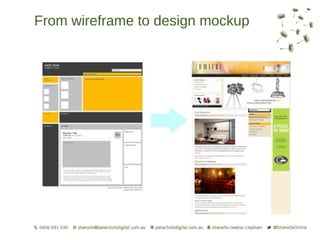
From wireframe to design mockup
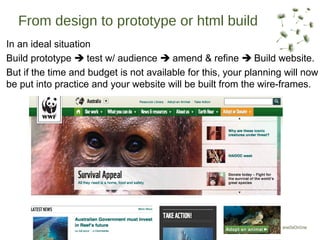
From design to prototype or html build
In an ideal situation
Build prototype  test w/ audience  amend & refine  Build website.
But if the time and budget is not available for this, your planning will now
be put into practice and your website will be built from the wire-frames.
Now we must test to make sure it
works
Once your website is finished, you must test your theory in the
real world.

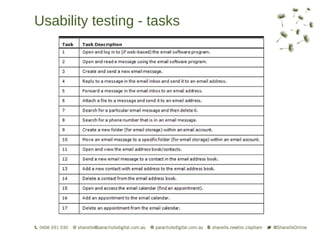
Typically usability testing would:
   • Recruit test subjects to match website personas
   • Test subjects follow user scenarios and complete tasks to
      determine if website behaves as expected
   • Any usability issues can be amended before going live
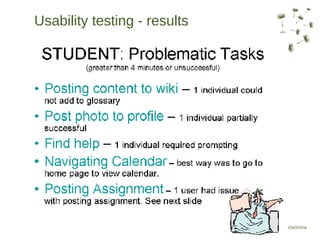
   • The usability tests create a bench-mark for the future.
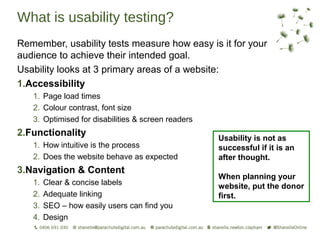
What is usability testing?
Remember, usability tests measure how easy is it for your
audience to achieve their intended goal.
Usability looks at 3 primary areas of a website:
1.Accessibility
   1. Page load times
   2. Colour contrast, font size
   3. Optimised for disabilities & screen readers
2.Functionality
                                                    Usability is not as
   1. How intuitive is the process                  successful if it is an
   2. Does the website behave as expected           after thought.
3.Navigation & Content
                                                    When planning your
   1.   Clear & concise labels                      website, put the donor
   2.   Adequate linking                            first.
   3.   SEO – how easily users can find you
   4.   Design
Your website is now live and operational
and your supporters are happy.

But has anything changed over time?
Usability testing lets you know if
your supporters are having a
good online user experience.
Usability testing & bench-marketing
Because user experience (UX) is about how people think,
feel and behave with online products and services –
naturally these things can change over time, as technology,
the marketplace and our expectations shift.

Regular (annual) usability testing should be undertaken to
ensure that your website continues to meet your user’s
needs.

It is not unheard of to see a carefully UX planned website
fail to meet their use’s needs soon after launch, because the
customer has not been kept top of mind during business as
usual operations.
If you’re thinking about a new website or online touch-point,
Usability testing is a great place to start, .
Usability testing - tasks
Usability testing - results
Usability bench-marketing

Forrester’s is the world’s leading authority on website user
experience and usability testing.

There are of course other agencies and suppliers who
specialise in user experience planning and offer usability
testing also.
Recap.

Why put the customer first and

How to plan your digital strategy
around the best possible
user experience
Online, if you put your
customer’s needs first,
  you will achieve your
 business goals as well.
Why you should put the customer first

• Because
  •   It will help you understand them better
  •   they expect it and deserve it
  •   it will make your organisation more profitable
  •   it will ensure a superior online experience
  •   it will differentiate you from your competitors & keep your
      supporters loyal
  •   they will drive actions & innovation
  •   it will streamline business operations & the supply chain
  •   it will promote transparency and accountability
  •   you will be able to better predict and forecast
  •   you can’t succeed without them
How - User Experience Workflow
     Who is your audience?


                 How do they think and feel?


                             What information/ content do they want?


                                         What are their expectations?


                                                   Look & feel to match


                                                                Touch
Any Questions?
Remember, Parachute Digital is here to
guide you through the digital landscape.

Putting the Customer's User Experience First Online

  • 1.
    Putting the supporter’s onlineexperience first Why Planning, Testing & Focusing on the User Experience Creates Great Nonprofit Websites
  • 2.
    Online, if youput your customer’s needs first, you will achieve your business goals as well.
  • 3.
    Being customer focusedonline means • Really knowing who your customers are Did you know that your online audience may be different to your traditional audience? • Understanding what your customers needs and expectations are WHY did they join/ visit your website, mobile app or Facebook page? • Planning & building your online content to meet your customers needs Make it easy for your visitors to achieve their goal.
  • 4.
    User experience (UX)is the way a person feels about using a product, system or service and how easy it is to use. User experience is subjective because it is measuring an individual’s feelings and thoughts about the system. User experience is dynamic, because technology and thus our human behaviour, changes over time.
  • 5.
    Why you shouldput your supporters first?
  • 6.
    Why you shouldput the supporter first? • Because • It will help you understand them better • they expect it and deserve it • it will make your organisation more profitable • it will ensure a superior online experience • it will differentiate you from your competitors & keep your supporters loyal • they will drive actions & innovation • it will streamline business operations & the supply chain • it will promote transparency and accountability • you will be able to better predict and forecast • you can’t succeed without them
  • 7.
    How to implementa good User Experience? Planning your digital strategy around giving your user the best possible user experience.
  • 8.
    A good supporterexperience is • Giving the user options to support, donate, engage • Allow the user to choose how they want to support and make it easy for them • Creating multiple online touch-points • And each of those touch-points being consistent in their tone, look & feel and functionality • Providing expert information and guidance in your field • Be that sustainability, human rights or aged care • Make the supporter feel good about their contribution • Help them share their thoughts, feelings and good deeds.
  • 9.
    The elements ofUser Experience (UX)
  • 10.
    User Experience PlanningWorkflow Who is your audience? How do they think and feel? What information/ content do they want? What are their expectations? Look & feel to match Touch
  • 11.
    Who is youraudience, really?
  • 12.
    Website personas Really knowwho your online audience is (not the stereotype) and what their thoughts and feelings are
  • 13.
  • 14.
  • 15.
  • 16.
    A useful process- audience personas By going through the process of identifying your primary target audience and then understanding if they are in-fact the same people online (because they might be different), your organisation will learn how your supporters think, feel and behave online. This puts you in a better position to provide a superior online experience as well as excellent supporter programs and services. And you now have a documented target audience for your knowledge bank.
  • 17.
    What are yourvisitor’s needs & expectations?
  • 18.
    A supporter’s goalonline is called a user scenario Creating a user scenario from your website personas means that your organisation understands the general thought process and consideration cycle that a supporter will follow online. User scenarios can be incredibly complex, or very simple. It depends on your audience and your product or service.
  • 19.
    Map of userscenario - mobile
  • 20.
    Map of auser scenario - web
  • 21.
  • 22.
  • 23.
    How user scenarioshelp guide us Your supporter user scenarios will help guide the website requirements, functionality spec & technology choices. Once your audience user scenarios are mapped out in theory, you are able to then test & refine them in practice. Documented user scenarios are incredibly important for bench-marketing our assumptions of user behaviour & how they change over time.
  • 24.
    What are theylooking for? What do your supporters want to do online?
  • 25.
    Your business determinestheir needs Online users are finding your organisation through search or social media or because they know and trust your brand. When they arrive on your website, mobile site or application or social networking profile, they already have an idea of what they want to do because they understand what your organisation is about. Your job is to meet and exceed their expectations.
  • 26.
    Content created toaid the user’s goals You can understand your audience and their needs better than any of your competitors, but if you don’t deliver the content, products or actions that they are looking for ….
  • 27.
    Content that meetsthe user’s needs
  • 28.
    UX, Content &website navigation Content needs to be user focused & it should be in a format that works online. A website’s content should not assume too much knowledge of the user and it should not be structured, based on internal organisational structure.
  • 29.
    e.g. A user’sexpectations of online content People behave differently online than offline. Digital is about research, engagement & transaction. •Shorter sentences, less formal language, shorter copy in general •Keyword rich content for search engines – say exactly what you mean, no puns or metaphors •Engagement objects like games, video, infographics, polls & images help tell the story at a glance •Real time transactions & automated responses – users expect their receipt immediately.
  • 30.
    How easy itis for your supporters to find what they’re looking for/ do what they came to do?
  • 31.
    Usability makes theworld work better
  • 32.
    Usability – howeasy is it to use? • It should just make sense • The user’s goals should be quick & easy to achieve • The design & user experience must match the channel & device • It is more important for your website, mobile site/ application or social media profile to be user-friendly, than beautiful.
  • 33.
    What kind ofthings do your supporters want to do online? When a supporter visits your brand online, they have a goal in mind. Some supporter goals might be • Sign a petition • Make an enquiry • Find information • Make a donation • Use a calculator • Watch a video • Subscribe to a newsletter • Buy a goat A well designed site will make it quick & easy for the user to complete their task.
  • 34.
    Does your websitemeet the supporter’s needs? Is the design and functionality intuitive?
  • 35.
    User experience design AUser Experience Architect takes the website personas & user scenarios developed and combines this your organisation’s product & service and their knowledge of how users behave online to design a website that; •Can predict the user journey and workflow •Is intuitive and easy of use •Is accessible to all people •Maximises the technology •Compliments the content •And doesn’t hinder the aesthetic design.
  • 36.
    The online userjourney predicts the supporter’s needs
  • 37.
    Integrating the userneeds with the backend functionality & design A user experience website designer will make sure they fully understand the audience and the website functionality requirements before they start to think about design.
  • 38.
    Wire-framing marries theuser’s needs with functionality A wire-frame is a user experience website or mobile design layout. A wire-frame maps out both the user behaviour and website functionality, so as to ensure the user’s needs are met before the website look and feel (design) is applied.
  • 39.
    User experience wire-frames Wire-framesare the practical interpretation of your organisations mission aligned to the website personas, user scenarios and functionality. Wire-frames provide an excellent tool to reflect against when your website has been designed and then built. Your wire-frames form the blueprint of your website. Wire-frames are not always literally translated into design and then built. Like all things, sometimes functionality planned in theory doesn’t work in practice. However, they still act as an excellent guide.
  • 40.
    Now you haveto put theory into practice and bring it to life.
  • 41.
    From wireframe todesign mockup
  • 42.
    From design toprototype or html build In an ideal situation Build prototype  test w/ audience  amend & refine  Build website. But if the time and budget is not available for this, your planning will now be put into practice and your website will be built from the wire-frames.
  • 43.
    Now we musttest to make sure it works Once your website is finished, you must test your theory in the real world. Typically usability testing would: • Recruit test subjects to match website personas • Test subjects follow user scenarios and complete tasks to determine if website behaves as expected • Any usability issues can be amended before going live • The usability tests create a bench-mark for the future.
  • 44.
    What is usabilitytesting? Remember, usability tests measure how easy is it for your audience to achieve their intended goal. Usability looks at 3 primary areas of a website: 1.Accessibility 1. Page load times 2. Colour contrast, font size 3. Optimised for disabilities & screen readers 2.Functionality Usability is not as 1. How intuitive is the process successful if it is an 2. Does the website behave as expected after thought. 3.Navigation & Content When planning your 1. Clear & concise labels website, put the donor 2. Adequate linking first. 3. SEO – how easily users can find you 4. Design
  • 45.
    Your website isnow live and operational and your supporters are happy. But has anything changed over time?
  • 46.
    Usability testing letsyou know if your supporters are having a good online user experience.
  • 47.
    Usability testing &bench-marketing Because user experience (UX) is about how people think, feel and behave with online products and services – naturally these things can change over time, as technology, the marketplace and our expectations shift. Regular (annual) usability testing should be undertaken to ensure that your website continues to meet your user’s needs. It is not unheard of to see a carefully UX planned website fail to meet their use’s needs soon after launch, because the customer has not been kept top of mind during business as usual operations. If you’re thinking about a new website or online touch-point, Usability testing is a great place to start, .
  • 48.
  • 49.
  • 50.
    Usability bench-marketing Forrester’s isthe world’s leading authority on website user experience and usability testing. There are of course other agencies and suppliers who specialise in user experience planning and offer usability testing also.
  • 51.
    Recap. Why put thecustomer first and How to plan your digital strategy around the best possible user experience
  • 52.
    Online, if youput your customer’s needs first, you will achieve your business goals as well.
  • 53.
    Why you shouldput the customer first • Because • It will help you understand them better • they expect it and deserve it • it will make your organisation more profitable • it will ensure a superior online experience • it will differentiate you from your competitors & keep your supporters loyal • they will drive actions & innovation • it will streamline business operations & the supply chain • it will promote transparency and accountability • you will be able to better predict and forecast • you can’t succeed without them
  • 54.
    How - UserExperience Workflow Who is your audience? How do they think and feel? What information/ content do they want? What are their expectations? Look & feel to match Touch
  • 55.
  • 56.
    Remember, Parachute Digitalis here to guide you through the digital landscape.

Editor's Notes

  • #3 Our philosophy
  • #5 In its simplest form. It’s about make the website user friendly and intuitive.
  • #7 The benefits
  • #9 Key characteristics Demographics Background View of the world Personality type Needs and Goals
  • #13 Key characteristics Demographics Background View of the world Personality type Needs and Goals
  • #14 Key characteristics Demographics Background View of the world Personality type Needs and Goals
  • #30 Mobile sites could be another example.
  • #45 Donor first It’s expensive because you need to plan the testing scenarios, get users to test, find a moderator/ tester, have a facility to test, record and view the sessions, compile a report and then make any major changes requires. And it takes time. Not so different to focus groups for campaign messaging or design.
  • #53 Our philosophy