Blood Pressure
Aims and Objectives
• What is blood pressure?
• Why is it measured?
• Equipment.
• Know how to record.
• Discuss the factors affecting blood pressure.
• Procedure for taking manual blood pressure.
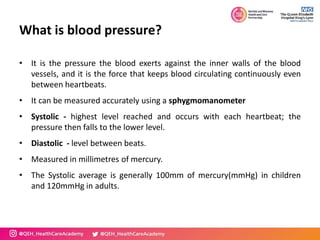
What is blood pressure?
• It is the pressure the blood exerts against the inner walls of the blood
vessels, and it is the force that keeps blood circulating continuously even
between heartbeats.
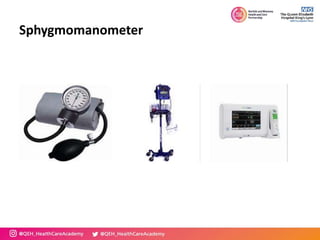
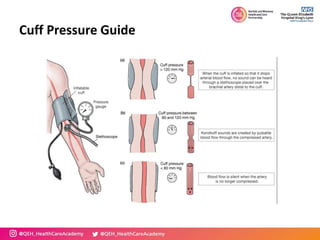
• It can be measured accurately using a sphygmomanometer
• Systolic - highest level reached and occurs with each heartbeat; the
pressure then falls to the lower level.
• Diastolic - level between beats.
• Measured in millimetres of mercury.
• The Systolic average is generally 100mm of mercury(mmHg) in children
and 120mmHg in adults.
Hypertension
Hypertension is the Rise in systolic pressure. There are various risk factors,
these include:
• kidney disease
• Diabetes
• High salt intake
• Smoking
• Obesity
• Stress
• Lack of physical activity
• Genetics
Hypertension increases the risk of strokes and heart attacks.
Hypotension
This is low blood pressure. Causes vary, but can include:
• Dehydration, resulting from excessive sweating, vomiting or diarrhoea
• Pregnancy
• Injury, bleeding or shock
• Old age
• Diabetes and other medical conditions
• Some people develop low blood pressure as they get older.
Symptoms of Hypotension
• Dizziness or light-headedness
• Fainting
• Dehydration and unusual thirst
• Lack of concentration
• Blurred vision
• Nausea
• Cold, clammy pale skin
• Rapid, shallow breathing
• Fatigue
• Depression
Sphygmomanometer
Cuff Pressure Guide
Cautions
• If patient has intravenous infusions running in one arm then record blood
pressure (BP) on the other.
• If patient has lymphoedema, has had radiotherapy, trauma or surgery to a
hand, arm, shoulder, or breast then take measurement on the opposite
arm to avoid further injury or complications caused by the pressure of the
cuff.
• If both sides are affected then BP can be taken on the patients thigh using
the correct sized thigh cuff.
• Under no circumstances should you take BP on lower leg. If you need to
use the thigh a registered practitioner Will need to be informed and
check skin integrity first.
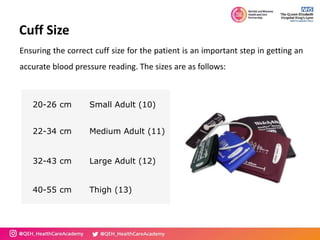
Cuff Size
Ensuring the correct cuff size for the patient is an important step in getting an
accurate blood pressure reading. The sizes are as follows:
20-26 cm Small Adult (10)
22-34 cm Medium Adult (11)
32-43 cm
40-55 cm
Large Adult (12)
Thigh (13)
Postural Hypotension
• In healthy patients there is little difference between lying, sitting and
standing blood pressure measurements. However in some patients, for
example those with postural hypotension, a significant fall in blood
pressure (20mmHg or more) can occur on standing. Postural hypotension
can present with a clinical picture of dizziness, syncope and falls, and is
more common in elderly people. Accurate measurement of the lying and
standing blood pressure can help with diagnosis.
• Lying and standing BP must be taken on all patients at risk of falls/over 60
on admission.
• If in the event of an elderly patient falling, a lying and standing blood
pressure must be taken.
Procedure for Lying and Standing BP
• If patient has an irregular pulse, measure BP manually. (NICE GUIDELINES)
• Measure BP after the patient has been either supine or seated for
5 minutes.
• Stand the patient for 1 minute and measure BP again.
• If the patient is able, ask them to stand for a further 3 minutes and
re-measure blood pressure.
• Record any symptoms of dizziness, light headedness, blurring of vision,
fatigue or palpitation.
• The lying and standing BP should be recorded in adjacent columns on the
NEWS2 by just writing lying/standing at the top of the column under the
time.
Any Questions?
If you have any queries related to the information delivered in this
presentation, feel free to contact us
Andrea.bhogall@qehkl.nhs.uk
Ryan.slater@qehkl.nhs.uk
01553 214583

Blood pressure

  • 1.
  • 2.
    Aims and Objectives •What is blood pressure? • Why is it measured? • Equipment. • Know how to record. • Discuss the factors affecting blood pressure. • Procedure for taking manual blood pressure.
  • 3.
    What is bloodpressure? • It is the pressure the blood exerts against the inner walls of the blood vessels, and it is the force that keeps blood circulating continuously even between heartbeats. • It can be measured accurately using a sphygmomanometer • Systolic - highest level reached and occurs with each heartbeat; the pressure then falls to the lower level. • Diastolic - level between beats. • Measured in millimetres of mercury. • The Systolic average is generally 100mm of mercury(mmHg) in children and 120mmHg in adults.
  • 4.
    Hypertension Hypertension is theRise in systolic pressure. There are various risk factors, these include: • kidney disease • Diabetes • High salt intake • Smoking • Obesity • Stress • Lack of physical activity • Genetics Hypertension increases the risk of strokes and heart attacks.
  • 5.
    Hypotension This is lowblood pressure. Causes vary, but can include: • Dehydration, resulting from excessive sweating, vomiting or diarrhoea • Pregnancy • Injury, bleeding or shock • Old age • Diabetes and other medical conditions • Some people develop low blood pressure as they get older.
  • 6.
    Symptoms of Hypotension •Dizziness or light-headedness • Fainting • Dehydration and unusual thirst • Lack of concentration • Blurred vision • Nausea • Cold, clammy pale skin • Rapid, shallow breathing • Fatigue • Depression
  • 7.
  • 8.
  • 9.
    Cautions • If patienthas intravenous infusions running in one arm then record blood pressure (BP) on the other. • If patient has lymphoedema, has had radiotherapy, trauma or surgery to a hand, arm, shoulder, or breast then take measurement on the opposite arm to avoid further injury or complications caused by the pressure of the cuff. • If both sides are affected then BP can be taken on the patients thigh using the correct sized thigh cuff. • Under no circumstances should you take BP on lower leg. If you need to use the thigh a registered practitioner Will need to be informed and check skin integrity first.
  • 10.
    Cuff Size Ensuring thecorrect cuff size for the patient is an important step in getting an accurate blood pressure reading. The sizes are as follows: 20-26 cm Small Adult (10) 22-34 cm Medium Adult (11) 32-43 cm 40-55 cm Large Adult (12) Thigh (13)
  • 11.
    Postural Hypotension • Inhealthy patients there is little difference between lying, sitting and standing blood pressure measurements. However in some patients, for example those with postural hypotension, a significant fall in blood pressure (20mmHg or more) can occur on standing. Postural hypotension can present with a clinical picture of dizziness, syncope and falls, and is more common in elderly people. Accurate measurement of the lying and standing blood pressure can help with diagnosis. • Lying and standing BP must be taken on all patients at risk of falls/over 60 on admission. • If in the event of an elderly patient falling, a lying and standing blood pressure must be taken.
  • 12.
    Procedure for Lyingand Standing BP • If patient has an irregular pulse, measure BP manually. (NICE GUIDELINES) • Measure BP after the patient has been either supine or seated for 5 minutes. • Stand the patient for 1 minute and measure BP again. • If the patient is able, ask them to stand for a further 3 minutes and re-measure blood pressure. • Record any symptoms of dizziness, light headedness, blurring of vision, fatigue or palpitation. • The lying and standing BP should be recorded in adjacent columns on the NEWS2 by just writing lying/standing at the top of the column under the time.
  • 13.
    Any Questions? If youhave any queries related to the information delivered in this presentation, feel free to contact us Andrea.bhogall@qehkl.nhs.uk Ryan.slater@qehkl.nhs.uk 01553 214583