International Journal of Modern Engineering Research (IJMER)
               www.ijmer.com         Vol.2, Issue.6, Nov-Dec. 2012 pp-4083-4085       ISSN: 2249-6645

                    Pulse Detonation Engine - A Next Gen Propulsion
                                                        T K Jindal
                               Assistant Professor PEC University of Technology Chandigarh.

Abstract: Pulse detonation technology has the potential to       explained by the fact that the combustion occurs in
revolutionise both in-atmosphere and space flight. Having        detonative mode. The efficiency of the cycle can be
an engine capable of running efficiently at Mach 5 will not      explained by the high level of pre compression due to the
only allow for faster, more efficient intercontinental travel,   strong shock wave in the detonation. Also, the simplicity of
but will also change the way spacecrafts are launched. The       the device is a result of the fact that the shock wave
preset paper discuss about the applications of Pulse             responsible for this compression is an integral part of the
detonation engines and different possible variants of the        detonation. PDE is similar to both the pulse-jet and the ram
engine.                                                          jet engine as no moving part is present in these engines. But
                                                                 in those two cases the mechanism behind the pre-
Key words: Pulse detonation, deflagration, detonation,           compression is completely different. For the pulse-jet the
DDT                                                              pre-compression is a result of momentum effects of the
                 I. INTRODUCTION                                 gases, and is a part of the resonance effects of the engine. In
         The main differences between the PDE and the            the ramjet, pre-compression is obtained through the ram
conventional internal combustion engine is that in the PDE       effects as the air is decelerated from supersonic to subsonic.
the combustion chamber is open and no moving parts are                     The major drawback with this concept is that the
used to compress the mixture before ignition and no shaft        engine is ineffective for speeds lower than around M =2.
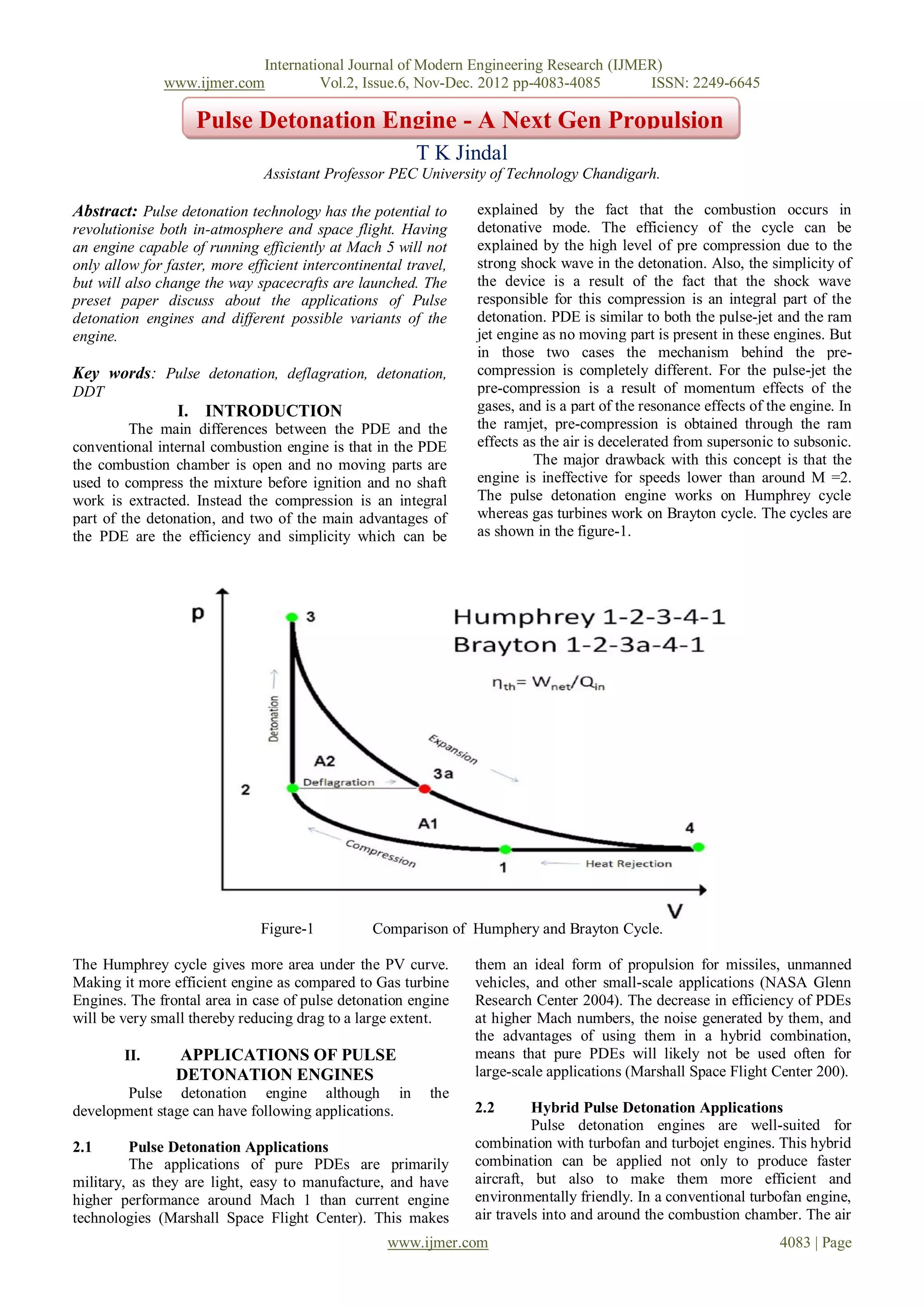
work is extracted. Instead the compression is an integral        The pulse detonation engine works on Humphrey cycle
part of the detonation, and two of the main advantages of        whereas gas turbines work on Brayton cycle. The cycles are
the PDE are the efficiency and simplicity which can be           as shown in the figure-1.


                               Figure-1          Comparison of Humphery and Brayton Cycle.

The Humphrey cycle gives more area under the PV curve.           them an ideal form of propulsion for missiles, unmanned
Making it more efficient engine as compared to Gas turbine       vehicles, and other small-scale applications (NASA Glenn
Engines. The frontal area in case of pulse detonation engine     Research Center 2004). The decrease in efficiency of PDEs
will be very small thereby reducing drag to a large extent.      at higher Mach numbers, the noise generated by them, and
                                                                 the advantages of using them in a hybrid combination,
        II.      APPLICATIONS OF PULSE                           means that pure PDEs will likely not be used often for
                 DETONATION ENGINES                              large-scale applications (Marshall Space Flight Center 200).
        Pulse detonation engine although in                the
development stage can have following applications.               2.2       Hybrid Pulse Detonation Applications
                                                                           Pulse detonation engines are well-suited for
2.1      Pulse Detonation Applications                           combination with turbofan and turbojet engines. This hybrid
         The applications of pure PDEs are primarily             combination can be applied not only to produce faster
military, as they are light, easy to manufacture, and have       aircraft, but also to make them more efficient and
higher performance around Mach 1 than current engine             environmentally friendly. In a conventional turbofan engine,
technologies (Marshall Space Flight Center). This makes          air travels into and around the combustion chamber. The air
                                                    www.ijmer.com                                                  4083 | Page
International Journal of Modern Engineering Research (IJMER)
               www.ijmer.com             Vol.2, Issue.6, Nov-Dec. 2012 pp-4083-4085            ISSN: 2249-6645
travelling around the chamber mixes with the exhaust from        detonation chamber at supersonic velocities, igniting the
the combustion chamber to provide the thrust. In a hybrid        propellants and elevating the upstream pressure to several
pulse detonation engine, the bypass air enters pulse             times (6-12 times) that of the initial fill pressure. Like
detonation tubes that surround the standard combustion           conventional, steady combustion rocket engines, PRDEs
chamber as shown in the figure-2. The tubes are then             require pressurization of the detonation chamber to obtain
cyclically detonated; one detonates while the others fill with   high performance. However, due to the high pressure ratios
air or are primed with fuel. This combination promises to        associated with detonation combustion, PDRE detonation
require simpler engine mechanisms and yield higher thrust        chamber fill pressures are much lower than chamber
with lower fuel consumption (NASA Glenn Research                 pressures associated with conventional rocket engines.
Center 2004; General Electric 2004).                                        PDREs can employ a variety of thermodynamic
          Hybrid pulse detonation engines will allow             cycles to power turbo pumps, such as gas generator, staged
commercial aircraft to be faster, more efficient, and more       combustion, or expander cycles, or incorporate pressurized
environmentally friendly. NASA is projecting that the            feed systems. PDRE operating pressures may be on the
intercity travel time will reduce significantly by the year      order of 100-200 psia, as compared to several hundred psia
2007, and inter-continental travel time will also reduce         for conventional open cycle engines and several thousand
significantly by 2022, thanks to this technology. In addition,   psia for conventional closed cycle engines.
they suggest that NOx emissions may decrease by up to                       The multiple-chamber PDRE concept shown in
70% and 80% respectively in the same time periods (NASA          Figure-3 is provided by Pratt & Whitney Aero sciences.
Glenn Research Center 2004).                                     This concept includes six detonation chambers coupled to a
                                                                 common feed system and nozzle assembly. Operationally,
                                                                 the detonation chambers are fired in a phased manner
                                                                 allowing the feed system and manifolds to operate in a
                                                                 steady state manner. All of the detonation chamber
                                                                 combustion products are exhausted through the single
                                                                 common nozzle.
                                                                            Other PDRE configurations are possible. PDRE
                                                                 designs and configurations are influenced by specific
                                                                 mission requirements and engineering solutions adopted to
                                                                 address fundamental technical and operability issues.
          Figure 2: A PDE Hybrid Turbofan (right)
                                                                 2.4        Pulse detonation wave engine
          Similarly, hybrid PDEs can also be used in military               One option for a hypersonic vehicle might be four
applications. A large number of modern fighter jets employ       or six Pulse Detonation Wave Engines (PDWEs), fuelled
afterburner-equipped low-bypass turbofan or turbojet             with liquid methane. As air breathers, these PDWEs could
engines. Although this process is an effective solution, it is   theoretically propel a hypersonic aircraft towards Mach 10
not a fuel efficient solution. Hybrid PDEs will deliver the      at an altitude in excess of 180,000 feet.
same thrust with less fuel consumption.                                     The PDWE works by creating a liquid hydrogen
                                                                 detonation inside a specially designed chamber when the
2.3       Pulse Detonation Rocket Engines (PDREs)                aircraft is traveling beyond the speed of sound [3]. When
          Similar to PDEs, PDREs produce thrust by               traveling at such speeds, a thrust wall is created in front of
cyclically detonating propellants within a detonation            the aircraft. When the detonation takes place, the airplane's
chamber and exhausting the combustion products through a         thrust wall is pushed forward. This process is continually
nozzle. However, unlike PDEs PDREs must carry all of the         repeated to propel the aircraft. From the ground the jet
oxidizer necessary to complete their specific missions           stream looks like "donuts-on-a-rope."Not much is known
onboard, and PDREs may have vacuum start and restart             about Pulse Detonation Wave technology, but there have
requirements for many applications. PDREs will incorporate       been quite a few reports and sightings of mysterious aircraft
propellant storage, feed, and injection system components;       using propulsion technology unlike any heard or seen
one or more detonation chambers ignition systems,                before. One of them is like……….
detonation chamber/nozzle interface hardware, nozzles, and                  On February 25, 26, and 27, 1992, there were
engine control system components. Similar to PDEs,               night-time sightings of an unknown aircraft with a
numerous PDRE configurations may evolve depending                "diamond-pattern" of lights at Beale Air Force Base, which
upon engineering design solutions adopted to overcome            was thought to be the Aurora aircraft. The aircraft had a
technical challenges.                                            distinctive engine noise, described as "a very, very low
          Once propellants are injected into PDRE                rumble, like air rushing through a big tube." On the night of
detonation chambers, the fast-acting propellant injection        February 26, what was thought to be a ground test of
valves close to seal the detonation chamber and detonation       Aurora's propulsion systems took place. A series of
is initiated. The detonation wave passes through the


                                                   www.ijmer.com                                                   4084 | Page
International Journal of Modern Engineering Research (IJMER)
              www.ijmer.com         Vol.2, Issue.6, Nov-Dec. 2012 pp-4083-4085       ISSN: 2249-6645


                                   Figure 3Conceptual Pulse detonation rocket engine

"
Booms" was heard and described as similar to "artillery                             REFERNECES
fire" and "deep bass notes, not like sonic booms." It was       [1]   PULSE DETONATION ENGINE TECHNOLOGY:
thought these were "light-off" tests of the engines. It was           AN OVERVIEW by Matthew Lam, Daniel Tillie,
speculated that the aircraft was using Pulse Detonation               Timothy Leaver, and Brian McFadden Applied
Wave Engines. The noise and low frequency would, it was               Science 201The University of British Columbia
said, be consistent with PDWE technology.                             November 26, 2004.
                                                                [2]   T. Bussing, J. Hinkey and L. Kaye, Adroit Systems,
       III.     SPACE FLIGHT APPLICATIONS                             Inc., "Pulse Detonation Engine Preliminary Design
         While air breathing pulse detonation engines                 Considerations," 30th AIAA/ASME/SAE/ASEE Joint
would not be able to operate in space, they may be used to            Propulsion Conference, Indianapolis, IN (27-29 June
reduce the cost and complexity of launching spacecraft. As            1994).
PDEs do not require heavy and expensive pumps, they offer       [3]   E. Lynch and R. Eidelman, Rockwell International,
a viable alternative to current rocket engines. The decreased         "Analysis of the Pulse Detonation Wave Engine,"
weight, along with better fuel consumption, would                     Developments in High-Speed-Vehicle Propulsion
significantly reduce the cost of launching spacecraft. Using          Systems, AIAA Progress in Astronautics and
pulse detonation in combination with other propulsion                 Aeronautics, Vol. 165, pp. 473-516 (1996).
sources could potentially decrease the cost of launching        [4]   T. Bratkovich, et al.. Adroit Systems, Inc., "An
payloads into space.                                                  Introduction to Pulse Detonation Rocket Engines
                                                                      (PDREs)," 33rd AIAA/ASME/SAE/ASEE Joint
                IV.      CONCLUSION                                   Propulsion Conference and Exhibit, Seattle, WA,
         The Pulse detonation is a new technology, though             AIAA 97-2742 (6-9 July 1997),
the research started well in 1940. The pulse detonation         [5]   Mawid, M.A., Park, T.W., Sekar B. & Arana C.
engines have many advantages over the other engines for               (2003). Application of pulse detonation combustion to
propulsive purposes and can be more reliable when                     turbofan engines. Journal of Engineering for Gas
developed fully. The main concern is the production of the            Turbines and Power 125(1). 270-283.
shocks and noise. The other concern is the frequency of
operation and the control of the temperature in the tube
which lead to the material concerns. However there have
been many excellent demonstrations of the engine all over
the world. Pulse detonation engine is being seen as
promising next generation propulsion system which will
give aircrafts a clean configuration.


                                                   www.ijmer.com                                               4085 | Page

Pulse Detonation Engine - A Next Gen Propulsion

  • 1.
    International Journal ofModern Engineering Research (IJMER) www.ijmer.com Vol.2, Issue.6, Nov-Dec. 2012 pp-4083-4085 ISSN: 2249-6645 Pulse Detonation Engine - A Next Gen Propulsion T K Jindal Assistant Professor PEC University of Technology Chandigarh. Abstract: Pulse detonation technology has the potential to explained by the fact that the combustion occurs in revolutionise both in-atmosphere and space flight. Having detonative mode. The efficiency of the cycle can be an engine capable of running efficiently at Mach 5 will not explained by the high level of pre compression due to the only allow for faster, more efficient intercontinental travel, strong shock wave in the detonation. Also, the simplicity of but will also change the way spacecrafts are launched. The the device is a result of the fact that the shock wave preset paper discuss about the applications of Pulse responsible for this compression is an integral part of the detonation engines and different possible variants of the detonation. PDE is similar to both the pulse-jet and the ram engine. jet engine as no moving part is present in these engines. But in those two cases the mechanism behind the pre- Key words: Pulse detonation, deflagration, detonation, compression is completely different. For the pulse-jet the DDT pre-compression is a result of momentum effects of the I. INTRODUCTION gases, and is a part of the resonance effects of the engine. In The main differences between the PDE and the the ramjet, pre-compression is obtained through the ram conventional internal combustion engine is that in the PDE effects as the air is decelerated from supersonic to subsonic. the combustion chamber is open and no moving parts are The major drawback with this concept is that the used to compress the mixture before ignition and no shaft engine is ineffective for speeds lower than around M =2. work is extracted. Instead the compression is an integral The pulse detonation engine works on Humphrey cycle part of the detonation, and two of the main advantages of whereas gas turbines work on Brayton cycle. The cycles are the PDE are the efficiency and simplicity which can be as shown in the figure-1. Figure-1 Comparison of Humphery and Brayton Cycle. The Humphrey cycle gives more area under the PV curve. them an ideal form of propulsion for missiles, unmanned Making it more efficient engine as compared to Gas turbine vehicles, and other small-scale applications (NASA Glenn Engines. The frontal area in case of pulse detonation engine Research Center 2004). The decrease in efficiency of PDEs will be very small thereby reducing drag to a large extent. at higher Mach numbers, the noise generated by them, and the advantages of using them in a hybrid combination, II. APPLICATIONS OF PULSE means that pure PDEs will likely not be used often for DETONATION ENGINES large-scale applications (Marshall Space Flight Center 200). Pulse detonation engine although in the development stage can have following applications. 2.2 Hybrid Pulse Detonation Applications Pulse detonation engines are well-suited for 2.1 Pulse Detonation Applications combination with turbofan and turbojet engines. This hybrid The applications of pure PDEs are primarily combination can be applied not only to produce faster military, as they are light, easy to manufacture, and have aircraft, but also to make them more efficient and higher performance around Mach 1 than current engine environmentally friendly. In a conventional turbofan engine, technologies (Marshall Space Flight Center). This makes air travels into and around the combustion chamber. The air www.ijmer.com 4083 | Page
  • 2.
    International Journal ofModern Engineering Research (IJMER) www.ijmer.com Vol.2, Issue.6, Nov-Dec. 2012 pp-4083-4085 ISSN: 2249-6645 travelling around the chamber mixes with the exhaust from detonation chamber at supersonic velocities, igniting the the combustion chamber to provide the thrust. In a hybrid propellants and elevating the upstream pressure to several pulse detonation engine, the bypass air enters pulse times (6-12 times) that of the initial fill pressure. Like detonation tubes that surround the standard combustion conventional, steady combustion rocket engines, PRDEs chamber as shown in the figure-2. The tubes are then require pressurization of the detonation chamber to obtain cyclically detonated; one detonates while the others fill with high performance. However, due to the high pressure ratios air or are primed with fuel. This combination promises to associated with detonation combustion, PDRE detonation require simpler engine mechanisms and yield higher thrust chamber fill pressures are much lower than chamber with lower fuel consumption (NASA Glenn Research pressures associated with conventional rocket engines. Center 2004; General Electric 2004). PDREs can employ a variety of thermodynamic Hybrid pulse detonation engines will allow cycles to power turbo pumps, such as gas generator, staged commercial aircraft to be faster, more efficient, and more combustion, or expander cycles, or incorporate pressurized environmentally friendly. NASA is projecting that the feed systems. PDRE operating pressures may be on the intercity travel time will reduce significantly by the year order of 100-200 psia, as compared to several hundred psia 2007, and inter-continental travel time will also reduce for conventional open cycle engines and several thousand significantly by 2022, thanks to this technology. In addition, psia for conventional closed cycle engines. they suggest that NOx emissions may decrease by up to The multiple-chamber PDRE concept shown in 70% and 80% respectively in the same time periods (NASA Figure-3 is provided by Pratt & Whitney Aero sciences. Glenn Research Center 2004). This concept includes six detonation chambers coupled to a common feed system and nozzle assembly. Operationally, the detonation chambers are fired in a phased manner allowing the feed system and manifolds to operate in a steady state manner. All of the detonation chamber combustion products are exhausted through the single common nozzle. Other PDRE configurations are possible. PDRE designs and configurations are influenced by specific mission requirements and engineering solutions adopted to address fundamental technical and operability issues. Figure 2: A PDE Hybrid Turbofan (right) 2.4 Pulse detonation wave engine Similarly, hybrid PDEs can also be used in military One option for a hypersonic vehicle might be four applications. A large number of modern fighter jets employ or six Pulse Detonation Wave Engines (PDWEs), fuelled afterburner-equipped low-bypass turbofan or turbojet with liquid methane. As air breathers, these PDWEs could engines. Although this process is an effective solution, it is theoretically propel a hypersonic aircraft towards Mach 10 not a fuel efficient solution. Hybrid PDEs will deliver the at an altitude in excess of 180,000 feet. same thrust with less fuel consumption. The PDWE works by creating a liquid hydrogen detonation inside a specially designed chamber when the 2.3 Pulse Detonation Rocket Engines (PDREs) aircraft is traveling beyond the speed of sound [3]. When Similar to PDEs, PDREs produce thrust by traveling at such speeds, a thrust wall is created in front of cyclically detonating propellants within a detonation the aircraft. When the detonation takes place, the airplane's chamber and exhausting the combustion products through a thrust wall is pushed forward. This process is continually nozzle. However, unlike PDEs PDREs must carry all of the repeated to propel the aircraft. From the ground the jet oxidizer necessary to complete their specific missions stream looks like "donuts-on-a-rope."Not much is known onboard, and PDREs may have vacuum start and restart about Pulse Detonation Wave technology, but there have requirements for many applications. PDREs will incorporate been quite a few reports and sightings of mysterious aircraft propellant storage, feed, and injection system components; using propulsion technology unlike any heard or seen one or more detonation chambers ignition systems, before. One of them is like………. detonation chamber/nozzle interface hardware, nozzles, and On February 25, 26, and 27, 1992, there were engine control system components. Similar to PDEs, night-time sightings of an unknown aircraft with a numerous PDRE configurations may evolve depending "diamond-pattern" of lights at Beale Air Force Base, which upon engineering design solutions adopted to overcome was thought to be the Aurora aircraft. The aircraft had a technical challenges. distinctive engine noise, described as "a very, very low Once propellants are injected into PDRE rumble, like air rushing through a big tube." On the night of detonation chambers, the fast-acting propellant injection February 26, what was thought to be a ground test of valves close to seal the detonation chamber and detonation Aurora's propulsion systems took place. A series of is initiated. The detonation wave passes through the www.ijmer.com 4084 | Page
  • 3.
    International Journal ofModern Engineering Research (IJMER) www.ijmer.com Vol.2, Issue.6, Nov-Dec. 2012 pp-4083-4085 ISSN: 2249-6645 Figure 3Conceptual Pulse detonation rocket engine " Booms" was heard and described as similar to "artillery REFERNECES fire" and "deep bass notes, not like sonic booms." It was [1] PULSE DETONATION ENGINE TECHNOLOGY: thought these were "light-off" tests of the engines. It was AN OVERVIEW by Matthew Lam, Daniel Tillie, speculated that the aircraft was using Pulse Detonation Timothy Leaver, and Brian McFadden Applied Wave Engines. The noise and low frequency would, it was Science 201The University of British Columbia said, be consistent with PDWE technology. November 26, 2004. [2] T. Bussing, J. Hinkey and L. Kaye, Adroit Systems, III. SPACE FLIGHT APPLICATIONS Inc., "Pulse Detonation Engine Preliminary Design While air breathing pulse detonation engines Considerations," 30th AIAA/ASME/SAE/ASEE Joint would not be able to operate in space, they may be used to Propulsion Conference, Indianapolis, IN (27-29 June reduce the cost and complexity of launching spacecraft. As 1994). PDEs do not require heavy and expensive pumps, they offer [3] E. Lynch and R. Eidelman, Rockwell International, a viable alternative to current rocket engines. The decreased "Analysis of the Pulse Detonation Wave Engine," weight, along with better fuel consumption, would Developments in High-Speed-Vehicle Propulsion significantly reduce the cost of launching spacecraft. Using Systems, AIAA Progress in Astronautics and pulse detonation in combination with other propulsion Aeronautics, Vol. 165, pp. 473-516 (1996). sources could potentially decrease the cost of launching [4] T. Bratkovich, et al.. Adroit Systems, Inc., "An payloads into space. Introduction to Pulse Detonation Rocket Engines (PDREs)," 33rd AIAA/ASME/SAE/ASEE Joint IV. CONCLUSION Propulsion Conference and Exhibit, Seattle, WA, The Pulse detonation is a new technology, though AIAA 97-2742 (6-9 July 1997), the research started well in 1940. The pulse detonation [5] Mawid, M.A., Park, T.W., Sekar B. & Arana C. engines have many advantages over the other engines for (2003). Application of pulse detonation combustion to propulsive purposes and can be more reliable when turbofan engines. Journal of Engineering for Gas developed fully. The main concern is the production of the Turbines and Power 125(1). 270-283. shocks and noise. The other concern is the frequency of operation and the control of the temperature in the tube which lead to the material concerns. However there have been many excellent demonstrations of the engine all over the world. Pulse detonation engine is being seen as promising next generation propulsion system which will give aircrafts a clean configuration. www.ijmer.com 4085 | Page