G.Dinesh kumar, D.Gowri Shankar, D.Balaji / International Journal of Engineering Research
           and Applications       (IJERA) ISSN: 2248-9622         www.ijera.com
                   Vol. 3, Issue 1, January -February 2013, pp.1955-1960

       Computational evaluation of strut based scramjet engine
        combustion with different conventional fuel/oxidizer

                   G.Dinesh kumar1, D.Gowri Shankar2, D.Balaji3
                    Department of Aeronautical Engineering, Hindustan University, India

Abstract —
         The high performance and instability in       This type of vehicle, according to current proposals,
combustion chamber are the most challenging            will use scramjet propulsion system. Both hydrogen
requirements for faster developments and               and hydrocarbon fuels are considered depending on
technical advances in most of the engines. The         applications and speed range. Although, hydrogen
design and development challenges of such              has attractive features in terms of specific impulse,
engines are highly influenced by its combustion        ignition characteristics, etc., liquid hydrocarbon fuel
behavior taking place inside the combustion            is preferred for volume limited applications in the
chamber. Studies on the injection, vaporization        lower hypersonic region (M<8). Starting from the
and combustion phenomena inside combustion             pioneering work of significant advances is made in
chamber are a growing challenge and difficult          the design of scramjet engines. Over the last few
entities in design and vigorously investigated by      decades, great emphases were placed on analytical,
researchers. In this domain, the present research      experimental and CFD techniques to understand the
is formulated for analyzing the combustion             mixing and combustion processes in the scramjet
performance of hydrogen/hydrocarbon and                combustors. In a recent review, Emerging hypersonic
oxygen computationally in a strut based                air breathing propulsion systems offer the potential to
combustion chamber. This work leads way to             enable new classes of flight vehicles that allow rapid
identify the injection flow behavior and the           response at long range, more maneuverable flight,
hypersonic combustion nature of various fuels          better survivability, and routine and assured access to
with comparison of different parameters. CFD           space. Historically, rocket boosters have been used to
simulations of the hydrogen/hydrocarbon fuelled        propel hypersonic vehicles (i.e., those flying faster
strut based scramjet combustor are performed at        than 5 times the local speed of sound) for
Mach 2 airstream having typical Mach 10 flying         applications such as space launch, long-range
conditions. The primary objective of this study is     ballistic flight, and air-defense interceptor missiles.
to    numerically      evaluate    the    combustor    Air breathing propulsion systems currently under
performance for varying fuels and its injection        development will provide a means for sustained and
parameters       .Mixing    and     reacting   flow    accelerating flight within the atmosphere at
characteristics of the combustor are studied for       hypersonic speeds long-range cruise missiles for
the centrally located strut based scramjet             attack of time-sensitive targets, flexible high-altitude
combustor solving three dimensional RANS               atmospheric interceptors, responsive hypersonic
equations k-epsilon turbulence model using             aircraft for global payload delivery, and reusable
coupled implicit solver based on finite volume         launch vehicles for efficient space access.
approach. Salient results of non-reacting and             Using kerosene fuel and commercial CFD Behera
reacting flow simulations are presented.               and Chakraborty1 numerically studied the flow field
Performance parameter like mixing efficiency,          of a ramp cavity based scramjet combustor. Their
total         pressure          recovery        and    computational results had shown good agreement
hydrogen/hydrocarbon          consumption       are    with experimental values, and the computed
computed and compared for different cases. The         combustion efficiency was near unity, when the fuel
computation is performed by using a CFD solver         equivalence ratio was small
FLUENT and analyzed for LES model of four                 The requirements of numerical simulation for
different fuels.                                       modelling turbulent combusting flows and the
                                                       problems associated with it were studied by Borgi et
Keywords— Hydrogen fuel, Hypersonic                    al. 2. The author observed that the reactive zones
combustion, Combustion performance, Strut              were very thin leads to problems in modelling of
injector, Air breathing hypersonic vehicle             mean reaction rates. The authors found out that the
                                                       temperature       and     concentration     fluctuations
               I. INTRODUCTION                         influenced strongly the chemistry of combustion.
        The success of an efficient design of a           To assess the merits of kerosene and methane for
hypersonic air breathing cruise vehicle largely        future reusable booster stage was investigated by
depends on the proper choice of propulsion system.     Burkhardt et al. 3. They used liquid oxygen as the
                                                       oxidizer for both fuels. Initially they identified the


                                                                                              1955 | P a g e
G.Dinesh kumar, D.Gowri Shankar, D.Balaji / International Journal of Engineering Research
           and Applications       (IJERA) ISSN: 2248-9622         www.ijera.com
                   Vol. 3, Issue 1, January -February 2013, pp.1955-1960

thermodynamic and chemical properties of kerosene                c) Equation of conservation of energy:
and methane. They found that methane fueled                                     
propulsive systems are disadvantageous, when cost                    ( E )  . ( E  p) 
                                                                  t                                            =
was considered
   Grueing and Mayinger 4 carried out an                                                     
experimental investigation of supersonic combustion        .k eff T   h j J j  ( . eff )  Q
of liquid hydrocarbons. They burnt kerosene in air           
                                                                        j                      
                                                                                                     (2.5)
flow at Mach 2.5 in a modelled scramjet combustor.                d) Equation of state:
On comparing the results with hydrogen combustion                 p = ρRT               (2.6)
they found that the kerosene combustion by a gas                  For numerical modelling of multiphase flows
dynamic feedback mechanism strongly affected the           existing in the flow field, the above equations are
supersonic combustion process.                             slightly modified to adjust the effect of the liquid-
   Town end 5 reported about the best possible             vapour mixture.
applications of scramjets in the current scenario.
Citing several examples he proved the value of             3. Material and Design
hydrocarbons for the initial stages of launcher                         a. Length of strut - 0.39m.
acceleration and reduction of bulky tankage by                           b. Radius of injector - 0.005m.
selection of kerosene as the fuel. Through his                           c. Breadth - 0.01m.
findings the author came to a conclusion that the use                    d. Wedge angle - 100.
of hydrocarbons.
                                                              The above mentioned data’s are the geometric
               II. CFD ANALYSIS                            dimensions of channel that is taken for analysis. It is
        For the ideal thrust chamber, some of the          designed using AutoCAD or Gambit in a 2
parameters are directly dealt by design parameters         dimensional aspect. The purpose of these studies was
such as combustor geometry, size, and injector             to determine the hypersonic combustion analyses of
element design and nozzle configuration. Here an           various fuels are analyzed. This strut is placed along
attempt has been carried out to analyse the sizable        the flow distribution with the blunt leading edge
parameters related to thrust chamber design through
numerical modelling of thrust chamber performance          A. Computational Modelling
encompassing a wide range of approaches of CFD.                The computational domain is created with proper
Hence, the results of the numerical analysis have          dimensions. The dimension of the channel is .039 x
been found out in two major domain of thrust               0.1m with the half wedge angle is 100 and the radius
chamber.                                                   of the injector is 0.005m. This 2-D model is designed
                                                           by using the GAMBIT software. Before design the
1) Injection system using strut injector,                  proper dimension should be selected and after the
2) Analysis of various fuels.                              design is to be meshed.
          Thus the investigation of combustion and
flow behaviour in a propulsion system’s thrust             B. Meshing of Model
chamber has been carried out with the help of                  The grid was generated by using the gambit
numerical scheme using the governing equations as          software and size of the meshed file is 0.1 spacing
follows                                                    between the grid points. In the figure shown below
          The mass flow rate of an injector can be         rectangular obstacle were used. Similarly for others
determined using the continuity equation:                  the grid was generated.
 m  U 1 A1  U 2 A2
                                         (2.1)                The above mentioned data’s are the geometric
and the Bernoulli equation:                                dimensions of channel that is taken for analysis. It is
                                                           designed using AutoCAD or Gambit in a 2
              U 1 2            U 2
                                   2
p 01  p1              p2             p1 2 (2.2)     dimensional aspect. The purpose of these studies was
                2                   2                      to determine the supersonic combustion using this
a) Equation of conservation of mass:                       strut based centrally located injector. Even the
                                                        hypersonic combustion analysis of various fuels is
      .v   0                                 (2.3)   analyzed. This strut is placed along the flow
  t                                                       distribution with the blunt leading edge
b) Equation of conservation of
momentum                                                   C. Boundary Conditions
     
v                                 
        .( )  p  .( )  g  F          (2.4)            The flow domain has been formed inside the
  t                                                       combustion channel. The dimension of combustion

               T   . I 
                                     2                channel has been taken as 1600mm × 38mm. The
where                                                      fuel Injection having diameter 10mm, located at the
                             3                           leading edge of the combustion channel has been


                                                                                                   1956 | P a g e
G.Dinesh kumar, D.Gowri Shankar, D.Balaji / International Journal of Engineering Research
           and Applications       (IJERA) ISSN: 2248-9622         www.ijera.com
                   Vol. 3, Issue 1, January -February 2013, pp.1955-1960

made for computation. The following boundary                    In this project seeing all these analysis and
condition has been assigned. For modelling purpose         numerical simulations we conclude that air breathing
oxygen velocity inlet boundary condition has been          engine (scramjet engine) found to show better result
assigned for the inlet domain and pressure outlet          using kerosene fuel at 8.8 Mach and 21500 Pascal
condition has been assigned to the outlet domain.          when fuel injected by strut. The ejection velocity
Other boundary condition includes the default hard         finally we got near 4400m/s, which comes around 13
interior of the wall created using Gambit. The             Mach. This shows combustor is performing in Hyper-
boundary conditions are given in the table 4.1 for the     sonic regimes
inlet and outlet.
                                                                   V. FUTURE SCOPE OF WORK
     III. RESULTS AND DISCUSSIONS                                   The work done gives a satisfactory result
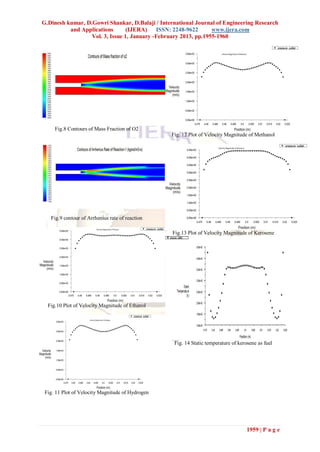
          A comparative histogram showing exit             with present combustor model and for more concise
velocities of scramjet combustor for various fuels are     dealing we can change some design parameters. The
shown fig 6.6e. In that plot kerosene found to be          future scopes in this work are:
most efficient, the next lays ethanol, then methanol.               The problem we solved is 2D and single
Hydrogen is pollution free fuel but not suitable for air   plane mixing is analyzed. In future we can extend to
breathing engines at hypersonic velocities. The plots      3D, and double plane mixing is possible. We can
clearly show that kerosene is best efficient fuel for      predict the flow at each nook and corner of
our combustor model. The exit velocity found to            combustor.
increase with respect to time in fig .13                        We analyzed for a fuel velocity of 660m/s. In
    From the plot, the next efficient fuel is ethanol,     future we shall do it by changing velocities of fuel
having 6 hydrogen bonds. Based the number of               and air flow. It may give a better understanding of
hydrogen bond, the performance is rated. The               fuel performance at various ranges.
numerical investigation also shows a similar result.                New type of injector other than strut such as
Methanol having 4 hydrogen bonds showing results           aerodynamic, ramp based or cantilever shall be
lesser than ethanol. Hydrogen stands last in the           employed to see results.
analysis. The performance results of analysis shows a               We defined our fuel temperature at injector.
very lower velocity magnitude for hydrogen fuel.           In alternate we can specify the interior and exterior
                                                           wall temperature of the combustor.
                IV. CONCLUSION
          Designs for hypersonic engines have been                          REFERENCES
around since the early 1900’s. Ramjet technology             [1]   Ahmed, A., and Briec, E., ―Overview of
has been developing over the past eight decades and,               CFD in automotive engine combustion‖,
except for marginal improvements, has been shown                   Network Newsletter, Vol-1, No.-3, Dept.of
to be suited for atmospheric flight speeds up to Mach              Engine Engineering, Renault, January, 2002,
5. The desire for faster, more efficient engines gave              pp. 17-20.
birth to the idea of a scramjet, utilizing supersonic        [2]   Ananias, T., ―A numerical approach for the
combustion and potentially expanding the speed                     simulation of non-premixed counter flow
envelope to the Mach 15 range. The promise of                      flames and reacting mixing layer‖,
covering the entire planet at high speed from                      Institution for Mathematics and it’s
horizontal takeoff for both civil and military aircraft            Applications Publication,Vol-3, 1999-2000,
is an attractive prospect. However, along with new                 pp. 1-2.
technology and discoveries also come new obstacles           [3]   Arunajatesan, S., and Sinha, N., ―Large eddy
to be addressed.                                                   simulations of supersonic impinging jet flow
          In order to study the establishment of the               fields‖, AIAA 2002-4287, proceedings of 38
major flow features in a generic scramjet combustor                AIAA/ASME/SAE/ASEE Joint Propulsion
several numerical simulations were carried out. A                  Conf. and Exhibit, Vol-1, July 7-10, 2002,
question still prevails in efficient fuel for hypersonic           pp. 1-9.
regions. We considered 4 fuels for our analysis              [4]   Bai, H.C, Le, J.L, Zhang, Z.C, Goldfield,
(Hydrogen, kerosene, ethanol & methanol).                          M.A, Nestoulia, R.V., and Starov, A.V, “
          On comparing performance of all the fuels,               Methodical aspects of investigation of
we concluded that kerosene has higher ejection                     kerosene ignition and combustion in a
velocity. The reason is number of hydrogen bonds.                  scramjet model”,Report of Centre of
Breaking up of hydrogen bonds releases heat energy,                Aerodynamic             Research          and
since kerosene has several hydrogen bonds (C12H23)                 Development,China, Vol-13,July, 2002, pp.
the energy released is much higher than other fuel                 101-105.
under specified operating conditions.                        [5]   Behera, and Chakraborty, D “Numerically
                                                                   studied the flow field of a ramp cavity based


                                                                                                1957 | P a g e
G.Dinesh kumar, D.Gowri Shankar, D.Balaji / International Journal of Engineering Research
           and Applications       (IJERA) ISSN: 2248-9622         www.ijera.com
                   Vol. 3, Issue 1, January -February 2013, pp.1955-1960

         scramjet combustor”, AIAA Paper No.
         2006–3895 2010.
  [6]    Bhatia, R., and Sirignano, W.A., “One-
         dimensional analysis of liquid fuelled
         combustion instability”, Jr. of Prop. and
         Power, Vol. 7, No. 6, November-December,
         1991, pp. 652-660.
  [7]    Bogdanoff, D.W., “Advanced injection and
         mixing      techniques      for     scramjet
         combustors”, Jr. of Prop. and Power, Vol.
         10, No.2, March-April, 1994, pp. 183-187.
         111
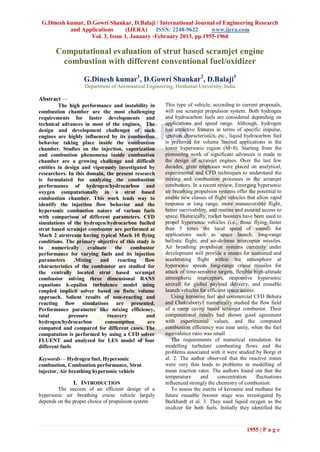
  [8]    Broadbent, E.G., “Calculation of inviscid 3-   Fig.4 Contours of Velocity Magnitude after
         d supersonic flows with heat and mass                         Combustion
         addition”, Phil. Trans. Royal Soc. London,A
         (1999) 357, 1999, pp. 2379- 2386
  [9]    Burkhardt, H., Sippel, M., Herbertz, A., and
         Klevanski, J., “Comparative study of
         kerosene and methane propellant engines
         for reusable liquid booster stages”,
         Proceedings of 4th Intl. Conf. on Launcher
         Tech., December 3-6, 2002, pp. 1-12
  [10]   Charles. M., Gokhale, S.S, and Jayaraj, S.,
         “The Nonreactive mixing study injector of a
         scramjet swept-strut fuel injector”, Jr. of
         Aerospace Sciences and Technologies , Vol
         58, No 4, November, 2006, pp. 1-7
11. Table and Figure                                    Fig.5 Contours of Velocity Magnitude after
                                                                       Combustion


Fig.1 A generic scramjet combustor with centrally
located Fuel injector strut. (From NASA Contractor
                                                          Fig.6 Contours of Mass Fraction of co2
Report 187467)


         Fig.3 Combustor boundary conditions


                                                         Fig.7 Contours of Mass Fraction of H2 o


                                                                                       1958 | P a g e
G.Dinesh kumar, D.Gowri Shankar, D.Balaji / International Journal of Engineering Research
          and Applications       (IJERA) ISSN: 2248-9622         www.ijera.com
                  Vol. 3, Issue 1, January -February 2013, pp.1955-1960


     Fig.8 Contours of Mass Fraction of O2
                                                  Fig. 12 Plot of Velocity Magnitude of Methanol


   Fig.9 contour of Arrhenius rate of reaction

                                                  Fig.13 Plot of Velocity Magnitude of Kerosene


  Fig.10 Plot of Velocity Magnitude of Ethanol


                                                   Fig. 14 Static temperature of kerosene as fuel


 Fig. 11 Plot of Velocity Magnitude of Hydrogen


                                                                                     1959 | P a g e
Fig. 15 Histogram comparing velocity of all fuel


                                                   1960 | P a g e

Kr3119551960

  • 1.
    G.Dinesh kumar, D.GowriShankar, D.Balaji / International Journal of Engineering Research and Applications (IJERA) ISSN: 2248-9622 www.ijera.com Vol. 3, Issue 1, January -February 2013, pp.1955-1960 Computational evaluation of strut based scramjet engine combustion with different conventional fuel/oxidizer G.Dinesh kumar1, D.Gowri Shankar2, D.Balaji3 Department of Aeronautical Engineering, Hindustan University, India Abstract — The high performance and instability in This type of vehicle, according to current proposals, combustion chamber are the most challenging will use scramjet propulsion system. Both hydrogen requirements for faster developments and and hydrocarbon fuels are considered depending on technical advances in most of the engines. The applications and speed range. Although, hydrogen design and development challenges of such has attractive features in terms of specific impulse, engines are highly influenced by its combustion ignition characteristics, etc., liquid hydrocarbon fuel behavior taking place inside the combustion is preferred for volume limited applications in the chamber. Studies on the injection, vaporization lower hypersonic region (M<8). Starting from the and combustion phenomena inside combustion pioneering work of significant advances is made in chamber are a growing challenge and difficult the design of scramjet engines. Over the last few entities in design and vigorously investigated by decades, great emphases were placed on analytical, researchers. In this domain, the present research experimental and CFD techniques to understand the is formulated for analyzing the combustion mixing and combustion processes in the scramjet performance of hydrogen/hydrocarbon and combustors. In a recent review, Emerging hypersonic oxygen computationally in a strut based air breathing propulsion systems offer the potential to combustion chamber. This work leads way to enable new classes of flight vehicles that allow rapid identify the injection flow behavior and the response at long range, more maneuverable flight, hypersonic combustion nature of various fuels better survivability, and routine and assured access to with comparison of different parameters. CFD space. Historically, rocket boosters have been used to simulations of the hydrogen/hydrocarbon fuelled propel hypersonic vehicles (i.e., those flying faster strut based scramjet combustor are performed at than 5 times the local speed of sound) for Mach 2 airstream having typical Mach 10 flying applications such as space launch, long-range conditions. The primary objective of this study is ballistic flight, and air-defense interceptor missiles. to numerically evaluate the combustor Air breathing propulsion systems currently under performance for varying fuels and its injection development will provide a means for sustained and parameters .Mixing and reacting flow accelerating flight within the atmosphere at characteristics of the combustor are studied for hypersonic speeds long-range cruise missiles for the centrally located strut based scramjet attack of time-sensitive targets, flexible high-altitude combustor solving three dimensional RANS atmospheric interceptors, responsive hypersonic equations k-epsilon turbulence model using aircraft for global payload delivery, and reusable coupled implicit solver based on finite volume launch vehicles for efficient space access. approach. Salient results of non-reacting and Using kerosene fuel and commercial CFD Behera reacting flow simulations are presented. and Chakraborty1 numerically studied the flow field Performance parameter like mixing efficiency, of a ramp cavity based scramjet combustor. Their total pressure recovery and computational results had shown good agreement hydrogen/hydrocarbon consumption are with experimental values, and the computed computed and compared for different cases. The combustion efficiency was near unity, when the fuel computation is performed by using a CFD solver equivalence ratio was small FLUENT and analyzed for LES model of four The requirements of numerical simulation for different fuels. modelling turbulent combusting flows and the problems associated with it were studied by Borgi et Keywords— Hydrogen fuel, Hypersonic al. 2. The author observed that the reactive zones combustion, Combustion performance, Strut were very thin leads to problems in modelling of injector, Air breathing hypersonic vehicle mean reaction rates. The authors found out that the temperature and concentration fluctuations I. INTRODUCTION influenced strongly the chemistry of combustion. The success of an efficient design of a To assess the merits of kerosene and methane for hypersonic air breathing cruise vehicle largely future reusable booster stage was investigated by depends on the proper choice of propulsion system. Burkhardt et al. 3. They used liquid oxygen as the oxidizer for both fuels. Initially they identified the 1955 | P a g e
  • 2.
    G.Dinesh kumar, D.GowriShankar, D.Balaji / International Journal of Engineering Research and Applications (IJERA) ISSN: 2248-9622 www.ijera.com Vol. 3, Issue 1, January -February 2013, pp.1955-1960 thermodynamic and chemical properties of kerosene c) Equation of conservation of energy: and methane. They found that methane fueled   propulsive systems are disadvantageous, when cost ( E )  . ( E  p)  t = was considered Grueing and Mayinger 4 carried out an     experimental investigation of supersonic combustion .k eff T   h j J j  ( . eff )  Q of liquid hydrocarbons. They burnt kerosene in air   j   (2.5) flow at Mach 2.5 in a modelled scramjet combustor. d) Equation of state: On comparing the results with hydrogen combustion p = ρRT (2.6) they found that the kerosene combustion by a gas For numerical modelling of multiphase flows dynamic feedback mechanism strongly affected the existing in the flow field, the above equations are supersonic combustion process. slightly modified to adjust the effect of the liquid- Town end 5 reported about the best possible vapour mixture. applications of scramjets in the current scenario. Citing several examples he proved the value of 3. Material and Design hydrocarbons for the initial stages of launcher a. Length of strut - 0.39m. acceleration and reduction of bulky tankage by b. Radius of injector - 0.005m. selection of kerosene as the fuel. Through his c. Breadth - 0.01m. findings the author came to a conclusion that the use d. Wedge angle - 100. of hydrocarbons. The above mentioned data’s are the geometric II. CFD ANALYSIS dimensions of channel that is taken for analysis. It is For the ideal thrust chamber, some of the designed using AutoCAD or Gambit in a 2 parameters are directly dealt by design parameters dimensional aspect. The purpose of these studies was such as combustor geometry, size, and injector to determine the hypersonic combustion analyses of element design and nozzle configuration. Here an various fuels are analyzed. This strut is placed along attempt has been carried out to analyse the sizable the flow distribution with the blunt leading edge parameters related to thrust chamber design through numerical modelling of thrust chamber performance A. Computational Modelling encompassing a wide range of approaches of CFD. The computational domain is created with proper Hence, the results of the numerical analysis have dimensions. The dimension of the channel is .039 x been found out in two major domain of thrust 0.1m with the half wedge angle is 100 and the radius chamber. of the injector is 0.005m. This 2-D model is designed by using the GAMBIT software. Before design the 1) Injection system using strut injector, proper dimension should be selected and after the 2) Analysis of various fuels. design is to be meshed. Thus the investigation of combustion and flow behaviour in a propulsion system’s thrust B. Meshing of Model chamber has been carried out with the help of The grid was generated by using the gambit numerical scheme using the governing equations as software and size of the meshed file is 0.1 spacing follows between the grid points. In the figure shown below The mass flow rate of an injector can be rectangular obstacle were used. Similarly for others determined using the continuity equation: the grid was generated. m  U 1 A1  U 2 A2  (2.1) The above mentioned data’s are the geometric and the Bernoulli equation: dimensions of channel that is taken for analysis. It is designed using AutoCAD or Gambit in a 2 U 1 2 U 2 2 p 01  p1   p2   p1 2 (2.2) dimensional aspect. The purpose of these studies was 2 2 to determine the supersonic combustion using this a) Equation of conservation of mass: strut based centrally located injector. Even the   hypersonic combustion analysis of various fuels is  .v   0 (2.3) analyzed. This strut is placed along the flow t distribution with the blunt leading edge b) Equation of conservation of momentum C. Boundary Conditions  v     .( )  p  .( )  g  F (2.4) The flow domain has been formed inside the t combustion channel. The dimension of combustion       T   . I     2   channel has been taken as 1600mm × 38mm. The where fuel Injection having diameter 10mm, located at the  3  leading edge of the combustion channel has been 1956 | P a g e
  • 3.
    G.Dinesh kumar, D.GowriShankar, D.Balaji / International Journal of Engineering Research and Applications (IJERA) ISSN: 2248-9622 www.ijera.com Vol. 3, Issue 1, January -February 2013, pp.1955-1960 made for computation. The following boundary In this project seeing all these analysis and condition has been assigned. For modelling purpose numerical simulations we conclude that air breathing oxygen velocity inlet boundary condition has been engine (scramjet engine) found to show better result assigned for the inlet domain and pressure outlet using kerosene fuel at 8.8 Mach and 21500 Pascal condition has been assigned to the outlet domain. when fuel injected by strut. The ejection velocity Other boundary condition includes the default hard finally we got near 4400m/s, which comes around 13 interior of the wall created using Gambit. The Mach. This shows combustor is performing in Hyper- boundary conditions are given in the table 4.1 for the sonic regimes inlet and outlet. V. FUTURE SCOPE OF WORK III. RESULTS AND DISCUSSIONS The work done gives a satisfactory result A comparative histogram showing exit with present combustor model and for more concise velocities of scramjet combustor for various fuels are dealing we can change some design parameters. The shown fig 6.6e. In that plot kerosene found to be future scopes in this work are: most efficient, the next lays ethanol, then methanol. The problem we solved is 2D and single Hydrogen is pollution free fuel but not suitable for air plane mixing is analyzed. In future we can extend to breathing engines at hypersonic velocities. The plots 3D, and double plane mixing is possible. We can clearly show that kerosene is best efficient fuel for predict the flow at each nook and corner of our combustor model. The exit velocity found to combustor. increase with respect to time in fig .13 We analyzed for a fuel velocity of 660m/s. In From the plot, the next efficient fuel is ethanol, future we shall do it by changing velocities of fuel having 6 hydrogen bonds. Based the number of and air flow. It may give a better understanding of hydrogen bond, the performance is rated. The fuel performance at various ranges. numerical investigation also shows a similar result. New type of injector other than strut such as Methanol having 4 hydrogen bonds showing results aerodynamic, ramp based or cantilever shall be lesser than ethanol. Hydrogen stands last in the employed to see results. analysis. The performance results of analysis shows a We defined our fuel temperature at injector. very lower velocity magnitude for hydrogen fuel. In alternate we can specify the interior and exterior wall temperature of the combustor. IV. CONCLUSION Designs for hypersonic engines have been REFERENCES around since the early 1900’s. Ramjet technology [1] Ahmed, A., and Briec, E., ―Overview of has been developing over the past eight decades and, CFD in automotive engine combustion‖, except for marginal improvements, has been shown Network Newsletter, Vol-1, No.-3, Dept.of to be suited for atmospheric flight speeds up to Mach Engine Engineering, Renault, January, 2002, 5. The desire for faster, more efficient engines gave pp. 17-20. birth to the idea of a scramjet, utilizing supersonic [2] Ananias, T., ―A numerical approach for the combustion and potentially expanding the speed simulation of non-premixed counter flow envelope to the Mach 15 range. The promise of flames and reacting mixing layer‖, covering the entire planet at high speed from Institution for Mathematics and it’s horizontal takeoff for both civil and military aircraft Applications Publication,Vol-3, 1999-2000, is an attractive prospect. However, along with new pp. 1-2. technology and discoveries also come new obstacles [3] Arunajatesan, S., and Sinha, N., ―Large eddy to be addressed. simulations of supersonic impinging jet flow In order to study the establishment of the fields‖, AIAA 2002-4287, proceedings of 38 major flow features in a generic scramjet combustor AIAA/ASME/SAE/ASEE Joint Propulsion several numerical simulations were carried out. A Conf. and Exhibit, Vol-1, July 7-10, 2002, question still prevails in efficient fuel for hypersonic pp. 1-9. regions. We considered 4 fuels for our analysis [4] Bai, H.C, Le, J.L, Zhang, Z.C, Goldfield, (Hydrogen, kerosene, ethanol & methanol). M.A, Nestoulia, R.V., and Starov, A.V, “ On comparing performance of all the fuels, Methodical aspects of investigation of we concluded that kerosene has higher ejection kerosene ignition and combustion in a velocity. The reason is number of hydrogen bonds. scramjet model”,Report of Centre of Breaking up of hydrogen bonds releases heat energy, Aerodynamic Research and since kerosene has several hydrogen bonds (C12H23) Development,China, Vol-13,July, 2002, pp. the energy released is much higher than other fuel 101-105. under specified operating conditions. [5] Behera, and Chakraborty, D “Numerically studied the flow field of a ramp cavity based 1957 | P a g e
  • 4.
    G.Dinesh kumar, D.GowriShankar, D.Balaji / International Journal of Engineering Research and Applications (IJERA) ISSN: 2248-9622 www.ijera.com Vol. 3, Issue 1, January -February 2013, pp.1955-1960 scramjet combustor”, AIAA Paper No. 2006–3895 2010. [6] Bhatia, R., and Sirignano, W.A., “One- dimensional analysis of liquid fuelled combustion instability”, Jr. of Prop. and Power, Vol. 7, No. 6, November-December, 1991, pp. 652-660. [7] Bogdanoff, D.W., “Advanced injection and mixing techniques for scramjet combustors”, Jr. of Prop. and Power, Vol. 10, No.2, March-April, 1994, pp. 183-187. 111 [8] Broadbent, E.G., “Calculation of inviscid 3- Fig.4 Contours of Velocity Magnitude after d supersonic flows with heat and mass Combustion addition”, Phil. Trans. Royal Soc. London,A (1999) 357, 1999, pp. 2379- 2386 [9] Burkhardt, H., Sippel, M., Herbertz, A., and Klevanski, J., “Comparative study of kerosene and methane propellant engines for reusable liquid booster stages”, Proceedings of 4th Intl. Conf. on Launcher Tech., December 3-6, 2002, pp. 1-12 [10] Charles. M., Gokhale, S.S, and Jayaraj, S., “The Nonreactive mixing study injector of a scramjet swept-strut fuel injector”, Jr. of Aerospace Sciences and Technologies , Vol 58, No 4, November, 2006, pp. 1-7 11. Table and Figure Fig.5 Contours of Velocity Magnitude after Combustion Fig.1 A generic scramjet combustor with centrally located Fuel injector strut. (From NASA Contractor Fig.6 Contours of Mass Fraction of co2 Report 187467) Fig.3 Combustor boundary conditions Fig.7 Contours of Mass Fraction of H2 o 1958 | P a g e
  • 5.
    G.Dinesh kumar, D.GowriShankar, D.Balaji / International Journal of Engineering Research and Applications (IJERA) ISSN: 2248-9622 www.ijera.com Vol. 3, Issue 1, January -February 2013, pp.1955-1960 Fig.8 Contours of Mass Fraction of O2 Fig. 12 Plot of Velocity Magnitude of Methanol Fig.9 contour of Arrhenius rate of reaction Fig.13 Plot of Velocity Magnitude of Kerosene Fig.10 Plot of Velocity Magnitude of Ethanol Fig. 14 Static temperature of kerosene as fuel Fig. 11 Plot of Velocity Magnitude of Hydrogen 1959 | P a g e
  • 6.
    Fig. 15 Histogramcomparing velocity of all fuel 1960 | P a g e