BLENDED WING BODY
FUTURE OF AVIATION
PRESENTED BY:- ASIM KUMAR GHATAK
V SEMESTER
MECHANICAL ENGINEERING
JSS ACADEMY OF TECHNICAL EDUCATION NOIDA
CONTENTS
1. INTRODUCTION
2. BRIEF HISTORY OF BWB
3. HOW AEROPLANES FLY?
4. SOME ORGANISMS WITH BWB
5. DESIGN AND STRUCTURE OF BWB
6. CONVENTIONAL AEROPLANES Vs. BWB
7. ADVANTAGES AND DISADVANTAGES OF BWB
8. FUTURE SCOPE AND CHALLENGES
9. CONCLUSION
10. REFERENCES
INTRODUCTION
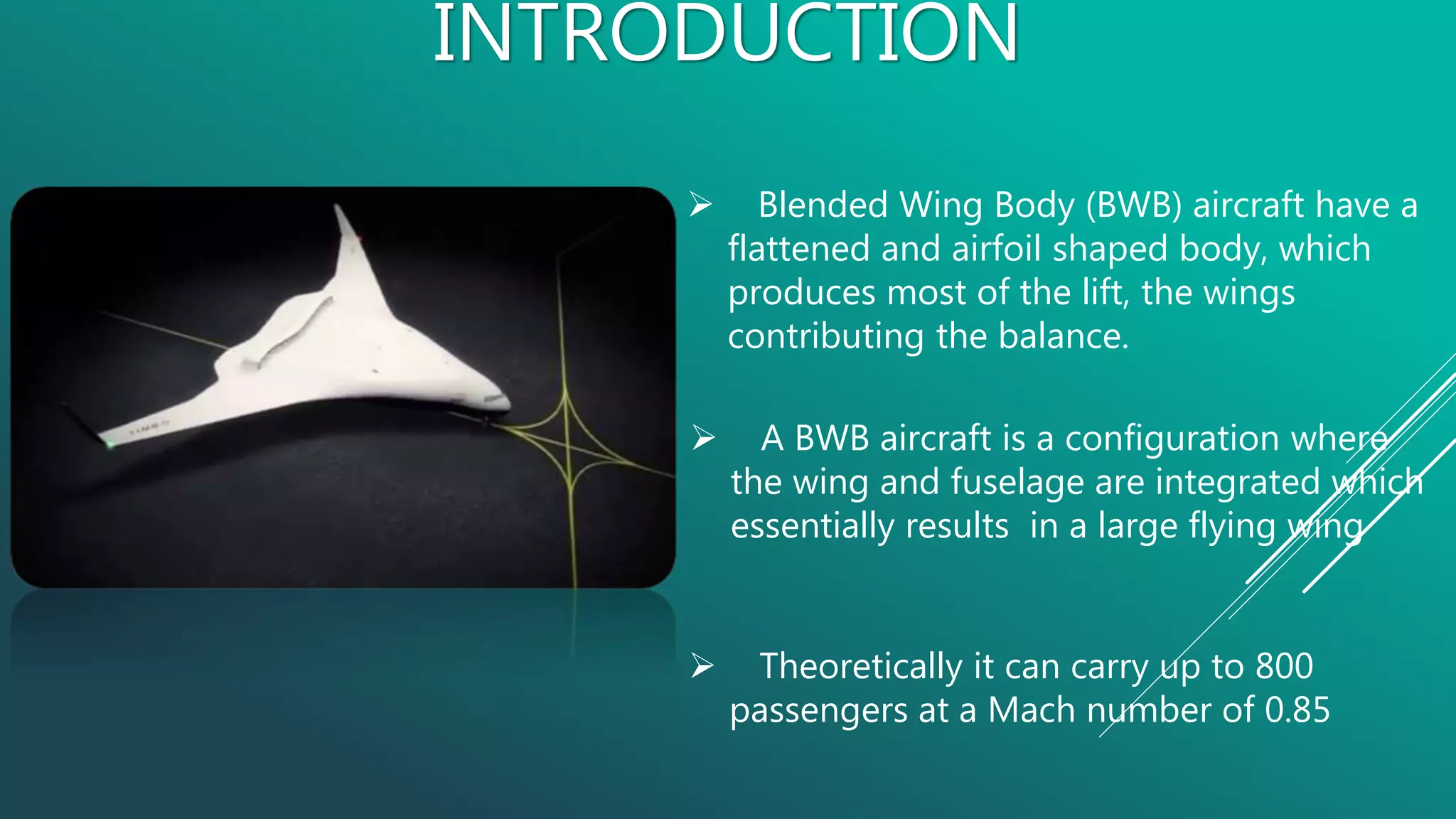
 Blended Wing Body (BWB) aircraft have a
flattened and airfoil shaped body, which
produces most of the lift, the wings
contributing the balance.
 A BWB aircraft is a configuration where
the wing and fuselage are integrated which
essentially results in a large flying wing
 Theoretically it can carry up to 800
passengers at a Mach number of 0.85
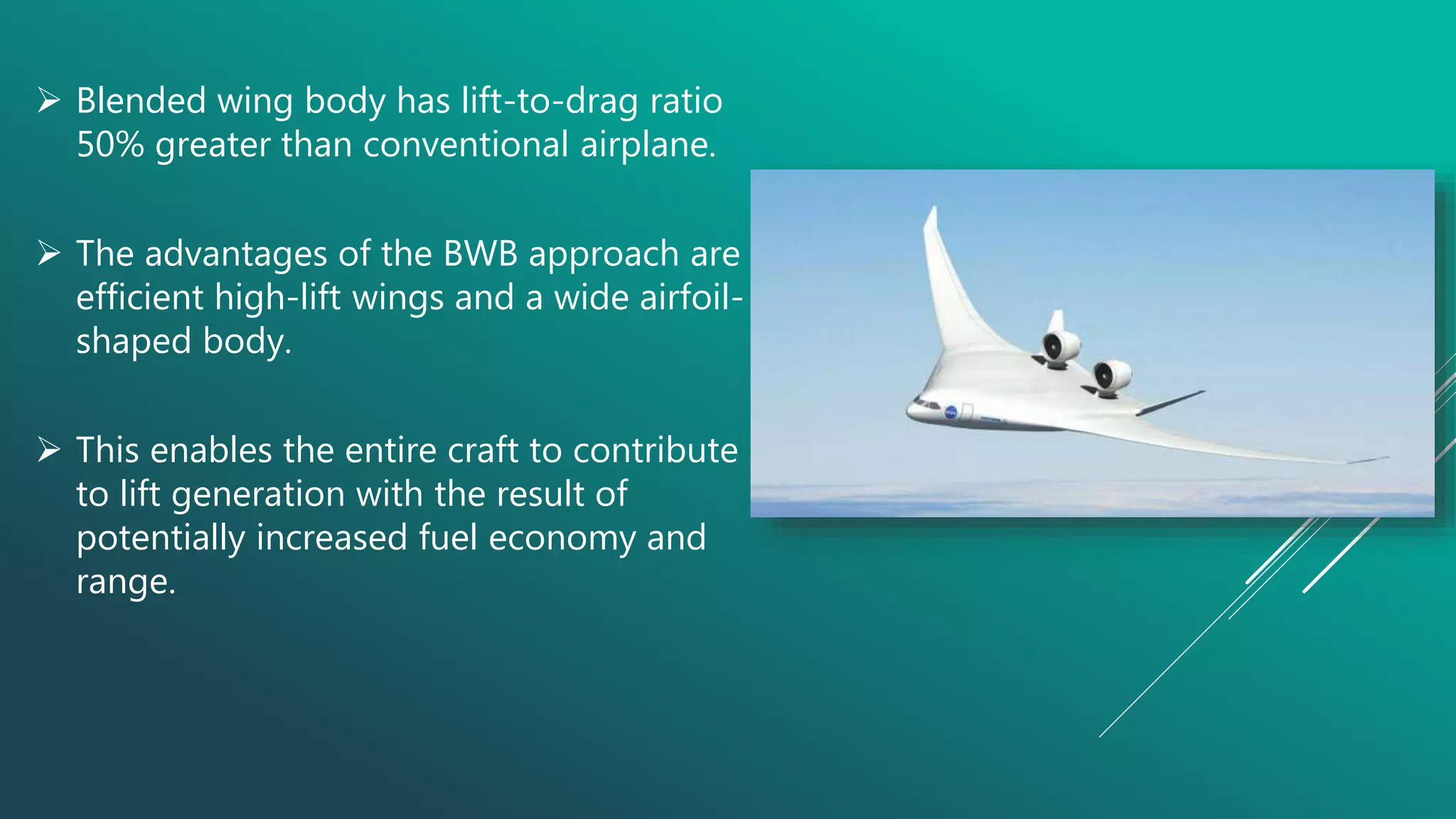
 Blended wing body has lift-to-drag ratio
50% greater than conventional airplane.
 The advantages of the BWB approach are
efficient high-lift wings and a wide airfoil-
shaped body.
 This enables the entire craft to contribute
to lift generation with the result of
potentially increased fuel economy and
range.
Northrop N1M “Jeep”, by Northrop Corporation, USA
The concept of Blended Wing
body was introduced almost
27 years ago.
The idea was to build a new type of
aircraft that would allow the aircraft
to carry more passengers.
[1]
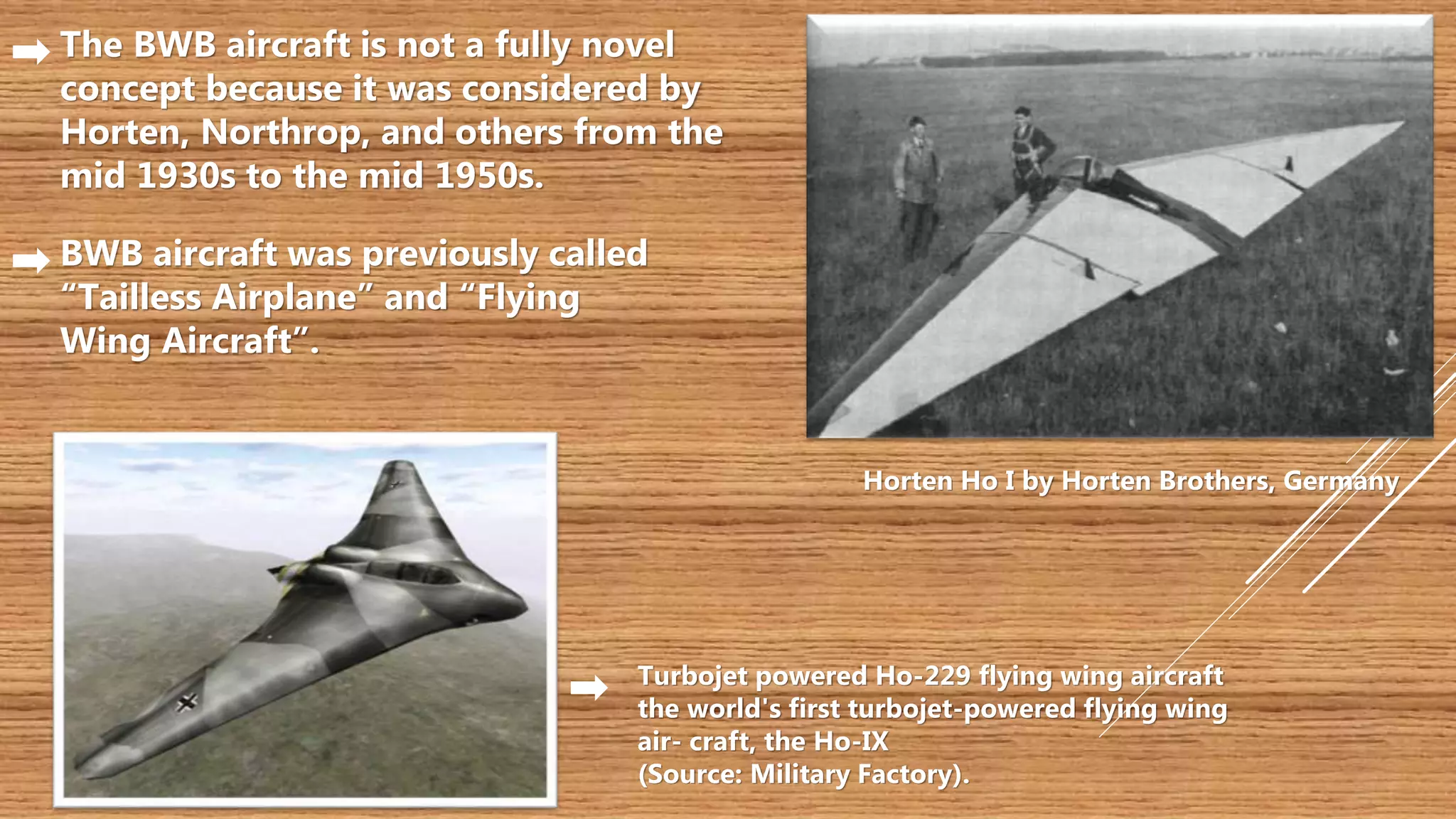
Horten Ho I by Horten Brothers, Germany
The BWB aircraft is not a fully novel
concept because it was considered by
Horten, Northrop, and others from the
mid 1930s to the mid 1950s.
BWB aircraft was previously called
“Tailless Airplane” and “Flying
Wing Aircraft”.
Turbojet powered Ho-229 flying wing aircraft
the world's first turbojet-powered flying wing
air- craft, the Ho-IX
(Source: Military Factory).
The Northrop semi-flying wing aircraft
1928
(Source: Smithsonian NASA Museum).
Northrop XB-35 piston-engined long-range
bomber 1946 (Source: Virtual Aircraft Museum).
The Northrop XB-35 aircraft, which came into service
in1946, is powered by four piston engines, each
driving two contra-rotating four-blade pusher
propeller through a long shaft and gear box.
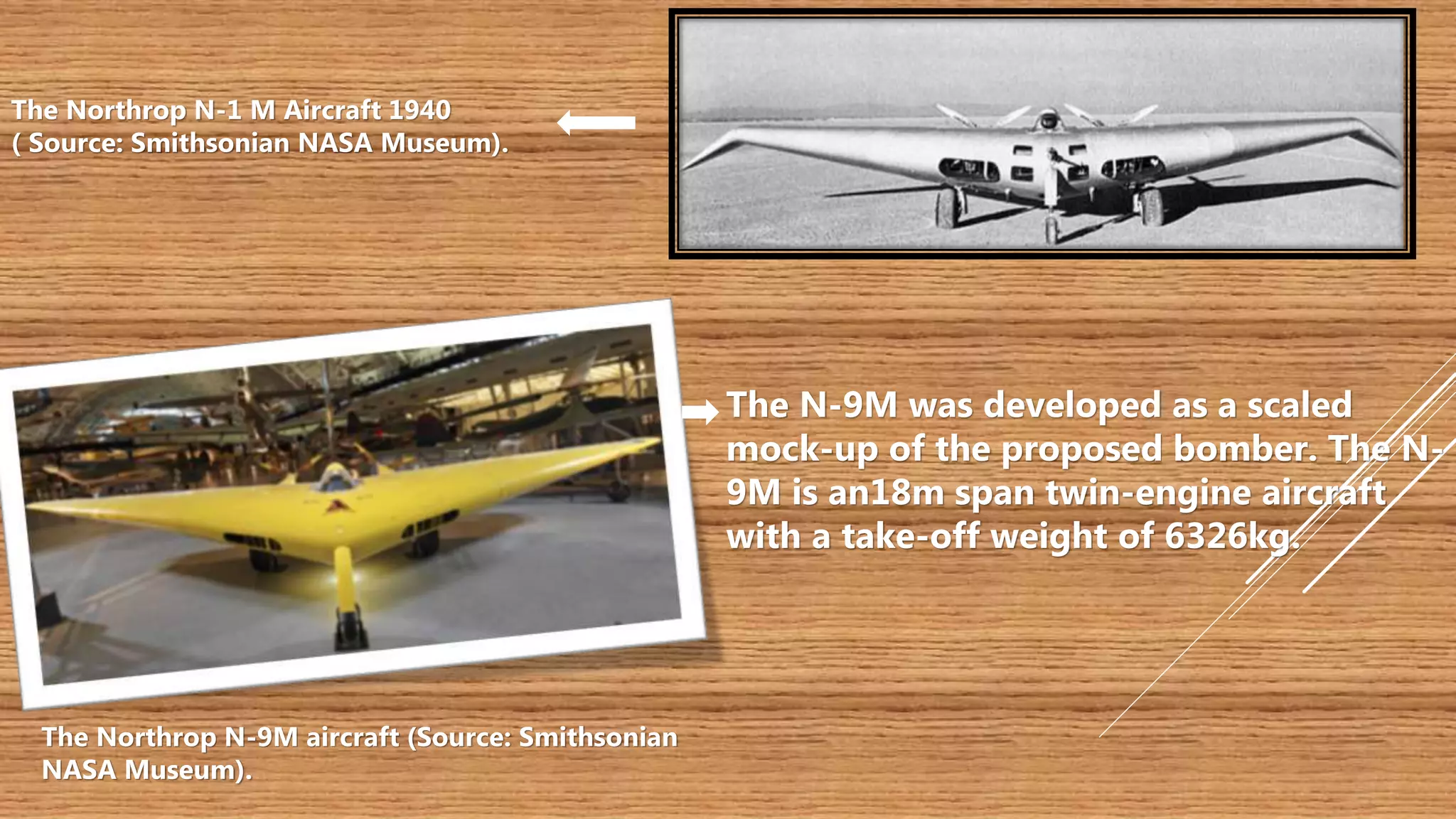
The Northrop N-1 M Aircraft 1940
( Source: Smithsonian NASA Museum).
The Northrop N-9M aircraft (Source: Smithsonian
NASA Museum).
The N-9M was developed as a scaled
mock-up of the proposed bomber. The N-
9M is an18m span twin-engine aircraft
with a take-off weight of 6326kg.
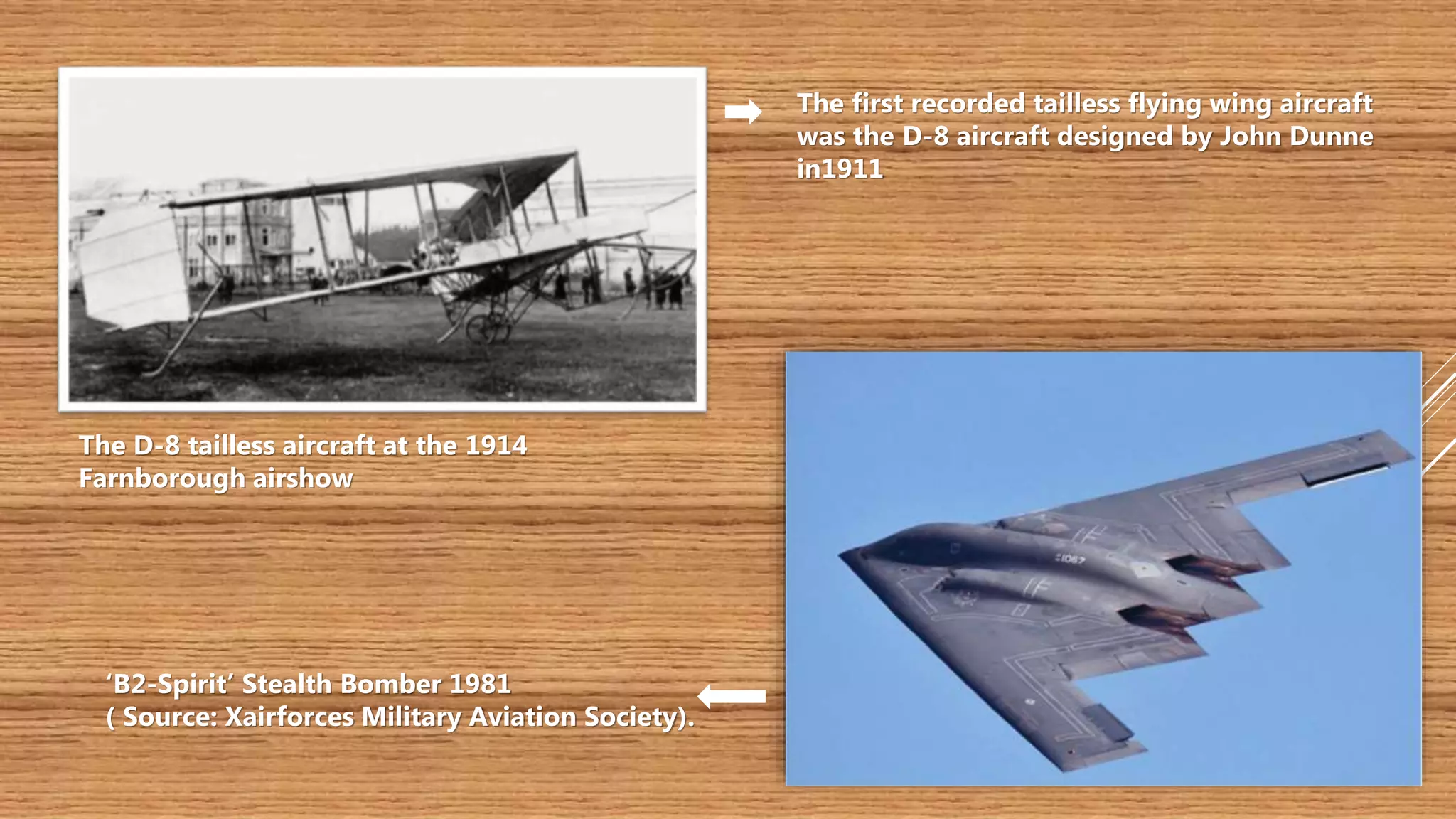
The D-8 tailless aircraft at the 1914
Farnborough airshow
‘B2-Spirit’ Stealth Bomber 1981
( Source: Xairforces Military Aviation Society).
The first recorded tailless flying wing aircraft
was the D-8 aircraft designed by John Dunne
in1911
HOW DO AEROPLANES FLY
LIFT
WEIGHT
THRUST DRAG
LIFT
DRAG
THRUST
WEIGHT
Lift is the force created by the interaction between the
wings and the airflow. It always act upwards. Lift must
exceed weight for flight.
This force acts in reverse direction to that of 'Thrust' and
hinders forward motion. Drag is considered as a negative
force.
This force is created by an aircraft's engine and is required
for forward motion.
This force acts on an aircraft due to the interaction between
the aircraft's body weight and Earth's gravity.
FL= CL*0.5*ρ*A*V2
FD= CD*0.5*ρ*A*V2
1
3
2
LIFT
4
6
5
BY BERNOULLI EQUATION
AND MAGNUS EFFECT
The wake of a Boeing 767
disrupts the top
of a cumulus cloud and clearly
shows the
counter-rotating trailing
vortices.[2]
F L
F L
F L
F D
F D
F D
At large angles of
attack (usually
larger than 15°), flow
may separate
completely from the
top surface of an
airfoil, reducing lift
drastically and
causing the airfoil to
stall.
(a) 5°
(c) 30°
(b) 15°
(b) 15°
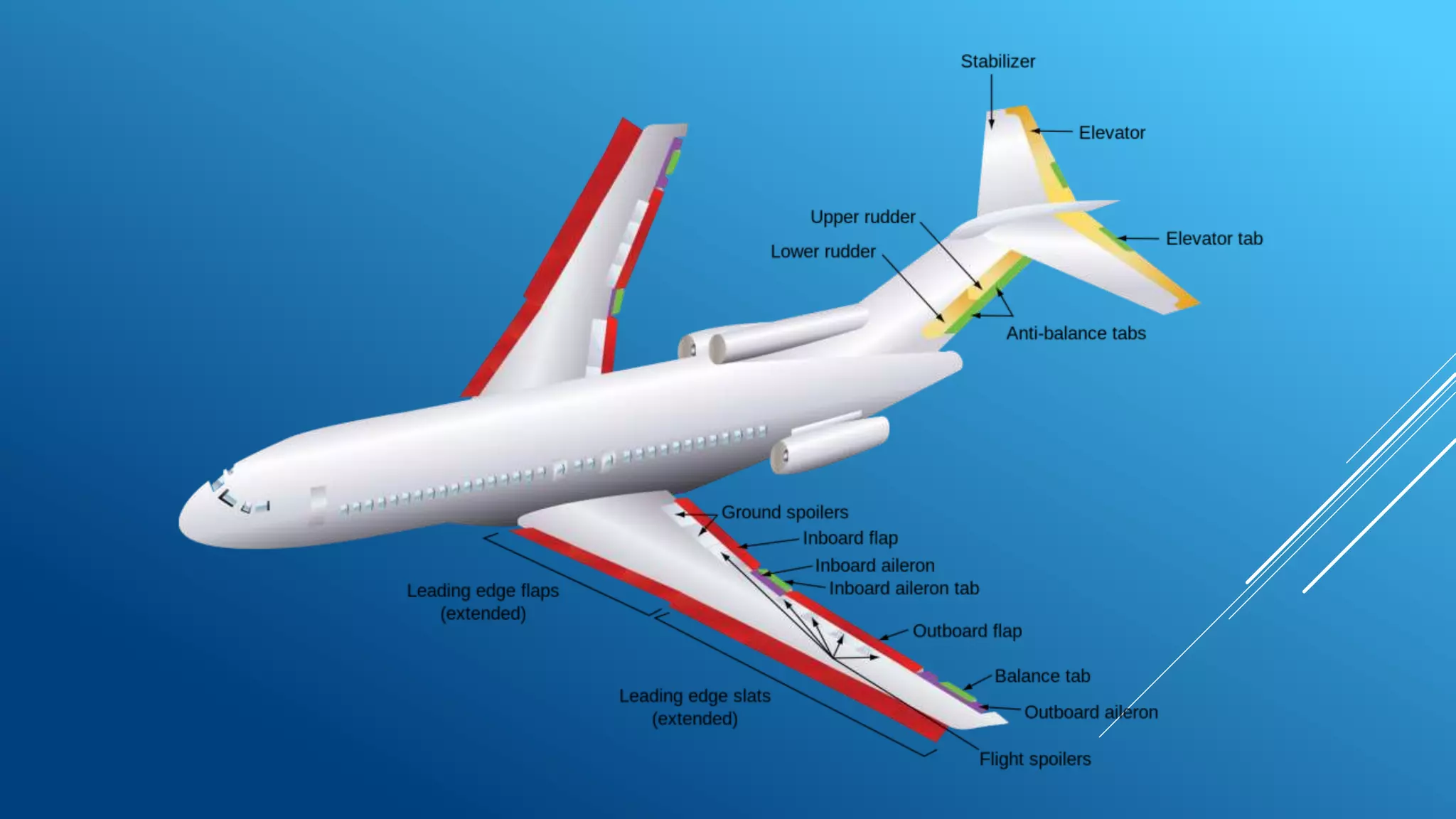
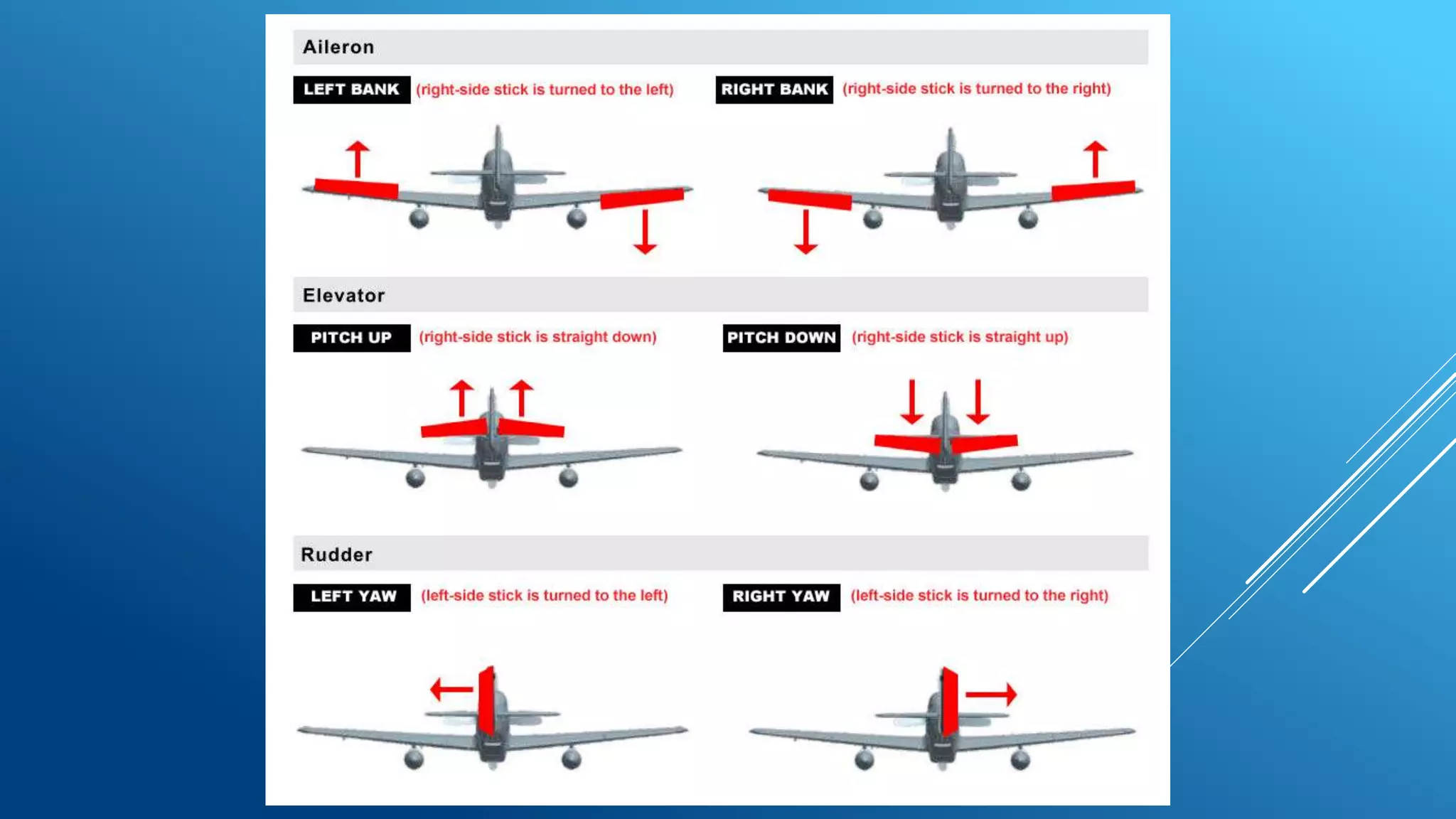
Aircraft Control Surfaces
Flaps
Ailerons
Slats
Rudder
Elevators
Flaperons
Elevons
Spoilers
Vortex Generators
Winglet
ORGANISMS THAT HAVE BLENDED WING BODY
MANTA RAY
GLIDING SMOOTHLY IN
GOTHAM CITY
DRAG… WHAT IS IT?
THRUST. HUH..DON’T NEED IT
WEIGHT!!! DO I LOOK FAT TO
YOU?..
PHYSICS DON’T APPLY TO KRYPTONIANS
DESIGN AND STRUCTURE OF BWB
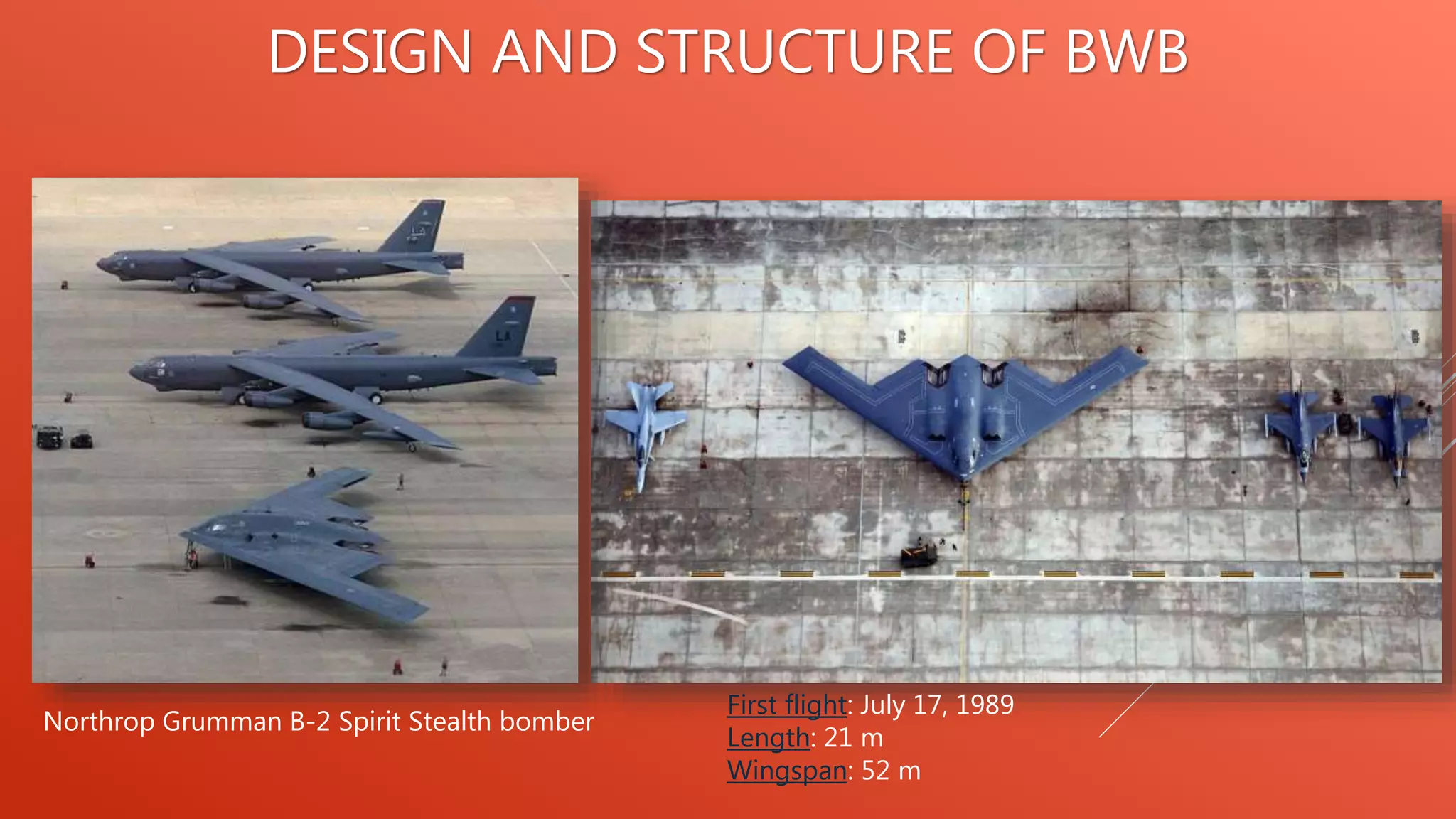
Northrop Grumman B-2 Spirit Stealth bomber
First flight: July 17, 1989
Length: 21 m
Wingspan: 52 m
DESIGN AND STRUCTURE OF BWB
[3]
[4]
[5]
VELA 2 baseline
concept[6]
DESIGN AND STRUCTURE OF BWB
Cambridge MIT silent aircraft concept
(Source: The Cambridge-MIT Institute). [7]
The ACFA BWB configuration
The project called Active Flight Control for Flexible
Aircraft is the design of an innovative ultra efficient 450
passenger capacity BWB aircraft with highly swept back
center-body and 2 podded turbofan engines [8]
DESIGN AND STRUCTURE OF BWB
CONCEPT OF WINDOWLESS
AIRCRAFT[9]
BWB CONCEPTUAL SEATING
ARRANGEMENT[10]
BOEING X48C PROTOTYPE (2011)[11]
CONVENTIONAL AEROPLANES VS BWB
Transformation of a 650m2
ball into a conventional and
BWB aircraft [12]
PERFORMANCE COMPARISON
BETWEEN A CONVENTIONAL
AND BWB CONFIGURATION[14]
[13]
LIFT Vs WEIGHT
DISTRIBUTION
[15]
[16]
[17]
NO WINDOWS!!!
Each seat will have a multifunctional
LCD screen on the seat in front of them. A
selector will allow the passenger to select from a
number of views, including looking to the rear
and straight down.
It can be used as a cargo plane as it has large
space and there is no problem of internal
pressurization.
[18]
ADVANTAGES AND DISADVANTAGES OF BWB
ADVANTAGES :-
Aerodynamics: The aerodynamic benefits of the
BWB are derived from the integration of its
‘fuselage’ and wings to obtain ‘low wetted
surface area to volume ratio’ and reduced
interference drag.
This lowers total drag and provides higher L/D
ratio compared to conventional configuration
DOC- direct operating costs includes
 Fuel
 Landing fees
 Maintenance
 Annual inspection
[19]
 Increase in the passenger capacity up to 800
 Reduction in fuel consumption of the aircraft(burns 27% lesser fuel)
 High L/D ratio due to a decreased relative wetted area(area which is in
contact with the external airflow)
 Favorable load distribution along the span
 Possible engine noise shielding
 15% lower takeoff weight
 12% lower empty operating weight
 27% lower total thrust
 27% lower fuel BURNED
 20% higher L/D ratio as compared to conventional aircraft
 Lower production cost (lower production costs come from not have as
many tight bends so the manufacturing costs go down)
 Lower fares
 Reduced airport/airspace congestion
 Improved safety
ADVANTAGES :-
ADVANTAGES AND DISADVANTAGES OF BWB
DISADVANTAGES :-
 High bending stresses resulting from
the effect of pressure on the box-like
shape of the BWB
 High bending stress associated
with a non-cylindrical pressure
vessel.
 typical aircrafts have a cylindrical shape which requires less strength and is
easier to pressurize as opposed to the interior shape of a BWB.
[20]
 Evacuating a BWB in an emergency could be a challenge. Because of the
aircraft’s shape, the seating layout would be theatre style instead of
tubular. This imposes inherent limits on exit doors. (90 seconds
evacuation)
 As engines are placed above the rear fuselage. Air safety authorities have
expressed concern that in an accident they could become detached and
their momentum carry them forwards so that they fall onto the passenger
cabin.
 “Bulging” at the outer surface will occur as the aircraft is pressurized. This
will deform the elegant cruise airfoil shape that is being planned, so it has
to be taken into consideration in the design.
 The two decks also raised concerns over passenger safety in a crash
situation where the upper deck could collapse onto the lower one.
 As there will be no windows, people will feel air sickness. And by
integrating a giant LCD in the partition wall might cause some people
nausea.
 The last issue was how to you handle 800 passengers as several terminals
are not designed to handle that volume of humanity.
DISADVANTAGES :-
FUTURE SCOPES AND CHALLENGES
With the increase in population exponentially we cannot have a congested traffic in the mid air or
an “Air Traffic Jam”. So we need some new innovation which can carry more passengers, have a
small size and less pollutant and can integrate new thrust mechanisms like hybrid engines and
produce less noise and take less runaway for take off and landing and terminal congestion
With these factors in consideration we can assume that by 2020 the world might see the BWB in
their airport with its eye catching design and body like an UFO.
Challenges ahead
 Structural and material (structural – wingspan exceeds 262ft. Or 80m)& (Structures is back to the
pressurization issues and the integration issue revolves around making the structure clean enough to
work aerodynamically and achieve the savings potential.)
 Aero structural integration
 Aerodynamics
 Controls
 System integration
 Infrastructure
CONCLUSION
 The BWB is fuel efficient
 Less material required to produce the body
 Less complicated design
 Less noise
 High L/D ratio
 Carry more passengers
 Less size compared to conventional aircraft
 Aerodynamic design
 Less pollutant
 Can integrate new hybrid turbines AND turboprop fans
 From the conceptual point of view, the BWB design has been demonstrated to be
more attractive than the conventional aircraft.
 The flight features of small drag value and less engine thrust requirement predict to
perform with less noise emission, and make it a more environmentally-friendly
vehicle.

Blended Wing Body (BWB) - Future Of Aviation

  • 1.
    BLENDED WING BODY FUTUREOF AVIATION PRESENTED BY:- ASIM KUMAR GHATAK V SEMESTER MECHANICAL ENGINEERING JSS ACADEMY OF TECHNICAL EDUCATION NOIDA
  • 2.
    CONTENTS 1. INTRODUCTION 2. BRIEFHISTORY OF BWB 3. HOW AEROPLANES FLY? 4. SOME ORGANISMS WITH BWB 5. DESIGN AND STRUCTURE OF BWB 6. CONVENTIONAL AEROPLANES Vs. BWB 7. ADVANTAGES AND DISADVANTAGES OF BWB 8. FUTURE SCOPE AND CHALLENGES 9. CONCLUSION 10. REFERENCES
  • 3.
    INTRODUCTION  Blended WingBody (BWB) aircraft have a flattened and airfoil shaped body, which produces most of the lift, the wings contributing the balance.  A BWB aircraft is a configuration where the wing and fuselage are integrated which essentially results in a large flying wing  Theoretically it can carry up to 800 passengers at a Mach number of 0.85
  • 4.
     Blended wingbody has lift-to-drag ratio 50% greater than conventional airplane.  The advantages of the BWB approach are efficient high-lift wings and a wide airfoil- shaped body.  This enables the entire craft to contribute to lift generation with the result of potentially increased fuel economy and range.
  • 5.
    Northrop N1M “Jeep”,by Northrop Corporation, USA The concept of Blended Wing body was introduced almost 27 years ago. The idea was to build a new type of aircraft that would allow the aircraft to carry more passengers. [1]
  • 6.
    Horten Ho Iby Horten Brothers, Germany The BWB aircraft is not a fully novel concept because it was considered by Horten, Northrop, and others from the mid 1930s to the mid 1950s. BWB aircraft was previously called “Tailless Airplane” and “Flying Wing Aircraft”. Turbojet powered Ho-229 flying wing aircraft the world's first turbojet-powered flying wing air- craft, the Ho-IX (Source: Military Factory).
  • 7.
    The Northrop semi-flyingwing aircraft 1928 (Source: Smithsonian NASA Museum). Northrop XB-35 piston-engined long-range bomber 1946 (Source: Virtual Aircraft Museum). The Northrop XB-35 aircraft, which came into service in1946, is powered by four piston engines, each driving two contra-rotating four-blade pusher propeller through a long shaft and gear box.
  • 8.
    The Northrop N-1M Aircraft 1940 ( Source: Smithsonian NASA Museum). The Northrop N-9M aircraft (Source: Smithsonian NASA Museum). The N-9M was developed as a scaled mock-up of the proposed bomber. The N- 9M is an18m span twin-engine aircraft with a take-off weight of 6326kg.
  • 9.
    The D-8 taillessaircraft at the 1914 Farnborough airshow ‘B2-Spirit’ Stealth Bomber 1981 ( Source: Xairforces Military Aviation Society). The first recorded tailless flying wing aircraft was the D-8 aircraft designed by John Dunne in1911
  • 10.
    HOW DO AEROPLANESFLY LIFT WEIGHT THRUST DRAG
  • 11.
    LIFT DRAG THRUST WEIGHT Lift is theforce created by the interaction between the wings and the airflow. It always act upwards. Lift must exceed weight for flight. This force acts in reverse direction to that of 'Thrust' and hinders forward motion. Drag is considered as a negative force. This force is created by an aircraft's engine and is required for forward motion. This force acts on an aircraft due to the interaction between the aircraft's body weight and Earth's gravity. FL= CL*0.5*ρ*A*V2 FD= CD*0.5*ρ*A*V2
  • 12.
  • 13.
  • 14.
    The wake ofa Boeing 767 disrupts the top of a cumulus cloud and clearly shows the counter-rotating trailing vortices.[2]
  • 15.
    F L F L FL F D F D F D At large angles of attack (usually larger than 15°), flow may separate completely from the top surface of an airfoil, reducing lift drastically and causing the airfoil to stall. (a) 5° (c) 30° (b) 15° (b) 15°
  • 16.
  • 19.
    ORGANISMS THAT HAVEBLENDED WING BODY MANTA RAY
  • 20.
  • 21.
    DRAG… WHAT ISIT? THRUST. HUH..DON’T NEED IT WEIGHT!!! DO I LOOK FAT TO YOU?.. PHYSICS DON’T APPLY TO KRYPTONIANS
  • 22.
    DESIGN AND STRUCTUREOF BWB Northrop Grumman B-2 Spirit Stealth bomber First flight: July 17, 1989 Length: 21 m Wingspan: 52 m
  • 23.
    DESIGN AND STRUCTUREOF BWB [3] [4] [5]
  • 24.
  • 25.
    DESIGN AND STRUCTUREOF BWB Cambridge MIT silent aircraft concept (Source: The Cambridge-MIT Institute). [7] The ACFA BWB configuration The project called Active Flight Control for Flexible Aircraft is the design of an innovative ultra efficient 450 passenger capacity BWB aircraft with highly swept back center-body and 2 podded turbofan engines [8]
  • 26.
    DESIGN AND STRUCTUREOF BWB CONCEPT OF WINDOWLESS AIRCRAFT[9] BWB CONCEPTUAL SEATING ARRANGEMENT[10] BOEING X48C PROTOTYPE (2011)[11]
  • 27.
    CONVENTIONAL AEROPLANES VSBWB Transformation of a 650m2 ball into a conventional and BWB aircraft [12]
  • 28.
    PERFORMANCE COMPARISON BETWEEN ACONVENTIONAL AND BWB CONFIGURATION[14] [13]
  • 29.
  • 30.
    NO WINDOWS!!! Each seatwill have a multifunctional LCD screen on the seat in front of them. A selector will allow the passenger to select from a number of views, including looking to the rear and straight down. It can be used as a cargo plane as it has large space and there is no problem of internal pressurization. [18]
  • 31.
    ADVANTAGES AND DISADVANTAGESOF BWB ADVANTAGES :- Aerodynamics: The aerodynamic benefits of the BWB are derived from the integration of its ‘fuselage’ and wings to obtain ‘low wetted surface area to volume ratio’ and reduced interference drag. This lowers total drag and provides higher L/D ratio compared to conventional configuration DOC- direct operating costs includes  Fuel  Landing fees  Maintenance  Annual inspection [19]
  • 32.
     Increase inthe passenger capacity up to 800  Reduction in fuel consumption of the aircraft(burns 27% lesser fuel)  High L/D ratio due to a decreased relative wetted area(area which is in contact with the external airflow)  Favorable load distribution along the span  Possible engine noise shielding  15% lower takeoff weight  12% lower empty operating weight  27% lower total thrust  27% lower fuel BURNED  20% higher L/D ratio as compared to conventional aircraft  Lower production cost (lower production costs come from not have as many tight bends so the manufacturing costs go down)  Lower fares  Reduced airport/airspace congestion  Improved safety ADVANTAGES :-
  • 33.
    ADVANTAGES AND DISADVANTAGESOF BWB DISADVANTAGES :-  High bending stresses resulting from the effect of pressure on the box-like shape of the BWB  High bending stress associated with a non-cylindrical pressure vessel.  typical aircrafts have a cylindrical shape which requires less strength and is easier to pressurize as opposed to the interior shape of a BWB. [20]
  • 34.
     Evacuating aBWB in an emergency could be a challenge. Because of the aircraft’s shape, the seating layout would be theatre style instead of tubular. This imposes inherent limits on exit doors. (90 seconds evacuation)  As engines are placed above the rear fuselage. Air safety authorities have expressed concern that in an accident they could become detached and their momentum carry them forwards so that they fall onto the passenger cabin.  “Bulging” at the outer surface will occur as the aircraft is pressurized. This will deform the elegant cruise airfoil shape that is being planned, so it has to be taken into consideration in the design.  The two decks also raised concerns over passenger safety in a crash situation where the upper deck could collapse onto the lower one.  As there will be no windows, people will feel air sickness. And by integrating a giant LCD in the partition wall might cause some people nausea.  The last issue was how to you handle 800 passengers as several terminals are not designed to handle that volume of humanity. DISADVANTAGES :-
  • 35.
    FUTURE SCOPES ANDCHALLENGES With the increase in population exponentially we cannot have a congested traffic in the mid air or an “Air Traffic Jam”. So we need some new innovation which can carry more passengers, have a small size and less pollutant and can integrate new thrust mechanisms like hybrid engines and produce less noise and take less runaway for take off and landing and terminal congestion With these factors in consideration we can assume that by 2020 the world might see the BWB in their airport with its eye catching design and body like an UFO. Challenges ahead  Structural and material (structural – wingspan exceeds 262ft. Or 80m)& (Structures is back to the pressurization issues and the integration issue revolves around making the structure clean enough to work aerodynamically and achieve the savings potential.)  Aero structural integration  Aerodynamics  Controls  System integration  Infrastructure
  • 36.
    CONCLUSION  The BWBis fuel efficient  Less material required to produce the body  Less complicated design  Less noise  High L/D ratio  Carry more passengers  Less size compared to conventional aircraft  Aerodynamic design  Less pollutant  Can integrate new hybrid turbines AND turboprop fans  From the conceptual point of view, the BWB design has been demonstrated to be more attractive than the conventional aircraft.  The flight features of small drag value and less engine thrust requirement predict to perform with less noise emission, and make it a more environmentally-friendly vehicle.

Editor's Notes

  • #15 The pressure difference between the lower surface (high pressure region) and the upper surface (low-pressure region) drives the fluid at the tips upward while the fluid is swept toward the back because of the relative motion between the fluid and the wing. This results in a swirling motion that spirals along the flow, called the tip vortex, at the tips of both wings. Vortices are also formed along the airfoil between the tips of the wings. These distributed vortices collect toward the edges after being shed from the trailing edges of the wings and combine with the tip vortices to form two streaks of powerful trailing vortices along the tips of the wings. Trailing vortices generated by large aircraft persist for a long time for long distances (over 10 km) before they gradually disappear due to viscous dissipation.
  • #16 The phenomenon of producing lift by the rotation of a solid body is called the Magnus effect after the German scientist Heinrich Magnus (1802–1870), stagnation point: A point in a fluid flow where the velocity goes to zero. For example, the point on the streamline that intersects the nose of a moving projectile is a stagnation point. stall: The phenomenon of massive flow separation from the surface of a wing when angle of attack exceeds a critical value, and consequent dramatic loss of lift and increase in drag. A plane in stall drops rapidly and must have its nose brought down to reestablish attached boundary layer flow and regenerate lift and reduce drag.