SAMPLING METHODS
1. Probability
2. nonprobability
A. Probability sampling
Sample has a known probability of being selected.
 Methods of probability sampling:
i. Simple random sampling
ii. Systematic random sampling
iii. Stratified random sampling
iv. Multistage sampling
v. Cluster sampling
1. Simple random sampling
 This is the basic sampling technique where we select a group of subject
(sample) for study from a larger group (population).
 Each individual has an equal chance to be selected from the target
population.
2. SYSTEMATIC RANDOM SAMPLING
 Involves arranging the target population according to some ordering scheme
and then selecting elements at regular intervals through that ordered list
 Systematic sampling involves a random start and then proceeds with the
selection of every kth element from then onwards
3. Stratified random sampling
 A stratified sample is one that ensures that subgroups (strata) of a given population are
each adequately represented within the whole sample population of a research study.
 For example, one might divide a sample of adults into subgroups by age, like 18-29, 30-
39, 40-49, 50-59, and 60 and above. To stratify this sample, the researcher would then
randomly select proportional amounts of people from each age group.
 This is an effective sampling technique for studying how a trend or issue might differ
across subgroups.
 Importantly, strata used in this technique must not overlap, because if they did, some
individuals would have a higher chance of being selected than others. This would create
a skewed sample that would bias the research and render the results invalid.
 Some of the most common strata used in stratified random sampling include age,
gender, religion, race, educational attainment, socioeconomic status, and nationality
Cont.…
 There are many situations in which researchers would choose stratified random
sampling over other types of sampling.
a) First, it is used when the researcher wants to examine subgroups within a
population.
b) Researchers also use this technique when they want to observe relationships
between two or more subgroups, or
c) when they want to examine the rare extremes of a population.
 With this type of sampling, the researcher is guaranteed subjects from each
subgroup are included in the final sample, whereas simple random
sampling does not ensure that subgroups are represented equally or
proportionately within the sample.
Cont…
 For example, social scientists have used stratified sampling to study differences
in parenting between gay and straight couples, how swearing differs from place
to place and the connection between level of education and duration of
marriage.
 There are two types of stratified random sampling:
a. Proportionate Stratified Random
Sampling
b. Disproportionate Stratified Random
Sampling
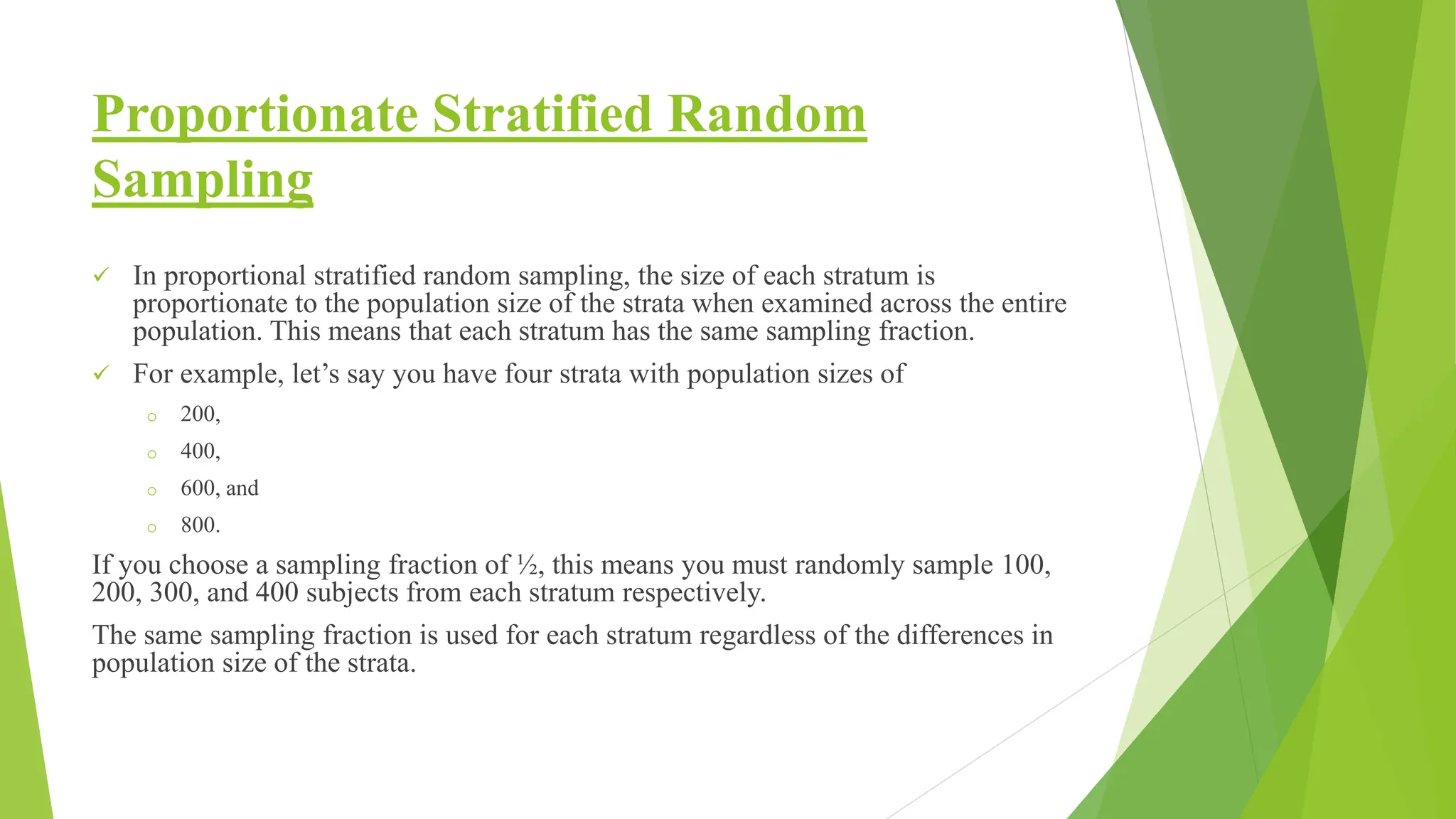
Proportionate Stratified Random
Sampling
 In proportional stratified random sampling, the size of each stratum is
proportionate to the population size of the strata when examined across the entire
population. This means that each stratum has the same sampling fraction.
 For example, let’s say you have four strata with population sizes of
o 200,
o 400,
o 600, and
o 800.
If you choose a sampling fraction of ½, this means you must randomly sample 100,
200, 300, and 400 subjects from each stratum respectively.
The same sampling fraction is used for each stratum regardless of the differences in
population size of the strata.
Disproportionate Stratified Random Sample
 In disproportionate stratified random sampling, the different strata do not have the same
sampling fractions as each other.
 For instance, if your four strata contain 200, 400, 600, and 800 people, you may choose
to have different sampling fractions for each stratum. Perhaps the first stratum with 200
people has a sampling fraction of ½, resulting in 100 people selected for the sample,
while the last stratum with 800 people has a sampling fraction of ¼, resulting in 200
people selected for the sample.
 The precision of using disproportionate stratified random sampling is highly dependent
on the sampling fractions chosen and used by the researcher.
 Here, the researcher must be very careful and know exactly what he or she is doing.
 Mistakes made in choosing and using sampling fractions could result in a stratum that is
overrepresented or underrepresented, resulting in skewed results.
4. Multistage Sampling
 It is a type of sampling which involves dividing the population into groups (or clusters).
Then, one or more clusters are chosen at random and everyone within the chosen
cluster is sampled.
 ITS useful since it reduces costs of sampling all clusters
 THE researcher randomly selects elements from each cluster;
 Constructing the clusters is the first stage, Deciding what elements within the cluster to
use is the second stage.
 The technique is used frequently when a complete list of all members of the population
does not exist and is inappropriate.
5. Cluster sampling
 Cluster sampling refers to the process by which a researcher divides the population into
separate groups, called clusters.
 Then, a simple random sample of clusters is selected from the population.
 The researcher conducts his analysis on data from the sampled clusters
 The population within a cluster should ideally be as heterogeneous as possible, but there
should be homogeneity between clusters.
 Each cluster should be a small-scale representation of the total population. The clusters
should be mutually exclusive and collectively exhaustive.
 A random sampling technique is then used on any relevant clusters to choose which clusters
to include in the study.
 The main difference between cluster sampling and stratified sampling is that in cluster
sampling the cluster is treated as the sampling unit so sampling is done on a population of
clusters (at least in the first stage).
Cont..
 In stratified sampling, the sampling is done on elements within each strata. In stratified
sampling, a random sample is drawn from each of the strata, whereas in cluster sampling
only the selected clusters are sampled.
 A common motivation of cluster sampling is to reduce costs by increasing sampling
efficiency. This contrasts with stratified sampling where the motivation is to increase
precision.
 An example of cluster sampling is area sampling or geographical cluster sampling. Each
cluster is a geographical area. Because a geographically dispersed population can be
expensive to survey, greater economy than simple random sampling can be achieved by
grouping several respondents within a local area into a cluster.
 It is usually necessary to increase the total sample size to achieve equivalent precision in
the estimators, but cost savings may make such an increase in sample size feasible.
 Cluster sampling is used to estimate high mortalities in cases such
as wars, famines and natural disasters.
Advantages of probabilistic method of
sampling
1. Cost effective. Task of assignment of random number to different items
makes process half done
2. Involves lesser degree of judgement. Random trend makes the process more
effective and accurate
3. Comparatively easier way of sampling ,does not involve complex long
process
4. Less time consuming ,simple and short process
5. Can be done even by non technical persons.
6. Sample representation of population. It ensures that the sample vary as
much as the population
Disadvantages
a) Chances of selecting specific class of sample only is high
b) Redundant and monotonus work
B. Nonprobability methods
1. Convenience sampling
2. Purposive sampling
3. quota sampling
4. Snowball sampling
1. Convenience sampling
A convenience sample It simply one where the units that are selected for
inclusion in the sample are the easiest to access
2. Purposive sampling
 Also called judgmental ,selective or subjective sampling
 Purposive sampling rely on the judgment of the researcher when it comes to
selecting units that are to be studied.
 Usually, the sample being investigated is quite small compared with
probabilistic sampling techniques
 The main goal of of purposive sampling is to focus on a particular
characteristic of the population that are of interest which will best enable
you to answer your research questions
Cont…
Purposive sampling techniques include;
 Maximum variation sampling
 homogenous sampling
 Total population sampling
 Expert sampling
Purposive sampling techniques
1.Maximum variation sampling
Used to capture wide range of perspective relating to the thing you are
interested in studying.
2.Homogenous sampling
It aims to achieve homogenous sample that is a sample whose units share the
same characteristic or traits
3.Typical case sampling
Used when interested in normality/typicality of units you are interested because
they are normal.
Cont…
4.Extreme/deviant case sampling
Used to focus on cases that are special, unusual typically in the sense that that
cases highlight notable outcomes, failure or successes.
5.Critical case sampling
Its particularly useful in exploratory qualitative research, research with limited
resources, as well as research where a single case can be decisive in explaining
phenomenon of interest.
Cont…
6.Total population sampling
This is where you choose to examine the entire population that have a particular
set of characteristics.
7.Expert sampling
Used when research needs to glean knowledge from individual that have
particular expertise.
3. Snowball sampling
 The researcher starts with a key person and introduce the next one to be
come a chain.
4 .Quota sampling
 The population is first segmented into mutually exclusive subgroups, just as in
stratified sampling.
Advantages of nonprobability methods
Convenience sampling
 Very easy to carry out with few rules governing how sample should be
collected.
 Relative time spent and cost incurred are small.
 Help gather important data and information not possible with probabilistic
sampling methods which require a formal access to a list of population.
Cont…
Purposive
1. There are a wide range of qualitative research design that researcher can
draw on.
2. Each type of purposive sampling technique have different goals, they can
provide researcher with justification to make generalization from the sample
being studied
3. Qualitative research design can involve multiple phases with each phase
building on previous one
Cont…
Quota
Less expensive and speedy
When population has no suitable framework quota sampling is the only practical
method to use
Collection of data through quota sampling is not a time consuming one
Ensures convenience in executing sampling study
Cont…
Snowball
1. It allows for study to take place where otherwise it might be impossible to
conduct because of lack of participants interested
2. Snowball sampling may help you discover characteristics/secretive nature
about a population that you weren’t aware existed
3. Sensitivity of coming forward to take part in research is more acute in such
research context since individual with common characteristics traits and
social factors recruit each other
4. There may be no otherway of accessing your sample making snowball the only
viable choice of sampling strategy
Disadvantages of nonprobability
methods
purposive sampling
1. Purposive samples, irrespective of the type of purposive sampling used, can
be highly prone to research bias.
2. The subjectivity and non probability based nature of units selection in
purposive sampling means that it can be difficult to defend
representativeness of sample.
Cont…
convenience sampling
1. Suffer from biases from a number of biases
2. Sampling frame is not known and sample is not chosen at random the inherent
bias is convenience sample is unlikely to be representative of population
being studied
Cont…
Snowball sampling
 Its usually impossible to determine the sampling error or make inferences
about population based on obtained sample since snowball sampling does not
select unit for inclusion in the sample based on random selection
Cont…
Quota
1. Bias arises in matter of selecting the sample units
2. Needs several investigators so the results cannot be uniform
3. Since data is collected from people who are easily available and accessible
the value of data collected is affected
4. Work of interviewer cannot be supervised properly hence no certainty of
correctness of data
THE END
THANK YOU!

SAMPLING METHODS 5.pptx research community health

  • 1.
  • 2.
    A. Probability sampling Samplehas a known probability of being selected.  Methods of probability sampling: i. Simple random sampling ii. Systematic random sampling iii. Stratified random sampling iv. Multistage sampling v. Cluster sampling
  • 3.
    1. Simple randomsampling  This is the basic sampling technique where we select a group of subject (sample) for study from a larger group (population).  Each individual has an equal chance to be selected from the target population.
  • 4.
    2. SYSTEMATIC RANDOMSAMPLING  Involves arranging the target population according to some ordering scheme and then selecting elements at regular intervals through that ordered list  Systematic sampling involves a random start and then proceeds with the selection of every kth element from then onwards
  • 5.
    3. Stratified randomsampling  A stratified sample is one that ensures that subgroups (strata) of a given population are each adequately represented within the whole sample population of a research study.  For example, one might divide a sample of adults into subgroups by age, like 18-29, 30- 39, 40-49, 50-59, and 60 and above. To stratify this sample, the researcher would then randomly select proportional amounts of people from each age group.  This is an effective sampling technique for studying how a trend or issue might differ across subgroups.  Importantly, strata used in this technique must not overlap, because if they did, some individuals would have a higher chance of being selected than others. This would create a skewed sample that would bias the research and render the results invalid.  Some of the most common strata used in stratified random sampling include age, gender, religion, race, educational attainment, socioeconomic status, and nationality
  • 6.
    Cont.…  There aremany situations in which researchers would choose stratified random sampling over other types of sampling. a) First, it is used when the researcher wants to examine subgroups within a population. b) Researchers also use this technique when they want to observe relationships between two or more subgroups, or c) when they want to examine the rare extremes of a population.  With this type of sampling, the researcher is guaranteed subjects from each subgroup are included in the final sample, whereas simple random sampling does not ensure that subgroups are represented equally or proportionately within the sample.
  • 7.
    Cont…  For example,social scientists have used stratified sampling to study differences in parenting between gay and straight couples, how swearing differs from place to place and the connection between level of education and duration of marriage.  There are two types of stratified random sampling: a. Proportionate Stratified Random Sampling b. Disproportionate Stratified Random Sampling
  • 8.
    Proportionate Stratified Random Sampling In proportional stratified random sampling, the size of each stratum is proportionate to the population size of the strata when examined across the entire population. This means that each stratum has the same sampling fraction.  For example, let’s say you have four strata with population sizes of o 200, o 400, o 600, and o 800. If you choose a sampling fraction of ½, this means you must randomly sample 100, 200, 300, and 400 subjects from each stratum respectively. The same sampling fraction is used for each stratum regardless of the differences in population size of the strata.
  • 9.
    Disproportionate Stratified RandomSample  In disproportionate stratified random sampling, the different strata do not have the same sampling fractions as each other.  For instance, if your four strata contain 200, 400, 600, and 800 people, you may choose to have different sampling fractions for each stratum. Perhaps the first stratum with 200 people has a sampling fraction of ½, resulting in 100 people selected for the sample, while the last stratum with 800 people has a sampling fraction of ¼, resulting in 200 people selected for the sample.  The precision of using disproportionate stratified random sampling is highly dependent on the sampling fractions chosen and used by the researcher.  Here, the researcher must be very careful and know exactly what he or she is doing.  Mistakes made in choosing and using sampling fractions could result in a stratum that is overrepresented or underrepresented, resulting in skewed results.
  • 10.
    4. Multistage Sampling It is a type of sampling which involves dividing the population into groups (or clusters). Then, one or more clusters are chosen at random and everyone within the chosen cluster is sampled.  ITS useful since it reduces costs of sampling all clusters  THE researcher randomly selects elements from each cluster;  Constructing the clusters is the first stage, Deciding what elements within the cluster to use is the second stage.  The technique is used frequently when a complete list of all members of the population does not exist and is inappropriate.
  • 11.
    5. Cluster sampling Cluster sampling refers to the process by which a researcher divides the population into separate groups, called clusters.  Then, a simple random sample of clusters is selected from the population.  The researcher conducts his analysis on data from the sampled clusters  The population within a cluster should ideally be as heterogeneous as possible, but there should be homogeneity between clusters.  Each cluster should be a small-scale representation of the total population. The clusters should be mutually exclusive and collectively exhaustive.  A random sampling technique is then used on any relevant clusters to choose which clusters to include in the study.  The main difference between cluster sampling and stratified sampling is that in cluster sampling the cluster is treated as the sampling unit so sampling is done on a population of clusters (at least in the first stage).
  • 12.
    Cont..  In stratifiedsampling, the sampling is done on elements within each strata. In stratified sampling, a random sample is drawn from each of the strata, whereas in cluster sampling only the selected clusters are sampled.  A common motivation of cluster sampling is to reduce costs by increasing sampling efficiency. This contrasts with stratified sampling where the motivation is to increase precision.  An example of cluster sampling is area sampling or geographical cluster sampling. Each cluster is a geographical area. Because a geographically dispersed population can be expensive to survey, greater economy than simple random sampling can be achieved by grouping several respondents within a local area into a cluster.  It is usually necessary to increase the total sample size to achieve equivalent precision in the estimators, but cost savings may make such an increase in sample size feasible.  Cluster sampling is used to estimate high mortalities in cases such as wars, famines and natural disasters.
  • 13.
    Advantages of probabilisticmethod of sampling 1. Cost effective. Task of assignment of random number to different items makes process half done 2. Involves lesser degree of judgement. Random trend makes the process more effective and accurate 3. Comparatively easier way of sampling ,does not involve complex long process 4. Less time consuming ,simple and short process 5. Can be done even by non technical persons. 6. Sample representation of population. It ensures that the sample vary as much as the population
  • 14.
    Disadvantages a) Chances ofselecting specific class of sample only is high b) Redundant and monotonus work
  • 15.
    B. Nonprobability methods 1.Convenience sampling 2. Purposive sampling 3. quota sampling 4. Snowball sampling
  • 16.
    1. Convenience sampling Aconvenience sample It simply one where the units that are selected for inclusion in the sample are the easiest to access
  • 17.
    2. Purposive sampling Also called judgmental ,selective or subjective sampling  Purposive sampling rely on the judgment of the researcher when it comes to selecting units that are to be studied.  Usually, the sample being investigated is quite small compared with probabilistic sampling techniques  The main goal of of purposive sampling is to focus on a particular characteristic of the population that are of interest which will best enable you to answer your research questions
  • 18.
    Cont… Purposive sampling techniquesinclude;  Maximum variation sampling  homogenous sampling  Total population sampling  Expert sampling
  • 19.
    Purposive sampling techniques 1.Maximumvariation sampling Used to capture wide range of perspective relating to the thing you are interested in studying. 2.Homogenous sampling It aims to achieve homogenous sample that is a sample whose units share the same characteristic or traits 3.Typical case sampling Used when interested in normality/typicality of units you are interested because they are normal.
  • 20.
    Cont… 4.Extreme/deviant case sampling Usedto focus on cases that are special, unusual typically in the sense that that cases highlight notable outcomes, failure or successes. 5.Critical case sampling Its particularly useful in exploratory qualitative research, research with limited resources, as well as research where a single case can be decisive in explaining phenomenon of interest.
  • 21.
    Cont… 6.Total population sampling Thisis where you choose to examine the entire population that have a particular set of characteristics. 7.Expert sampling Used when research needs to glean knowledge from individual that have particular expertise.
  • 22.
    3. Snowball sampling The researcher starts with a key person and introduce the next one to be come a chain. 4 .Quota sampling  The population is first segmented into mutually exclusive subgroups, just as in stratified sampling.
  • 23.
    Advantages of nonprobabilitymethods Convenience sampling  Very easy to carry out with few rules governing how sample should be collected.  Relative time spent and cost incurred are small.  Help gather important data and information not possible with probabilistic sampling methods which require a formal access to a list of population.
  • 24.
    Cont… Purposive 1. There area wide range of qualitative research design that researcher can draw on. 2. Each type of purposive sampling technique have different goals, they can provide researcher with justification to make generalization from the sample being studied 3. Qualitative research design can involve multiple phases with each phase building on previous one
  • 25.
    Cont… Quota Less expensive andspeedy When population has no suitable framework quota sampling is the only practical method to use Collection of data through quota sampling is not a time consuming one Ensures convenience in executing sampling study
  • 26.
    Cont… Snowball 1. It allowsfor study to take place where otherwise it might be impossible to conduct because of lack of participants interested 2. Snowball sampling may help you discover characteristics/secretive nature about a population that you weren’t aware existed 3. Sensitivity of coming forward to take part in research is more acute in such research context since individual with common characteristics traits and social factors recruit each other 4. There may be no otherway of accessing your sample making snowball the only viable choice of sampling strategy
  • 27.
    Disadvantages of nonprobability methods purposivesampling 1. Purposive samples, irrespective of the type of purposive sampling used, can be highly prone to research bias. 2. The subjectivity and non probability based nature of units selection in purposive sampling means that it can be difficult to defend representativeness of sample.
  • 28.
    Cont… convenience sampling 1. Sufferfrom biases from a number of biases 2. Sampling frame is not known and sample is not chosen at random the inherent bias is convenience sample is unlikely to be representative of population being studied
  • 29.
    Cont… Snowball sampling  Itsusually impossible to determine the sampling error or make inferences about population based on obtained sample since snowball sampling does not select unit for inclusion in the sample based on random selection
  • 30.
    Cont… Quota 1. Bias arisesin matter of selecting the sample units 2. Needs several investigators so the results cannot be uniform 3. Since data is collected from people who are easily available and accessible the value of data collected is affected 4. Work of interviewer cannot be supervised properly hence no certainty of correctness of data
  • 31.