‫الرحيم‬ ‫الرحمن‬ ‫هللا‬ ‫بسم‬
Dr. Radhwan H. AL-Khashab
consulatant anaesthesia & ICU
Assisst prof.
2022
Surgical Intensive Care Unit (SICU) offers critical care
treatment to unstable, severely ill patients in the
perioperative setting, who have life-threatening conditions
and require comprehensive care, constant monitoring, and
possible emergency interventions.
Definitions
So it`s tertiary care facility in the hospital that
provides a state of medical care to critically ill patients
referred to it via different surgical department
Who take care?
Anesthesiologists played a major role in SICU . Relative to
most other physicians, anesthesiologists have greater
expertise in airway management, mechanical ventilation,
drug and fluid resuscitation, and advanced monitoring
techniques that are central to effective care in critical
illness.
The role of surgeons in SICUs provides specific insights
and perspectives concerning the care of surgical patients,
Trauma management and postoperative care require active
input from surgeons in the intensive care unit .
(Hellenic Journal of Surgery (2016) 88:1, 3-4)
A high-dependency unit is an area in a hospital, usually
located close to the intensive care unit, where patients
can be cared for more extensively than on a normal ward,
but not to the point of intensive care. It is appropriate for
patients who have had major surgery and for those with
single-organ failure.
Indication of admission to SICU
A. Surgical causes includes:
 Pre and post-operative patients of ASA IV and V,
undergoing major and ultra major surgeries.which may
includes:
 All craniotomy patients.
 All thoracotomy patients.
 All ultra major surgeries.
B- Severely injured patient : whether there is
indication for mechanical ventilation or not.
C-Medical causes : any previous medical problems in
which the anesthesia & surgery increase the severity of pre-
existing disease e.g. patient with COPD, restrictive lung
disease ,heart failure , uncontrolled DM or H.T. .
D- Anaesthesia related causes :
Cardiac arrest , sudden hyper or hypotension, cardiac
dysrrhythmias , delay recovery from anaesthesia , oliguria
or anuria.
Generally speaking, any surgical patient who requires
continuous monitoring, 1:1 nursing and /or continuous life
support is a candidate for SICU admission.
As with any other treatment, the decision to admit a patient
to an intensive care unit should be based on the concept of
potential benefit. Patients who are too well to benefit or
those with no hope of recovering to an acceptable quality
of life should not be admitted.
‫نينوى‬ ‫صحة‬ ‫دائرة‬
‫التعليمي‬ ‫الجمهوري‬ ‫مستشفى‬
‫المركزة‬ ‫والعناية‬ ‫التخدير‬ ‫قسم‬
ICU admission forma
Patient name: …………………………………………………………………………………..
Age:…………………………………
Sex:…………………………………
Primary diagnosis:
…………………………………………………………………………………………………
Indication to ICU admission:
……………………………………………………………………………………………………
‫معلومات‬ ‫تدقيق‬ ‫وسيتم‬ ‫االستمارة‬ ‫هذه‬ ‫بدون‬ ‫مريض‬ ‫اي‬ ‫ادخال‬ ‫اليتم‬ :‫مالحظة‬
‫العناية‬ ‫شعبة‬ ‫مدير‬ ‫قبل‬ ‫من‬ ‫المريض‬
‫المسؤول‬ ‫االقدم‬ ‫المقيم‬
‫المنتظر‬ ‫االختصاص‬ ‫الطبيب‬
Who should manage surgical patient in SICU
 To provide quality critical care to this patients the surgeon
& intensivist should be in close communication through out
the patient stay in SICU.
 The surgeon should inform the SICU team preoperatively
regarding a patient who may need postoperative
admission.
 Postoperatively the surgeon & intensivist will need to work
side by side , goals of care should be discussed frequently
& the plans should be communicated daily.
Who should manage surgical patient in SICU
Author: Stefan Alfred Hubertus Rohrig, Marcus D. Lance, M. Faisal
Malmstrom,Publish Year: 2020
Patient`s monitoring
Basic patient`s
monitoring
Advanced patient`s
monitoring
 Heart rate
 Blood pressure
 Respiratory rate
 ETCO2
 Pulse Oximetry
 Hourly urine output
 Temperature
 GCS
 ABG
 CVP
 IBP
 PCWP
 PAP
 ICP
 IAP
Normal patient`s parameters
APACHE II scoring system
 APACHE : Acute physiology & chronic health evaluation.
 Published in 1985. Up to four points are assigned to each
 Physiological variable according to its most abnormal value.
 During the first 24 hours in intensive care. Points are also
assigned for age, history of severe clinical conditions, and
surgical status. The total number of points gives a score ranging
from 0-71, with an increasing score representing a greater
severity of illness.
 APACHE II allows the probability of death before discharge from
hospital to be estimated.
Discharge from intensive care and high
dependency care.
A patient should be discharged from the ICU when the
condition that led to the admission has been
adequately reversed or when the patient is no longer
benefiting from the treatment available.
Unless a patient’s death is imminent, it is
appropriate to transfer the patient to another area of the
hospital and allow death with dignity.
Intensive care patients may be discharged to high
dependency care or to the general ward ,as appropriate.
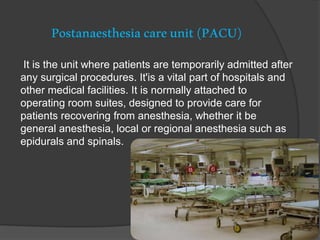
Postanaesthesiacareunit(PACU)
It is the unit where patients are temporarily admitted after
any surgical procedures. It'is a vital part of hospitals and
other medical facilities. It is normally attached to
operating room suites, designed to provide care for
patients recovering from anesthesia, whether it be
general anesthesia, local or regional anesthesia such as
epidurals and spinals.
DischargingcirteiafromPACU
Any Q.?

icu admission.2022 pptx.pdf

  • 1.
  • 2.
    Dr. Radhwan H.AL-Khashab consulatant anaesthesia & ICU Assisst prof. 2022
  • 3.
    Surgical Intensive CareUnit (SICU) offers critical care treatment to unstable, severely ill patients in the perioperative setting, who have life-threatening conditions and require comprehensive care, constant monitoring, and possible emergency interventions. Definitions
  • 4.
    So it`s tertiarycare facility in the hospital that provides a state of medical care to critically ill patients referred to it via different surgical department
  • 5.
    Who take care? Anesthesiologistsplayed a major role in SICU . Relative to most other physicians, anesthesiologists have greater expertise in airway management, mechanical ventilation, drug and fluid resuscitation, and advanced monitoring techniques that are central to effective care in critical illness. The role of surgeons in SICUs provides specific insights and perspectives concerning the care of surgical patients, Trauma management and postoperative care require active input from surgeons in the intensive care unit . (Hellenic Journal of Surgery (2016) 88:1, 3-4)
  • 6.
    A high-dependency unitis an area in a hospital, usually located close to the intensive care unit, where patients can be cared for more extensively than on a normal ward, but not to the point of intensive care. It is appropriate for patients who have had major surgery and for those with single-organ failure.
  • 7.
    Indication of admissionto SICU A. Surgical causes includes:  Pre and post-operative patients of ASA IV and V, undergoing major and ultra major surgeries.which may includes:  All craniotomy patients.  All thoracotomy patients.  All ultra major surgeries.
  • 8.
    B- Severely injuredpatient : whether there is indication for mechanical ventilation or not. C-Medical causes : any previous medical problems in which the anesthesia & surgery increase the severity of pre- existing disease e.g. patient with COPD, restrictive lung disease ,heart failure , uncontrolled DM or H.T. . D- Anaesthesia related causes : Cardiac arrest , sudden hyper or hypotension, cardiac dysrrhythmias , delay recovery from anaesthesia , oliguria or anuria.
  • 9.
    Generally speaking, anysurgical patient who requires continuous monitoring, 1:1 nursing and /or continuous life support is a candidate for SICU admission. As with any other treatment, the decision to admit a patient to an intensive care unit should be based on the concept of potential benefit. Patients who are too well to benefit or those with no hope of recovering to an acceptable quality of life should not be admitted.
  • 10.
    ‫نينوى‬ ‫صحة‬ ‫دائرة‬ ‫التعليمي‬‫الجمهوري‬ ‫مستشفى‬ ‫المركزة‬ ‫والعناية‬ ‫التخدير‬ ‫قسم‬ ICU admission forma Patient name: ………………………………………………………………………………….. Age:………………………………… Sex:………………………………… Primary diagnosis: ………………………………………………………………………………………………… Indication to ICU admission: …………………………………………………………………………………………………… ‫معلومات‬ ‫تدقيق‬ ‫وسيتم‬ ‫االستمارة‬ ‫هذه‬ ‫بدون‬ ‫مريض‬ ‫اي‬ ‫ادخال‬ ‫اليتم‬ :‫مالحظة‬ ‫العناية‬ ‫شعبة‬ ‫مدير‬ ‫قبل‬ ‫من‬ ‫المريض‬ ‫المسؤول‬ ‫االقدم‬ ‫المقيم‬ ‫المنتظر‬ ‫االختصاص‬ ‫الطبيب‬
  • 11.
    Who should managesurgical patient in SICU  To provide quality critical care to this patients the surgeon & intensivist should be in close communication through out the patient stay in SICU.  The surgeon should inform the SICU team preoperatively regarding a patient who may need postoperative admission.  Postoperatively the surgeon & intensivist will need to work side by side , goals of care should be discussed frequently & the plans should be communicated daily. Who should manage surgical patient in SICU Author: Stefan Alfred Hubertus Rohrig, Marcus D. Lance, M. Faisal Malmstrom,Publish Year: 2020
  • 12.
    Patient`s monitoring Basic patient`s monitoring Advancedpatient`s monitoring  Heart rate  Blood pressure  Respiratory rate  ETCO2  Pulse Oximetry  Hourly urine output  Temperature  GCS  ABG  CVP  IBP  PCWP  PAP  ICP  IAP
  • 13.
  • 14.
    APACHE II scoringsystem  APACHE : Acute physiology & chronic health evaluation.  Published in 1985. Up to four points are assigned to each  Physiological variable according to its most abnormal value.  During the first 24 hours in intensive care. Points are also assigned for age, history of severe clinical conditions, and surgical status. The total number of points gives a score ranging from 0-71, with an increasing score representing a greater severity of illness.  APACHE II allows the probability of death before discharge from hospital to be estimated.
  • 16.
    Discharge from intensivecare and high dependency care. A patient should be discharged from the ICU when the condition that led to the admission has been adequately reversed or when the patient is no longer benefiting from the treatment available. Unless a patient’s death is imminent, it is appropriate to transfer the patient to another area of the hospital and allow death with dignity. Intensive care patients may be discharged to high dependency care or to the general ward ,as appropriate.
  • 17.
    Postanaesthesiacareunit(PACU) It is theunit where patients are temporarily admitted after any surgical procedures. It'is a vital part of hospitals and other medical facilities. It is normally attached to operating room suites, designed to provide care for patients recovering from anesthesia, whether it be general anesthesia, local or regional anesthesia such as epidurals and spinals.
  • 18.
  • 19.