Not for Profit Club Planning
Narelle Stoll
May 2013
Why write a Plan
 Imagine you are going on a journey to a designation along a
unfamiliar route. No doubt one of the essential items you
would pack would be a map describing the route and
environment you would be travelling in.
 A plan is like the road map for your organisation.
 While the destination may be defined, often the journey to the
destination can be littered with obstacles and diversions. If
these are not properly managed, this can result in the
Organisation not meeting its objectives.
 The purpose of developing a Plan is to identify these
situations and develop a plan for managing them when they
arise.
The Vision Statement
 The first step in creating a plan is to identify
where you want to be or in other words
“What is it we want our Club to become”
Values
 The purpose of identifying values is to
identify the core beliefs or attitudes that
drives members to achieve within the Club
 Without identifying the core values it will be
difficult for the Organisation to define its
mission statement.
 Examples of values include words such as
“Excellence, Collaboration, Pride,
Innovation”
Mission
 The purpose of the mission statement is to
define why a organisation exists and what is
its purpose.
"What business are we in?', "What are we
doing or delivering"
Strategic Objectives
 The Strategic Objectives are the long term objectives of what we want to achieve in the next
3-5 years.
Examples of Strategic Objectives are
 Improve our profitability
 Develop our members
 Grow our support network or centres of influence
 Develop standardised procedures for program delivery
Questions to ask during this process include
 Who benefits from our services?
 What services do we provide and should be providing in the future?
 How might the stakeholders change in the future?
 How might the Organisation respond in the future?
 Will we be attractive to our market if we meet our objectives?
 What effort will the Organisation make reorganise its priorities if conditions change?
 Where should our efforts be concentrated?
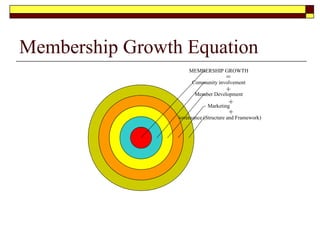
Membership Growth Equation
Governance (Structure and Framework)
Marketing
Member Development
Community involvement
MEMBERSHIP GROWTH
+
+
+
=
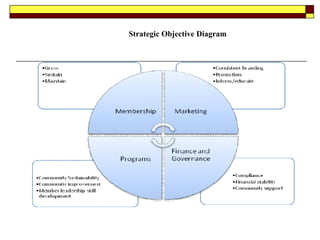
Strategic Objective Diagram
Stakeholders
 Stakeholders are groups or individuals that
have the ability to impact on a clubs strategic
objectives
 Depending on their level of influence
Stakeholders can either have a positive or
negative influence on an organisation
 Need to be identified and managed
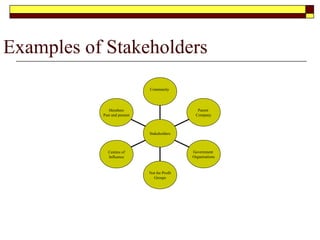
Members
Past and present
Centres of
Influence
Not for Profit
Groups
Government
Organisations
Parent
Company
Community
Stakeholders
Examples of Stakeholders
SWOT Analysis
 A SWOT Analysis provides the organisation
with the opportunity to identify the
stakeholders and their potential impacts
 The advantage of a SWOT analysis it enables
the club to prioritise the stakeholders and
other external forces
 Allows a club to develop a targeted strategy
to address them when they arise
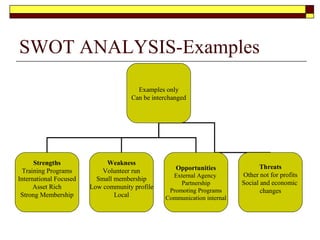
SWOT ANALYSIS-Examples
Examples only
Can be interchanged
Strengths
Training Programs
International Focused
Asset Rich
Strong Membership
Weakness
Volunteer run
Small membership
Low community profile
Local
Opportunities
External Agency
Partnership
Promoting Programs
Communication internal
Threats
Other not for profits
Social and economic
changes
Goal setting
 Once the gaps have been identified short term goals or
objectives need to be set. The purpose of goals is to define
clearly what the Chapter needs to achieve in a specific
timeframe. The goals should therefore follow the SMART
format:
 Specific
 Measurable
 Achievable
 Realistic
 Timely
Defining Activities
 Once an Organisation has defined its goals it now needs to identify and
define the activities that it needs to complete in order to achieve its
objectives.
 While the activities may vary from organisation to organisation they
should generally fall under one of the following categories:
 Governance and Financial Management
 Member Development-training and mentoring
 Community development and improvement
 Marketing and Public Relations- stakeholder communication
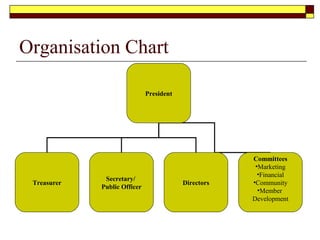
 Once the Organisation has defined its activities it should create an
organisational chart like the one pictured that provides an outline of the
activities and the roles and positions that govern them
Organisation Chart
President
Treasurer
Secretary/
Public Officer
Directors
Committees
•Marketing
•Financial
•Community
•Member
Development
Programming
The next step for the Club is to define the process as to how its
events, programs and activities will be run and managed. This
includes defining the following
 What activities are to be completed to meet the objectives
 Rules and procedures governing the activities
 Priority for activities A. Must do, B. Should do C. Might do
 Who will be responsible for the activities
 Location
 The Timeframe's activities are to be completed in
 Cost involved
 Process for review of activities in terms of progress and outcome
 Important for a club to ensure its Program meets its Governance
requirements and Club Reporting requirements as well as member
needs
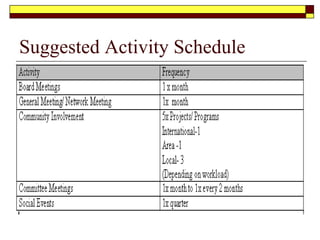
Suggested Activity Schedule
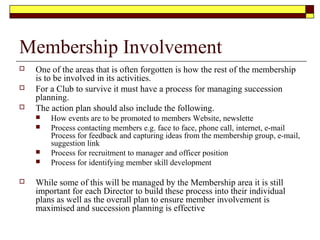
Membership Involvement
 One of the areas that is often forgotten is how the rest of the membership
is to be involved in its activities.
 For a Club to survive it must have a process for managing succession
planning.
 The action plan should also include the following.
 How events are to be promoted to members Website, newslette
 Process contacting members e.g. face to face, phone call, internet, e-mail
Process for feedback and capturing ideas from the membership group, e-mail,
suggestion link
 Process for recruitment to manager and officer position
 Process for identifying member skill development
 While some of this will be managed by the Membership area it is still
important for each Director to build these process into their individual
plans as well as the overall plan to ensure member involvement is
maximised and succession planning is effective
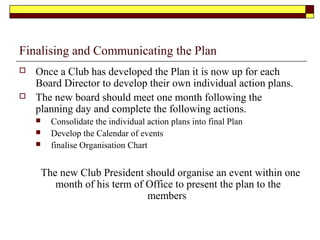
Finalising and Communicating the Plan
 Once a Club has developed the Plan it is now up for each
Board Director to develop their own individual action plans.
 The new board should meet one month following the
planning day and complete the following actions.
 Consolidate the individual action plans into final Plan
 Develop the Calendar of events
 finalise Organisation Chart
The new Club President should organise an event within one
month of his term of Office to present the plan to the
members
Quote
 "All you need is the plan, the road map, and
the courage to press on to your destination".
Earl nightingale http://www.motivational-inspirational-corner.com
Resources
Click on link for the following
Planning Template
 Position Descriptions
 Planning Day Agenda
Directors Yearly Plan
Videos
Click on link for
Strategic Plan
Goal setting
Vision Statement
Mission Statement
Values
Strategic Objectives
SWOT Analysis

Planning

  • 1.
    Not for ProfitClub Planning Narelle Stoll May 2013
  • 2.
    Why write aPlan  Imagine you are going on a journey to a designation along a unfamiliar route. No doubt one of the essential items you would pack would be a map describing the route and environment you would be travelling in.  A plan is like the road map for your organisation.  While the destination may be defined, often the journey to the destination can be littered with obstacles and diversions. If these are not properly managed, this can result in the Organisation not meeting its objectives.  The purpose of developing a Plan is to identify these situations and develop a plan for managing them when they arise.
  • 3.
    The Vision Statement The first step in creating a plan is to identify where you want to be or in other words “What is it we want our Club to become”
  • 4.
    Values  The purposeof identifying values is to identify the core beliefs or attitudes that drives members to achieve within the Club  Without identifying the core values it will be difficult for the Organisation to define its mission statement.  Examples of values include words such as “Excellence, Collaboration, Pride, Innovation”
  • 5.
    Mission  The purposeof the mission statement is to define why a organisation exists and what is its purpose. "What business are we in?', "What are we doing or delivering"
  • 6.
    Strategic Objectives  TheStrategic Objectives are the long term objectives of what we want to achieve in the next 3-5 years. Examples of Strategic Objectives are  Improve our profitability  Develop our members  Grow our support network or centres of influence  Develop standardised procedures for program delivery Questions to ask during this process include  Who benefits from our services?  What services do we provide and should be providing in the future?  How might the stakeholders change in the future?  How might the Organisation respond in the future?  Will we be attractive to our market if we meet our objectives?  What effort will the Organisation make reorganise its priorities if conditions change?  Where should our efforts be concentrated?
  • 7.
    Membership Growth Equation Governance(Structure and Framework) Marketing Member Development Community involvement MEMBERSHIP GROWTH + + + =
  • 8.
  • 9.
    Stakeholders  Stakeholders aregroups or individuals that have the ability to impact on a clubs strategic objectives  Depending on their level of influence Stakeholders can either have a positive or negative influence on an organisation  Need to be identified and managed
  • 10.
    Members Past and present Centresof Influence Not for Profit Groups Government Organisations Parent Company Community Stakeholders Examples of Stakeholders
  • 11.
    SWOT Analysis  ASWOT Analysis provides the organisation with the opportunity to identify the stakeholders and their potential impacts  The advantage of a SWOT analysis it enables the club to prioritise the stakeholders and other external forces  Allows a club to develop a targeted strategy to address them when they arise
  • 12.
    SWOT ANALYSIS-Examples Examples only Canbe interchanged Strengths Training Programs International Focused Asset Rich Strong Membership Weakness Volunteer run Small membership Low community profile Local Opportunities External Agency Partnership Promoting Programs Communication internal Threats Other not for profits Social and economic changes
  • 13.
    Goal setting  Oncethe gaps have been identified short term goals or objectives need to be set. The purpose of goals is to define clearly what the Chapter needs to achieve in a specific timeframe. The goals should therefore follow the SMART format:  Specific  Measurable  Achievable  Realistic  Timely
  • 14.
    Defining Activities  Oncean Organisation has defined its goals it now needs to identify and define the activities that it needs to complete in order to achieve its objectives.  While the activities may vary from organisation to organisation they should generally fall under one of the following categories:  Governance and Financial Management  Member Development-training and mentoring  Community development and improvement  Marketing and Public Relations- stakeholder communication  Once the Organisation has defined its activities it should create an organisational chart like the one pictured that provides an outline of the activities and the roles and positions that govern them
  • 15.
  • 16.
    Programming The next stepfor the Club is to define the process as to how its events, programs and activities will be run and managed. This includes defining the following  What activities are to be completed to meet the objectives  Rules and procedures governing the activities  Priority for activities A. Must do, B. Should do C. Might do  Who will be responsible for the activities  Location  The Timeframe's activities are to be completed in  Cost involved  Process for review of activities in terms of progress and outcome  Important for a club to ensure its Program meets its Governance requirements and Club Reporting requirements as well as member needs
  • 17.
  • 18.
    Membership Involvement  Oneof the areas that is often forgotten is how the rest of the membership is to be involved in its activities.  For a Club to survive it must have a process for managing succession planning.  The action plan should also include the following.  How events are to be promoted to members Website, newslette  Process contacting members e.g. face to face, phone call, internet, e-mail Process for feedback and capturing ideas from the membership group, e-mail, suggestion link  Process for recruitment to manager and officer position  Process for identifying member skill development  While some of this will be managed by the Membership area it is still important for each Director to build these process into their individual plans as well as the overall plan to ensure member involvement is maximised and succession planning is effective
  • 19.
    Finalising and Communicatingthe Plan  Once a Club has developed the Plan it is now up for each Board Director to develop their own individual action plans.  The new board should meet one month following the planning day and complete the following actions.  Consolidate the individual action plans into final Plan  Develop the Calendar of events  finalise Organisation Chart The new Club President should organise an event within one month of his term of Office to present the plan to the members
  • 20.
    Quote  "All youneed is the plan, the road map, and the courage to press on to your destination". Earl nightingale http://www.motivational-inspirational-corner.com
  • 21.
    Resources Click on linkfor the following Planning Template  Position Descriptions  Planning Day Agenda Directors Yearly Plan
  • 22.
    Videos Click on linkfor Strategic Plan Goal setting Vision Statement Mission Statement Values Strategic Objectives SWOT Analysis