You, literally have thirty seconds
to set the tone, establish
credibility, and hook your
audience into listening to you.
Your opening sets the entire
tone of your presentation
(including whether you'll be
interesting or not).
The first minute is when you
introduce your message and
tell the audience why they
need to hear it.
Successful Opening #1
Go against the expected.
Eg. “Everyone hates paying
Taxes. Except me. I love
paying my Taxes.”
This hooks your audience.
“Why would he love paying
taxes?”
Successful Opening #2
Ask a series of rhetorical
questions. Not just one,
but several.
Eg. “When did life begin?
How did we get on earth?
Is there life on other
Planets?”
Your talk will challenge
the audience’s intellect.
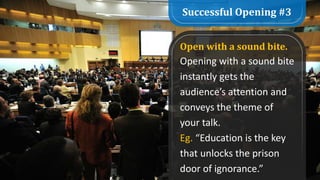
Successful Opening #3
Open with a sound bite.
Opening with a sound bite
instantly gets the
audience’s attention and
conveys the theme of
your talk.
Eg. “Education is the key
that unlocks the prison
door of ignorance.”
Successful Opening #4
Give a Shocking Statistic
or Fact.
Find something shocking that
will instantly capture the
audience’s attention.
Eg. “In the time it takes you
to listen to my talk, 1200
people will die of heart
attacks somewhere in the
world.”
Successful Opening #5
Silence
A pause, whether two
seconds or 10 seconds,
allows your audience to
sit and quiet down. An
extra pause brings all the
attention right where you
should want it – on you.
Successful Opening #6
Start with a Powerful
Quote and then add your
own Twist.
Eg. “Oprah Winfrey says ‘You
can’t be friends with someone
who wants your life.’ I’d add to
that, ‘You can’t be friends with
someone who wants your life
and doesn’t want you to have it
either.’”
Successful Opening #7
Take them through a
What If scenario.
This is a great opening if you
are talking about a product,
service, or a solution to a
problem.
Eg. “What if you were debt
free? Or, “What if you woke up
tomorrow and didn’t have a
weight problem?
Successful Opening #8
Tell them a story that
evokes emotion.
Our brains are hard-wired
to listen to and
understand stories. To
make this opening
successful, you have to
keep the story short.
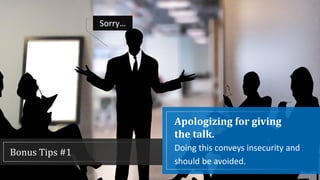
Bonus Tips #1
Sorry…
Apologizing for giving
the talk.
Doing this conveys insecurity and
should be avoided.
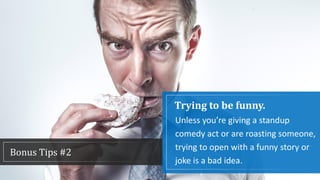
Trying to be funny.
Unless you’re giving a standup
comedy act or are roasting someone,
trying to open with a funny story or
joke is a bad idea.
Bonus Tips #2
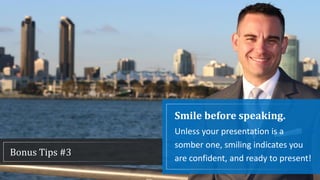
Smile before speaking.
Unless your presentation is a
somber one, smiling indicates you
are confident, and ready to present!
Bonus Tips #3
Not prepared for speaking.
Never, even if true, tell the
audience you are not prepared for
your presentation.
Bonus Tips #4
Bonus Tips #5
Don’t make excuses.
“I had a bad night.” “I misjudged
the time it would take to get here.”
“I had a family emergency”
Why You Need to Start and End Your Speech Strongly?
There are two concepts
Primacy states that
people remember
most vividly what
they hear at the
beginning of a
speech
Primacy
Recency says those
same people will
strongly recall
what you say at
the end.
Recency
It sounds like a lot for thirty
seconds. But, it’s the most
important thirty seconds of
your whole talk.
To open your talk effectively,
you need to connect with
your audience somehow.
BOTTOM LINE
8 Successful Ways to Open Your Speech

8 Successful Ways to Open Your Speech

  • 2.
    You, literally havethirty seconds to set the tone, establish credibility, and hook your audience into listening to you.
  • 3.
    Your opening setsthe entire tone of your presentation (including whether you'll be interesting or not).
  • 4.
    The first minuteis when you introduce your message and tell the audience why they need to hear it.
  • 5.
    Successful Opening #1 Goagainst the expected. Eg. “Everyone hates paying Taxes. Except me. I love paying my Taxes.” This hooks your audience. “Why would he love paying taxes?”
  • 6.
    Successful Opening #2 Aska series of rhetorical questions. Not just one, but several. Eg. “When did life begin? How did we get on earth? Is there life on other Planets?” Your talk will challenge the audience’s intellect.
  • 7.
    Successful Opening #3 Openwith a sound bite. Opening with a sound bite instantly gets the audience’s attention and conveys the theme of your talk. Eg. “Education is the key that unlocks the prison door of ignorance.”
  • 8.
    Successful Opening #4 Givea Shocking Statistic or Fact. Find something shocking that will instantly capture the audience’s attention. Eg. “In the time it takes you to listen to my talk, 1200 people will die of heart attacks somewhere in the world.”
  • 9.
    Successful Opening #5 Silence Apause, whether two seconds or 10 seconds, allows your audience to sit and quiet down. An extra pause brings all the attention right where you should want it – on you.
  • 10.
    Successful Opening #6 Startwith a Powerful Quote and then add your own Twist. Eg. “Oprah Winfrey says ‘You can’t be friends with someone who wants your life.’ I’d add to that, ‘You can’t be friends with someone who wants your life and doesn’t want you to have it either.’”
  • 11.
    Successful Opening #7 Takethem through a What If scenario. This is a great opening if you are talking about a product, service, or a solution to a problem. Eg. “What if you were debt free? Or, “What if you woke up tomorrow and didn’t have a weight problem?
  • 12.
    Successful Opening #8 Tellthem a story that evokes emotion. Our brains are hard-wired to listen to and understand stories. To make this opening successful, you have to keep the story short.
  • 13.
    Bonus Tips #1 Sorry… Apologizingfor giving the talk. Doing this conveys insecurity and should be avoided.
  • 14.
    Trying to befunny. Unless you’re giving a standup comedy act or are roasting someone, trying to open with a funny story or joke is a bad idea. Bonus Tips #2
  • 15.
    Smile before speaking. Unlessyour presentation is a somber one, smiling indicates you are confident, and ready to present! Bonus Tips #3
  • 16.
    Not prepared forspeaking. Never, even if true, tell the audience you are not prepared for your presentation. Bonus Tips #4
  • 17.
    Bonus Tips #5 Don’tmake excuses. “I had a bad night.” “I misjudged the time it would take to get here.” “I had a family emergency”
  • 18.
    Why You Needto Start and End Your Speech Strongly?
  • 19.
    There are twoconcepts Primacy states that people remember most vividly what they hear at the beginning of a speech Primacy Recency says those same people will strongly recall what you say at the end. Recency
  • 20.
    It sounds likea lot for thirty seconds. But, it’s the most important thirty seconds of your whole talk. To open your talk effectively, you need to connect with your audience somehow. BOTTOM LINE