The Leader in you
Mentoring Program for Volunteers
Created by Narelle Stoll Community Leadership
Network
Introduction
The purpose of this document is to assist volunteers develop leadership skills
through participation in activities
It is hoped that through this document an individual will gain the skills and
knowledge needed for them to become an effective community leader
For more information please visit the websites below. Particularly if any of the
links on this presentation are missing or broken
Regards
Narelle Stoll
Community Leadership Network
Community Leadership Blog
About this presentation
This presentation is made of a series of modules containing brief
information, recommended readings and activities
While the suggested timeframe for each module is one month
there really is no time limit.
To get the best our of this course get a folder with paper to allow
you to write down information and download and save
articles and other useful information
Don’t forget to use your mentor
to assist you on your journey
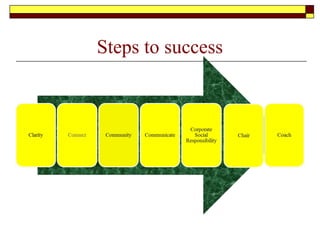
Steps to success
Steps to success
 What each of these steps represent is a skills you need to
develop towards you becoming a leader
 They have been arranged in a logical order to assist you
progress and grow in your own pace
 So lets start with Module 1 Clarity
Module 1 Clarity
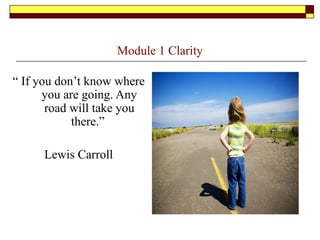
“ If you don’t know where
you are going. Any
road will take you
there.”
Lewis Carroll
Purpose of Clarity
 As you might have discovered your organisation offers a
world of possibilities.
 However without a structured plan in place you may find
yourself drifting and at the end of year feeling disappointed
you did not get what you wanted out of the organisation.
 A written career plan will give you direction
Areas to consider
 Financial
 Health
 Career
 Social/Family
 Spiritual/ belief
Consider short term 1-2 years
Long term 3+
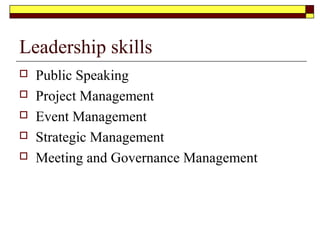
Leadership skills
 Public Speaking
 Project Management
 Event Management
 Strategic Management
 Meeting and Governance Management
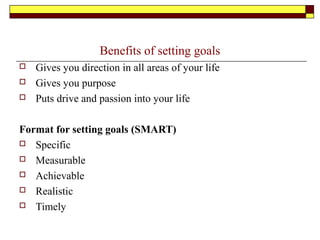
Benefits of setting goals
 Gives you direction in all areas of your life
 Gives you purpose
 Puts drive and passion into your life
Format for setting goals (SMART)
 Specific
 Measurable
 Achievable
 Realistic
 Timely
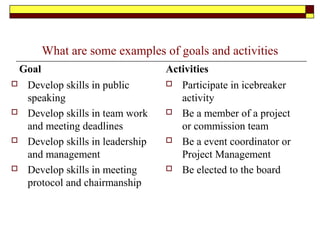
What are some examples of goals and activities
Goal
 Develop skills in public
speaking
 Develop skills in team work
and meeting deadlines
 Develop skills in leadership
and management
 Develop skills in meeting
protocol and chairmanship
Activities
 Participate in icebreaker
activity
 Be a member of a project
or commission team
 Be a event coordinator or
Project Management
 Be elected to the board
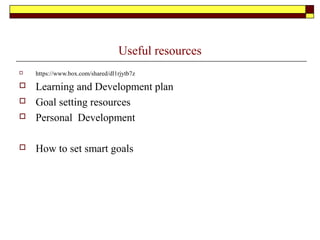
Useful resources
 https://www.box.com/shared/dl1rjytb7z
 Learning and Development plan
 Goal setting resources
 Personal Development
 How to set smart goals
Exercise
1. Watch the following video
2. Write down the goals of the people featured in the video or a
person that inspires you
3. Sit and reflect on what you think your purpose or goal is in
life
4. Write it down
Activity: Leadership- People that
inspire
Great Leaders of the World that Inspired Humanity
Further Activity
1. Download and read the resource information on goal setting
2. Download and read and Learning and Development plan
3. Decide what goals you want to achieve for the next six
months
4. Write them on the learning and development plan
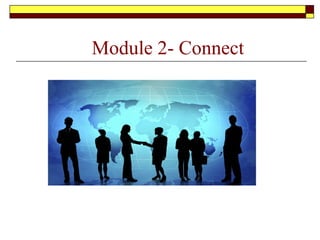
Module 2- Connect
The magic of networking
 One of the attributes of a successful leader is to have a wide
circle of contacts and resources to draw on
 This is achieved through successful and targeted networking
 Your organisation can provide many networking
opportunities both local and perhaps National or International
depending on its size
 Meeting new people can be a daunting experience
So here are some tips to get you started
Some tips on being a successful networker
 Do your homework-Know why you are going to the event
 Dress appropriately
 Take business cards
 If you don’t know anyone start with small groups of (2-3)
people
 Introduce yourself with handshake, smile and eye contact
 Maintain interest in the person
 Avoid topics that might offend
 Exchange cards- write date of event when you receive the
card
 Work the room, don’t stay in the one place
Activity
1. Before you attend your next function write down the following on a piece of
paper
 What is the purpose of the event?
 Why am I attending?
 What type of people I want to network with?
 What can I offer them?
Put these skills into practise at the next event
2. Sign up to your organisation social networking sites if you have not already
done so.
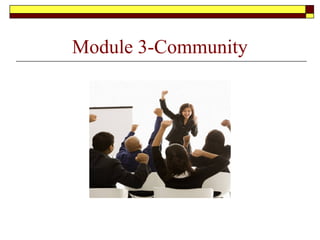
Module 3-Community
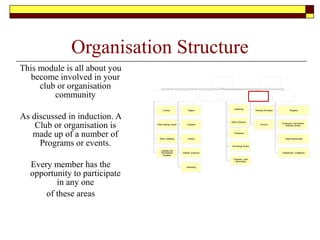
Organisation Structure
This module is all about you
become involved in your
club or organisation
community
As discussed in induction. A
Club or organisation is
made up of a number of
Programs or events.
Every member has the
opportunity to participate
in any one
of these areas
Getting involved
By being involved in assisting with events you can gain some
valuable skills.
 Time management
 Networking
 Protocol
 Event Management
 Lateral thinking
 Marketing and Promotion
 Budgeting
 Public speaking
Different type of roles
There are a variety of different roles you can take on within a team.
These can include
 Marketing/ PR person
 Logistics- venue hire/layout/catering
 Event promotion
 Administration
 Membership (Training and skill development)
 Financial manager
 Sponsorship
 Technical volunteer ( specialist skills/qualifications may be required)
Just remember, unlike work generally no qualifications
or expertise required. Just a willingness to give it a go
How to be an effective team member
 Turn up to meetings on time
 Participate in discussion
 Take a note book to jot down actions you are required to do
 Commit to actions in the specified time
 Be honest and communicate in advance if unable to complete a
task
 Support and assist other members of the team
How to be an effective team member
 Respect and follow directions of team leader or supervisor if
safe to do so
 Respect and follow the rules and protocol of the organisation
 Take initiative if you see a task requires doing
 Be positive and enthusiastic
 Don’t forget to wear organisation t-shirts or other promotional
material when hosting a public event
Refer to video- Leadership Lessons from the Dancing Guy
Notes on formal events
 Your organisation may have the opportunity to host an
international visitor or local dignitary (Mayor, Member of
Parliament)
 Events of this type usually involve a special procedure for
how the event is to be run
 These types of events will normally have a dress code,
running sheet, Master of Ceremonies and formal activities
like toasts, speeches and presentations.
 Ensure you are briefed and adhere to the protocol associated
with the event.
General etiquette at formal events
 Respect the dress code for the event
 Turn up to the event at the prescribed time
 Address the guest formally by correct title when introduced
 Ensure you stand/sit and be silent when asked to do so by the
Master of Ceremonies
 Respond to a toast when requested
 Mind your manners-avoid comments that may offend
 Wear your organisation badge
 If seated at a table know your table manners and the correct
position for the cutlery and glasses and side plate
Activity
1. Obtain a copy of your Chapter or Clubs organisation chart and
event calendar
2. Write down all the activities and events coming up within the
next two months
3. Write down two events and roles you would be interested in
participating in
4. Contact the Event Coordinator to make arrangements to
attend your first meeting
Module 4- Communicate
Opportunities to develop confidence in Public Speaking
 Your organisation can offer many opportunities for members to
gain confidence in public speaking. These include
 Participation in formal courses
 Participating in public speaking/debating competitions
 Delivering verbal report to a meeting
 Promoting an event to club members
 Participating in a icebreaker event
Tips on improving your public speaking skills
 Do your research- know your audience
 Research your topic well
 Allow sufficient time to prepare and practice your speech
 Write your speech out in full and read it out loud before
converting to cards
 Practice your speech using hand cards
Tips on improving your public speaking skills
 On the day dress professionally with minimum jewellery
 Maintain eye contact with your audience
 Speak slowly and clearly
 Smile and look enthusiastic
 Finish your speech when requested to do so
 Watch the following video for inspiration
Martin Luther “I had a dream”
Activity
Here are some suggested activities to assist you to get confidence with public
speaking
1. Prepare a verbal report and present it at the next committee meeting
2. Participate in a icebreaking activity
3. Get two friends involved in a fun ice breaker activity at your next
meeting as the speakers
4. Introduce or thank a guest speaker at your next meeting
5. Promote a Project or event you are working to the organisation
6. Prepare an article for the newsletter
Module 5- Corporate Social Responsibility
Projects
 There are many projects you will find that your organisation
conducts both at local and possibly even at International level
 Projects have two functions.

1. Develop members leadership skills
2. Develop and improve communities at both local and
international level
Members have opportunities to participate in Projects at all levels
of the organisation
Skills members can develop
 As well as the skills listed under module 3 members will also develop the
following skills
 Leadership
 Cultural awareness
 Planning
 Volunteer Resource management
 Teamwork
 Budgeting
 Chairing and running meetings
 Media relations
 Grant applications
 Award submissions
 Technical or trade skills
Your focus for this module
 This is now your opportunity to step up and use the skills you
have developed in modules 2 and 3 to lead a project or event
team.
 This skill not only requires you to have developed skills in
planning, but also the ability to inspire and motivate others
Tips for successful Project Management
 Ensure you have developed a Project Plan with clearly defined
objectives and roles
 Recruit your team based on what you need to deliver
 Communicate your plan to the team defining clearly the
activities that need to be achieved by each role
 Develop written position description for each role
 Have a established meeting schedule where actions are
reviewed and issues discussed
 Ensure minutes are taken and circulated in a timely manner
 Communicate with team members regularly
Exercise
Watch the following video “Power of one”
Identify some of the issues in the video
What can you do to make a difference?
Activity
1. Offer to chair a community project or Program your organisation is
involved in
2. Read your local paper. Identify a cause or project your organisation can
become involved in. Prepare a project proposal and present to a board
meeting
3. Speak about a cause or area of interest at your next club event
4. Offer to invite a guest speaker from a community organisation to your
next event your members might be interested in
5. Prepare a press release
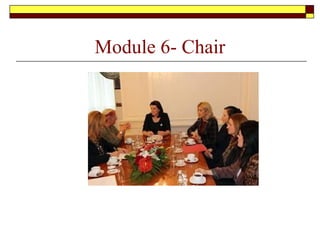
Module 6- Chair
What this module is about
 The purpose of this module is to introduce you to the process
for running a formal meeting
 This module is for those members who have stepped up to
take on a board position in their organization
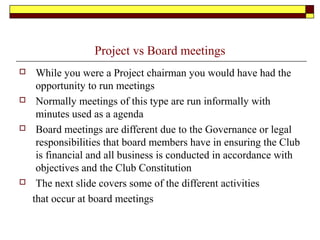
Project vs Board meetings
 While you were a Project chairman you would have had the
opportunity to run meetings
 Normally meetings of this type are run informally with
minutes used as a agenda
 Board meetings are different due to the Governance or legal
responsibilities that board members have in ensuring the Club
is financial and all business is conducted in accordance with
objectives and the Club Constitution
 The next slide covers some of the different activities
that occur at board meetings
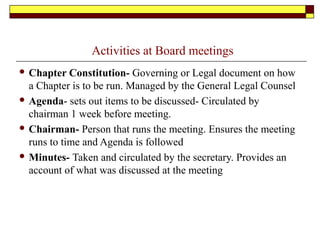
Activities at Board meetings
 Chapter Constitution- Governing or Legal document on how
a Chapter is to be run. Managed by the General Legal Counsel
 Agenda- sets out items to be discussed- Circulated by
chairman 1 week before meeting.
 Chairman- Person that runs the meeting. Ensures the meeting
runs to time and Agenda is followed
 Minutes- Taken and circulated by the secretary. Provides an
account of what was discussed at the meeting
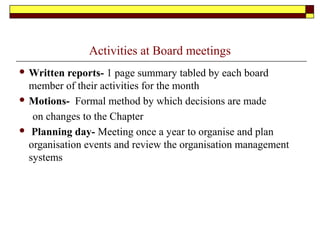
Activities at Board meetings
 Written reports- 1 page summary tabled by each board
member of their activities for the month
 Motions- Formal method by which decisions are made
on changes to the Chapter
 Planning day- Meeting once a year to organise and plan
organisation events and review the organisation management
systems
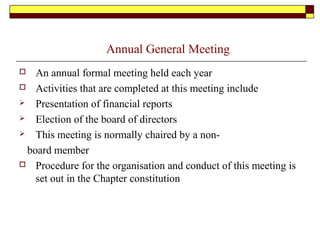
Annual General Meeting
 An annual formal meeting held each year
 Activities that are completed at this meeting include
 Presentation of financial reports
 Election of the board of directors
 This meeting is normally chaired by a non-
board member
 Procedure for the organisation and conduct of this meeting is
set out in the Chapter constitution
Tips for delivering a report (1-2 minutes)
 Prepare what you are going to speak on
 Structure the report in the following format ( no more than 3
points under each heading)
 What was/is the event about
 Progress to date
 Further action to be taken
 When called stand and address the chairman and the audience
 Speak clearly and stick to the points on the page
 Finish within the time allocated
 Conclude with the words “Mr/ Madam Chairman
I would like to table my report.”
Tips for chairing a meeting
 Prepare and circulate the agenda one week prior to the
meeting
 Read the constitution and parliamentary procedures for
chairing meetings. Seek assistance from General Legal
Counsel if unsure about procedures
 Request board members reports one week prior to the
meeting so they be distributed with the agenda
Tips for chairing a meeting
 Start the meeting on time
 Stick to the Agenda
 Remain impartial, professional and objective. Take charge if
the meeting is running over the agenda or becoming heated
due to a sensitive matter being discussed
 Allow everyone to have a say.
Activity
1. At your first meeting after being elected to the board present a report to the
organization or club meeting on your role and areas of responsibilities
2. Prepare and present a motion to your board meeting
3. Conduct a small group exercise with a minimum of three other people where
people in the group take turns being a chairman and conducting a meeting that
runs for about 5-10 minutes. Two other members pretend acting as secretary, a
director and have one person as a observer. Swap roles and critique each others
performance.
4. Obtain a copy and read your organisation’s Constitution
5. Obtain a copy of your organisations Parliamentary Procedures
Module 7-Coach
About this module
 This module is designed to assist people who may be in a
position of assisting or guiding other members. This can
include
 Board member
 Trainer
 Project Manager
 Member more than 6 months
The purpose of this module is to provide you with some
Guidance on how you can become an effective coach
Being a coach
 The responsibility for being a coach is not something to be taken lightly.
You are responsible for ensuring a newer member of the organisation
receives the best knowledge and assistance to enable them to become a
better person or leader.
 You are also seen as a representative of the organisation by the new
member. A new member will judge the organisation on how you conduct
yourself
 A coach is not designed to be the expert in everything really just a guiding
hand to assist the new member
 There is considerable rewards in being a coach or mentor. The best is seeing
new members grow in confidence and take on leadership roles
Some tips on being a great coach
 Be committed – Meet the new member at agreed schedules. Don’t be
distracted by phones and other members during the meeting.
 Be honest- If you don’t know something say so. But also offer to find out
the information and get back to the member by the agreed time.
 Be prepared- Prepare what you are going to deliver and discuss at the
meeting in advance
 Be professional and objective- As a coach you are responsible for
providing feedback to assist the member in being a better person. As well as
giving praise also give constructive feedback on what they can do to
improve next time.
 Be supportive and respectful- Don’t be disrespectful and demeaning if an
individual does not understand something. Remember once you were a
beginner yourself
 Be prepared to learn- Knowledge is a two way street. Don’t be afraid to
learn something from the person you are coaching.
Activity
1. Volunteer to partner with a new member to assist them
become orientated to the organisation and activities
2. Offer to run some a training courses to new members
Video Resources
Video Link to the following
http://www.flickr.com/photos/communityleasership/sets/7215763
3734010504/
 Information on mentoring
 Team Building through Effective Coaching Skills
Useful resources
Community Leadership Network online Leadership Courses
http://nfphub.wordpress.com/online-leadership-training-
courses/
 Public Speaking
 Planning
 Meeting Procedure
 Event Management
 Project Management
 How to Lobby
Conclusion
I hope you have enjoyed the presentation and have gained many tools and ideas to
equip you on your leadership journey.
Remember
“A journey of a thousand miles begins with a single step”
Laozi (c 604 bc - c 531 bc)
To conclude please watch this inspiring video. All the best.
Think Different

Theleaderinyou

  • 1.
    The Leader inyou Mentoring Program for Volunteers Created by Narelle Stoll Community Leadership Network
  • 2.
    Introduction The purpose ofthis document is to assist volunteers develop leadership skills through participation in activities It is hoped that through this document an individual will gain the skills and knowledge needed for them to become an effective community leader For more information please visit the websites below. Particularly if any of the links on this presentation are missing or broken Regards Narelle Stoll Community Leadership Network Community Leadership Blog
  • 3.
    About this presentation Thispresentation is made of a series of modules containing brief information, recommended readings and activities While the suggested timeframe for each module is one month there really is no time limit. To get the best our of this course get a folder with paper to allow you to write down information and download and save articles and other useful information Don’t forget to use your mentor to assist you on your journey
  • 4.
  • 5.
    Steps to success What each of these steps represent is a skills you need to develop towards you becoming a leader  They have been arranged in a logical order to assist you progress and grow in your own pace  So lets start with Module 1 Clarity
  • 6.
    Module 1 Clarity “If you don’t know where you are going. Any road will take you there.” Lewis Carroll
  • 7.
    Purpose of Clarity As you might have discovered your organisation offers a world of possibilities.  However without a structured plan in place you may find yourself drifting and at the end of year feeling disappointed you did not get what you wanted out of the organisation.  A written career plan will give you direction
  • 8.
    Areas to consider Financial  Health  Career  Social/Family  Spiritual/ belief Consider short term 1-2 years Long term 3+
  • 9.
    Leadership skills  PublicSpeaking  Project Management  Event Management  Strategic Management  Meeting and Governance Management
  • 10.
    Benefits of settinggoals  Gives you direction in all areas of your life  Gives you purpose  Puts drive and passion into your life Format for setting goals (SMART)  Specific  Measurable  Achievable  Realistic  Timely
  • 11.
    What are someexamples of goals and activities Goal  Develop skills in public speaking  Develop skills in team work and meeting deadlines  Develop skills in leadership and management  Develop skills in meeting protocol and chairmanship Activities  Participate in icebreaker activity  Be a member of a project or commission team  Be a event coordinator or Project Management  Be elected to the board
  • 12.
    Useful resources  https://www.box.com/shared/dl1rjytb7z Learning and Development plan  Goal setting resources  Personal Development  How to set smart goals
  • 13.
    Exercise 1. Watch thefollowing video 2. Write down the goals of the people featured in the video or a person that inspires you 3. Sit and reflect on what you think your purpose or goal is in life 4. Write it down
  • 14.
    Activity: Leadership- Peoplethat inspire Great Leaders of the World that Inspired Humanity
  • 15.
    Further Activity 1. Downloadand read the resource information on goal setting 2. Download and read and Learning and Development plan 3. Decide what goals you want to achieve for the next six months 4. Write them on the learning and development plan
  • 16.
  • 17.
    The magic ofnetworking  One of the attributes of a successful leader is to have a wide circle of contacts and resources to draw on  This is achieved through successful and targeted networking  Your organisation can provide many networking opportunities both local and perhaps National or International depending on its size  Meeting new people can be a daunting experience So here are some tips to get you started
  • 18.
    Some tips onbeing a successful networker  Do your homework-Know why you are going to the event  Dress appropriately  Take business cards  If you don’t know anyone start with small groups of (2-3) people  Introduce yourself with handshake, smile and eye contact  Maintain interest in the person  Avoid topics that might offend  Exchange cards- write date of event when you receive the card  Work the room, don’t stay in the one place
  • 19.
    Activity 1. Before youattend your next function write down the following on a piece of paper  What is the purpose of the event?  Why am I attending?  What type of people I want to network with?  What can I offer them? Put these skills into practise at the next event 2. Sign up to your organisation social networking sites if you have not already done so.
  • 20.
  • 21.
    Organisation Structure This moduleis all about you become involved in your club or organisation community As discussed in induction. A Club or organisation is made up of a number of Programs or events. Every member has the opportunity to participate in any one of these areas
  • 22.
    Getting involved By beinginvolved in assisting with events you can gain some valuable skills.  Time management  Networking  Protocol  Event Management  Lateral thinking  Marketing and Promotion  Budgeting  Public speaking
  • 23.
    Different type ofroles There are a variety of different roles you can take on within a team. These can include  Marketing/ PR person  Logistics- venue hire/layout/catering  Event promotion  Administration  Membership (Training and skill development)  Financial manager  Sponsorship  Technical volunteer ( specialist skills/qualifications may be required) Just remember, unlike work generally no qualifications or expertise required. Just a willingness to give it a go
  • 24.
    How to bean effective team member  Turn up to meetings on time  Participate in discussion  Take a note book to jot down actions you are required to do  Commit to actions in the specified time  Be honest and communicate in advance if unable to complete a task  Support and assist other members of the team
  • 25.
    How to bean effective team member  Respect and follow directions of team leader or supervisor if safe to do so  Respect and follow the rules and protocol of the organisation  Take initiative if you see a task requires doing  Be positive and enthusiastic  Don’t forget to wear organisation t-shirts or other promotional material when hosting a public event Refer to video- Leadership Lessons from the Dancing Guy
  • 26.
    Notes on formalevents  Your organisation may have the opportunity to host an international visitor or local dignitary (Mayor, Member of Parliament)  Events of this type usually involve a special procedure for how the event is to be run  These types of events will normally have a dress code, running sheet, Master of Ceremonies and formal activities like toasts, speeches and presentations.  Ensure you are briefed and adhere to the protocol associated with the event.
  • 27.
    General etiquette atformal events  Respect the dress code for the event  Turn up to the event at the prescribed time  Address the guest formally by correct title when introduced  Ensure you stand/sit and be silent when asked to do so by the Master of Ceremonies  Respond to a toast when requested  Mind your manners-avoid comments that may offend  Wear your organisation badge  If seated at a table know your table manners and the correct position for the cutlery and glasses and side plate
  • 28.
    Activity 1. Obtain acopy of your Chapter or Clubs organisation chart and event calendar 2. Write down all the activities and events coming up within the next two months 3. Write down two events and roles you would be interested in participating in 4. Contact the Event Coordinator to make arrangements to attend your first meeting
  • 29.
  • 30.
    Opportunities to developconfidence in Public Speaking  Your organisation can offer many opportunities for members to gain confidence in public speaking. These include  Participation in formal courses  Participating in public speaking/debating competitions  Delivering verbal report to a meeting  Promoting an event to club members  Participating in a icebreaker event
  • 31.
    Tips on improvingyour public speaking skills  Do your research- know your audience  Research your topic well  Allow sufficient time to prepare and practice your speech  Write your speech out in full and read it out loud before converting to cards  Practice your speech using hand cards
  • 32.
    Tips on improvingyour public speaking skills  On the day dress professionally with minimum jewellery  Maintain eye contact with your audience  Speak slowly and clearly  Smile and look enthusiastic  Finish your speech when requested to do so  Watch the following video for inspiration Martin Luther “I had a dream”
  • 33.
    Activity Here are somesuggested activities to assist you to get confidence with public speaking 1. Prepare a verbal report and present it at the next committee meeting 2. Participate in a icebreaking activity 3. Get two friends involved in a fun ice breaker activity at your next meeting as the speakers 4. Introduce or thank a guest speaker at your next meeting 5. Promote a Project or event you are working to the organisation 6. Prepare an article for the newsletter
  • 34.
    Module 5- CorporateSocial Responsibility
  • 35.
    Projects  There aremany projects you will find that your organisation conducts both at local and possibly even at International level  Projects have two functions. 1. Develop members leadership skills 2. Develop and improve communities at both local and international level Members have opportunities to participate in Projects at all levels of the organisation
  • 36.
    Skills members candevelop  As well as the skills listed under module 3 members will also develop the following skills  Leadership  Cultural awareness  Planning  Volunteer Resource management  Teamwork  Budgeting  Chairing and running meetings  Media relations  Grant applications  Award submissions  Technical or trade skills
  • 37.
    Your focus forthis module  This is now your opportunity to step up and use the skills you have developed in modules 2 and 3 to lead a project or event team.  This skill not only requires you to have developed skills in planning, but also the ability to inspire and motivate others
  • 38.
    Tips for successfulProject Management  Ensure you have developed a Project Plan with clearly defined objectives and roles  Recruit your team based on what you need to deliver  Communicate your plan to the team defining clearly the activities that need to be achieved by each role  Develop written position description for each role  Have a established meeting schedule where actions are reviewed and issues discussed  Ensure minutes are taken and circulated in a timely manner  Communicate with team members regularly
  • 39.
    Exercise Watch the followingvideo “Power of one” Identify some of the issues in the video What can you do to make a difference?
  • 40.
    Activity 1. Offer tochair a community project or Program your organisation is involved in 2. Read your local paper. Identify a cause or project your organisation can become involved in. Prepare a project proposal and present to a board meeting 3. Speak about a cause or area of interest at your next club event 4. Offer to invite a guest speaker from a community organisation to your next event your members might be interested in 5. Prepare a press release
  • 41.
  • 42.
    What this moduleis about  The purpose of this module is to introduce you to the process for running a formal meeting  This module is for those members who have stepped up to take on a board position in their organization
  • 43.
    Project vs Boardmeetings  While you were a Project chairman you would have had the opportunity to run meetings  Normally meetings of this type are run informally with minutes used as a agenda  Board meetings are different due to the Governance or legal responsibilities that board members have in ensuring the Club is financial and all business is conducted in accordance with objectives and the Club Constitution  The next slide covers some of the different activities that occur at board meetings
  • 44.
    Activities at Boardmeetings  Chapter Constitution- Governing or Legal document on how a Chapter is to be run. Managed by the General Legal Counsel  Agenda- sets out items to be discussed- Circulated by chairman 1 week before meeting.  Chairman- Person that runs the meeting. Ensures the meeting runs to time and Agenda is followed  Minutes- Taken and circulated by the secretary. Provides an account of what was discussed at the meeting
  • 45.
    Activities at Boardmeetings  Written reports- 1 page summary tabled by each board member of their activities for the month  Motions- Formal method by which decisions are made on changes to the Chapter  Planning day- Meeting once a year to organise and plan organisation events and review the organisation management systems
  • 46.
    Annual General Meeting An annual formal meeting held each year  Activities that are completed at this meeting include  Presentation of financial reports  Election of the board of directors  This meeting is normally chaired by a non- board member  Procedure for the organisation and conduct of this meeting is set out in the Chapter constitution
  • 47.
    Tips for deliveringa report (1-2 minutes)  Prepare what you are going to speak on  Structure the report in the following format ( no more than 3 points under each heading)  What was/is the event about  Progress to date  Further action to be taken  When called stand and address the chairman and the audience  Speak clearly and stick to the points on the page  Finish within the time allocated  Conclude with the words “Mr/ Madam Chairman I would like to table my report.”
  • 48.
    Tips for chairinga meeting  Prepare and circulate the agenda one week prior to the meeting  Read the constitution and parliamentary procedures for chairing meetings. Seek assistance from General Legal Counsel if unsure about procedures  Request board members reports one week prior to the meeting so they be distributed with the agenda
  • 49.
    Tips for chairinga meeting  Start the meeting on time  Stick to the Agenda  Remain impartial, professional and objective. Take charge if the meeting is running over the agenda or becoming heated due to a sensitive matter being discussed  Allow everyone to have a say.
  • 50.
    Activity 1. At yourfirst meeting after being elected to the board present a report to the organization or club meeting on your role and areas of responsibilities 2. Prepare and present a motion to your board meeting 3. Conduct a small group exercise with a minimum of three other people where people in the group take turns being a chairman and conducting a meeting that runs for about 5-10 minutes. Two other members pretend acting as secretary, a director and have one person as a observer. Swap roles and critique each others performance. 4. Obtain a copy and read your organisation’s Constitution 5. Obtain a copy of your organisations Parliamentary Procedures
  • 51.
  • 52.
    About this module This module is designed to assist people who may be in a position of assisting or guiding other members. This can include  Board member  Trainer  Project Manager  Member more than 6 months The purpose of this module is to provide you with some Guidance on how you can become an effective coach
  • 53.
    Being a coach The responsibility for being a coach is not something to be taken lightly. You are responsible for ensuring a newer member of the organisation receives the best knowledge and assistance to enable them to become a better person or leader.  You are also seen as a representative of the organisation by the new member. A new member will judge the organisation on how you conduct yourself  A coach is not designed to be the expert in everything really just a guiding hand to assist the new member  There is considerable rewards in being a coach or mentor. The best is seeing new members grow in confidence and take on leadership roles
  • 54.
    Some tips onbeing a great coach  Be committed – Meet the new member at agreed schedules. Don’t be distracted by phones and other members during the meeting.  Be honest- If you don’t know something say so. But also offer to find out the information and get back to the member by the agreed time.  Be prepared- Prepare what you are going to deliver and discuss at the meeting in advance  Be professional and objective- As a coach you are responsible for providing feedback to assist the member in being a better person. As well as giving praise also give constructive feedback on what they can do to improve next time.  Be supportive and respectful- Don’t be disrespectful and demeaning if an individual does not understand something. Remember once you were a beginner yourself  Be prepared to learn- Knowledge is a two way street. Don’t be afraid to learn something from the person you are coaching.
  • 55.
    Activity 1. Volunteer topartner with a new member to assist them become orientated to the organisation and activities 2. Offer to run some a training courses to new members
  • 56.
    Video Resources Video Linkto the following http://www.flickr.com/photos/communityleasership/sets/7215763 3734010504/  Information on mentoring  Team Building through Effective Coaching Skills
  • 57.
    Useful resources Community LeadershipNetwork online Leadership Courses http://nfphub.wordpress.com/online-leadership-training- courses/  Public Speaking  Planning  Meeting Procedure  Event Management  Project Management  How to Lobby
  • 58.
    Conclusion I hope youhave enjoyed the presentation and have gained many tools and ideas to equip you on your leadership journey. Remember “A journey of a thousand miles begins with a single step” Laozi (c 604 bc - c 531 bc) To conclude please watch this inspiring video. All the best. Think Different

Editor's Notes

  • #2 To have your National or Local Organization’s logo appear automatically on every new slide, follow the instructions below. Click on View-> Master -> Slide Master Click on Insert-> Picture-> From file and select the file of your logo. Or copy and paste your logo from another document. Move your logo into the lower left corner, as indicated by the gray box. If it is necessary to reduce the size of the logo, be sure to maintain the proportions by holding down shift when using the arrow at the corner of the picture to resize. Increasing the size of the logo image may make the image blurry or degraded and is not recommended. After your logo is in the correct position on the cover slide, select the second Master Slide shown at left. Click on Insert-> Picture-> From file and select the file of your logo. Or copy and paste your logo from another document or page. Move your logo into the space indicated by the gray box, keeping in mind the recommendations above. Click on the button “Close Master View” or click on View-> Normal. Delete the gray boxes to show your logo. Para que el logotipo de tu Organización Nacional o Local aparezca automáticamente en todas las diapositivas (“slides”), en la posición donde está el cuadro gris, sigue las instrucciones que aparecen a continuación. 1. Haz clic en Ver -> Patrón -> Patrón de diapositivas 2. Haz clic en Insertar-> Imagen -> Desde archivo y selecciona el archivo donde se encuentra tu logotipo. También puedes copiar el logotipo de otro documento y pegarlo (“paste”) en la diapositiva. 3. Traslada el logotipo hasta la esquina inferior izquierda, donde está el punto rojo. Si necesitas reducir el tamaño del logotipo, asegúrate de conservar las proporciones manteniendo presionada la tecla de mayúsculas (“shift”) mientras utilizas la flecha para agarrar la imagen por una esquina y alterar el tamaño. No es recomendable aumentar el tamaño del logotipo, ya que esto puede causar que la imagen se vea borrosa o pierda calidad. 4. Una vez que el logotipo se encuentre en la posición correcta en la diapositiva que servirá de portada de la presentación, selecciona la segunda Diapositiva que aparece a la izquierda. 5. Haz clic en Insertar-> Imagen -> Desde archivo y selecciona el archivo donde se encuentra grabado tu logotipo. También puedes copiar el logotipo de otro documento o página y pegarlo en la diapositiva. 6. Traslada el logotipo hasta la esquina inferior izquierda, donde está punto rojo, teniendo en cuenta las recomendaciones indicadas anteriormente. 7. Haz clic en el botón “Cerrar Vista Patrón” o haz clic en Ver -> Normal. 8. Borra los cuadros grises para que se pueda ver tu logotipo. Pour que le logo de ton Organisation nationale ou locale apparaisse automatiquement sur chaque nouveau transparent, veuille suivre les instructions ci-jointes. 1. Clique sur View-> Master -> Slide Master 2. Clique sur Insert-> Picture-> (insérer image) dans fichier et sélectionne le fichier de ton logo. Tu peux aussi copier et coller ton logo d’un autre document. 3. Déplace ton logo pour le placer en bas à gauche, comme l’indique la case grise. Il se peut que tu aies à diminuer la taille du logo. Dans ce cas veille à garder les proportions en appuyant sur la touche shift lorsque tu utilises la flèche sur le côté de l’image dont tu souhaites changer la dimension. Si tu augmentes la talle du logo, il se peut que l’image soit déformée ou pas très nette et donc il n’est pas recommandé de le faire. 4. Une fois que ton logo se trouve à l’endroit voulu sur le transparent de garde, sélectionne le deuxième Master transparent qui apparait à gauche. 5. Clique sur Insert-> Picture-> dans fichier et sélectionne le fichier de ton logo. Tu peux aussi copier et coller ton logo d’un autre document ou page. 6. Déplace ton logo dans l’espace indiqué par la case grise, en tenant compte des recommandations précédentes. 7. Clique sur la touche “Close (fermer) Master View” ou clique sur View-> Normal. 8. Supprime les cases grises pour que ton logo soit bien visible.
  • #4 JCI uses the slogan to communicate what the organisation helps members achieve: to Be Better - better people, better leaders, better managers, better professionals, better citizens of communities, better business owners, better politicians and better parents.
  • #7 JCI uses the slogan to communicate what the organisation helps members achieve: to Be Better - better people, better leaders, better managers, better professionals, better citizens of communities, better business owners, better politicians and better parents.