Public Relations
Program Planning FAQs
Wilcox, D.L., & Cameron, G.T. (2009). Public relations: Strategies and tactics (9th Ed.). Boston: Allyn & Bacon.


                                                                                                                                C
                                                                                                                                H
                                                                                                                                A
                                                                                                                                P
                                                                                                                                T
                                                                                                                                E
                                                                                                                                R


                                                                                                                   Copyright © Allyn and Bacon 2009
What We’ll Discuss Today
 The   Value of Planning

 Approaches   to Planning

 Elements   of a Program Plan

                                 Copyright © Allyn and Bacon 2009
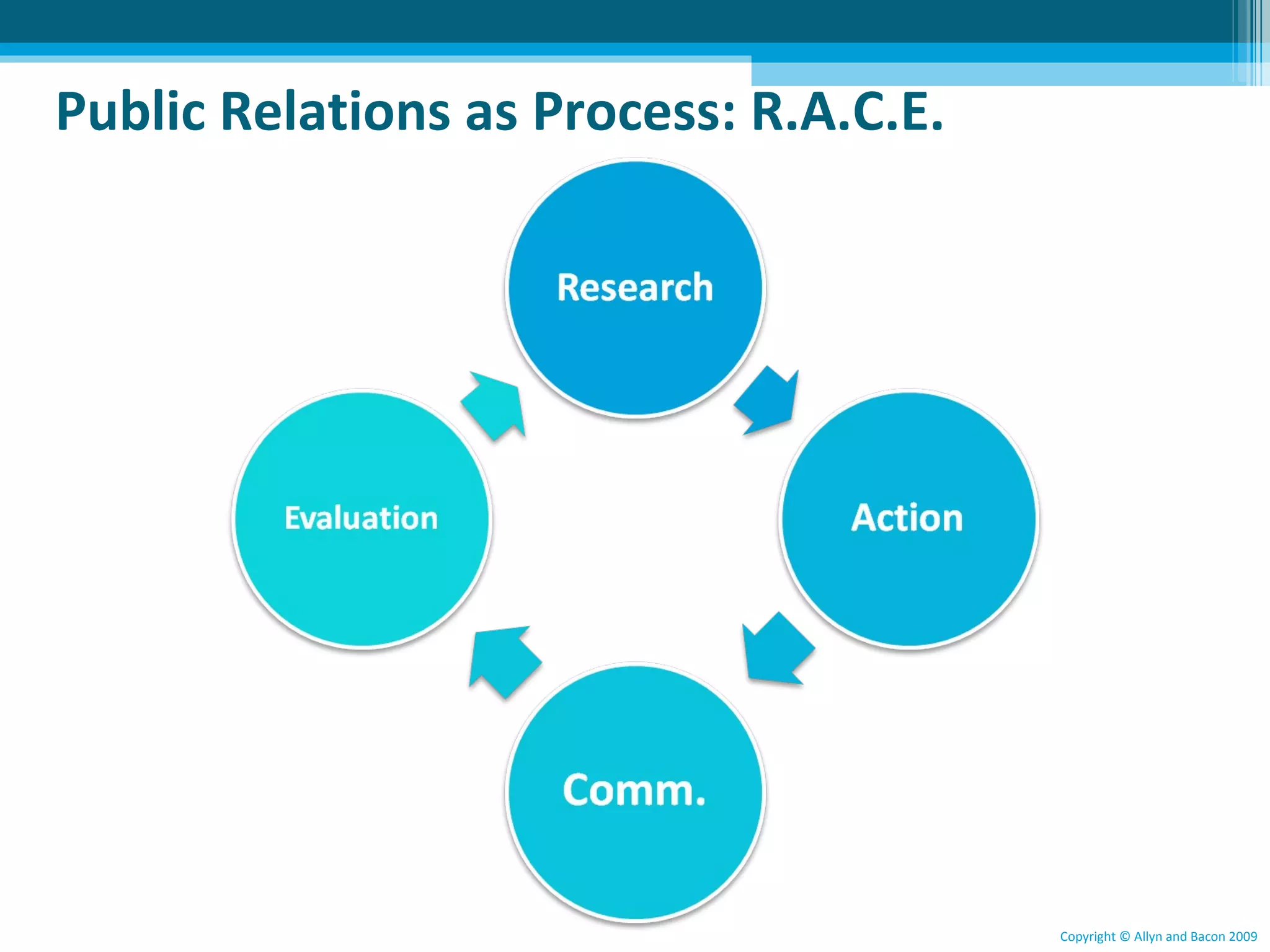
Public Relations as Process: R.A.C.E.

                      Research


         Evaluation              Action


                      Comm.

                                          Copyright © Allyn and Bacon 2009
Why is planning so important?


http://flickr.com/photos/aussiegall/715616558/   Copyright © Allyn and Bacon 2009
What goes into a program plan?


http://www.flickr.com/photos/vermininc/3327459367/   Copyright © Allyn and Bacon 2009
What are three situations that often
    require a PR campaign?

     • Remedial

     • One-time project

     • Reinforcement


www.flickr.com/photos/stevewall/377650283/   Copyright © Allyn and Bacon 2009
What’s the difference between
an informational objective
and a motivational objective?


                                Copyright © Allyn and Bacon 2009
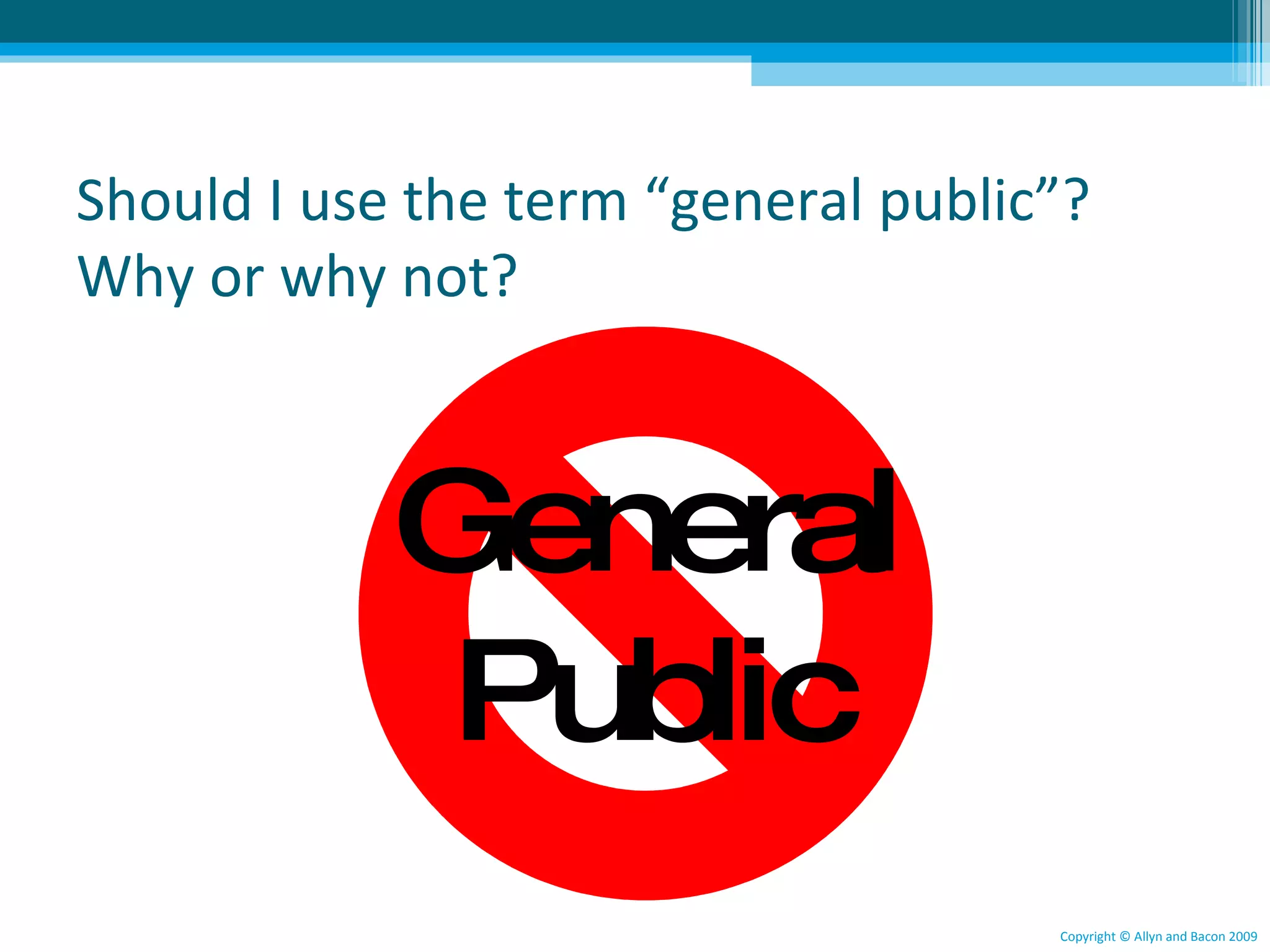
Should I use the term “general public”?
Why or why not?


          General
           Public
                                      Copyright © Allyn and Bacon 2009
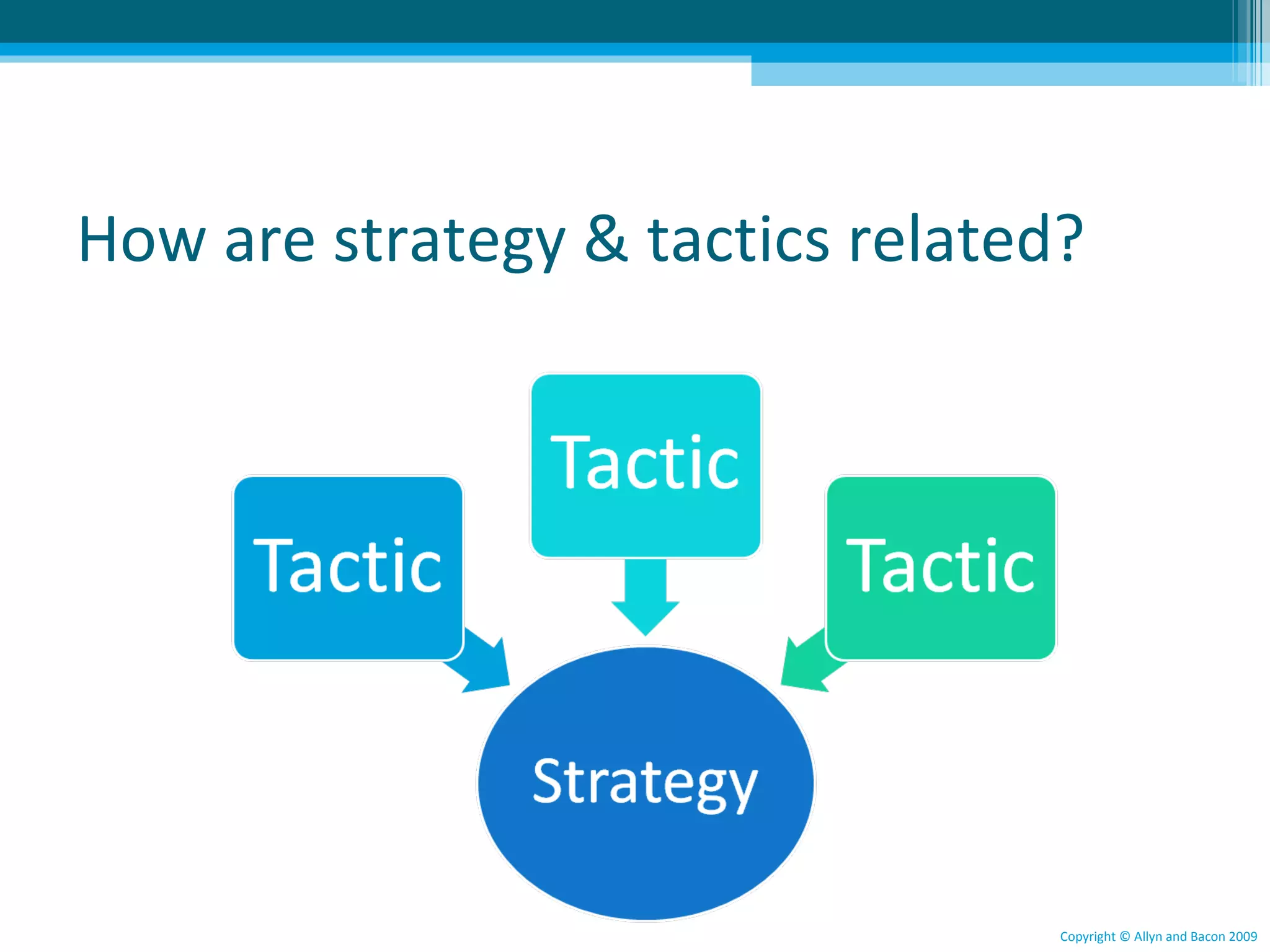
How are strategy & tactics related?


                Tactic
      Tactic              Tactic

               Strategy
                                   Copyright © Allyn and Bacon 2009
Why are timing/scheduling so important?


                                   Copyright © Allyn and Bacon 2009
What’s the largest expense in a campaign?


                                    Copyright © Allyn and Bacon 2009
Why is the evaluation of a campaign linked
to the program’s objectives?


                                     Copyright © Allyn and Bacon 2009
Contact Me
   Barbara B. Nixon, Ph.D. (ABD)
   Adjunct Professor of Public Relations
   Southeastern University

   Life Member & Past President
      of the International Listening Association (listen.org)
   • E-mail:          bbnixon@seuniversity.edu
   • Twitter:         barbaranixon
   • Skype:           barbara.b.nixon
   • Blogs:           publicrelationsmatters.com &
                                learnercentered.wordpress.com

Public Relations Program Planning

  • 1.
  • 2.
    Wilcox, D.L., &Cameron, G.T. (2009). Public relations: Strategies and tactics (9th Ed.). Boston: Allyn & Bacon. C H A P T E R Copyright © Allyn and Bacon 2009
  • 3.
    What We’ll DiscussToday  The Value of Planning  Approaches to Planning  Elements of a Program Plan Copyright © Allyn and Bacon 2009
  • 4.
    Public Relations asProcess: R.A.C.E. Research Evaluation Action Comm. Copyright © Allyn and Bacon 2009
  • 5.
    Why is planningso important? http://flickr.com/photos/aussiegall/715616558/ Copyright © Allyn and Bacon 2009
  • 6.
    What goes intoa program plan? http://www.flickr.com/photos/vermininc/3327459367/ Copyright © Allyn and Bacon 2009
  • 7.
    What are threesituations that often require a PR campaign? • Remedial • One-time project • Reinforcement www.flickr.com/photos/stevewall/377650283/ Copyright © Allyn and Bacon 2009
  • 8.
    What’s the differencebetween an informational objective and a motivational objective? Copyright © Allyn and Bacon 2009
  • 9.
    Should I usethe term “general public”? Why or why not? General Public Copyright © Allyn and Bacon 2009
  • 10.
    How are strategy& tactics related? Tactic Tactic Tactic Strategy Copyright © Allyn and Bacon 2009
  • 11.
    Why are timing/schedulingso important? Copyright © Allyn and Bacon 2009
  • 12.
    What’s the largestexpense in a campaign? Copyright © Allyn and Bacon 2009
  • 13.
    Why is theevaluation of a campaign linked to the program’s objectives? Copyright © Allyn and Bacon 2009
  • 14.
    Contact Me Barbara B. Nixon, Ph.D. (ABD) Adjunct Professor of Public Relations Southeastern University Life Member & Past President of the International Listening Association (listen.org) • E-mail: bbnixon@seuniversity.edu • Twitter: barbaranixon • Skype: barbara.b.nixon • Blogs: publicrelationsmatters.com & learnercentered.wordpress.com

Editor's Notes

  • #6 1. Why is planning so important in the public relations process?(pg. 152) Planning is important because it helps to prevent haphazard, ineffectivecommunication. Planning is a systematic process that includes gathering information,analyzing it, and applying it for the purpose of achieving set objectives.
  • #7 3. Name the eight elements of a program plan.(pg. 155) The eight elements of a program are: situation, objectives, audience, strategy,tactics, calendar/timetable, budget, and evaluation.
  • #8 4. Identify the three situations that often require a public relations campaign.(pgs. 155-157) The three situations that require a public relations campaign are: remedial(overcoming a negative situation), one-time project, and reinforcement (preserving reputationand public support).
  • #9 5. Explain the difference between an informational objective and a motivationalobjective.(pgs. 158-159) An informational objective deals primarily with information and awareness ofan issue, the most common of which are message exposure and accurate dissemination ofmessages. A motivational objective is easier to measure. They are bottom-line oriented andbased on clearly measurable results that can be quantified.
  • #10 6. Should a practitioner define an audience as the “general public”? Why or why not?(pg. 160) No, practitioners should target specific publics WITHIN the general public, and notlook at the general public as an amorphous whole.
  • #11 7. What is the difference between a strategy and a tactic?(pgs. 161-163) A strategy statement describes how, conceptually, an objective is to beachieved, offering a rationale for the actions and program components that are planned.Strategy usually consists of guidelines and key messages for the program. Tactics are thenext step of a plan; they describe specific activities that put each strategy into action and helpto achieve the stated objectives. Tactics usually consist of various methods to reachaudiences with the key messages.
  • #12 9. Why are timing and scheduling so important in a public relations campaign?(pg. 164-165) Timing/scheduling is important so that messages are more meaningful to theintended audience. Some campaigns are environmentally or seasonally noteworthy, andothers aren’t time or event-sensitive. The sequencing of events is as important as the timing.
  • #13 10. What is the largest expense in campaign conducted by a public relations firm?(pg. 166) The largest expense incurred in a campaign budget is staff and administrative time,which can account for about 70 percent of expenses (salaries and administrative fees).
  • #14 11. Why is evaluation of a campaign linked to the program’s objectives?(pg. 166-167) Objectives must be measurable in order to demonstrate the program’seffectiveness for the client. As a result, the evaluation component of the plan suggests themetrics that can be used to evaluate whether the objectives have been accomplished.