The Changing
Adult Learner
Barbara B. Nixon, Ph.D. (ABD)
Green Bay Center
Handout
In times of change learners inherit the earth,
while the learned find themselves
beautifully equipped to deal with a world that no
longer exists.
Eric Hoffer
This afternoon
Demographics
Andragogy
Engage
Millennials
The hope: Wide awake audience
The reality: Sleepy audience
CUW Adult Learner
Demographics
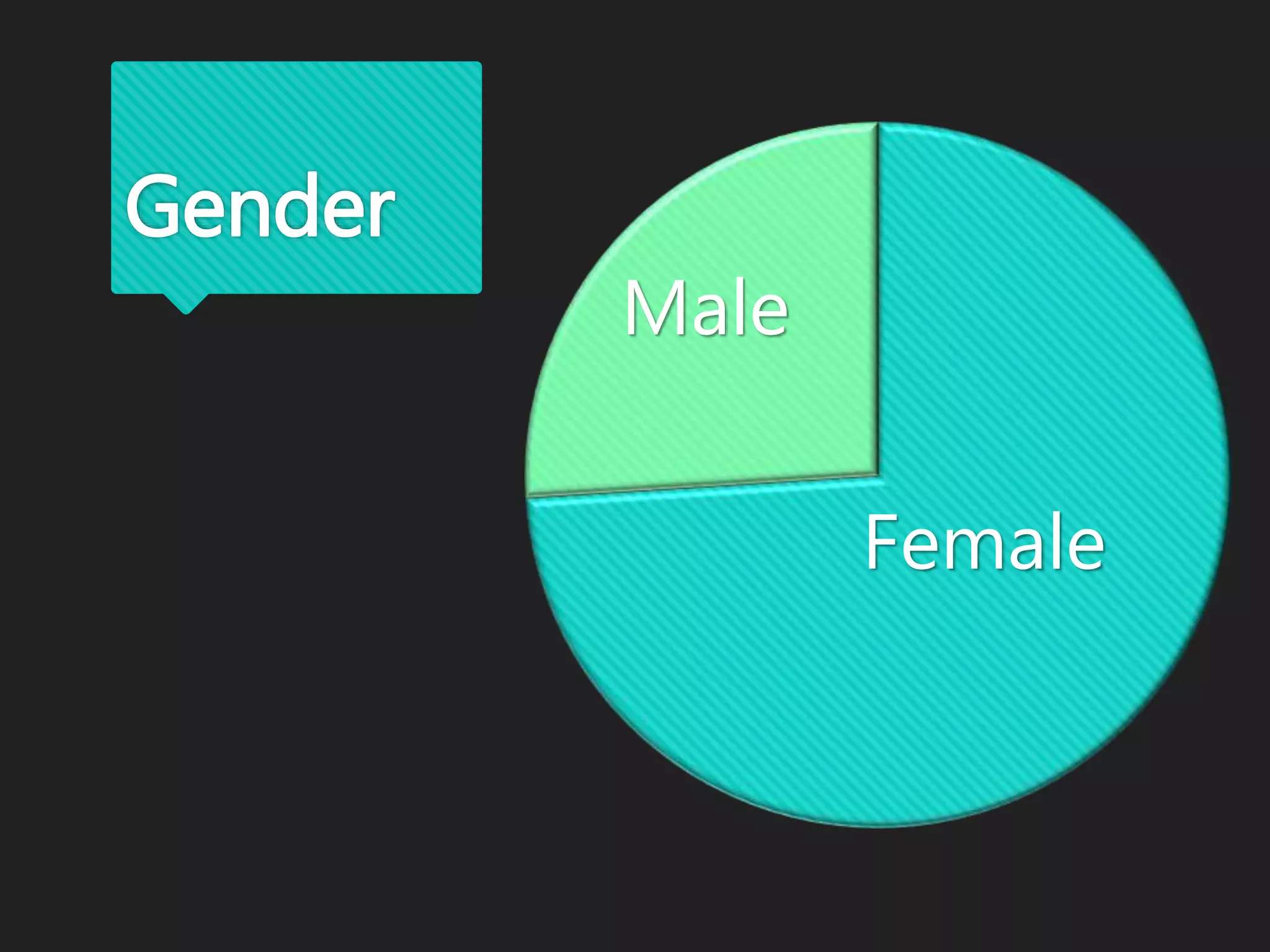
Gender
Male
Female
Age 17-21
50+
40-49
30-39
20-29
Ethnicity
White
Hispanic
African-American
Native American
Two or More Races
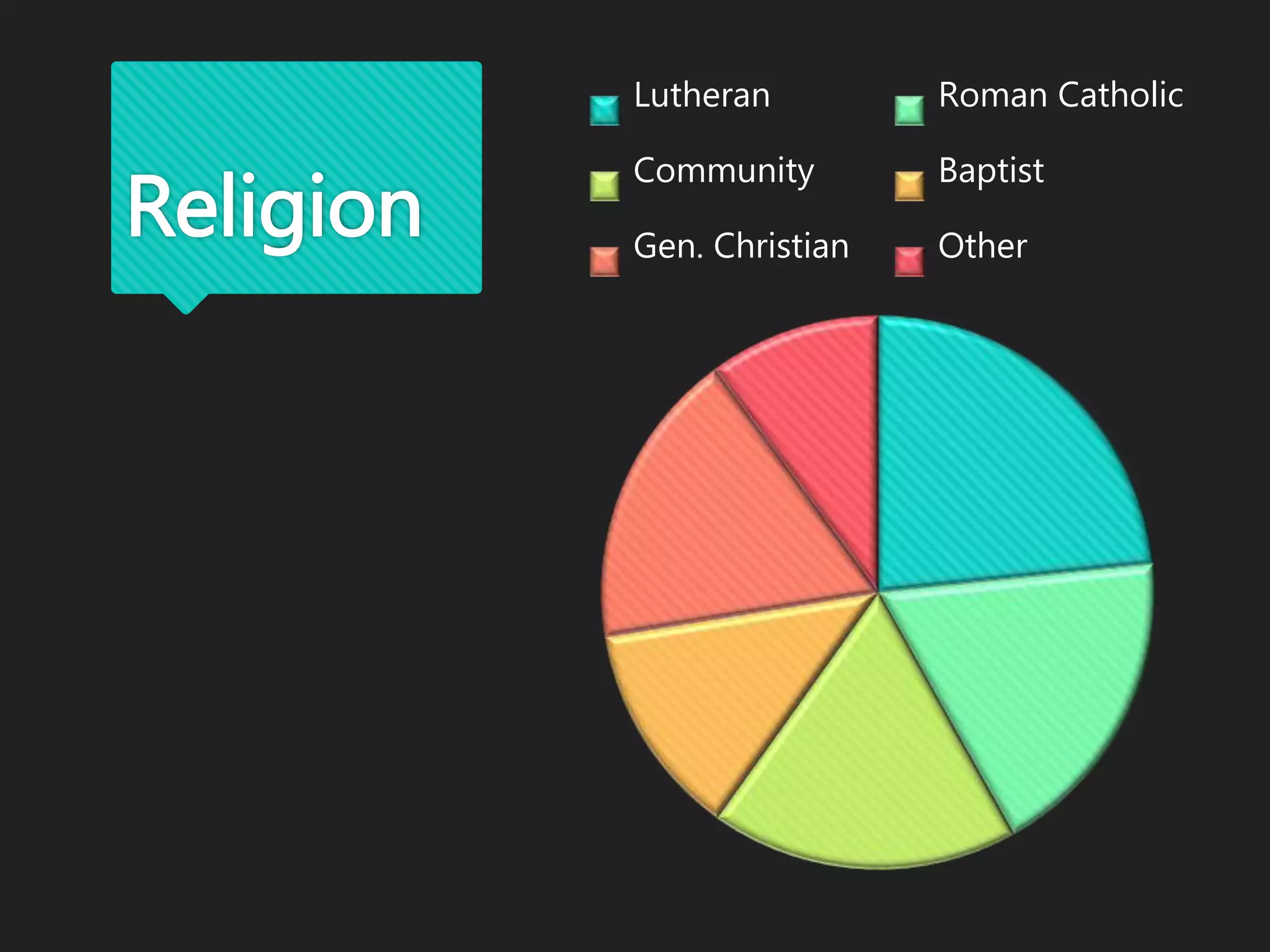
Religion
Lutheran Roman Catholic
Community Baptist
Gen. Christian Other
Jobs
Full-time
Part-
time
?
Andragogy:
A Quick Review
They need to understand why something is
important for them to know or do.
They want the freedomto learn in
their own way.
Learning is experiential.
The process is
positive and encouraging.
The time is right for them to learn.
Which of these can
we, as faculty, impact?
 They understand why something is important for
them to know or do.
 They have the freedom to learn in their own way.
 Learning is experiential.
 The process is positive and encouraging.
 The time is right for them to learn.
Engaging
Our Adult Learners
Roadblocks
My three best tips, plus some
watchouts
Utilize technology wisely
And . . .No Death by PowerPoint
Offer & accept timely feedback
And . . . Know what to do with
defensiveness
Incorporate storytelling
And . . . Watch out for creating a
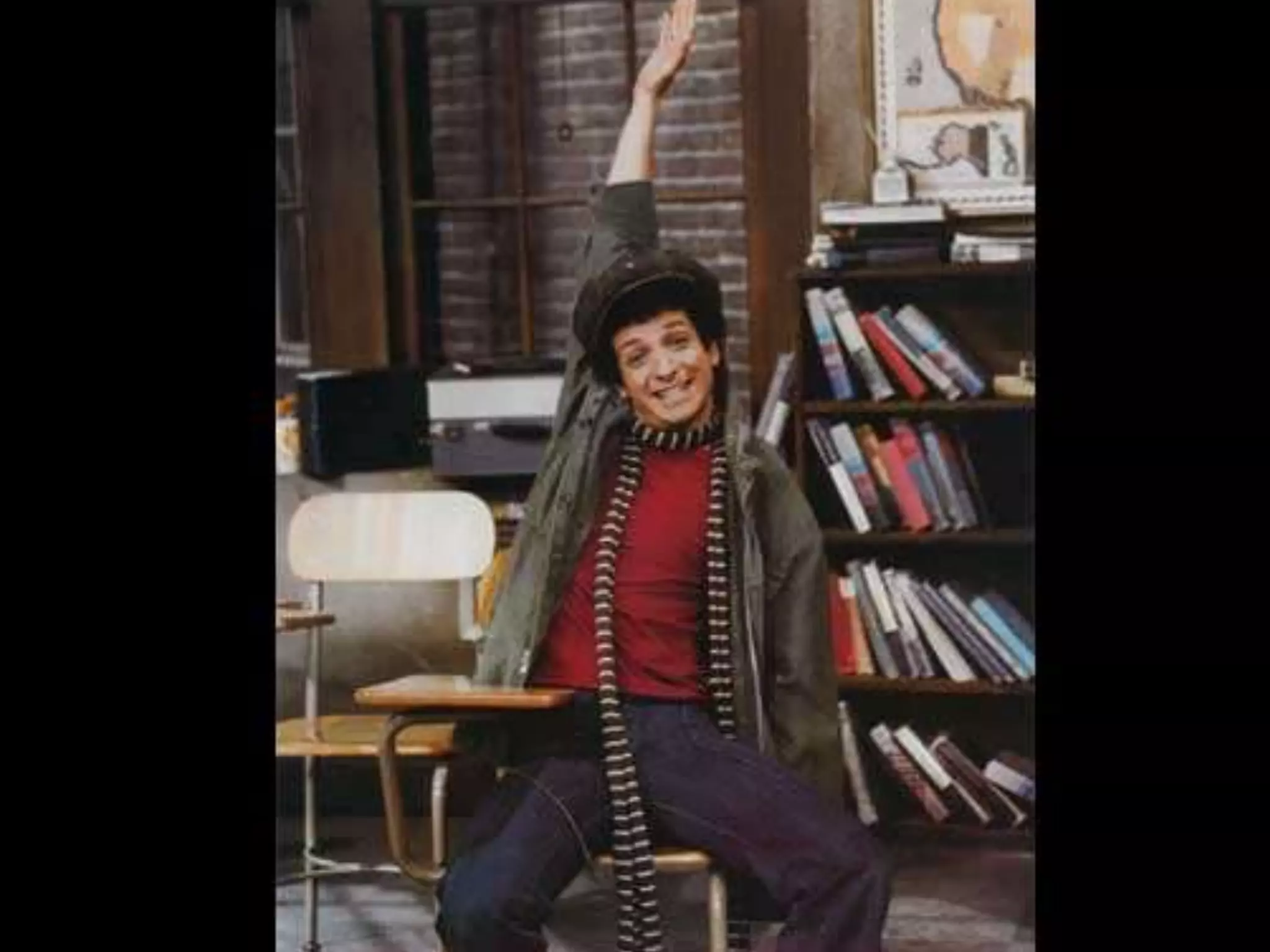
class of Horshacks
The Future of
Adult Learning
Some facts from the most recent
Beloit Mindset List
 This year’s entering class has never licked a postage stamp, and for
them electronic mail has always been the “new formal” (as opposed
to texting and Instagram and Facebook and Twitter).
 Google has always been there
 Princess Diana has always been dead.
 When they were born, cell phone usage was so expensive that
families only used their large phones, usually in cars, for emergencies.
 The proud parents recorded their first steps on camcorders, mounted
on their shoulders like bazookas.
 If you say “around the turn of the century,” they may well ask you,
“which one?”
For students who were born in
the late 1980s
 Computers have always fit in their backpacks.
 Gas has always been unleaded.
 There has always been some association between fried eggs and your
brain.
 Stores have always had scanners at the checkout.
 George Foreman has always been a barbecue grill salesman.
 Tylenol has always been impossible for children or adults to open.
 They have always been able to make photocopies at home.
Teaching Millennials
1.Know about generational
differences
2.Recognize environmental &
cultural forces
3.Understand potential
intergenerational tension
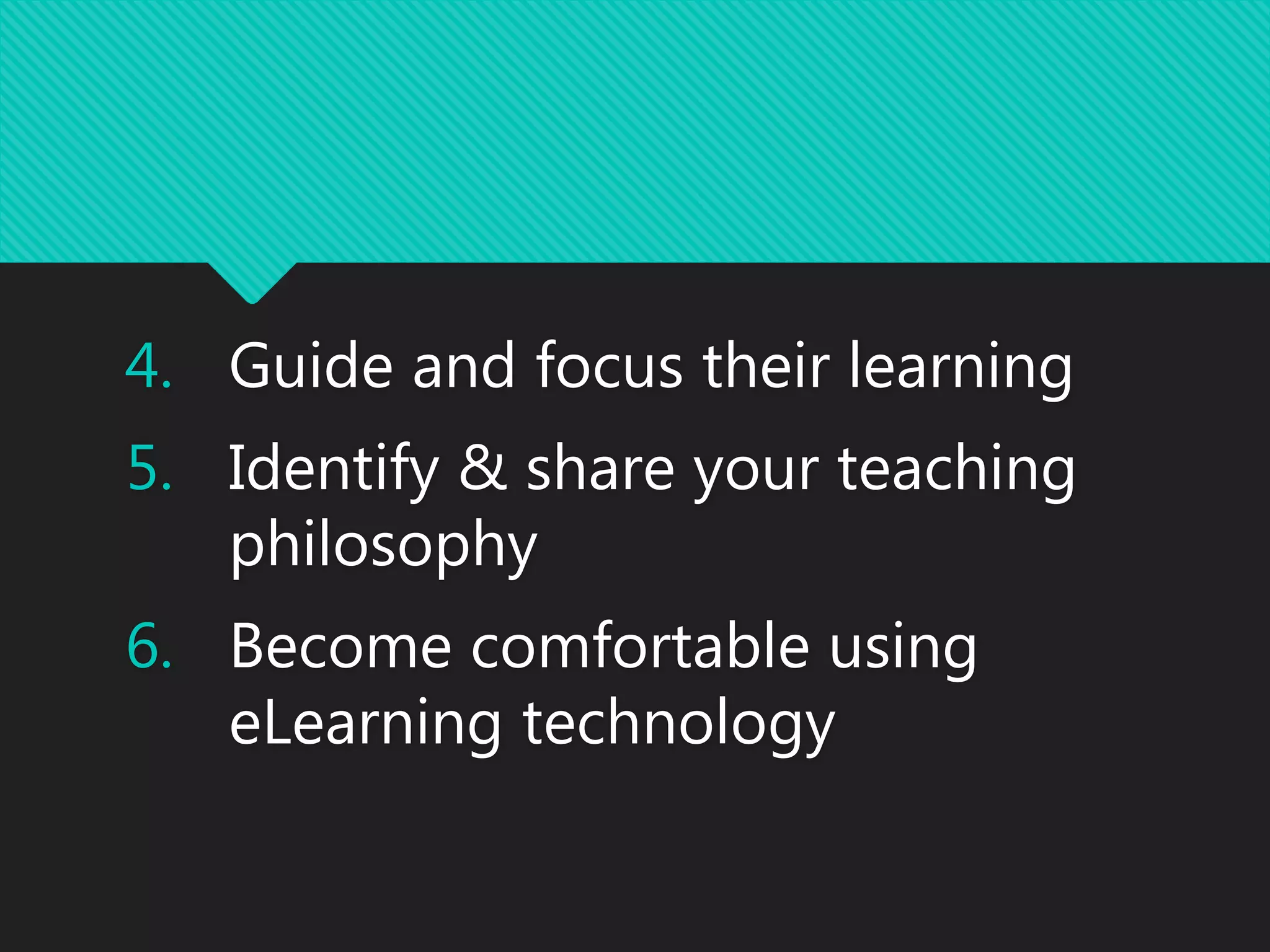
4. Guide and focus their learning
5. Identify & share your teaching
philosophy
6. Become comfortable using
eLearning technology
7. Create aesthetically pleasing
presentations
8. Help them know where to find
support
9. Encourage curiosity
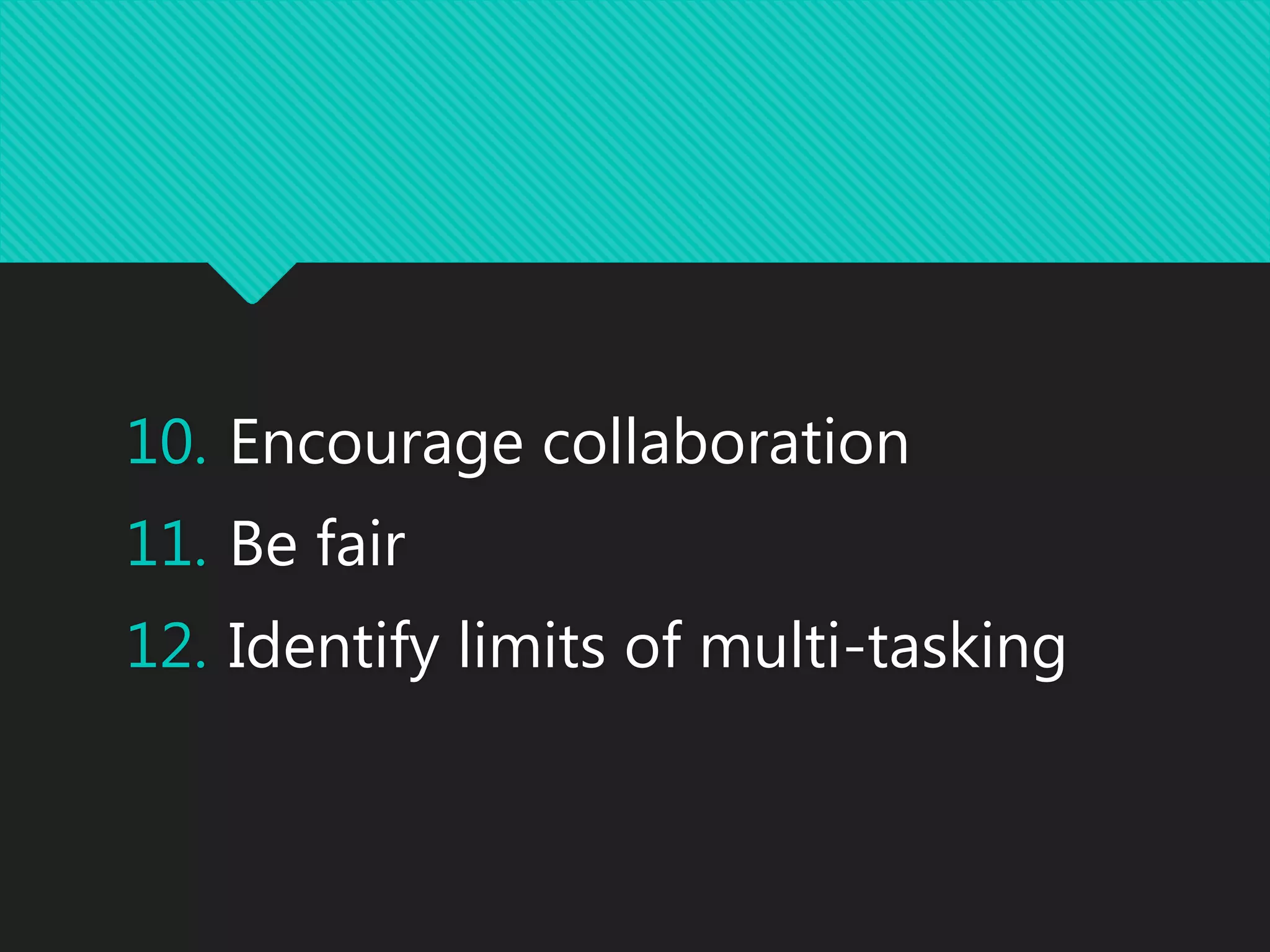
10. Encourage collaboration
11. Be fair
12. Identify limits of multi-tasking
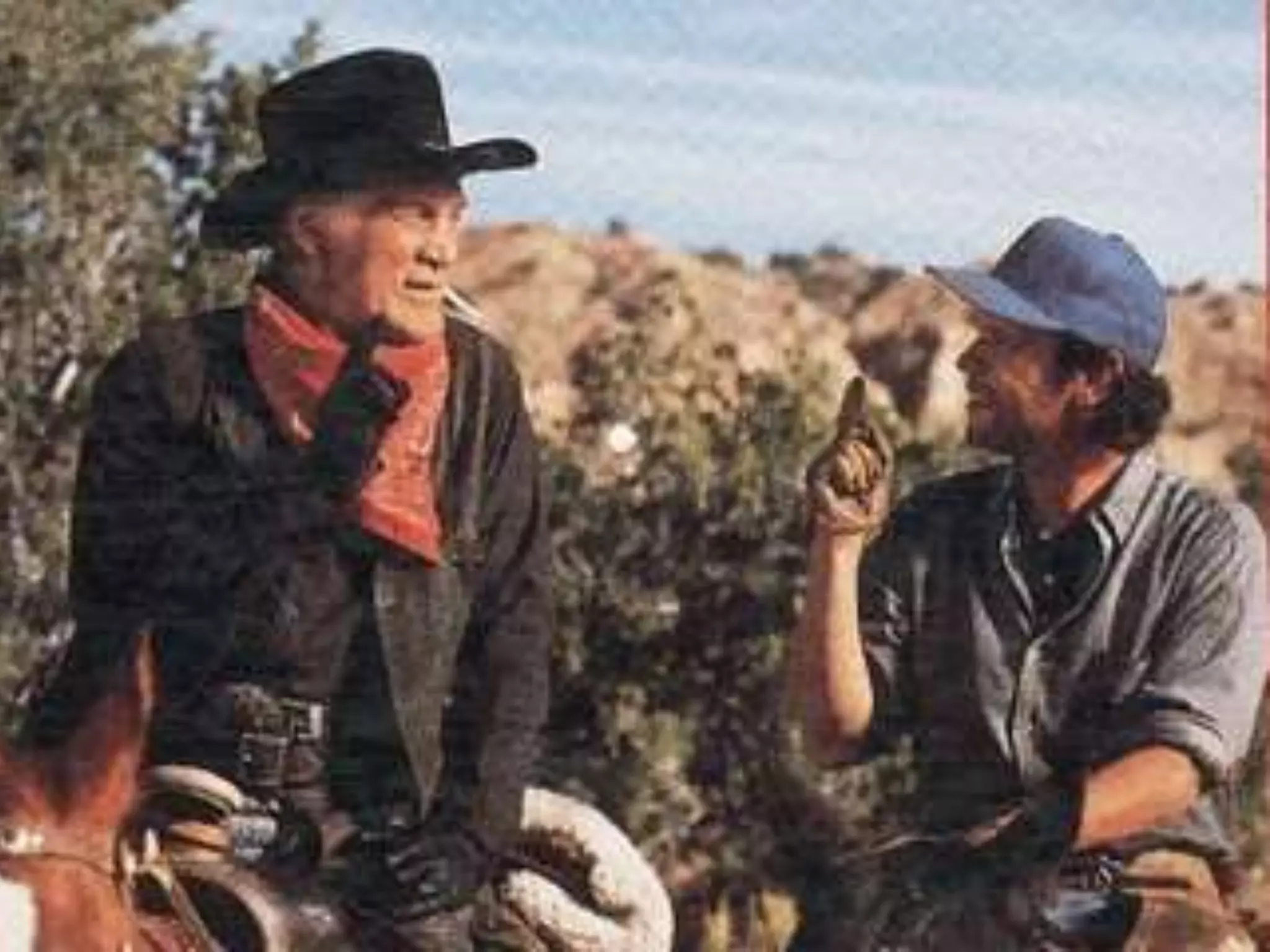
The One Thing
In times of change learners inherit the earth,
while the learned find themselves
beautifully equipped to deal with a world that no
longer exists.
Eric Hoffer
Contact Me
 Barbara B. Nixon, Ph.D. (ABD)
Adjunct Professor, CUW Green Bay Center
Manager of Learning & Documentation, SPI
 E-mail: barbara.nixon@cuw.edu
 Social Media: @barbaranixon
 Blog: publicrelationsmatters.com

The Changing Adult Learner

Editor's Notes

  • #2 .
  • #3 Before I officially start . . . Like many others, I was hoping to see a few more of my peers here today. I wonder if we put this sign out front we might attract more? Show of hands: how many of you have any idea what that sign means?
  • #5 One of my favorite quotations has long been one by social philosopher, Presidential Medal of Freedom recipient and longshoreman (seriously) Eric Hoffer. “In times of change LEARNERS inherit the earth, while the LEARNED find themselves beautifully equipped to deal with a world that no longer exists. “ [twitter] Testing AutoTweet plugin [/twitter]
  • #6 Learn about the demographics of our students Have a quick refresher on the principles of andragogy Discuss how to engage adult learners in our classes Become familiar with the future of adult learning
  • #7 And being the first presenter after lunch can be challenging. I’m hoping y’all will be more like this audience, than THIS one . . .
  • #9 Okay, now let’s start off with the demographics of our students in the Adult Learning Program here at Concordia. I’d like to thank Bernard Bull and Tamara Ferry for helping me to gather these numbers for you.
  • #10 This may be one of the easy ones to guess, just based on what you’ve seen in your classes. Which group do you think is larger, male or female? Female 74 Male 26
  • #11 This one may be a little tougher to guess. Which age bracket do you think has the most students? 17-21 5 22-29 26 30-39 35 40-49 24 50+ 11
  • #12 As far as ethnicity goes, would you say that your classes are representative of your community? White 53 Hispanic 4 African-American 30 Native American 2 Two or More Races 4 Asian 2
  • #13 This one looks more like a Trivial Pursuit game piece than any of the others . . . Our students are almost evenly balanced among these religions – with Lutherans being the largest piece of the pie Lutheran 23 Roman Catholic 18 Community 18 Baptist 12 Gen. Christian 17 Other 10
  • #14 The last demographic I’ll share is related to our students’ employment. And this is pretty dramatic. A full three-quarters of our students are employed full time, and then they come to us one, or sometimes two, evenings a week. For those of us who come from a background of teaching so-called traditional students, this is quite different. Full-time 75 Part-time 18 None 5
  • #15 We’ll get to that in just a little bit. So now you know some of the numbers . . .
  • #16 Let’s move into some background that many of us are familiar with regarding teaching adults, and that’s the main principles of andragogy. These are based on the work of Malcolm Knowles.
  • #17 And there are five main things to keep in mind about adult learners.
  • #18 They need to understand why something is important for them to know or do.
  • #19 They want the freedom to learn in their own way.
  • #20 For adult learners, it works best when Learning is experiential.
  • #21 Make the process is positive and encouraging for them
  • #22 And finally, they learn best when The time is right for them to learn.
  • #24 Before we get into how to engage our adult learners, let’s discuss (move to next slide) some of the roadblocks to engagement . . .
  • #26 I’d like to share my three best tips for engaging our adult learners, and then I’ll provide you with the opportunity to share some of yours. Photo Credit: <a href="https://www.flickr.com/photos/49968232@N00/14087668094/">Leo Reynolds</a> via <a href="http://compfight.com">Compfight</a> <a href="https://creativecommons.org/licenses/by-nc-sa/2.0/">cc</a>
  • #27 #1 – use technology wisely
  • #28 …. And make sure there’s no Death by PowerPoint
  • #29 #2 Offer AND accept timely feedback
  • #30 And . . . Watch for defensiveness
  • #31 And #3, incorporate storytelling
  • #32 And watch out for creating a class of Horshacks. (How many of you knew who this was even before I said his name? After? No clue who he is?)
  • #33 So far, we’ve discussed the demographics in our classes, some principles of adult learning, and a little on how to engage adults in our classes. Keep in mind that the longer we teach, the more generational differences we’ll need to work with and adapt to in our classes. Let’s now see a short video about how social media transforms the way we live and learn. As the video proceeds, jot down any stats or facts that were surprising to you.
  • #34 The social media revolution, by Eric Qualman
  • #35 What are some of the things that surprised you from the Social Media Revolution? Share at your own tables, then I’ll ask for a few to report back.
  • #36 So what’s going on in the minds of our millennial students? Researchers at Beloit University put together a “Mindset List” every year to help us out. There should be a colorful piece of cardstock on most tables. PINK & PURPLE = for graduating seniors now entering college GREEN & GOLD = for students about a decade older
  • #37 Source: https://www.beloit.edu/mindset/2019/ Maybe put these on notecards, and have audience members read them off
  • #39 It’s SO easy to fall in to the trap of sounding like an old geezer to our students.
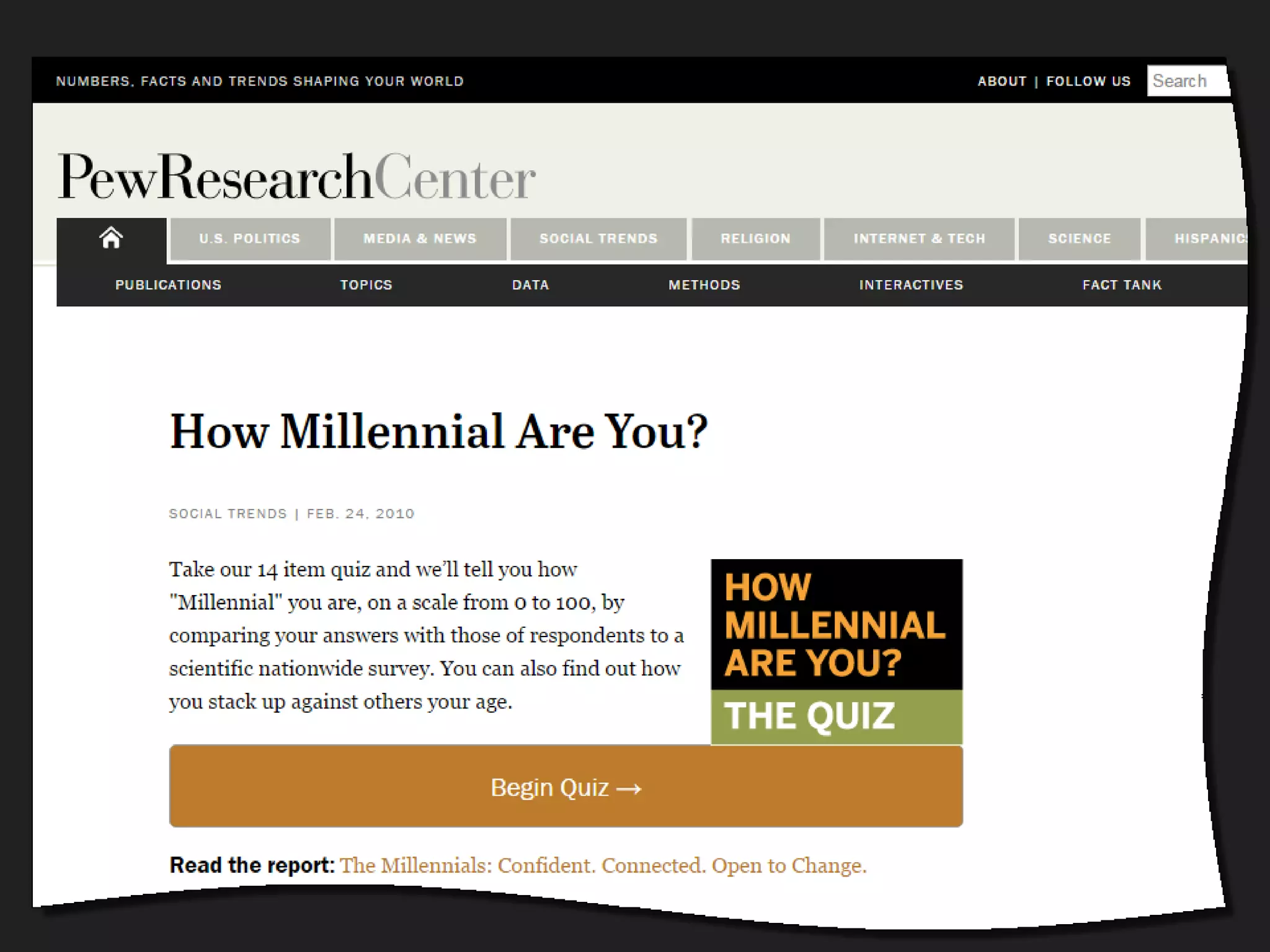
  • #40 http://www.pewresearch.org/quiz/how-millennial-are-you/ -- or just Google “how millennial are you?” We don’t have time to do this now, and I encourage you to try the quiz after the conference. I discovered that even though I’m over 50, I am 88% millennial.
  • #41 So how can we best teach our millennial students? Educators at Harvard have developed a dozen tips.
  • #47 Recognize these guys? What movie is this from? (City Slickers) Curly was the tough old cowboy character played by the late Jack Palance. Here’s the scene from the movie where Curly espouses his life philosophy to Mitch, Billy Crystal’s character: Curly: Do you know what the secret of life is? Curly: This. [holds up one finger] Mitch: Your finger? Curly: One thing. Just one thing. You stick to that and the rest don’t mean shit. Mitch: But what is the “one thing?” Curly: [smiles] That’s what you have to find out. Image Credit: http://www.positive-feedback.com/Issue51/images/Pic3-City%20Slickers%20Secret%20of%20Life[1].jpg