How should universities prepare
information graduates for the working
world?

Hazel Hall
School of Computing
Napier University
Breakout session agenda
Introduction (half an hour maximum)
       UK context
           Current provision of UK accredited LIS courses
       Institutional example
           Napier provision
       Challenges
       Your potential contribution


Breakout activity (one hour maximum)
       Explained at the end of the presentation…
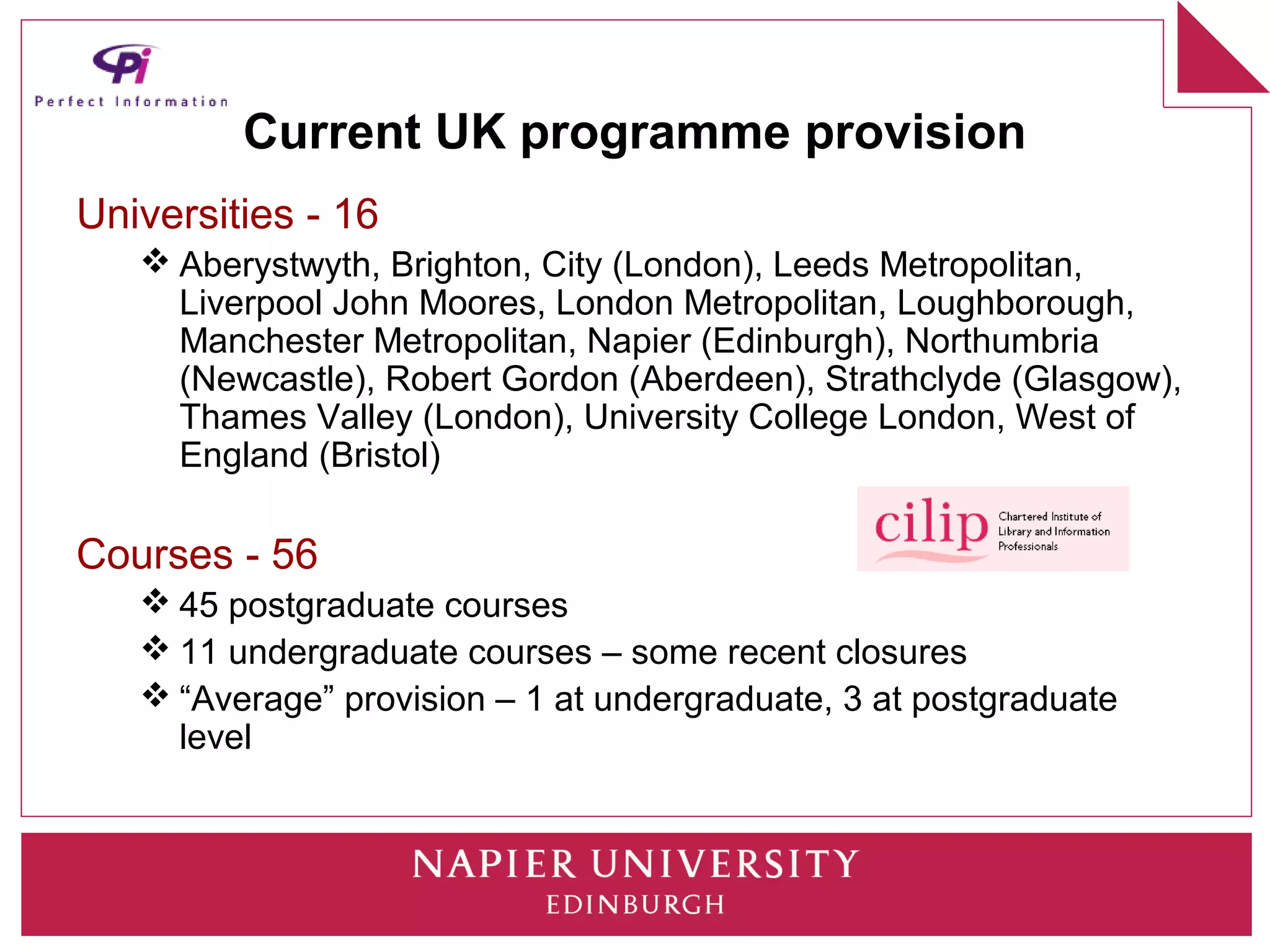
Current UK programme provision
Universities - 16
    Aberystwyth, Brighton, City (London), Leeds Metropolitan,
     Liverpool John Moores, London Metropolitan, Loughborough,
     Manchester Metropolitan, Napier (Edinburgh), Northumbria
     (Newcastle), Robert Gordon (Aberdeen), Strathclyde (Glasgow),
     Thames Valley (London), University College London, West of
     England (Bristol)

Courses - 56
    45 postgraduate courses
    11 undergraduate courses – some recent closures
    “Average” provision – 1 at undergraduate, 3 at postgraduate
     level
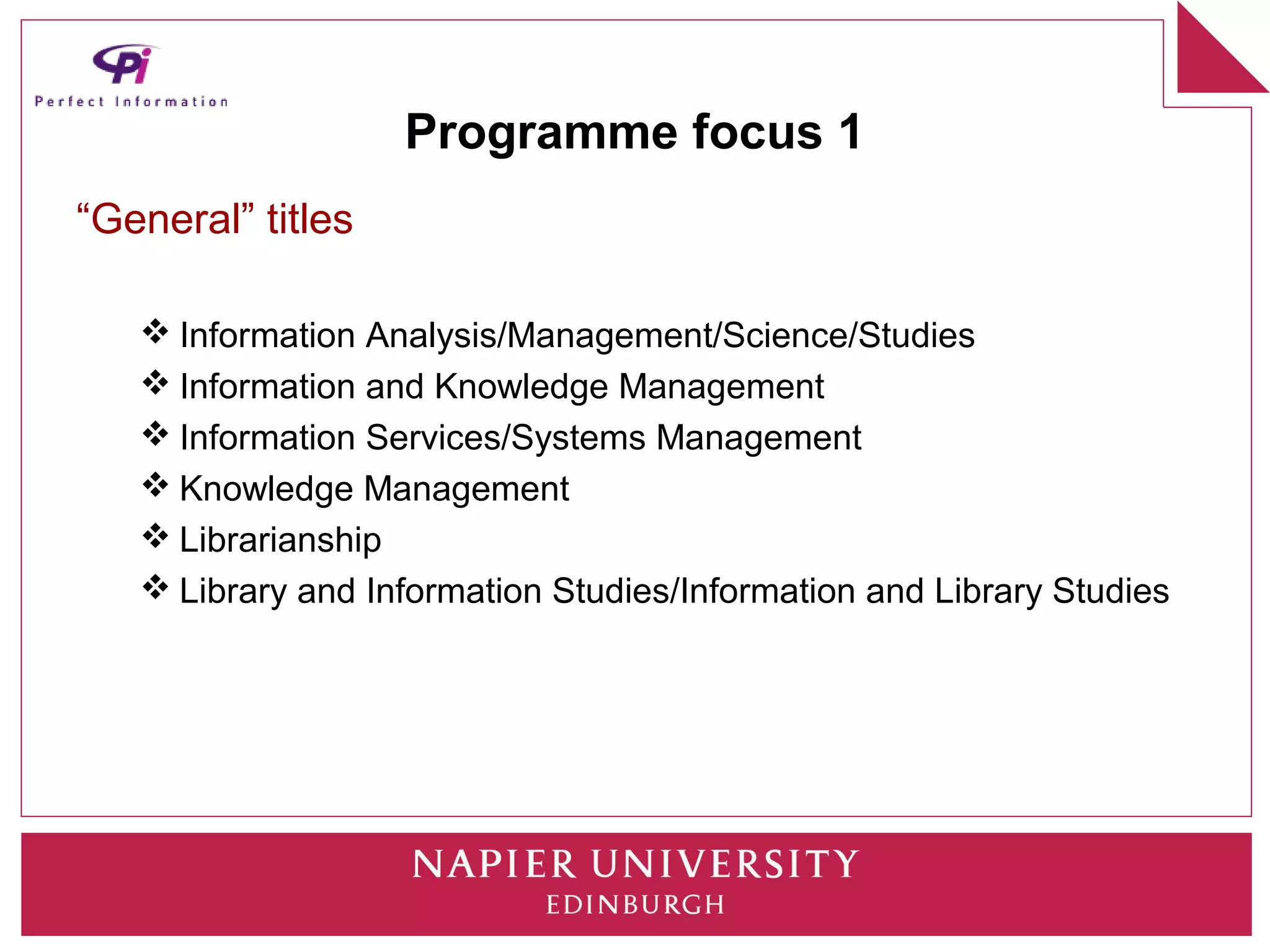
Programme focus 1
“General” titles

    Information Analysis/Management/Science/Studies
    Information and Knowledge Management
    Information Services/Systems Management
    Knowledge Management
    Librarianship
    Library and Information Studies/Information and Library Studies
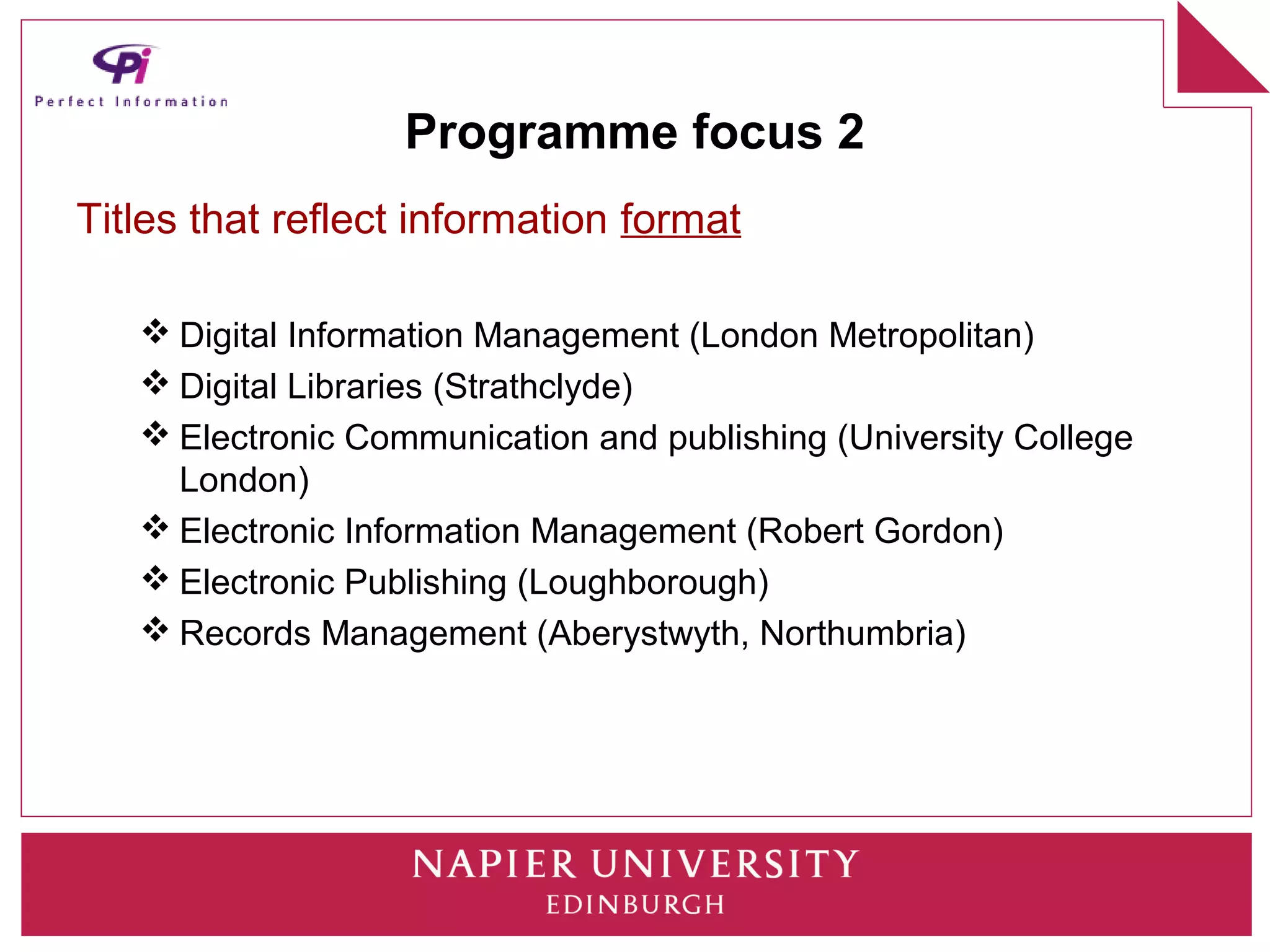
Programme focus 2
Titles that reflect information format

    Digital Information Management (London Metropolitan)
    Digital Libraries (Strathclyde)
    Electronic Communication and publishing (University College
     London)
    Electronic Information Management (Robert Gordon)
    Electronic Publishing (Loughborough)
    Records Management (Aberystwyth, Northumbria)
Programme focus 3
Sector-specific titles

    Chemoinformatics (Sheffield)
    Geographic Information Management (City)
    Health Informatics/Information Management (Brighton,
     Sheffield/Aberystwyth)
    Information Management in the Cultural Sector (City)

2 undergraduate business-related titles

    Business Management and Information (Liverpool John Moores)
    Information Management and Business Studies (Loughborough)
Programme priorities
Understanding
     of concepts and principles (i.e. theory); analysis, implementation and
      management of information and information services (i.e. practice).
Application
     of concepts and principles.
Evaluation
     of information systems and services, and their deployment to solve
      problems.
Independent judgement and critical awareness
     to enquire, analyse, think creatively, reflect, reason, communicate.
Achieving individual potential
     basis for future personal development, continuing professional
      development.
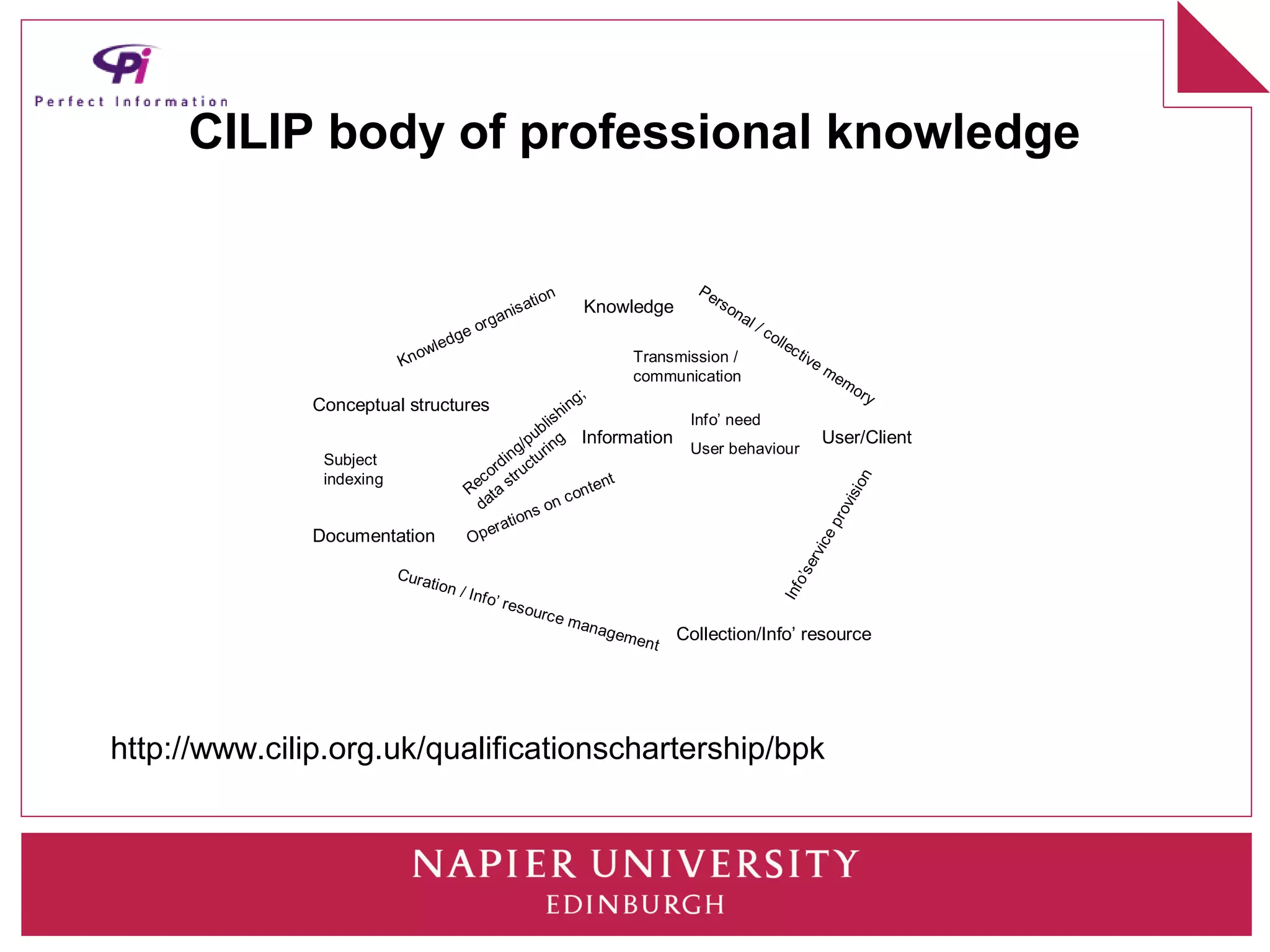
CILIP body of professional knowledge

                                                                                   Pe
                                                       t   ion                       rs o
                                                   is a          Knowledge               na
                                          or   g an                                        l/
                                     ge                                                         co
                              l ed                                                                ll e
                                                                                                      c
                          Know                                         Transmission /                     tiv
                                                                                                             e
                                                                       communication                             me
                                                                                                                   mo
                                                           ;                                                         ry
              Conceptual structures                     ng
                                                     hi
                                                 lis                              Info’ need
                                              ub
                                            /p ring Information                                                  User/Client
                                         ng tu                                    User behaviour
               Subject                 di
               indexing            c or truc                    t
                                                             ten


                                                                                                                       n
                                 Re ta s


                                                                                                                         io
                                     a                c on


                                                                                                                     vis
                                   d               n
                                              so
                                         tion


                                                                                                                 pr o
                                     era
              Documentation      Op


                                                                                                              ice
                                                                                                           erv
                         Cur a


                                                                                                       o’s
                              tion
                                   / Inf o


                                                                                                   Inf
                                          ’ r es
                                                 ourc
                                                      em         anag
                                                                      eme
                                                                         n       Collection/Info’ resource
                                                                             t


http://www.cilip.org.uk/qualificationschartership/bpk
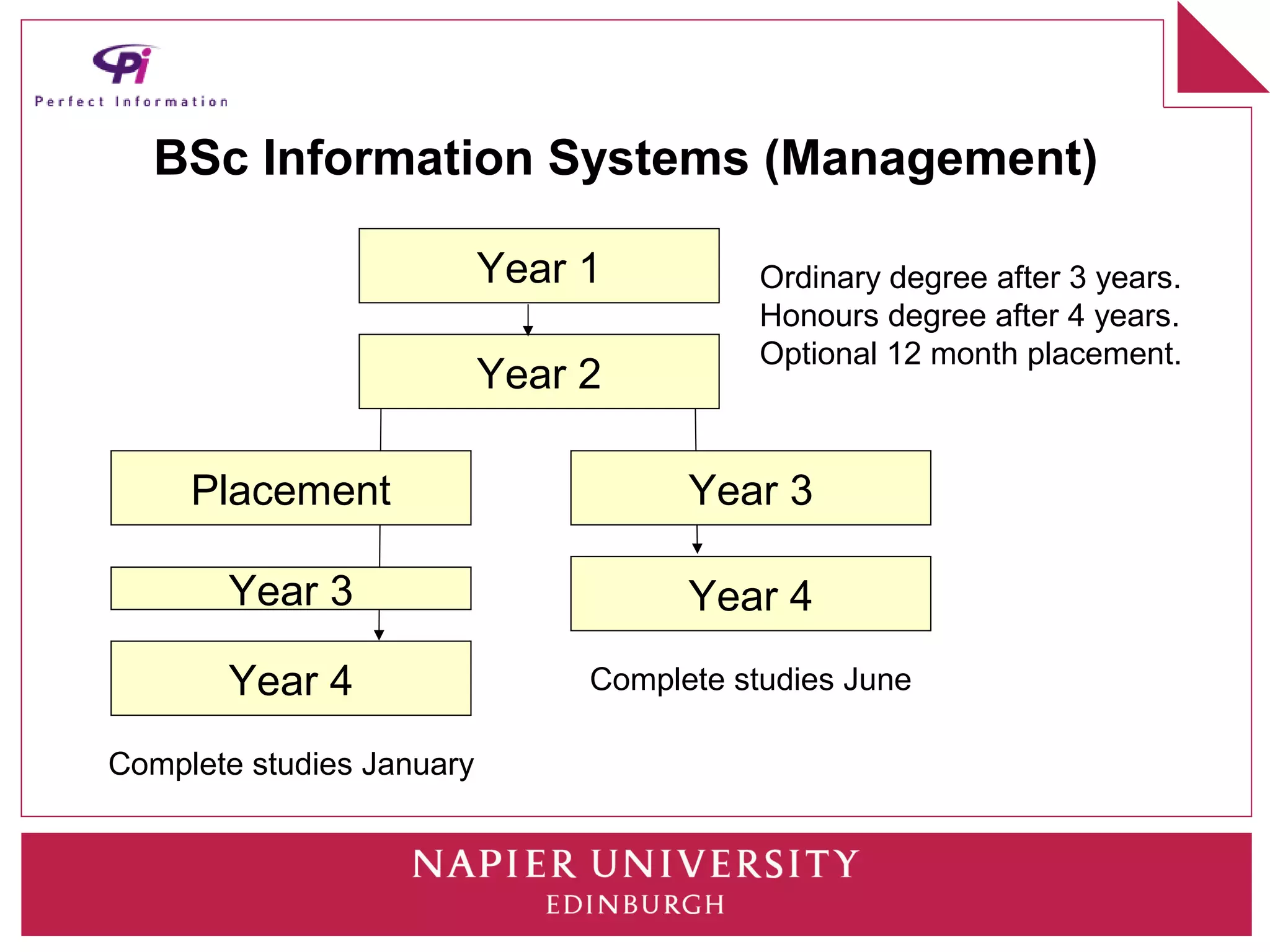
BSc Information Systems (Management)

                           Year 1          Ordinary degree after 3 years.
                                           Honours degree after 4 years.
                                           Optional 12 month placement.
                           Year 2

     Placement                        Year 3

       Year 3                         Year 4

       Year 4                   Complete studies June

Complete studies January
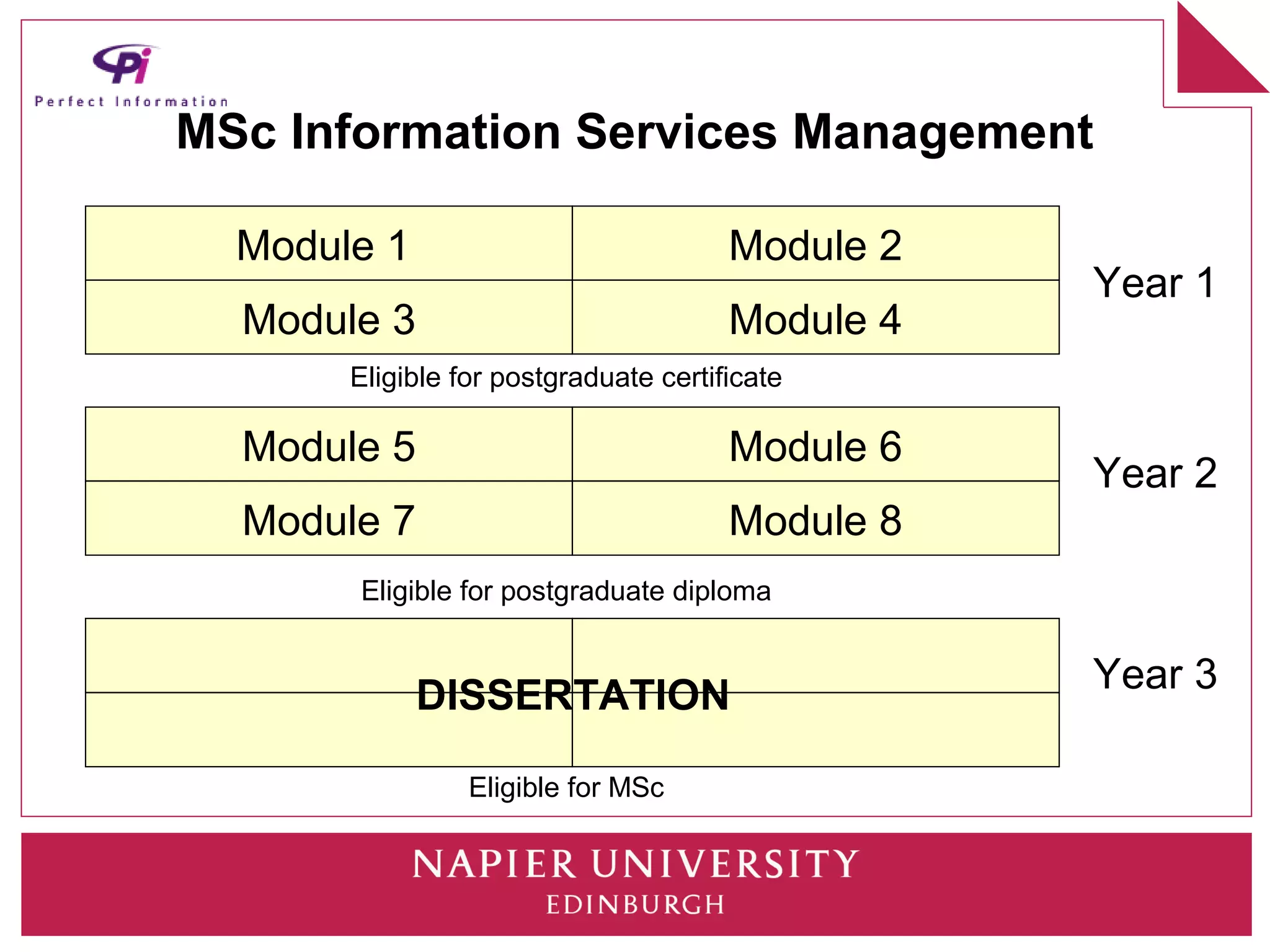
MSc Information Services Management

  Module 1                             Module 2
                                                  Year 1
  Module 3                             Module 4
       Eligible for postgraduate certificate

  Module 5                             Module 6
                                                  Year 2
  Module 7                             Module 8
       Eligible for postgraduate diploma


                                                  Year 3
             DISSERTATION

                 Eligible for MSc
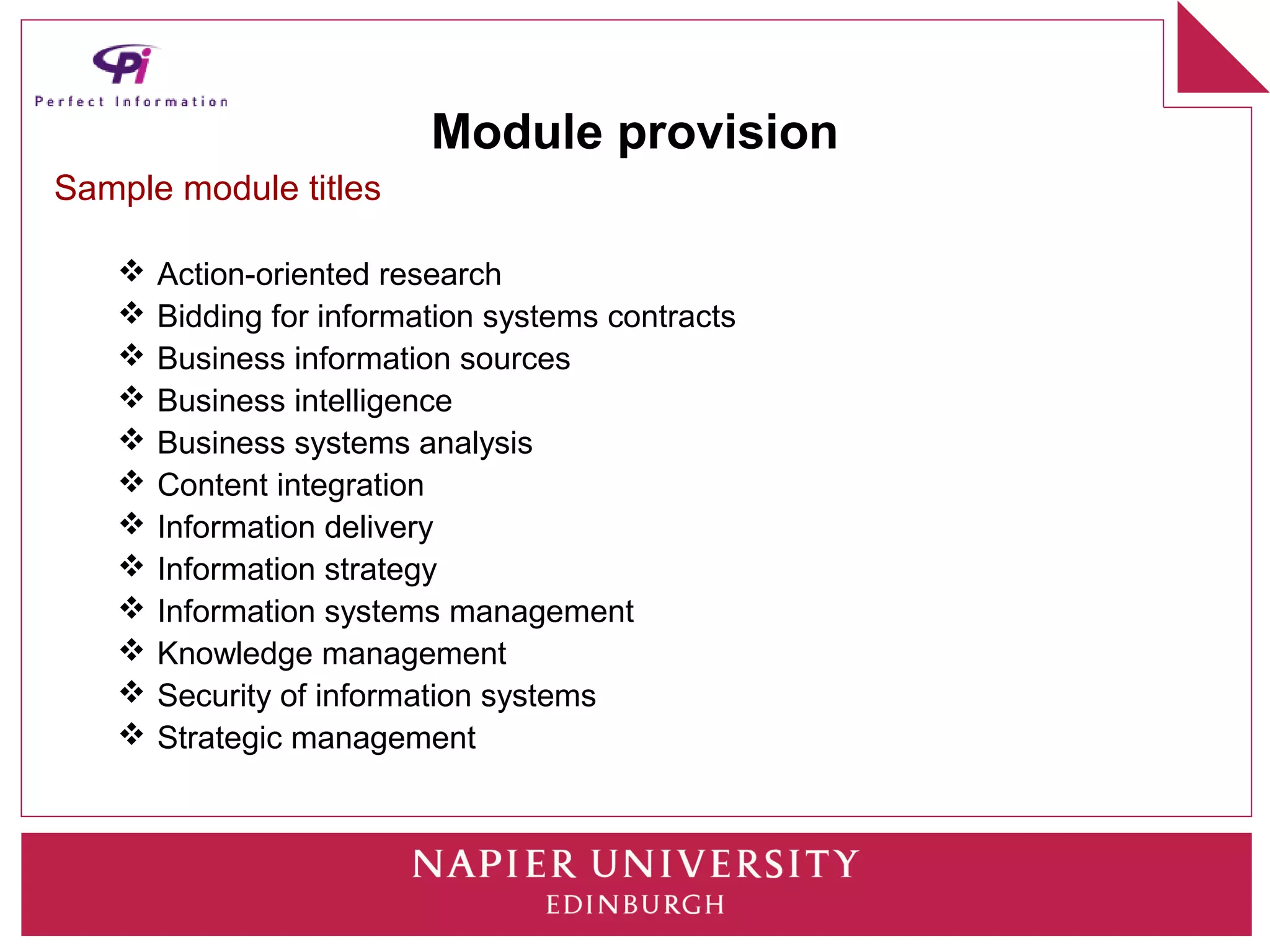
Module provision
Sample module titles

      Action-oriented research
      Bidding for information systems contracts
      Business information sources
      Business intelligence
      Business systems analysis
      Content integration
      Information delivery
      Information strategy
      Information systems management
      Knowledge management
      Security of information systems
      Strategic management
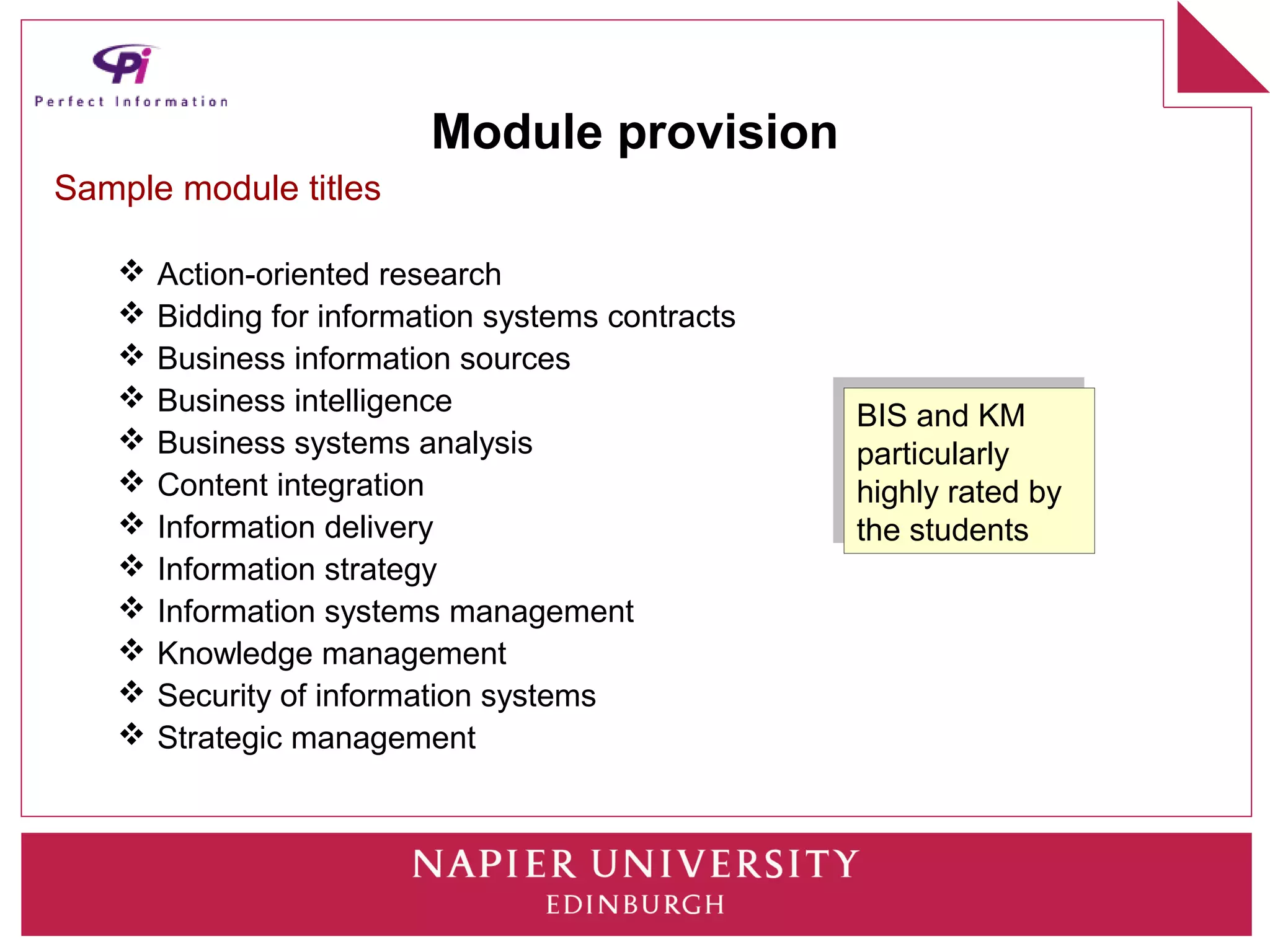
Module provision
Sample module titles

      Action-oriented research
      Bidding for information systems contracts
      Business information sources
      Business intelligence                       BIS and KM
                                                    BIS and KM
      Business systems analysis                   particularly
                                                    particularly
      Content integration                         highly rated by
                                                    highly rated by
      Information delivery                        the students
                                                    the students
      Information strategy
      Information systems management
      Knowledge management
      Security of information systems
      Strategic management
Specialism through dissertations
Dissertation themes - examples

    Internal blogging in corporate environments: their role in
     innovation and new knowledge creation
    Business applications of social software (messaging)
    New media channels for house sales
    Web logs and current awareness services
    Centralised versus decentralised intranet content development
    User perceptions of commercial online information services
    Role of the information professional in investment banking
    Mergers and acquisitions in the online information services
     industry
Business relevance
Work incorporated into degree programmes
    Placements on undergraduate programmes
    Work experience requirements for admission to postgraduate
     courses
    Work-based assessments, e.g. BIS tenders, AOR proposals
Industry contributions to modules
    Part-time lecturers, e.g. Kenny Walker on BIS
    Guest speakers, e.g. Sun on IDEL, TFPL and Scottish
     Enterprise on KM, RBS on BIS, Oracle on BISC
    Events, e.g. KM panel session, IS Student Conference
Field trips
    e.g. Scottish & Newcastle, CapGemini, Online conference
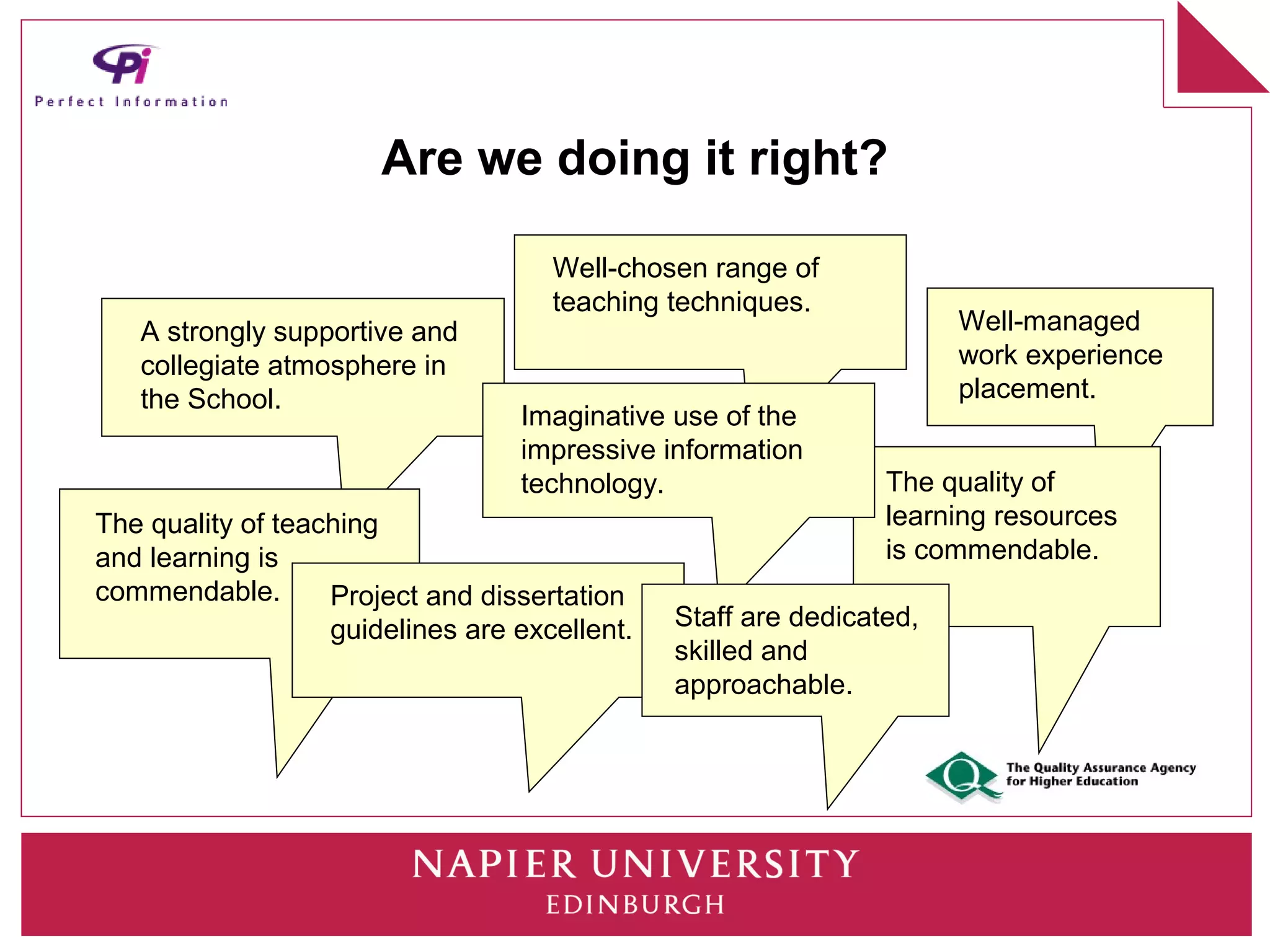
Are we doing it right?

                                     Well-chosen range of
                                     teaching techniques.
   A strongly supportive and                                          Well-managed
   collegiate atmosphere in                                           work experience
   the School.                                                        placement.
                                  Imaginative use of the
                                  impressive information
                                  technology.                   The quality of
The quality of teaching                                         learning resources
and learning is                                                 is commendable.
commendable.       Project and dissertation
                   guidelines are excellent.   Staff are dedicated,
                                               skilled and
                                               approachable.
But we face BIG challenges: 1
How to attract quality students in the first place
    Decline in undergraduate interest
        Dot.com bubble bust
        Misperceptions of a subject area not necessarily taught at school:
         computing/library work is boring; there is no longer a need for
         specialist education in this area; career potential wiped out due to
         outsourcing; lack of vocational certainty
        Parental/teacher preference for “traditional” subject choice in
         “traditional” institutions at undergraduate level
    Postgraduate concerns
          Debt from undergraduate career
          Lack of access to funding/sponsorship
          Fitting study into “life”
          A postgraduate degree is not a requirement for information work
But we face BIG challenges: 2
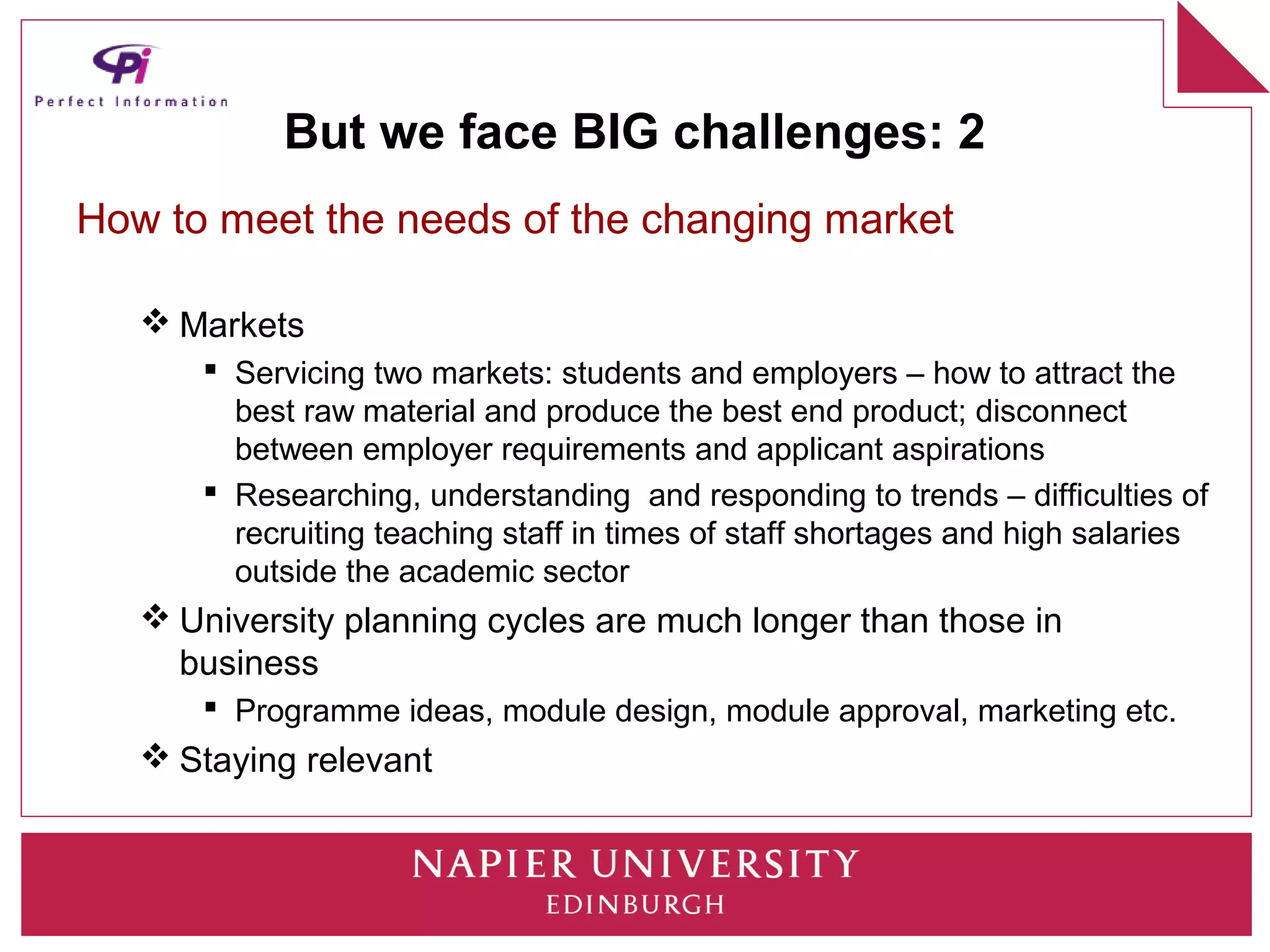
How to meet the needs of the changing market

    Markets
       Servicing two markets: students and employers – how to attract the
        best raw material and produce the best end product; disconnect
        between employer requirements and applicant aspirations
       Researching, understanding and responding to trends – difficulties of
        recruiting teaching staff in times of staff shortages and high salaries
        outside the academic sector
    University planning cycles are much longer than those in
     business
       Programme ideas, module design, module approval, marketing etc.
    Staying relevant
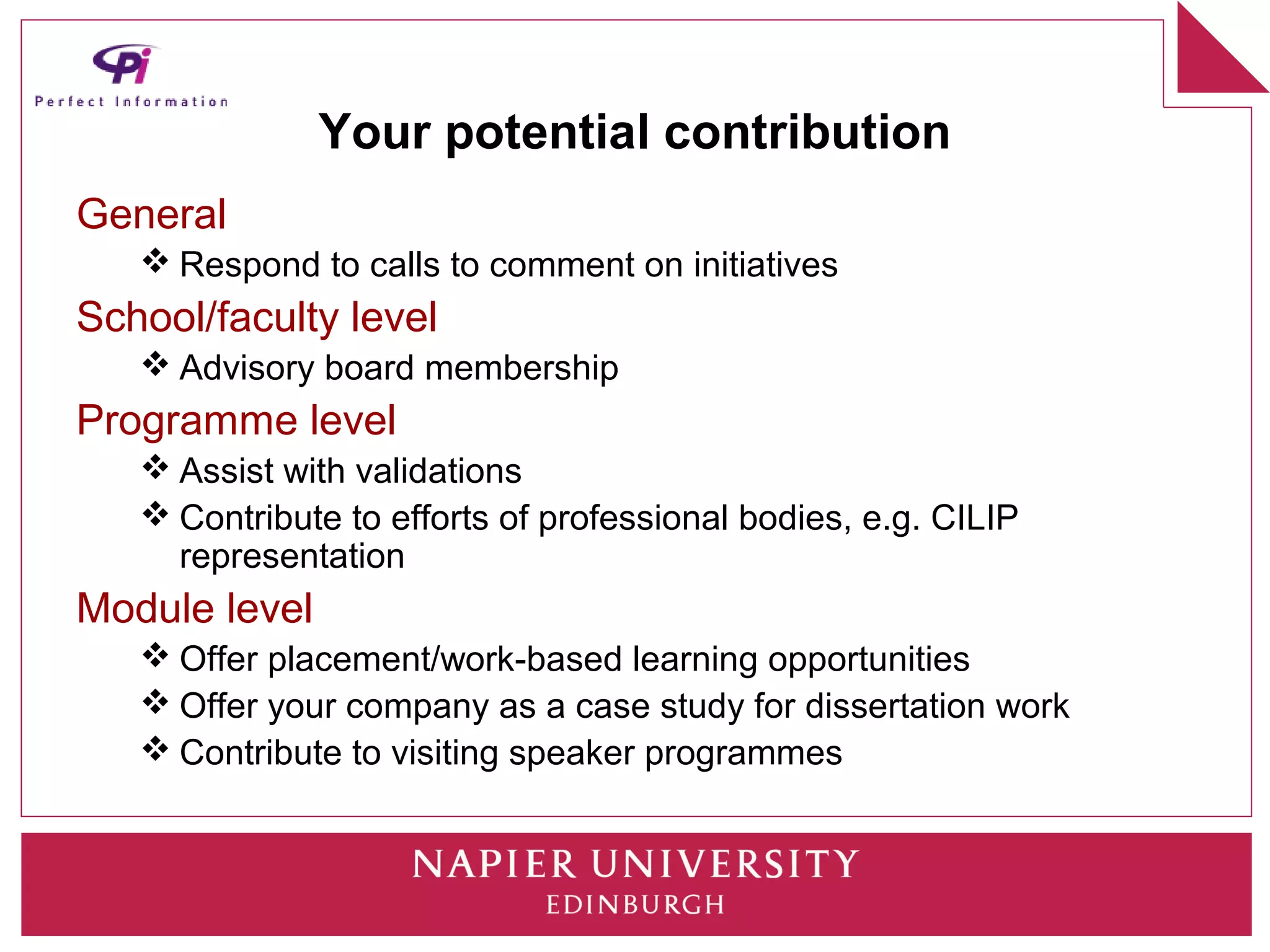
Your potential contribution
General
    Respond to calls to comment on initiatives
School/faculty level
    Advisory board membership
Programme level
    Assist with validations
    Contribute to efforts of professional bodies, e.g. CILIP
     representation
Module level
    Offer placement/work-based learning opportunities
    Offer your company as a case study for dissertation work
    Contribute to visiting speaker programmes
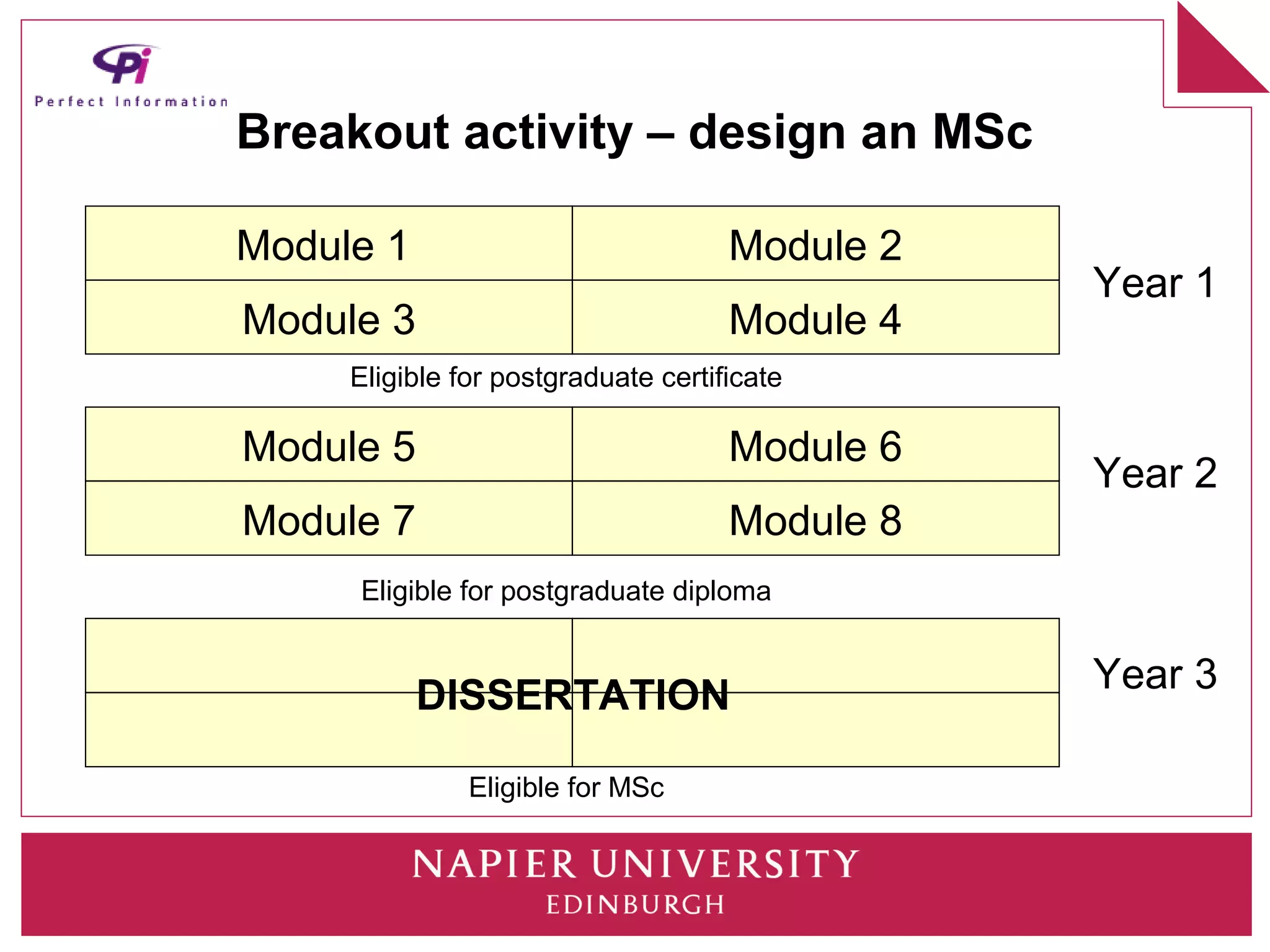
Breakout activity – design an MSc

Module 1                             Module 2
                                                Year 1
Module 3                             Module 4
     Eligible for postgraduate certificate

Module 5                             Module 6
                                                Year 2
Module 7                             Module 8
     Eligible for postgraduate diploma


                                                Year 3
           DISSERTATION

               Eligible for MSc
Discussion points
For each module
    Decide a title
    List learning outcomes (4 maximum). Use the wording:
       On completion of this module the student will be able to…[explain
        the general principles of X/critically assess/evaluate…]
    Describe the module content (6 sentences maximum)
    Suggest how the module might be assessed, giving both the
     assignment format and “question”:
       For example, a 3000 word report on X
For the dissertation module
    Suggest some dissertation topics
And if time allows…
    Devise a marketing plan for your new degree
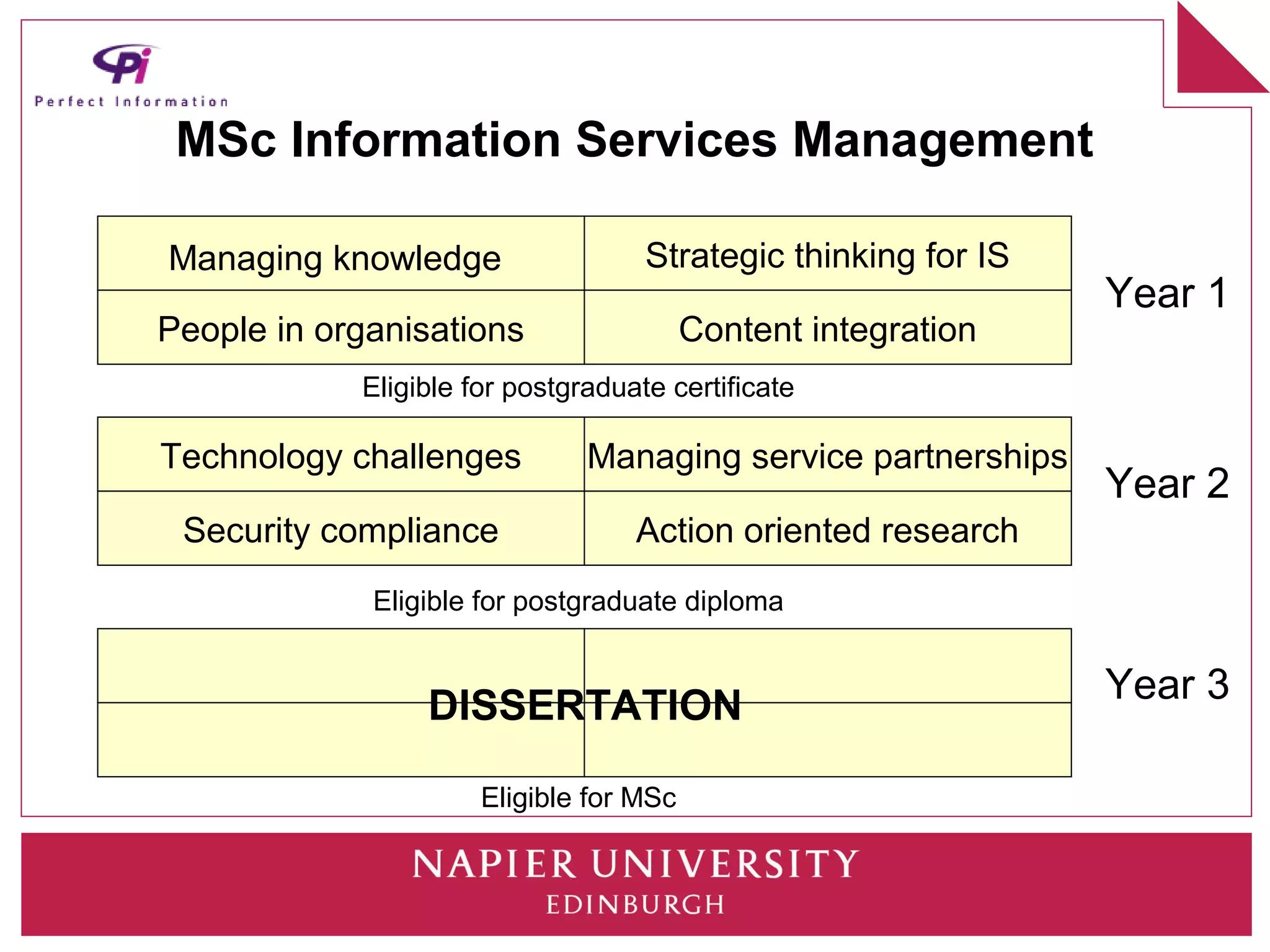
MSc Information Services Management

Managing knowledge                  Strategic thinking for IS
                                                                Year 1
People in organisations                  Content integration
            Eligible for postgraduate certificate

Technology challenges          Managing service partnerships
                                                                Year 2
 Security compliance               Action oriented research
             Eligible for postgraduate diploma


                                                                Year 3
                 DISSERTATION

                      Eligible for MSc

How should universities prepare information graduates for the working world?

  • 1.
    How should universitiesprepare information graduates for the working world? Hazel Hall School of Computing Napier University
  • 2.
    Breakout session agenda Introduction(half an hour maximum)  UK context  Current provision of UK accredited LIS courses  Institutional example  Napier provision  Challenges  Your potential contribution Breakout activity (one hour maximum)  Explained at the end of the presentation…
  • 3.
    Current UK programmeprovision Universities - 16  Aberystwyth, Brighton, City (London), Leeds Metropolitan, Liverpool John Moores, London Metropolitan, Loughborough, Manchester Metropolitan, Napier (Edinburgh), Northumbria (Newcastle), Robert Gordon (Aberdeen), Strathclyde (Glasgow), Thames Valley (London), University College London, West of England (Bristol) Courses - 56  45 postgraduate courses  11 undergraduate courses – some recent closures  “Average” provision – 1 at undergraduate, 3 at postgraduate level
  • 4.
    Programme focus 1 “General”titles  Information Analysis/Management/Science/Studies  Information and Knowledge Management  Information Services/Systems Management  Knowledge Management  Librarianship  Library and Information Studies/Information and Library Studies
  • 5.
    Programme focus 2 Titlesthat reflect information format  Digital Information Management (London Metropolitan)  Digital Libraries (Strathclyde)  Electronic Communication and publishing (University College London)  Electronic Information Management (Robert Gordon)  Electronic Publishing (Loughborough)  Records Management (Aberystwyth, Northumbria)
  • 6.
    Programme focus 3 Sector-specifictitles  Chemoinformatics (Sheffield)  Geographic Information Management (City)  Health Informatics/Information Management (Brighton, Sheffield/Aberystwyth)  Information Management in the Cultural Sector (City) 2 undergraduate business-related titles  Business Management and Information (Liverpool John Moores)  Information Management and Business Studies (Loughborough)
  • 7.
    Programme priorities Understanding  of concepts and principles (i.e. theory); analysis, implementation and management of information and information services (i.e. practice). Application  of concepts and principles. Evaluation  of information systems and services, and their deployment to solve problems. Independent judgement and critical awareness  to enquire, analyse, think creatively, reflect, reason, communicate. Achieving individual potential  basis for future personal development, continuing professional development.
  • 9.
    CILIP body ofprofessional knowledge Pe t ion rs o is a Knowledge na or g an l/ ge co l ed ll e c Know Transmission / tiv e communication me mo ; ry Conceptual structures ng hi lis Info’ need ub /p ring Information User/Client ng tu User behaviour Subject di indexing c or truc t ten n Re ta s io a c on vis d n so tion pr o era Documentation Op ice erv Cur a o’s tion / Inf o Inf ’ r es ourc em anag eme n Collection/Info’ resource t http://www.cilip.org.uk/qualificationschartership/bpk
  • 10.
    BSc Information Systems(Management) Year 1 Ordinary degree after 3 years. Honours degree after 4 years. Optional 12 month placement. Year 2 Placement Year 3 Year 3 Year 4 Year 4 Complete studies June Complete studies January
  • 11.
    MSc Information ServicesManagement Module 1 Module 2 Year 1 Module 3 Module 4 Eligible for postgraduate certificate Module 5 Module 6 Year 2 Module 7 Module 8 Eligible for postgraduate diploma Year 3 DISSERTATION Eligible for MSc
  • 12.
    Module provision Sample moduletitles  Action-oriented research  Bidding for information systems contracts  Business information sources  Business intelligence  Business systems analysis  Content integration  Information delivery  Information strategy  Information systems management  Knowledge management  Security of information systems  Strategic management
  • 13.
    Module provision Sample moduletitles  Action-oriented research  Bidding for information systems contracts  Business information sources  Business intelligence BIS and KM BIS and KM  Business systems analysis particularly particularly  Content integration highly rated by highly rated by  Information delivery the students the students  Information strategy  Information systems management  Knowledge management  Security of information systems  Strategic management
  • 14.
    Specialism through dissertations Dissertationthemes - examples  Internal blogging in corporate environments: their role in innovation and new knowledge creation  Business applications of social software (messaging)  New media channels for house sales  Web logs and current awareness services  Centralised versus decentralised intranet content development  User perceptions of commercial online information services  Role of the information professional in investment banking  Mergers and acquisitions in the online information services industry
  • 15.
    Business relevance Work incorporatedinto degree programmes  Placements on undergraduate programmes  Work experience requirements for admission to postgraduate courses  Work-based assessments, e.g. BIS tenders, AOR proposals Industry contributions to modules  Part-time lecturers, e.g. Kenny Walker on BIS  Guest speakers, e.g. Sun on IDEL, TFPL and Scottish Enterprise on KM, RBS on BIS, Oracle on BISC  Events, e.g. KM panel session, IS Student Conference Field trips  e.g. Scottish & Newcastle, CapGemini, Online conference
  • 16.
    Are we doingit right? Well-chosen range of teaching techniques. A strongly supportive and Well-managed collegiate atmosphere in work experience the School. placement. Imaginative use of the impressive information technology. The quality of The quality of teaching learning resources and learning is is commendable. commendable. Project and dissertation guidelines are excellent. Staff are dedicated, skilled and approachable.
  • 17.
    But we faceBIG challenges: 1 How to attract quality students in the first place  Decline in undergraduate interest  Dot.com bubble bust  Misperceptions of a subject area not necessarily taught at school: computing/library work is boring; there is no longer a need for specialist education in this area; career potential wiped out due to outsourcing; lack of vocational certainty  Parental/teacher preference for “traditional” subject choice in “traditional” institutions at undergraduate level  Postgraduate concerns  Debt from undergraduate career  Lack of access to funding/sponsorship  Fitting study into “life”  A postgraduate degree is not a requirement for information work
  • 18.
    But we faceBIG challenges: 2 How to meet the needs of the changing market  Markets  Servicing two markets: students and employers – how to attract the best raw material and produce the best end product; disconnect between employer requirements and applicant aspirations  Researching, understanding and responding to trends – difficulties of recruiting teaching staff in times of staff shortages and high salaries outside the academic sector  University planning cycles are much longer than those in business  Programme ideas, module design, module approval, marketing etc.  Staying relevant
  • 19.
    Your potential contribution General  Respond to calls to comment on initiatives School/faculty level  Advisory board membership Programme level  Assist with validations  Contribute to efforts of professional bodies, e.g. CILIP representation Module level  Offer placement/work-based learning opportunities  Offer your company as a case study for dissertation work  Contribute to visiting speaker programmes
  • 20.
    Breakout activity –design an MSc Module 1 Module 2 Year 1 Module 3 Module 4 Eligible for postgraduate certificate Module 5 Module 6 Year 2 Module 7 Module 8 Eligible for postgraduate diploma Year 3 DISSERTATION Eligible for MSc
  • 21.
    Discussion points For eachmodule  Decide a title  List learning outcomes (4 maximum). Use the wording:  On completion of this module the student will be able to…[explain the general principles of X/critically assess/evaluate…]  Describe the module content (6 sentences maximum)  Suggest how the module might be assessed, giving both the assignment format and “question”:  For example, a 3000 word report on X For the dissertation module  Suggest some dissertation topics And if time allows…  Devise a marketing plan for your new degree
  • 22.
    MSc Information ServicesManagement Managing knowledge Strategic thinking for IS Year 1 People in organisations Content integration Eligible for postgraduate certificate Technology challenges Managing service partnerships Year 2 Security compliance Action oriented research Eligible for postgraduate diploma Year 3 DISSERTATION Eligible for MSc