Evaluating and Measuring the
Effects of Public Relations
James E. Grunig
Professor Emeritus
Department of Communication
University of Maryland
What Kind of Organizational
Function is Public Relations?
 A messaging, publicity, informational, media-relations
function?
 Publications, news, communication campaigns, media
contacts.
 A marketing function?
 Support for marketing through media publicity?
 A strategic management function?
 Active participant in decision making?
 Research-based, organizational listening and learning?
 Building relationships for other functions, including
marketing?
 Public relations participates in strategic decision-making
to help manage the behavior of the organization.
 Public relations is a bridging activity to build
relationships with stakeholders rather than a set of
messaging activities designed to buffer the organization
from stakeholders.
 Emphasis is on two-way and symmetrical communication
of many kinds to provide publics a voice in management
decisions and to facilitate dialogue between management
and publics.
 Research and evaluation are critical components of this
approach.
The Behavioral, Strategic
Management, Paradigm
Some Initial Caveats
 “Research” is a more appropriate term than
“measurement” or “metrics.”
 Research includes conceptualization as well
as measurement.
 The lack of conceptualization in public
relations is a greater problem than the lack
of measurement.
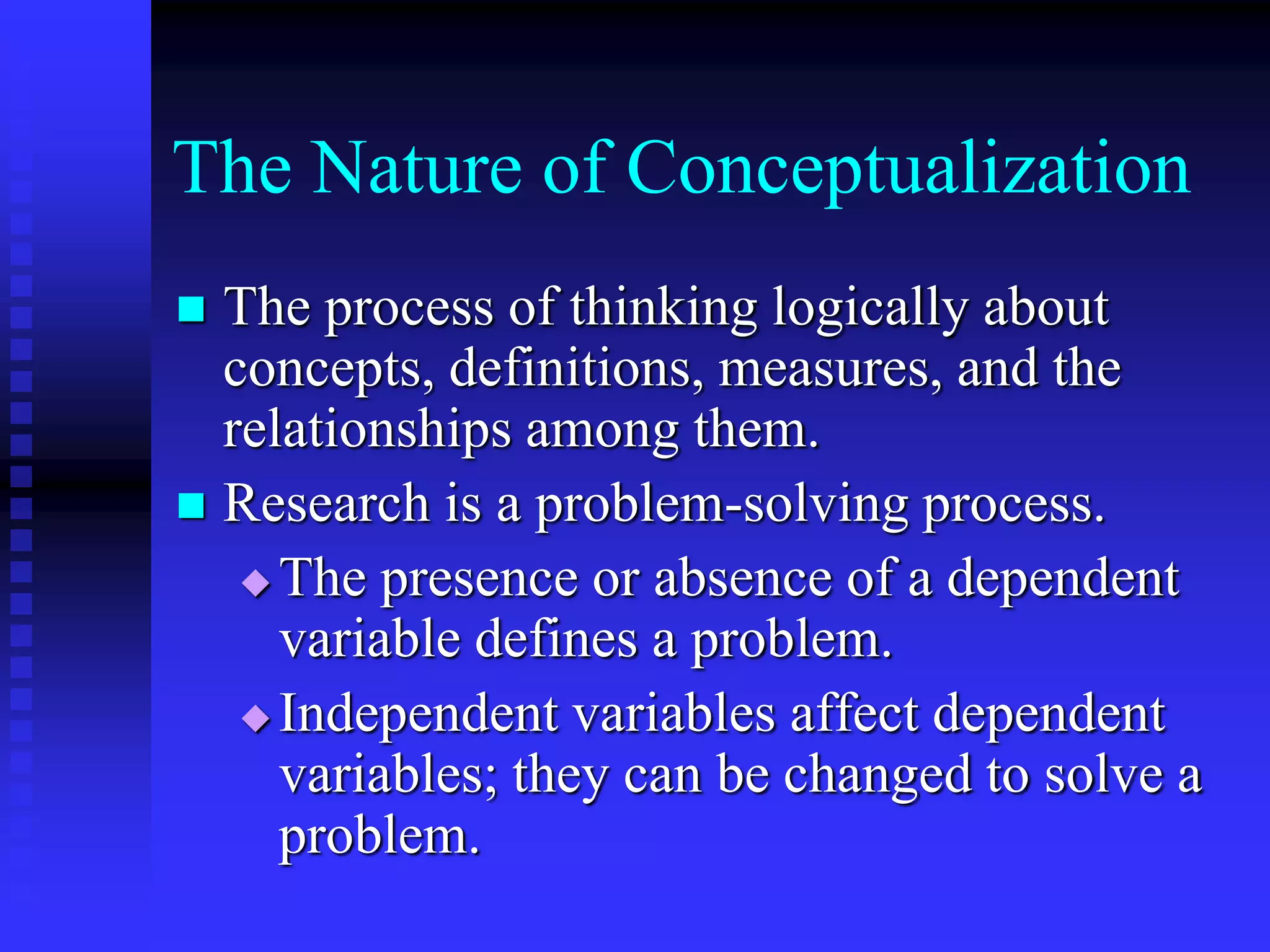
The Nature of Conceptualization
 The process of thinking logically about
concepts, definitions, measures, and the
relationships among them.
 Research is a problem-solving process.
 The presence or absence of a dependent
variable defines a problem.
 Independent variables affect dependent
variables; they can be changed to solve a
problem.
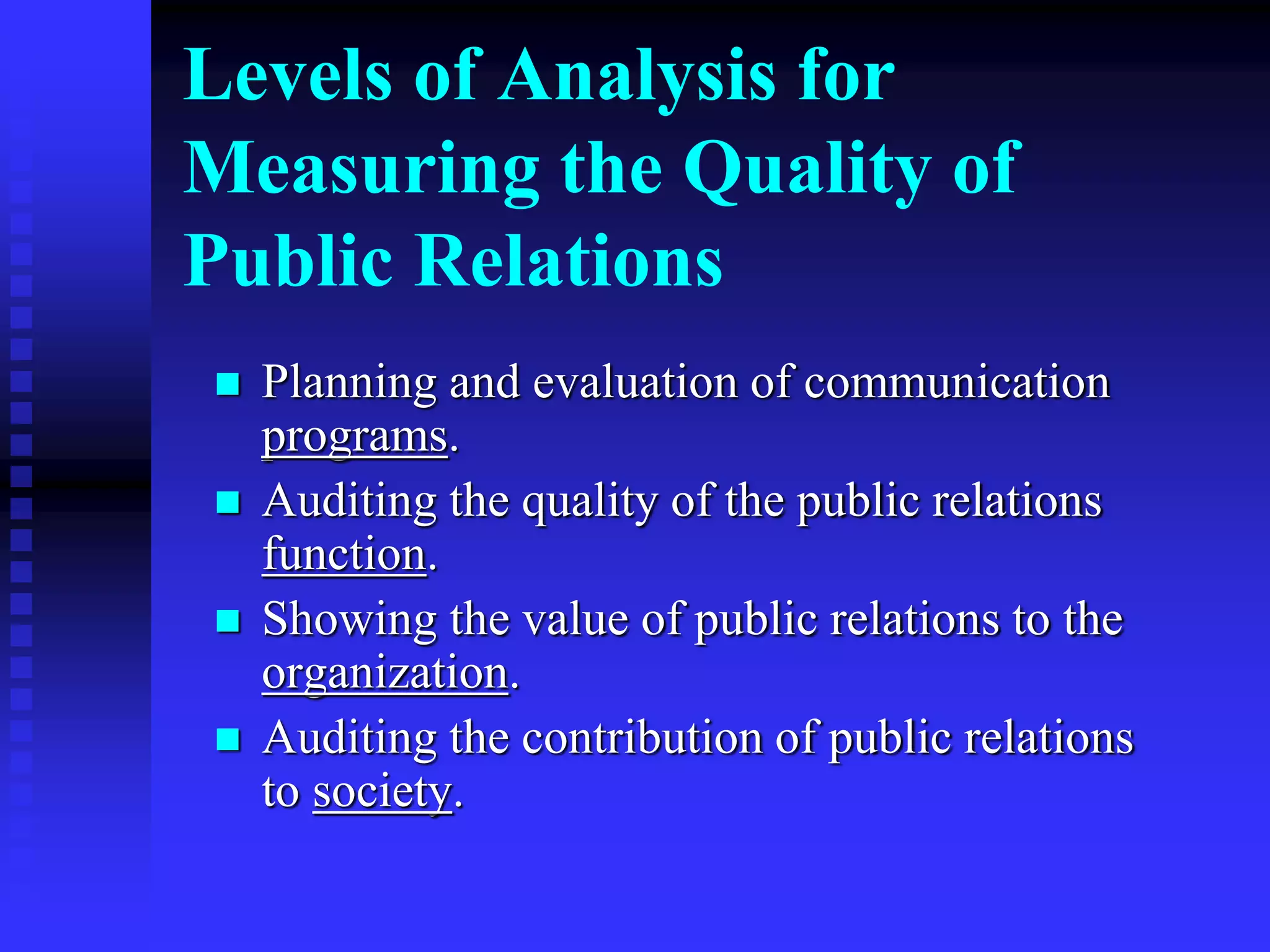
Levels of Analysis for
Measuring the Quality of
Public Relations
 Planning and evaluation of communication
programs.
 Auditing the quality of the public relations
function.
 Showing the value of public relations to the
organization.
 Auditing the contribution of public relations
to society.
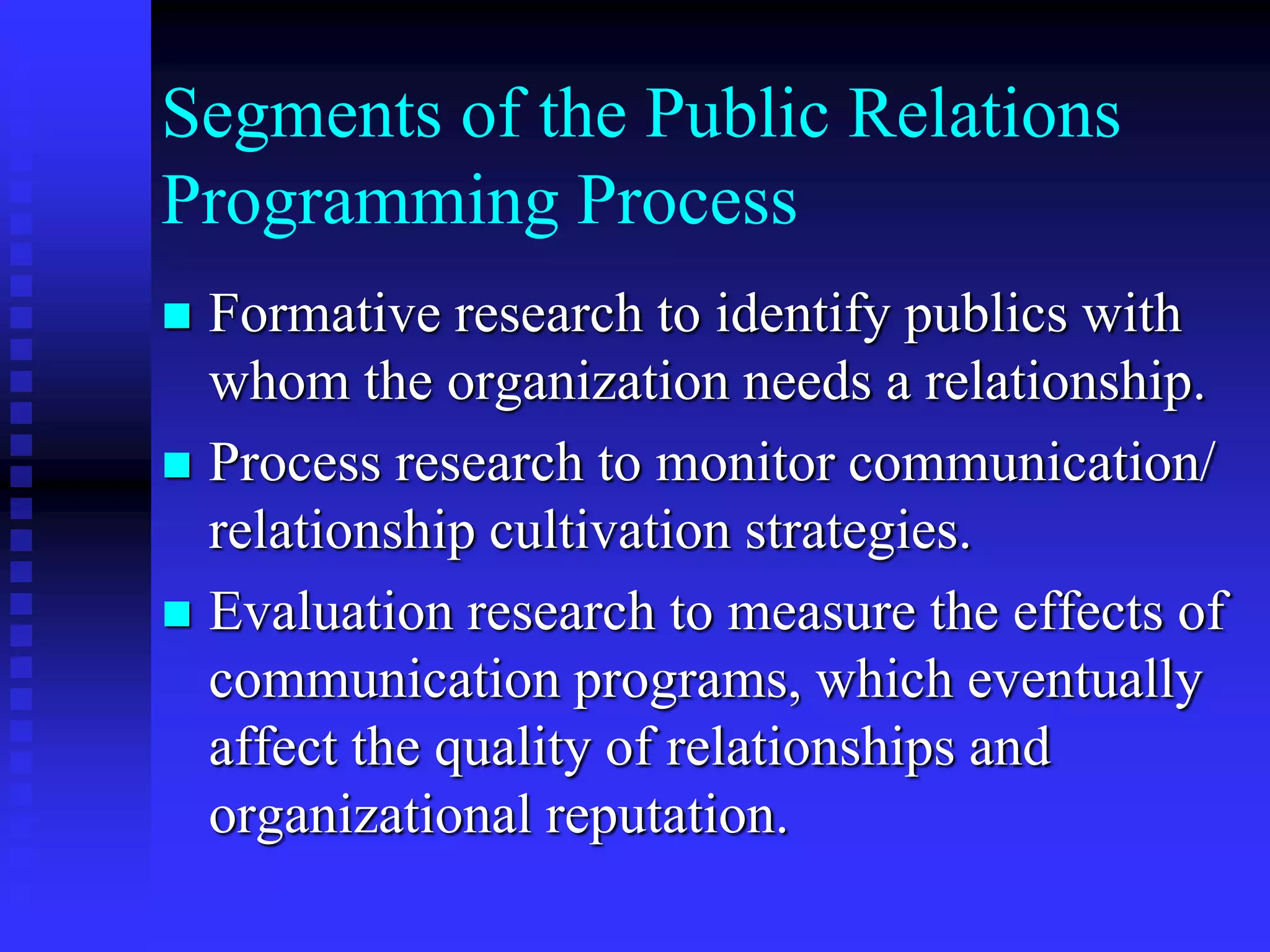
Segments of the Public Relations
Programming Process
 Formative research to identify publics with
whom the organization needs a relationship.
 Process research to monitor communication/
relationship cultivation strategies.
 Evaluation research to measure the effects of
communication programs, which eventually
affect the quality of relationships and
organizational reputation.
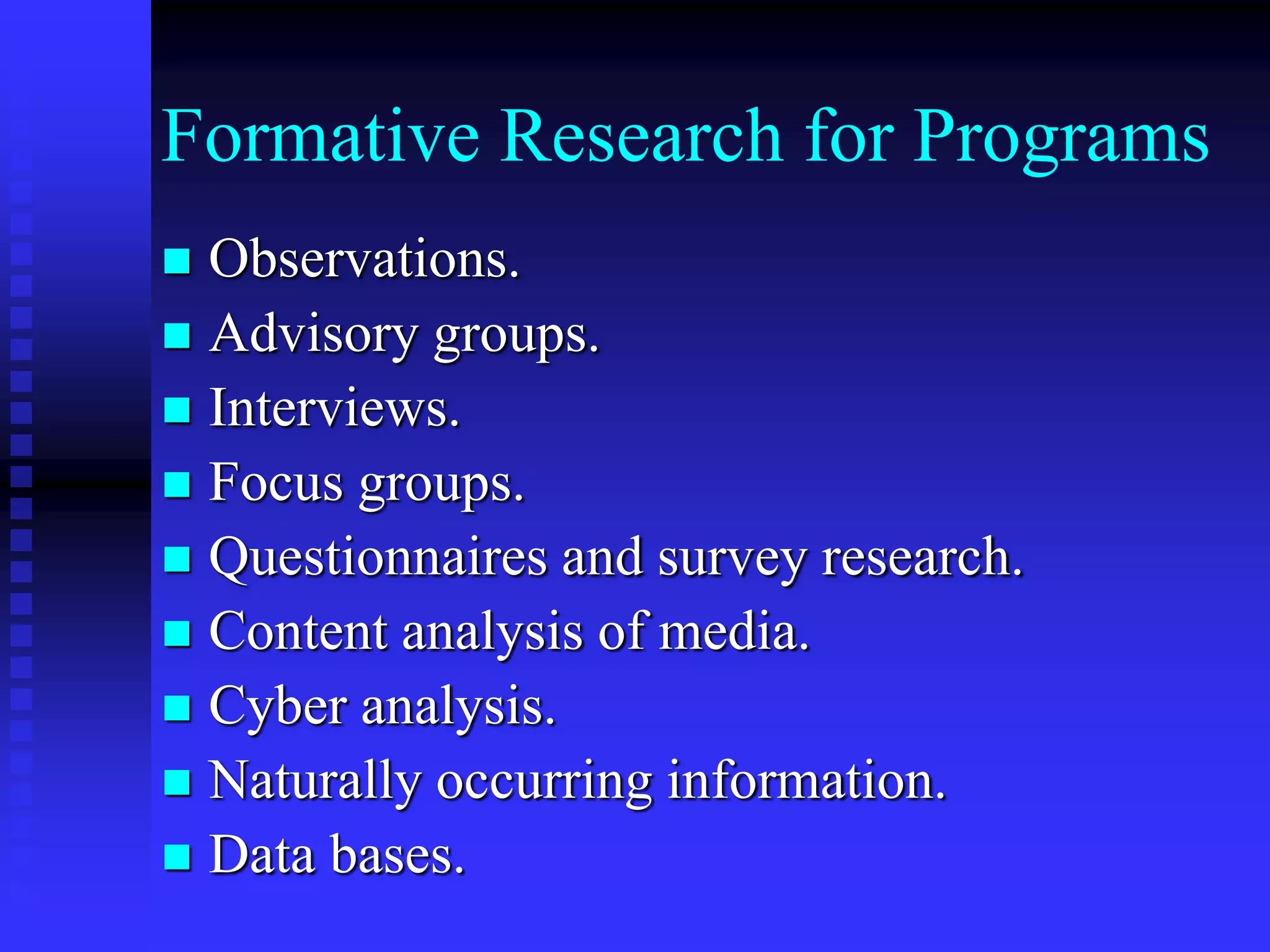
Formative Research for Programs
 Observations.
 Advisory groups.
 Interviews.
 Focus groups.
 Questionnaires and survey research.
 Content analysis of media.
 Cyber analysis.
 Naturally occurring information.
 Data bases.
Evaluation Research at the
Program Level
Individual communication programs
such as media relations, community
relations, or customer relations are
successful when they affect the
awareness, cognitions, attitudes, and
behaviors of both publics and members
of the organization.
Methods of Limited Value
 Media analysis (except for monitoring
media relations).
 Advertising equivalencies.
 General surveys of attitudes, images, or
reputation.
Process Objectives for Evaluation
of Programs
 Public relations research has identified
cultivation strategies that improve the
quality of relationships with publics.
 Examples are:
 Disclosure by publics of concerns.
 Complaints or inquiries by publics.
 Disclosure by management to publics.
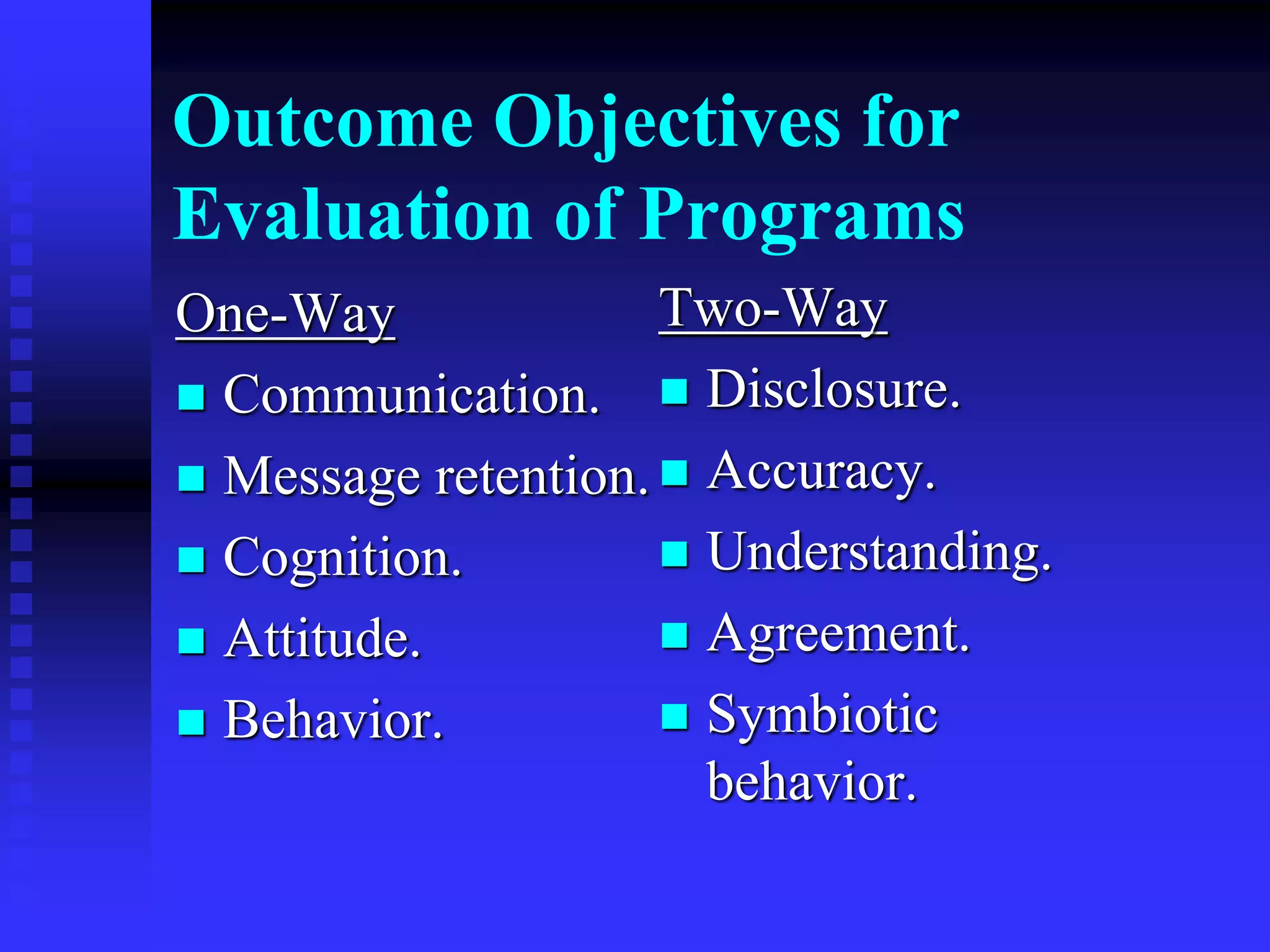
Outcome Objectives for
Evaluation of Programs
One-Way
 Communication.
 Message retention.
 Cognition.
 Attitude.
 Behavior.
Two-Way
 Disclosure.
 Accuracy.
 Understanding.
 Agreement.
 Symbiotic
behavior.
Research Methods for
Communication Programs
 Quantitative
Surveys.
Experiments.
 Qualitative
Observations.
Interviews.
Focus Groups.
Research at the Organizational Level
• Over the long-term, successful short-term
communication activities and programs
contribute to the building of quality, long-
term relationships with strategic publics.
• Relationships add value by reducing costs,
reducing risks, and increasing revenue.
• The organizational value of public relations
can be determined by measuring the type
and quality of relationships.
Formative Research at the Organizational
Level: Environmental Scanning
 Monitoring of management decisions for
implications on stakeholders.
 Segmentation of stakeholders and publics.
 Qualitative observations of activists, advisory
groups, contacts.
 Interviews with organizational boundary
spanners.
 Cyber scanning.
 Electronic databases.
 Monitoring of media and political processes.
The Long-Term Value of Public
Relations Can Be Evaluated by
Measuring the Quality of Relationships
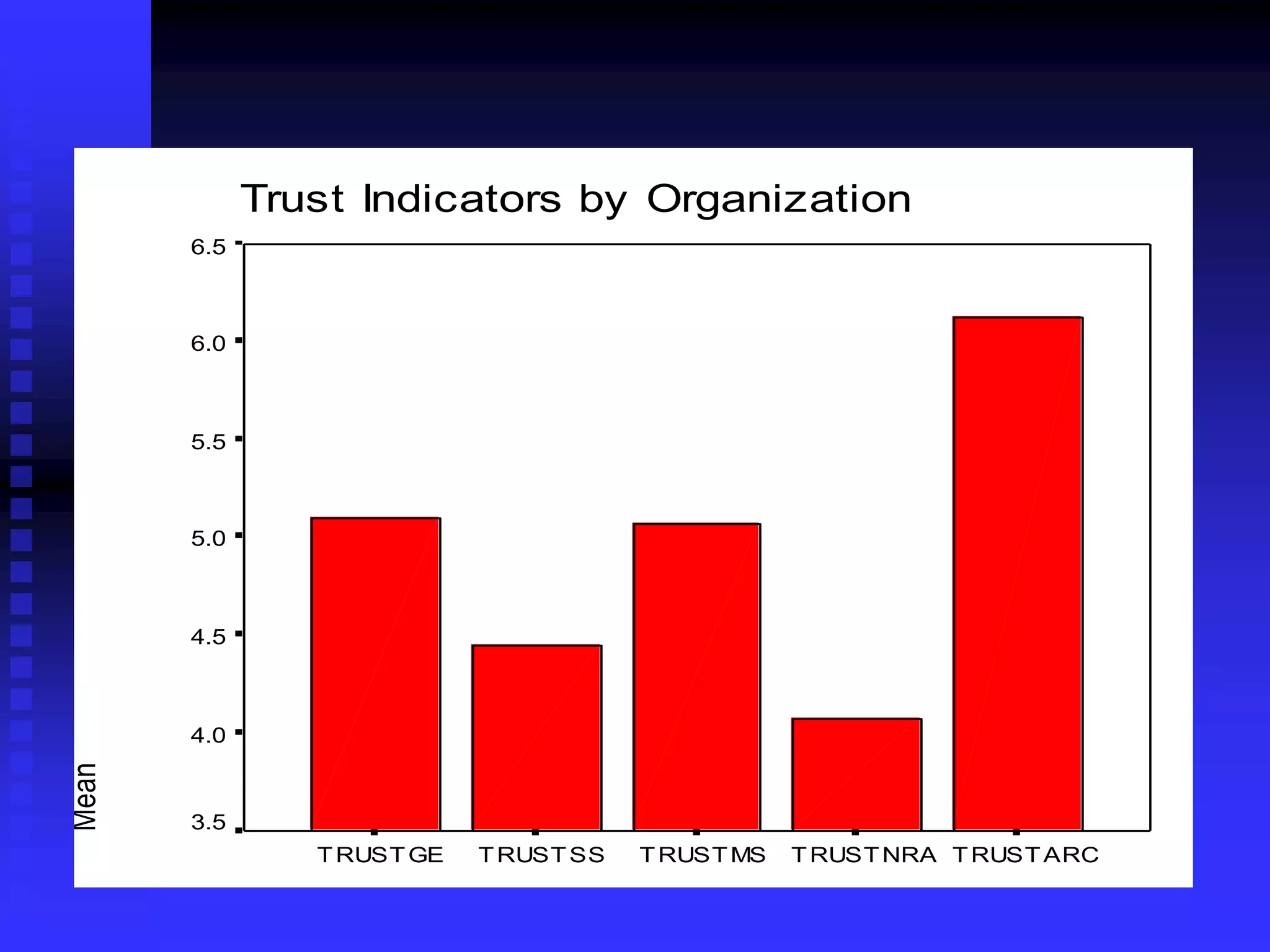
 Trust.
One party’s level of confidence in and
willingness to open itself to the other party.
(e.g., “Whenever this organization makes an important decision, I know
it will be concerned about people like me.”)
 Mutuality of control.
The degree to which parties agree on who has
rightful power to influence one another.
(e.g., “The management of this organization gives people like me
enough say in the decision-making process.”)
More Qualities of Relationships
 Commitment
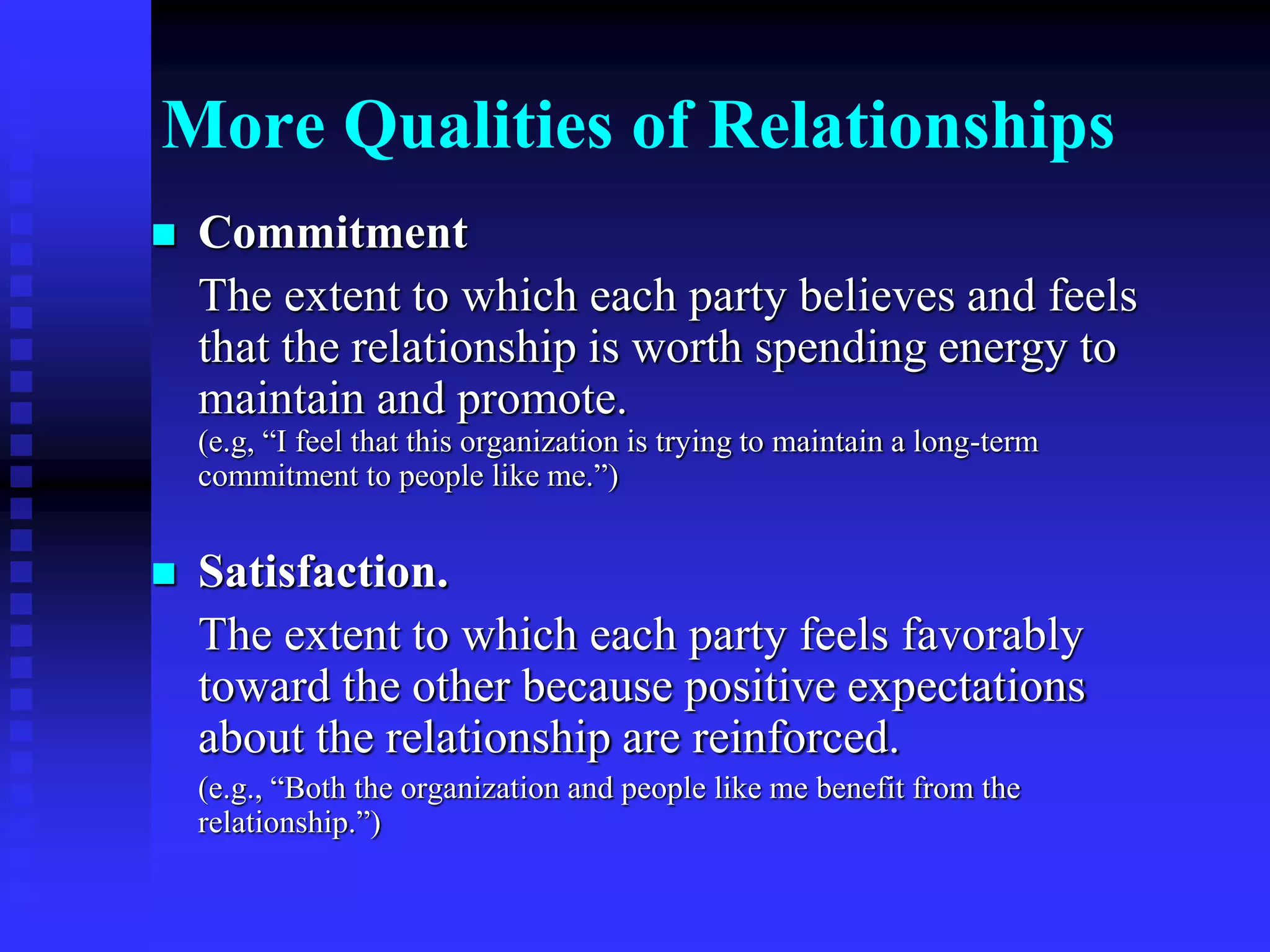
The extent to which each party believes and feels
that the relationship is worth spending energy to
maintain and promote.
(e.g, “I feel that this organization is trying to maintain a long-term
commitment to people like me.”)
 Satisfaction.
The extent to which each party feels favorably
toward the other because positive expectations
about the relationship are reinforced.
(e.g., “Both the organization and people like me benefit from the
relationship.”)
Types of Relationships
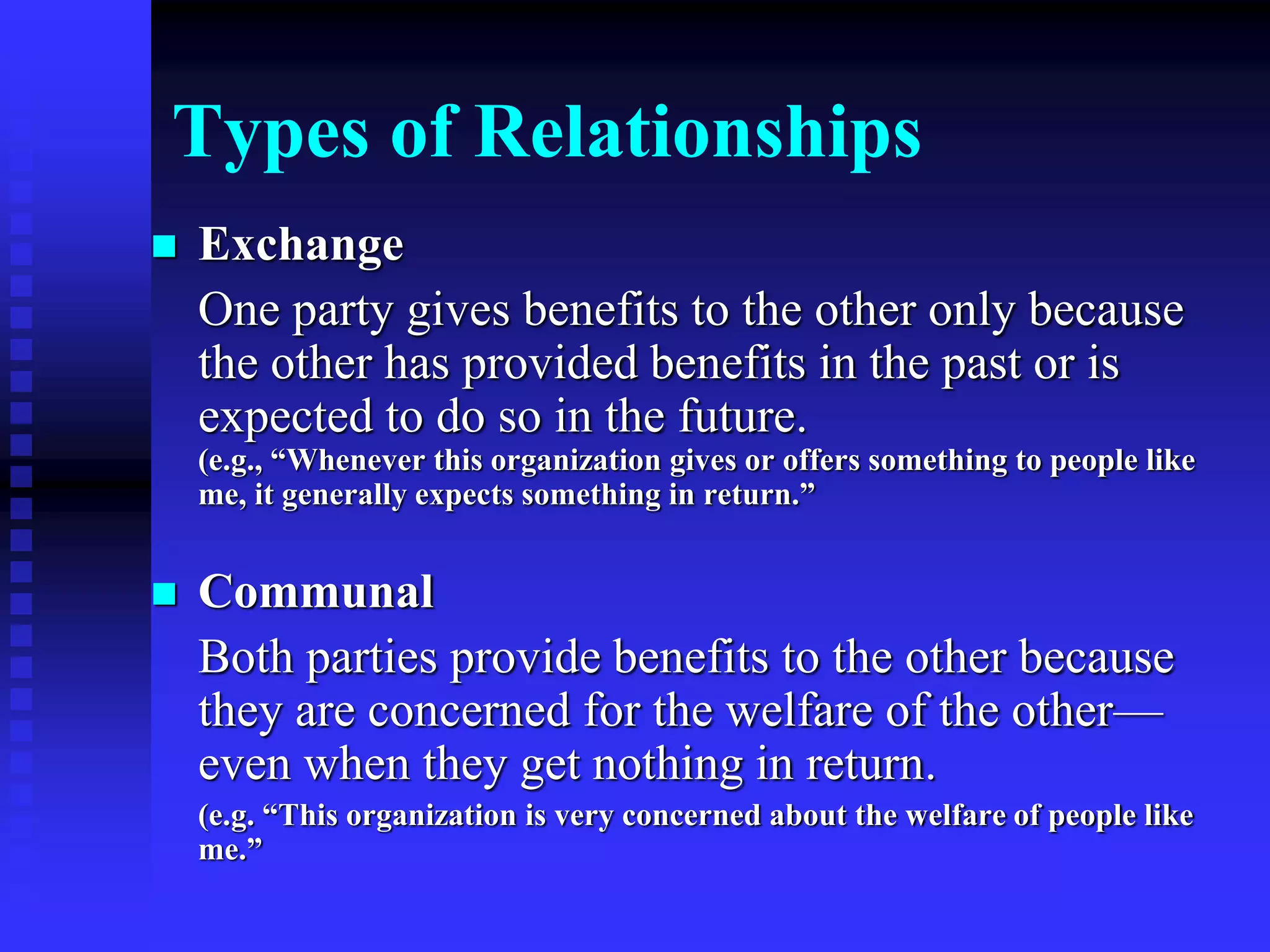
 Exchange
One party gives benefits to the other only because
the other has provided benefits in the past or is
expected to do so in the future.
(e.g., “Whenever this organization gives or offers something to people like
me, it generally expects something in return.”
 Communal
Both parties provide benefits to the other because
they are concerned for the welfare of the other—
even when they get nothing in return.
(e.g. “This organization is very concerned about the welfare of people like
me.”
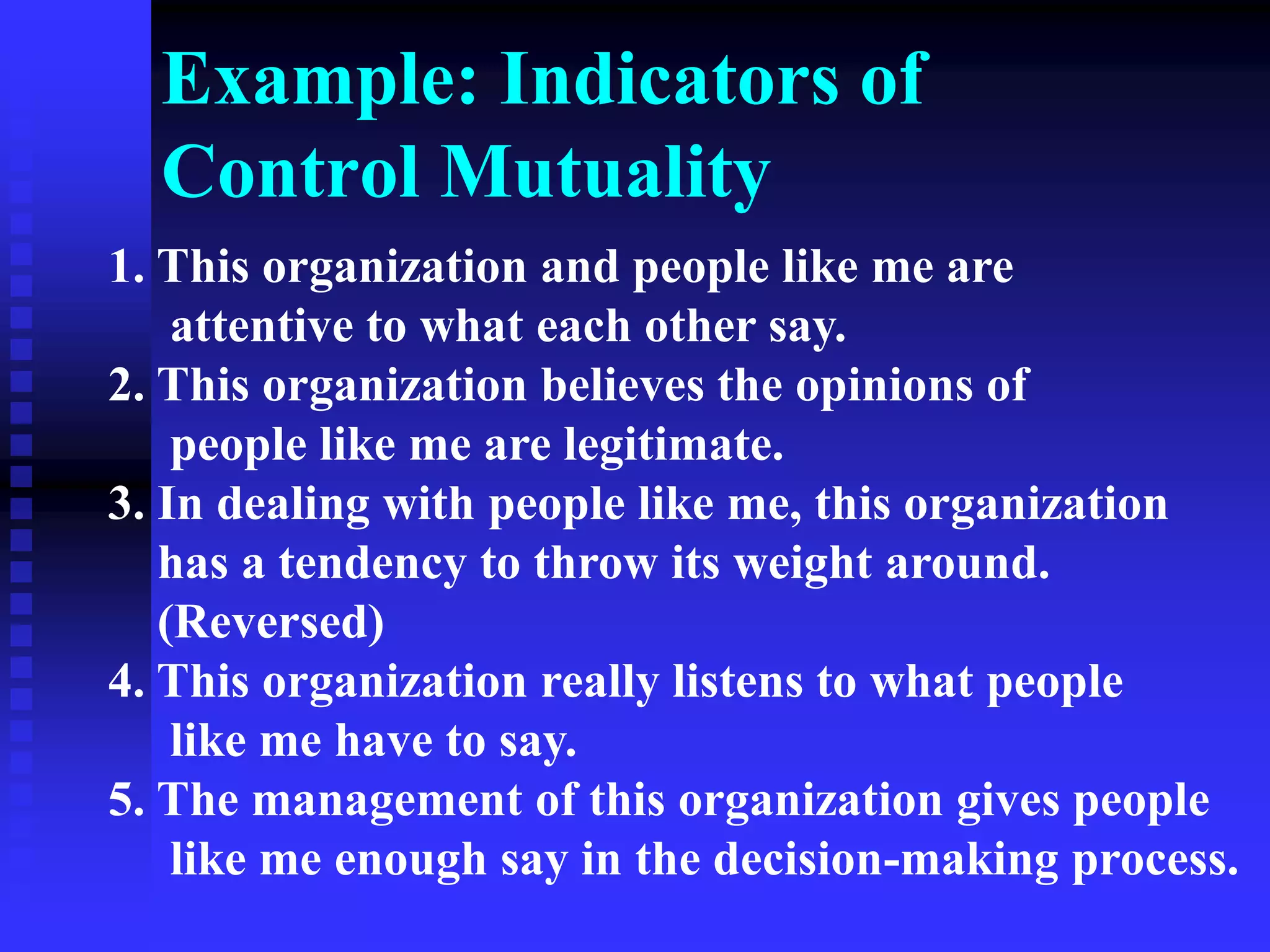
Example: Indicators of
Control Mutuality
1. This organization and people like me are
attentive to what each other say.
2. This organization believes the opinions of
people like me are legitimate.
3. In dealing with people like me, this organization
has a tendency to throw its weight around.
(Reversed)
4. This organization really listens to what people
like me have to say.
5. The management of this organization gives people
like me enough say in the decision-making process.
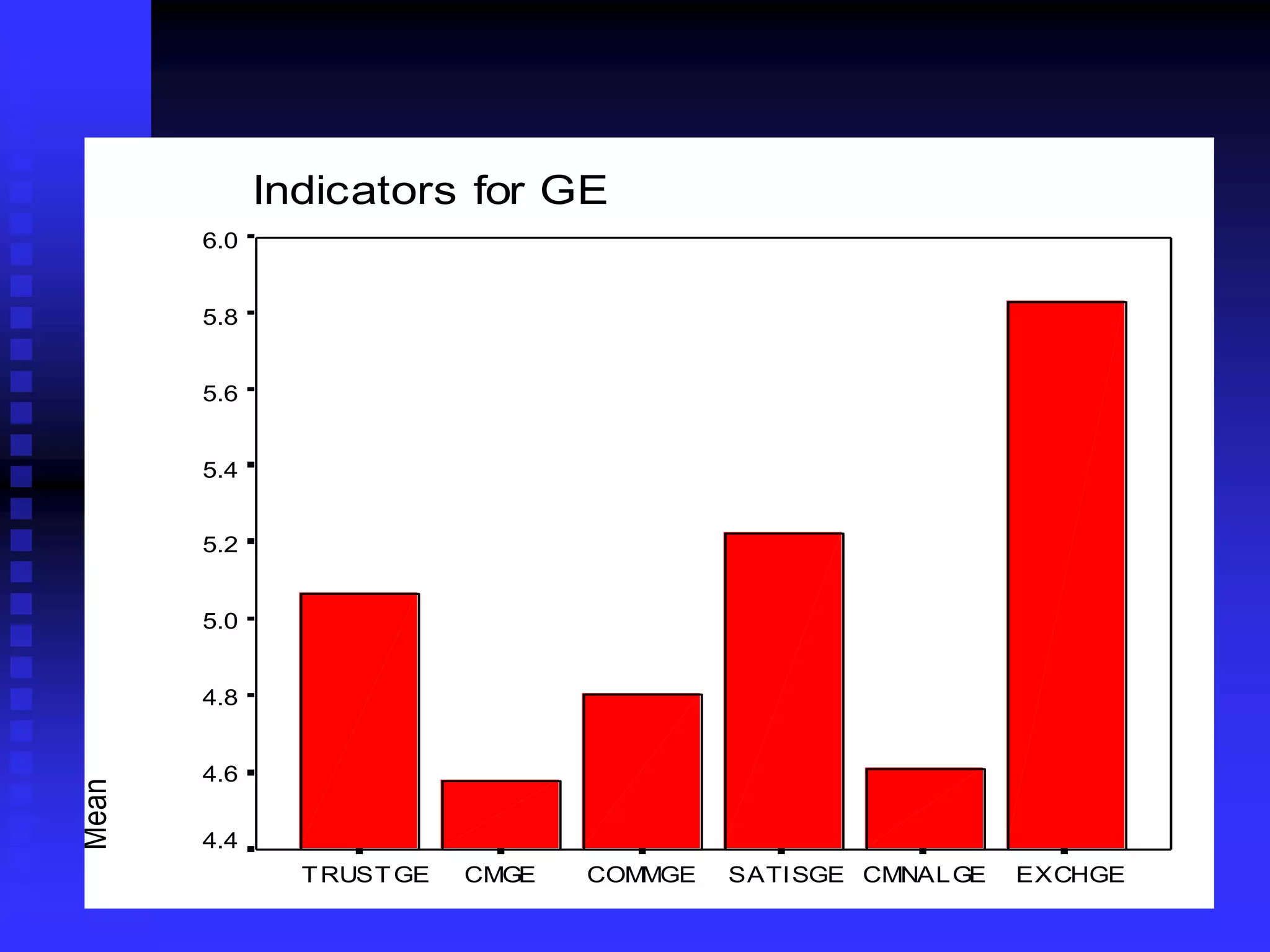
Indicators for GE
EXCHGECMNALGESATISGECOMMGECMGETRUSTGE
Mean
6.0
5.8
5.6
5.4
5.2
5.0
4.8
4.6
4.4
Trust Indicators by Organization
TRUSTARCTRUSTNRATRUSTMSTRUSTSSTRUSTGE
Mean
6.5
6.0
5.5
5.0
4.5
4.0
3.5
Qualitative Research on Relationships
 Begin with “grand-tour” questions:
1. “Do you feel that you have a relationship with
(organization)(public)? Why or why not?
2. “Please describe your relationship with
(organization)(public).
 Analyze using the dimensions of
relationship or new characteristics that
emerge.
 Probe for dimensions of relationships.
Trust
 Would you describe any things that (organization)
(public) has done to treat (organization)(public) fairly
and justly, or unfairly and unjustly? (integrity)
 Would you describe things that (organization)(public)
has done that indicate it can be relied on to keep its
promises, or that it does not keep its promises?
(dependability)
 How confident are you that (organization)(public) has
the ability to accomplish what it says it will do? Can
you give me examples of why you feel that way?
(competence)
Relationships and Reputation
 Most thinking about and measurement of
reputation assumes that a reputation can be
“managed” by managing messages.
 Reputation is a byproduct of organizational
performance, as evaluated by stakeholders,
and of relationships with stakeholders.
 The concept of reputation has value when
used in conjunction with relationships.
What Is a Reputation?
 What is generally said or believed about a
person or thing.
 Must be said or believed collectively, but a
person or thing may have more than one
reputation. (D. B. Bromley [1993], Reputation,
Image, and Impression Management.)
Open-End Questions Measure
Reputations Best
 Initially developed by Bromley.
 Used in research on risk assessment by Paul
Slovic. (Science, 1991, pp. 1603-1607)
 “In a sentence or two, please tell me what
comes to mind when you think of
[organization].”
 Code by type of cognitive representation.
Reputation Results
 Categories of cognitive representations
found among all five organizations:
 Positive attributes
 Negative attributes
 Descriptive attributes
 Good behaviors
 Bad behaviors
Other Cognitive Representations
 Positive and negative evaluations
(attitudes).
 Evaluations of products.
 Objects, such as CEOs, spokespersons,
members, recipients of benefits,
technology, stock, lawsuits, guns, hunting,
war, blood, disasters, tax, social security
number, and welfare.
Our Major Conclusion
Recall of behaviors had the strongest
associations with relationships.
Functional Level
The public relations function as a whole can
be audited by comparing the structure and
processes of the department or departments
that implement the function with the best
practices of the public relations function in
other organizations or with theoretical
principles derived from scholarly research.
Evaluation at this level can be called
theoretical or practical benchmarking.
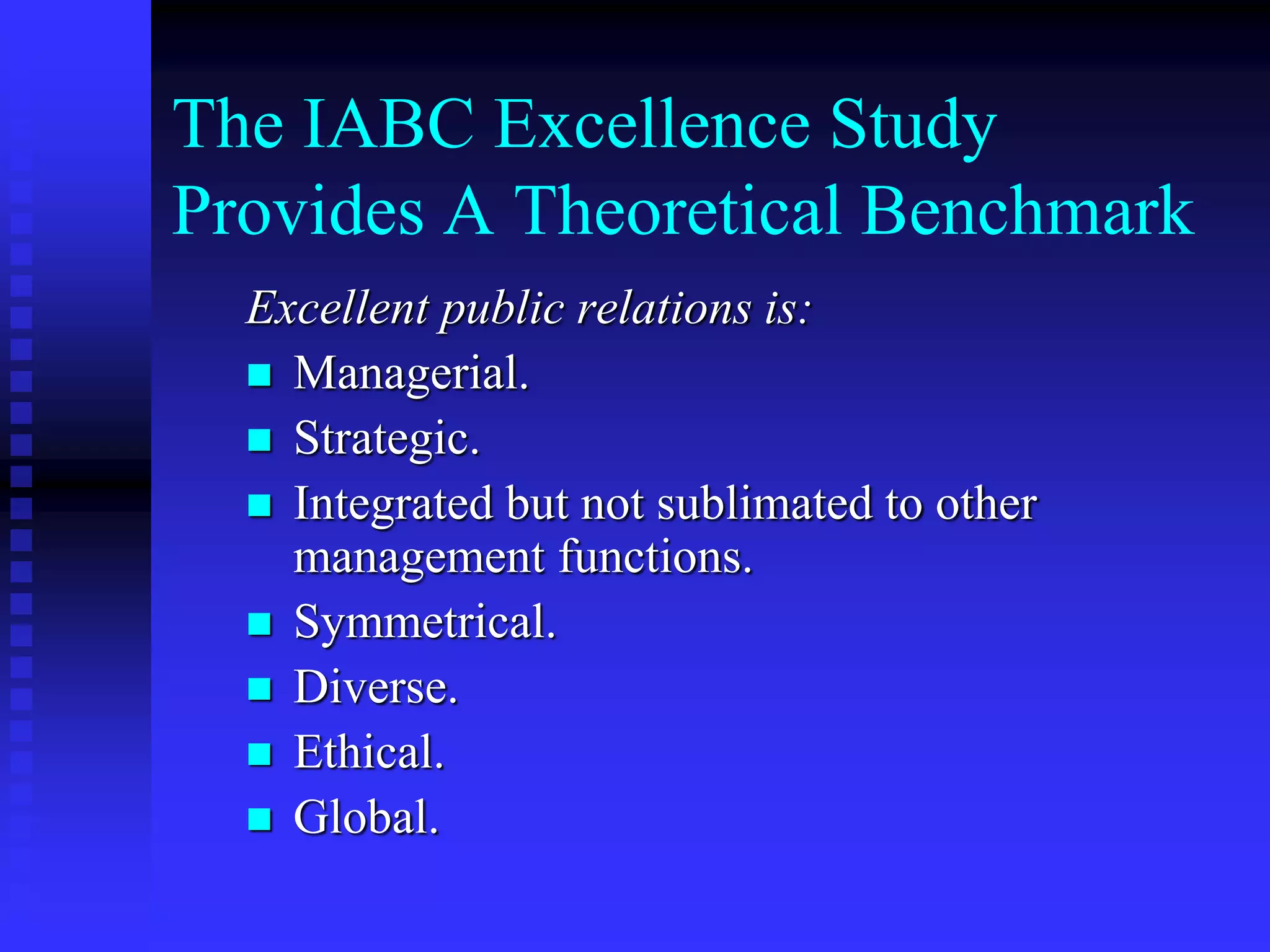
The IABC Excellence Study
Provides A Theoretical Benchmark
Excellent public relations is:
 Managerial.
 Strategic.
 Integrated but not sublimated to other
management functions.
 Symmetrical.
 Diverse.
 Ethical.
 Global.
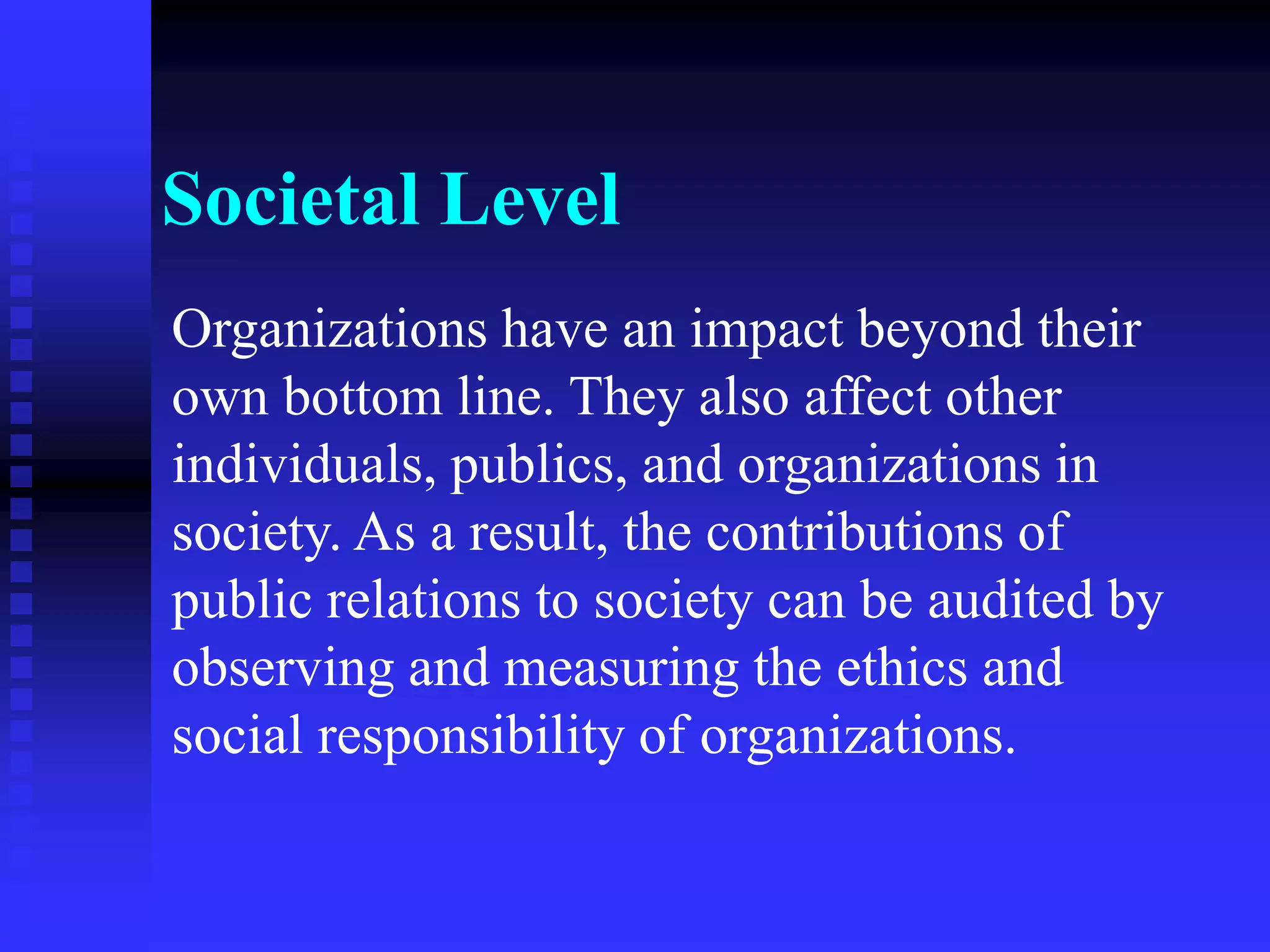
Societal Level
Organizations have an impact beyond their
own bottom line. They also affect other
individuals, publics, and organizations in
society. As a result, the contributions of
public relations to society can be audited by
observing and measuring the ethics and
social responsibility of organizations.
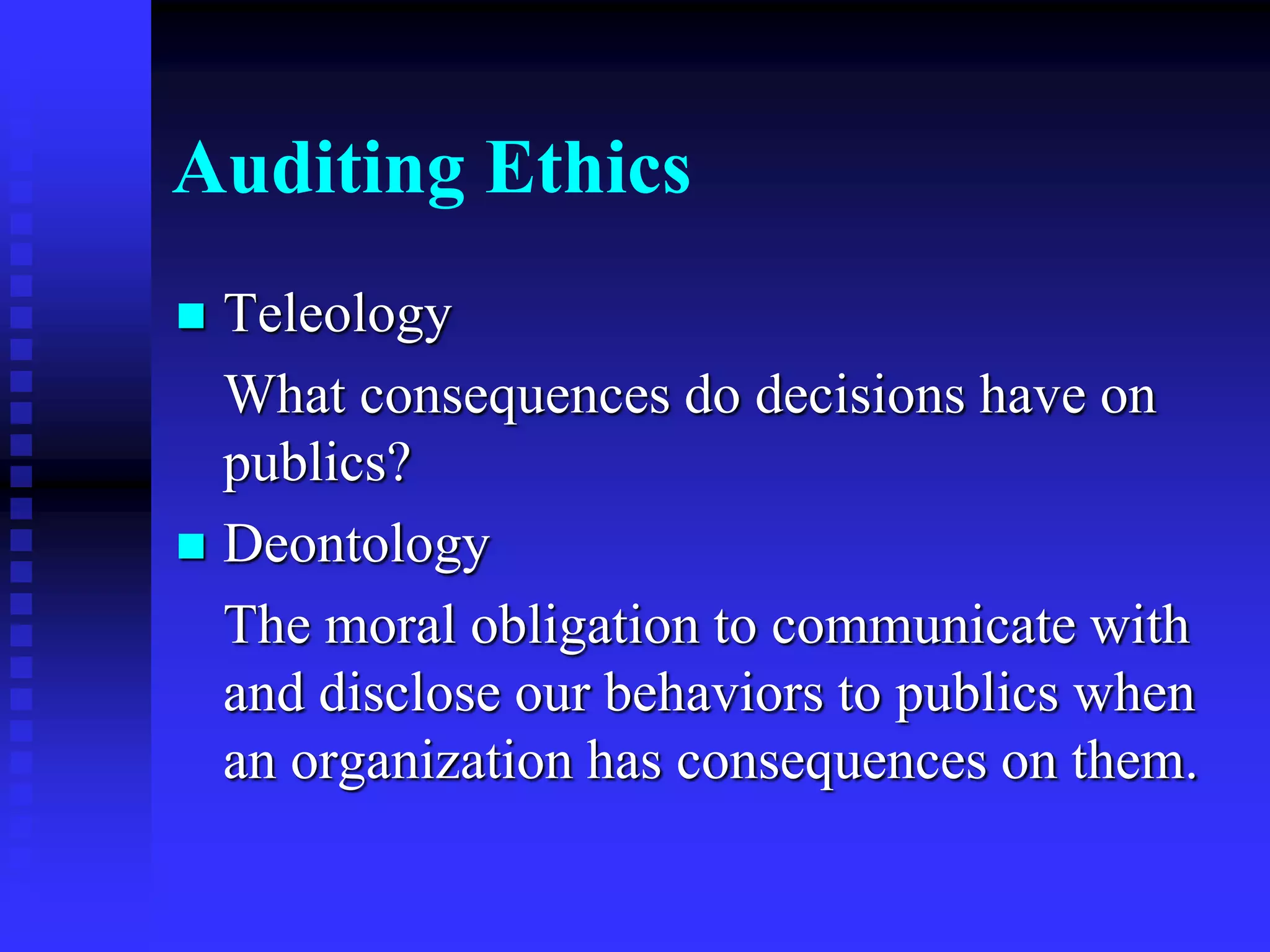
Auditing Ethics
 Teleology
What consequences do decisions have on
publics?
 Deontology
The moral obligation to communicate with
and disclose our behaviors to publics when
an organization has consequences on them.

Evaluating and Measuring the Effects of Public Relations

  • 1.
    Evaluating and Measuringthe Effects of Public Relations James E. Grunig Professor Emeritus Department of Communication University of Maryland
  • 2.
    What Kind ofOrganizational Function is Public Relations?  A messaging, publicity, informational, media-relations function?  Publications, news, communication campaigns, media contacts.  A marketing function?  Support for marketing through media publicity?  A strategic management function?  Active participant in decision making?  Research-based, organizational listening and learning?  Building relationships for other functions, including marketing?
  • 3.
     Public relationsparticipates in strategic decision-making to help manage the behavior of the organization.  Public relations is a bridging activity to build relationships with stakeholders rather than a set of messaging activities designed to buffer the organization from stakeholders.  Emphasis is on two-way and symmetrical communication of many kinds to provide publics a voice in management decisions and to facilitate dialogue between management and publics.  Research and evaluation are critical components of this approach. The Behavioral, Strategic Management, Paradigm
  • 4.
    Some Initial Caveats “Research” is a more appropriate term than “measurement” or “metrics.”  Research includes conceptualization as well as measurement.  The lack of conceptualization in public relations is a greater problem than the lack of measurement.
  • 5.
    The Nature ofConceptualization  The process of thinking logically about concepts, definitions, measures, and the relationships among them.  Research is a problem-solving process.  The presence or absence of a dependent variable defines a problem.  Independent variables affect dependent variables; they can be changed to solve a problem.
  • 6.
    Levels of Analysisfor Measuring the Quality of Public Relations  Planning and evaluation of communication programs.  Auditing the quality of the public relations function.  Showing the value of public relations to the organization.  Auditing the contribution of public relations to society.
  • 7.
    Segments of thePublic Relations Programming Process  Formative research to identify publics with whom the organization needs a relationship.  Process research to monitor communication/ relationship cultivation strategies.  Evaluation research to measure the effects of communication programs, which eventually affect the quality of relationships and organizational reputation.
  • 8.
    Formative Research forPrograms  Observations.  Advisory groups.  Interviews.  Focus groups.  Questionnaires and survey research.  Content analysis of media.  Cyber analysis.  Naturally occurring information.  Data bases.
  • 9.
    Evaluation Research atthe Program Level Individual communication programs such as media relations, community relations, or customer relations are successful when they affect the awareness, cognitions, attitudes, and behaviors of both publics and members of the organization.
  • 10.
    Methods of LimitedValue  Media analysis (except for monitoring media relations).  Advertising equivalencies.  General surveys of attitudes, images, or reputation.
  • 11.
    Process Objectives forEvaluation of Programs  Public relations research has identified cultivation strategies that improve the quality of relationships with publics.  Examples are:  Disclosure by publics of concerns.  Complaints or inquiries by publics.  Disclosure by management to publics.
  • 12.
    Outcome Objectives for Evaluationof Programs One-Way  Communication.  Message retention.  Cognition.  Attitude.  Behavior. Two-Way  Disclosure.  Accuracy.  Understanding.  Agreement.  Symbiotic behavior.
  • 13.
    Research Methods for CommunicationPrograms  Quantitative Surveys. Experiments.  Qualitative Observations. Interviews. Focus Groups.
  • 14.
    Research at theOrganizational Level • Over the long-term, successful short-term communication activities and programs contribute to the building of quality, long- term relationships with strategic publics. • Relationships add value by reducing costs, reducing risks, and increasing revenue. • The organizational value of public relations can be determined by measuring the type and quality of relationships.
  • 15.
    Formative Research atthe Organizational Level: Environmental Scanning  Monitoring of management decisions for implications on stakeholders.  Segmentation of stakeholders and publics.  Qualitative observations of activists, advisory groups, contacts.  Interviews with organizational boundary spanners.  Cyber scanning.  Electronic databases.  Monitoring of media and political processes.
  • 16.
    The Long-Term Valueof Public Relations Can Be Evaluated by Measuring the Quality of Relationships  Trust. One party’s level of confidence in and willingness to open itself to the other party. (e.g., “Whenever this organization makes an important decision, I know it will be concerned about people like me.”)  Mutuality of control. The degree to which parties agree on who has rightful power to influence one another. (e.g., “The management of this organization gives people like me enough say in the decision-making process.”)
  • 17.
    More Qualities ofRelationships  Commitment The extent to which each party believes and feels that the relationship is worth spending energy to maintain and promote. (e.g, “I feel that this organization is trying to maintain a long-term commitment to people like me.”)  Satisfaction. The extent to which each party feels favorably toward the other because positive expectations about the relationship are reinforced. (e.g., “Both the organization and people like me benefit from the relationship.”)
  • 18.
    Types of Relationships Exchange One party gives benefits to the other only because the other has provided benefits in the past or is expected to do so in the future. (e.g., “Whenever this organization gives or offers something to people like me, it generally expects something in return.”  Communal Both parties provide benefits to the other because they are concerned for the welfare of the other— even when they get nothing in return. (e.g. “This organization is very concerned about the welfare of people like me.”
  • 19.
    Example: Indicators of ControlMutuality 1. This organization and people like me are attentive to what each other say. 2. This organization believes the opinions of people like me are legitimate. 3. In dealing with people like me, this organization has a tendency to throw its weight around. (Reversed) 4. This organization really listens to what people like me have to say. 5. The management of this organization gives people like me enough say in the decision-making process.
  • 20.
  • 21.
    Trust Indicators byOrganization TRUSTARCTRUSTNRATRUSTMSTRUSTSSTRUSTGE Mean 6.5 6.0 5.5 5.0 4.5 4.0 3.5
  • 22.
    Qualitative Research onRelationships  Begin with “grand-tour” questions: 1. “Do you feel that you have a relationship with (organization)(public)? Why or why not? 2. “Please describe your relationship with (organization)(public).  Analyze using the dimensions of relationship or new characteristics that emerge.  Probe for dimensions of relationships.
  • 23.
    Trust  Would youdescribe any things that (organization) (public) has done to treat (organization)(public) fairly and justly, or unfairly and unjustly? (integrity)  Would you describe things that (organization)(public) has done that indicate it can be relied on to keep its promises, or that it does not keep its promises? (dependability)  How confident are you that (organization)(public) has the ability to accomplish what it says it will do? Can you give me examples of why you feel that way? (competence)
  • 24.
    Relationships and Reputation Most thinking about and measurement of reputation assumes that a reputation can be “managed” by managing messages.  Reputation is a byproduct of organizational performance, as evaluated by stakeholders, and of relationships with stakeholders.  The concept of reputation has value when used in conjunction with relationships.
  • 25.
    What Is aReputation?  What is generally said or believed about a person or thing.  Must be said or believed collectively, but a person or thing may have more than one reputation. (D. B. Bromley [1993], Reputation, Image, and Impression Management.)
  • 26.
    Open-End Questions Measure ReputationsBest  Initially developed by Bromley.  Used in research on risk assessment by Paul Slovic. (Science, 1991, pp. 1603-1607)  “In a sentence or two, please tell me what comes to mind when you think of [organization].”  Code by type of cognitive representation.
  • 27.
    Reputation Results  Categoriesof cognitive representations found among all five organizations:  Positive attributes  Negative attributes  Descriptive attributes  Good behaviors  Bad behaviors
  • 28.
    Other Cognitive Representations Positive and negative evaluations (attitudes).  Evaluations of products.  Objects, such as CEOs, spokespersons, members, recipients of benefits, technology, stock, lawsuits, guns, hunting, war, blood, disasters, tax, social security number, and welfare.
  • 29.
    Our Major Conclusion Recallof behaviors had the strongest associations with relationships.
  • 30.
    Functional Level The publicrelations function as a whole can be audited by comparing the structure and processes of the department or departments that implement the function with the best practices of the public relations function in other organizations or with theoretical principles derived from scholarly research. Evaluation at this level can be called theoretical or practical benchmarking.
  • 31.
    The IABC ExcellenceStudy Provides A Theoretical Benchmark Excellent public relations is:  Managerial.  Strategic.  Integrated but not sublimated to other management functions.  Symmetrical.  Diverse.  Ethical.  Global.
  • 32.
    Societal Level Organizations havean impact beyond their own bottom line. They also affect other individuals, publics, and organizations in society. As a result, the contributions of public relations to society can be audited by observing and measuring the ethics and social responsibility of organizations.
  • 33.
    Auditing Ethics  Teleology Whatconsequences do decisions have on publics?  Deontology The moral obligation to communicate with and disclose our behaviors to publics when an organization has consequences on them.