PUBLIC BORROWING AND PUBLIC DEBT/THEORIES OF
PUBLIC BORROWING
PA10 – PUBLIC FISCAL ADMINSTRATION
3RD YEAR- BPA A31
TAGUIG CITY UNIVERSITY
LEADER: RICARDO PERRAS
ROMEILYN APLACADOR
REX RAMOS
RENESSA CASCANO
HAROLD DHAN MIRABALLES
What is public borrowing?
Public borrowing involves transfer of purchasing power from individual
to government and a subsequent retransfer of the same to the
individuals from the government. Thus, public debt, in one sense, has
the 'revenue effect', and, in another sense, has the 'expenditure effect'.
How does government borrow money from public?
Government borrows through issue of government securities called G-secs and Treasury Bills. ... It is
essentially the total amount of money that the central government borrows to fund its spending on
public services and benefits
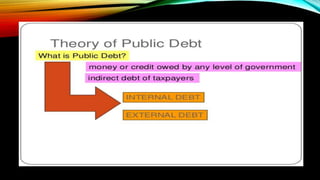
Internal and External Debt:
Public loans floated within the country are called internal debt. Public
borrowings from other countries are referred as external debt.
External debt represents a claim of foreigners against the real income of the
country, when it borrows from other countries and has to repay at the time of
maturity.
External public debt permits import of real resources. It enables the country to
consume more than it produces.
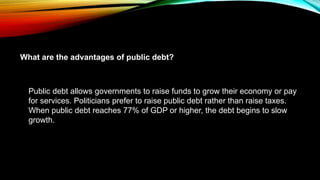
Public debt allows governments to raise funds to grow their economy or pay
for services. Politicians prefer to raise public debt rather than raise taxes.
When public debt reaches 77% of GDP or higher, the debt begins to slow
growth.
What are the advantages of public debt?
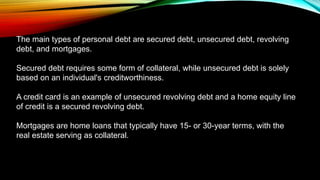
The main types of personal debt are secured debt, unsecured debt, revolving
debt, and mortgages.
Secured debt requires some form of collateral, while unsecured debt is solely
based on an individual's creditworthiness.
A credit card is an example of unsecured revolving debt and a home equity line
of credit is a secured revolving debt.
Mortgages are home loans that typically have 15- or 30-year terms, with the
real estate serving as collateral.
https://www.economicsdiscussion.net/public-finance/public-borrowing-effects-and-
justification/17470#:~:text=Public%20borrowing%20involves%20transfer%20of,has%20the%20'expenditur
e%20effect'.
References
https://www.focus-economics.com/economic-indicator/public-debt
https://www.investopedia.com/ask/answers/110614/what-are-main-categories-debt.asp

PUBLIC BORROWING AND PUBLIC DEBTS

  • 1.
    PUBLIC BORROWING ANDPUBLIC DEBT/THEORIES OF PUBLIC BORROWING PA10 – PUBLIC FISCAL ADMINSTRATION 3RD YEAR- BPA A31 TAGUIG CITY UNIVERSITY LEADER: RICARDO PERRAS ROMEILYN APLACADOR REX RAMOS RENESSA CASCANO HAROLD DHAN MIRABALLES
  • 2.
    What is publicborrowing? Public borrowing involves transfer of purchasing power from individual to government and a subsequent retransfer of the same to the individuals from the government. Thus, public debt, in one sense, has the 'revenue effect', and, in another sense, has the 'expenditure effect'.
  • 3.
    How does governmentborrow money from public? Government borrows through issue of government securities called G-secs and Treasury Bills. ... It is essentially the total amount of money that the central government borrows to fund its spending on public services and benefits
  • 5.
    Internal and ExternalDebt: Public loans floated within the country are called internal debt. Public borrowings from other countries are referred as external debt. External debt represents a claim of foreigners against the real income of the country, when it borrows from other countries and has to repay at the time of maturity. External public debt permits import of real resources. It enables the country to consume more than it produces.
  • 8.
    Public debt allowsgovernments to raise funds to grow their economy or pay for services. Politicians prefer to raise public debt rather than raise taxes. When public debt reaches 77% of GDP or higher, the debt begins to slow growth. What are the advantages of public debt?
  • 9.
    The main typesof personal debt are secured debt, unsecured debt, revolving debt, and mortgages. Secured debt requires some form of collateral, while unsecured debt is solely based on an individual's creditworthiness. A credit card is an example of unsecured revolving debt and a home equity line of credit is a secured revolving debt. Mortgages are home loans that typically have 15- or 30-year terms, with the real estate serving as collateral.
  • 10.