A Secure Model of IoT Using
Blockchain
Prof. Ahmed Banafa
College of Engineering
San Jose State University
San Jose, CA USA
• The Internet of Things (IoT) as a concept is
fascinating and exciting, but one of the major
challenging aspects of IoT is having a secure
ecosystem encompassing all building blocks of
IoT-architecture.
• Understanding the different building blocks of
IoT, identifying the areas of vulnerability in
each block and exploring technologies needed
to counter each of the weaknesses are
essential in dealing with the security issue of
IoT.
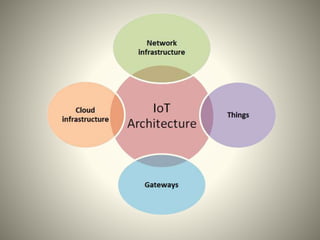
IoT architecture can be represented
by four building blocks:
• Things: These are defined as uniquely
identifiable nodes, primarily sensors that
communicate without human interaction
using different connectivity methods.
• Gateways: These act as intermediaries
between things and the cloud to provide the
needed connectivity, security, and
manageability.
• Network infrastructure: This is comprised of
routers, aggregators, gateways, repeaters and
other devices that control and secure data
flow.
• Cloud infrastructure: Cloud infrastructure
contains large pools of virtualized servers and
storage that are networked together with
computing and analytical capabilities
Challenges to secure IoT deployments
• Existing security technologies will play a role
in mitigating IoT risks but they are not
enough. The goal is to get data securely to the
right place, at the right time, in the right
format. It's easier said than done for many
reasons, and here is a list of some of the
challenges:
• Many IoT Systems are poorly designed and
implemented, using diverse protocols and
technologies that create complex and
sometimes conflicting configurations.
• Limited guidance for life cycle maintenance
and management of IoT devices
• IoT privacy concerns are complex and not
always readily evident.
• There is a lack of standards for authentication
and authorization of IoT edge devices.
• Security standards, for platform configurations,
involving virtualized IoT platforms supporting
multi-tenancy is immature.
• The uses for Internet of Things technology are
expanding and changing—often in uncharted
waters.
• In addition to the above list, new security
technologies will be required to protect IoT
devices and platforms from both information
attacks and physical tampering, to encrypt
their communications, and to address new
challenges such as impersonating "things" or
denial-of-sleep attacks that drain batteries, to
denial-of-service attacks (DoS).
• But IoT security will be complicated by the fact
that many "things" use simple processors and
operating systems that may not support
sophisticated security approaches.
• A prime example of the urgent need for such new
security technologies is the recent massive
distributed denial of service attack (DDoS) that
crippled the servers of popular services like
Twitter, Netflix, NYTimes, and PayPal across the
U.S. on October 21st, 2016. It was the result of an
immense assault that involved millions of
internet addresses and malicious software.
• One source of the traffic for the attacks was
devices infected by the Mirai malware.
• The attack comes amid heightened
cybersecurity fears and a rising number of
internet security breaches. All indications
suggest that countless IoT devices that power
everyday technology like closed-circuit
cameras and smart-home devices were
hijacked by the malware, and used against the
servers.
The problem with the current
centralized model
• Current IoT ecosystems rely on centralized,
brokered communication models, otherwise
known as the server/client paradigm.
• All devices are identified, authenticated and
connected through cloud servers that sport
huge processing and storage capacities.
Connections between devices have to
exclusively go through the internet, even if
they happen to be a few feet apart.
• While this model has connected generic
computing devices for decades and will
continue to support small-scale IoT networks
as we see them today, it will not be able to
respond to the growing needs of the huge IoT
ecosystems of tomorrow.
• Existing IoT solutions are expensive because of
the high infrastructure and maintenance cost
associated with centralized clouds, large
server farms, and networking equipment.
• The sheer amount of communications that will
have to be handled when there are tens of
billions of IoT devices will increase those costs
substantially.
• Even if the unprecedented economic and
engineering challenges are overcome, cloud
servers will remain a bottleneck and point of
failure that can disrupt the entire network.
Decentralizing IoT networks
• A decentralized approach to IoT networking
would solve many of the issues above.
• Adopting a standardized peer-to-peer
communication model to process the
hundreds of billions of transactions between
devices will significantly reduce the costs
associated with installing and maintaining
large centralized data centers and will
distribute computation and storage needs
across the billions of devices that form IoT
networks.
• This will prevent failure in any single node in a
network from bringing the entire network to a
halting collapse.
• However, establishing peer-to-peer
communications will present its own set of
challenges, chief among them the issue of
security. And as we all know, IoT security is much
more than just about protecting sensitive data.
• The proposed solution will have to maintain
privacy and security in huge IoT networks and
offer some form of validation and consensus for
transactions to prevent spoofing and theft.
To perform the functions of traditional IoT
solutions without a centralized control, any
decentralized approach must support three
foundational functions:
• Peer-to-peer messaging;
• Distributed file sharing;
• Autonomous device coordination.
The Blockchain Approach
• Blockchain, the "distributed ledger"
technology, has emerged as an object of
intense interest in the tech industry and
beyond. Blockchain technology offers a way of
recording transactions or any digital
interaction in a way that is designed to be
secure, transparent, highly resistant to
outages, auditable, and efficient; as such, it
carries the possibility of disrupting industries
and enabling new business models.
• The technology is young and changing very
rapidly; widespread commercialization is still a
few years off. Nonetheless, to avoid disruptive
surprises or missed opportunities, strategists,
planners, and decision makers across
industries and business functions should pay
heed now and begin to investigate
applications of the technology.
What is Blockchain?
• Blockchain is a database that maintains a
continuously growing set of data records. It is
distributed in nature, meaning that there is no
master computer holding the entire chain.
Rather, the participating nodes have a copy of
the chain. It’s also ever-growing — data
records are only added to the chain.
A blockchain consists of two types of elements:
• Transactions are the actions created by the
participants in the system.
• Blocks record these transactions and make
sure they are in the correct sequence and
have not been tampered with.
What are some advantages of
blockchain?
• The big advantage of blockchain is that it's
public. Everyone participating can see the
blocks and the transactions stored in them.
This doesn't mean everyone can see the
actual content of your transaction, however;
that's protected by your private key.
• A blockchain is decentralized, so there is no
single authority that can approve the
transactions or set specific rules to have
transactions accepted.
• That means there's a huge amount of trust
involved since all the participants in the
network have to reach a consensus to accept
transactions.
• Most importantly, it's secure. The database
can only be extended and previous records
cannot be changed (at least, there's a very
high cost if someone wants to alter previous
records).
How does it work?
• When someone wants to add a transaction to
the chain, all the participants in the network
will validate it. They do this by applying an
algorithm to the transaction to verify its
validity.
• What exactly is understood by "valid" is
defined by the blockchain system and can
differ between systems. Then it is up to a
majority of the participants to agree that the
transaction is valid.
• A set of approved transactions is then bundled
in a block, which gets sent to all the nodes in
the network. They, in turn, validate the new
block. Each successive block contains a hash,
which is a unique fingerprint, of the previous
block.
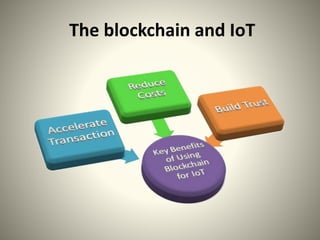
The blockchain and IoT
• Blockchain technology is the missing link to
settle privacy and reliability concerns in the
Internet of Things. Blockchain technology
could perhaps be the silver bullet needed by
the IoT industry.
• It can be used in tracking billions of connected
devices, enabling the processing of
transactions and coordination between
devices; this allows for significant savings for
IoT industry manufacturers.
• This decentralized approach would eliminate
single points of failure, creating a more
resilient ecosystem for devices to run on. The
cryptographic algorithms used by blockchains
would make consumer data more private.
• The ledger is tamper-proof and cannot be
manipulated by malicious actors because it
doesn't exist in any single location, and man-
in-the-middle attacks cannot be staged
because there is no single thread of
communication that can be intercepted.
• Blockchain makes trustless, peer-to-peer
messaging possible and has already proven its
worth in the world of financial services
through cryptocurrencies such as bitcoin,
providing guaranteed peer-to-peer payment
services without the need for third-party
brokers.
• The decentralized, autonomous, and trustless
capabilities of the blockchain make it an ideal
component to become a foundational
element of IoT solutions.
• It is no surprise that enterprise IoT
technologies have quickly become one of the
early adopters of blockchain technology.
• In an IoT network, the blockchain can keep an
immutable record of the history of smart
devices. This feature enables the autonomous
functioning of smart devices without the need
for centralized authority.
• As a result, the blockchain opens the door to a
series of IoT scenarios that were remarkably
difficult, or even impossible to implement
without it.
• For example, by leveraging the blockchain, IoT
solutions can enable secure, trustless
messaging between devices in an IoT network.
• In this model, the blockchain will treat
message exchanges between devices similar
to financial transactions in a bitcoin network.
To enable message exchanges, devices will
leverage smart contracts which then model
the agreement between the two parties
• One of the most exciting capabilities of the
blockchain is the ability to maintain a duly
decentralized, trusted ledger of all
transactions occurring in a network.
• This capability is essential to enable the many
compliances and regulatory requirements of
industrial IoT (IIoT) applications without the
need to rely on a centralized model.
What are the challenges?
In spite of all its benefits, the blockchain model
is not without its flaws and shortcomings:
• Scalability issues pertaining to the
blockchain that might lead to centralization,
which is casting a shadow over the future of
the cryptocurrency.
• Processing power and time required to
perform encryption for all the objects involved
in a blockchain-based ecosystem. IoT
ecosystems are very diverse. In contrast to
generic computing networks, IoT networks are
comprised of devices that have very different
computing capabilities, and not all of them
will be capable of running the same
encryption algorithms at the desired speed.
• Storage too will be a hurdle. Blockchain
eliminates the need for a central server to
store transactions and device IDs, but the
ledger has to be stored on the nodes
themselves. And the ledger will increase in
size as time passes. That is beyond the
capabilities of a wide range of smart devices
such as sensors, which have very low storage
capacity.
• Lack of skills: few people understand how
blockchain technology really works and when
you add IoT to the mix that number will shrink
drastically.
• Legal and compliance issues: It's a new
territory in all aspects without any legal or
compliance code to follow, which is a serious
problem for manufacturers and service
providers. This challenge alone will scare off
many businesses from using blockchain
technology.
Hyperledger
• Hyperledger is an new approach to solve
many of the issues related to Blockchain, it's
an Open Source project
• Hyperledger is a protocol for business to
business and business to customer
transactions.
• Hyperledger takes a novel approach to the
traditional blockchain model, in part by managing
the admission of participants at its core. In other
words, Hyperledger is a permissioned, shared
ledger.
• Hyperledger saves computation cycles, scales
well, and responds to the multitude of industrial
use case requirements by providing a secure,
robust model for identity, auditability and privacy.
The Optimum Platform
Developing solutions for the Internet of Things
requires unprecedented collaboration,
coordination, and connectivity for each piece in
the ecosystem, and throughout the ecosystem
as a whole.
All devices must work together and be
integrated with all other devices, and all devices
must communicate and interact seamlessly with
connected systems and infrastructures. It's
possible, but it can be expensive, time-
consuming, and difficult.
The optimum platform for IoT can:
• Acquire and manage data to create a
standards-based, scalable, and secure
platform.
• Integrate and secure data to reduce cost and
complexity while protecting your investment.
• Analyze data and act by extracting business
value from data, and then acting on it.
• Security needs to be built in as a foundation of
IoT systems, with rigorous validity checks,
authentication, data verification, and all the
data needs to be encrypted.
• At the application level, software
development organizations need to be better
at writing code that is stable, resilient and
trustworthy, with better code development
standards, training, threat analysis and testing
• As systems interact with each other, it's
essential to have an agreed interoperability
standard, which is safe and valid. Without a
solid bottom-top structure we will create
more threats with every device added to the
IoT. What we need is a secure and safe IoT
with privacy protected.
• That's a tough trade off but not impossible
and blockchain technology is an attractive
option if we can overcome its drawbacks.
Any questions?
Thank you!
@BanafaAhmed
https://www.linkedin.com/in/ahmedbanafa
ahmed.banafa@sjsu.edu

A Secure Model of IoT Using Blockchain

  • 2.
    A Secure Modelof IoT Using Blockchain Prof. Ahmed Banafa College of Engineering San Jose State University San Jose, CA USA
  • 3.
    • The Internetof Things (IoT) as a concept is fascinating and exciting, but one of the major challenging aspects of IoT is having a secure ecosystem encompassing all building blocks of IoT-architecture.
  • 4.
    • Understanding thedifferent building blocks of IoT, identifying the areas of vulnerability in each block and exploring technologies needed to counter each of the weaknesses are essential in dealing with the security issue of IoT.
  • 6.
    IoT architecture canbe represented by four building blocks: • Things: These are defined as uniquely identifiable nodes, primarily sensors that communicate without human interaction using different connectivity methods.
  • 7.
    • Gateways: Theseact as intermediaries between things and the cloud to provide the needed connectivity, security, and manageability.
  • 8.
    • Network infrastructure:This is comprised of routers, aggregators, gateways, repeaters and other devices that control and secure data flow.
  • 9.
    • Cloud infrastructure:Cloud infrastructure contains large pools of virtualized servers and storage that are networked together with computing and analytical capabilities
  • 10.
    Challenges to secureIoT deployments • Existing security technologies will play a role in mitigating IoT risks but they are not enough. The goal is to get data securely to the right place, at the right time, in the right format. It's easier said than done for many reasons, and here is a list of some of the challenges:
  • 11.
    • Many IoTSystems are poorly designed and implemented, using diverse protocols and technologies that create complex and sometimes conflicting configurations. • Limited guidance for life cycle maintenance and management of IoT devices • IoT privacy concerns are complex and not always readily evident.
  • 12.
    • There isa lack of standards for authentication and authorization of IoT edge devices. • Security standards, for platform configurations, involving virtualized IoT platforms supporting multi-tenancy is immature. • The uses for Internet of Things technology are expanding and changing—often in uncharted waters.
  • 13.
    • In additionto the above list, new security technologies will be required to protect IoT devices and platforms from both information attacks and physical tampering, to encrypt their communications, and to address new challenges such as impersonating "things" or denial-of-sleep attacks that drain batteries, to denial-of-service attacks (DoS).
  • 14.
    • But IoTsecurity will be complicated by the fact that many "things" use simple processors and operating systems that may not support sophisticated security approaches.
  • 15.
    • A primeexample of the urgent need for such new security technologies is the recent massive distributed denial of service attack (DDoS) that crippled the servers of popular services like Twitter, Netflix, NYTimes, and PayPal across the U.S. on October 21st, 2016. It was the result of an immense assault that involved millions of internet addresses and malicious software. • One source of the traffic for the attacks was devices infected by the Mirai malware.
  • 16.
    • The attackcomes amid heightened cybersecurity fears and a rising number of internet security breaches. All indications suggest that countless IoT devices that power everyday technology like closed-circuit cameras and smart-home devices were hijacked by the malware, and used against the servers.
  • 17.
    The problem withthe current centralized model • Current IoT ecosystems rely on centralized, brokered communication models, otherwise known as the server/client paradigm.
  • 18.
    • All devicesare identified, authenticated and connected through cloud servers that sport huge processing and storage capacities. Connections between devices have to exclusively go through the internet, even if they happen to be a few feet apart.
  • 19.
    • While thismodel has connected generic computing devices for decades and will continue to support small-scale IoT networks as we see them today, it will not be able to respond to the growing needs of the huge IoT ecosystems of tomorrow.
  • 20.
    • Existing IoTsolutions are expensive because of the high infrastructure and maintenance cost associated with centralized clouds, large server farms, and networking equipment. • The sheer amount of communications that will have to be handled when there are tens of billions of IoT devices will increase those costs substantially.
  • 21.
    • Even ifthe unprecedented economic and engineering challenges are overcome, cloud servers will remain a bottleneck and point of failure that can disrupt the entire network.
  • 22.
    Decentralizing IoT networks •A decentralized approach to IoT networking would solve many of the issues above.
  • 23.
    • Adopting astandardized peer-to-peer communication model to process the hundreds of billions of transactions between devices will significantly reduce the costs associated with installing and maintaining large centralized data centers and will distribute computation and storage needs across the billions of devices that form IoT networks.
  • 24.
    • This willprevent failure in any single node in a network from bringing the entire network to a halting collapse.
  • 25.
    • However, establishingpeer-to-peer communications will present its own set of challenges, chief among them the issue of security. And as we all know, IoT security is much more than just about protecting sensitive data. • The proposed solution will have to maintain privacy and security in huge IoT networks and offer some form of validation and consensus for transactions to prevent spoofing and theft.
  • 26.
    To perform thefunctions of traditional IoT solutions without a centralized control, any decentralized approach must support three foundational functions: • Peer-to-peer messaging; • Distributed file sharing; • Autonomous device coordination.
  • 27.
    The Blockchain Approach •Blockchain, the "distributed ledger" technology, has emerged as an object of intense interest in the tech industry and beyond. Blockchain technology offers a way of recording transactions or any digital interaction in a way that is designed to be secure, transparent, highly resistant to outages, auditable, and efficient; as such, it carries the possibility of disrupting industries and enabling new business models.
  • 28.
    • The technologyis young and changing very rapidly; widespread commercialization is still a few years off. Nonetheless, to avoid disruptive surprises or missed opportunities, strategists, planners, and decision makers across industries and business functions should pay heed now and begin to investigate applications of the technology.
  • 29.
    What is Blockchain? •Blockchain is a database that maintains a continuously growing set of data records. It is distributed in nature, meaning that there is no master computer holding the entire chain. Rather, the participating nodes have a copy of the chain. It’s also ever-growing — data records are only added to the chain.
  • 30.
    A blockchain consistsof two types of elements: • Transactions are the actions created by the participants in the system. • Blocks record these transactions and make sure they are in the correct sequence and have not been tampered with.
  • 31.
    What are someadvantages of blockchain? • The big advantage of blockchain is that it's public. Everyone participating can see the blocks and the transactions stored in them. This doesn't mean everyone can see the actual content of your transaction, however; that's protected by your private key.
  • 32.
    • A blockchainis decentralized, so there is no single authority that can approve the transactions or set specific rules to have transactions accepted. • That means there's a huge amount of trust involved since all the participants in the network have to reach a consensus to accept transactions.
  • 33.
    • Most importantly,it's secure. The database can only be extended and previous records cannot be changed (at least, there's a very high cost if someone wants to alter previous records).
  • 34.
    How does itwork? • When someone wants to add a transaction to the chain, all the participants in the network will validate it. They do this by applying an algorithm to the transaction to verify its validity.
  • 35.
    • What exactlyis understood by "valid" is defined by the blockchain system and can differ between systems. Then it is up to a majority of the participants to agree that the transaction is valid.
  • 36.
    • A setof approved transactions is then bundled in a block, which gets sent to all the nodes in the network. They, in turn, validate the new block. Each successive block contains a hash, which is a unique fingerprint, of the previous block.
  • 37.
  • 38.
    • Blockchain technologyis the missing link to settle privacy and reliability concerns in the Internet of Things. Blockchain technology could perhaps be the silver bullet needed by the IoT industry.
  • 39.
    • It canbe used in tracking billions of connected devices, enabling the processing of transactions and coordination between devices; this allows for significant savings for IoT industry manufacturers.
  • 40.
    • This decentralizedapproach would eliminate single points of failure, creating a more resilient ecosystem for devices to run on. The cryptographic algorithms used by blockchains would make consumer data more private.
  • 41.
    • The ledgeris tamper-proof and cannot be manipulated by malicious actors because it doesn't exist in any single location, and man- in-the-middle attacks cannot be staged because there is no single thread of communication that can be intercepted.
  • 42.
    • Blockchain makestrustless, peer-to-peer messaging possible and has already proven its worth in the world of financial services through cryptocurrencies such as bitcoin, providing guaranteed peer-to-peer payment services without the need for third-party brokers.
  • 43.
    • The decentralized,autonomous, and trustless capabilities of the blockchain make it an ideal component to become a foundational element of IoT solutions. • It is no surprise that enterprise IoT technologies have quickly become one of the early adopters of blockchain technology.
  • 44.
    • In anIoT network, the blockchain can keep an immutable record of the history of smart devices. This feature enables the autonomous functioning of smart devices without the need for centralized authority. • As a result, the blockchain opens the door to a series of IoT scenarios that were remarkably difficult, or even impossible to implement without it.
  • 45.
    • For example,by leveraging the blockchain, IoT solutions can enable secure, trustless messaging between devices in an IoT network.
  • 46.
    • In thismodel, the blockchain will treat message exchanges between devices similar to financial transactions in a bitcoin network. To enable message exchanges, devices will leverage smart contracts which then model the agreement between the two parties
  • 47.
    • One ofthe most exciting capabilities of the blockchain is the ability to maintain a duly decentralized, trusted ledger of all transactions occurring in a network.
  • 48.
    • This capabilityis essential to enable the many compliances and regulatory requirements of industrial IoT (IIoT) applications without the need to rely on a centralized model.
  • 49.
    What are thechallenges?
  • 50.
    In spite ofall its benefits, the blockchain model is not without its flaws and shortcomings: • Scalability issues pertaining to the blockchain that might lead to centralization, which is casting a shadow over the future of the cryptocurrency.
  • 51.
    • Processing powerand time required to perform encryption for all the objects involved in a blockchain-based ecosystem. IoT ecosystems are very diverse. In contrast to generic computing networks, IoT networks are comprised of devices that have very different computing capabilities, and not all of them will be capable of running the same encryption algorithms at the desired speed.
  • 52.
    • Storage toowill be a hurdle. Blockchain eliminates the need for a central server to store transactions and device IDs, but the ledger has to be stored on the nodes themselves. And the ledger will increase in size as time passes. That is beyond the capabilities of a wide range of smart devices such as sensors, which have very low storage capacity.
  • 53.
    • Lack ofskills: few people understand how blockchain technology really works and when you add IoT to the mix that number will shrink drastically.
  • 54.
    • Legal andcompliance issues: It's a new territory in all aspects without any legal or compliance code to follow, which is a serious problem for manufacturers and service providers. This challenge alone will scare off many businesses from using blockchain technology.
  • 55.
    Hyperledger • Hyperledger isan new approach to solve many of the issues related to Blockchain, it's an Open Source project • Hyperledger is a protocol for business to business and business to customer transactions.
  • 56.
    • Hyperledger takesa novel approach to the traditional blockchain model, in part by managing the admission of participants at its core. In other words, Hyperledger is a permissioned, shared ledger. • Hyperledger saves computation cycles, scales well, and responds to the multitude of industrial use case requirements by providing a secure, robust model for identity, auditability and privacy.
  • 57.
    The Optimum Platform Developingsolutions for the Internet of Things requires unprecedented collaboration, coordination, and connectivity for each piece in the ecosystem, and throughout the ecosystem as a whole.
  • 58.
    All devices mustwork together and be integrated with all other devices, and all devices must communicate and interact seamlessly with connected systems and infrastructures. It's possible, but it can be expensive, time- consuming, and difficult.
  • 59.
    The optimum platformfor IoT can: • Acquire and manage data to create a standards-based, scalable, and secure platform. • Integrate and secure data to reduce cost and complexity while protecting your investment. • Analyze data and act by extracting business value from data, and then acting on it.
  • 60.
    • Security needsto be built in as a foundation of IoT systems, with rigorous validity checks, authentication, data verification, and all the data needs to be encrypted.
  • 61.
    • At theapplication level, software development organizations need to be better at writing code that is stable, resilient and trustworthy, with better code development standards, training, threat analysis and testing
  • 62.
    • As systemsinteract with each other, it's essential to have an agreed interoperability standard, which is safe and valid. Without a solid bottom-top structure we will create more threats with every device added to the IoT. What we need is a secure and safe IoT with privacy protected.
  • 63.
    • That's atough trade off but not impossible and blockchain technology is an attractive option if we can overcome its drawbacks.
  • 64.
  • 65.