
FIRST LANGUAGE
ACQUISITION
Erika Barragán
Alejandra López
BEHAVIOURISM
Burrhus Frederic "B. F." Skinner
(March 20, 1904 – August 18, 1990)
Book:Verbal Behavior (1957)
“Language is not a mental
phenomenon: it is behavior”
Stages:
1. Imitation
2. Reinforcement
3. Repetition
4. Conditioned
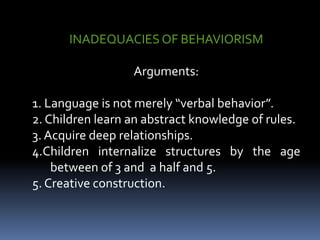
INADEQUACIES OF BEHAVIORISM
Arguments:
1. Language is not merely “verbal behavior”.
2. Children learn an abstract knowledge of rules.
3. Acquire deep relationships.
4.Children internalize structures by the age
between of 3 and a half and 5.
5. Creative construction.
LANGUAGEACQUISITION DEVICE (LAD)
1. It is specific to the human species.
2. It is a means of processing.
3. It can contain some of the “universal”
features.
“First language learning : General cognitive
capacities and Specific language-processing
mechanisms”
THE GRAMMATICAL DEVELOPMENTOF
CHILDREN
TELEGRAPHIC SPEECH
• Lack of inflections and many of the small
“function words”.
Eg.Allgone outside (after closing the door)
•The situation plays an important role.
Eg. Mommy sock (possession/ agent- object)
• Lois Bloom (1970): five relationship
Eg: 1. Conjunction (cup and glass)
2. Description (a party hat)
3. Possession (daddy’s hat)
4. Location (sweater chair)
5. Agent-object (mom is reading a book)
THE DEVELOPMENTOF INFLECTIONS AND
FUNCTIONWORDS
Roger Brown (1973)
Acquisition of fourteen morphemes:
1. Present progressive –ing
2. Preposition -on
3. Preposition –in
4. Plural –s
5. Irregular past forms
6. Possessive ‘s
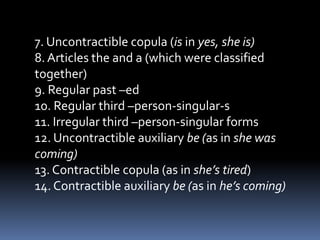
7. Uncontractible copula (is in yes, she is)
8. Articles the and a (which were classified
together)
9. Regular past –ed
10. Regular third –person-singular-s
11. Irregular third –person-singular forms
12. Uncontractible auxiliary be (as in she was
coming)
13. Contractible copula (as in she’s tired)
14. Contractible auxiliary be (as in he’s coming)
THE DEVELOPMENTOF “TRANSFORMATIONS”
•Children increase the ability to carry out
transformations on the basic sentences structures.
•Similar sequences on the development of
negative and interrogative structures.
NEGATIVES
1) No singing song.
No the sun shining.
2) I no want envelope.
He don’t want it.
3)You don’t want some supper.
Paul didn’t laugh.
INTERROGATIVES
• Yes/No questions: See hole?
You can’t fix it?
• Wh-interrogatives:Where daddy going?
Where my spoon goed?
• Ursula Bellugi-Klima (1968): She found that
there is a progression in the child’s ability to
carry out more than one transformation in a
single utterance.
LATER DEVELOPMENT
•Even before the age of ten the child has not
mastered some grammatical distinctions:
John asked Bill to come vs John promised Bill to
come.
•Second language learners acquire these
distinctions later too.
COGNITIVE FACTORS IN FIRST LANGUAGE
ADQUISITION
•How does language acquisition relate to
cognitive factors?
•Language and concepts:
Language development is related to the child’s
knowledge about the world.
Eg. Use of the English perfect tense: (he has
walked) before the age of four and a half.
•Language learning mechanisms:
How does the child make sense of the
linguistic system itself?
Operating principles:
- Avoid exceptions.
- Underlying meaning-relationships should
be marked clearly.
-The use of grammatical markers should
make semantic sense.
THE LANGUAGE ENVIRONMENT OFTHE
CHILD
•Behaviorist approach:The environment is the
major influence in the acquisition of the
language.
• Cognitive approach: Child’s internal
processes.
•Caretaker speech.

First language acquisition

  • 1.
  • 3.
    BEHAVIOURISM Burrhus Frederic "B.F." Skinner (March 20, 1904 – August 18, 1990) Book:Verbal Behavior (1957) “Language is not a mental phenomenon: it is behavior” Stages: 1. Imitation 2. Reinforcement 3. Repetition 4. Conditioned
  • 4.
    INADEQUACIES OF BEHAVIORISM Arguments: 1.Language is not merely “verbal behavior”. 2. Children learn an abstract knowledge of rules. 3. Acquire deep relationships. 4.Children internalize structures by the age between of 3 and a half and 5. 5. Creative construction.
  • 5.
    LANGUAGEACQUISITION DEVICE (LAD) 1.It is specific to the human species. 2. It is a means of processing. 3. It can contain some of the “universal” features. “First language learning : General cognitive capacities and Specific language-processing mechanisms”
  • 6.
  • 7.
    TELEGRAPHIC SPEECH • Lackof inflections and many of the small “function words”. Eg.Allgone outside (after closing the door) •The situation plays an important role. Eg. Mommy sock (possession/ agent- object) • Lois Bloom (1970): five relationship Eg: 1. Conjunction (cup and glass) 2. Description (a party hat) 3. Possession (daddy’s hat) 4. Location (sweater chair) 5. Agent-object (mom is reading a book)
  • 8.
    THE DEVELOPMENTOF INFLECTIONSAND FUNCTIONWORDS Roger Brown (1973) Acquisition of fourteen morphemes: 1. Present progressive –ing 2. Preposition -on 3. Preposition –in 4. Plural –s 5. Irregular past forms 6. Possessive ‘s
  • 9.
    7. Uncontractible copula(is in yes, she is) 8. Articles the and a (which were classified together) 9. Regular past –ed 10. Regular third –person-singular-s 11. Irregular third –person-singular forms 12. Uncontractible auxiliary be (as in she was coming) 13. Contractible copula (as in she’s tired) 14. Contractible auxiliary be (as in he’s coming)
  • 10.
    THE DEVELOPMENTOF “TRANSFORMATIONS” •Childrenincrease the ability to carry out transformations on the basic sentences structures. •Similar sequences on the development of negative and interrogative structures.
  • 11.
    NEGATIVES 1) No singingsong. No the sun shining. 2) I no want envelope. He don’t want it. 3)You don’t want some supper. Paul didn’t laugh.
  • 12.
    INTERROGATIVES • Yes/No questions:See hole? You can’t fix it? • Wh-interrogatives:Where daddy going? Where my spoon goed? • Ursula Bellugi-Klima (1968): She found that there is a progression in the child’s ability to carry out more than one transformation in a single utterance.
  • 13.
    LATER DEVELOPMENT •Even beforethe age of ten the child has not mastered some grammatical distinctions: John asked Bill to come vs John promised Bill to come. •Second language learners acquire these distinctions later too.
  • 14.
    COGNITIVE FACTORS INFIRST LANGUAGE ADQUISITION •How does language acquisition relate to cognitive factors? •Language and concepts: Language development is related to the child’s knowledge about the world. Eg. Use of the English perfect tense: (he has walked) before the age of four and a half.
  • 15.
    •Language learning mechanisms: Howdoes the child make sense of the linguistic system itself? Operating principles: - Avoid exceptions. - Underlying meaning-relationships should be marked clearly. -The use of grammatical markers should make semantic sense.
  • 16.
    THE LANGUAGE ENVIRONMENTOFTHE CHILD •Behaviorist approach:The environment is the major influence in the acquisition of the language. • Cognitive approach: Child’s internal processes. •Caretaker speech.