SHEILA MARIA G. MORADA, R.N.
Focal Person, Mental Health
DepEd Sorsogon
Dear Teachers,
Did you know?
noblest profession
selfless
silent frontliner
……and
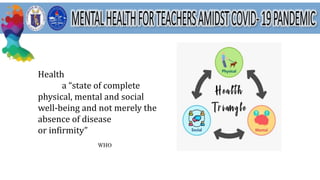
Health
a “state of complete
physical, mental and social
well-being and not merely the
absence of disease
or infirmity”
WHO
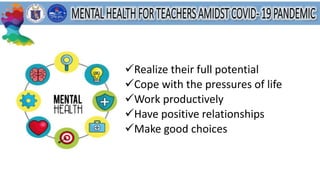
Realize their full potential
Cope with the pressures of life
Work productively
Have positive relationships
Make good choices
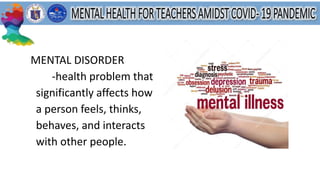
MENTAL DISORDER
-health problem that
significantly affects how
a person feels, thinks,
behaves, and interacts
with other people.
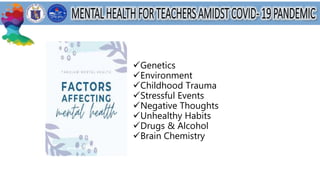
Genetics
Environment
Childhood Trauma
Stressful Events
Negative Thoughts
Unhealthy Habits
Drugs & Alcohol
Brain Chemistry
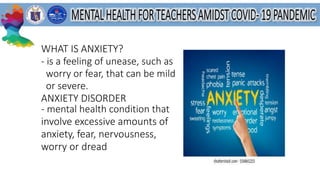
WHAT IS ANXIETY?
- is a feeling of unease, such as
worry or fear, that can be mild
or severe.
ANXIETY DISORDER
- mental health condition that
involve excessive amounts of
anxiety, fear, nervousness,
worry or dread
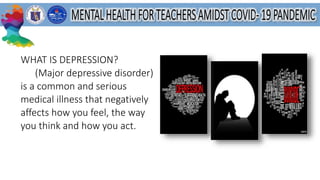
WHAT IS DEPRESSION?
(Major depressive disorder)
is a common and serious
medical illness that negatively
affects how you feel, the way
you think and how you act.
Depression
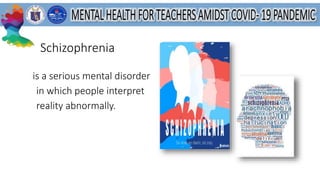
Schizophrenia
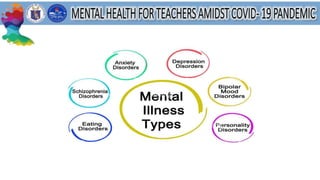
is a serious mental disorder
in which people interpret
reality abnormally.
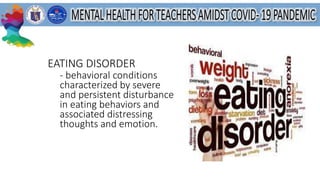
EATING DISORDER
- behavioral conditions
characterized by severe
and persistent disturbance
in eating behaviors and
associated distressing
thoughts and emotion.
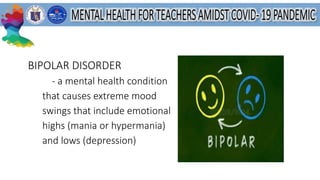
BIPOLAR DISORDER
- a mental health condition
that causes extreme mood
swings that include emotional
highs (mania or hypermania)
and lows (depression)
PERSONALITY DISORDERS
- are long-term patterns of
behavior and inner experiences
that differs significantly from
what is expected.
-A personality disorder is a type of mental disorder in which you have a
rigid and unhealthy pattern of thinking, functioning and behaving. A
person with a personality disorder has trouble perceiving and relating to
situations and people.
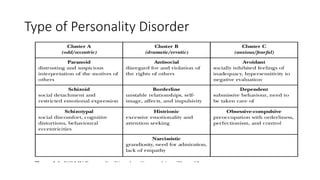
Type of Personality Disorder
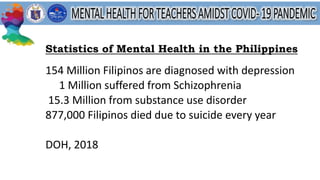
Statistics of Mental Health in the Philippines
154 Million Filipinos are diagnosed with depression
1 Million suffered from Schizophrenia
15.3 Million from substance use disorder
877,000 Filipinos died due to suicide every year
DOH, 2018
Uncle Toni chestnut knows ,
chestnut knows,
chestnut knows.
Uncle Toni chestnut knows I love you
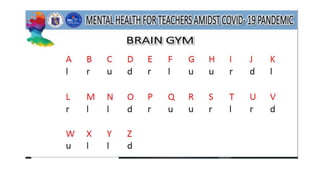
Brain Gym
Understanding
MHPSS
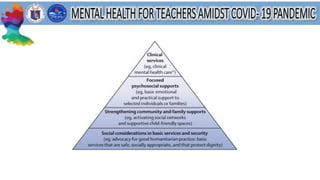
Mental Health and Psychosocial
Support (MHPSS) – includes any
support that people receive to
protect or promote their mental
health and psychosocial wellbeing
and or prevent/ treat mental
disorder.
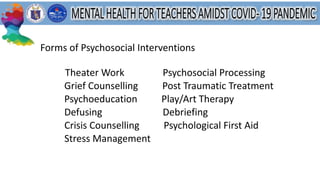
Forms of Psychosocial Interventions
Theater Work Psychosocial Processing
Grief Counselling Post Traumatic Treatment
Psychoeducation Play/Art Therapy
Defusing Debriefing
Crisis Counselling Psychological First Aid
Stress Management
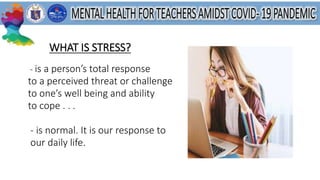
WHAT IS STRESS?
- is a person’s total response
to a perceived threat or challenge
to one’s well being and ability
to cope . . .
- is normal. It is our response to
our daily life.
COMMON SIGNS OF STRESS
Changes in mood Clammy or sweaty palms Decrease sex drive
Diarrhea Difficulty sleeping Digestive problems
Dizziness Feeling anxious Frequent sickness
Grinding teeth Headaches Low energy
Muscle tension Physical aches and pains Racing heartbeat
Trembling
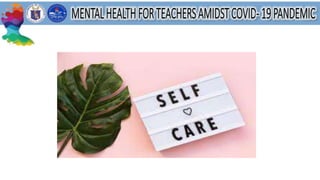
Managing Self-Care
DepEd Order No 14, s. 2020
GUIDELINES ON THE REQUIRED HEALTH
STANDARDS IN BASIC EDUCATION OFFICES &
SCHOOLS
SUPPORT PROTOCOLS
49. Learners, teachers & personnel who are confirmed to be
COVID-19 positive, under isolation/quarantine, or categorized as
suspect and probable cases shall be provided with Mental Health &
Psychosocial Support (MHPSS) facilitated by school’s guidance
office and/or personnel trained on MHPSS.
• Enclosure No. 2 to DepEd Order 014, s. 2020
III. Support Mechanisms
A. Physical & Mental Resilience
o Validating & Normalizing Feelings
o Calming Down & Controlling One’s Emotions
o Identifying & Addressing Needs
o Sources of Strength
• Validating & Normalizing Feelings
Recognizing someone’s feelings and acknowledging them as important by
listening and responding.
• Give verbal responses to show you are listening
• Use body language to show that you are listening.
• Stay present
• Ask clarifying questions
• Repeat their words back to them
• Strive to talk less and listen more
• Calming Down & Controlling One’s Emotions
Emotional regulation – ability to manage your emotions and
behavior in accordance with the demands of the situation.
Regulation skills
• Create a space
• Noticing what you feel
• Naming what you feel
• Accepting the emotion
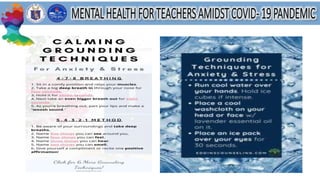
• Practicing mindfulness
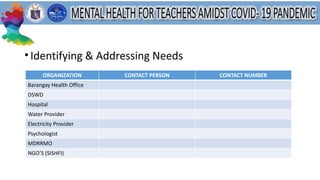
• Identifying & Addressing Needs
ORGANIZATION
• CONTACT PERSON
• CONTACT NUMBER
ORGANIZATION CONTACT PERSON CONTACT NUMBER
Barangay Health Office
DSWD
Hospital
Water Provider
Electricity Provider
Psychologist
MDRRMO
NGO’S (SISHFI)
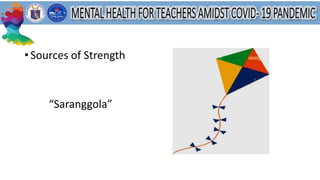
• Sources of Strength
“Saranggola”
LIFE MAY BE HARD
Don’t stop and scream at the pebble that made you fall
If you can’t get up, at least crawl.
You gotta move forward
And never be cornered
By the thoughts that created in invisible border.
Life is hard.
Life may leave some scars,
But never be afraid
Of what lies ahead
You can get through,
You just need some faith.
And the belief that everything works out for the best.
LIFE MAY BE HARD
When life gets you down, you gotta bounce back up.
No matter how hard, you have to get up.
Life maybe hard,
But it can also be fun.
Explore different paths
And hold up your flag.
The flag is the symbol that you’ve made it far.
EVERY DAY IS A BLESSING
FAMILYFRIENDPOEM.COM
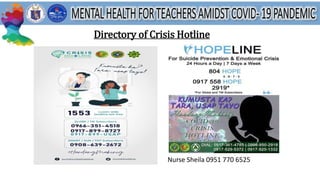
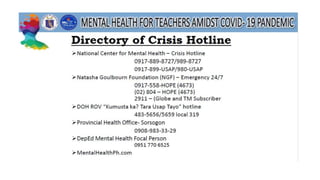
Directory of Crisis Hotline
Nurse Sheila 0951 770 6525
THERE IS NO HEALTH WITHOUT MENTAL HEALTH
Mental Health-TALK - Revised.pptx

Mental Health-TALK - Revised.pptx

  • 1.
    SHEILA MARIA G.MORADA, R.N. Focal Person, Mental Health DepEd Sorsogon
  • 8.
    Dear Teachers, Did youknow? noblest profession selfless silent frontliner ……and
  • 10.
    Health a “state ofcomplete physical, mental and social well-being and not merely the absence of disease or infirmity” WHO
  • 11.
    Realize their fullpotential Cope with the pressures of life Work productively Have positive relationships Make good choices
  • 12.
    MENTAL DISORDER -health problemthat significantly affects how a person feels, thinks, behaves, and interacts with other people.
  • 13.
    Genetics Environment Childhood Trauma Stressful Events NegativeThoughts Unhealthy Habits Drugs & Alcohol Brain Chemistry
  • 15.
    WHAT IS ANXIETY? -is a feeling of unease, such as worry or fear, that can be mild or severe. ANXIETY DISORDER - mental health condition that involve excessive amounts of anxiety, fear, nervousness, worry or dread
  • 16.
    WHAT IS DEPRESSION? (Majordepressive disorder) is a common and serious medical illness that negatively affects how you feel, the way you think and how you act.
  • 17.
  • 18.
    Schizophrenia is a seriousmental disorder in which people interpret reality abnormally.
  • 19.
    EATING DISORDER - behavioralconditions characterized by severe and persistent disturbance in eating behaviors and associated distressing thoughts and emotion.
  • 20.
    BIPOLAR DISORDER - amental health condition that causes extreme mood swings that include emotional highs (mania or hypermania) and lows (depression)
  • 21.
    PERSONALITY DISORDERS - arelong-term patterns of behavior and inner experiences that differs significantly from what is expected. -A personality disorder is a type of mental disorder in which you have a rigid and unhealthy pattern of thinking, functioning and behaving. A person with a personality disorder has trouble perceiving and relating to situations and people.
  • 22.
  • 23.
    Statistics of MentalHealth in the Philippines 154 Million Filipinos are diagnosed with depression 1 Million suffered from Schizophrenia 15.3 Million from substance use disorder 877,000 Filipinos died due to suicide every year DOH, 2018
  • 24.
    Uncle Toni chestnutknows , chestnut knows, chestnut knows. Uncle Toni chestnut knows I love you Brain Gym
  • 25.
  • 26.
    Mental Health andPsychosocial Support (MHPSS) – includes any support that people receive to protect or promote their mental health and psychosocial wellbeing and or prevent/ treat mental disorder.
  • 28.
    Forms of PsychosocialInterventions Theater Work Psychosocial Processing Grief Counselling Post Traumatic Treatment Psychoeducation Play/Art Therapy Defusing Debriefing Crisis Counselling Psychological First Aid Stress Management
  • 29.
    WHAT IS STRESS? -is a person’s total response to a perceived threat or challenge to one’s well being and ability to cope . . . - is normal. It is our response to our daily life.
  • 30.
    COMMON SIGNS OFSTRESS Changes in mood Clammy or sweaty palms Decrease sex drive Diarrhea Difficulty sleeping Digestive problems Dizziness Feeling anxious Frequent sickness Grinding teeth Headaches Low energy Muscle tension Physical aches and pains Racing heartbeat Trembling
  • 41.
  • 47.
    DepEd Order No14, s. 2020 GUIDELINES ON THE REQUIRED HEALTH STANDARDS IN BASIC EDUCATION OFFICES & SCHOOLS SUPPORT PROTOCOLS 49. Learners, teachers & personnel who are confirmed to be COVID-19 positive, under isolation/quarantine, or categorized as suspect and probable cases shall be provided with Mental Health & Psychosocial Support (MHPSS) facilitated by school’s guidance office and/or personnel trained on MHPSS.
  • 48.
    • Enclosure No.2 to DepEd Order 014, s. 2020 III. Support Mechanisms A. Physical & Mental Resilience o Validating & Normalizing Feelings o Calming Down & Controlling One’s Emotions o Identifying & Addressing Needs o Sources of Strength
  • 49.
    • Validating &Normalizing Feelings Recognizing someone’s feelings and acknowledging them as important by listening and responding. • Give verbal responses to show you are listening • Use body language to show that you are listening. • Stay present • Ask clarifying questions • Repeat their words back to them • Strive to talk less and listen more
  • 50.
    • Calming Down& Controlling One’s Emotions Emotional regulation – ability to manage your emotions and behavior in accordance with the demands of the situation.
  • 51.
    Regulation skills • Createa space • Noticing what you feel • Naming what you feel • Accepting the emotion • Practicing mindfulness
  • 52.
    • Identifying &Addressing Needs ORGANIZATION • CONTACT PERSON • CONTACT NUMBER ORGANIZATION CONTACT PERSON CONTACT NUMBER Barangay Health Office DSWD Hospital Water Provider Electricity Provider Psychologist MDRRMO NGO’S (SISHFI)
  • 53.
    • Sources ofStrength “Saranggola”
  • 56.
    LIFE MAY BEHARD Don’t stop and scream at the pebble that made you fall If you can’t get up, at least crawl. You gotta move forward And never be cornered By the thoughts that created in invisible border. Life is hard. Life may leave some scars, But never be afraid Of what lies ahead You can get through, You just need some faith. And the belief that everything works out for the best.
  • 57.
    LIFE MAY BEHARD When life gets you down, you gotta bounce back up. No matter how hard, you have to get up. Life maybe hard, But it can also be fun. Explore different paths And hold up your flag. The flag is the symbol that you’ve made it far. EVERY DAY IS A BLESSING FAMILYFRIENDPOEM.COM
  • 58.
    Directory of CrisisHotline Nurse Sheila 0951 770 6525
  • 61.
    THERE IS NOHEALTH WITHOUT MENTAL HEALTH

Editor's Notes

  • #7 Smiling: May Lower your blood pressure…
  • #9 Our teachers as All heroes have different circumstances but similar deeds.
  • #14 1. FAMILY CRISIS 2. HEALTH PROBLEMS 3. SUBSTANCE USE 4. SEXUAL ASSAULT AND VIOLENCE 5. ADJUSTING TO A NEW SITUATION
  • #15 Personality disorder 1. Borderline personality disorder, antisocial, histrionic, narcissistic, avoidant and obsessive compulsive personality disorder.
  • #16 6 MAJOR TYPES OF ANXIETY DISORDER Separation Anxiety Disorder (SAD) Specific Phobia- Social Anxiety Disorder Panic Disorder Agoraphobia General Anxiety Disorder (GAD)
  • #17 Symptoms: Feeling sad or having a depressed mood. Loss of interest or pleasure in activities once enjoyed Changes in appetite Trouble sleeping or sleeping too much Loss of energy or increased fatigue Feeling worthless or guilty Difficulty thinking, concentrating or making decisions Thoughts of death or suicide
  • #19 Symptoms include delusions, hallucinations, disorganized speech, troubled with thinking and lack of motivation.
  • #20 Types of eating dsorder; Anorexia Nervosa, Bulimia Nervosa, Binge Eating Disorder, Avoidant Restrictive Food Intake Disorder, other specified feeding and eating disorder, pica and rumination disorder
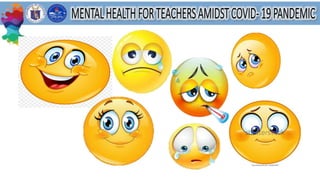
  • #24 Our smiles matter, and our kumusta ka? Is a magic word. It might help them if we emphathize them
  • #30 Our brains and bodies naturally react to stressful situation to tell us that something is not good, and we need to be alert. Our natural reactions to stress are necessary for us to understand that the situation is not normal
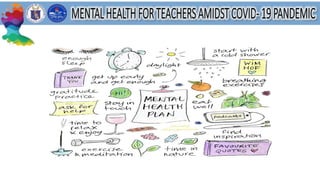
  • #32 An activity that we do in order to take care of ourselves – mentally, emotionally and physically. A simple concept in theory, but we very often overlook Good self-care is a key to improve mood and reduce anxiety and depression. Reducing stress and improving resilience, improving happiness, increasing energy, reducing burn out & A key to good relationship with oneself and others. According to the WHO, self care is important because it can help promote health, prevent diseases and help people better cope with illness.
  • #43 Be informed Have enough sleep Eat well Drink sensibly Do something that you are good at Physcal activities, exercise, yoga, meditation, Spend time in nature, breath some fresh air
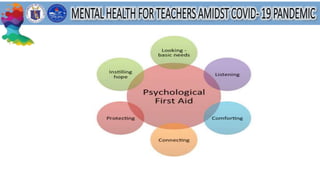
  • #46 Comforting someone who is in distress and helping them feel safe and calm. Protecting them from further harm, provide emotional support and immediate basic needs.