Promoting Resilience
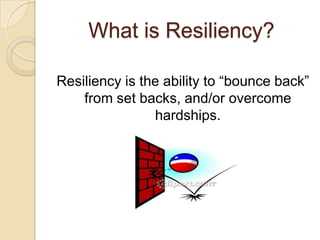
What is Resiliency?
Resiliency is the ability to “bounce back”
from set backs, and/or overcome
hardships.
Topics of Discussion
 Social Competence
 Social Development Model
 Risk Factors
 PROTECTIVE FACTORS
What is Social
Competence?
 Social Competence is the condition of
possessing the social, emotional, and
academic skills needed for successful
social adaptation.
Social Development Model
 The Social Development Model (SDM) is
a theory that attempts to explain why
both socially competent and antisocial
behaviors arise in youths. SDM
assumes that all behavior is learned
through bonding with major social
institutions (e.g. family, school, faith, and
gangs). Once a bond is established, a
child acts in ways that are consistent
with the group.
Risk Factors
 Peer Rejection
 Low Academic Achievement
 Family Discord
 Low Self-Esteem
 Poor Quality School
For Example…
 A child who can self regulate is more apt to
make friends and connect with others.
 A child who experiences academic success is
more likely to have higher self-esteem.
 Research shows that academic achievement
and school involvement reduce engagement in
risk-taking and antisocial behavior.
These CONNECTIONS are critical when developing
resiliency.
Protective Factors
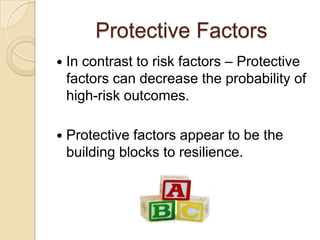
 In contrast to risk factors – Protective
factors can decrease the probability of
high-risk outcomes.
 Protective factors appear to be the
building blocks to resilience.
Protective Factors
 Proactive Orientation
 Self-Regulation
 Connections and Attachment
 School Achievement and Involvement
 Community
Proactive Orientation
 Resilient individuals have a realistic positive sense
of self-worth and self-efficacy (Second Step, Self-
Talk).
 Those who possess who a high degree of
“perceived self-efficacy” are more likely to interpret
successes as indication of their capabilities.
 Teaching children to help others is an effective way
to promote responsibility, empathy and self-
esteem.
Self-Regulation
 One of the most fundamental protective
factors is success in developing self-
regulation and self-control.
◦ Coping Skills
◦ Teaching Pro-Social Behaviors
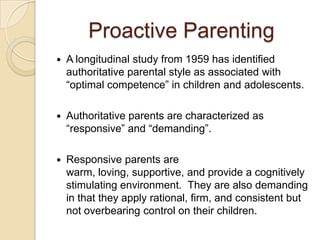
Proactive Parenting
 A longitudinal study from 1959 has identified
authoritative parental style as associated with
“optimal competence” in children and adolescents.
 Authoritative parents are characterized as
“responsive” and “demanding”.
 Responsive parents are
warm, loving, supportive, and provide a cognitively
stimulating environment. They are also demanding
in that they apply rational, firm, and consistent but
not overbearing control on their children.
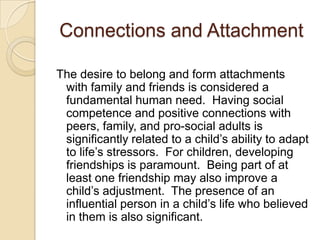
Connections and Attachment
The desire to belong and form attachments
with family and friends is considered a
fundamental human need. Having social
competence and positive connections with
peers, family, and pro-social adults is
significantly related to a child’s ability to adapt
to life’s stressors. For children, developing
friendships is paramount. Being part of at
least one friendship may also improve a
child’s adjustment. The presence of an
influential person in a child’s life who believed
in them is also significant.
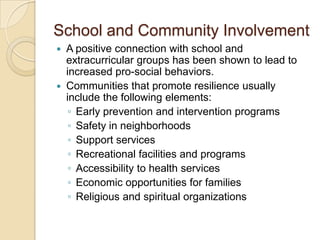
School and Community Involvement
 A positive connection with school and
extracurricular groups has been shown to lead to
increased pro-social behaviors.
 Communities that promote resilience usually
include the following elements:
◦ Early prevention and intervention programs
◦ Safety in neighborhoods
◦ Support services
◦ Recreational facilities and programs
◦ Accessibility to health services
◦ Economic opportunities for families
◦ Religious and spiritual organizations
Opportunities for Connection at
Westgate
 Team Tutoring
 Young Rembrandts
 Club K
 School Patrol
 Park District
 Boy Scouts and Brownies
 Faith-Based Organizations
 CAP
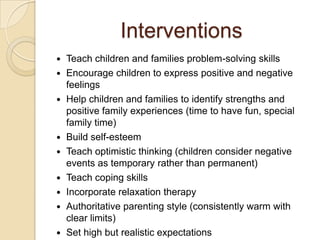
Interventions
 Teach children and families problem-solving skills
 Encourage children to express positive and negative
feelings
 Help children and families to identify strengths and
positive family experiences (time to have fun, special
family time)
 Build self-esteem
 Teach optimistic thinking (children consider negative
events as temporary rather than permanent)
 Teach coping skills
 Incorporate relaxation therapy
 Authoritative parenting style (consistently warm with
clear limits)
 Set high but realistic expectations

Resilience powerpoint

  • 1.
  • 2.
    What is Resiliency? Resiliencyis the ability to “bounce back” from set backs, and/or overcome hardships.
  • 3.
    Topics of Discussion Social Competence  Social Development Model  Risk Factors  PROTECTIVE FACTORS
  • 4.
    What is Social Competence? Social Competence is the condition of possessing the social, emotional, and academic skills needed for successful social adaptation.
  • 5.
    Social Development Model The Social Development Model (SDM) is a theory that attempts to explain why both socially competent and antisocial behaviors arise in youths. SDM assumes that all behavior is learned through bonding with major social institutions (e.g. family, school, faith, and gangs). Once a bond is established, a child acts in ways that are consistent with the group.
  • 6.
    Risk Factors  PeerRejection  Low Academic Achievement  Family Discord  Low Self-Esteem  Poor Quality School
  • 7.
    For Example…  Achild who can self regulate is more apt to make friends and connect with others.  A child who experiences academic success is more likely to have higher self-esteem.  Research shows that academic achievement and school involvement reduce engagement in risk-taking and antisocial behavior. These CONNECTIONS are critical when developing resiliency.
  • 8.
    Protective Factors  Incontrast to risk factors – Protective factors can decrease the probability of high-risk outcomes.  Protective factors appear to be the building blocks to resilience.
  • 9.
    Protective Factors  ProactiveOrientation  Self-Regulation  Connections and Attachment  School Achievement and Involvement  Community
  • 10.
    Proactive Orientation  Resilientindividuals have a realistic positive sense of self-worth and self-efficacy (Second Step, Self- Talk).  Those who possess who a high degree of “perceived self-efficacy” are more likely to interpret successes as indication of their capabilities.  Teaching children to help others is an effective way to promote responsibility, empathy and self- esteem.
  • 11.
    Self-Regulation  One ofthe most fundamental protective factors is success in developing self- regulation and self-control. ◦ Coping Skills ◦ Teaching Pro-Social Behaviors
  • 12.
    Proactive Parenting  Alongitudinal study from 1959 has identified authoritative parental style as associated with “optimal competence” in children and adolescents.  Authoritative parents are characterized as “responsive” and “demanding”.  Responsive parents are warm, loving, supportive, and provide a cognitively stimulating environment. They are also demanding in that they apply rational, firm, and consistent but not overbearing control on their children.
  • 13.
    Connections and Attachment Thedesire to belong and form attachments with family and friends is considered a fundamental human need. Having social competence and positive connections with peers, family, and pro-social adults is significantly related to a child’s ability to adapt to life’s stressors. For children, developing friendships is paramount. Being part of at least one friendship may also improve a child’s adjustment. The presence of an influential person in a child’s life who believed in them is also significant.
  • 14.
    School and CommunityInvolvement  A positive connection with school and extracurricular groups has been shown to lead to increased pro-social behaviors.  Communities that promote resilience usually include the following elements: ◦ Early prevention and intervention programs ◦ Safety in neighborhoods ◦ Support services ◦ Recreational facilities and programs ◦ Accessibility to health services ◦ Economic opportunities for families ◦ Religious and spiritual organizations
  • 15.
    Opportunities for Connectionat Westgate  Team Tutoring  Young Rembrandts  Club K  School Patrol  Park District  Boy Scouts and Brownies  Faith-Based Organizations  CAP
  • 16.
    Interventions  Teach childrenand families problem-solving skills  Encourage children to express positive and negative feelings  Help children and families to identify strengths and positive family experiences (time to have fun, special family time)  Build self-esteem  Teach optimistic thinking (children consider negative events as temporary rather than permanent)  Teach coping skills  Incorporate relaxation therapy  Authoritative parenting style (consistently warm with clear limits)  Set high but realistic expectations