Accelerated
Preceptorship:
Developing
Resilience
2
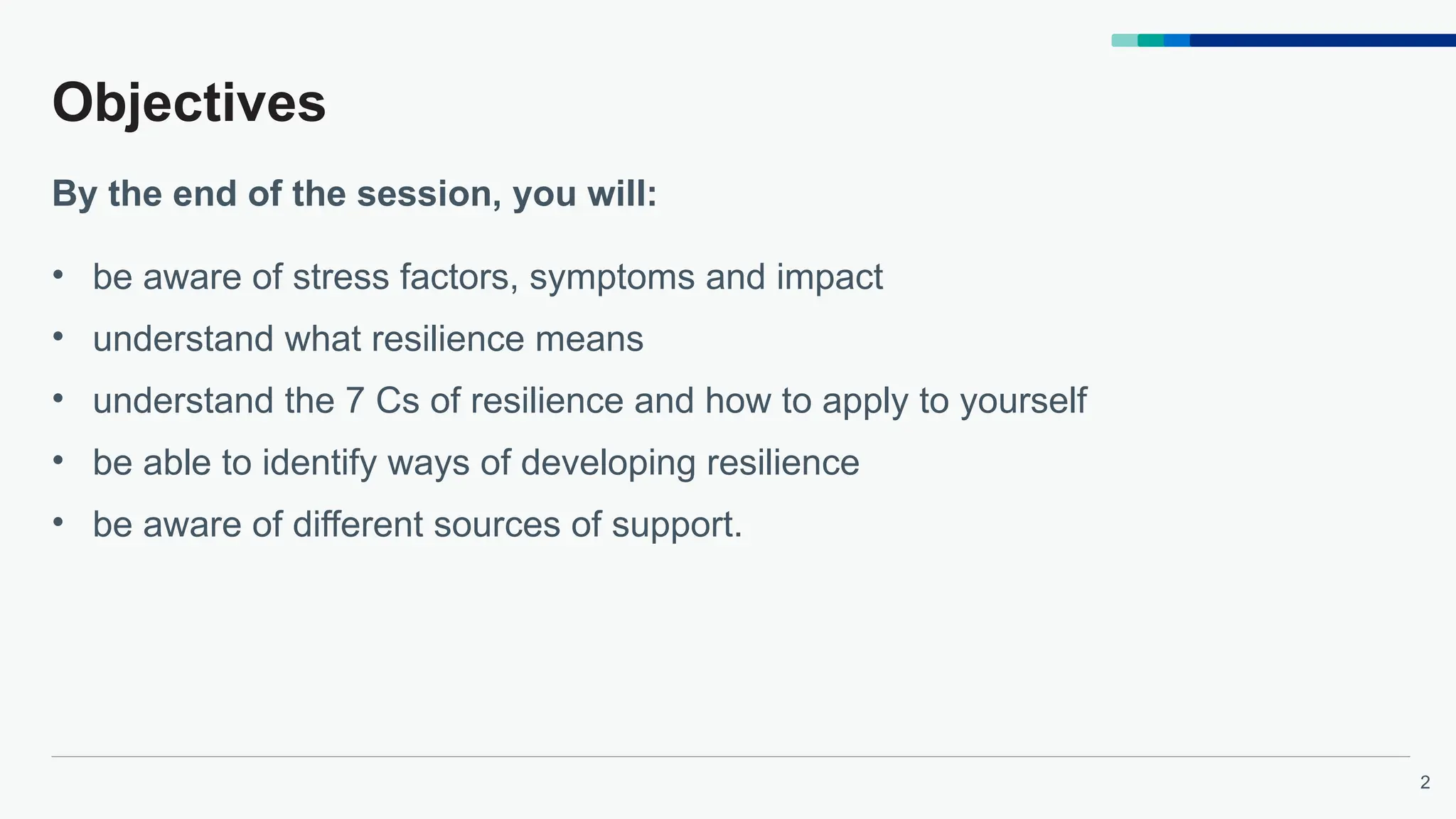
Objectives
• be aware of stress factors, symptoms and impact
• understand what resilience means
• understand the 7 Cs of resilience and how to apply to yourself
• be able to identify ways of developing resilience
• be aware of different sources of support.
By the end of the session, you will:
3
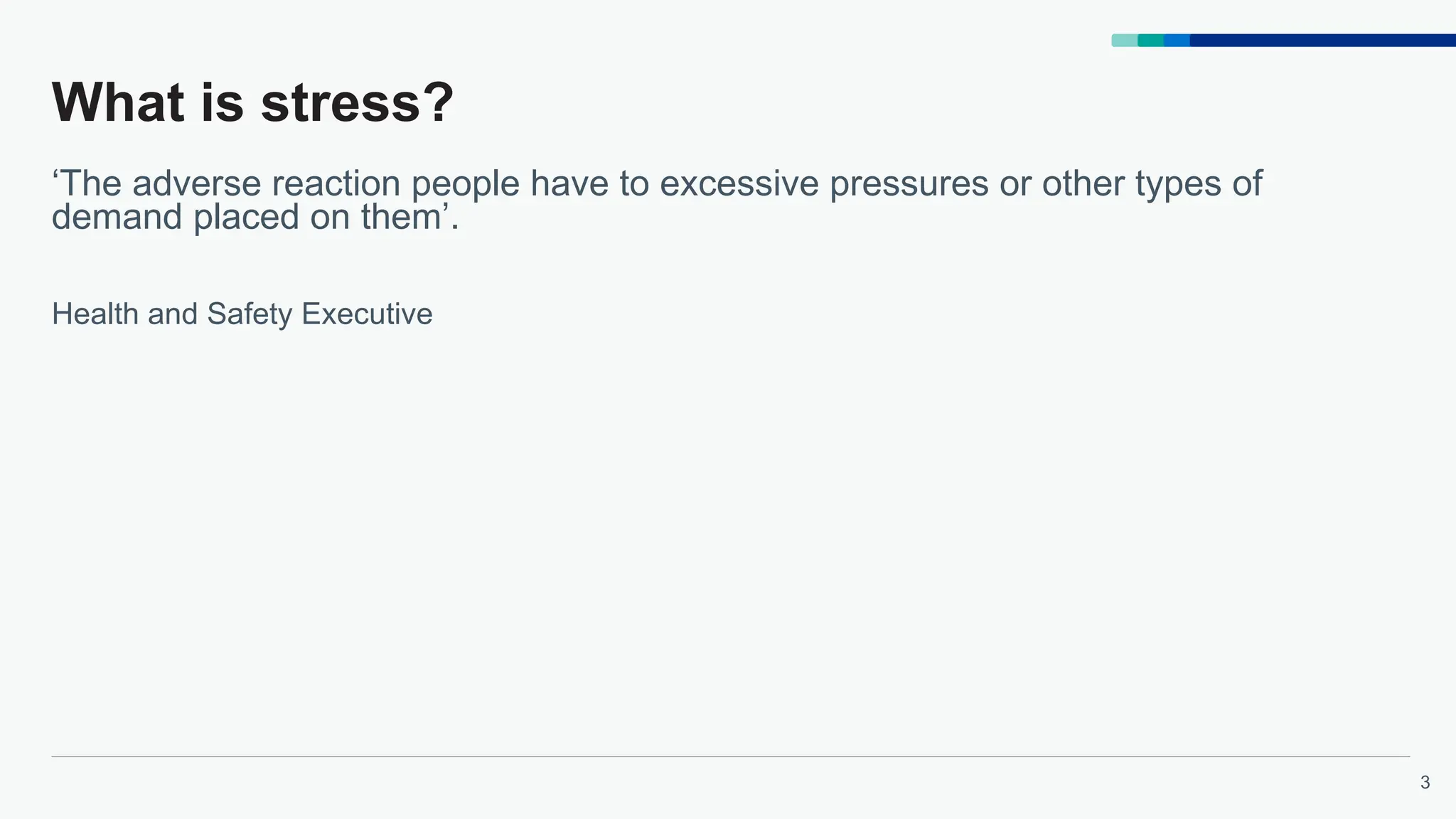
What is stress?
‘The adverse reaction people have to excessive pressures or other types of
demand placed on them’.
Health and Safety Executive
4
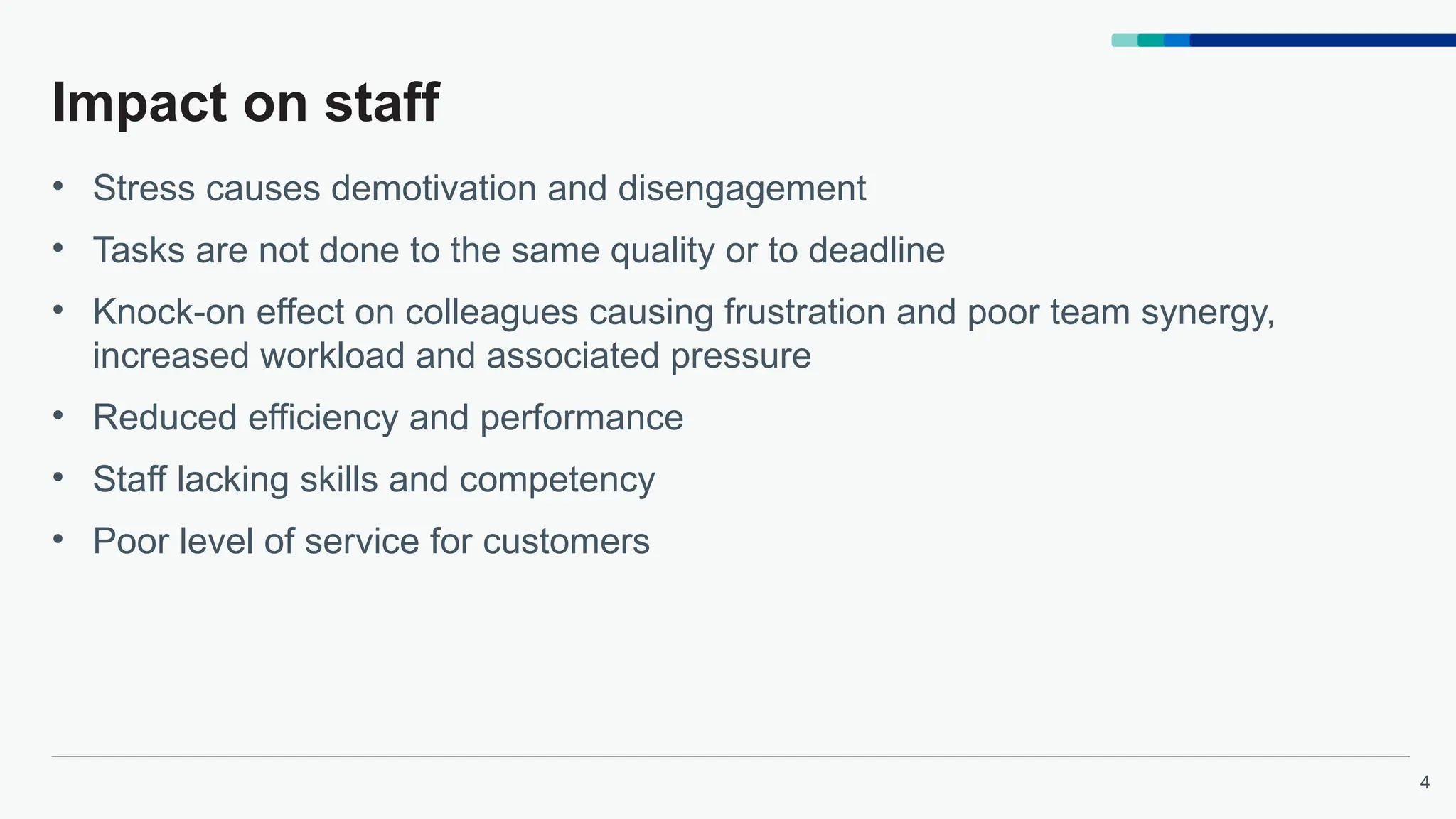
Impact on staff
• Stress causes demotivation and disengagement
• Tasks are not done to the same quality or to deadline
• Knock-on effect on colleagues causing frustration and poor team synergy,
increased workload and associated pressure
• Reduced efficiency and performance
• Staff lacking skills and competency
• Poor level of service for customers
5
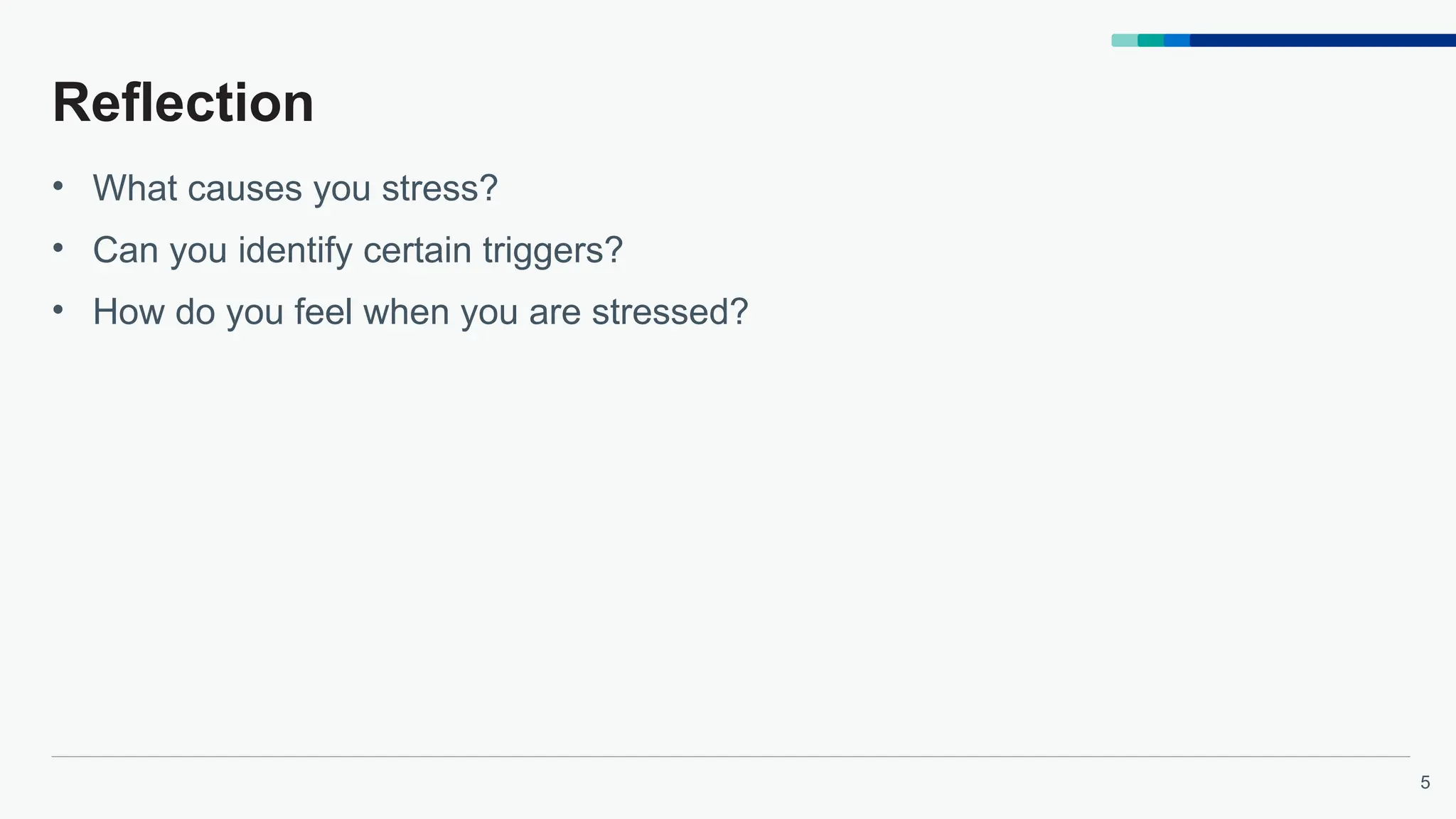
Reflection
• What causes you stress?
• Can you identify certain triggers?
• How do you feel when you are stressed?
6
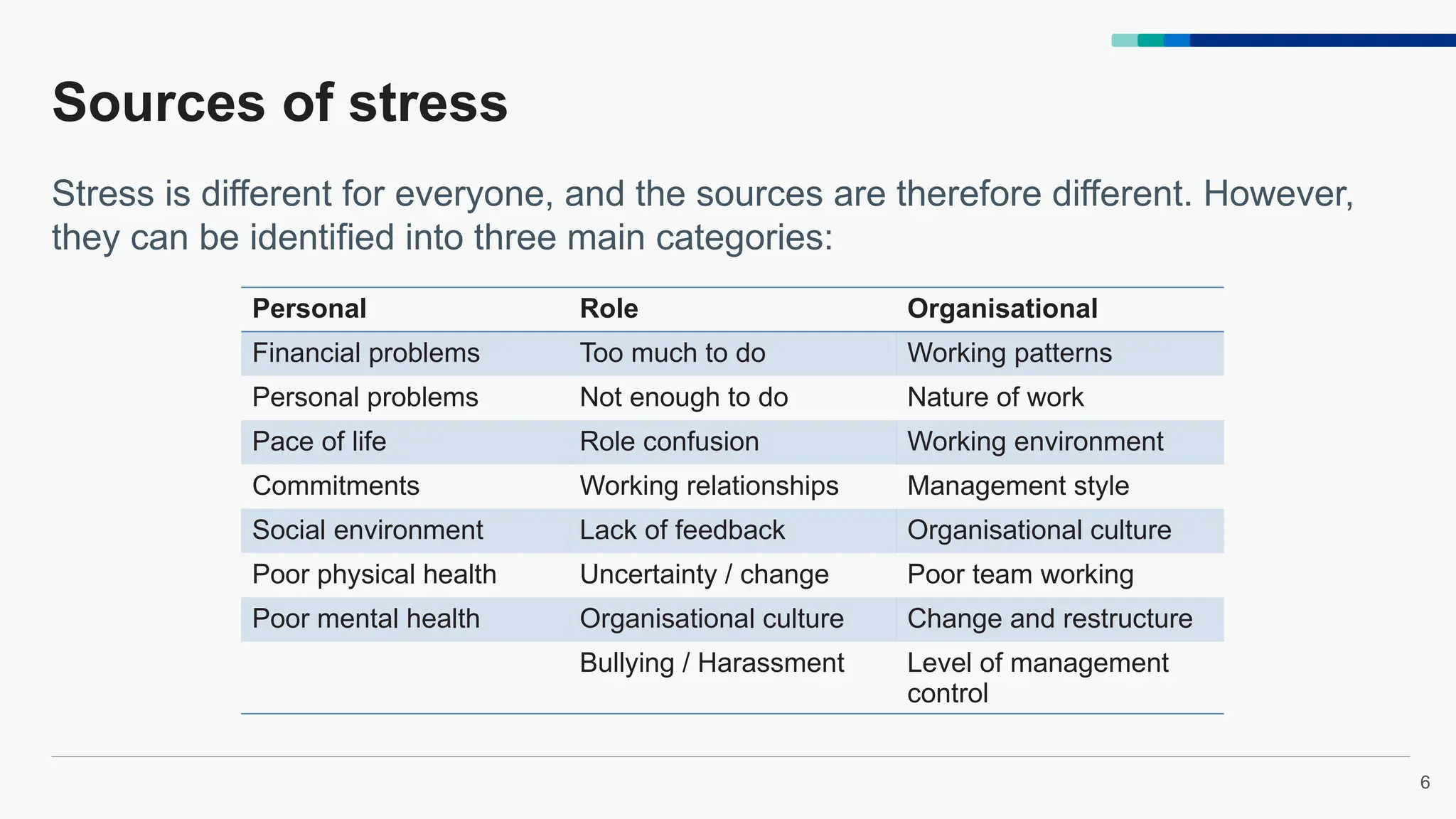
Sources of stress
Stress is different for everyone, and the sources are therefore different. However,
they can be identified into three main categories:
Personal Role Organisational
Financial problems Too much to do Working patterns
Personal problems Not enough to do Nature of work
Pace of life Role confusion Working environment
Commitments Working relationships Management style
Social environment Lack of feedback Organisational culture
Poor physical health Uncertainty / change Poor team working
Poor mental health Organisational culture Change and restructure
Bullying / Harassment Level of management
control
7
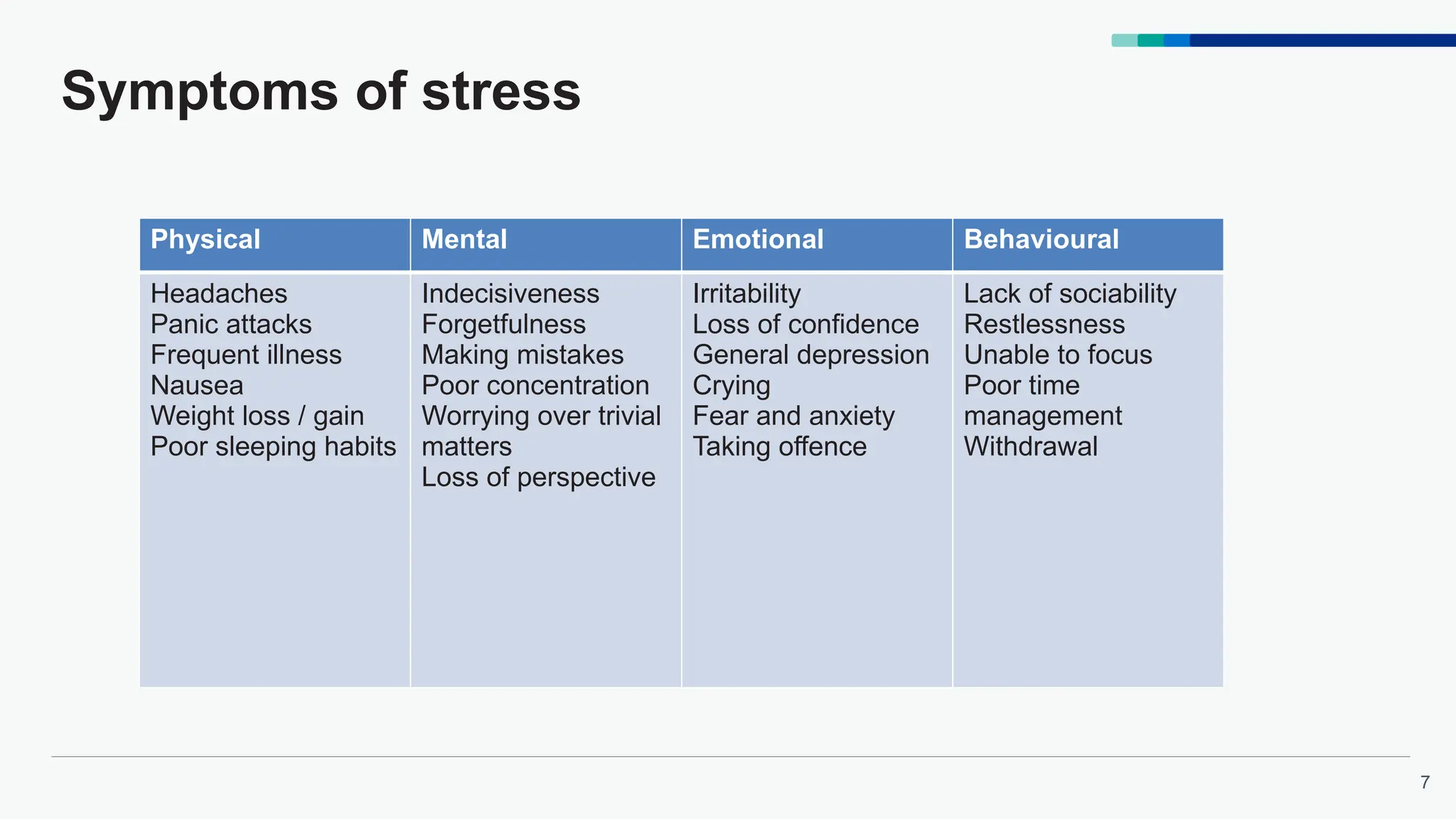
Symptoms of stress
Physical Mental Emotional Behavioural
Headaches
Panic attacks
Frequent illness
Nausea
Weight loss / gain
Poor sleeping habits
Indecisiveness
Forgetfulness
Making mistakes
Poor concentration
Worrying over trivial
matters
Loss of perspective
Irritability
Loss of confidence
General depression
Crying
Fear and anxiety
Taking offence
Lack of sociability
Restlessness
Unable to focus
Poor time
management
Withdrawal
8
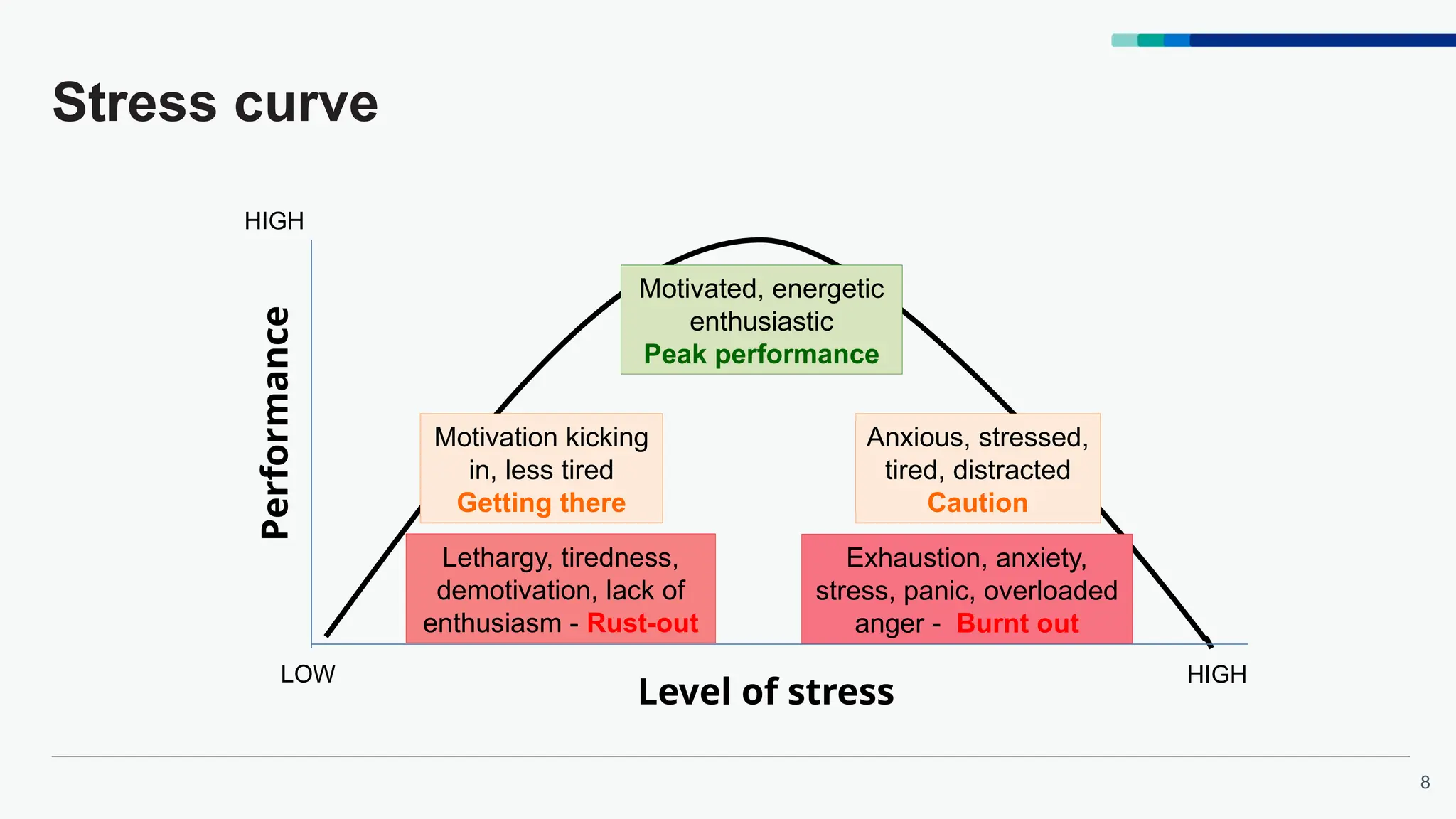
Stress curve
Level of stress
Performance
LOW HIGH
HIGH
Lethargy, tiredness,
demotivation, lack of
enthusiasm - Rust-out
Exhaustion, anxiety,
stress, panic, overloaded
anger - Burnt out
Motivated, energetic
enthusiastic
Peak performance
Motivation kicking
in, less tired
Getting there
Anxious, stressed,
tired, distracted
Caution
9
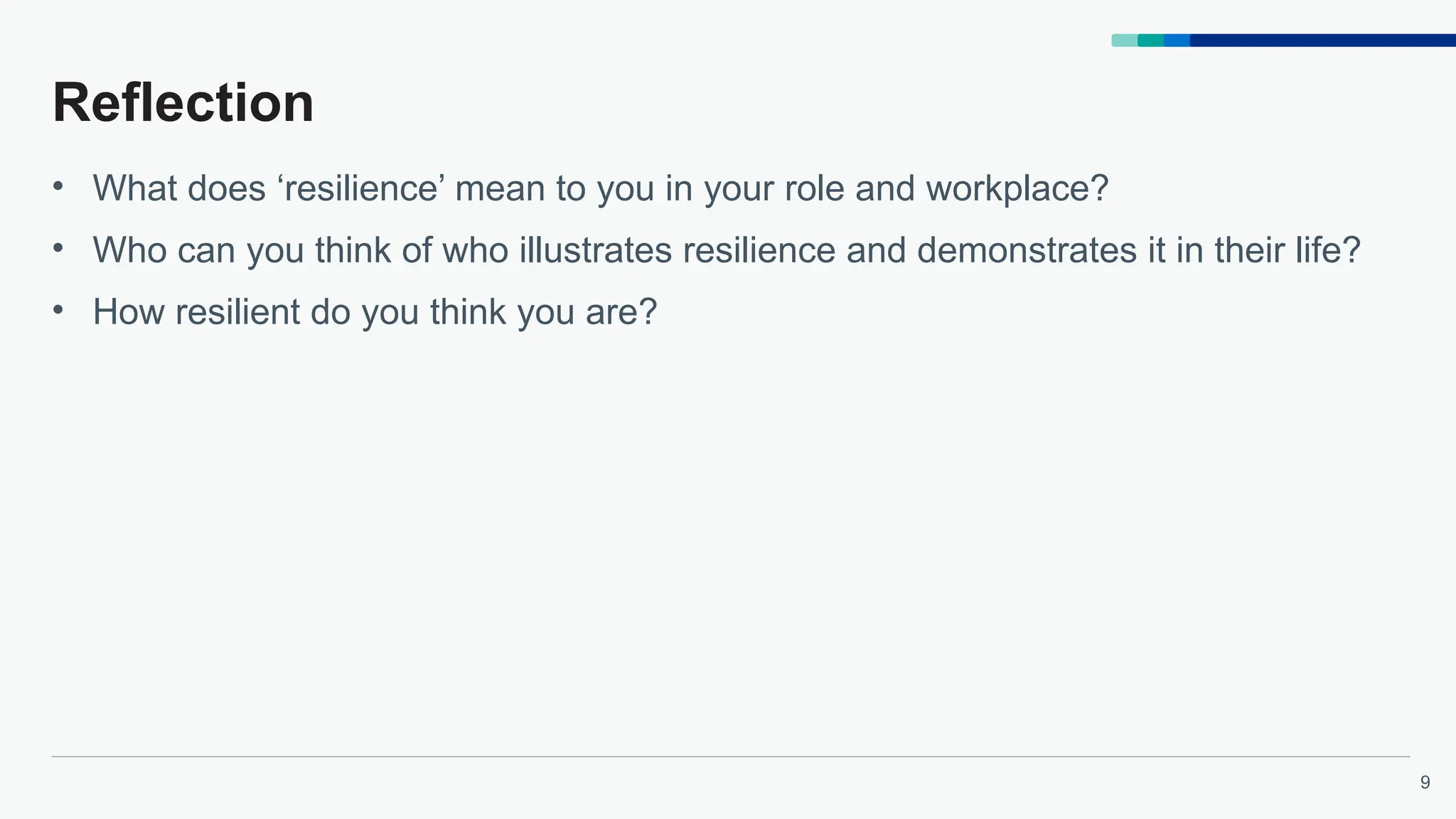
Reflection
• What does ‘resilience’ mean to you in your role and workplace?
• Who can you think of who illustrates resilience and demonstrates it in their life?
• How resilient do you think you are?
10
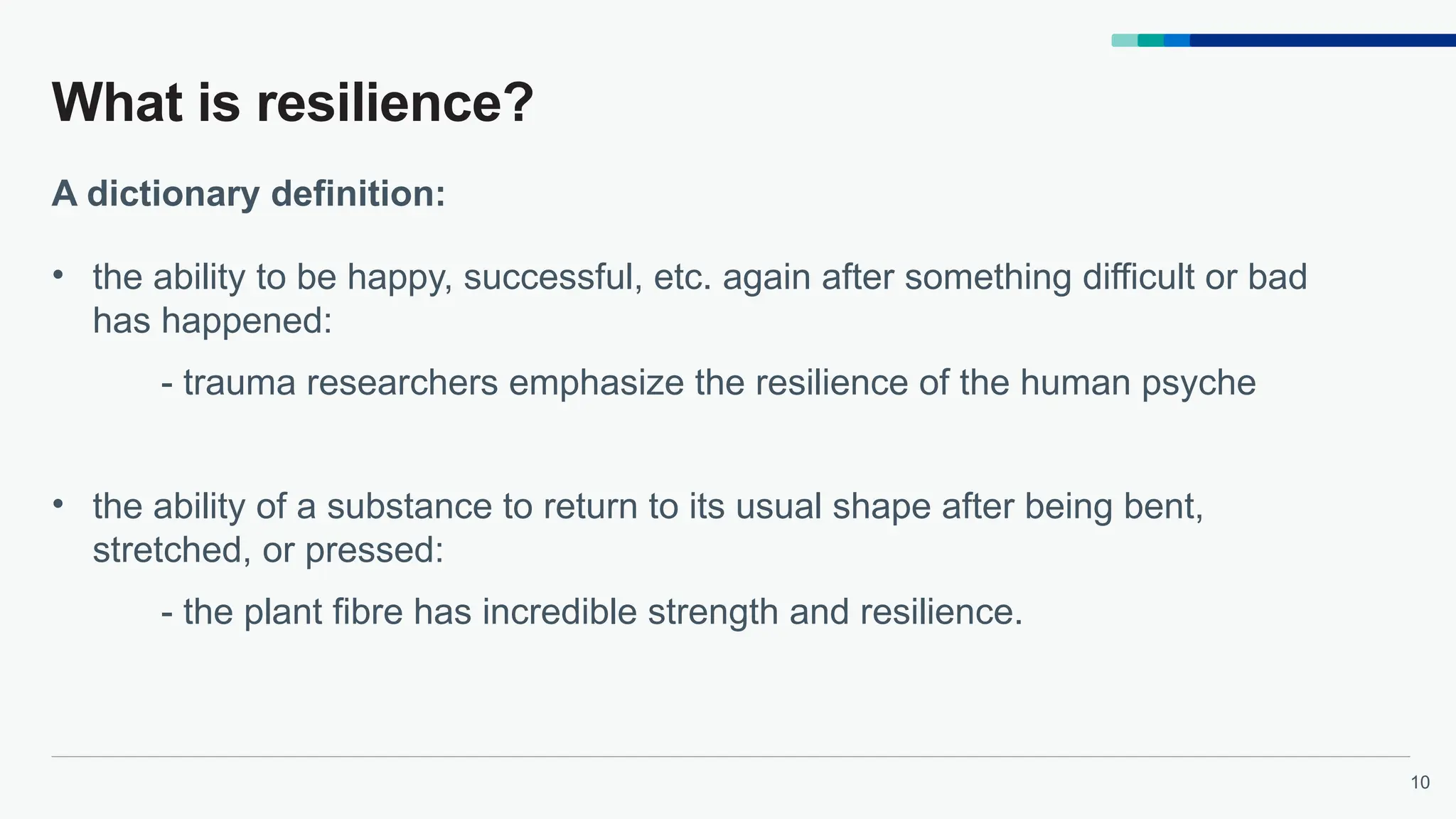
What is resilience?
• the ability to be happy, successful, etc. again after something difficult or bad
has happened:
- trauma researchers emphasize the resilience of the human psyche
• the ability of a substance to return to its usual shape after being bent,
stretched, or pressed:
- the plant fibre has incredible strength and resilience.
A dictionary definition:
11
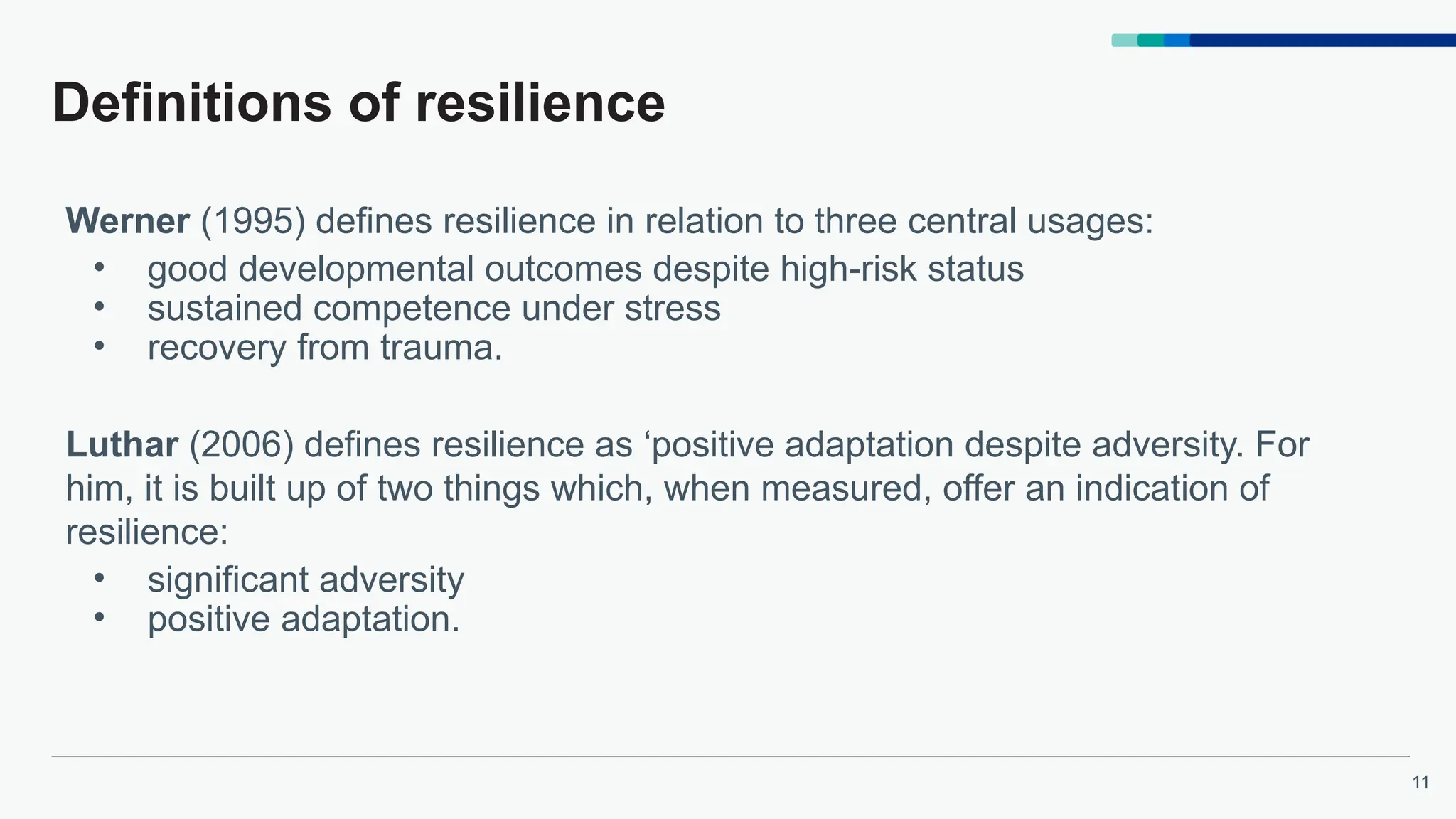
Definitions of resilience
Werner (1995) defines resilience in relation to three central usages:
• good developmental outcomes despite high-risk status
• sustained competence under stress
• recovery from trauma.
Luthar (2006) defines resilience as ‘positive adaptation despite adversity. For
him, it is built up of two things which, when measured, offer an indication of
resilience:
• significant adversity
• positive adaptation.
12
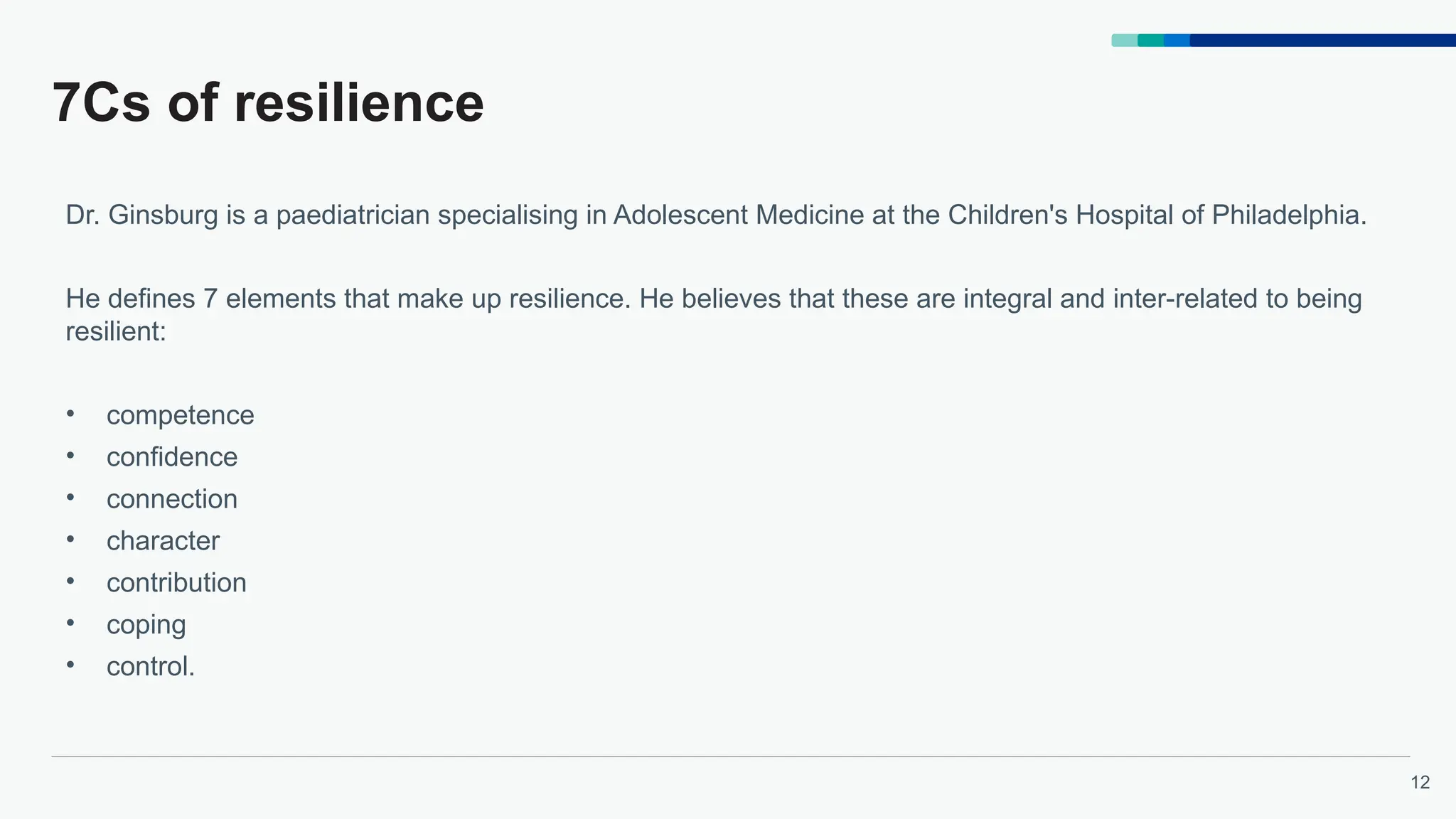
7Cs of resilience
Dr. Ginsburg is a paediatrician specialising in Adolescent Medicine at the Children's Hospital of Philadelphia.
He defines 7 elements that make up resilience. He believes that these are integral and inter-related to being
resilient:
• competence
• confidence
• connection
• character
• contribution
• coping
• control.
13
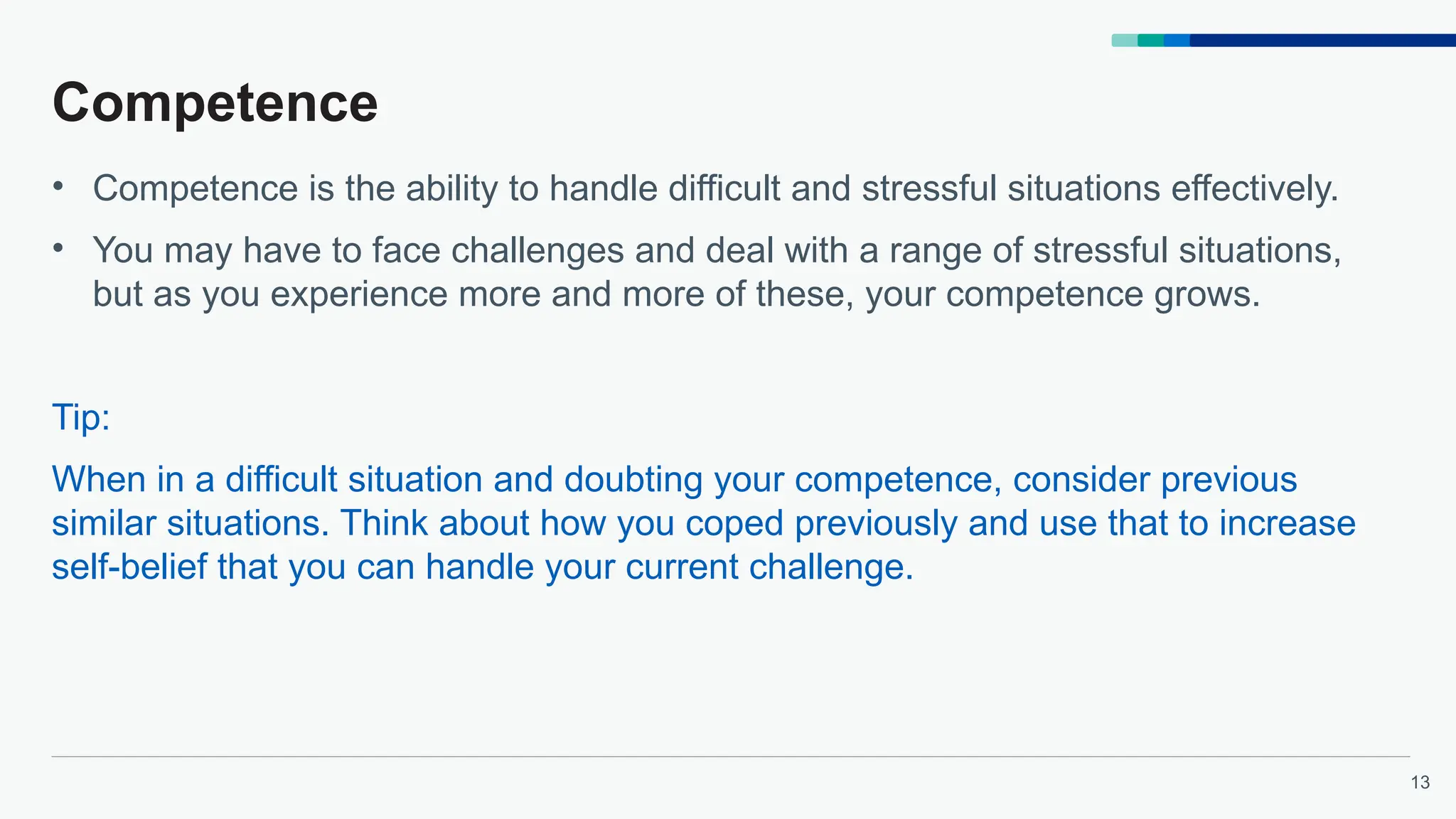
Competence
• Competence is the ability to handle difficult and stressful situations effectively.
• You may have to face challenges and deal with a range of stressful situations,
but as you experience more and more of these, your competence grows.
Tip:
When in a difficult situation and doubting your competence, consider previous
similar situations. Think about how you coped previously and use that to increase
self-belief that you can handle your current challenge.
14
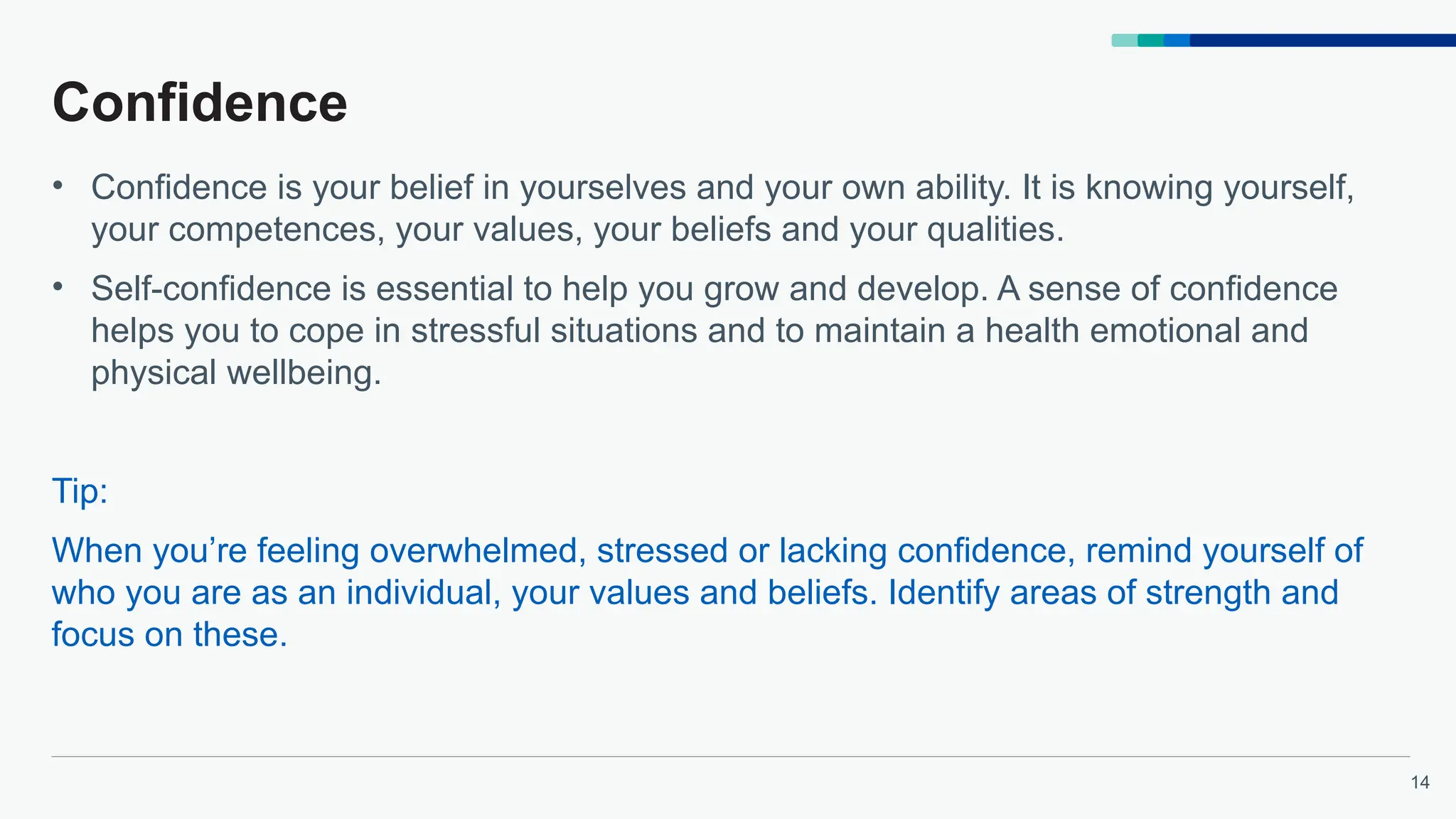
Confidence
• Confidence is your belief in yourselves and your own ability. It is knowing yourself,
your competences, your values, your beliefs and your qualities.
• Self-confidence is essential to help you grow and develop. A sense of confidence
helps you to cope in stressful situations and to maintain a health emotional and
physical wellbeing.
Tip:
When you’re feeling overwhelmed, stressed or lacking confidence, remind yourself of
who you are as an individual, your values and beliefs. Identify areas of strength and
focus on these.
15
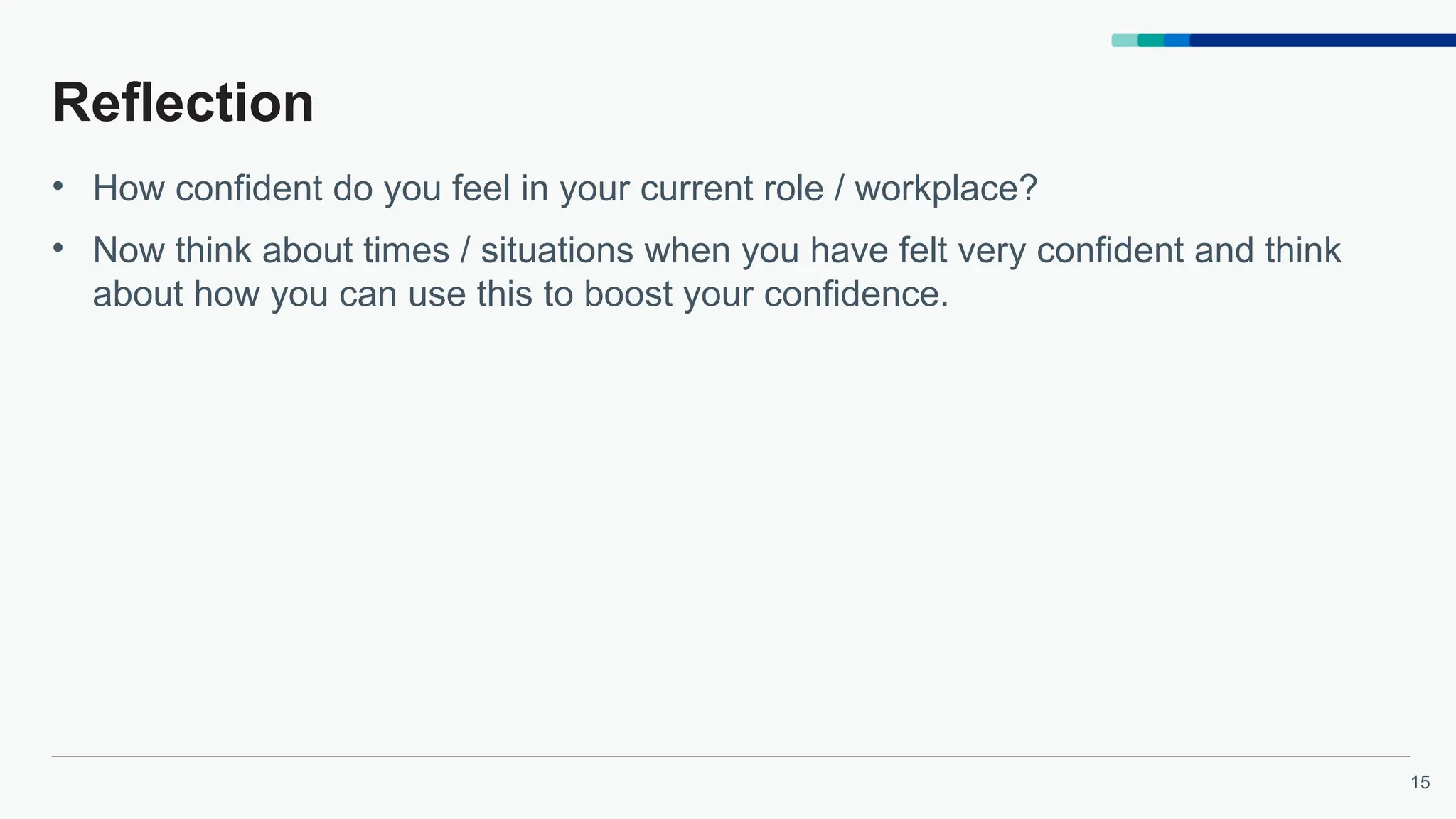
Reflection
• How confident do you feel in your current role / workplace?
• Now think about times / situations when you have felt very confident and think
about how you can use this to boost your confidence.
16
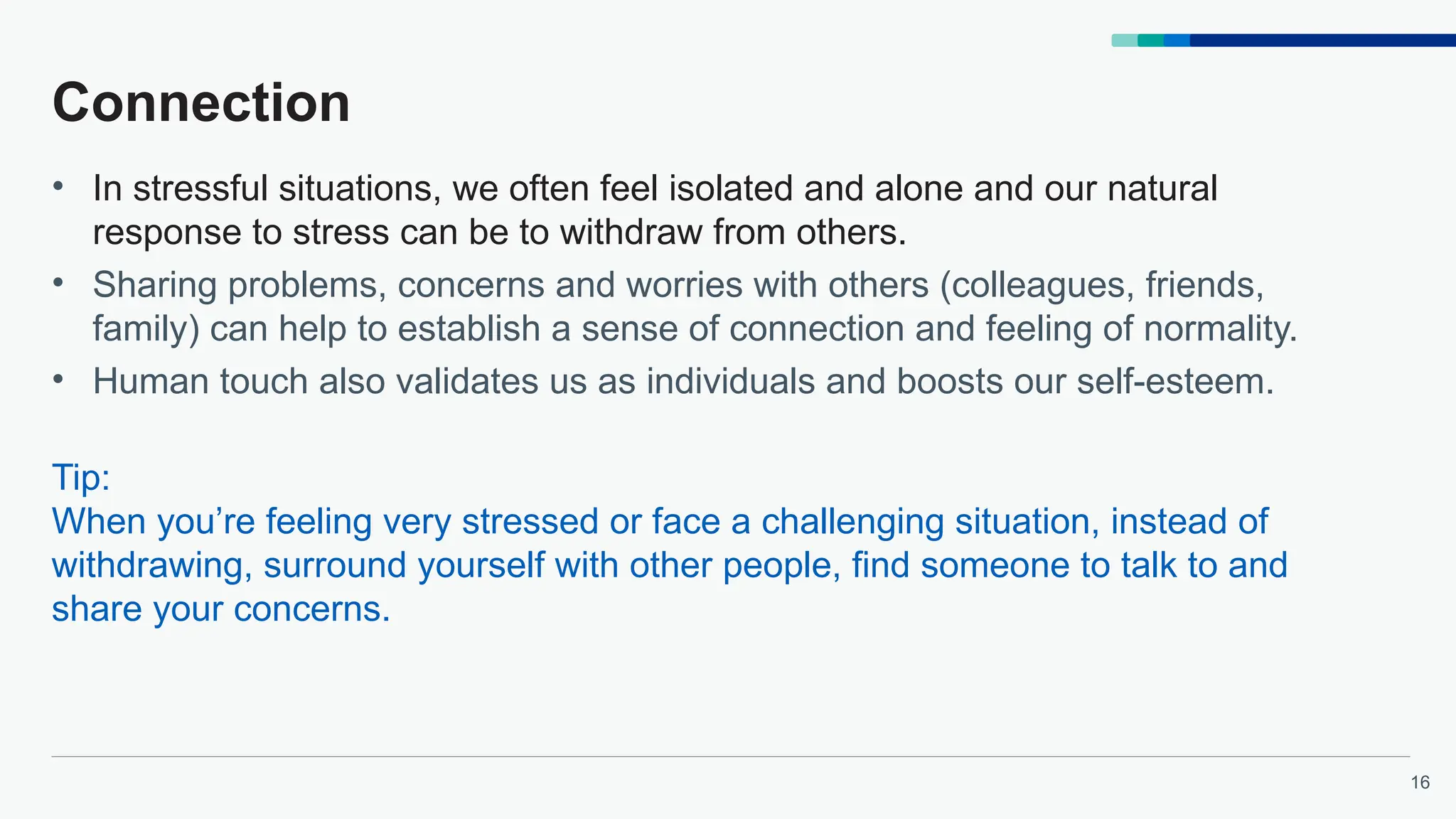
Connection
• In stressful situations, we often feel isolated and alone and our natural
response to stress can be to withdraw from others.
• Sharing problems, concerns and worries with others (colleagues, friends,
family) can help to establish a sense of connection and feeling of normality.
• Human touch also validates us as individuals and boosts our self-esteem.
Tip:
When you’re feeling very stressed or face a challenging situation, instead of
withdrawing, surround yourself with other people, find someone to talk to and
share your concerns.
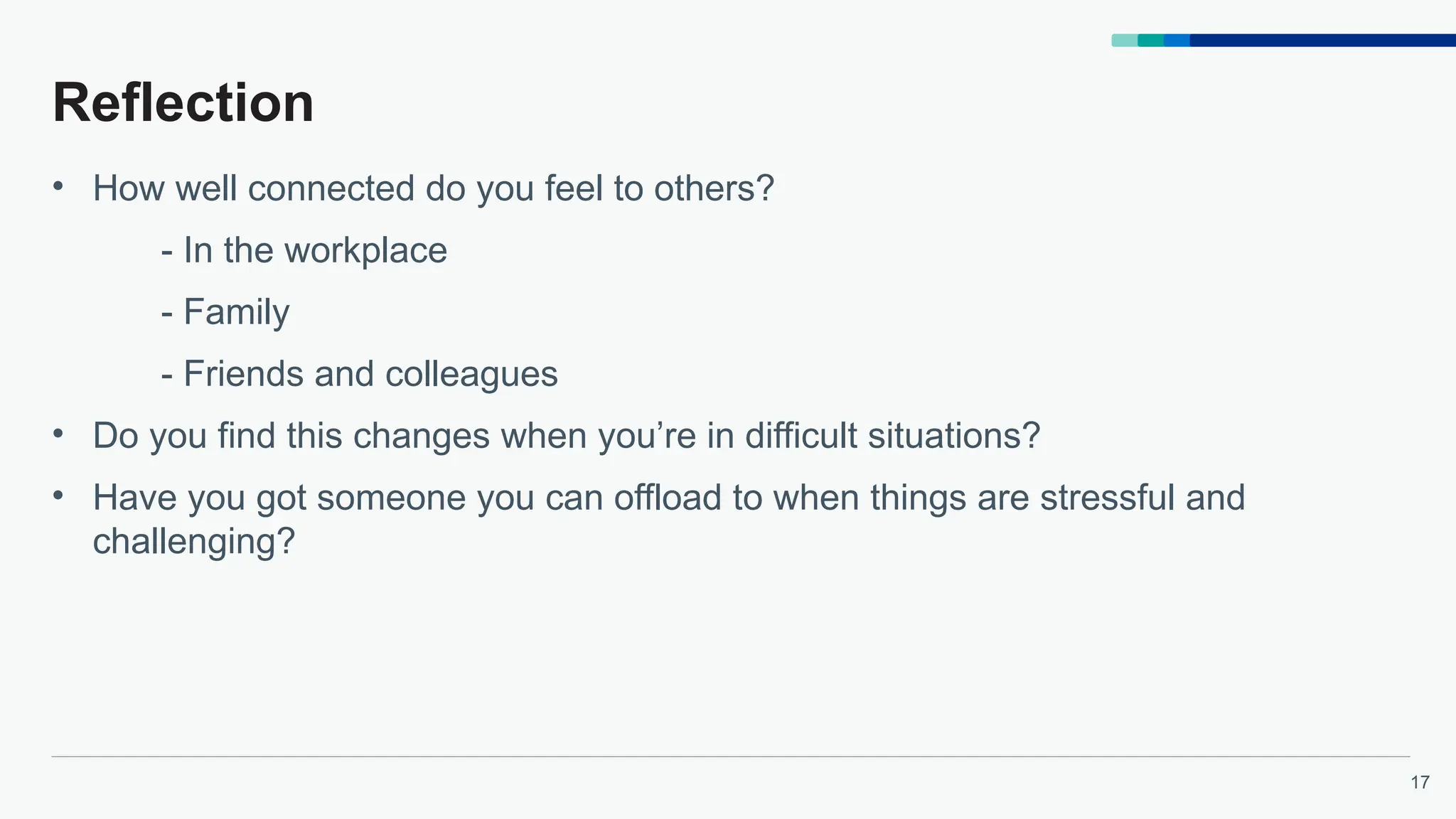
17
Reflection
• How well connected do you feel to others?
- In the workplace
- Family
- Friends and colleagues
• Do you find this changes when you’re in difficult situations?
• Have you got someone you can offload to when things are stressful and
challenging?
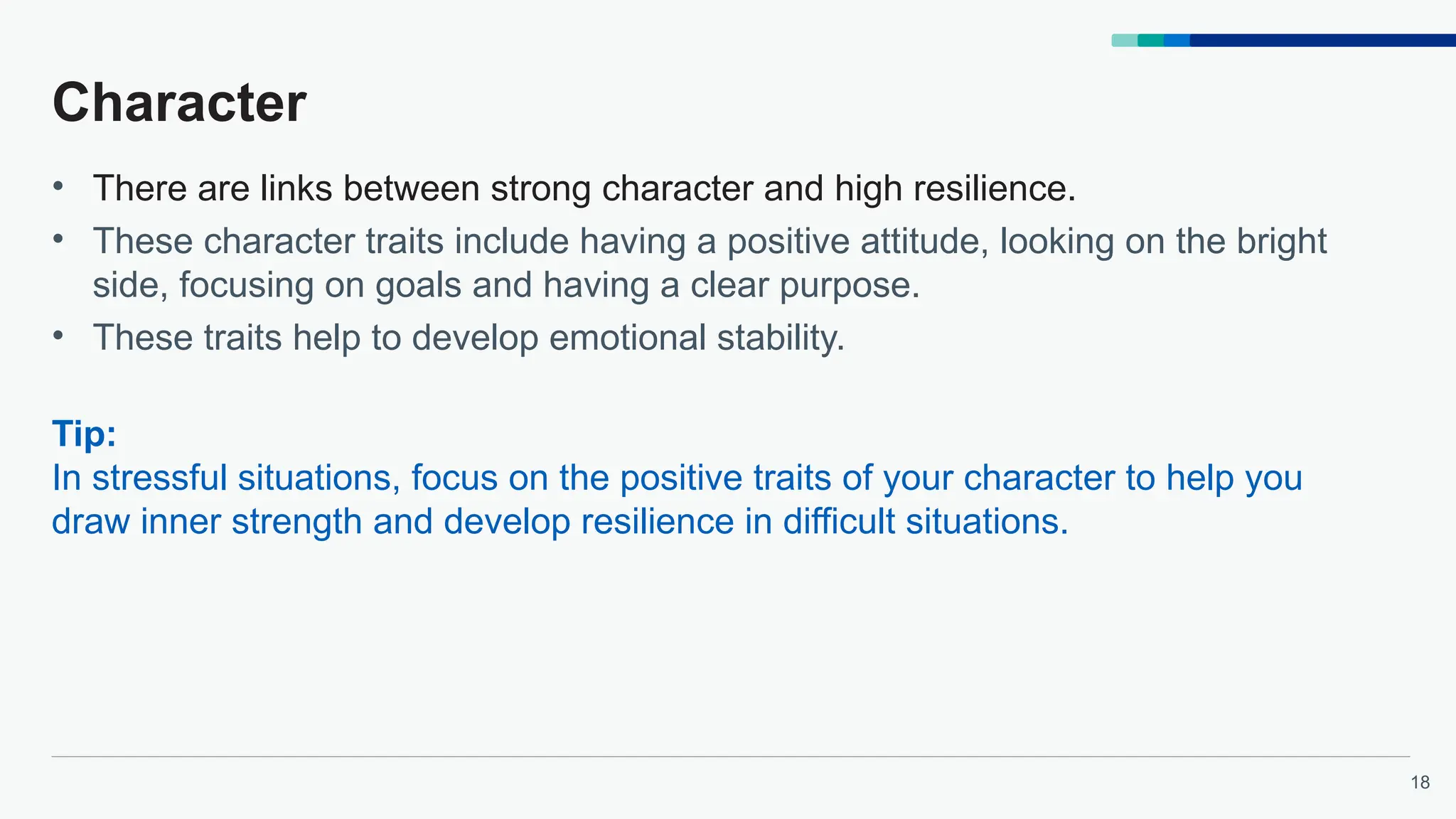
18
Character
• There are links between strong character and high resilience.
• These character traits include having a positive attitude, looking on the bright
side, focusing on goals and having a clear purpose.
• These traits help to develop emotional stability.
Tip:
In stressful situations, focus on the positive traits of your character to help you
draw inner strength and develop resilience in difficult situations.
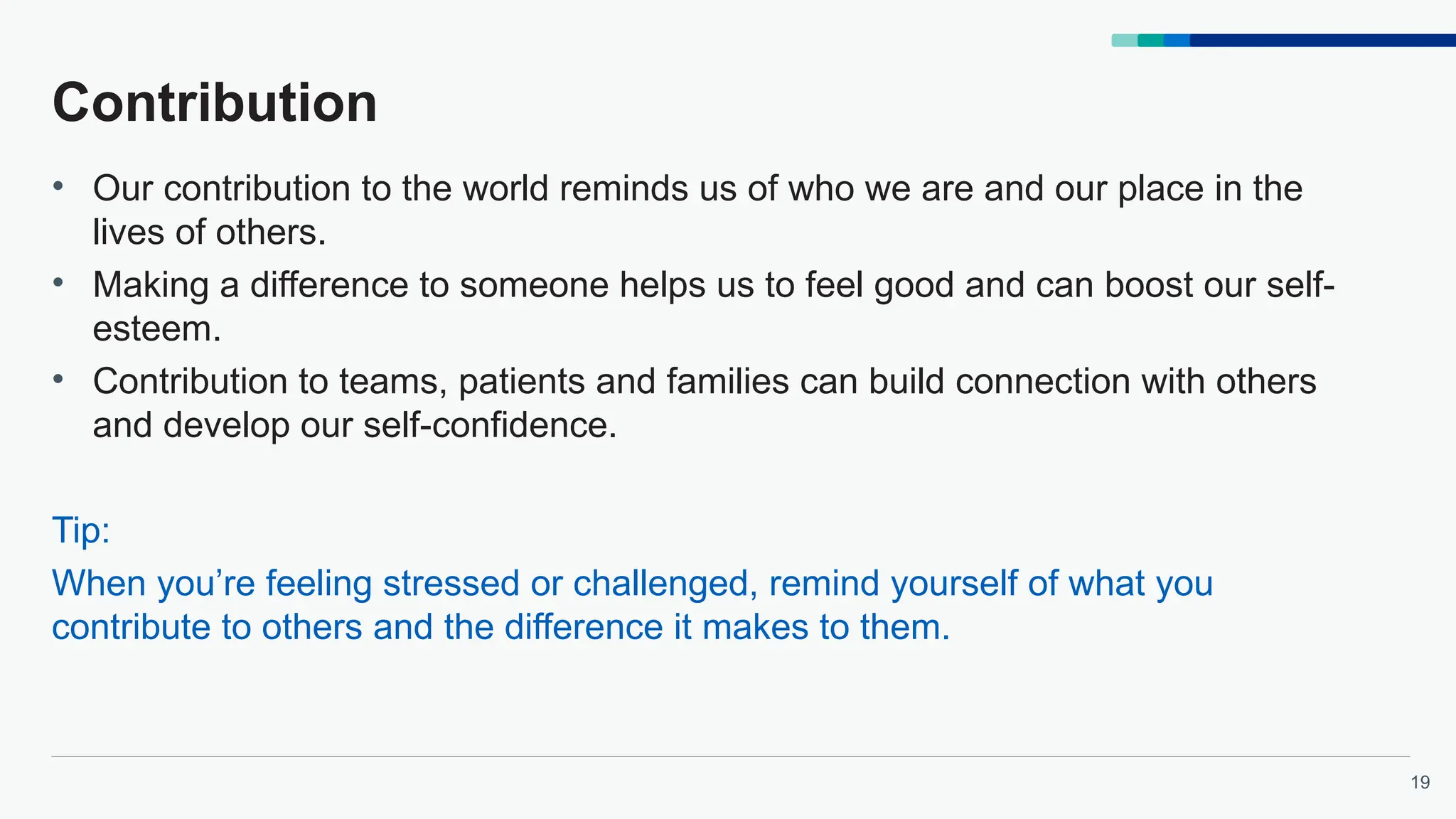
19
Contribution
• Our contribution to the world reminds us of who we are and our place in the
lives of others.
• Making a difference to someone helps us to feel good and can boost our self-
esteem.
• Contribution to teams, patients and families can build connection with others
and develop our self-confidence.
Tip:
When you’re feeling stressed or challenged, remind yourself of what you
contribute to others and the difference it makes to them.
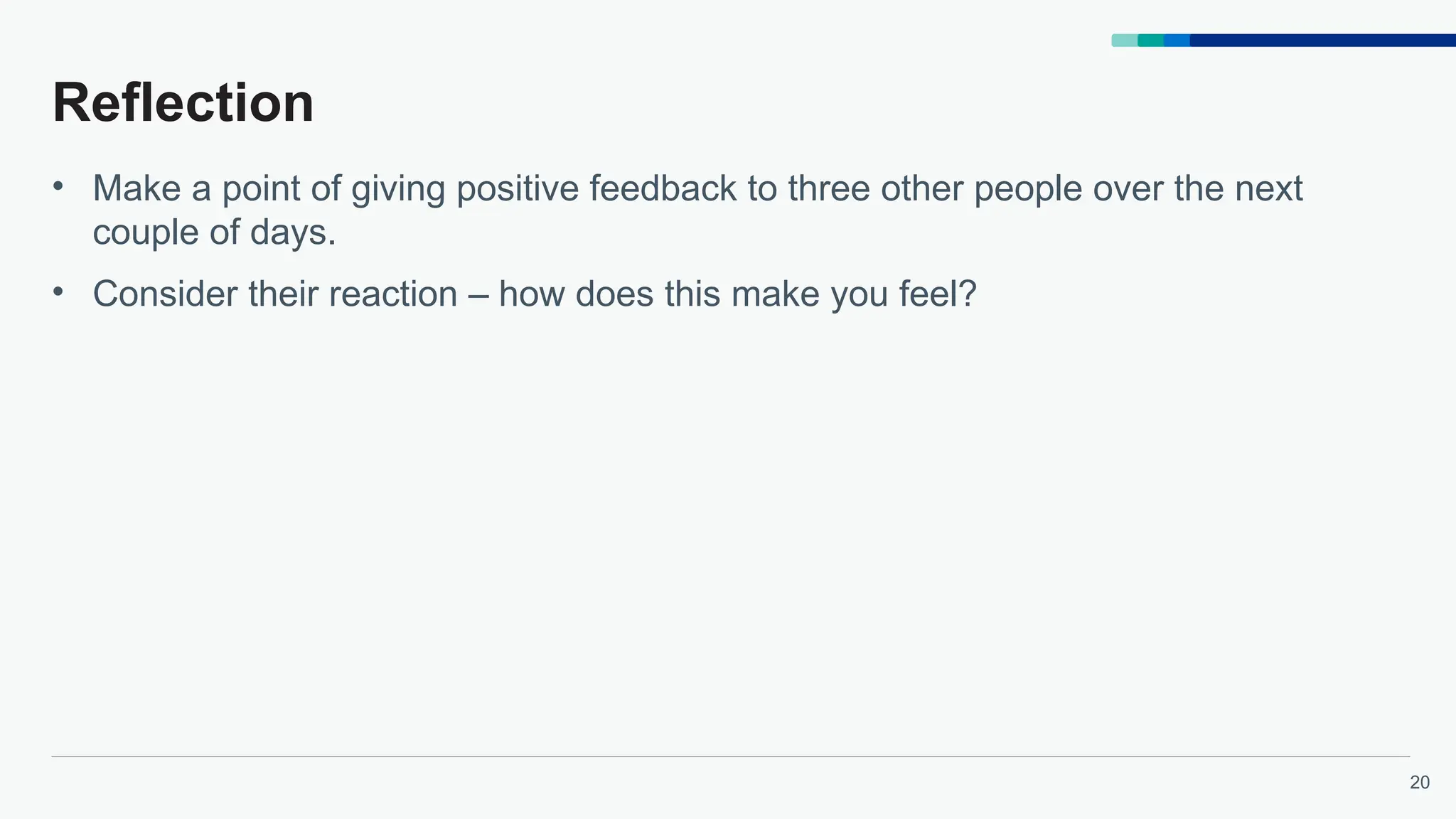
20
Reflection
• Make a point of giving positive feedback to three other people over the next
couple of days.
• Consider their reaction – how does this make you feel?
21
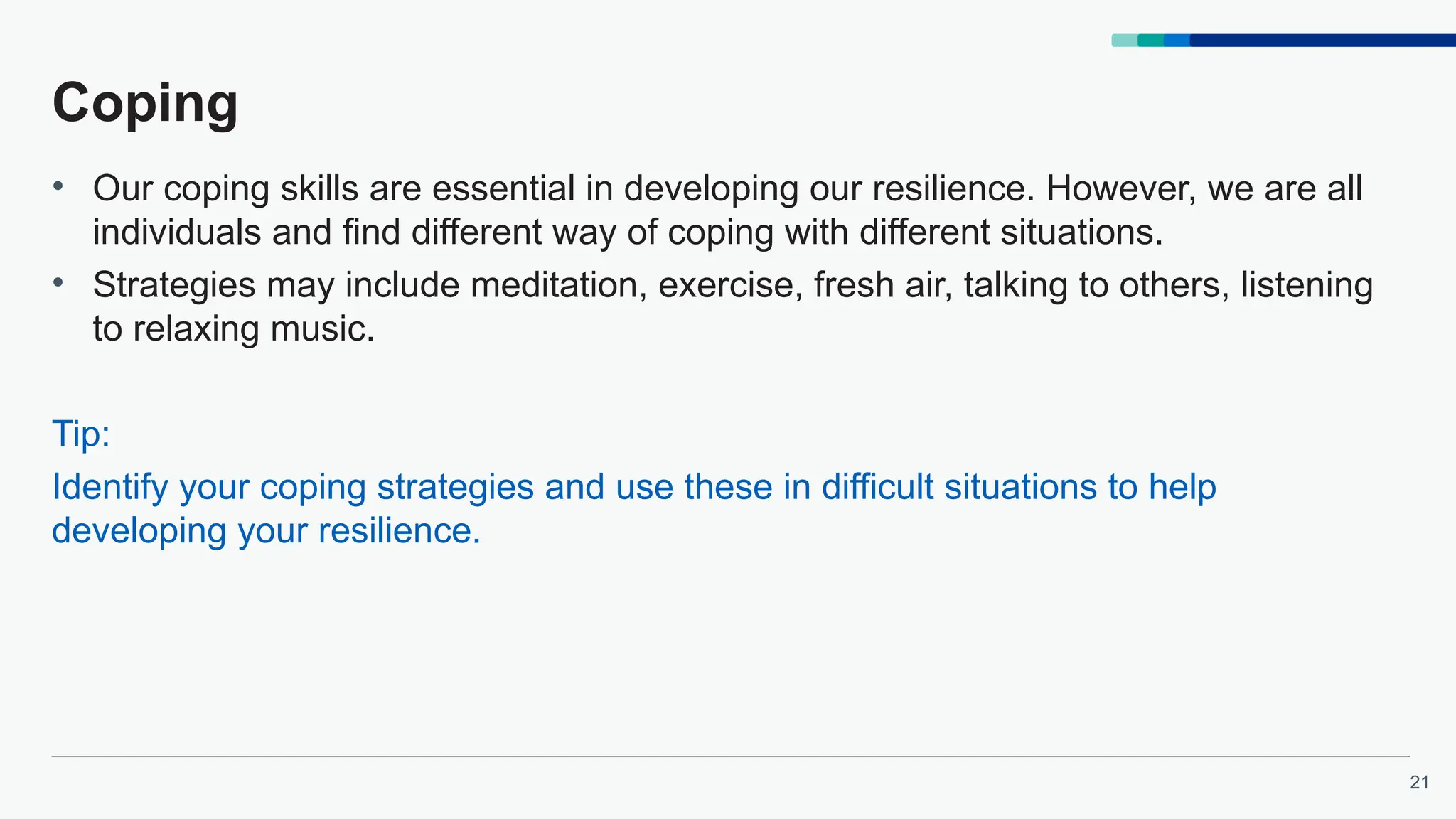
Coping
• Our coping skills are essential in developing our resilience. However, we are all
individuals and find different way of coping with different situations.
• Strategies may include meditation, exercise, fresh air, talking to others, listening
to relaxing music.
Tip:
Identify your coping strategies and use these in difficult situations to help
developing your resilience.
22
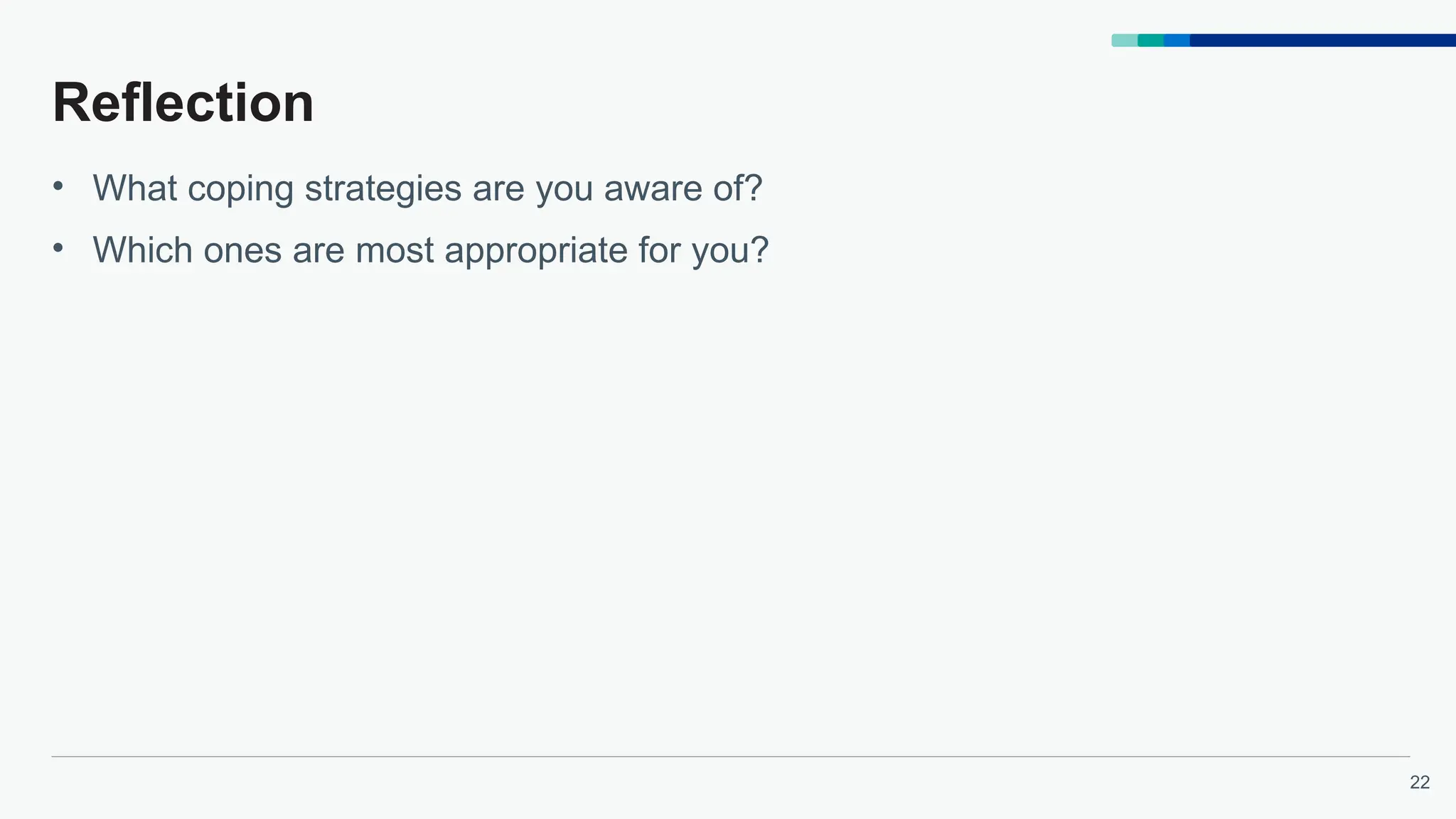
Reflection
• What coping strategies are you aware of?
• Which ones are most appropriate for you?
23
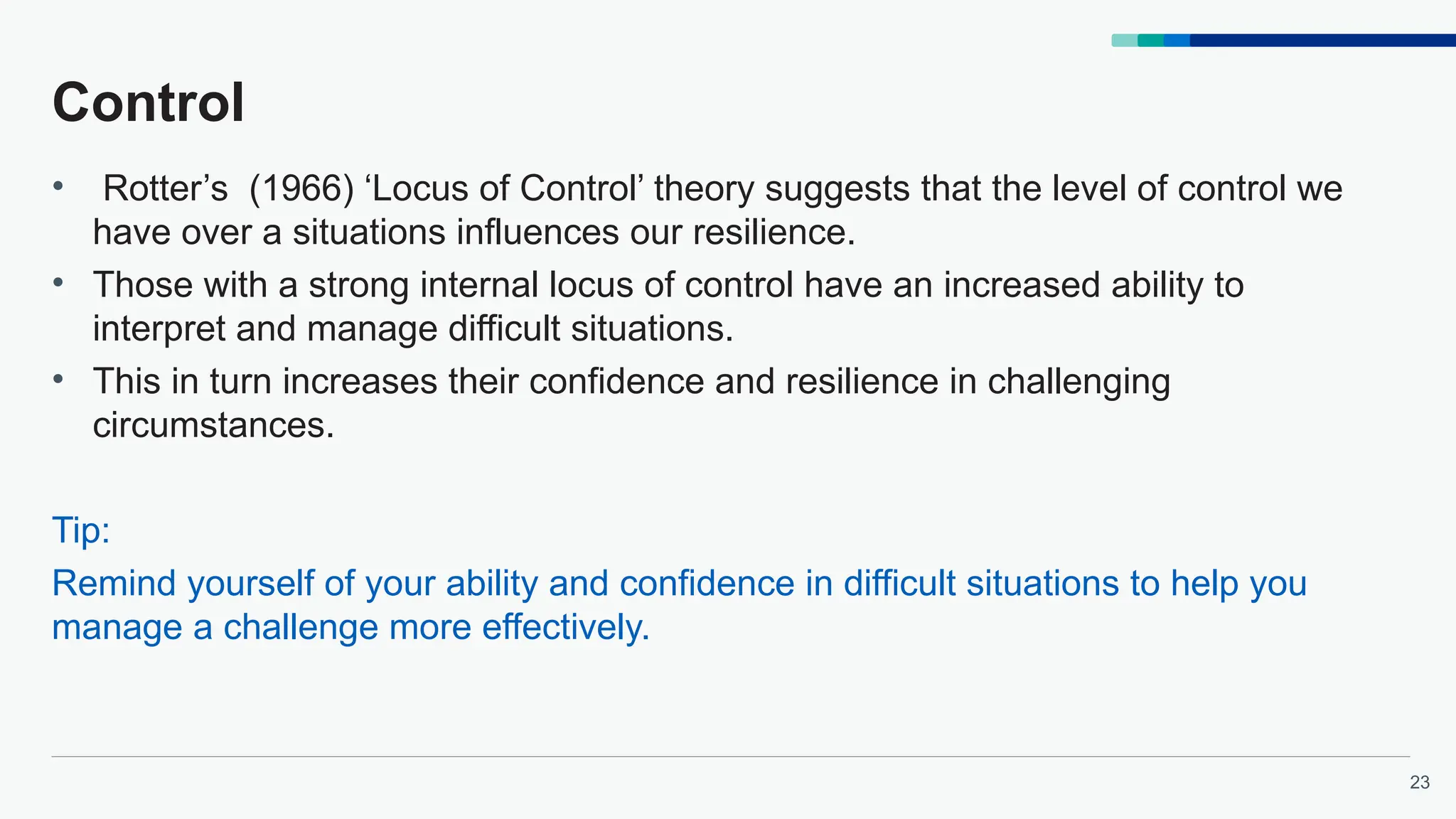
Control
• Rotter’s (1966) ‘Locus of Control’ theory suggests that the level of control we
have over a situations influences our resilience.
• Those with a strong internal locus of control have an increased ability to
interpret and manage difficult situations.
• This in turn increases their confidence and resilience in challenging
circumstances.
Tip:
Remind yourself of your ability and confidence in difficult situations to help you
manage a challenge more effectively.
24
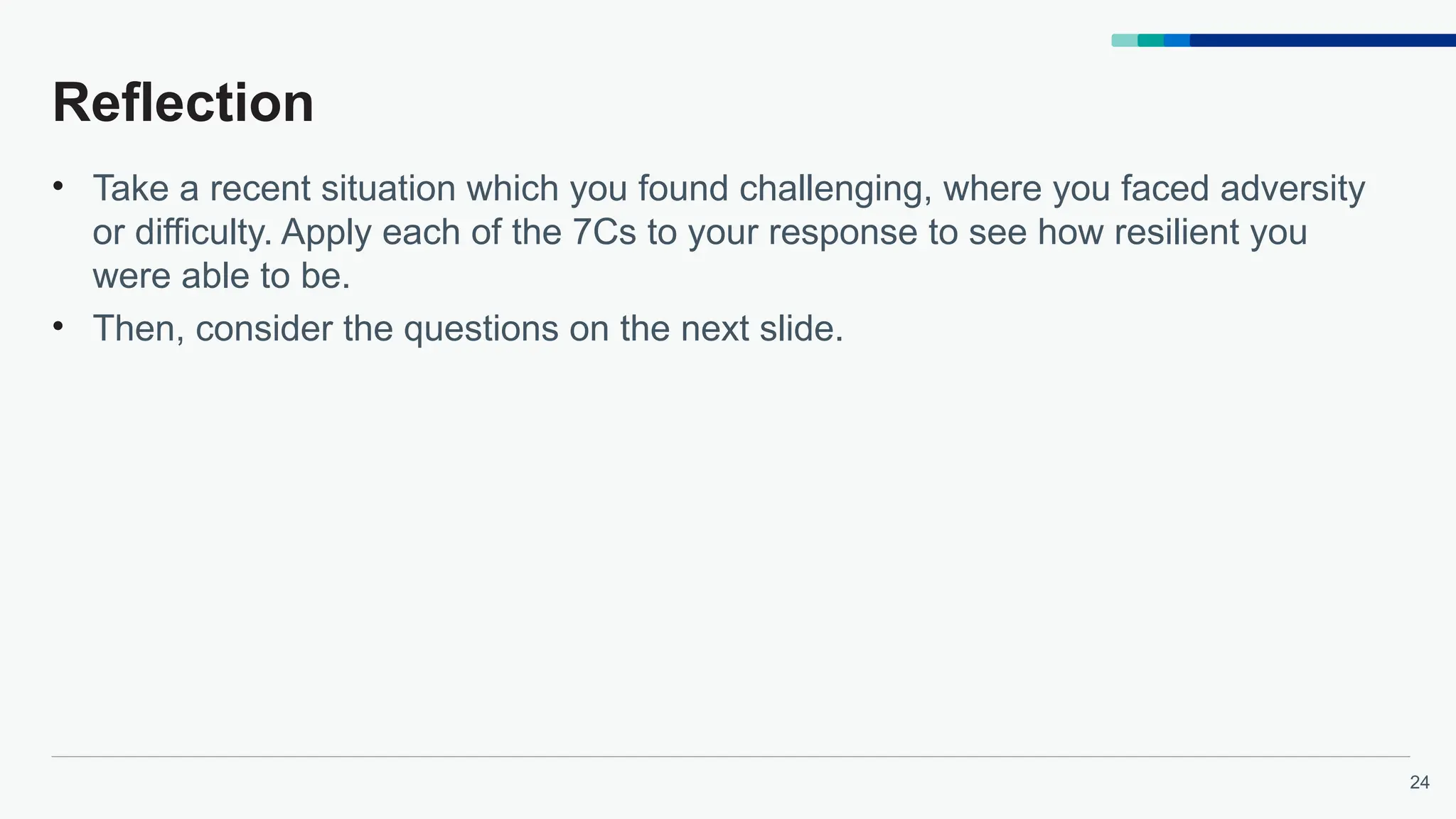
Reflection
• Take a recent situation which you found challenging, where you faced adversity
or difficulty. Apply each of the 7Cs to your response to see how resilient you
were able to be.
• Then, consider the questions on the next slide.
25
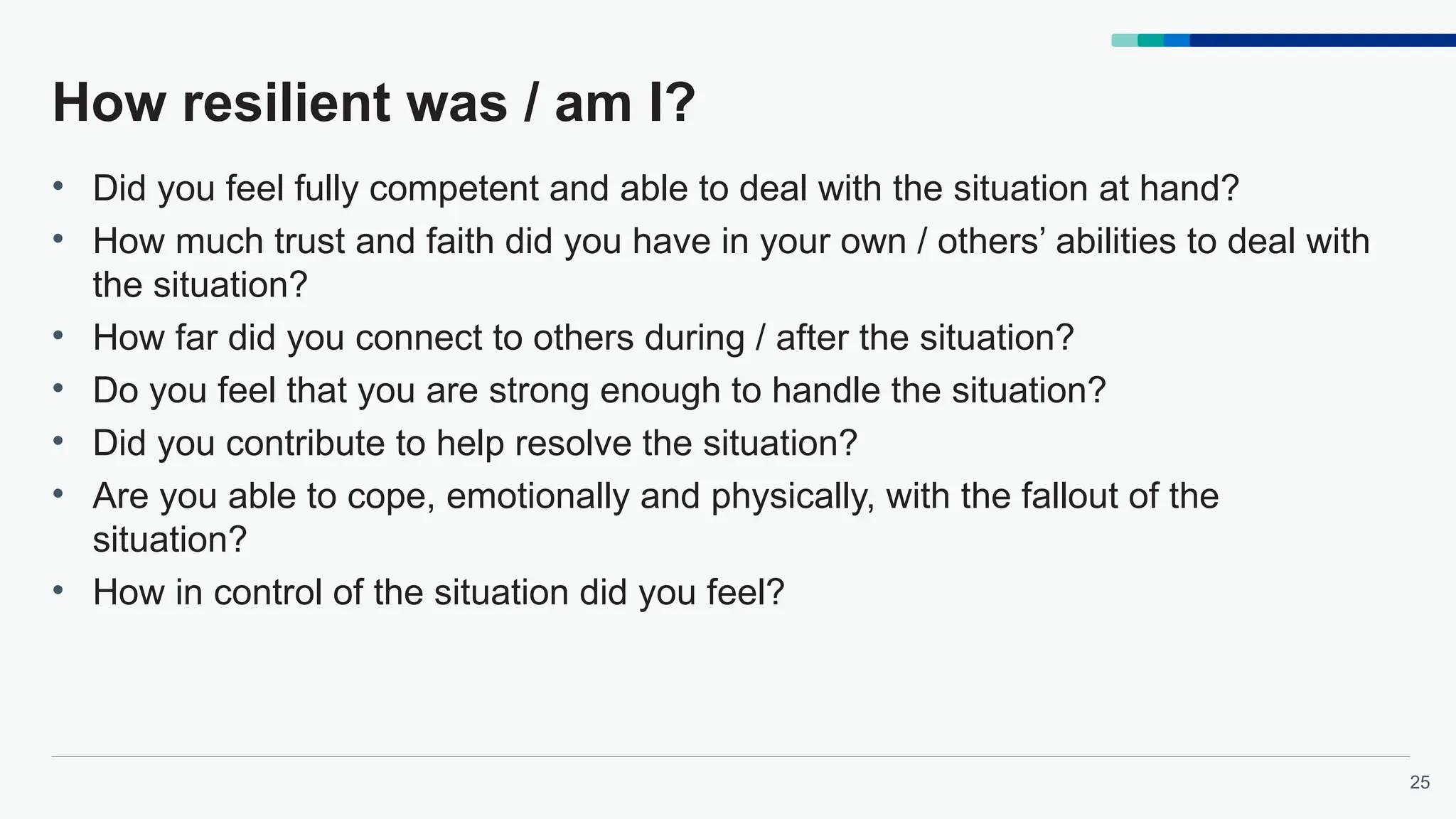
How resilient was / am I?
• Did you feel fully competent and able to deal with the situation at hand?
• How much trust and faith did you have in your own / others’ abilities to deal with
the situation?
• How far did you connect to others during / after the situation?
• Do you feel that you are strong enough to handle the situation?
• Did you contribute to help resolve the situation?
• Are you able to cope, emotionally and physically, with the fallout of the
situation?
• How in control of the situation did you feel?
26
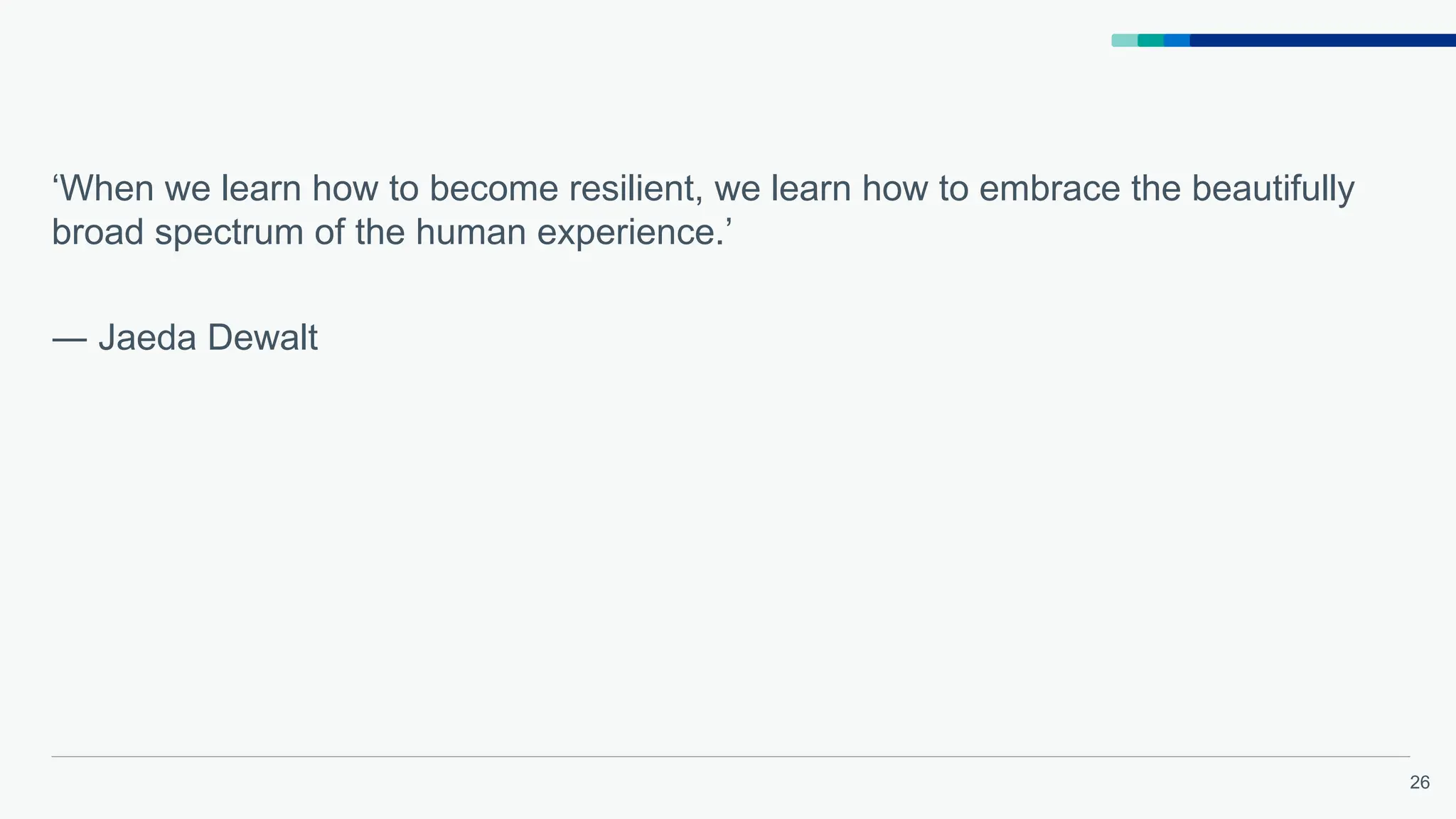
‘When we learn how to become resilient, we learn how to embrace the beautifully
broad spectrum of the human experience.’
― Jaeda Dewalt
27
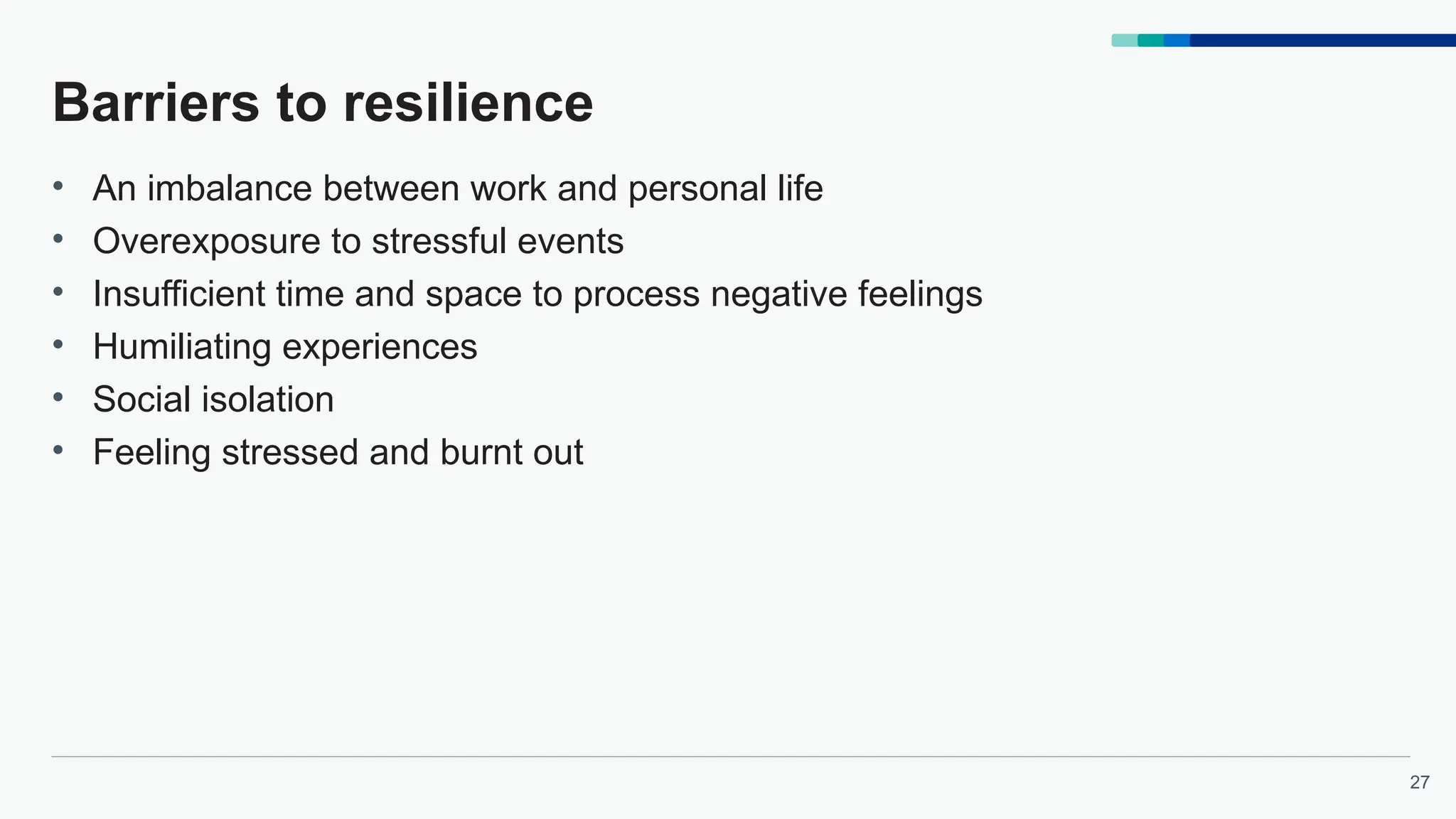
Barriers to resilience
• An imbalance between work and personal life
• Overexposure to stressful events
• Insufficient time and space to process negative feelings
• Humiliating experiences
• Social isolation
• Feeling stressed and burnt out
28
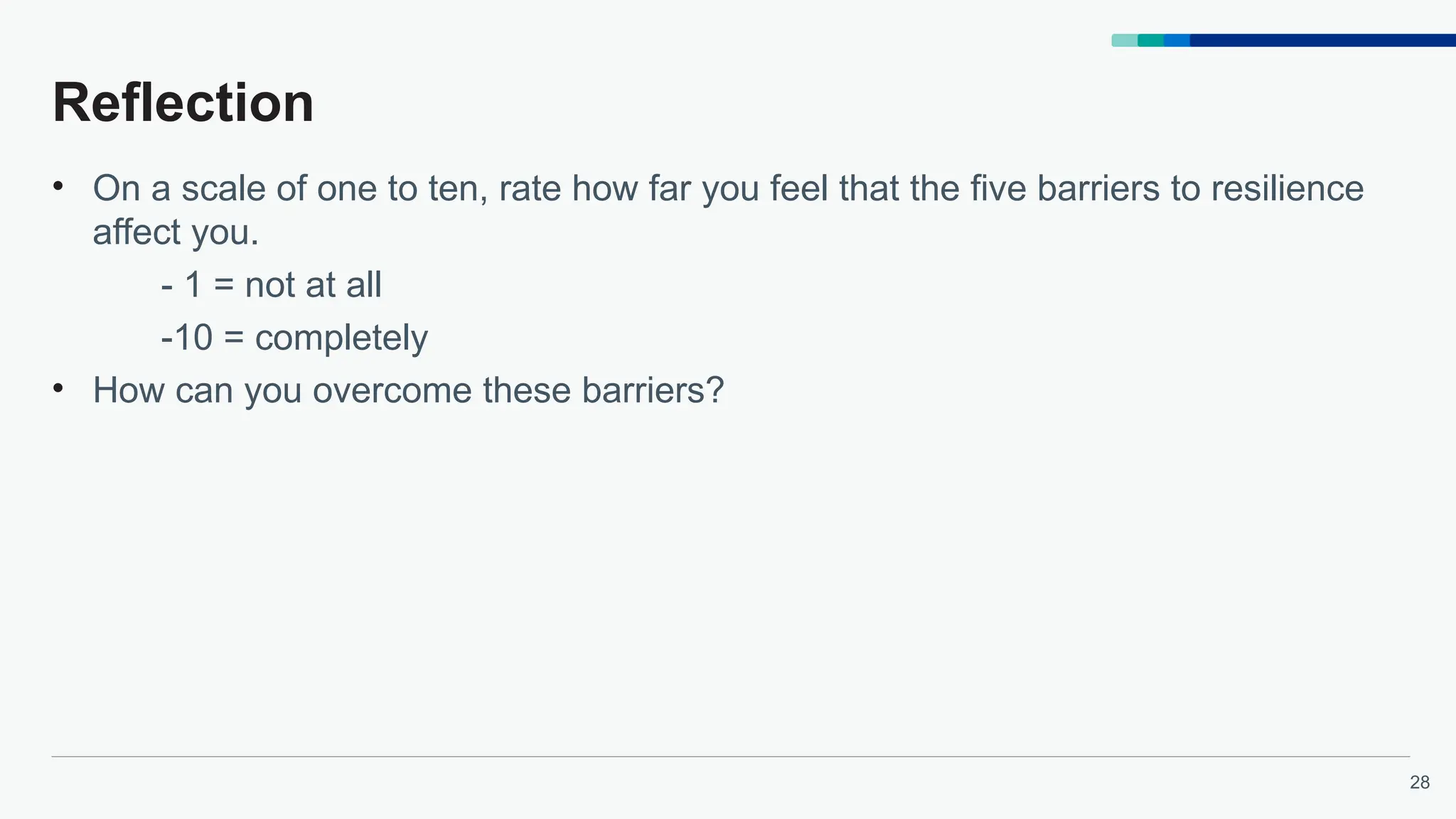
Reflection
• On a scale of one to ten, rate how far you feel that the five barriers to resilience
affect you.
- 1 = not at all
-10 = completely
• How can you overcome these barriers?
29
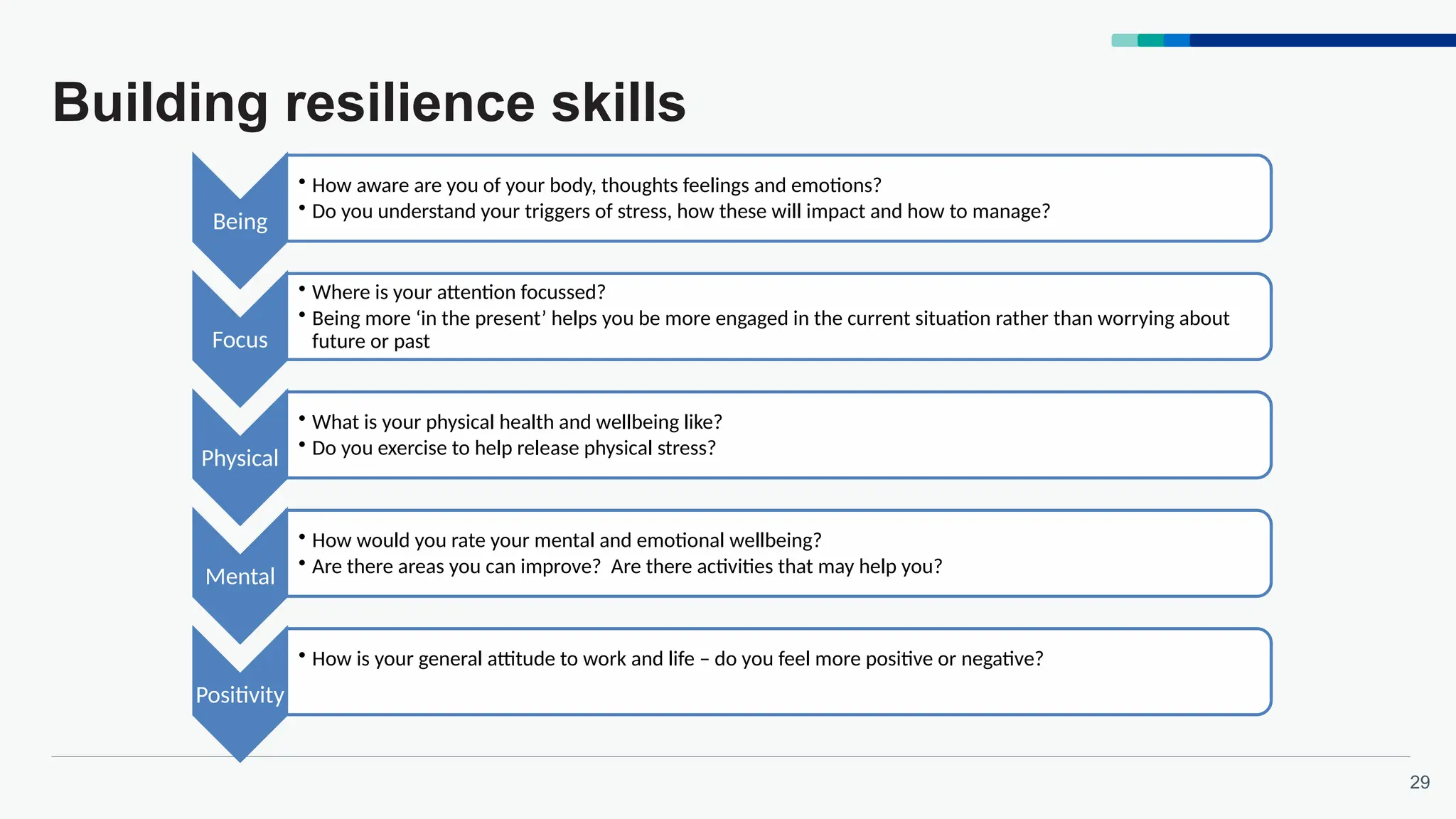
Building resilience skills
Being
• How aware are you of your body, thoughts feelings and emotions?
• Do you understand your triggers of stress, how these will impact and how to manage?
Focus
• Where is your attention focussed?
• Being more ‘in the present’ helps you be more engaged in the current situation rather than worrying about
future or past
Physical
• What is your physical health and wellbeing like?
• Do you exercise to help release physical stress?
Mental
• How would you rate your mental and emotional wellbeing?
• Are there areas you can improve? Are there activities that may help you?
Positivity
• How is your general attitude to work and life – do you feel more positive or negative?
30
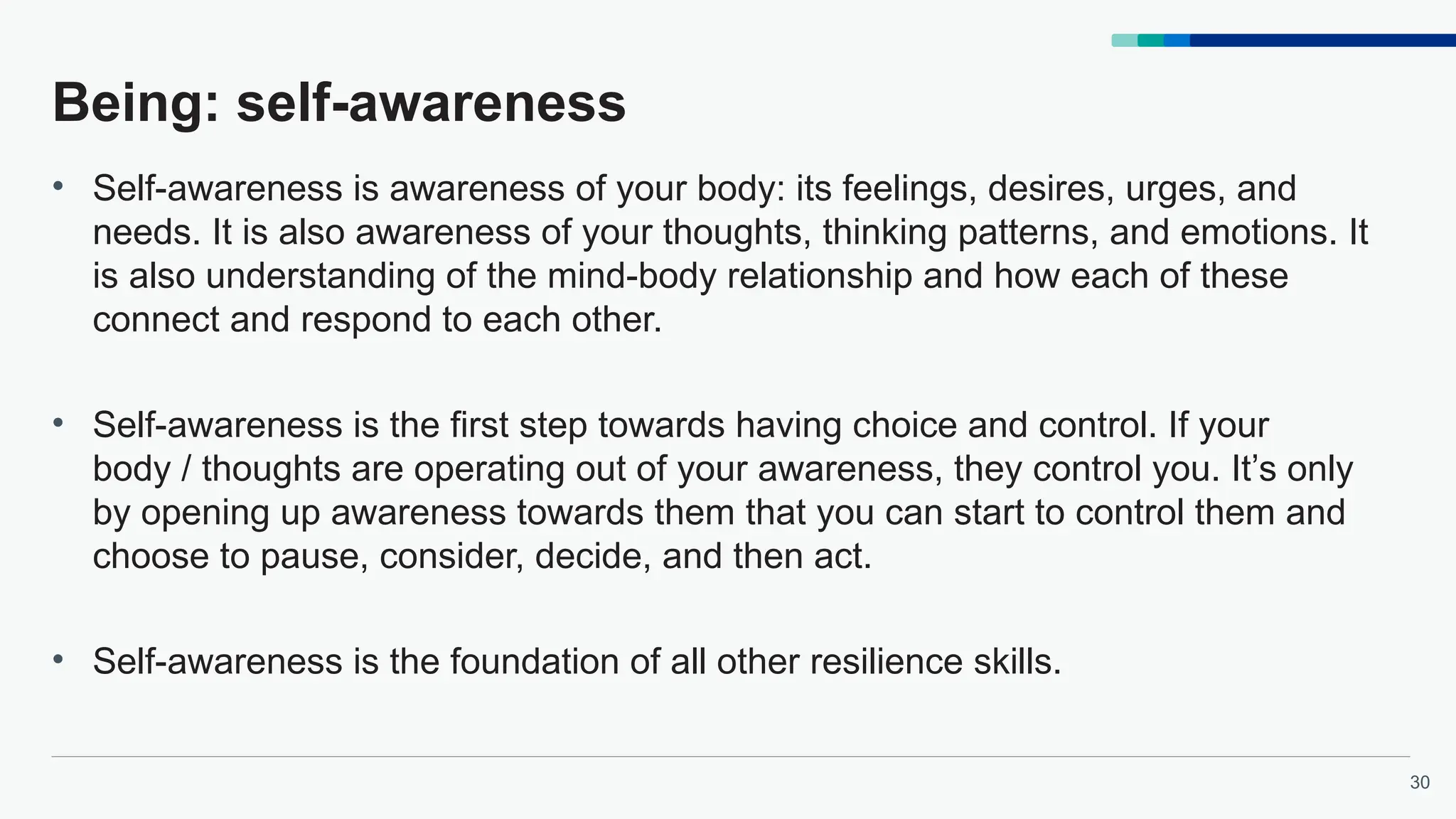
Being: self-awareness
• Self-awareness is awareness of your body: its feelings, desires, urges, and
needs. It is also awareness of your thoughts, thinking patterns, and emotions. It
is also understanding of the mind-body relationship and how each of these
connect and respond to each other.
• Self-awareness is the first step towards having choice and control. If your
body / thoughts are operating out of your awareness, they control you. It’s only
by opening up awareness towards them that you can start to control them and
choose to pause, consider, decide, and then act.
• Self-awareness is the foundation of all other resilience skills.
31
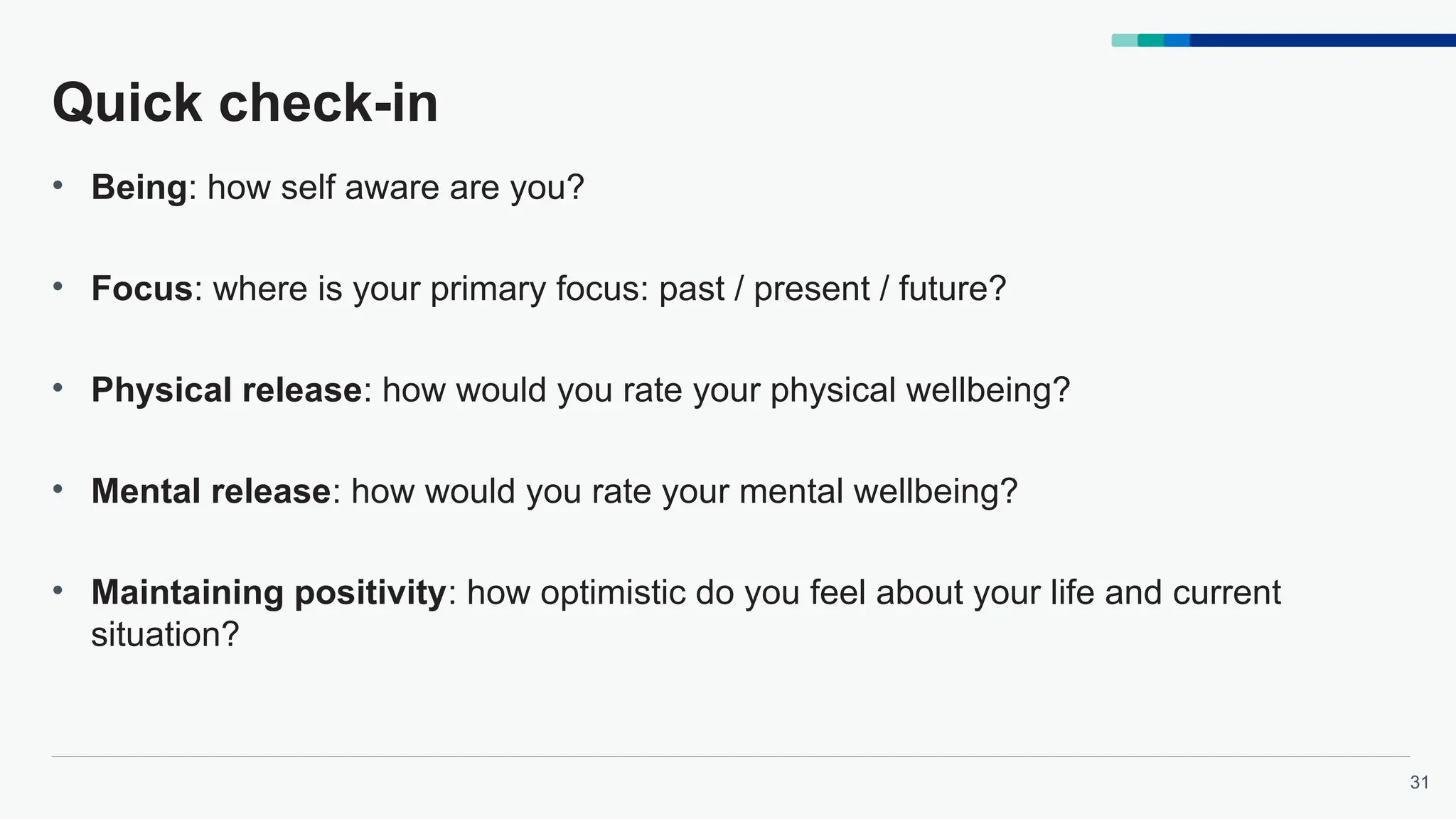
Quick check-in
• Being: how self aware are you?
• Focus: where is your primary focus: past / present / future?
• Physical release: how would you rate your physical wellbeing?
• Mental release: how would you rate your mental wellbeing?
• Maintaining positivity: how optimistic do you feel about your life and current
situation?
32
Starter steps to resilience
• Can you come up with some easy ways to try and become more resilient?
• Focus on things that you can weave into your everyday life (for example,
smiling more, practising mindfulness each morning / evening, keeping a
gratitude journal…).
33
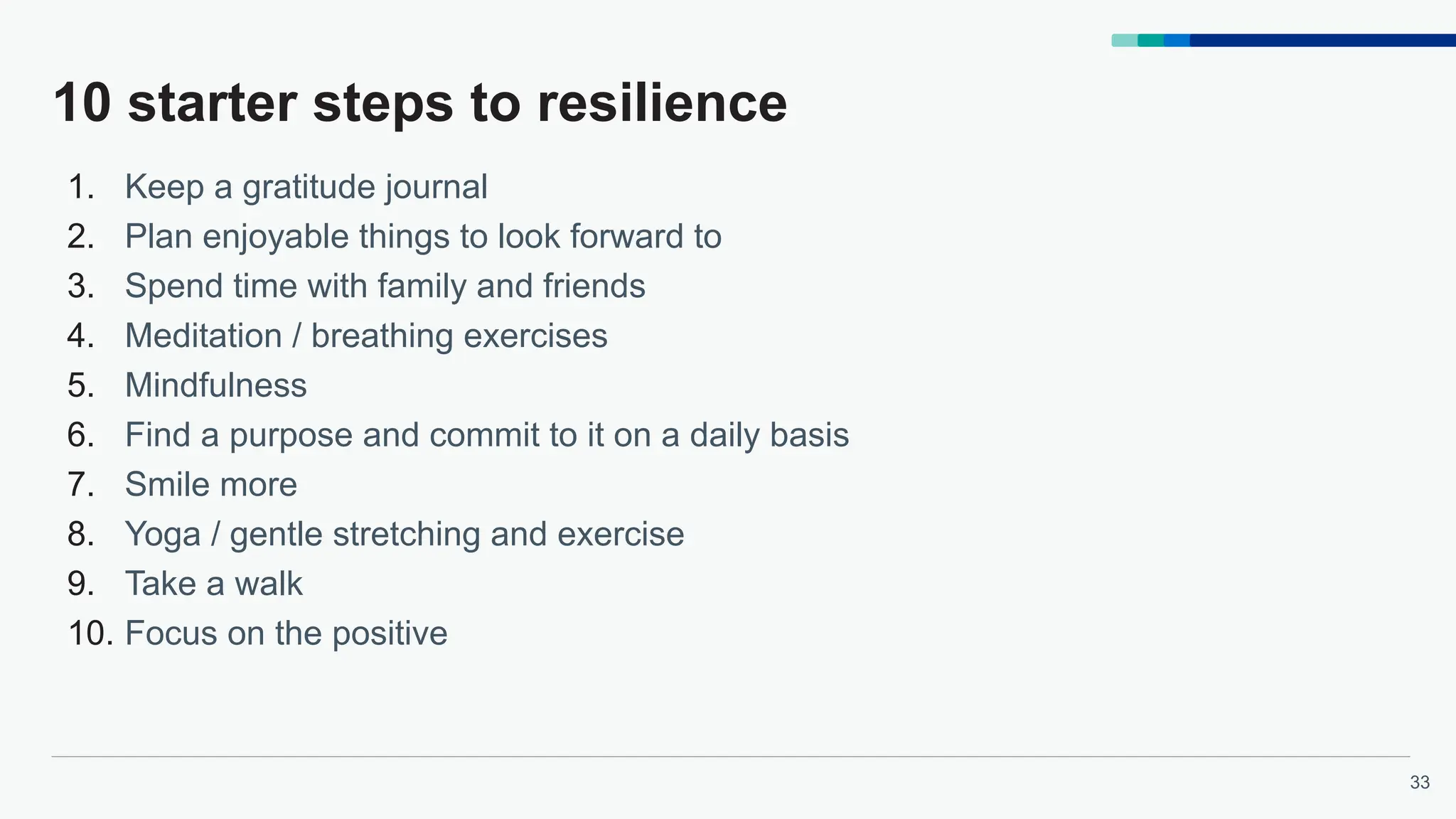
10 starter steps to resilience
1. Keep a gratitude journal
2. Plan enjoyable things to look forward to
3. Spend time with family and friends
4. Meditation / breathing exercises
5. Mindfulness
6. Find a purpose and commit to it on a daily basis
7. Smile more
8. Yoga / gentle stretching and exercise
9. Take a walk
10. Focus on the positive
34
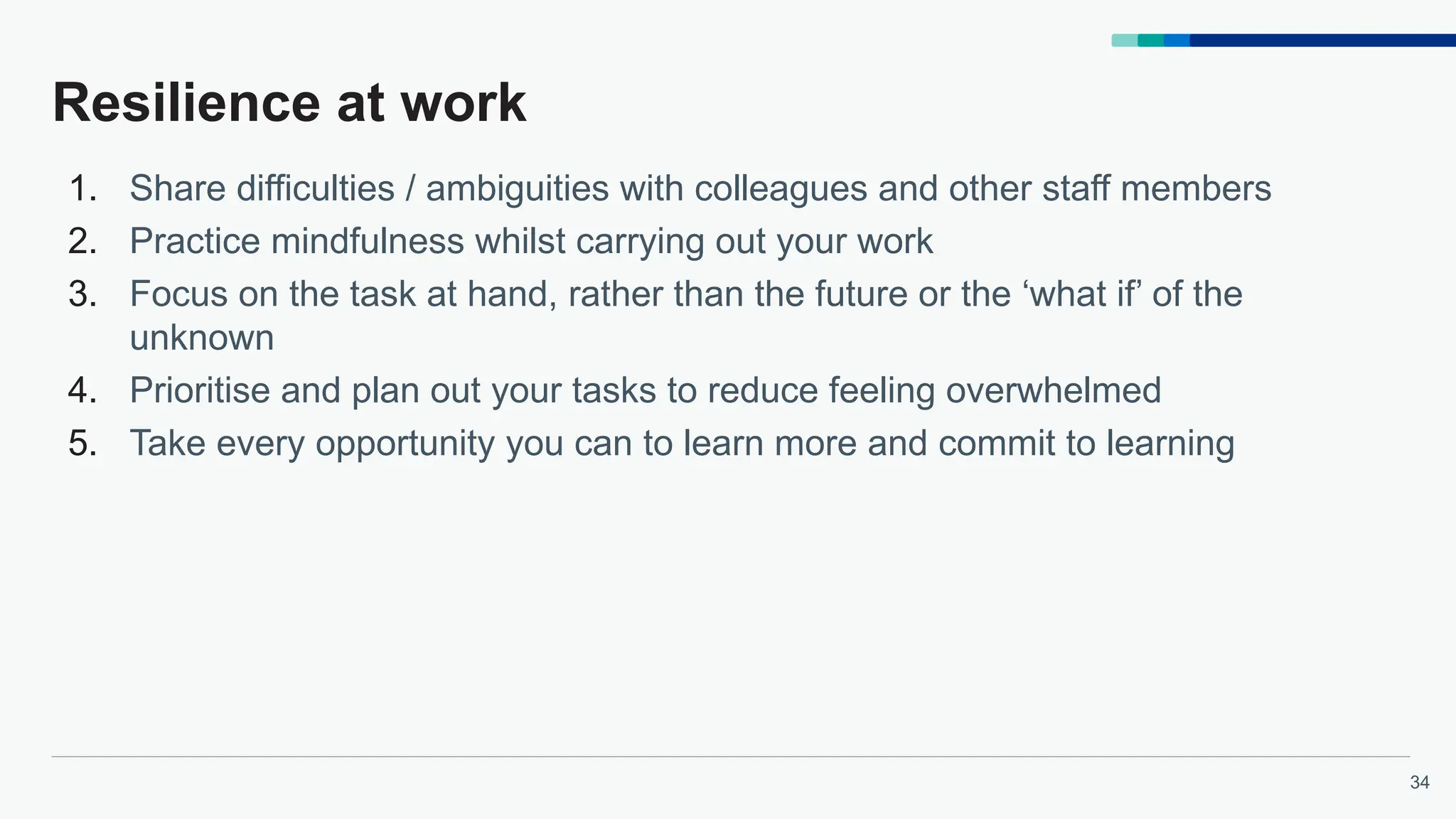
Resilience at work
1. Share difficulties / ambiguities with colleagues and other staff members
2. Practice mindfulness whilst carrying out your work
3. Focus on the task at hand, rather than the future or the ‘what if’ of the
unknown
4. Prioritise and plan out your tasks to reduce feeling overwhelmed
5. Take every opportunity you can to learn more and commit to learning
35
Wellbeing strategies
• There is a number of different strategies to help you improve your mental and
emotional well-being.
• Not every technique works for every individual – it is about finding which works
best for you.
• The next few slides provide some different ideas for you and further resources
are available on the CapitalNurse website under ‘compassionate education’.
36
Sources of support
Asking for help when you need it is a sign of strength and should be your first
action when feeling overwhelmed. There are various sources of support available:
• your preceptor
• your manager
• colleagues
• Professional Nurse Advocate (PNA).
37
Professional Nurse Advocate
• The role of the PNA is to provide restorative supervision to nursing and
midwifery support.
• Every organisation offers access to the PNA programme.
• Each PNA is specially trained to provide restorative supervision.
• Restorative supervision is particularly effective in reducing burnout and stress
by providing an opportunity for discussion and reflective learning following an
incident or in challenging situations. The PNA will help an individual to gain
perspective and take control in difficult times.
38
Next steps…
• Pair up with a ‘buddy’.
• Pick two actions (each) to carry out over the following week, to help build your
resilience.
• Set a time, roughly one week in advance, to meet up again
• Check in with your ‘buddy’ to see how far each of you have managed to try your
resilience building activities into your week
39
FOFBOC
Feet on Floor, Body On Chair
Developed as a mindfulness technique, this 3-minute method takes you from 'fight or
flight' to 'rest and digest' which can help after a difficult intervention:
• Sit on a chair with feet resting on the floor
• Feel your body on the chair
• Now feel your feet on the floor
• Think about your legs and how they feel moving onto lower body
• Focus on your belly, then your breathing
• Sit and relax for just a couple of minutes tuned into an awareness of your body
40
Body awareness
A technique to help you focus on yourself in the present. You can do this sitting or standing. Focus
on how your body feels from head to toe, noticing each part in turn:
• Can you feel your hair around your face, forehead, or shoulders? Glasses on your ears or your
nose? Any earrings in your ears or necklace around your neck? The weight of your shirt on your
shoulders?
• What position are your arms in? Do they feel relaxed or tense? Can you feel your heartbeat? Is it
rapid or steady?
• Does your stomach feel full, or are you hungry?
• Are your legs crossed, or are your feet resting on the floor?
• Is your back straight?
• Curl your fingers and wiggle your toes. Are you barefoot or in shoes? Are your feet warm or cold?
How does the floor feel against your feet?
41
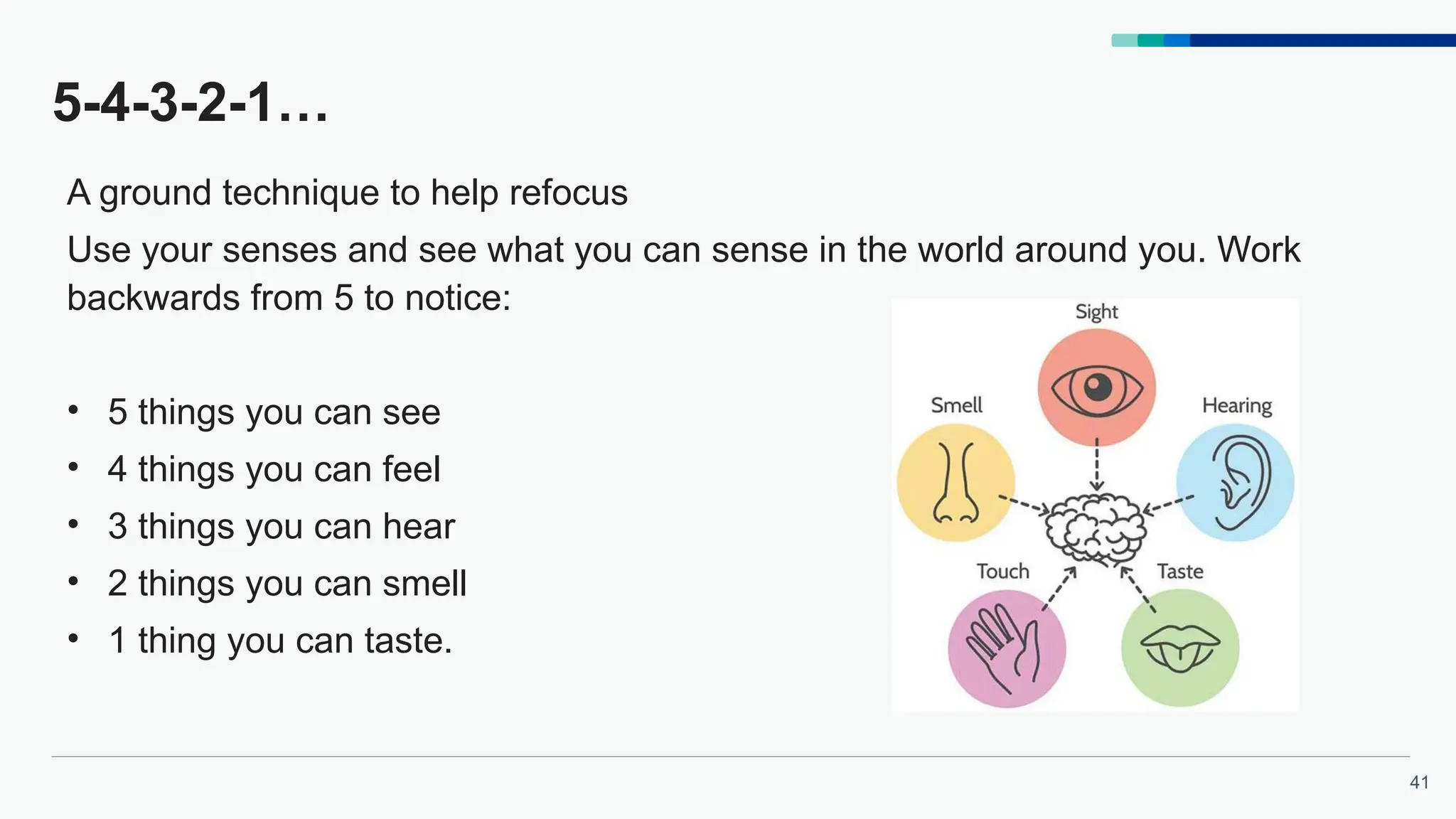
5-4-3-2-1…
A ground technique to help refocus
Use your senses and see what you can sense in the world around you. Work
backwards from 5 to notice:
• 5 things you can see
• 4 things you can feel
• 3 things you can hear
• 2 things you can smell
• 1 thing you can taste.
42
Category thinking
Refocus activity
This simple activity helps distract your mind whilst focusing on something
meaningless. It helps to refocus your energy.
• Take a category – for example: musical instruments, or ice cream flavours.
• Give yourself a minute or two to list as many things from that category as
possible.
43
I remember, I remember…
‘I remember, I remember,
The house where I was born,
The little window where the sun
Came peeping in at morn…’
Choose a happy memory. Then close your eyes and think about:
• what are you doing?
• where are you?
• who’s with you?
• what can you feel?
44
3-4-5 Breathing
This simple breathing techniques helped you to reduce the activation of your
stress state and encourage your body to move into a 'thrive' state.
Find a quiet place, you may want to close your eyes:
• breathe in for three seconds
• hold your breath for four seconds
• breathe out for five seconds
• repeat for a few minutes.
45
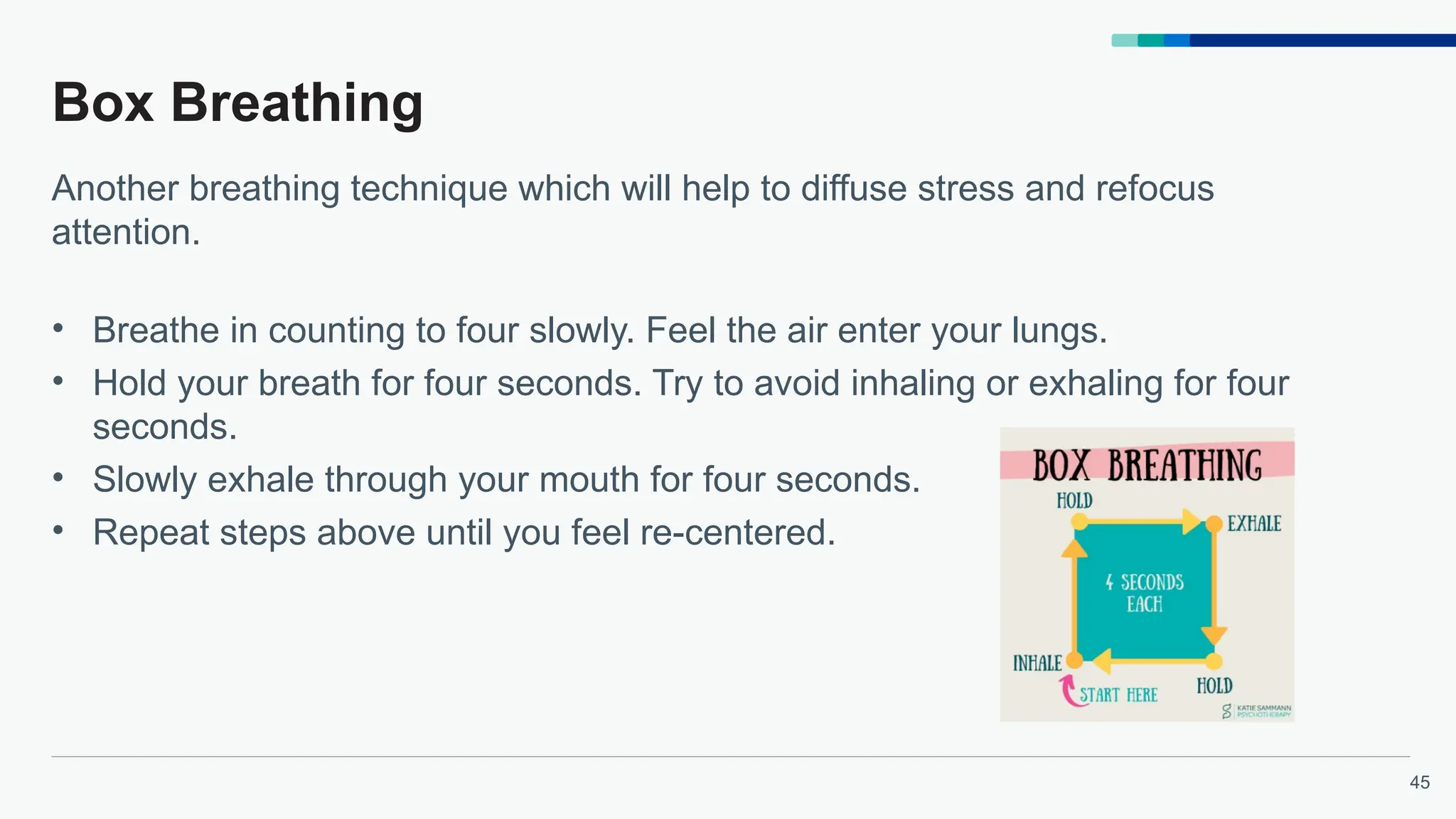
Box Breathing
Another breathing technique which will help to diffuse stress and refocus
attention.
• Breathe in counting to four slowly. Feel the air enter your lungs.
• Hold your breath for four seconds. Try to avoid inhaling or exhaling for four
seconds.
• Slowly exhale through your mouth for four seconds.
• Repeat steps above until you feel re-centered.
46
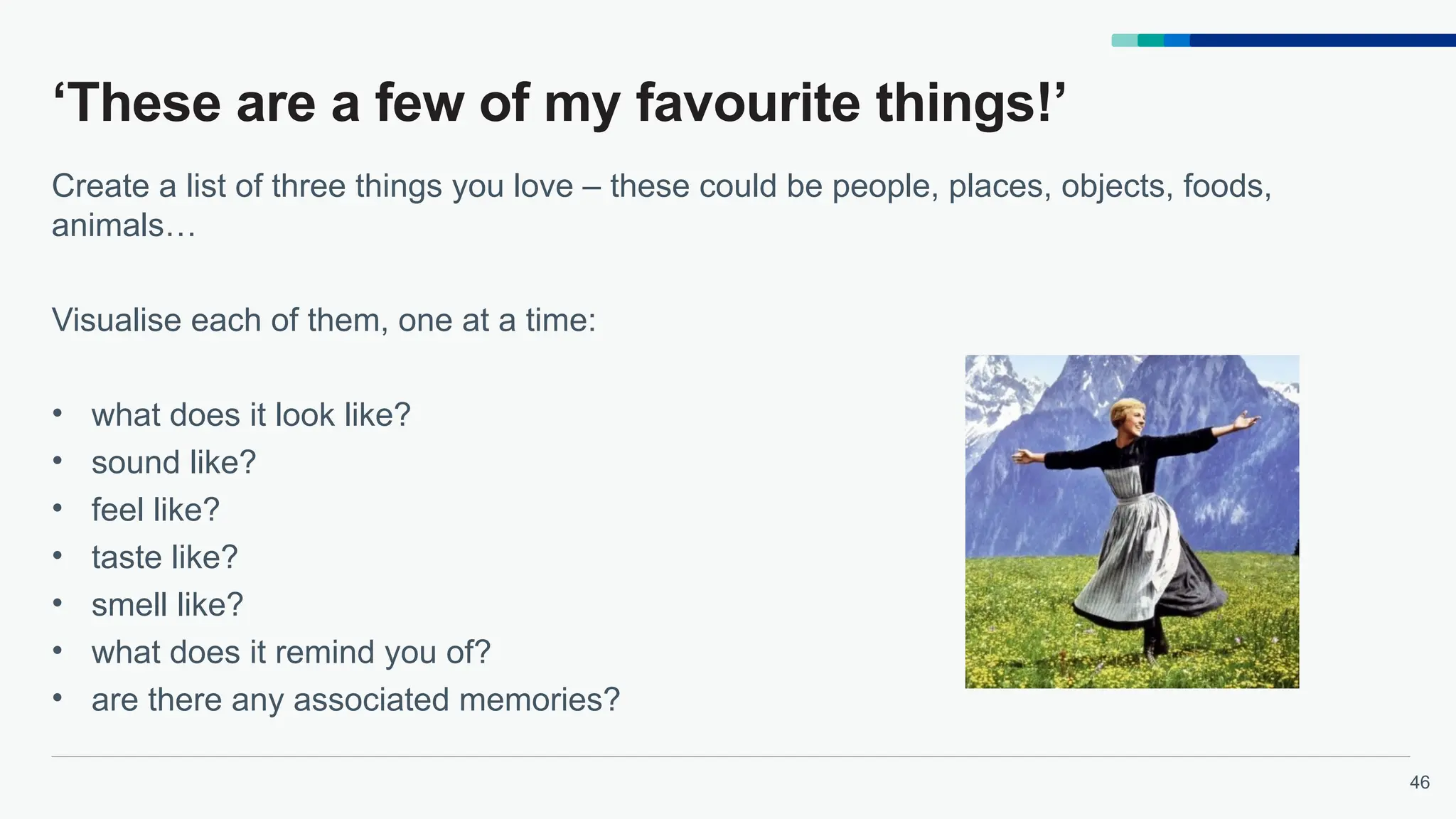
‘These are a few of my favourite things!’
Create a list of three things you love – these could be people, places, objects, foods,
animals…
Visualise each of them, one at a time:
• what does it look like?
• sound like?
• feel like?
• taste like?
• smell like?
• what does it remind you of?
• are there any associated memories?
47
References
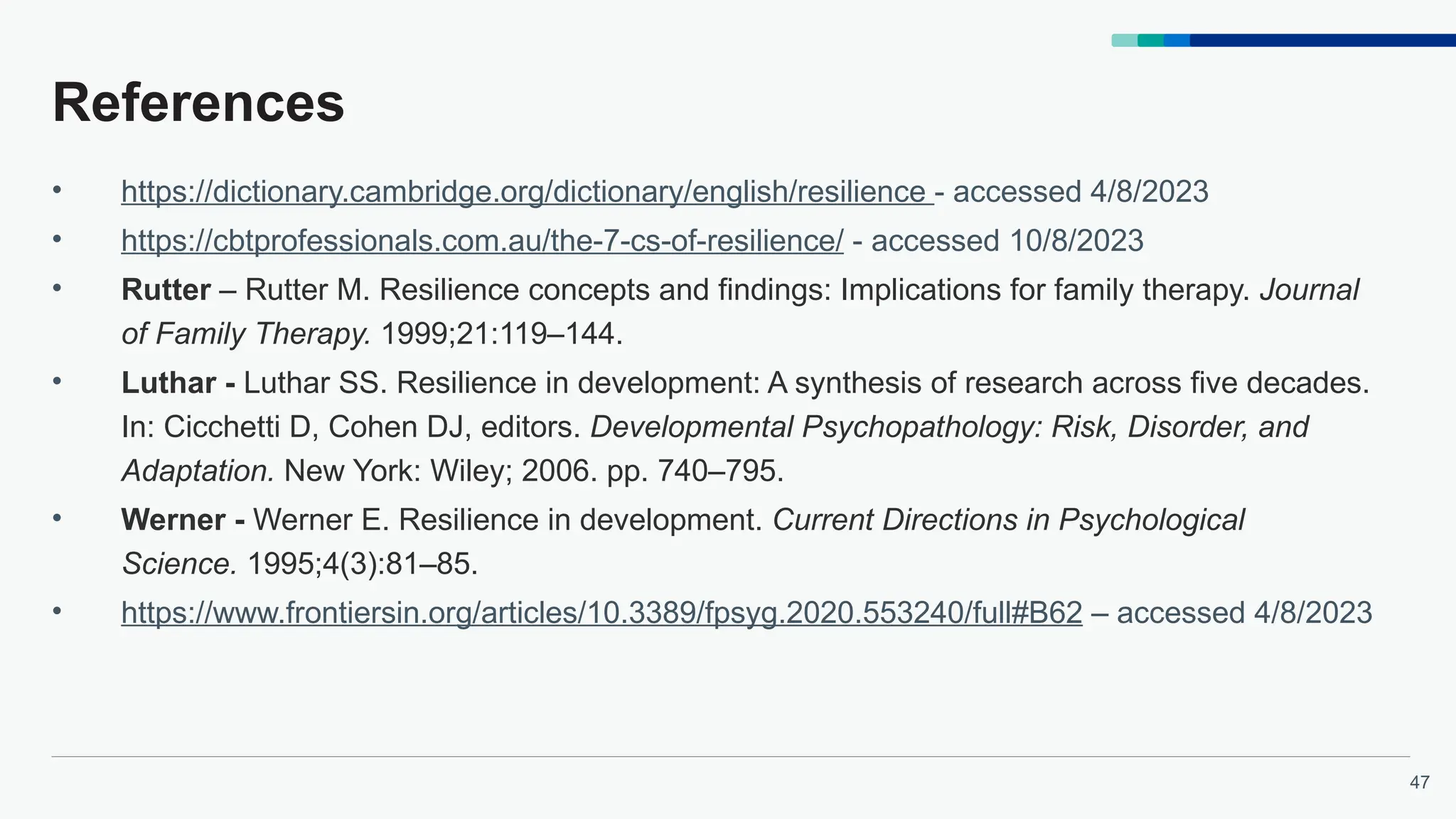
• https://dictionary.cambridge.org/dictionary/english/resilience - accessed 4/8/2023
• https://cbtprofessionals.com.au/the-7-cs-of-resilience/ - accessed 10/8/2023
• Rutter – Rutter M. Resilience concepts and findings: Implications for family therapy. Journal
of Family Therapy. 1999;21:119–144.
• Luthar - Luthar SS. Resilience in development: A synthesis of research across five decades.
In: Cicchetti D, Cohen DJ, editors. Developmental Psychopathology: Risk, Disorder, and
Adaptation. New York: Wiley; 2006. pp. 740–795.
• Werner - Werner E. Resilience in development. Current Directions in Psychological
Science. 1995;4(3):81–85.
• https://www.frontiersin.org/articles/10.3389/fpsyg.2020.553240/full#B62 – accessed 4/8/2023
48
Acknowledgments
Written by Desiree Cox, CapitalNurse Preceptorship Project Manager and National
Preceptorship Programme Lead, NHS England, with thanks to:
• Tracey Coyne, Preceptorship Lead, London and North West Hospitals
• James Clay, Preceptorship Lead, Central and North West London NHS Foundation Trust
• Riina Hilton, Preceptorship Lead, NELFT NHS Foundation Trust
• Maddy Cox, Clinical Nurse Specialist, Epsom and St Helier
• Jake Chambers, Oxleas
• Hannah Fosbery, University College London Hospital

Resilence and its importance in our day life

  • 1.
  • 2.
    2 Objectives • be awareof stress factors, symptoms and impact • understand what resilience means • understand the 7 Cs of resilience and how to apply to yourself • be able to identify ways of developing resilience • be aware of different sources of support. By the end of the session, you will:
  • 3.
    3 What is stress? ‘Theadverse reaction people have to excessive pressures or other types of demand placed on them’. Health and Safety Executive
  • 4.
    4 Impact on staff •Stress causes demotivation and disengagement • Tasks are not done to the same quality or to deadline • Knock-on effect on colleagues causing frustration and poor team synergy, increased workload and associated pressure • Reduced efficiency and performance • Staff lacking skills and competency • Poor level of service for customers
  • 5.
    5 Reflection • What causesyou stress? • Can you identify certain triggers? • How do you feel when you are stressed?
  • 6.
    6 Sources of stress Stressis different for everyone, and the sources are therefore different. However, they can be identified into three main categories: Personal Role Organisational Financial problems Too much to do Working patterns Personal problems Not enough to do Nature of work Pace of life Role confusion Working environment Commitments Working relationships Management style Social environment Lack of feedback Organisational culture Poor physical health Uncertainty / change Poor team working Poor mental health Organisational culture Change and restructure Bullying / Harassment Level of management control
  • 7.
    7 Symptoms of stress PhysicalMental Emotional Behavioural Headaches Panic attacks Frequent illness Nausea Weight loss / gain Poor sleeping habits Indecisiveness Forgetfulness Making mistakes Poor concentration Worrying over trivial matters Loss of perspective Irritability Loss of confidence General depression Crying Fear and anxiety Taking offence Lack of sociability Restlessness Unable to focus Poor time management Withdrawal
  • 8.
    8 Stress curve Level ofstress Performance LOW HIGH HIGH Lethargy, tiredness, demotivation, lack of enthusiasm - Rust-out Exhaustion, anxiety, stress, panic, overloaded anger - Burnt out Motivated, energetic enthusiastic Peak performance Motivation kicking in, less tired Getting there Anxious, stressed, tired, distracted Caution
  • 9.
    9 Reflection • What does‘resilience’ mean to you in your role and workplace? • Who can you think of who illustrates resilience and demonstrates it in their life? • How resilient do you think you are?
  • 10.
    10 What is resilience? •the ability to be happy, successful, etc. again after something difficult or bad has happened: - trauma researchers emphasize the resilience of the human psyche • the ability of a substance to return to its usual shape after being bent, stretched, or pressed: - the plant fibre has incredible strength and resilience. A dictionary definition:
  • 11.
    11 Definitions of resilience Werner(1995) defines resilience in relation to three central usages: • good developmental outcomes despite high-risk status • sustained competence under stress • recovery from trauma. Luthar (2006) defines resilience as ‘positive adaptation despite adversity. For him, it is built up of two things which, when measured, offer an indication of resilience: • significant adversity • positive adaptation.
  • 12.
    12 7Cs of resilience Dr.Ginsburg is a paediatrician specialising in Adolescent Medicine at the Children's Hospital of Philadelphia. He defines 7 elements that make up resilience. He believes that these are integral and inter-related to being resilient: • competence • confidence • connection • character • contribution • coping • control.
  • 13.
    13 Competence • Competence isthe ability to handle difficult and stressful situations effectively. • You may have to face challenges and deal with a range of stressful situations, but as you experience more and more of these, your competence grows. Tip: When in a difficult situation and doubting your competence, consider previous similar situations. Think about how you coped previously and use that to increase self-belief that you can handle your current challenge.
  • 14.
    14 Confidence • Confidence isyour belief in yourselves and your own ability. It is knowing yourself, your competences, your values, your beliefs and your qualities. • Self-confidence is essential to help you grow and develop. A sense of confidence helps you to cope in stressful situations and to maintain a health emotional and physical wellbeing. Tip: When you’re feeling overwhelmed, stressed or lacking confidence, remind yourself of who you are as an individual, your values and beliefs. Identify areas of strength and focus on these.
  • 15.
    15 Reflection • How confidentdo you feel in your current role / workplace? • Now think about times / situations when you have felt very confident and think about how you can use this to boost your confidence.
  • 16.
    16 Connection • In stressfulsituations, we often feel isolated and alone and our natural response to stress can be to withdraw from others. • Sharing problems, concerns and worries with others (colleagues, friends, family) can help to establish a sense of connection and feeling of normality. • Human touch also validates us as individuals and boosts our self-esteem. Tip: When you’re feeling very stressed or face a challenging situation, instead of withdrawing, surround yourself with other people, find someone to talk to and share your concerns.
  • 17.
    17 Reflection • How wellconnected do you feel to others? - In the workplace - Family - Friends and colleagues • Do you find this changes when you’re in difficult situations? • Have you got someone you can offload to when things are stressful and challenging?
  • 18.
    18 Character • There arelinks between strong character and high resilience. • These character traits include having a positive attitude, looking on the bright side, focusing on goals and having a clear purpose. • These traits help to develop emotional stability. Tip: In stressful situations, focus on the positive traits of your character to help you draw inner strength and develop resilience in difficult situations.
  • 19.
    19 Contribution • Our contributionto the world reminds us of who we are and our place in the lives of others. • Making a difference to someone helps us to feel good and can boost our self- esteem. • Contribution to teams, patients and families can build connection with others and develop our self-confidence. Tip: When you’re feeling stressed or challenged, remind yourself of what you contribute to others and the difference it makes to them.
  • 20.
    20 Reflection • Make apoint of giving positive feedback to three other people over the next couple of days. • Consider their reaction – how does this make you feel?
  • 21.
    21 Coping • Our copingskills are essential in developing our resilience. However, we are all individuals and find different way of coping with different situations. • Strategies may include meditation, exercise, fresh air, talking to others, listening to relaxing music. Tip: Identify your coping strategies and use these in difficult situations to help developing your resilience.
  • 22.
    22 Reflection • What copingstrategies are you aware of? • Which ones are most appropriate for you?
  • 23.
    23 Control • Rotter’s (1966)‘Locus of Control’ theory suggests that the level of control we have over a situations influences our resilience. • Those with a strong internal locus of control have an increased ability to interpret and manage difficult situations. • This in turn increases their confidence and resilience in challenging circumstances. Tip: Remind yourself of your ability and confidence in difficult situations to help you manage a challenge more effectively.
  • 24.
    24 Reflection • Take arecent situation which you found challenging, where you faced adversity or difficulty. Apply each of the 7Cs to your response to see how resilient you were able to be. • Then, consider the questions on the next slide.
  • 25.
    25 How resilient was/ am I? • Did you feel fully competent and able to deal with the situation at hand? • How much trust and faith did you have in your own / others’ abilities to deal with the situation? • How far did you connect to others during / after the situation? • Do you feel that you are strong enough to handle the situation? • Did you contribute to help resolve the situation? • Are you able to cope, emotionally and physically, with the fallout of the situation? • How in control of the situation did you feel?
  • 26.
    26 ‘When we learnhow to become resilient, we learn how to embrace the beautifully broad spectrum of the human experience.’ ― Jaeda Dewalt
  • 27.
    27 Barriers to resilience •An imbalance between work and personal life • Overexposure to stressful events • Insufficient time and space to process negative feelings • Humiliating experiences • Social isolation • Feeling stressed and burnt out
  • 28.
    28 Reflection • On ascale of one to ten, rate how far you feel that the five barriers to resilience affect you. - 1 = not at all -10 = completely • How can you overcome these barriers?
  • 29.
    29 Building resilience skills Being •How aware are you of your body, thoughts feelings and emotions? • Do you understand your triggers of stress, how these will impact and how to manage? Focus • Where is your attention focussed? • Being more ‘in the present’ helps you be more engaged in the current situation rather than worrying about future or past Physical • What is your physical health and wellbeing like? • Do you exercise to help release physical stress? Mental • How would you rate your mental and emotional wellbeing? • Are there areas you can improve? Are there activities that may help you? Positivity • How is your general attitude to work and life – do you feel more positive or negative?
  • 30.
    30 Being: self-awareness • Self-awarenessis awareness of your body: its feelings, desires, urges, and needs. It is also awareness of your thoughts, thinking patterns, and emotions. It is also understanding of the mind-body relationship and how each of these connect and respond to each other. • Self-awareness is the first step towards having choice and control. If your body / thoughts are operating out of your awareness, they control you. It’s only by opening up awareness towards them that you can start to control them and choose to pause, consider, decide, and then act. • Self-awareness is the foundation of all other resilience skills.
  • 31.
    31 Quick check-in • Being:how self aware are you? • Focus: where is your primary focus: past / present / future? • Physical release: how would you rate your physical wellbeing? • Mental release: how would you rate your mental wellbeing? • Maintaining positivity: how optimistic do you feel about your life and current situation?
  • 32.
    32 Starter steps toresilience • Can you come up with some easy ways to try and become more resilient? • Focus on things that you can weave into your everyday life (for example, smiling more, practising mindfulness each morning / evening, keeping a gratitude journal…).
  • 33.
    33 10 starter stepsto resilience 1. Keep a gratitude journal 2. Plan enjoyable things to look forward to 3. Spend time with family and friends 4. Meditation / breathing exercises 5. Mindfulness 6. Find a purpose and commit to it on a daily basis 7. Smile more 8. Yoga / gentle stretching and exercise 9. Take a walk 10. Focus on the positive
  • 34.
    34 Resilience at work 1.Share difficulties / ambiguities with colleagues and other staff members 2. Practice mindfulness whilst carrying out your work 3. Focus on the task at hand, rather than the future or the ‘what if’ of the unknown 4. Prioritise and plan out your tasks to reduce feeling overwhelmed 5. Take every opportunity you can to learn more and commit to learning
  • 35.
    35 Wellbeing strategies • Thereis a number of different strategies to help you improve your mental and emotional well-being. • Not every technique works for every individual – it is about finding which works best for you. • The next few slides provide some different ideas for you and further resources are available on the CapitalNurse website under ‘compassionate education’.
  • 36.
    36 Sources of support Askingfor help when you need it is a sign of strength and should be your first action when feeling overwhelmed. There are various sources of support available: • your preceptor • your manager • colleagues • Professional Nurse Advocate (PNA).
  • 37.
    37 Professional Nurse Advocate •The role of the PNA is to provide restorative supervision to nursing and midwifery support. • Every organisation offers access to the PNA programme. • Each PNA is specially trained to provide restorative supervision. • Restorative supervision is particularly effective in reducing burnout and stress by providing an opportunity for discussion and reflective learning following an incident or in challenging situations. The PNA will help an individual to gain perspective and take control in difficult times.
  • 38.
    38 Next steps… • Pairup with a ‘buddy’. • Pick two actions (each) to carry out over the following week, to help build your resilience. • Set a time, roughly one week in advance, to meet up again • Check in with your ‘buddy’ to see how far each of you have managed to try your resilience building activities into your week
  • 39.
    39 FOFBOC Feet on Floor,Body On Chair Developed as a mindfulness technique, this 3-minute method takes you from 'fight or flight' to 'rest and digest' which can help after a difficult intervention: • Sit on a chair with feet resting on the floor • Feel your body on the chair • Now feel your feet on the floor • Think about your legs and how they feel moving onto lower body • Focus on your belly, then your breathing • Sit and relax for just a couple of minutes tuned into an awareness of your body
  • 40.
    40 Body awareness A techniqueto help you focus on yourself in the present. You can do this sitting or standing. Focus on how your body feels from head to toe, noticing each part in turn: • Can you feel your hair around your face, forehead, or shoulders? Glasses on your ears or your nose? Any earrings in your ears or necklace around your neck? The weight of your shirt on your shoulders? • What position are your arms in? Do they feel relaxed or tense? Can you feel your heartbeat? Is it rapid or steady? • Does your stomach feel full, or are you hungry? • Are your legs crossed, or are your feet resting on the floor? • Is your back straight? • Curl your fingers and wiggle your toes. Are you barefoot or in shoes? Are your feet warm or cold? How does the floor feel against your feet?
  • 41.
    41 5-4-3-2-1… A ground techniqueto help refocus Use your senses and see what you can sense in the world around you. Work backwards from 5 to notice: • 5 things you can see • 4 things you can feel • 3 things you can hear • 2 things you can smell • 1 thing you can taste.
  • 42.
    42 Category thinking Refocus activity Thissimple activity helps distract your mind whilst focusing on something meaningless. It helps to refocus your energy. • Take a category – for example: musical instruments, or ice cream flavours. • Give yourself a minute or two to list as many things from that category as possible.
  • 43.
    43 I remember, Iremember… ‘I remember, I remember, The house where I was born, The little window where the sun Came peeping in at morn…’ Choose a happy memory. Then close your eyes and think about: • what are you doing? • where are you? • who’s with you? • what can you feel?
  • 44.
    44 3-4-5 Breathing This simplebreathing techniques helped you to reduce the activation of your stress state and encourage your body to move into a 'thrive' state. Find a quiet place, you may want to close your eyes: • breathe in for three seconds • hold your breath for four seconds • breathe out for five seconds • repeat for a few minutes.
  • 45.
    45 Box Breathing Another breathingtechnique which will help to diffuse stress and refocus attention. • Breathe in counting to four slowly. Feel the air enter your lungs. • Hold your breath for four seconds. Try to avoid inhaling or exhaling for four seconds. • Slowly exhale through your mouth for four seconds. • Repeat steps above until you feel re-centered.
  • 46.
    46 ‘These are afew of my favourite things!’ Create a list of three things you love – these could be people, places, objects, foods, animals… Visualise each of them, one at a time: • what does it look like? • sound like? • feel like? • taste like? • smell like? • what does it remind you of? • are there any associated memories?
  • 47.
    47 References • https://dictionary.cambridge.org/dictionary/english/resilience -accessed 4/8/2023 • https://cbtprofessionals.com.au/the-7-cs-of-resilience/ - accessed 10/8/2023 • Rutter – Rutter M. Resilience concepts and findings: Implications for family therapy. Journal of Family Therapy. 1999;21:119–144. • Luthar - Luthar SS. Resilience in development: A synthesis of research across five decades. In: Cicchetti D, Cohen DJ, editors. Developmental Psychopathology: Risk, Disorder, and Adaptation. New York: Wiley; 2006. pp. 740–795. • Werner - Werner E. Resilience in development. Current Directions in Psychological Science. 1995;4(3):81–85. • https://www.frontiersin.org/articles/10.3389/fpsyg.2020.553240/full#B62 – accessed 4/8/2023
  • 48.
    48 Acknowledgments Written by DesireeCox, CapitalNurse Preceptorship Project Manager and National Preceptorship Programme Lead, NHS England, with thanks to: • Tracey Coyne, Preceptorship Lead, London and North West Hospitals • James Clay, Preceptorship Lead, Central and North West London NHS Foundation Trust • Riina Hilton, Preceptorship Lead, NELFT NHS Foundation Trust • Maddy Cox, Clinical Nurse Specialist, Epsom and St Helier • Jake Chambers, Oxleas • Hannah Fosbery, University College London Hospital

Editor's Notes

  • #1 Standard title slide
  • #2 Plain slide with subhead and bullets
  • #3 Plain slide with subhead and bullets
  • #4 Plain slide with subhead and bullets
  • #5 Plain slide with subhead and bullets
  • #6 Plain slide with subhead and bullets
  • #7 Plain slide with subhead and bullets
  • #8 Plain slide with subhead and bullets
  • #9 Plain slide with subhead and bullets
  • #10 Plain slide with subhead and bullets
  • #11 Plain slide with subhead and bullets
  • #12 Plain slide with subhead and bullets
  • #13 Plain slide with subhead and bullets
  • #14 Plain slide with subhead and bullets
  • #15 Plain slide with subhead and bullets
  • #16 Plain slide with subhead and bullets
  • #17 Plain slide with subhead and bullets
  • #18 Plain slide with subhead and bullets
  • #19 Plain slide with subhead and bullets
  • #20 Plain slide with subhead and bullets
  • #21 Plain slide with subhead and bullets
  • #22 Plain slide with subhead and bullets
  • #23 Plain slide with subhead and bullets
  • #24 Plain slide with subhead and bullets
  • #25 Plain slide with subhead and bullets
  • #26 Plain slide with subhead and bullets
  • #27 Plain slide with subhead and bullets
  • #28 Plain slide with subhead and bullets
  • #29 Plain slide with subhead and bullets
  • #30 Plain slide with subhead and bullets
  • #31 Plain slide with subhead and bullets
  • #32 Plain slide with subhead and bullets
  • #33 Plain slide with subhead and bullets
  • #34 Plain slide with subhead and bullets
  • #35 Plain slide with subhead and bullets
  • #36 Plain slide with subhead and bullets
  • #37 Plain slide with subhead and bullets
  • #38 Plain slide with subhead and bullets
  • #39 Plain slide with subhead and bullets
  • #40 Plain slide with subhead and bullets
  • #41 Plain slide with subhead and bullets
  • #42 Plain slide with subhead and bullets
  • #43 Plain slide with subhead and bullets
  • #44 Plain slide with subhead and bullets
  • #45 Plain slide with subhead and bullets
  • #46 Plain slide with subhead and bullets
  • #47 Plain slide with subhead and bullets
  • #48 Plain slide with subhead and bullets