Why People Buy:
Consumer Behavior
Consumer Behavior
• The process individuals and groups go
through to select, purchase, or use goods,
services, ideas, or experiences
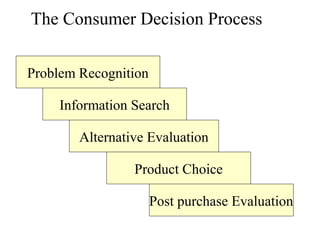
The Consumer Decision Process
Problem Recognition
Information Search
Alternative Evaluation
Product Choice
Post purchase Evaluation
Problem Recognition
• Occurs whenever a consumer recognizes a
difference between the current state and the
ideal or desired state
• Internal cues - consumers recognize state of
discomfort
• External cues - marketers may stimulate
consumers to recognize problem
Information Search
• Consumer checks memory and surveys
environment to identify what options are
available
• Sources might include personal experience
and knowledge, friends, advertising, web
sites, and magazines.
Evaluation of Alternatives
• Identify consideration set
• Narrow list and compare pros and cons
• Use evaluative criteria to decide among
remaining choices
Product Choice
• People may ultimately make the choice
based on heuristics
• Heuristics represent rules of thumb
– brand loyalty
– country of origin
– liking
Post purchase Evaluation
• How good a choice was it?
• Customer satisfaction/dissatisfaction –
“buyer’s remorse”
• Ultimately affects future decisions and
word of mouth communication
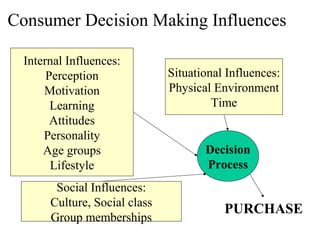
Consumer Decision Making Influences
Internal Influences:
Perception
Motivation
Learning
Attitudes
Personality
Age groups
Lifestyle
Situational Influences:
Physical Environment
Time
Social Influences:
Culture, Social class
Group memberships
Decision
Process
PURCHASE
Internal Influences
• Perception
• Motivation
• Learning
• Attitudes
• Personality
• Age
• Lifestyle
Perception
• Process by which people select, organize,
and interpret information
– Exposure: stimulus must be within sensory
receptors to be noticed
– Perceptual Selection: consumers will pay
attention to some stimuli and not to others
– Interpretation: consumers assign meaning to
stimuli
Motivation
• An internal state that drives us to satisfy
needs
• Once we activate a need, a state of tension
exists that drives the consumer to some goal
that will reduce this tension and eliminate
the need
• Consequently, only unmet needs motivate
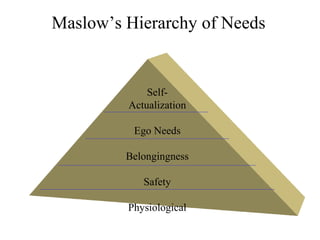
Maslow’s Hierarchy of Needs
Self-
Actualization
Ego Needs
Belongingness
Safety
Physiological
Learning
• A change in behavior caused by information
or experience
• Behavior learning theories assume learning
takes place as the result of connections
formed between events
• Cognitive learning occurs when consumers
make a connection between ideas or by
observing things in their environment
Attitudes
• A lasting evaluation of a person, object, or
issue
• 3 components of attitudes
– affect
– cognition
– behavior
Personality
• The set of unique psychological
characteristics that consistently influences
the way a person responds to situations in
the environment
– Innovativeness
– Self-confidence
– Sociability
Family Life Cycle
• Related to age groups, our purchases also
depend on our current position in the family
life cycle
– stages through which family members pass as
they grow older
Lifestyles
• Pattern of living that determines how people
choose to spend their time, money, energy and
reflects their values, tastes, and preferences
• Expressed through preferences for sports
activities, music interests, and political opinions
• Psychographics is the segmentation tool used to
group consumers according to AIOs
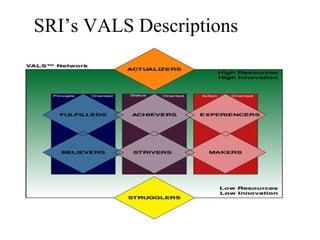
SRI’s VALS Descriptions
Situational Influences
• Physical Environment
– arousal
– pleasure
• Time
– time poverty
Social Influences
• Culture and Subcultures
• Social Class
• Group Behavior and Reference Groups
• Opinion Leaders
Cultures and Subcultures
• Culture is the values, beliefs, customs, and
tastes produced and valued by a group of
people
• A subculture is a group coexisting with
other groups in a larger culture whose
members share a distinctive set of beliefs or
characteristics
Social Class
• Social class is the overall rank of people in
a society
• People in the same class tend to have
similar occupations, similar income levels,
share common tastes in clothes, decorating
styles, and leisure activities. They may
share political and religious beliefs.
Reference Groups
• A reference group is a set of people a
consumer wants to please or imitate
• The “group” can be composed of one
person, a few people, or many people. They
may be people you know or don’t know
– Conformity is at work when people change as a
reaction to real or imagined group pressure
– Sex roles are society’s expectations regarding
appropriate attitudes, behaviors, and appearances for
men and women
Opinion Leaders
• A person who influences others’ attitudes or
behaviors because they are perceived as
possessing expertise about the product

Consumer behaviour

  • 1.
  • 2.
    Consumer Behavior • Theprocess individuals and groups go through to select, purchase, or use goods, services, ideas, or experiences
  • 3.
    The Consumer DecisionProcess Problem Recognition Information Search Alternative Evaluation Product Choice Post purchase Evaluation
  • 4.
    Problem Recognition • Occurswhenever a consumer recognizes a difference between the current state and the ideal or desired state • Internal cues - consumers recognize state of discomfort • External cues - marketers may stimulate consumers to recognize problem
  • 5.
    Information Search • Consumerchecks memory and surveys environment to identify what options are available • Sources might include personal experience and knowledge, friends, advertising, web sites, and magazines.
  • 6.
    Evaluation of Alternatives •Identify consideration set • Narrow list and compare pros and cons • Use evaluative criteria to decide among remaining choices
  • 7.
    Product Choice • Peoplemay ultimately make the choice based on heuristics • Heuristics represent rules of thumb – brand loyalty – country of origin – liking
  • 8.
    Post purchase Evaluation •How good a choice was it? • Customer satisfaction/dissatisfaction – “buyer’s remorse” • Ultimately affects future decisions and word of mouth communication
  • 9.
    Consumer Decision MakingInfluences Internal Influences: Perception Motivation Learning Attitudes Personality Age groups Lifestyle Situational Influences: Physical Environment Time Social Influences: Culture, Social class Group memberships Decision Process PURCHASE
  • 10.
    Internal Influences • Perception •Motivation • Learning • Attitudes • Personality • Age • Lifestyle
  • 11.
    Perception • Process bywhich people select, organize, and interpret information – Exposure: stimulus must be within sensory receptors to be noticed – Perceptual Selection: consumers will pay attention to some stimuli and not to others – Interpretation: consumers assign meaning to stimuli
  • 12.
    Motivation • An internalstate that drives us to satisfy needs • Once we activate a need, a state of tension exists that drives the consumer to some goal that will reduce this tension and eliminate the need • Consequently, only unmet needs motivate
  • 13.
    Maslow’s Hierarchy ofNeeds Self- Actualization Ego Needs Belongingness Safety Physiological
  • 14.
    Learning • A changein behavior caused by information or experience • Behavior learning theories assume learning takes place as the result of connections formed between events • Cognitive learning occurs when consumers make a connection between ideas or by observing things in their environment
  • 15.
    Attitudes • A lastingevaluation of a person, object, or issue • 3 components of attitudes – affect – cognition – behavior
  • 16.
    Personality • The setof unique psychological characteristics that consistently influences the way a person responds to situations in the environment – Innovativeness – Self-confidence – Sociability
  • 17.
    Family Life Cycle •Related to age groups, our purchases also depend on our current position in the family life cycle – stages through which family members pass as they grow older
  • 18.
    Lifestyles • Pattern ofliving that determines how people choose to spend their time, money, energy and reflects their values, tastes, and preferences • Expressed through preferences for sports activities, music interests, and political opinions • Psychographics is the segmentation tool used to group consumers according to AIOs
  • 19.
  • 20.
    Situational Influences • PhysicalEnvironment – arousal – pleasure • Time – time poverty
  • 21.
    Social Influences • Cultureand Subcultures • Social Class • Group Behavior and Reference Groups • Opinion Leaders
  • 22.
    Cultures and Subcultures •Culture is the values, beliefs, customs, and tastes produced and valued by a group of people • A subculture is a group coexisting with other groups in a larger culture whose members share a distinctive set of beliefs or characteristics
  • 23.
    Social Class • Socialclass is the overall rank of people in a society • People in the same class tend to have similar occupations, similar income levels, share common tastes in clothes, decorating styles, and leisure activities. They may share political and religious beliefs.
  • 24.
    Reference Groups • Areference group is a set of people a consumer wants to please or imitate • The “group” can be composed of one person, a few people, or many people. They may be people you know or don’t know – Conformity is at work when people change as a reaction to real or imagined group pressure – Sex roles are society’s expectations regarding appropriate attitudes, behaviors, and appearances for men and women
  • 25.
    Opinion Leaders • Aperson who influences others’ attitudes or behaviors because they are perceived as possessing expertise about the product