CHAPTER 3: PSYCHOLOGICAL RESEARCH
THE SCIENCE OF PSYCHOLOGY
Psychologists follow scientific procedures similar to the way
other scientists do
Research and experiments help investigate cause – and –
effect relationships
• There are two TYPES of research within psychology 🡪
BASIC or APPLIED
THE SCIENCE OF PSYCHOLOGY
Basic research is conducted to study theoretical questions
without trying to solve a specific problem (general ideas or
concepts)
Applied research utilizes the principles and discoveries of
psychology for practical purposes (finding solutions to real
world problems)
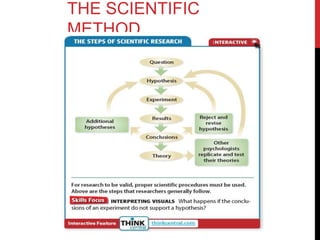
THE SCIENTIFIC METHOD
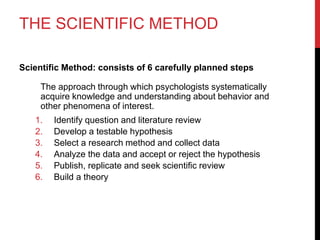
Scientific Method: consists of 6 carefully planned steps
The approach through which psychologists systematically
acquire knowledge and understanding about behavior and
other phenomena of interest.
1. Identify question and literature review
2. Develop a testable hypothesis
3. Select a research method and collect data
4. Analyze the data and accept or reject the hypothesis
5. Publish, replicate and seek scientific review
6. Build a theory
THE SCIENTIFIC
METHOD
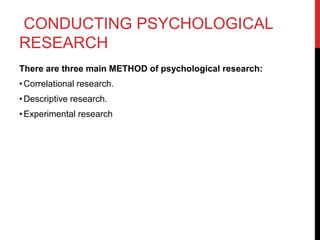
CONDUCTING PSYCHOLOGICAL
RESEARCH
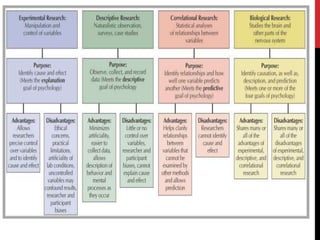
There are three main METHOD of psychological research:
•Correlational research.
•Descriptive research.
•Experimental research
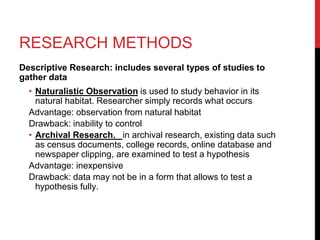
RESEARCH METHODS
Descriptive Research: includes several types of studies to
gather data
• Naturalistic Observation is used to study behavior in its
natural habitat. Researcher simply records what occurs
Advantage: observation from natural habitat
Drawback: inability to control
• Archival Research. in archival research, existing data such
as census documents, college records, online database and
newspaper clipping, are examined to test a hypothesis
Advantage: inexpensive
Drawback: data may not be in a form that allows to test a
hypothesis fully.
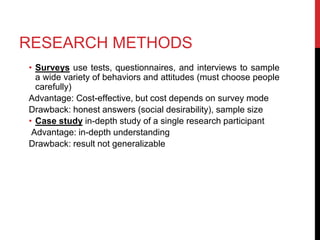
RESEARCH METHODS
• Surveys use tests, questionnaires, and interviews to sample
a wide variety of behaviors and attitudes (must choose people
carefully)
Advantage: Cost-effective, but cost depends on survey mode
Drawback: honest answers (social desirability), sample size
• Case study in-depth study of a single research participant
Advantage: in-depth understanding
Drawback: result not generalizable
RESEARCH METHODS
Correlational Research
A correlation refers to a relationship between two variables.1
Correlations can be strong or weak and positive or negative.
Sometimes, there is no correlation.
•Positive correlations: Both variables increase or decrease at
the same time. A correlation coefficient close to +1.00 indicates a
strong positive correlation.
•Negative correlations: As the amount of one variable
increases, the other decreases (and vice versa). A correlation
coefficient close to -1.00 indicates a strong negative correlation.
•No correlation: There is no relationship between the two
variables. A correlation coefficient of 0 indicates no correlation.
RESEARCH METHODS
Correlation is a major relationship within psychology
It CANNOT show a Cause and Effect Relationship
Just because two things are related does not mean one causes
the other
RESEARCH METHODS
Experimental Research
Experimental research is a scientific approach to research, where
one or more independent variables are manipulated and applied
to one or more dependent variables to measure their effect on the
latter. It assess cause and effect relationship between variables.
•Experimental manipulation
•Experimental and control groups
•Independent and dependent variables
•Random assignment of participants
HARLOW'S STUDIES
https://www.youtube.com/watch?v=OrNBEhzjg8I
THE STANFORD
EXPERIMENT
https://www.youtube.com/watch?v=Ax2teThF3BM
ETHICS OF RESEARCH
Ethical Guidelines when experimenting
1. Human participants 🡪 informed consent, voluntary
participation, debriefing, confidentiality, and use of
students as subjects
• #1 is the most rigorous guideline because it deals with the
rights of people being studied
2. Animal Rights 🡪 cruelty to animals
3. Clients in therapy 🡪 confidentiality
ETHICS OF RESEARCH
When to use Animals in Research
• Only a small number of psychological studies involve animals
• Psychologists use animals only when there is no alternative
and when they believe the benefit outweighs the harm
• Most psychological studies that use animals do not harm the
animals
Ethical Guidelines when experimenting
• Psychologists must comply with extremely strict ethical
guidelines
• The American Psychological Association (APA) has published
specific guidelines that must be followed
• There are three areas that are addressed by the APA

Psychological research.pptx

  • 1.
  • 2.
    THE SCIENCE OFPSYCHOLOGY Psychologists follow scientific procedures similar to the way other scientists do Research and experiments help investigate cause – and – effect relationships • There are two TYPES of research within psychology 🡪 BASIC or APPLIED
  • 3.
    THE SCIENCE OFPSYCHOLOGY Basic research is conducted to study theoretical questions without trying to solve a specific problem (general ideas or concepts) Applied research utilizes the principles and discoveries of psychology for practical purposes (finding solutions to real world problems)
  • 4.
    THE SCIENTIFIC METHOD ScientificMethod: consists of 6 carefully planned steps The approach through which psychologists systematically acquire knowledge and understanding about behavior and other phenomena of interest. 1. Identify question and literature review 2. Develop a testable hypothesis 3. Select a research method and collect data 4. Analyze the data and accept or reject the hypothesis 5. Publish, replicate and seek scientific review 6. Build a theory
  • 5.
  • 6.
    CONDUCTING PSYCHOLOGICAL RESEARCH There arethree main METHOD of psychological research: •Correlational research. •Descriptive research. •Experimental research
  • 7.
    RESEARCH METHODS Descriptive Research:includes several types of studies to gather data • Naturalistic Observation is used to study behavior in its natural habitat. Researcher simply records what occurs Advantage: observation from natural habitat Drawback: inability to control • Archival Research. in archival research, existing data such as census documents, college records, online database and newspaper clipping, are examined to test a hypothesis Advantage: inexpensive Drawback: data may not be in a form that allows to test a hypothesis fully.
  • 8.
    RESEARCH METHODS • Surveysuse tests, questionnaires, and interviews to sample a wide variety of behaviors and attitudes (must choose people carefully) Advantage: Cost-effective, but cost depends on survey mode Drawback: honest answers (social desirability), sample size • Case study in-depth study of a single research participant Advantage: in-depth understanding Drawback: result not generalizable
  • 9.
    RESEARCH METHODS Correlational Research Acorrelation refers to a relationship between two variables.1 Correlations can be strong or weak and positive or negative. Sometimes, there is no correlation. •Positive correlations: Both variables increase or decrease at the same time. A correlation coefficient close to +1.00 indicates a strong positive correlation. •Negative correlations: As the amount of one variable increases, the other decreases (and vice versa). A correlation coefficient close to -1.00 indicates a strong negative correlation. •No correlation: There is no relationship between the two variables. A correlation coefficient of 0 indicates no correlation.
  • 10.
    RESEARCH METHODS Correlation isa major relationship within psychology It CANNOT show a Cause and Effect Relationship Just because two things are related does not mean one causes the other
  • 11.
    RESEARCH METHODS Experimental Research Experimentalresearch is a scientific approach to research, where one or more independent variables are manipulated and applied to one or more dependent variables to measure their effect on the latter. It assess cause and effect relationship between variables. •Experimental manipulation •Experimental and control groups •Independent and dependent variables •Random assignment of participants
  • 12.
  • 13.
  • 15.
    ETHICS OF RESEARCH EthicalGuidelines when experimenting 1. Human participants 🡪 informed consent, voluntary participation, debriefing, confidentiality, and use of students as subjects • #1 is the most rigorous guideline because it deals with the rights of people being studied 2. Animal Rights 🡪 cruelty to animals 3. Clients in therapy 🡪 confidentiality
  • 16.
    ETHICS OF RESEARCH Whento use Animals in Research • Only a small number of psychological studies involve animals • Psychologists use animals only when there is no alternative and when they believe the benefit outweighs the harm • Most psychological studies that use animals do not harm the animals
  • 17.
    Ethical Guidelines whenexperimenting • Psychologists must comply with extremely strict ethical guidelines • The American Psychological Association (APA) has published specific guidelines that must be followed • There are three areas that are addressed by the APA