Psych Eye 
for the 
Innovation 
Guy 
3 Must-Have Innovation 
Insights from Consumer 
Psychology 
1 
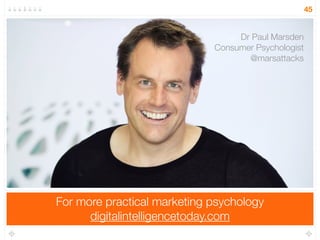
Dr Paul Marsden 
Consumer Psychologist 
@marsattacks
3 psychological insights for consumer innovation 
2 
WHAT TO INNOVATE 
HOW TO APPEAL TO THE CONSUMER MIND 
HOW TO BRAND INNOVATIONS
Say hello to your incredible shrinking brain! 
(don’t panic it’s still the world’s most powerful computer) 
3 
1.5KG 
1,200CC 
78% WATER 
100BN NEURONS 
100TR SYNAPSES 
-10% SIZE VS. 20K YEARS
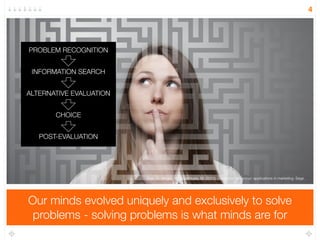
Our minds evolved uniquely and exclusively to solve 
problems - solving problems is what minds are for 
4 
PROBLEM RECOGNITION 
INFORMATION SEARCH 
ALTERNATIVE EVALUATION 
CHOICE 
POST-EVALUATION 
East, R., Wright, M., & Vanhuele, M. (2013). Consumer behaviour: applications in marketing. Sage.
Without problems to solve we’d probably adopt the same 
strategy as sea-squirts, and eat our own brains 
5 
Dennett, D. C. (1993). Consciousness explained. Penguin UK. Chicago
Psychologists like problems - understanding people’s 
problems and helping solve them keeps us in business 
6
Problems also keep innovators in business - without 
7 
problems to solve consumer minds are closed for business
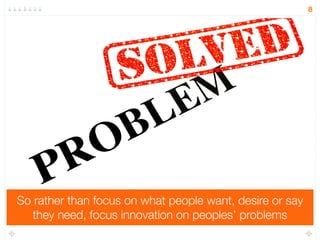
So rather than focus on what people want, desire or say 
they need, focus innovation on peoples’ problems 
8
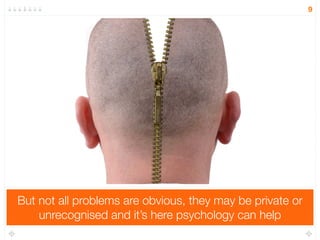
But not all problems are obvious, they may be private or 
unrecognised and it’s here psychology can help 
9
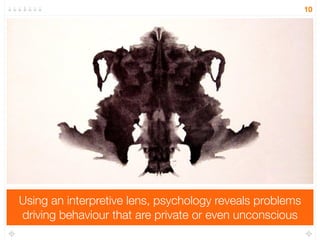
Using an interpretive lens, psychology reveals problems 
driving behaviour that are private or even unconscious 
10
11 
PSYCH PROBLEMS 
‘THE BIG 3’ 
ACHIEVEMENT - NO SENSE OF 
ACCOMPLISHMENT 
POWER - NOT FEELING IN 
CONTROL 
AFFILIATION - NO FEELING OF 
BELONGING 
Sokolowski, Kurt, et al. "Assessing achievement, affiliation, and power motives all at once: The Multi-Motive Grid (MMG)." Journal of Personality Assessment 74.1 (2000): 126-145. APA 
For example, motivational psychology interprets behaviour 
through the lens of three ‘implicit’ core problems (‘APA’)
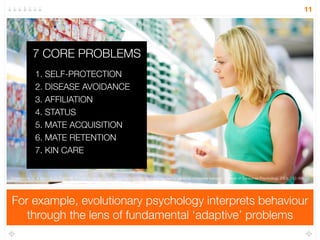
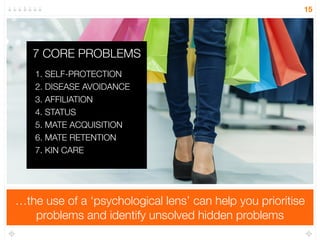
7 CORE PROBLEMS 
Whilst evolutionary psychology interprets behaviour 
through the lens of fundamental ‘adaptive’ problems 
12 
1. SELF-PROTECTION 
2. DISEASE AVOIDANCE 
3. AFFILIATION 
4. STATUS 
5. MATE ACQUISITION 
6. MATE RETENTION 
7. KIN CARE 
Griskevicius, V., & Kenrick, D. T. (2013). Fundamental motives for why we buy: How evolutionary needs influence consumer behavior. Journal of Consumer Psychology, 23(3), 372-386.
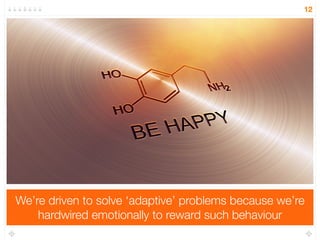
We’re driven to solve ‘adaptive’ problems because we’re 
hardwired emotionally to reward such behaviour 
13
14 
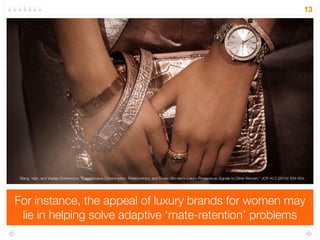
Wang, Yajin, and Vladas Griskevicius. "Conspicuous Consumption, Relationships, and Rivals: Women’s Luxury Products as Signals to Other Women." JCR 40.5 (2014): 834-854. 
For instance, the appeal of luxury brands for women may 
lie in helping solve adaptive ‘mate-retention’ problems
15 
AESTHETICS 
COMFORT 
SAFETY 
UTILITY 
WHY IS THIS A 
PROBLEM? 
WHY IS THIS A 
PROBLEM? 
WHY IS THIS A 
PROBLEM? 
PROBLEM PYRAMID PROBLEM 
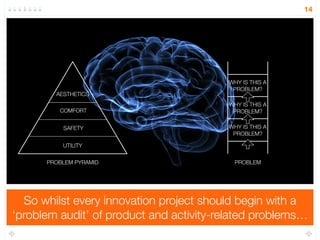
So whilst every innovation project should begin with a 
‘problem audit’ of product and activity-related problems…
…the use of a ‘psychological lens’ can help you prioritise 
problems and identify unsolved hidden problems 
16 
1. SELF-PROTECTION 
2. DISEASE AVOIDANCE 
3. AFFILIATION 
4. STATUS 
5. MATE ACQUISITION 
6. MATE RETENTION 
7. KIN CARE
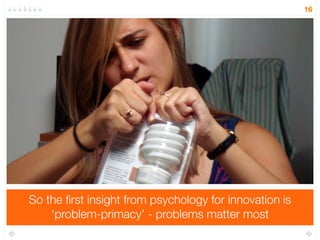
So the first insight from psychology for innovation is 
‘problem-primacy’ - problems matter most 
17
The second psychological insight is that innovations can 
appeal to our unconscious mind 
18
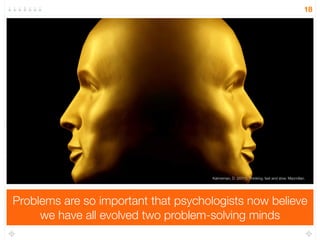
Problems are so important that psychologists now believe 
we have all evolved two problem-solving minds 
19 
Kahneman, D. (2011). Thinking, fast and slow. Macmillan.
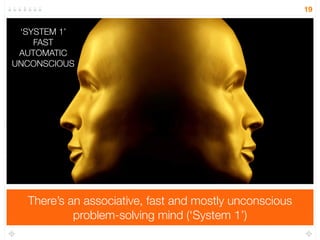
There’s an associative, fast and mostly unconscious 
problem-solving mind (‘System 1’) 
20 
‘SYSTEM 1’ 
FAST 
AUTOMATIC 
UNCONSCIOUS
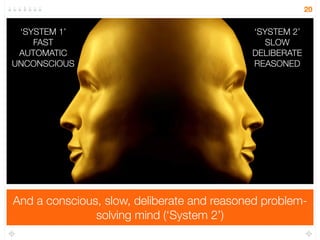
And a conscious, slow, deliberate and reasoned problem-solving 
mind (‘System 2’) 
21 
‘SYSTEM 1’ 
FAST 
AUTOMATIC 
UNCONSCIOUS 
‘SYSTEM 2’ 
SLOW 
DELIBERATE 
REASONED
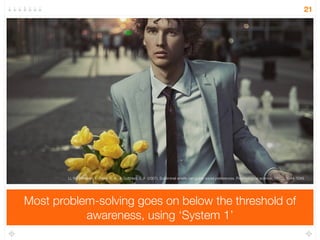
Most problem-solving goes on below the threshold of 
awareness, using ‘System 1’ 
22 
Li, W., Moallem, I., Paller, K. A., & Gottfried, J. A. (2007). Subliminal smells can guide social preferences. Psychological science, 18(12), 1044-1049.
Although we do like to post-rationalise - justifying the 
‘System 1’ auto-pilot with ‘System 2’ excuses 
23
24 
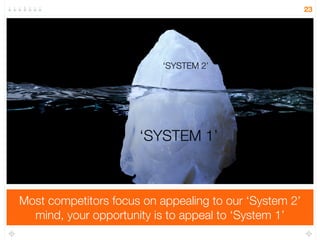
‘SYSTEM 2’ 
‘SYSTEM 1’ 
So the innovation opportunity is to appeal to the ‘System 1’ 
problem-solving mind, not the System 2 excuse machine
25 
Verwijmeren, Thijs, et al. "The workings and limits of subliminal advertising: The role of habits." Journal of Consumer Psychology 21.2 (2011): 206-213. 
System 1 appeals are powerful because they ‘feel’ right 
and responses are experienced as ‘intrinsically’ motivated
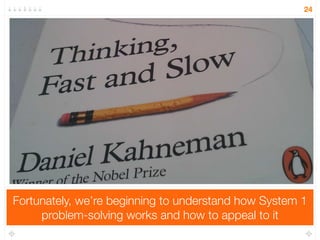
Fortunately, we’re beginning to understand how System 1 
problem-solving works and how to appeal to it 
26
So here are five ways your innovation can appeal to the 
System 1 problem-solving mind 
27
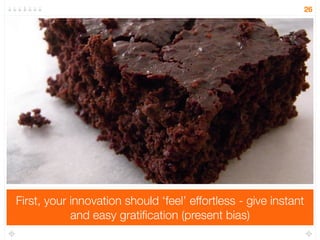
First, your innovation should ‘feel’ effortless - give instant 
and easy gratification (present bias) 
28
29 
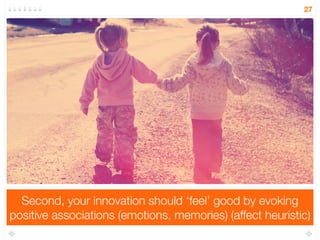
Second, your innovation should ‘feel’ good by evoking 
positive associations (emotions, memories) (affect heuristic)
30 
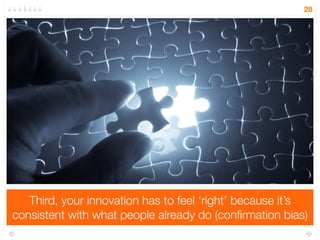
Third, your innovation has to feel ‘right’ because it’s 
consistent with what people already do (confirmation bias)
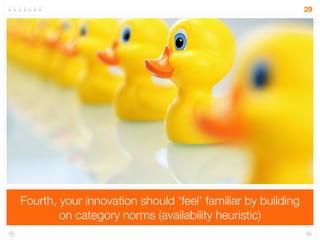
Fourth, your innovation should ‘feel’ familiar by building 
on category norms (availability heuristic) 
31
Fifth, your innovation should ‘feel’ empowering - giving 
people control over their lives (optimism bias) 
32
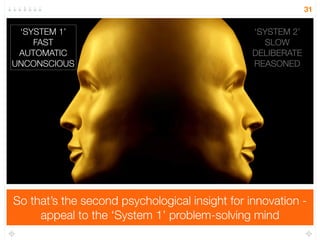
So that’s the second psychological insight for innovation - 
appeal to the ‘System 1’ problem-solving mind 
33 
‘SYSTEM 1’ 
FAST 
AUTOMATIC 
UNCONSCIOUS 
‘SYSTEM 2’ 
SLOW 
DELIBERATE 
REASONED
Finally, let’s turn to the third psychological insight for 
innovation - how to brand your innovation 
34
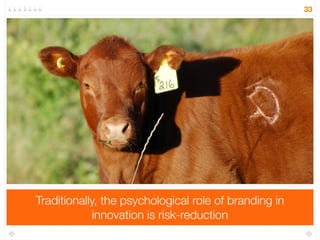
Traditionally, the psychological role of branding in 
innovation is to reduce the perception of risk 
35
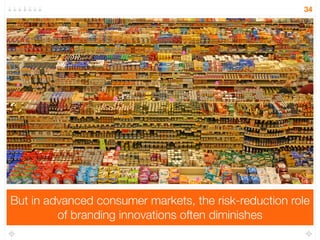
But in advanced consumer markets, the risk-reduction role 
of branding innovations often diminishes 
36
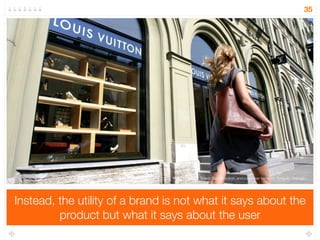
Instead, the utility of a brand is not what it says about the 
product but what it says about the user 
37 
Miller, G. (2009). Spent: Sex, evolution, and consumer behavior. Penguin. Chicago
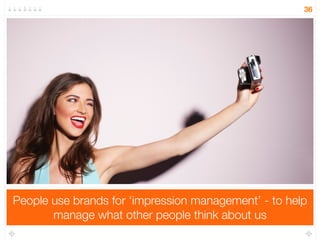
People use brands for ‘impression management’ - to help 
manage what other people think about us 
38
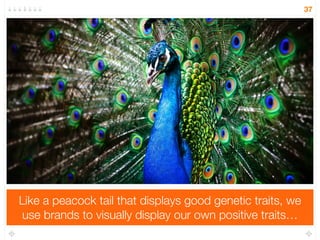
Like a peacock tail that displays good genetic traits, we 
use brands to visually display our own positive traits… 
39
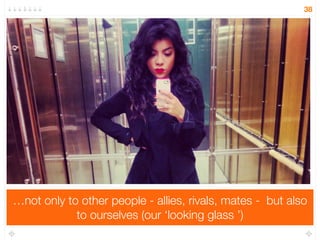
…not only to other people - allies, rivals, mates - but also 
to ourselves (our ‘looking glass ’) 
40
So how can innovations be branded to best harness their 
display value in impression management? 
41
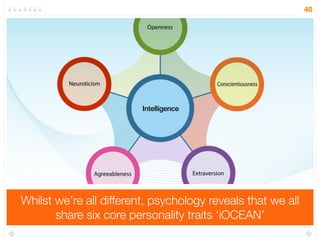
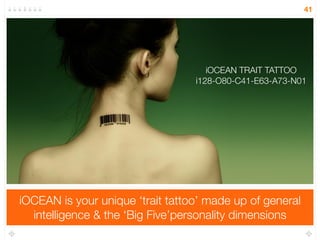
Whilst we’re all different, psychology reveals that we all 
share six core personality traits ‘iOCEAN’ 
42 
Intelligence
iOCEAN is your unique ‘trait tattoo’ made up of general 
intelligence & the ‘Big Five’personality dimensions 
43 
iOCEAN TRAIT TATTOO 
i128-O80-C41-E63-A73-N01
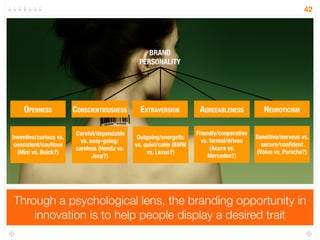
BRAND 
PERSONALITY 
Through a psychological lens, the branding opportunity in 
innovation is to help people display a desired trait 
44 
OPENNESS CONSCIENTIOUSNESS EXTRAVERSION AGREEABLENESS NEUROTICISM 
Inventive/curious vs. 
consistent/cautious 
(Mini vs. Buick?) 
Careful/dependable 
vs. easy-going/ 
careless (Honda vs. 
Jeep?) 
Outgoing/energetic 
vs. quiet/calm (BMW 
vs. Lexus?) 
Friendly/cooperative 
vs. formal/driven 
(Acura vs. 
Mercedes?) 
Sensitive/nervous vs. 
secure/confident 
(Volvo vs. Porsche?)
45 
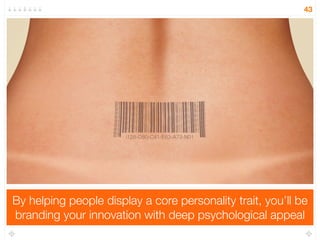
By helping people display a core personality trait, you’ll be 
branding your innovation with deep psychological appeal
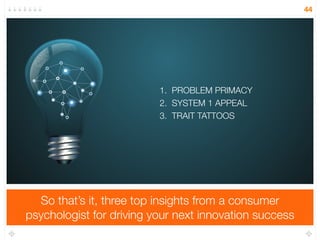
So that’s it, three top insights from a consumer 
psychologist for driving your next innovation success 
46 
1. PROBLEM PRIMACY 
2. SYSTEM 1 APPEAL 
3. TRAIT TATTOOS
For more practical marketing psychology 
digitalintelligencetoday.com 
47 
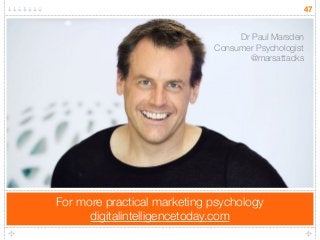
Dr Paul Marsden 
Consumer Psychologist 
@marsattacks

Psych Eye for the Innovation Guy

  • 1.
    Psych Eye forthe Innovation Guy 3 Must-Have Innovation Insights from Consumer Psychology 1 Dr Paul Marsden Consumer Psychologist @marsattacks
  • 2.
    3 psychological insightsfor consumer innovation 2 WHAT TO INNOVATE HOW TO APPEAL TO THE CONSUMER MIND HOW TO BRAND INNOVATIONS
  • 3.
    Say hello toyour incredible shrinking brain! (don’t panic it’s still the world’s most powerful computer) 3 1.5KG 1,200CC 78% WATER 100BN NEURONS 100TR SYNAPSES -10% SIZE VS. 20K YEARS
  • 4.
    Our minds evolveduniquely and exclusively to solve problems - solving problems is what minds are for 4 PROBLEM RECOGNITION INFORMATION SEARCH ALTERNATIVE EVALUATION CHOICE POST-EVALUATION East, R., Wright, M., & Vanhuele, M. (2013). Consumer behaviour: applications in marketing. Sage.
  • 5.
    Without problems tosolve we’d probably adopt the same strategy as sea-squirts, and eat our own brains 5 Dennett, D. C. (1993). Consciousness explained. Penguin UK. Chicago
  • 6.
    Psychologists like problems- understanding people’s problems and helping solve them keeps us in business 6
  • 7.
    Problems also keepinnovators in business - without 7 problems to solve consumer minds are closed for business
  • 8.
    So rather thanfocus on what people want, desire or say they need, focus innovation on peoples’ problems 8
  • 9.
    But not allproblems are obvious, they may be private or unrecognised and it’s here psychology can help 9
  • 10.
    Using an interpretivelens, psychology reveals problems driving behaviour that are private or even unconscious 10
  • 11.
    11 PSYCH PROBLEMS ‘THE BIG 3’ ACHIEVEMENT - NO SENSE OF ACCOMPLISHMENT POWER - NOT FEELING IN CONTROL AFFILIATION - NO FEELING OF BELONGING Sokolowski, Kurt, et al. "Assessing achievement, affiliation, and power motives all at once: The Multi-Motive Grid (MMG)." Journal of Personality Assessment 74.1 (2000): 126-145. APA For example, motivational psychology interprets behaviour through the lens of three ‘implicit’ core problems (‘APA’)
  • 12.
    7 CORE PROBLEMS Whilst evolutionary psychology interprets behaviour through the lens of fundamental ‘adaptive’ problems 12 1. SELF-PROTECTION 2. DISEASE AVOIDANCE 3. AFFILIATION 4. STATUS 5. MATE ACQUISITION 6. MATE RETENTION 7. KIN CARE Griskevicius, V., & Kenrick, D. T. (2013). Fundamental motives for why we buy: How evolutionary needs influence consumer behavior. Journal of Consumer Psychology, 23(3), 372-386.
  • 13.
    We’re driven tosolve ‘adaptive’ problems because we’re hardwired emotionally to reward such behaviour 13
  • 14.
    14 Wang, Yajin,and Vladas Griskevicius. "Conspicuous Consumption, Relationships, and Rivals: Women’s Luxury Products as Signals to Other Women." JCR 40.5 (2014): 834-854. For instance, the appeal of luxury brands for women may lie in helping solve adaptive ‘mate-retention’ problems
  • 15.
    15 AESTHETICS COMFORT SAFETY UTILITY WHY IS THIS A PROBLEM? WHY IS THIS A PROBLEM? WHY IS THIS A PROBLEM? PROBLEM PYRAMID PROBLEM So whilst every innovation project should begin with a ‘problem audit’ of product and activity-related problems…
  • 16.
    …the use ofa ‘psychological lens’ can help you prioritise problems and identify unsolved hidden problems 16 1. SELF-PROTECTION 2. DISEASE AVOIDANCE 3. AFFILIATION 4. STATUS 5. MATE ACQUISITION 6. MATE RETENTION 7. KIN CARE
  • 17.
    So the firstinsight from psychology for innovation is ‘problem-primacy’ - problems matter most 17
  • 18.
    The second psychologicalinsight is that innovations can appeal to our unconscious mind 18
  • 19.
    Problems are soimportant that psychologists now believe we have all evolved two problem-solving minds 19 Kahneman, D. (2011). Thinking, fast and slow. Macmillan.
  • 20.
    There’s an associative,fast and mostly unconscious problem-solving mind (‘System 1’) 20 ‘SYSTEM 1’ FAST AUTOMATIC UNCONSCIOUS
  • 21.
    And a conscious,slow, deliberate and reasoned problem-solving mind (‘System 2’) 21 ‘SYSTEM 1’ FAST AUTOMATIC UNCONSCIOUS ‘SYSTEM 2’ SLOW DELIBERATE REASONED
  • 22.
    Most problem-solving goeson below the threshold of awareness, using ‘System 1’ 22 Li, W., Moallem, I., Paller, K. A., & Gottfried, J. A. (2007). Subliminal smells can guide social preferences. Psychological science, 18(12), 1044-1049.
  • 23.
    Although we dolike to post-rationalise - justifying the ‘System 1’ auto-pilot with ‘System 2’ excuses 23
  • 24.
    24 ‘SYSTEM 2’ ‘SYSTEM 1’ So the innovation opportunity is to appeal to the ‘System 1’ problem-solving mind, not the System 2 excuse machine
  • 25.
    25 Verwijmeren, Thijs,et al. "The workings and limits of subliminal advertising: The role of habits." Journal of Consumer Psychology 21.2 (2011): 206-213. System 1 appeals are powerful because they ‘feel’ right and responses are experienced as ‘intrinsically’ motivated
  • 26.
    Fortunately, we’re beginningto understand how System 1 problem-solving works and how to appeal to it 26
  • 27.
    So here arefive ways your innovation can appeal to the System 1 problem-solving mind 27
  • 28.
    First, your innovationshould ‘feel’ effortless - give instant and easy gratification (present bias) 28
  • 29.
    29 Second, yourinnovation should ‘feel’ good by evoking positive associations (emotions, memories) (affect heuristic)
  • 30.
    30 Third, yourinnovation has to feel ‘right’ because it’s consistent with what people already do (confirmation bias)
  • 31.
    Fourth, your innovationshould ‘feel’ familiar by building on category norms (availability heuristic) 31
  • 32.
    Fifth, your innovationshould ‘feel’ empowering - giving people control over their lives (optimism bias) 32
  • 33.
    So that’s thesecond psychological insight for innovation - appeal to the ‘System 1’ problem-solving mind 33 ‘SYSTEM 1’ FAST AUTOMATIC UNCONSCIOUS ‘SYSTEM 2’ SLOW DELIBERATE REASONED
  • 34.
    Finally, let’s turnto the third psychological insight for innovation - how to brand your innovation 34
  • 35.
    Traditionally, the psychologicalrole of branding in innovation is to reduce the perception of risk 35
  • 36.
    But in advancedconsumer markets, the risk-reduction role of branding innovations often diminishes 36
  • 37.
    Instead, the utilityof a brand is not what it says about the product but what it says about the user 37 Miller, G. (2009). Spent: Sex, evolution, and consumer behavior. Penguin. Chicago
  • 38.
    People use brandsfor ‘impression management’ - to help manage what other people think about us 38
  • 39.
    Like a peacocktail that displays good genetic traits, we use brands to visually display our own positive traits… 39
  • 40.
    …not only toother people - allies, rivals, mates - but also to ourselves (our ‘looking glass ’) 40
  • 41.
    So how caninnovations be branded to best harness their display value in impression management? 41
  • 42.
    Whilst we’re alldifferent, psychology reveals that we all share six core personality traits ‘iOCEAN’ 42 Intelligence
  • 43.
    iOCEAN is yourunique ‘trait tattoo’ made up of general intelligence & the ‘Big Five’personality dimensions 43 iOCEAN TRAIT TATTOO i128-O80-C41-E63-A73-N01
  • 44.
    BRAND PERSONALITY Througha psychological lens, the branding opportunity in innovation is to help people display a desired trait 44 OPENNESS CONSCIENTIOUSNESS EXTRAVERSION AGREEABLENESS NEUROTICISM Inventive/curious vs. consistent/cautious (Mini vs. Buick?) Careful/dependable vs. easy-going/ careless (Honda vs. Jeep?) Outgoing/energetic vs. quiet/calm (BMW vs. Lexus?) Friendly/cooperative vs. formal/driven (Acura vs. Mercedes?) Sensitive/nervous vs. secure/confident (Volvo vs. Porsche?)
  • 45.
    45 By helpingpeople display a core personality trait, you’ll be branding your innovation with deep psychological appeal
  • 46.
    So that’s it,three top insights from a consumer psychologist for driving your next innovation success 46 1. PROBLEM PRIMACY 2. SYSTEM 1 APPEAL 3. TRAIT TATTOOS
  • 47.
    For more practicalmarketing psychology digitalintelligencetoday.com 47 Dr Paul Marsden Consumer Psychologist @marsattacks