







Data vs. Hunch
Hyper Island Stockholm, 2015
It used to be really simple…..
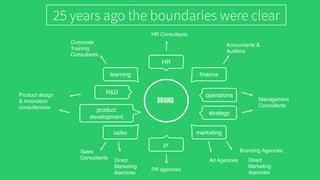
HR Consultants
brand
HR
pr
finance
operations
strategy
marketing
learning
R&D
product
development
sales
PR agencies
Accountants &
Auditors
Management
Consultants
Branding Agencies
Ad Agencies
Corporate
Training
Consultants
Sales
Consultants
Product design
& innovation
consultancies
Direct
Marketing
Agencies
Direct
Marketing
Agencies
25 years ago the boundaries were clear
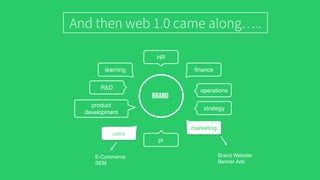
brand
HR
pr
finance
operations
strategy
marketing
learning
R&D
product
development
Brand Website
Banner Ads
And then web 1.0 came along…..
sales
E-Commerce
SEM
brand
HR
pr
finance
operations
strategy
marketing
learning
R&D
product
development
sales
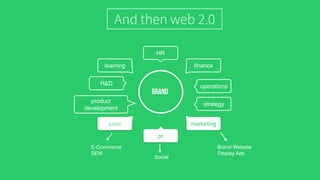
Brand Website
Display Ads
Social
E-Commerce
SEM
And then web 2.0
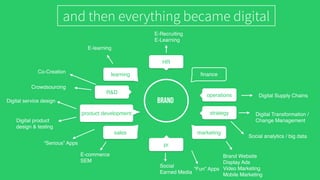
E-Recruiting
E-Learning
brand
HR
pr
finance
operations
strategy
marketing
learning
R&D
product development
sales
Digital Supply Chains
Social analytics / big data
E-learning
E-commerce
SEM
Digital product
design & testing
and then everything became digital
Digital Transformation /
Change Management
Brand Website
Display Ads
Video Marketing
Mobile Marketing
Social
Earned Media
“Fun” Apps
“Serious” Apps
Digital service design
Crowdsourcing
Co-Creation
Branding
PR
Management
Consultancies
Data
Analytics
Design
Social
Advertising
Digital
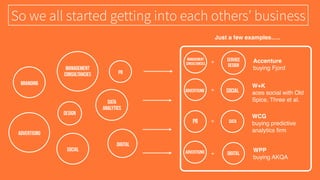
Accenture
buying Fjord
W+K
aces social with Old
Spice, Three et al.
WCG
buying predictive
analytics firm
WPP
buying AKQA
PR + Data
Analytics
DigitalAdvertising +
Advertising + Social
+Management
Consultancies
Service
Design
So we all started getting into each others’ business
Just a few examples…..
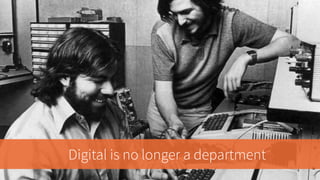
Digital is no longer a department
And with digital
pervasiveness comes some
challenges for marketers…..
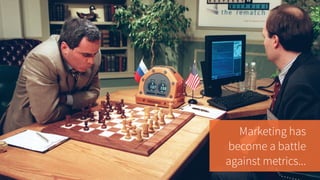
Marketing has
become a battle
against metrics…
Because with digital
came the rise of ever-
increasing trackability
Accountability through ROI became a
critical component in justifying and
making digital marketing spend as
efficient as possible….
CTRs, conversion rates, UVs, shares, followers,
downloads, A/B testing, attribution modelling,
etc. etc...
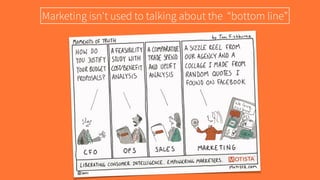
Marketing isn't used to talking about the “bottom line”
So how are we
doing?
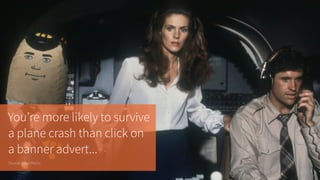
You’re more likely to survive

a plane crash than click on
a banner advert...
Source: Solve Media
..and there’s only a 

1 in 1,000,000 chance of
someone viewing your
YouTube video...
Source: wistia.com
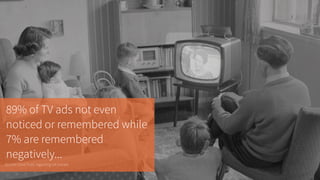
89% of TV ads not even
noticed or remembered while
7% are remembered
negatively...
Source: Dave Trott, regarding UK market
Is there anyone out there?
• 60 - 70% of marketing content goes
completely unused (Sirius Decisions)
• 30% of Microsoft’s 10MM pieces of
content has never been visited
(company audit)
• We are exposed to ~5,000 marketing
messages a day and a social link has
a half-life of 3 hours (various & Bitly)
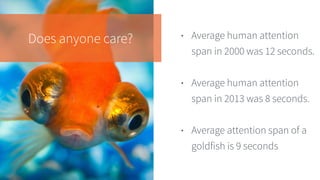
Does anyone care? • Average human attention
span in 2000 was 12 seconds.
• Average human attention
span in 2013 was 8 seconds.
• Average attention span of a
goldfish is 9 seconds
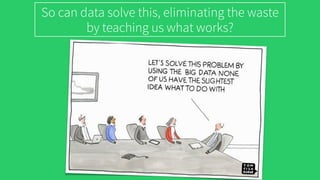
So can data solve this, eliminating the waste
by teaching us what works?
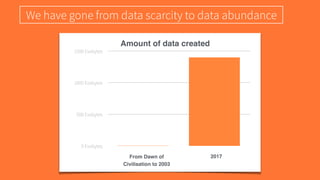
0 Exabytes
500 Exabytes
1000 Exabytes
1500 Exabytes
2017Dawn of Civilisation - 2003
We have gone from data scarcity to data abundance
Amount of data created
From Dawn of
Civilisation to 2003
2017
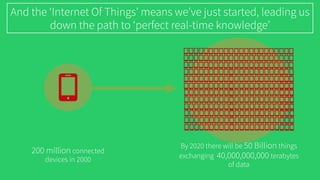
And the ‘Internet Of Things’ means we’ve just started, leading us
down the path to ‘perfect real-time knowledge’
200 million connected
devices in 2000
By 2020 there will be 50 Billion things 

exchanging 40,000,000,000 terabytes
of data
© Copyright 2013 Beyond. All rights reserved. Private and Confidential
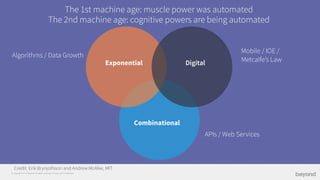
Algorithms / Data Growth
Exponential Digital
Combinational
Mobile / IOE /
Metcalfe’s Law
APIs / Web Services
Credit: Erik Brynjolfsson and Andrew McAfee, MIT
The 1st machine age: muscle power was automated
The 2nd machine age: cognitive powers are being automated
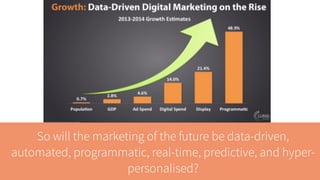
So will the marketing of the future be data-driven,
automated, programmatic, real-time, predictive, and hyper-
personalised?
Leading some marketers to question...
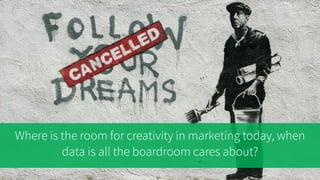
Where is the room for creativity in marketing today, when
data is all the boardroom cares about?
© Copyright 2013 Beyond. All rights reserved. Private and Confidential
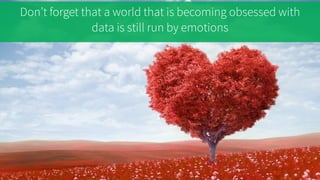
Don’t forget that a world that is becoming obsessed with
data is still run by emotions
© Copyright 2013 Beyond. All rights reserved. Private and Confidential
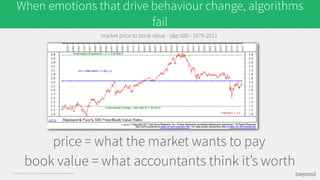
price = what the market wants to pay
book value = what accountants think it’s worth
market price to book value - s&p 500 - 1979-2011
When emotions that drive behaviour change, algorithms fail
Four tips for finding a balance between data & creativity
1. Understand what data is and isn’t good for
Too often people look for data to
provide the “silver bullet” insight,
and end up frustrated by lack of
answers.
We’re taught that math equals fact,
and that to measure something is to
understand it.
But the reality is data is a lot more
subjective than we think.
There are no silver bullets
With more data, we actually get
more uncertainty
“With more data, you get more spurious
correlations, more false positives, and
erroneous answers. If the quantity of
information is increasing by 2.5
quintillion bytes per day, the amount of
useful information almost certainly isn't.
Most of it is just noise, and the noise is
increasing faster than the signal.”
Nate Silver, The Noise & the Signal
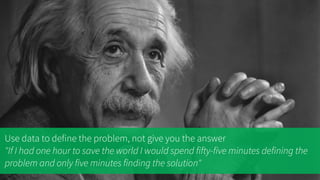
Use data to define the problem, not give you the answer
"If I had one hour to save the world I would spend fifty-five minutes defining the
problem and only five minutes finding the solution"
2. Use different data sets to look at the problem through as many
lenses as possible
473683173
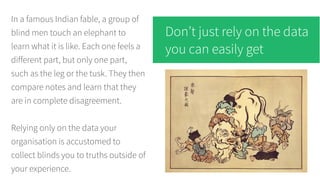
In a famous Indian fable, a group of
blind men touch an elephant to
learn what it is like. Each one feels a
different part, but only one part,
such as the leg or the tusk. They then
compare notes and learn that they
are in complete disagreement.
Relying only on the data your
organisation is accustomed to
collect blinds you to truths outside of
your experience.
Don’t just rely on the data
you can easily get
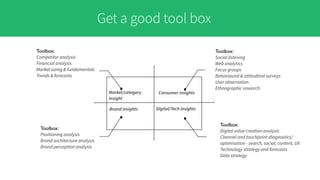
Brand insights
Market/category
Insight
Consumer insights
Digital/Tech insights
Toolbox:
Social listening
Web analytics
Focus groups
Behavioural & attitudinal surveys
User observation
Ethnographic research
Toolbox:
Competitor analysis
Financial analysis
Market sizing & fundamentals
Trends & forecasts
Toolbox:
Digital value creation analysis
Channel and touchpoint diagnostics/
optimisation - search, social, content, UX
Technology strategy and forecasts
Data strategy
Toolbox:
Positioning analysis
Brand architecture analysis
Brand perception analysis
Get a good tool box
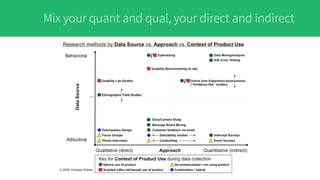
Mix your quant and qual, your direct and indirect
3. Be very clear about where data ends and strategy begins
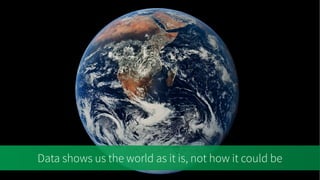
Data shows us the world as it is, not how it could be
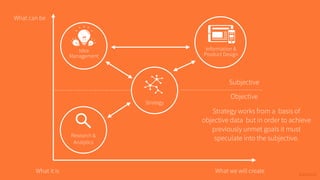
Idea
Management
Strategy
Research &
Analytics
Information &
Product Design
Strategy works from a basis of
objective data but in order to achieve
previously unmet goals it must
speculate into the subjective.
What we will createWhat it is
What can be
Objective
Subjective
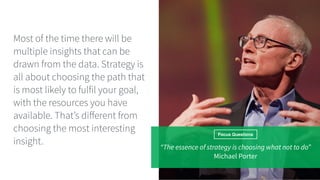
“The essence of strategy is choosing what not to do”
Michael Porter
Focus Questions
Most of the time there will be
multiple insights that can be
drawn from the data. Strategy is
all about choosing the path that
is most likely to fulfil your goal,
with the resources you have
available. That’s different from
choosing the most interesting
insight.
4. Don’t feel guilty for taking a creative leap
beyond the data
“The origins of an insight are usually to be found in
numbers. That's how we know an insight to be more
than airy whim…
But, except to the supernaturally numerate, numbers
seldom sing spontaneously…
[The] strategist who comes up with an immaculate and
scrupulously accurate relief map of the brand and its
market - and absolutely nothing else - will not be
greatly loved by the creative group…
By definition, a good creative brief contains a bold
hypothesis. To generate hypotheses you need to
speculate: you need to progress from the known to the
unknown. But you cannot paint the future in the colours
of the past. Other people's imaginations need to be
engaged…” Jeremy Bullmore
Speculate with hypotheses
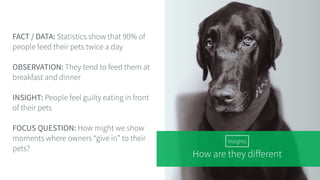
Insights
FACT / DATA: Statistics show that 90% of
people feed their pets twice a day
OBSERVATION: They tend to feed them at
breakfast and dinner
INSIGHT: People feel guilty eating in front
of their pets
FOCUS QUESTION: How might we show
moments where owners “give in” to their
pets?
How are they different
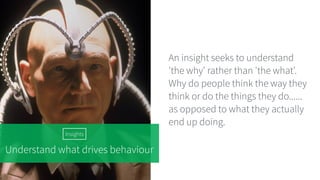
Insights
Understand what drives behaviour
An insight seeks to understand
'the why' rather than 'the what'.
Why do people think the way they
think or do the things they do......
as opposed to what they actually
end up doing.
Insights
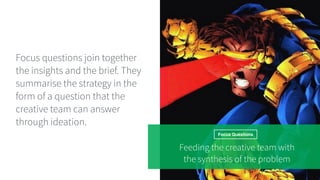
Focus Questions
Focus questions join together
the insights and the brief. They
summarise the strategy in the
form of a question that the
creative team can answer
through ideation.
Feeding the creative team with
the synthesis of the problem
Focus Questions
Why is a Good Focus Question Like a
Refrigerator?
Because the moment you look into it, a
light comes on.
Focus questions lead
to inspiration and
interaction. Your mind
should start filling with
possibilities as soon as
you read them.
Focus Questions
How can a focus question say so much
with so little?
Through the understanding of the feelings your
audience associate to certain words. Words
carry strong implicit meaning and, as such, play
a major role in how we perceive a problem.
Through the use of metaphors, analogies and
similes that can re-phrase the core tension you
have found in your insight.
Through using unexpected associations
between contrasting or disparate words or
ideas.
By avoiding the direct or explicit and using
creativity to phrase the problem in an inspiring
way.
Focus Questions
• The brief phrased as a
question.
• A collection of stats and data
from your analytics
A Focus Question is NOT
Strategy
Giving creative a framework
“Creativity loves constraints. It’s
why pictures have frames and
sonnets have fourteen lines. It’s
why Henry Ford set pricing for
his cars so low, because he
knew that ‘We make more
discoveries concerning
manufacturing and selling
under this forced method than
by any other leisurely
investigation’.”
Eric Schmidt
Strategy
Giving creative a framework
“When forced to work
within a strict framework,
the imagination is taxed
to its upmost and will
produce its richest ideas.
Given total freedom the
work is likely to sprawl”
T.S. Eliot
Now you have a strategic framework and some potent focus
questions, what’s the best way to harness a lot of ideas?
Clients are grappling with the pace at which technology changes and we need
to adapt our creative process to meet the new challenges clients throw at us
Challenge 1: The work is more complicated than ever
E-Recruiting
E-Learning
brand
HR
pr
finance
operations
strategy
marketing
learning
R&D
product development
sales
Digital Supply Chains
Social analytics / big data
E-learning
E-commerce
SEM
Digital product
design & testing
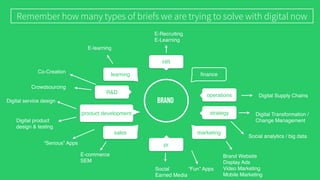
Remember how many types of briefs we are trying to solve with digital now
Digital Transformation /
Change Management
“Fun” Apps
“Serious” Apps
Digital service design
Crowdsourcing
Co-Creation
Brand Website
Display Ads
Video Marketing
Mobile Marketing
Social
Earned Media
Challenge 2: New technologies requiring new agency skill-sets
are appearing every day.
So how do you meet the needs of an ever more complex tech /
marketing lanscape?
Rather than limiting creative thinking and idea generation to a
creative department
Form custom cross-disciplined creative teams from across the agency for
each brief who have a variety of skills, perspectives and experience.
Use ideation methods that enable everyone to contribute
Idea Management
Make sure the team follows these
creative principles:
Think big & encourage wild ideas
Get all your ideas out
Quantity is a condition for quality
Postpone critical thinking and judgement
One conversation at a time
Build on each other ideas by saying yes
and…
At Beyond we use a process called Applied Creativity
We define Applied Creativity as a data driven process that
enables cross-discipline collaboration resulting in more
informed creative output.
What are the benefits of taking this approach?
Benefit 1: Different brains working together can tackle
problems from every angle
Benefit 2: New ideas often come from combining ideas
from different disciplines in orginal combinations
Benefit 3: When all the disciplines are involved in
conceiving the ideas, they can implement them quicker
Benefit 4: This approach liberates and makes the most of
your talent.
Thanks!
Nils Mork-Ulnes 

Head of Strategy
nils@bynd.com
Alex Hunting 

Strategist
alex@bynd.com
Charlie Lyons

GM, London
charlie@bynd.com

Data vs Hunch - Beyond Lecture at Hyper Island 2015

  • 1.
    Data vs. Hunch HyperIsland Stockholm, 2015
  • 2.
    It used tobe really simple…..
  • 3.
    HR Consultants brand HR pr finance operations strategy marketing learning R&D product development sales PR agencies Accountants& Auditors Management Consultants Branding Agencies Ad Agencies Corporate Training Consultants Sales Consultants Product design & innovation consultancies Direct Marketing Agencies Direct Marketing Agencies 25 years ago the boundaries were clear
  • 4.
  • 5.
  • 6.
    E-Recruiting E-Learning brand HR pr finance operations strategy marketing learning R&D product development sales Digital SupplyChains Social analytics / big data E-learning E-commerce SEM Digital product design & testing and then everything became digital Digital Transformation / Change Management Brand Website Display Ads Video Marketing Mobile Marketing Social Earned Media “Fun” Apps “Serious” Apps Digital service design Crowdsourcing Co-Creation
  • 7.
    Branding PR Management Consultancies Data Analytics Design Social Advertising Digital Accenture buying Fjord W+K aces socialwith Old Spice, Three et al. WCG buying predictive analytics firm WPP buying AKQA PR + Data Analytics DigitalAdvertising + Advertising + Social +Management Consultancies Service Design So we all started getting into each others’ business Just a few examples…..
  • 8.
    Digital is nolonger a department
  • 9.
    And with digital pervasivenesscomes some challenges for marketers…..
  • 10.
    Marketing has become abattle against metrics…
  • 11.
    Because with digital camethe rise of ever- increasing trackability Accountability through ROI became a critical component in justifying and making digital marketing spend as efficient as possible…. CTRs, conversion rates, UVs, shares, followers, downloads, A/B testing, attribution modelling, etc. etc...
  • 12.
    Marketing isn't usedto talking about the “bottom line”
  • 13.
    So how arewe doing?
  • 14.
    You’re more likelyto survive
 a plane crash than click on a banner advert... Source: Solve Media
  • 15.
    ..and there’s onlya 
 1 in 1,000,000 chance of someone viewing your YouTube video... Source: wistia.com
  • 16.
    89% of TVads not even noticed or remembered while 7% are remembered negatively... Source: Dave Trott, regarding UK market
  • 17.
    Is there anyoneout there? • 60 - 70% of marketing content goes completely unused (Sirius Decisions) • 30% of Microsoft’s 10MM pieces of content has never been visited (company audit) • We are exposed to ~5,000 marketing messages a day and a social link has a half-life of 3 hours (various & Bitly)
  • 18.
    Does anyone care?• Average human attention span in 2000 was 12 seconds. • Average human attention span in 2013 was 8 seconds. • Average attention span of a goldfish is 9 seconds
  • 19.
    So can datasolve this, eliminating the waste by teaching us what works?
  • 20.
    0 Exabytes 500 Exabytes 1000Exabytes 1500 Exabytes 2017Dawn of Civilisation - 2003 We have gone from data scarcity to data abundance Amount of data created From Dawn of Civilisation to 2003 2017
  • 21.
    And the ‘InternetOf Things’ means we’ve just started, leading us down the path to ‘perfect real-time knowledge’ 200 million connected devices in 2000 By 2020 there will be 50 Billion things 
 exchanging 40,000,000,000 terabytes of data
  • 22.
    © Copyright 2013Beyond. All rights reserved. Private and Confidential Algorithms / Data Growth Exponential Digital Combinational Mobile / IOE / Metcalfe’s Law APIs / Web Services Credit: Erik Brynjolfsson and Andrew McAfee, MIT The 1st machine age: muscle power was automated The 2nd machine age: cognitive powers are being automated
  • 23.
    So will themarketing of the future be data-driven, automated, programmatic, real-time, predictive, and hyper- personalised?
  • 24.
    Leading some marketersto question...
  • 25.
    Where is theroom for creativity in marketing today, when data is all the boardroom cares about?
  • 26.
    © Copyright 2013Beyond. All rights reserved. Private and Confidential Don’t forget that a world that is becoming obsessed with data is still run by emotions
  • 27.
    © Copyright 2013Beyond. All rights reserved. Private and Confidential price = what the market wants to pay book value = what accountants think it’s worth market price to book value - s&p 500 - 1979-2011 When emotions that drive behaviour change, algorithms fail
  • 28.
    Four tips forfinding a balance between data & creativity
  • 29.
    1. Understand whatdata is and isn’t good for
  • 30.
    Too often peoplelook for data to provide the “silver bullet” insight, and end up frustrated by lack of answers. We’re taught that math equals fact, and that to measure something is to understand it. But the reality is data is a lot more subjective than we think. There are no silver bullets
  • 31.
    With more data,we actually get more uncertainty “With more data, you get more spurious correlations, more false positives, and erroneous answers. If the quantity of information is increasing by 2.5 quintillion bytes per day, the amount of useful information almost certainly isn't. Most of it is just noise, and the noise is increasing faster than the signal.” Nate Silver, The Noise & the Signal
  • 32.
    Use data todefine the problem, not give you the answer "If I had one hour to save the world I would spend fifty-five minutes defining the problem and only five minutes finding the solution"
  • 33.
    2. Use differentdata sets to look at the problem through as many lenses as possible 473683173
  • 34.
    In a famousIndian fable, a group of blind men touch an elephant to learn what it is like. Each one feels a different part, but only one part, such as the leg or the tusk. They then compare notes and learn that they are in complete disagreement. Relying only on the data your organisation is accustomed to collect blinds you to truths outside of your experience. Don’t just rely on the data you can easily get
  • 35.
    Brand insights Market/category Insight Consumer insights Digital/Techinsights Toolbox: Social listening Web analytics Focus groups Behavioural & attitudinal surveys User observation Ethnographic research Toolbox: Competitor analysis Financial analysis Market sizing & fundamentals Trends & forecasts Toolbox: Digital value creation analysis Channel and touchpoint diagnostics/ optimisation - search, social, content, UX Technology strategy and forecasts Data strategy Toolbox: Positioning analysis Brand architecture analysis Brand perception analysis Get a good tool box
  • 36.
    Mix your quantand qual, your direct and indirect
  • 37.
    3. Be veryclear about where data ends and strategy begins
  • 38.
    Data shows usthe world as it is, not how it could be
  • 39.
    Idea Management Strategy Research & Analytics Information & ProductDesign Strategy works from a basis of objective data but in order to achieve previously unmet goals it must speculate into the subjective. What we will createWhat it is What can be Objective Subjective
  • 40.
    “The essence ofstrategy is choosing what not to do” Michael Porter Focus Questions Most of the time there will be multiple insights that can be drawn from the data. Strategy is all about choosing the path that is most likely to fulfil your goal, with the resources you have available. That’s different from choosing the most interesting insight.
  • 41.
    4. Don’t feelguilty for taking a creative leap beyond the data
  • 42.
    “The origins ofan insight are usually to be found in numbers. That's how we know an insight to be more than airy whim… But, except to the supernaturally numerate, numbers seldom sing spontaneously… [The] strategist who comes up with an immaculate and scrupulously accurate relief map of the brand and its market - and absolutely nothing else - will not be greatly loved by the creative group… By definition, a good creative brief contains a bold hypothesis. To generate hypotheses you need to speculate: you need to progress from the known to the unknown. But you cannot paint the future in the colours of the past. Other people's imaginations need to be engaged…” Jeremy Bullmore Speculate with hypotheses Insights
  • 43.
    FACT / DATA:Statistics show that 90% of people feed their pets twice a day OBSERVATION: They tend to feed them at breakfast and dinner INSIGHT: People feel guilty eating in front of their pets FOCUS QUESTION: How might we show moments where owners “give in” to their pets? How are they different Insights
  • 44.
    Understand what drivesbehaviour An insight seeks to understand 'the why' rather than 'the what'. Why do people think the way they think or do the things they do...... as opposed to what they actually end up doing. Insights
  • 45.
    Focus Questions Focus questionsjoin together the insights and the brief. They summarise the strategy in the form of a question that the creative team can answer through ideation. Feeding the creative team with the synthesis of the problem
  • 46.
    Focus Questions Why isa Good Focus Question Like a Refrigerator? Because the moment you look into it, a light comes on. Focus questions lead to inspiration and interaction. Your mind should start filling with possibilities as soon as you read them.
  • 47.
    Focus Questions How cana focus question say so much with so little? Through the understanding of the feelings your audience associate to certain words. Words carry strong implicit meaning and, as such, play a major role in how we perceive a problem. Through the use of metaphors, analogies and similes that can re-phrase the core tension you have found in your insight. Through using unexpected associations between contrasting or disparate words or ideas. By avoiding the direct or explicit and using creativity to phrase the problem in an inspiring way.
  • 48.
    Focus Questions • Thebrief phrased as a question. • A collection of stats and data from your analytics A Focus Question is NOT
  • 49.
    Strategy Giving creative aframework “Creativity loves constraints. It’s why pictures have frames and sonnets have fourteen lines. It’s why Henry Ford set pricing for his cars so low, because he knew that ‘We make more discoveries concerning manufacturing and selling under this forced method than by any other leisurely investigation’.” Eric Schmidt
  • 50.
    Strategy Giving creative aframework “When forced to work within a strict framework, the imagination is taxed to its upmost and will produce its richest ideas. Given total freedom the work is likely to sprawl” T.S. Eliot
  • 51.
    Now you havea strategic framework and some potent focus questions, what’s the best way to harness a lot of ideas?
  • 52.
    Clients are grapplingwith the pace at which technology changes and we need to adapt our creative process to meet the new challenges clients throw at us
  • 53.
    Challenge 1: Thework is more complicated than ever
  • 54.
    E-Recruiting E-Learning brand HR pr finance operations strategy marketing learning R&D product development sales Digital SupplyChains Social analytics / big data E-learning E-commerce SEM Digital product design & testing Remember how many types of briefs we are trying to solve with digital now Digital Transformation / Change Management “Fun” Apps “Serious” Apps Digital service design Crowdsourcing Co-Creation Brand Website Display Ads Video Marketing Mobile Marketing Social Earned Media
  • 55.
    Challenge 2: Newtechnologies requiring new agency skill-sets are appearing every day.
  • 56.
    So how doyou meet the needs of an ever more complex tech / marketing lanscape?
  • 57.
    Rather than limitingcreative thinking and idea generation to a creative department
  • 58.
    Form custom cross-disciplinedcreative teams from across the agency for each brief who have a variety of skills, perspectives and experience.
  • 59.
    Use ideation methodsthat enable everyone to contribute
  • 60.
    Idea Management Make surethe team follows these creative principles: Think big & encourage wild ideas Get all your ideas out Quantity is a condition for quality Postpone critical thinking and judgement One conversation at a time Build on each other ideas by saying yes and…
  • 61.
    At Beyond weuse a process called Applied Creativity
  • 62.
    We define AppliedCreativity as a data driven process that enables cross-discipline collaboration resulting in more informed creative output.
  • 63.
    What are thebenefits of taking this approach?
  • 64.
    Benefit 1: Differentbrains working together can tackle problems from every angle
  • 65.
    Benefit 2: Newideas often come from combining ideas from different disciplines in orginal combinations
  • 66.
    Benefit 3: Whenall the disciplines are involved in conceiving the ideas, they can implement them quicker
  • 67.
    Benefit 4: Thisapproach liberates and makes the most of your talent.
  • 68.
    Thanks! Nils Mork-Ulnes 
 Headof Strategy nils@bynd.com Alex Hunting 
 Strategist alex@bynd.com Charlie Lyons
 GM, London charlie@bynd.com