Copyright © 2015 Pearson Education
Copyright © 2015 Pearson Education Slide 2 of 35
Chapter 3 Learning Objectives
3.1 To understand the dynamics of motives,
needs, and goals and how they shape consumer
behavior.
3.2 To understand motivation theories and their
applications to consumer behavior.
3.3 To understand how to identify and measure
motives.
3.4 To understand the scope of personality and
theories of its development.
Copyright © 2015 Pearson Education Slide 3 of 35
Chapter 3 Learning Objectives
3.5 To understand how innovativeness and other
personality traits influence consumer behavior.
3.6 To understand the personification of
products and brands and its strategic
applications.
3.7 To understand self-image and its impact on
consumer behavior.
Copyright © 2015 Pearson Education Slide 4 of 35
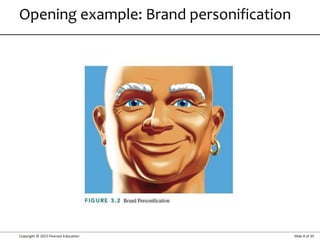
Opening example: Brand personification
Copyright © 2015 Pearson Education Slide 5 of 35
Learning Objective 3.1
3.1 To understand the dynamics of motives,
needs, and goals and how they shape consumer
behavior.
Copyright © 2015 Pearson Education Slide 6 of 35
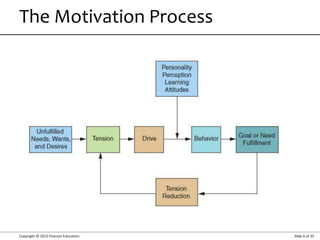
The Motivation Process
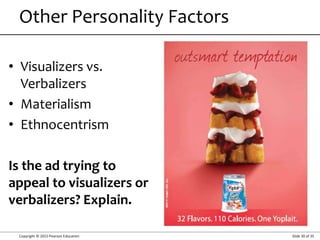
Copyright © 2015 Pearson Education Slide 7 of 35
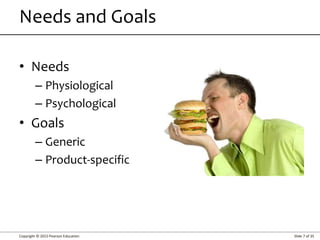
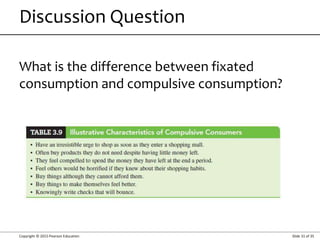
• Needs
– Physiological
– Psychological
• Goals
– Generic
– Product-specific
Needs and Goals
Copyright © 2015 Pearson Education Slide 8 of 35
Discussion Questions
What is the generic goal?
What is the product-
specific goal?
Application: Goals
Copyright © 2015 Pearson Education Slide 9 of 35
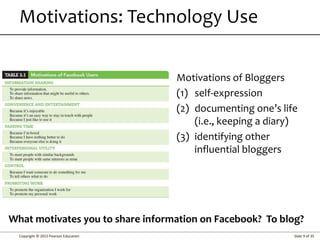
Motivations of Bloggers
(1) self-expression
(2) documenting one’s life
(i.e., keeping a diary)
(3) identifying other
influential bloggers
Motivations: Technology Use
What motivates you to share information on Facebook? To blog?
Copyright © 2015 Pearson Education Slide 10 of 35
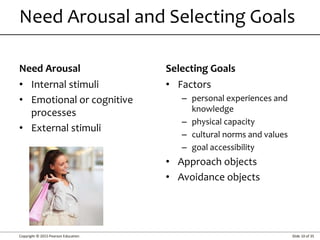
Need Arousal
• Internal stimuli
• Emotional or cognitive
processes
• External stimuli
Selecting Goals
• Factors
– personal experiences and
knowledge
– physical capacity
– cultural norms and values
– goal accessibility
• Approach objects
• Avoidance objects
Need Arousal and Selecting Goals
Copyright © 2015 Pearson Education Slide 11 of 35
• Needs and goals are interdependent
• Needs are never fully satisfied
• New needs emerge as old ones are satisfied
• Success and failure influence goals
Needs and Goals
Copyright © 2015 Pearson Education Slide 12 of 35
Frustration is the feeling that results
from failure to achieve a goal, and
defense mechanisms are cognitive
and behavioral ways to handle
frustration.
Frustration and Defense
Mechanisms
Copyright © 2015 Pearson Education Slide 13 of 35
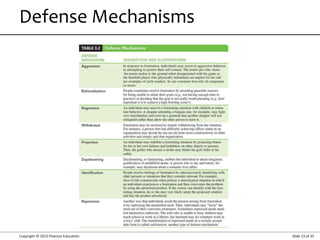
Defense Mechanisms
Copyright © 2015 Pearson Education Slide 14 of 35
Which Defense Mechanism is used?
Copyright © 2015 Pearson Education Slide 15 of 35
Learning Objective 3.2
3.2 To understand motivation theories and their
applications to consumer behavior.
Copyright © 2015 Pearson Education Slide 16 of 35
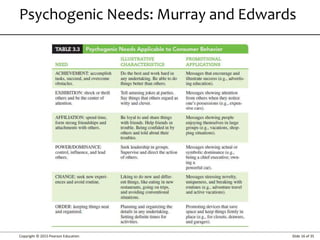
Psychogenic Needs: Murray and Edwards
Copyright © 2015 Pearson Education Slide 17 of 35
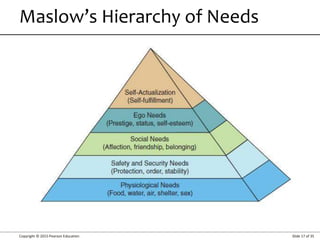
Maslow’s Hierarchy of Needs
Copyright © 2015 Pearson Education Slide 18 of 35
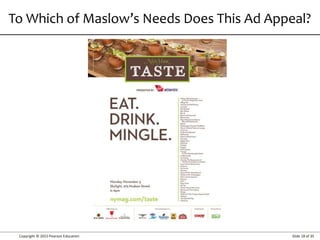
To Which of Maslow’s Needs Does This Ad Appeal?
Copyright © 2015 Pearson Education Slide 19 of 35
Discussion Questions
• What are three types of products related to
more then one level of Maslow’s Hierarchy
of Needs?
• For each type of product, consider two
brands. How do marketers attempt to
differentiate their product from the
competition?
Copyright © 2015 Pearson Education Slide 20 of 35
• Power
• Affiliation
• Achievement
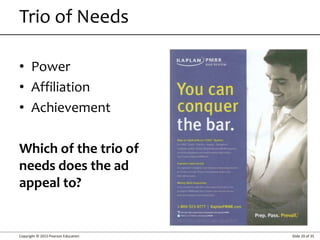
Which of the trio of
needs does the ad
appeal to?
Trio of Needs
Copyright © 2015 Pearson Education Slide 21 of 35
Learning Objective 3.3
3.3 To understand how to identify and measure
motives.
Copyright © 2015 Pearson Education Slide 22 of 35
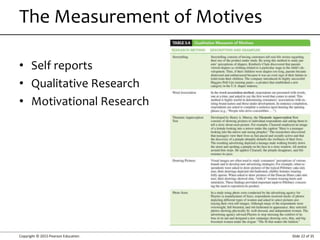
• Self reports
• Qualitative Research
• Motivational Research
The Measurement of Motives
Copyright © 2015 Pearson Education Slide 23 of 35
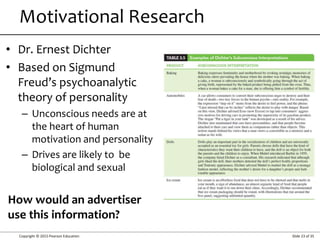
• Dr. Ernest Dichter
• Based on Sigmund
Freud’s psychoanalytic
theory of personality
– Unconscious needs are at
the heart of human
motivation and personality
– Drives are likely to be
biological and sexual
How would an advertiser
use this information?
Motivational Research
Copyright © 2015 Pearson Education Slide 24 of 35
Learning Objective 3.4
3.4 To understand the scope of personality and
theories of its development.
Copyright © 2015 Pearson Education Slide 25 of 35
The inner psychological characteristics
(the specific qualities, attributes,
traits, factors, and mannerisms that
distinguish one individual from other
individuals) that both determine and
reflect how we think and act.
Personality
Copyright © 2015 Pearson Education Slide 26 of 35
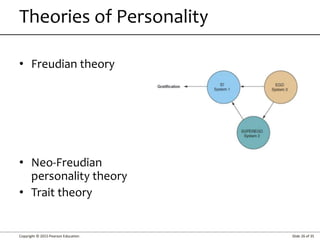
• Freudian theory
• Neo-Freudian
personality theory
• Trait theory
Theories of Personality
Copyright © 2015 Pearson Education Slide 27 of 35
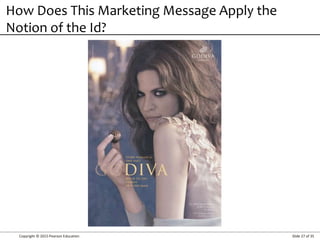
How Does This Marketing Message Apply the
Notion of the Id?
Copyright © 2015 Pearson Education Slide 28 of 35
Learning Objective 3.5
3.5 To understand how innovativeness and other
personality traits influence consumer behavior.
Copyright © 2015 Pearson Education Slide 29 of 35
• Motivational factors
• Levels of innovativeness
• Personality
– Dogmatism
– Social character
– Need for uniqueness
– Optimum stimulation level (OSL)
– Sensation-seeking
– Variety and novelty-seeking
– Need for Cognition
Innovativeness
Copyright © 2015 Pearson Education Slide 30 of 35
• Visualizers vs.
Verbalizers
• Materialism
• Ethnocentrism
Is the ad trying to
appeal to visualizers or
verbalizers? Explain.
Other Personality Factors
Copyright © 2015 Pearson Education Slide 31 of 35
What is the difference between fixated
consumption and compulsive consumption?
Discussion Question
Copyright © 2015 Pearson Education Slide 32 of 35
Learning Objective 3.6
3.6 To understand the personification of
products and brands and its strategic
applications.
Copyright © 2015 Pearson Education Slide 33 of 35
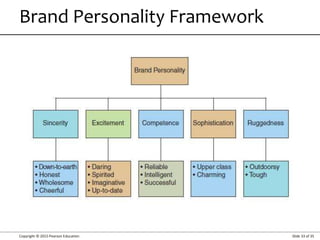
Brand Personality Framework
Copyright © 2015 Pearson Education Slide 34 of 35
Learning Objective 3.7
3.7 To understand self-image and its impact on
consumer behavior.
Copyright © 2015 Pearson Education Slide 35 of 35
• How are possessions an extension of the
self?
• How do consumers use self-altering
products?
• What are the two types of vanity? How does
vanity shape consumption behavior?
Discussion Questions
Copyright © 2015 Pearson Education Slide 36 of 35
All rights reserved. No part of this publication may be reproduced, stored in a
retrieval system, or transmitted, in any form or by any means, electronic,
mechanical, photocopying, recording, or otherwise, without the prior written
permission of the publisher. Printed in the United States of America.
Copyright © 2015 Pearson Education

cultures and consumer behavior and purchase decision

  • 1.
    Copyright © 2015Pearson Education
  • 2.
    Copyright © 2015Pearson Education Slide 2 of 35 Chapter 3 Learning Objectives 3.1 To understand the dynamics of motives, needs, and goals and how they shape consumer behavior. 3.2 To understand motivation theories and their applications to consumer behavior. 3.3 To understand how to identify and measure motives. 3.4 To understand the scope of personality and theories of its development.
  • 3.
    Copyright © 2015Pearson Education Slide 3 of 35 Chapter 3 Learning Objectives 3.5 To understand how innovativeness and other personality traits influence consumer behavior. 3.6 To understand the personification of products and brands and its strategic applications. 3.7 To understand self-image and its impact on consumer behavior.
  • 4.
    Copyright © 2015Pearson Education Slide 4 of 35 Opening example: Brand personification
  • 5.
    Copyright © 2015Pearson Education Slide 5 of 35 Learning Objective 3.1 3.1 To understand the dynamics of motives, needs, and goals and how they shape consumer behavior.
  • 6.
    Copyright © 2015Pearson Education Slide 6 of 35 The Motivation Process
  • 7.
    Copyright © 2015Pearson Education Slide 7 of 35 • Needs – Physiological – Psychological • Goals – Generic – Product-specific Needs and Goals
  • 8.
    Copyright © 2015Pearson Education Slide 8 of 35 Discussion Questions What is the generic goal? What is the product- specific goal? Application: Goals
  • 9.
    Copyright © 2015Pearson Education Slide 9 of 35 Motivations of Bloggers (1) self-expression (2) documenting one’s life (i.e., keeping a diary) (3) identifying other influential bloggers Motivations: Technology Use What motivates you to share information on Facebook? To blog?
  • 10.
    Copyright © 2015Pearson Education Slide 10 of 35 Need Arousal • Internal stimuli • Emotional or cognitive processes • External stimuli Selecting Goals • Factors – personal experiences and knowledge – physical capacity – cultural norms and values – goal accessibility • Approach objects • Avoidance objects Need Arousal and Selecting Goals
  • 11.
    Copyright © 2015Pearson Education Slide 11 of 35 • Needs and goals are interdependent • Needs are never fully satisfied • New needs emerge as old ones are satisfied • Success and failure influence goals Needs and Goals
  • 12.
    Copyright © 2015Pearson Education Slide 12 of 35 Frustration is the feeling that results from failure to achieve a goal, and defense mechanisms are cognitive and behavioral ways to handle frustration. Frustration and Defense Mechanisms
  • 13.
    Copyright © 2015Pearson Education Slide 13 of 35 Defense Mechanisms
  • 14.
    Copyright © 2015Pearson Education Slide 14 of 35 Which Defense Mechanism is used?
  • 15.
    Copyright © 2015Pearson Education Slide 15 of 35 Learning Objective 3.2 3.2 To understand motivation theories and their applications to consumer behavior.
  • 16.
    Copyright © 2015Pearson Education Slide 16 of 35 Psychogenic Needs: Murray and Edwards
  • 17.
    Copyright © 2015Pearson Education Slide 17 of 35 Maslow’s Hierarchy of Needs
  • 18.
    Copyright © 2015Pearson Education Slide 18 of 35 To Which of Maslow’s Needs Does This Ad Appeal?
  • 19.
    Copyright © 2015Pearson Education Slide 19 of 35 Discussion Questions • What are three types of products related to more then one level of Maslow’s Hierarchy of Needs? • For each type of product, consider two brands. How do marketers attempt to differentiate their product from the competition?
  • 20.
    Copyright © 2015Pearson Education Slide 20 of 35 • Power • Affiliation • Achievement Which of the trio of needs does the ad appeal to? Trio of Needs
  • 21.
    Copyright © 2015Pearson Education Slide 21 of 35 Learning Objective 3.3 3.3 To understand how to identify and measure motives.
  • 22.
    Copyright © 2015Pearson Education Slide 22 of 35 • Self reports • Qualitative Research • Motivational Research The Measurement of Motives
  • 23.
    Copyright © 2015Pearson Education Slide 23 of 35 • Dr. Ernest Dichter • Based on Sigmund Freud’s psychoanalytic theory of personality – Unconscious needs are at the heart of human motivation and personality – Drives are likely to be biological and sexual How would an advertiser use this information? Motivational Research
  • 24.
    Copyright © 2015Pearson Education Slide 24 of 35 Learning Objective 3.4 3.4 To understand the scope of personality and theories of its development.
  • 25.
    Copyright © 2015Pearson Education Slide 25 of 35 The inner psychological characteristics (the specific qualities, attributes, traits, factors, and mannerisms that distinguish one individual from other individuals) that both determine and reflect how we think and act. Personality
  • 26.
    Copyright © 2015Pearson Education Slide 26 of 35 • Freudian theory • Neo-Freudian personality theory • Trait theory Theories of Personality
  • 27.
    Copyright © 2015Pearson Education Slide 27 of 35 How Does This Marketing Message Apply the Notion of the Id?
  • 28.
    Copyright © 2015Pearson Education Slide 28 of 35 Learning Objective 3.5 3.5 To understand how innovativeness and other personality traits influence consumer behavior.
  • 29.
    Copyright © 2015Pearson Education Slide 29 of 35 • Motivational factors • Levels of innovativeness • Personality – Dogmatism – Social character – Need for uniqueness – Optimum stimulation level (OSL) – Sensation-seeking – Variety and novelty-seeking – Need for Cognition Innovativeness
  • 30.
    Copyright © 2015Pearson Education Slide 30 of 35 • Visualizers vs. Verbalizers • Materialism • Ethnocentrism Is the ad trying to appeal to visualizers or verbalizers? Explain. Other Personality Factors
  • 31.
    Copyright © 2015Pearson Education Slide 31 of 35 What is the difference between fixated consumption and compulsive consumption? Discussion Question
  • 32.
    Copyright © 2015Pearson Education Slide 32 of 35 Learning Objective 3.6 3.6 To understand the personification of products and brands and its strategic applications.
  • 33.
    Copyright © 2015Pearson Education Slide 33 of 35 Brand Personality Framework
  • 34.
    Copyright © 2015Pearson Education Slide 34 of 35 Learning Objective 3.7 3.7 To understand self-image and its impact on consumer behavior.
  • 35.
    Copyright © 2015Pearson Education Slide 35 of 35 • How are possessions an extension of the self? • How do consumers use self-altering products? • What are the two types of vanity? How does vanity shape consumption behavior? Discussion Questions
  • 36.
    Copyright © 2015Pearson Education Slide 36 of 35 All rights reserved. No part of this publication may be reproduced, stored in a retrieval system, or transmitted, in any form or by any means, electronic, mechanical, photocopying, recording, or otherwise, without the prior written permission of the publisher. Printed in the United States of America. Copyright © 2015 Pearson Education

Editor's Notes

  • #3 This chapter begins with a discussion of consumers’ needs and motivation and then describes how consumers’ personalities influence their buying behavior.
  • #5 Brand personification occurs when consumers attribute human traits or characteristics to a brand. A “brand personality” provides an emotional identity for a brand, which produces sentiments and feelings toward the brand among consumers. Brand personification is a form of anthropomorphism, which refers to attributing human characteristics to something that is not human. Mr. Clean is one of America’s most beloved and instantly recognized “persons.” The brand and mascot are owned by Procter and Gamble and used for positioning and marketing cleaning solutions and related items. The mascot was introduced in the 1950s, quickly became a best seller, and “his” product line now includes bathroom cleaners, a magic eraser, multisurface liquids and sprays, cleaning tools, and “Pro” items for heavy and outdoor cleaning.
  • #6 Motivation is the driving force that impels people to act. It represents the reasons one has for acting or behaving in a particular way. Needs are circumstances or things that that are wanted or required, and they direct the motivational forces. Motivation drives consumers to buy and is triggered by psychological tension caused by unfulfilled needs. Goals are the sought-after results of motivated behavior, and all human behavior is goal oriented.
  • #7 Individuals strive both consciously and subconsciously to reduce tension that is created by unfulfilled needs through selecting goals and subsequent behavior that they anticipate will fulfill their needs and thus relieve them of the tension they feel. Whether gratification is actually achieved depends on the course of action pursued. Personality characteristics guide the goals that people set and the courses of action they take to attain these goals.
  • #8 Physiological needs are innate (biogenic, primary) and fulfilling them sustains biological existence. They include the need for food, water, air, protection of the body from the outside environment (i.e., clothing and shelter), and sex. Psychological needs are learned from our parents, social environment, and interactions with others. Among many others, they include the needs for self-esteem, prestige, affection, power, learning, and achievement. Goals are the sought-after results of motivated behavior, and all human behavior is goal oriented. There are two types of goals: Generic goals are outcomes that consumers seek in order to satisfy physiological and psychological needs. Product-specific goals are outcomes that consumers seek by using a given product or service. When a consumer states they want a pair of jeans, they have stated a generic goal. When they announce they really want a pair of Calvin Klein jeans, then they have stated product-specific goals.
  • #9 The generic goal is passing the bar exam. The product-specific goal is taking the Kaplan bar review course.
  • #10 Marketers try to understand the motivations for social media use because consumers are spending time on social media and they listen to other consumers. The value of bloggers to marketers is undeniable – they post their experiences and exposures to brands online where many other users or potential users can hear more about the brands.
  • #11 Needs can be aroused by internal stimuli found in the individual’s physiological condition, emotional or cognitive processes, or stimuli in the outside environment. Many promotional messages are cues designed to arouse consumer needs. Creative marketing messages arouse needs by stimulating a psychological desire or imbalance in consumers’ minds. The goal then becomes to act on the desire, and reduce the felt imbalance by buying products. Purchase-related goals usually satisfy more than one need. And, for any given need, there are many different and appropriate goals. The goals that individuals select depend on those individuals’ personal experiences and knowledge, physical capacity, prevailing cultural norms and values, and the goal’s accessibility in the individuals’ physical and social environments. The goal object has to be both socially acceptable and physically accessible. The motivation to select goals can be either positive or negative. We may feel a driving force toward some object or condition or a driving force away from some object or condition. Positive outcomes that we seek are called approach objects; negative outcomes that we want to prevent are called avoidance objects.
  • #12 Needs and goals are interdependent; neither exists without the other. However, people are often not as aware of their needs as they are of their goals. Human needs are never fully or permanently satisfied. As individuals attain their goals, they develop new ones. If they do not attain their goals, they continue to strive for old goals or they develop substitute goals. Some motivational theorists believe that a hierarchy of needs exists and that new, higher-order needs emerge as lower-order needs are fulfilled. Individuals who achieve their goals usually set new and higher goals for themselves. Conversely, those who do not reach their goals sometimes lower their aspirations.
  • #14 Defense mechanisms are used when people cannot cope with frustration. They are often developed to protect one’s ego from feelings of failure when goals are not achieved. Perhaps you can identify a time when you used a defense mechanism when reacting to a difficult situation.
  • #15 The ad provides an example of daydreaming.
  • #16 There is no single, comprehensive, and commonly accepted list of human needs. Psychologists seem to agree about physiological needs, but they do not agree about how to define and categorize psychological (or psychogenic) needs (needs with nonphysical origins).
  • #17 Henry Murray prepared an extensive list of psychogenic needs in 1938, which represented the first systematic approach to the understanding of nonbiological human needs. Murray believed that needs can be interrelated, can support other needs, and can conflict with other needs. He also believed that environmental circumstances strongly influence how psychogenic needs are displayed in behavior. Murray organized his needs into five groups: ambition, materialistic, power, affection, and information needs. Later, psychologist Allen Edwards developed a self-administered personality inventory that became one of the most widely used tools in the study of personality traits. Table 3.3 lists the definition and illustrative characteristics of several needs researched by Murray and Edwards that are most relevant to consumer behavior.
  • #18 Psychologist Abraham Maslow formulated a theory of human motivation based on the notion that there is a hierarchy of human needs which rank in order of importance from lower-level (biogenic) needs to higher-level (psychogenic) needs. Individuals seek to satisfy lower-level needs before higher-level needs. The needs appear to be mutually exclusive, but there is some overlap. Maslow maintained that physiological needs (primary needs which are required to sustain biological life, including food, water, air, shelter, clothing, and sex—all biogenic needs) are the first and most basic level of human needs. After physiological needs have been satisfied, safety and security needs (physical safety, order, stability, routine, familiarity, and control over one’s life and environment) become the driving force behind an individual’s behavior. The third level of Maslow’s hierarchy consists of social needs, such as love, affection, belonging, and acceptance. When social needs are more or less satisfied, egoistic needs (inwardly directed: needs for self-acceptance, self-esteem, success, independence, and personal satisfaction; outwardly directed: needs for prestige, reputation, status, and recognition from others) become operative. The fifth level, self-actualization need, refers to an individual’s desire to fulfill his or her potential—to become everything that he or she is capable of becoming.
  • #19 The ad appeals to both Physiological and Social Needs
  • #20 To answer this question, think of products that provide safety and shelter but may also vary in price. For the second part of this question, you might want to consider companies that market coats and jackets. Some will emphasize different needs than the coat will meet and these unmet needs will exist in several layers of the hierarchy.
  • #21 The power need is an individual’s desire to control his or her environment. It includes the need to control other persons and various objects. This need appears to be closely related to the ego need, in that many individuals experience increased self-esteem when they exercise power over objects or people. The affiliation need is very similar to Maslow’s social need and suggests that behavior is strongly influenced by the desire for friendship, acceptance, and belonging. Individuals with a strong achievement need often regard personal accomplishment as an end in itself. They are self-confident, enjoy taking calculated risks, actively research their environments, and value feedback, often in the form of monetary rewards. The Kaplan ad is designed to appeal to those with a strong achievement need.
  • #22 Motives are hypothetical constructs (they cannot be seen or touched, handled, smelled, or otherwise tangibly observed) so no single measurement method can be considered a reliable index of motivation. Researchers usually rely on a combination of research techniques when trying to establish the presence and/or the strength of various motives, e.g. responses to questionnaires or survey data (i.e., self-reports of opinions and behaviors) and insights from focus group sessions and depth interviews (i.e., to discover underlying motives).
  • #23 Self-reported measures of motives consist of written statements which ask respondents to indicate how relevant each statement is to them. When respondents are unwilling or unable to report their motives, researchers use qualitative research to delve into the consumer’s unconscious or hidden motivations. Many qualitative methods also are termed projective techniques because they require respondents to interpret stimuli that do not have clear meanings, based on the assumption that the subjects will “reveal” or “project” their subconscious, hidden motives into (or onto) the ambiguous stimuli. Table 3.4 provides examples of different qualitative measures of motives. Motivation research is also qualitative and seeks to tap into the subconscious by adapting Freud’s psychoanalytical techniques.
  • #24 Dichter told marketers that consumers bought cigarettes and Life Saver candies because of their sexual symbolism, that men regarded convertible cars as surrogate mistresses, and that women baked cakes to fulfill their reproductive yearnings. Before long, almost every major advertising agency in the country had a psychologist on staff to conduct motivational research studies. Table 3.5 includes a sample of product profiles created by Dichter and his colleagues.
  • #26 Although research does not agree regarding the role of heredity and early childhood experiences on personality development vs. the role of broader social and environmental influences or on whether personality should be viewed ad a unified whole or as specific traits, researchers agree that: (1) personality reflects individual differences; (2) personality is generally consistent and enduring; and (3) although it is enduring, personality can sometimes change.
  • #27 These are the three major theories of personalities. There are many more but these three have been chosen because they are important to the relationship between personality and consumer behavior. Freudian theory suggests unconscious needs or drives are at the heart of human motivation. Neo-Freudian theory suggests social relationships are fundamental to the formation and development of personality. Trait theory takes a quantitative approach to personality as a set of psychological traits. A trait is any distinguishing, relatively enduring way in which one individual differs from another. According to Freud, human personality consists of these three systems, the id, super ego and the ego. The Id is the “warehouse” of primitive drives, basic physiological needs such as hunger, thirst, and sex. The superego drives the individual to fulfill their needs in a socially acceptable function. Finally, the ego is the internal monitor that balances the needs of the id and the superego. Neo-Fruedians believe social relationships are fundamental to personality (vs. Freud’s theories, which were based heavily on development). These relationships are formed to reduce feelings of inferiority (Adler) or tension (Sullivan). Furthermore, people can be classified as to how they interact with others – are they compliant, aggressive, or detached (Horney). A compliant individual desires attention, an aggressive desires admirations, and a detached person desires independence and freedom from obligation. What is particularly interesting is how research has shown that these different personality groups differ in their brand usage.
  • #28 It Captures Some of the Mystery and The Excitement Associated With the “Forces” of Primitive Drives.
  • #30 Four motivational factors: 1. Functional factors reflect interest in the performance of an innovation. 2. Hedonic factors relate to feeling gratified by using the innovation. 3. Social factors reflect the desire to be recognized by others because of one’s pursuit of innovations. 4. Cognitive factors express the mental stimulation experienced by using an innovation. Levels of innovativeness 1. Global innovativeness—a trait that exists independent of any product-related context and represents the “very nature” of consumers’ innovativeness 2. Domain-specific innovativeness—a narrowly defined activity within a specific domain or product category 3. Innovative behavior—actions or responses that indicate early acceptance of change and adoption of innovations (e.g., being among the first to purchase new and different products or services). Dogmatism is one’s degree of rigidity—the opposite of being open-minded—toward information and opinion contradictory to one’s beliefs and views (i.e., closed-mindedness). Dogmatic individuals are less likely to be innovators. Social character describes an individual’s inner or other-directedness. Inner-directed consumers rely on their own inner values or standards in evaluating new products and are likely to be consumer innovators. Conversely, other-directed consumers look to others for guidance as to what is appropriate or inappropriate and are unlikely to be consumer innovators. Need for uniqueness is defined as an individual’s pursuit of differentness relative to others that is achieved through the acquisition of consumer goods in order to enhance one’s personal and social identity. Optimum stimulation level (OSL) is the degree to which people like novel, complex, and unusual experiences (i.e., high OSL) or prefer a simple, uncluttered, and calm existence (i.e., low OSL). Sensation seeking is one’s need for varied, novel, and complex sensations and experiences, and the willingness to take risks for the sake of such experiences. Variety and novelty seeking consists of: 1. Exploratory purchase behavior includes switching brands to experience new, different, and possibly better alternatives. 2. Vicarious exploration consists of gathering information about new and different product alternatives and contemplating buying them. 3. Use innovativeness means using an already adopted product in a new or novel way. Need for cognition (NFC) measures a person’s craving for or enjoyment of thinking.
  • #31 Verbalizers prefer promotional messages containing a lot of written, textual, and verbal information. Visualizers are more receptive to pictorial images, and include: 1. Object visualizers, who encode and process images as a single perceptual unit. 2. Spatial visualizers, who process images piece by piece. Materialism gauges the extent to which an individual is preoccupied with purchasing and showing off physical possessions that are mostly nonessential and often conspicuous luxury goods. Ethnocentrism is the consumer’s willingness to buy or not buy foreign-made products.
  • #32 Fixated consumption refers to collectors’ and hobbyists’ tendency to accumulate items that are related to their interests and show them off to friends and others with similar interests. Fixated consumers share the following characteristics: 1. A passion for and interest in the category of what they collect. 2. Willingness to invest a lot of effort in adding to their collections. 3. Spending a lot of time and discretionary income searching and buying more items for their collections. 4. Aggressively competing in auctions. Compulsive consumption is addictive and out-of-control buying that often has damaging consequences for both the compulsive shopper and those around him or her. Examples of compulsive consumption problems are uncontrollable shopping, gambling, drug addiction, alcoholism, and even eating disorders.
  • #33 Brand personification occurs when consumers attribute human traits or characteristics to a brand. A “brand personality” provides an emotional identity for a brand, which produces sentiments and feelings toward the brand among consumers. Product personality has been associated with gender and geography, and consumers have given websites personalities as well.
  • #34 Figure 3.14 depicts 5 underlying dimensions of a brand’s personality—sincerity, excitement, competence, sophistication, and ruggedness—and 15 more narrowly defined characteristics, such as down-to-earth, daring, reliable, upper class, and outdoors.
  • #35 Consumer behavior researchers identified four components of self-image: 1. Actual self-image is the way consumers see themselves; 2. Ideal self-image is how consumers would like to see themselves; 3. Social self-image is how consumers feel others see them; and 4. Ideal social self-image is how consumers would like others to see them.
  • #36 Possessions represent an extension of the self: 1. Actually, by allowing the person to do things that otherwise would be very difficult or impossible to accomplish (e.g., problem solving by using a computer). 2. Symbolically, by making the person feel better (e.g., being considered the “best dressed” at work). 3. Conferring status or rank, for example, among collectors of rare works of art because of the ownership of a particular masterpiece). 4. Feelings of immortality because of leaving valuable bequests after death. Consumers use self-altering products to express their new selves or take on the appearances of particular types of people (e.g., a military person, physician, business executive, or college professor). Researchers discovered two types of vanity: (1) physical vanity, which is excessive concern with or inflated view of one’s physical appearance; and (2) achievement vanity, which is excessive concern with or inflated view of one’s personal achievements. Vain consumers: (1) are a lucrative market for personal care and beauty products; (2) welcome promotional messages showing that they attract others’ attention; and (3) are receptive to promotional messages featuring personal achievement.