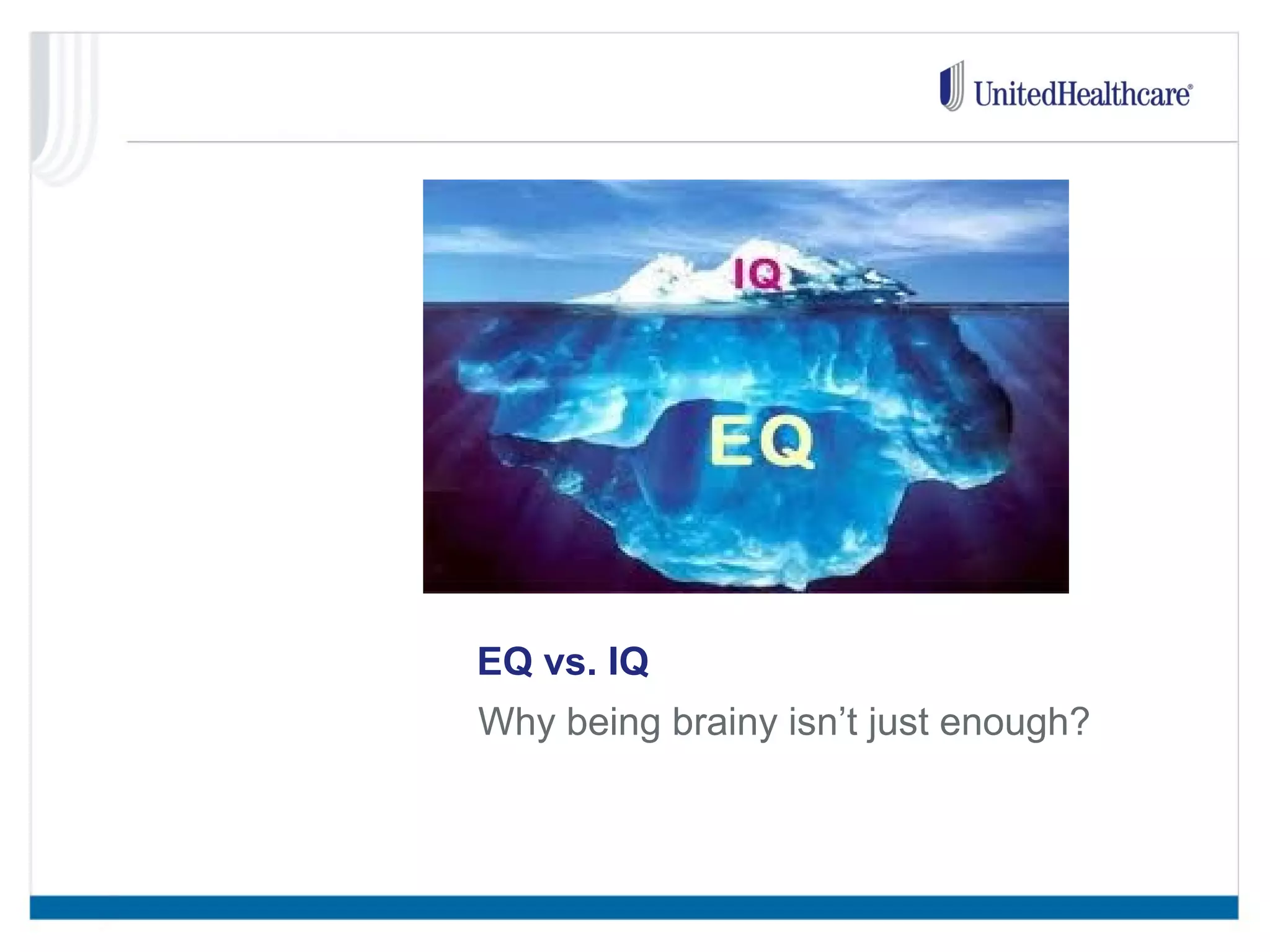
EQ vs. IQ
• Why being brainy isn’t just enough?
Cover area with cropped image.
Do not overlap blue bar.
Completely cover gray area.
What is EQ ??
• An iPhone app
• An Equation in Mathematics
• Equator in Geography
• Earthquake
• Equinox
• Equivalency in Chemistry ..
• ……Or something else?
HISTORY
• The term "emotional intelligence" seems first to have
appeared in a 1964 paper by Michael Beldoch and in the
1966 paper by B. Leuner entitled Emotional intelligence and
emancipation which appeared in the psychotherapeutic
journal:
• The term subsequently appeared in Wayne Payne's
doctoral thesis , A Study of Emotion: Developing Emotional
Intelligence from 1985.
• The first published use of the term 'EQ' (Emotional
Quotient) is an article by Keith Beasley in 1987 in the British
Mensa magazine.
3
Emotional Quotient
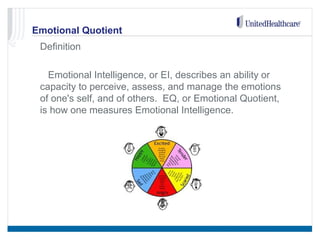
• Definition
• Emotional Intelligence, or EI, describes an ability or
capacity to perceive, assess, and manage the emotions
of one's self, and of others. EQ, or Emotional Quotient,
is how one measures Emotional Intelligence.
•
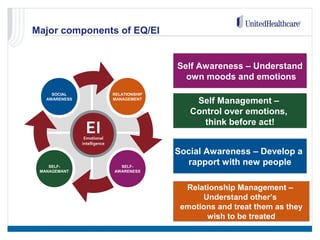
Major components of EQ/EI
RELATIONSHIP
MANAGEMENT
SELF-
MANAGEMANT
SOCIAL
AWARENESS
SELF-
AWARENESS
EIEmotional
intelligence
Self Awareness – Understand
own moods and emotions
Social Awareness – Develop a
rapport with new people
Relationship Management –
Understand other’s
emotions and treat them as they
wish to be treated
Self Management –
Control over emotions,
think before act!
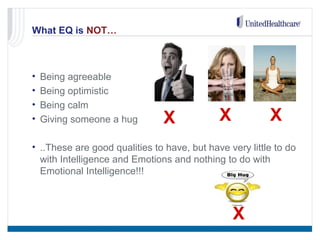
What EQ is NOT…
• Being agreeable
• Being optimistic
• Being calm
• Giving someone a hug
• ..These are good qualities to have, but have very little to do
with Intelligence and Emotions and nothing to do with
Emotional Intelligence!!!
X X X
X
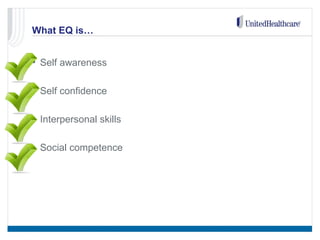
What EQ is…
• Self awareness
• Self confidence
• Interpersonal skills
• Social competence
HOW TO MEASURE AND DEVELOP EQ
1. Take emotions into account
•All emotions have a purpose, that is, they have a functional
aspect and help us communicate. For example, if someone
is hostile, we are in danger if we do not acknowledge it.
• For example, if I feel guilt, it generally means that I am
moving away from what is really important to me. If I ignore
this, I am not communicating with myself.
8
2. Use a valid theoretical model to evaluate
emotional intelligence
• a) Recognize (Immediate Read)
• Recognition is a highly developable
skill with three main focus points for
improvement:
• 1) Pay attention.
• 2) Increase the capture rate (stop
enough to take in what you are
seeing).
• 3) Get it right.
9
b) Use (impact of emotion on the thinking style)
• The head vs. heart approach is
nonsense: every rational decision
involves emotions.
• Mood-Task match:
• – Inductive reasoning is favoured
when in a relaxed, positive mood.
• – Deductive thinking is facilitated
by a neutral or slightly negative mood. A
slight sense of anxiety or concern
makes thinking work more efficient.
10
11
c) Understand
What am I really feeling? How will I feel later?
Ability to appreciate emotional complexity.
Ability to understand the causes and progression of
emotion.
d) Manage
Managing is not about controlling emotion. That is a
common popularization. Nothing supports the idea that this
is effective; in fact it is the opposite. Feeling and expressing
emotions can be most effective in most contexts.
Suppressing emotions carries a cost: trying not to think
about something uses cognitive resources, which is energy
consuming.
As a result, problem-solving capabilities decrease.
Thought to ponder…
• Do you ever wonder why do people with high IQ struggle in
life while others with moderate IQ succeed?
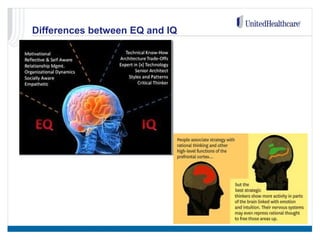
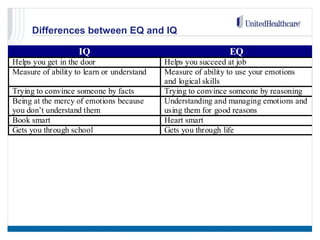
Differences between EQ and IQ
IQ EQ
Helps you get in the door Helps you succeed at job
Measure of ability to learn or understand Measure of ability to use your emotions
and logical skills
Trying to convince someone by facts Trying to convince someone by reasoning
Being at the mercy of emotions because
you don’t understand them
Understanding and managing emotions and
using them for good reasons
Book smart Heart smart
Gets you through school Gets you through life
15
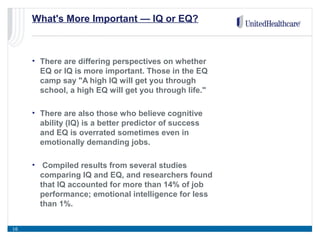
What's More Important — IQ or EQ?
• There are differing perspectives on whether
EQ or IQ is more important. Those in the EQ
camp say "A high IQ will get you through
school, a high EQ will get you through life."
• There are also those who believe cognitive
ability (IQ) is a better predictor of success
and EQ is overrated sometimes even in
emotionally demanding jobs.
• Compiled results from several studies
comparing IQ and EQ, and researchers found
that IQ accounted for more than 14% of job
performance; emotional intelligence for less
than 1%.
16
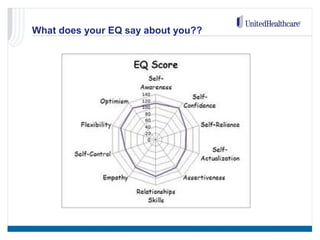
What does your EQ say about you??
19
How to raise your EQ?
• "There is only one corner of the
universe you can be certain of
improving... and that's your own self.
---- Aldous Huxley
How to raise your EQ
• Knowing one’s own emotions
• Recognize and name emotions you feel; understand why you feel
that way; and distinguish between feelings and actions
• Motivating oneself
• When considering how to productively harness your feelings,
practice some emotional self-control and delay gratification
• Recognizing emotions in others
• Be sensitive to other people’s feelings and listen well
How to raise your EQ
• Managing emotions
• Accept your feelings, but find a balance between over sensitivity
or over expression and emotional suppression
• Handling relationships
• Being perceptive, applying conflict management skills instead of
ignoring conflict, and being considerate and cooperative
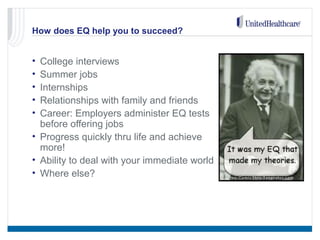
How does EQ help you to succeed?
• College interviews
• Summer jobs
• Internships
• Relationships with family and friends
• Career: Employers administer EQ tests
before offering jobs
• Progress quickly thru life and achieve
more!
• Ability to deal with your immediate world
• Where else?
KEY POINTS!!!
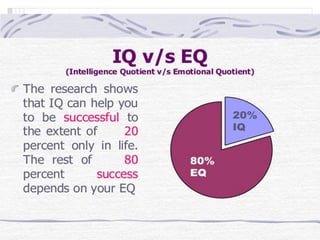
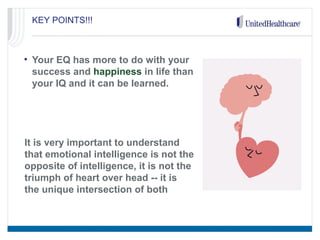
• Your EQ has more to do with your
success and happiness in life than
your IQ and it can be learned.
It is very important to understand
that emotional intelligence is not the
opposite of intelligence, it is not the
triumph of heart over head -- it is
the unique intersection of both
Challenge Yourself to Achieve!!!
• It is not just technical and analytical abilities (IQ) that makes one
successful
•
• To be successful in life, you need a combination of EQ and IQ.
• And here is the great news; EQ (unlike IQ) can be developed!!
•Thank you for your
attention!!

EQ V/S IQ

  • 1.
    EQ vs. IQ •Why being brainy isn’t just enough? Cover area with cropped image. Do not overlap blue bar. Completely cover gray area.
  • 2.
    What is EQ?? • An iPhone app • An Equation in Mathematics • Equator in Geography • Earthquake • Equinox • Equivalency in Chemistry .. • ……Or something else?
  • 3.
    HISTORY • The term"emotional intelligence" seems first to have appeared in a 1964 paper by Michael Beldoch and in the 1966 paper by B. Leuner entitled Emotional intelligence and emancipation which appeared in the psychotherapeutic journal: • The term subsequently appeared in Wayne Payne's doctoral thesis , A Study of Emotion: Developing Emotional Intelligence from 1985. • The first published use of the term 'EQ' (Emotional Quotient) is an article by Keith Beasley in 1987 in the British Mensa magazine. 3
  • 4.
    Emotional Quotient • Definition •Emotional Intelligence, or EI, describes an ability or capacity to perceive, assess, and manage the emotions of one's self, and of others. EQ, or Emotional Quotient, is how one measures Emotional Intelligence. •
  • 5.
    Major components ofEQ/EI RELATIONSHIP MANAGEMENT SELF- MANAGEMANT SOCIAL AWARENESS SELF- AWARENESS EIEmotional intelligence Self Awareness – Understand own moods and emotions Social Awareness – Develop a rapport with new people Relationship Management – Understand other’s emotions and treat them as they wish to be treated Self Management – Control over emotions, think before act!
  • 6.
    What EQ isNOT… • Being agreeable • Being optimistic • Being calm • Giving someone a hug • ..These are good qualities to have, but have very little to do with Intelligence and Emotions and nothing to do with Emotional Intelligence!!! X X X X
  • 7.
    What EQ is… •Self awareness • Self confidence • Interpersonal skills • Social competence
  • 8.
    HOW TO MEASUREAND DEVELOP EQ 1. Take emotions into account •All emotions have a purpose, that is, they have a functional aspect and help us communicate. For example, if someone is hostile, we are in danger if we do not acknowledge it. • For example, if I feel guilt, it generally means that I am moving away from what is really important to me. If I ignore this, I am not communicating with myself. 8
  • 9.
    2. Use avalid theoretical model to evaluate emotional intelligence • a) Recognize (Immediate Read) • Recognition is a highly developable skill with three main focus points for improvement: • 1) Pay attention. • 2) Increase the capture rate (stop enough to take in what you are seeing). • 3) Get it right. 9
  • 10.
    b) Use (impactof emotion on the thinking style) • The head vs. heart approach is nonsense: every rational decision involves emotions. • Mood-Task match: • – Inductive reasoning is favoured when in a relaxed, positive mood. • – Deductive thinking is facilitated by a neutral or slightly negative mood. A slight sense of anxiety or concern makes thinking work more efficient. 10
  • 11.
    11 c) Understand What amI really feeling? How will I feel later? Ability to appreciate emotional complexity. Ability to understand the causes and progression of emotion. d) Manage Managing is not about controlling emotion. That is a common popularization. Nothing supports the idea that this is effective; in fact it is the opposite. Feeling and expressing emotions can be most effective in most contexts. Suppressing emotions carries a cost: trying not to think about something uses cognitive resources, which is energy consuming. As a result, problem-solving capabilities decrease.
  • 12.
    Thought to ponder… •Do you ever wonder why do people with high IQ struggle in life while others with moderate IQ succeed?
  • 13.
  • 14.
    Differences between EQand IQ IQ EQ Helps you get in the door Helps you succeed at job Measure of ability to learn or understand Measure of ability to use your emotions and logical skills Trying to convince someone by facts Trying to convince someone by reasoning Being at the mercy of emotions because you don’t understand them Understanding and managing emotions and using them for good reasons Book smart Heart smart Gets you through school Gets you through life
  • 15.
  • 16.
    What's More Important— IQ or EQ? • There are differing perspectives on whether EQ or IQ is more important. Those in the EQ camp say "A high IQ will get you through school, a high EQ will get you through life." • There are also those who believe cognitive ability (IQ) is a better predictor of success and EQ is overrated sometimes even in emotionally demanding jobs. • Compiled results from several studies comparing IQ and EQ, and researchers found that IQ accounted for more than 14% of job performance; emotional intelligence for less than 1%. 16
  • 17.
    What does yourEQ say about you??
  • 18.
    What does yourEQ say about you??
  • 19.
  • 20.
    How to raiseyour EQ? • "There is only one corner of the universe you can be certain of improving... and that's your own self. ---- Aldous Huxley
  • 21.
    How to raiseyour EQ • Knowing one’s own emotions • Recognize and name emotions you feel; understand why you feel that way; and distinguish between feelings and actions • Motivating oneself • When considering how to productively harness your feelings, practice some emotional self-control and delay gratification • Recognizing emotions in others • Be sensitive to other people’s feelings and listen well
  • 22.
    How to raiseyour EQ • Managing emotions • Accept your feelings, but find a balance between over sensitivity or over expression and emotional suppression • Handling relationships • Being perceptive, applying conflict management skills instead of ignoring conflict, and being considerate and cooperative
  • 23.
    How does EQhelp you to succeed? • College interviews • Summer jobs • Internships • Relationships with family and friends • Career: Employers administer EQ tests before offering jobs • Progress quickly thru life and achieve more! • Ability to deal with your immediate world • Where else?
  • 24.
    KEY POINTS!!! • YourEQ has more to do with your success and happiness in life than your IQ and it can be learned. It is very important to understand that emotional intelligence is not the opposite of intelligence, it is not the triumph of heart over head -- it is the unique intersection of both
  • 25.
    Challenge Yourself toAchieve!!! • It is not just technical and analytical abilities (IQ) that makes one successful • • To be successful in life, you need a combination of EQ and IQ. • And here is the great news; EQ (unlike IQ) can be developed!!
  • 26.
    •Thank you foryour attention!!