EMOTIONAL INTELLIGENCE
BETTER DECISION MAKING
PRESENTED BY:
MUHAMMAD AWAIS
CMS: 18250
1
Emotional Intelligence
As far back as Socrates, and
probably before, we have
sought to understand our minds,
motivations, and behaviours.
The journey begins with
knowing ones self before
knowing others.
Know thyself
Socrates (ca. 400 BC)
2
What is Emotional Intelligence?
Simply: the awareness and understanding of
emotions
How does this help us?
 Being aware of our emotional state gives us options to
consider our responses
 Understanding emotions in others helps us know what
may be happening in the other person
3
What are Emotions?
• Typically they are a response to events of
concern, triggering physiological and
psychological changes in the person that
motivate behaviour.
• How are you feeling?
 Happy, Sad, Angry, Frustrated, Satisfied,
Shocked, Thoughtful, Surprised, Fearful, …
4
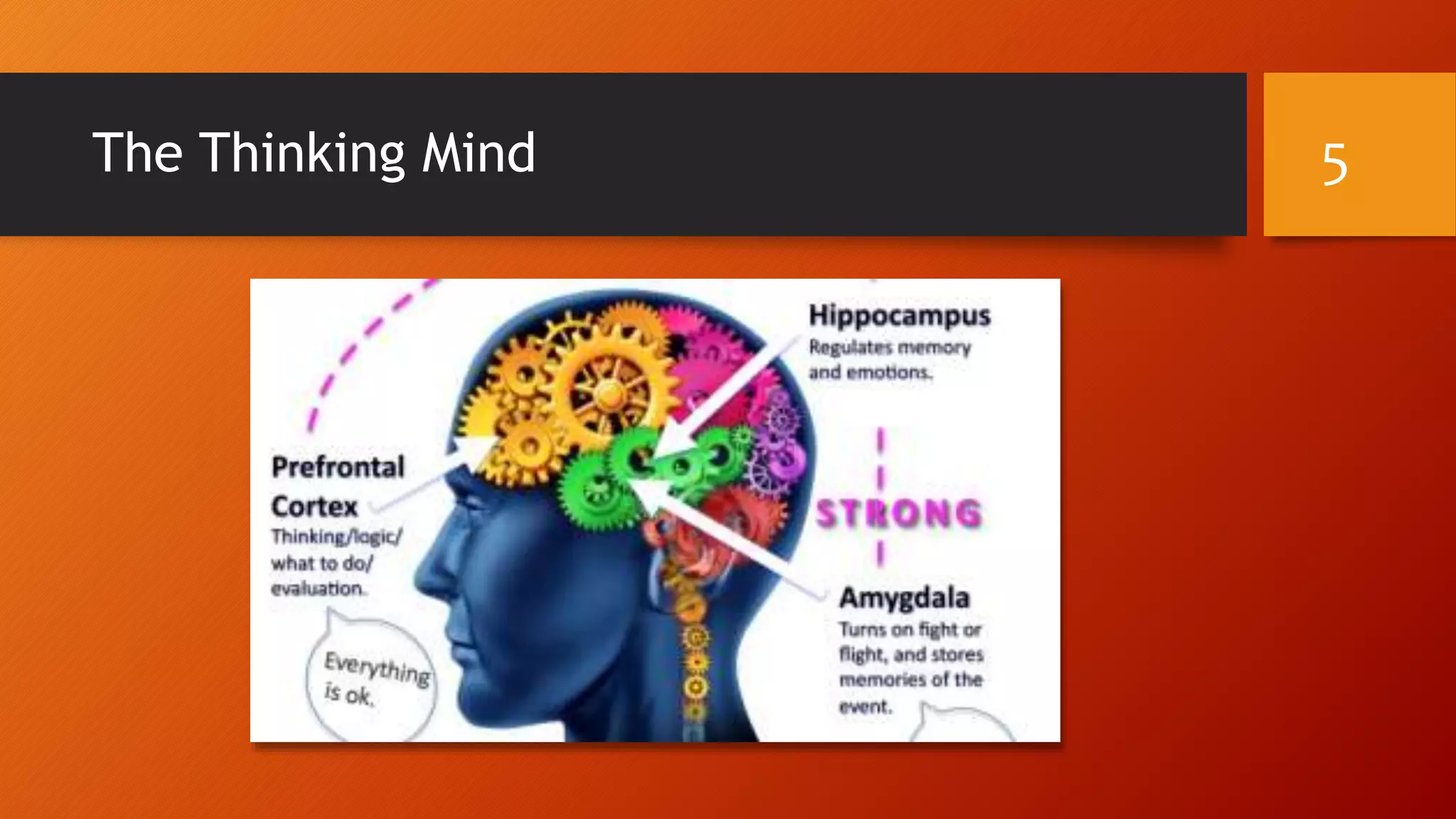
The Thinking Mind 5
Triggers:
Thoughts / Feelings / Behaviours 6
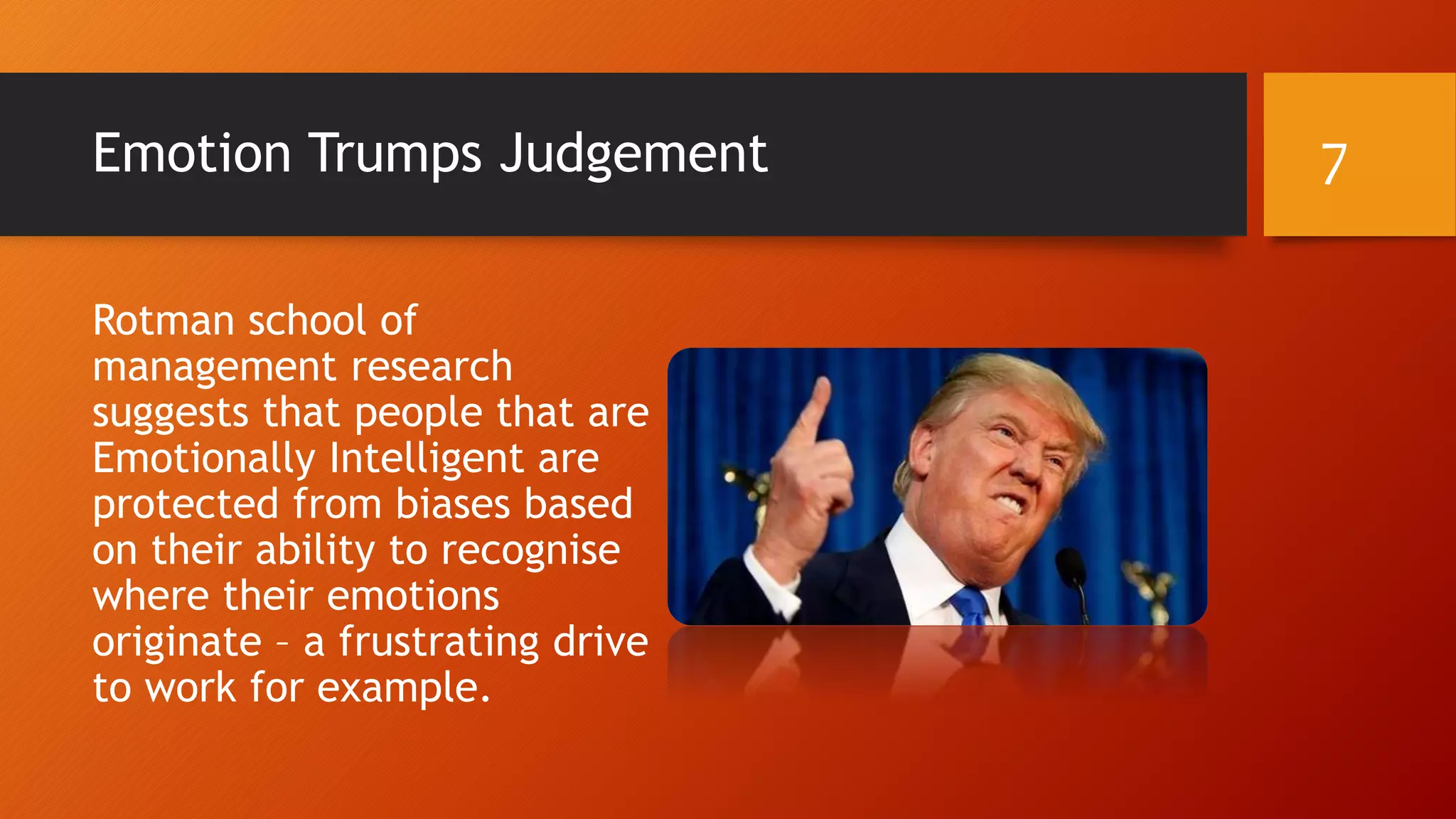
Emotion Trumps Judgement
Rotman school of
management research
suggests that people that are
Emotionally Intelligent are
protected from biases based
on their ability to recognise
where their emotions
originate – a frustrating drive
to work for example.
7
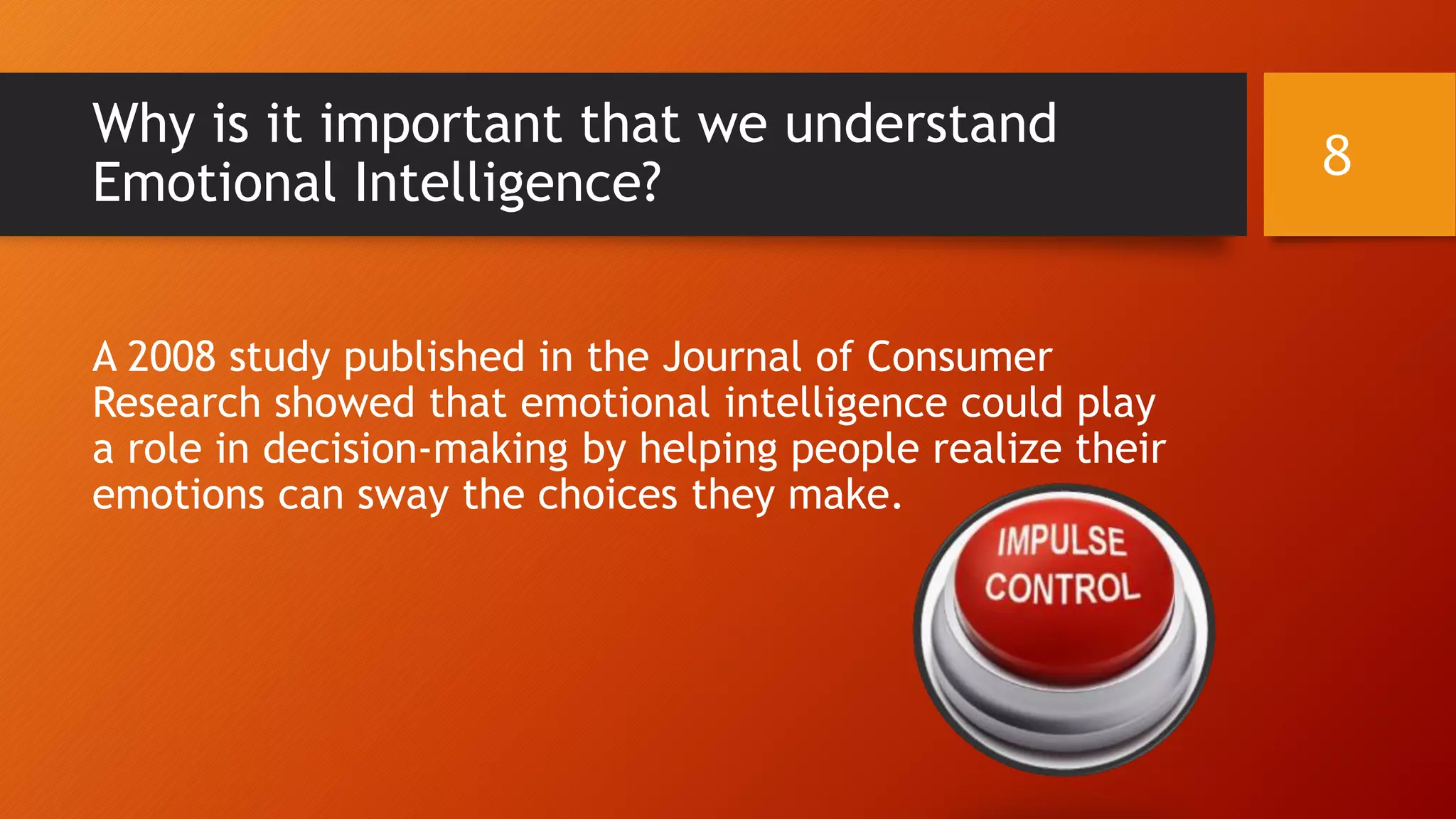
Why is it important that we understand
Emotional Intelligence?
A 2008 study published in the Journal of Consumer
Research showed that emotional intelligence could play
a role in decision-making by helping people realize their
emotions can sway the choices they make.
8
What does it all mean?
 Our emotional state plays a huge part in our
ability to make decisions
 We suffer from bias
 We have trouble making sound decisions when
stress hormones are released into our system
 And we are never really sure the decisions we
make are good decisions?
9
Understanding!
Let’s find out a little more about how Emotional
Intelligence can help us out!
10
Who defined Emotional Intelligence?
Three main schools of thought:
• Mayer, Salovey, & Caruso: MSCEIT – ability
based model (Personality)
• Daniel Goleman, Richard Boyatzis: (ESCI) –
ability and trait model (Personality &
Cognitive)
• Reuven Bar-On: EQ-I – ability based model
(Personality)
11
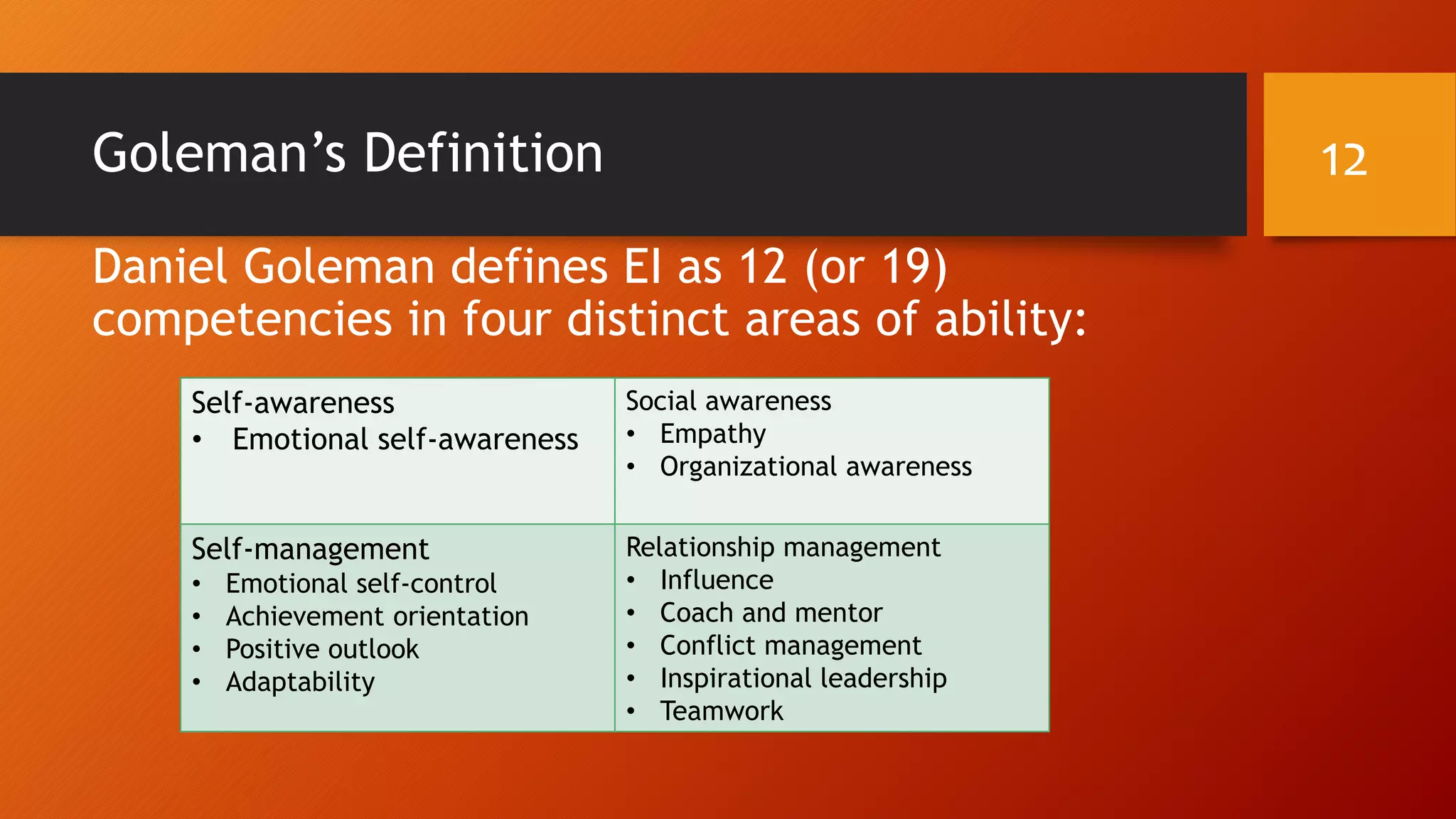
Goleman’s Definition
Daniel Goleman defines EI as 12 (or 19)
competencies in four distinct areas of ability:
Self-awareness
• Emotional self-awareness
Social awareness
• Empathy
• Organizational awareness
Self-management
• Emotional self-control
• Achievement orientation
• Positive outlook
• Adaptability
Relationship management
• Influence
• Coach and mentor
• Conflict management
• Inspirational leadership
• Teamwork
12
Recognising your Mood State:
Self-awareness
What frame of mind are you in?
Happy?
Sad?
Confident?
Confused?
Frustrated?
Angry?
What bias will you bring to the negotiation?
13
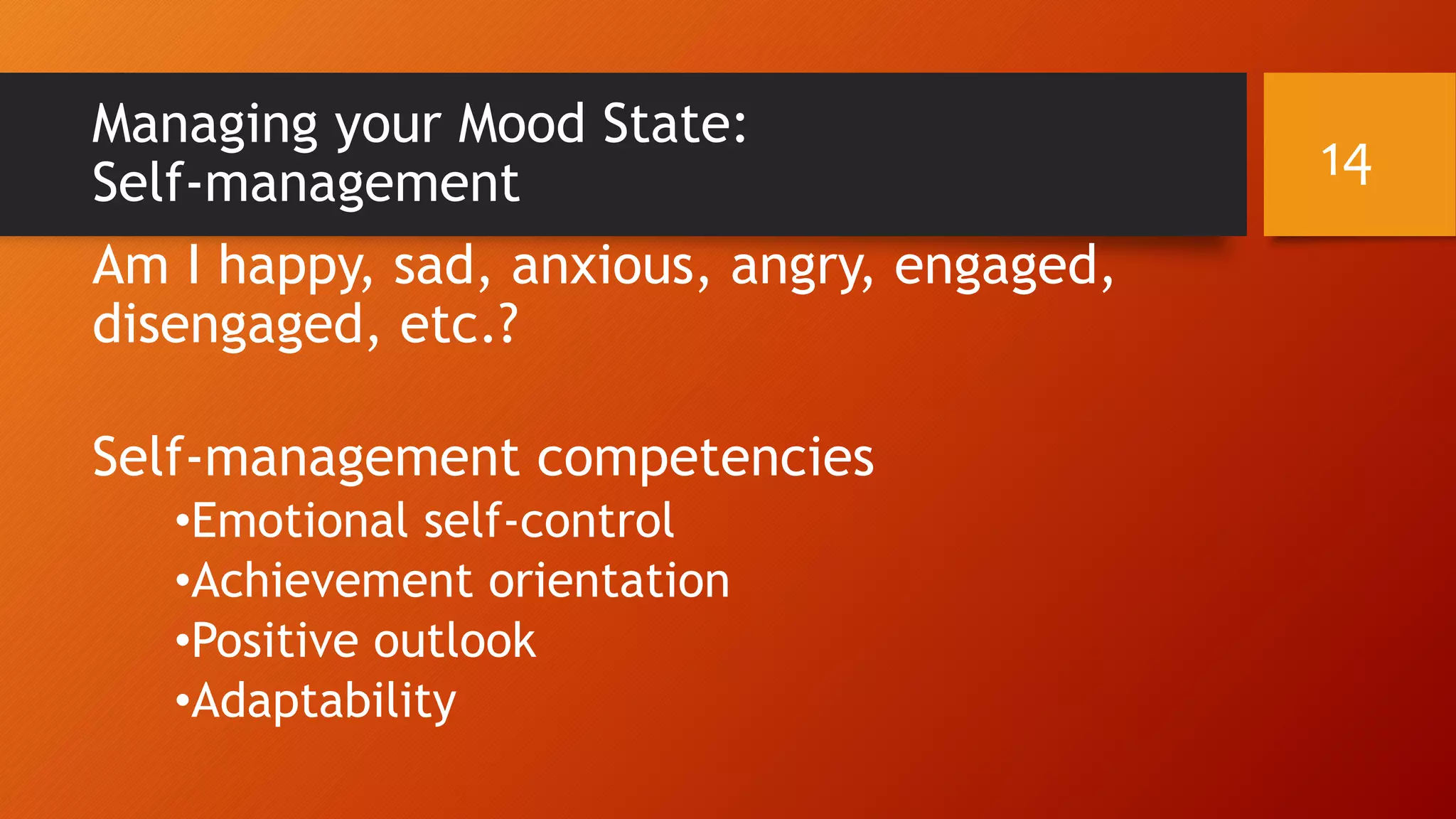
Managing your Mood State:
Self-management
Am I happy, sad, anxious, angry, engaged,
disengaged, etc.?
Self-management competencies
•Emotional self-control
•Achievement orientation
•Positive outlook
•Adaptability
14
How can Emotion Intelligence effectively
assist in Decision Making?
 By helping us to better understand our triggers
and manage automatic reactions
 By enabling us to STOP and choose a
‘response’
 By helping us better assess our mood state and
recognise this in others
 By enabling us to respond to new opportunities
 By helping us stay optimistic
15
Tips! Making Better Decisions
 Sleep
 Caffeine
 Meditate
 Reflect / Journal
 Understanding physiological/bodily signs
 Understanding Emotional states within yourself
 Understanding Emotional states within others
 Understanding your values
16
Better Decisions
We make better decisions when we act on information
from our feelings, our instincts, and our intuition, as
well as on information coming from our rational
intellect. It is our emotional brains, after all, that
allows us to access memory and assign weight or
preference to the choices we face at work and in our
personal lives. It is our Emotional Intelligence that
guides us in controlling or accessing emotions when we
must adapt to change, get along with others, or deal
with stress. Performance and leadership in any
organizational setting are both influenced by EQ
Source: The Science Behind Emotional Intelligence, Emily A. Sterrett, Ph.D. 2014, HRD Press, Inc.
17
“
”
THANK YOU END

Emotional Intelligence - Better Decision Making

  • 1.
  • 2.
  • 3.
    Emotional Intelligence As farback as Socrates, and probably before, we have sought to understand our minds, motivations, and behaviours. The journey begins with knowing ones self before knowing others. Know thyself Socrates (ca. 400 BC) 2
  • 4.
    What is EmotionalIntelligence? Simply: the awareness and understanding of emotions How does this help us?  Being aware of our emotional state gives us options to consider our responses  Understanding emotions in others helps us know what may be happening in the other person 3
  • 5.
    What are Emotions? •Typically they are a response to events of concern, triggering physiological and psychological changes in the person that motivate behaviour. • How are you feeling?  Happy, Sad, Angry, Frustrated, Satisfied, Shocked, Thoughtful, Surprised, Fearful, … 4
  • 6.
  • 7.
  • 8.
    Emotion Trumps Judgement Rotmanschool of management research suggests that people that are Emotionally Intelligent are protected from biases based on their ability to recognise where their emotions originate – a frustrating drive to work for example. 7
  • 9.
    Why is itimportant that we understand Emotional Intelligence? A 2008 study published in the Journal of Consumer Research showed that emotional intelligence could play a role in decision-making by helping people realize their emotions can sway the choices they make. 8
  • 10.
    What does itall mean?  Our emotional state plays a huge part in our ability to make decisions  We suffer from bias  We have trouble making sound decisions when stress hormones are released into our system  And we are never really sure the decisions we make are good decisions? 9
  • 11.
    Understanding! Let’s find outa little more about how Emotional Intelligence can help us out! 10
  • 12.
    Who defined EmotionalIntelligence? Three main schools of thought: • Mayer, Salovey, & Caruso: MSCEIT – ability based model (Personality) • Daniel Goleman, Richard Boyatzis: (ESCI) – ability and trait model (Personality & Cognitive) • Reuven Bar-On: EQ-I – ability based model (Personality) 11
  • 13.
    Goleman’s Definition Daniel Golemandefines EI as 12 (or 19) competencies in four distinct areas of ability: Self-awareness • Emotional self-awareness Social awareness • Empathy • Organizational awareness Self-management • Emotional self-control • Achievement orientation • Positive outlook • Adaptability Relationship management • Influence • Coach and mentor • Conflict management • Inspirational leadership • Teamwork 12
  • 14.
    Recognising your MoodState: Self-awareness What frame of mind are you in? Happy? Sad? Confident? Confused? Frustrated? Angry? What bias will you bring to the negotiation? 13
  • 15.
    Managing your MoodState: Self-management Am I happy, sad, anxious, angry, engaged, disengaged, etc.? Self-management competencies •Emotional self-control •Achievement orientation •Positive outlook •Adaptability 14
  • 16.
    How can EmotionIntelligence effectively assist in Decision Making?  By helping us to better understand our triggers and manage automatic reactions  By enabling us to STOP and choose a ‘response’  By helping us better assess our mood state and recognise this in others  By enabling us to respond to new opportunities  By helping us stay optimistic 15
  • 17.
    Tips! Making BetterDecisions  Sleep  Caffeine  Meditate  Reflect / Journal  Understanding physiological/bodily signs  Understanding Emotional states within yourself  Understanding Emotional states within others  Understanding your values 16
  • 18.
    Better Decisions We makebetter decisions when we act on information from our feelings, our instincts, and our intuition, as well as on information coming from our rational intellect. It is our emotional brains, after all, that allows us to access memory and assign weight or preference to the choices we face at work and in our personal lives. It is our Emotional Intelligence that guides us in controlling or accessing emotions when we must adapt to change, get along with others, or deal with stress. Performance and leadership in any organizational setting are both influenced by EQ Source: The Science Behind Emotional Intelligence, Emily A. Sterrett, Ph.D. 2014, HRD Press, Inc. 17
  • 19.