PERSONALITY
       DEVELOPMENT


PRESENTED BY:
Shahid Ali
SCHEME OF PRESENTATION
•INTRODUCTION & DEFINATION
•WHAT IS DEVELOPMENT
•DOMAINS OF DEVELOPMENT
•ERIK ERIKKSON THEORY
•JEAN PIAGET THEORY
• FACTORS AFFECTING PERSONALITY
•SUMMARY
DEFINATION OF PERSONALITY
• Personality is a Latin word which comes
  from the word ‘persona’ means ‘a mask’
• Personality is defined in terms of “Social
  attractiveness”
• A ability of a person to get along
• Study of an individual with his individuality,
  by which we may say ‘A’ person has great
  personality or person ‘B’ has no personality
WHAT IS DEVELOPMENT
• Development is a product of the interaction
  of the individual with environment, starts
  from the head proceed towards heal.
• Development sequence is creeping, crawling,
  walking and continuous. Different aspects of
  development are interrelated. Physical,
  mental, social and moral developments are
  interrelated to each other.
• Development is individualized process,
  which based on growth and experience.
DOMAINS OF DEVELOPMENT

1. Physical Development

2. Cognitive Development

3. Psychological Development
DOMAINS OF DEVELOPMENT

• PHYSICAL DEVELOPMENT
 Involves all those changes occurring in person's
 body like change in height, weight, in the brain,
 heart and other structures and process, and in
 skeletal, muscular and neurological features
 that affect motor skills.
DOMAINS OF DEVELOPMENT
• COGNITIVE DEVELOPMENT
  It involves all those changes that occur in the
  mental activity including sensations,
  perception, memory, thought, reasoning and
  language.
DOMAINS OF DEVELOPMENT

• PSYCOLIGICAL DEVELOPMENT
  Include all those changes that concern
  persons personality emotions and relation
  ship with others. Society distinguishes
  between children, adolescents and adults.
PSYCHOSOCIAL DEVELOPMENT THEORY

 Psychosocial development theory is based on
  eight stages of development.
 Erikson’s theory is based on the idea that
  development through life is a series of stages
  which are each defined by a crisis or challenge.
 The early stages provide the foundations for later
  stages so Erikson says that if a child does not
  resolve a crisis in a particular stage, they will have
  problems in later stages.
PSYCHOSOCIAL DEVELOPMENT THEORY

There are eight stages:

Stage 1 – Oral Sensory (Infancy, birth to 18 months)
Stage 2 – Muscular-Anal (Early Childhood, 2 to 3 years)
Stage 3 – Locomotor (Preschool, 3 to 5 years)
Stage 4 – Latency (School Age (6 to 11 years)
Stage 5 – Adolescence (Adolescence, 12 to 18 years)
Stage 6 – Young Adulthood (Young Adulthood,19 to 40
                                           years)
Stage 7 – Middle Adulthood (Middle Adulthood, 40 to 65
                                             years)
Stage 8 – Maturity (Maturity, 65 to death)
Stage 1 – Oral Sensory

• Birth to 1 year (infancy)
• Basic conflict is Trust vs. Mistrust.
• The important event is feeding and the important
  relationship is with the mother and nurse.
• The infant must develop a loving, trusting
  relationship with the mother/caregiver through
  feeding, teething and comforting.
• Failure to resolve this conflict can lead to fear and a
  belief that the world is inconsistent and
  unpredictable.
Stage 2 – Muscular-Anal
              • Age 1 to 3 years (Toddler)
              • Basic conflict is
              • Autonomy vs. shame/doubt.

              • The important event is toilet
                training and the important
                relationship is with the parents.

              • The child’s energy is directed
                towards mastering physical skills
                such as walking, grasping and
                muscular control.

              • The child learns self control but
                may develop shame, doubt,
                impulsivity (rash)or compulsion if
                not handled well.
Stage 3 – Locomotor
•   Age 3 to 6 years (preschool)
•   Basic conflict is
•   Initiative vs. Guilt
•   The important event is independence and the
    important relationship is family.

• The child continues to become more assertive in
  exploration, discovery, adventure and play.

• The child may show too much force in this stage
  causing feelings of guilt.

• Failure to resolve this conflict can lead to lack of
  initiative and self doubt.
Stage 4 – Latency
           • Age 6 to 12 years (school age)
           • the basic conflict in this stage is
             Industry vs. Inferiority
           • The important event is school
             and the important relationships
             are teachers, friends and
             neighbourhood.
           • The child must learn to deal
             with new skills and develop a
             sense of achievement and
             accomplishment.
           • Failure to do so can create a
             sense of inferiority, failure and
             incompetence.
Stage 5 – Adolescence
• Age 12 to 20 years (adolescent)
• the basic conflict is Identity vs.
  role Confusion.

• The important event is
  development of peer relationships
  and the important relationships are
  peers, groups and social
  influences.

• The teenager must achieve a sense
  of identity in occupation, sex roles,
  politics and religion. In addition,
  they must resolve their identity and
  direction.
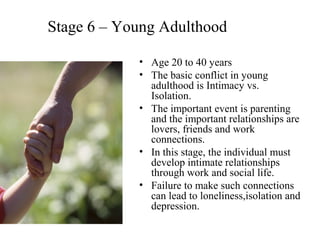
Stage 6 – Young Adulthood

            • Age 20 to 40 years
            • The basic conflict in young
              adulthood is Intimacy vs.
              Isolation.
            • The important event is parenting
              and the important relationships are
              lovers, friends and work
              connections.
            • In this stage, the individual must
              develop intimate relationships
              through work and social life.
            • Failure to make such connections
              can lead to loneliness,isolation and
              depression.
Stage 7 – Middle Adulthood
• Age 40 to 65 years
• the basic conflict is Generativity vs.
  Stagnation.
• The important event is parenting and the
  important relationships are with children
  and the community.

• This stage is based on the idea that each
  adult must find a way to satisfy, support
  and contribute to the next generation; it
  is often thought of as giving back.

• Failure to resolve this stage can lead to
  unproductive and uninvolved world.
Stage 8 – Maturity

      • Age 65 to death
      • The basic conflict is Ego integrity vs.
        Despair.

      • The important event is reflection on and
        acceptance of the individual’s life.

      • The individual is creating meaning and
        purpose of one’s life and reflecting on
        life achievements.

      • Failure to resolve this conflict can create
        feelings of dislike, regret, bitterness and
        despair.
JEAN PIAGET THEORY
• Piaget's theory is based on the idea that the developing
  child builds cognitive structures.

• He described the mechanism by which the mind
  processes new information. He said that a person
  understands whatever information fits into his established
  view of the world. When information does not fit, the
  person must reexamine and adjust his thinking to
  accommodate the new information. Piaget described four
  stages of cognitive development and relates them to a
  person's ability to understand and assimilate new
  information.
PIAGET’S STAGES

   Piaget's theory identifies four developmental
   stages and the processes by which children
   progress through them.
   The four stages are:

1. Sensorimotor stage (birth - 2 years)
   The child builds a set of concepts about reality
   and how it works through physical interaction
   with their environment. This is the stage where a
   child does not know that physical objects remain
   in existence even when out of sight.
Preoperational stage
                   (ages 2-7)

 The child is not yet able to think abstractly and needs
  concrete physical situations.

 Learns to use language and to represent objects by
  images and words. Thinking is still egocentric and has
  difficulty taking the viewpoint of others.

 Classifies objects by a single feature: e.g. groups
  together all the red blocks regardless of shape or all
  the square blocks regardless of colour.
Concrete operations
                (ages 7-11)

 As physical experience accumulate, the child starts
  to……

 Conceptualize, creating logical structures that
  explain their physical experiences.

 Abstract problem solving is also possible at this
  stage. For example, arithmetic equations can be
  solved with numbers, not just with objects.
Formal operations
           (beginning at ages 11-15)

 By this point, the child's cognitive structures are
  like those of an adult and include conceptual
  reasoning.
FACTORS AFFECTING
        PERSONALITY

1.   Heredity:
2.   Environment:
FACTORS AFFECTING
      PERSONALITY

Heredity:
1. Body build up of an individual.
2. Intelligence     inherited      from
   ancestors.
3. Hormones/fluids produced by the
   body an individual.
FACTORS AFFECTING
              PERSONALITY
Environment:
1. Social Characteristics of an individual.
2. Social economical status being rich or poor.
3. Education gained.
4. Observation perceived.
5. Experimentation made.
6. Provision of healthy food.
7. Privileges made available.
8. Good parental care.
9. Warmth, love and acceptance by associated.
10. Living in good areas versus slums.
FACTORS AFFECTING
               PERSONALITY

11.   Societal demands.
12.   Work environments.
13.   Home environment.
14.   Company of friends chosen to be associated.
15.   Career chosen.
16.   Geographic region to which an individual belongs.

Personality development

  • 1.
    PERSONALITY DEVELOPMENT PRESENTED BY: Shahid Ali
  • 2.
    SCHEME OF PRESENTATION •INTRODUCTION& DEFINATION •WHAT IS DEVELOPMENT •DOMAINS OF DEVELOPMENT •ERIK ERIKKSON THEORY •JEAN PIAGET THEORY • FACTORS AFFECTING PERSONALITY •SUMMARY
  • 3.
    DEFINATION OF PERSONALITY •Personality is a Latin word which comes from the word ‘persona’ means ‘a mask’ • Personality is defined in terms of “Social attractiveness” • A ability of a person to get along • Study of an individual with his individuality, by which we may say ‘A’ person has great personality or person ‘B’ has no personality
  • 4.
    WHAT IS DEVELOPMENT •Development is a product of the interaction of the individual with environment, starts from the head proceed towards heal. • Development sequence is creeping, crawling, walking and continuous. Different aspects of development are interrelated. Physical, mental, social and moral developments are interrelated to each other. • Development is individualized process, which based on growth and experience.
  • 5.
    DOMAINS OF DEVELOPMENT 1.Physical Development 2. Cognitive Development 3. Psychological Development
  • 6.
    DOMAINS OF DEVELOPMENT •PHYSICAL DEVELOPMENT Involves all those changes occurring in person's body like change in height, weight, in the brain, heart and other structures and process, and in skeletal, muscular and neurological features that affect motor skills.
  • 7.
    DOMAINS OF DEVELOPMENT •COGNITIVE DEVELOPMENT It involves all those changes that occur in the mental activity including sensations, perception, memory, thought, reasoning and language.
  • 8.
    DOMAINS OF DEVELOPMENT •PSYCOLIGICAL DEVELOPMENT Include all those changes that concern persons personality emotions and relation ship with others. Society distinguishes between children, adolescents and adults.
  • 9.
    PSYCHOSOCIAL DEVELOPMENT THEORY Psychosocial development theory is based on eight stages of development.  Erikson’s theory is based on the idea that development through life is a series of stages which are each defined by a crisis or challenge.  The early stages provide the foundations for later stages so Erikson says that if a child does not resolve a crisis in a particular stage, they will have problems in later stages.
  • 10.
    PSYCHOSOCIAL DEVELOPMENT THEORY Thereare eight stages: Stage 1 – Oral Sensory (Infancy, birth to 18 months) Stage 2 – Muscular-Anal (Early Childhood, 2 to 3 years) Stage 3 – Locomotor (Preschool, 3 to 5 years) Stage 4 – Latency (School Age (6 to 11 years) Stage 5 – Adolescence (Adolescence, 12 to 18 years) Stage 6 – Young Adulthood (Young Adulthood,19 to 40 years) Stage 7 – Middle Adulthood (Middle Adulthood, 40 to 65 years) Stage 8 – Maturity (Maturity, 65 to death)
  • 11.
    Stage 1 –Oral Sensory • Birth to 1 year (infancy) • Basic conflict is Trust vs. Mistrust. • The important event is feeding and the important relationship is with the mother and nurse. • The infant must develop a loving, trusting relationship with the mother/caregiver through feeding, teething and comforting. • Failure to resolve this conflict can lead to fear and a belief that the world is inconsistent and unpredictable.
  • 12.
    Stage 2 –Muscular-Anal • Age 1 to 3 years (Toddler) • Basic conflict is • Autonomy vs. shame/doubt. • The important event is toilet training and the important relationship is with the parents. • The child’s energy is directed towards mastering physical skills such as walking, grasping and muscular control. • The child learns self control but may develop shame, doubt, impulsivity (rash)or compulsion if not handled well.
  • 13.
    Stage 3 –Locomotor • Age 3 to 6 years (preschool) • Basic conflict is • Initiative vs. Guilt • The important event is independence and the important relationship is family. • The child continues to become more assertive in exploration, discovery, adventure and play. • The child may show too much force in this stage causing feelings of guilt. • Failure to resolve this conflict can lead to lack of initiative and self doubt.
  • 14.
    Stage 4 –Latency • Age 6 to 12 years (school age) • the basic conflict in this stage is Industry vs. Inferiority • The important event is school and the important relationships are teachers, friends and neighbourhood. • The child must learn to deal with new skills and develop a sense of achievement and accomplishment. • Failure to do so can create a sense of inferiority, failure and incompetence.
  • 15.
    Stage 5 –Adolescence • Age 12 to 20 years (adolescent) • the basic conflict is Identity vs. role Confusion. • The important event is development of peer relationships and the important relationships are peers, groups and social influences. • The teenager must achieve a sense of identity in occupation, sex roles, politics and religion. In addition, they must resolve their identity and direction.
  • 16.
    Stage 6 –Young Adulthood • Age 20 to 40 years • The basic conflict in young adulthood is Intimacy vs. Isolation. • The important event is parenting and the important relationships are lovers, friends and work connections. • In this stage, the individual must develop intimate relationships through work and social life. • Failure to make such connections can lead to loneliness,isolation and depression.
  • 17.
    Stage 7 –Middle Adulthood • Age 40 to 65 years • the basic conflict is Generativity vs. Stagnation. • The important event is parenting and the important relationships are with children and the community. • This stage is based on the idea that each adult must find a way to satisfy, support and contribute to the next generation; it is often thought of as giving back. • Failure to resolve this stage can lead to unproductive and uninvolved world.
  • 18.
    Stage 8 –Maturity • Age 65 to death • The basic conflict is Ego integrity vs. Despair. • The important event is reflection on and acceptance of the individual’s life. • The individual is creating meaning and purpose of one’s life and reflecting on life achievements. • Failure to resolve this conflict can create feelings of dislike, regret, bitterness and despair.
  • 19.
    JEAN PIAGET THEORY •Piaget's theory is based on the idea that the developing child builds cognitive structures. • He described the mechanism by which the mind processes new information. He said that a person understands whatever information fits into his established view of the world. When information does not fit, the person must reexamine and adjust his thinking to accommodate the new information. Piaget described four stages of cognitive development and relates them to a person's ability to understand and assimilate new information.
  • 20.
    PIAGET’S STAGES Piaget's theory identifies four developmental stages and the processes by which children progress through them. The four stages are: 1. Sensorimotor stage (birth - 2 years) The child builds a set of concepts about reality and how it works through physical interaction with their environment. This is the stage where a child does not know that physical objects remain in existence even when out of sight.
  • 21.
    Preoperational stage (ages 2-7)  The child is not yet able to think abstractly and needs concrete physical situations.  Learns to use language and to represent objects by images and words. Thinking is still egocentric and has difficulty taking the viewpoint of others.  Classifies objects by a single feature: e.g. groups together all the red blocks regardless of shape or all the square blocks regardless of colour.
  • 22.
    Concrete operations (ages 7-11)  As physical experience accumulate, the child starts to……  Conceptualize, creating logical structures that explain their physical experiences.  Abstract problem solving is also possible at this stage. For example, arithmetic equations can be solved with numbers, not just with objects.
  • 23.
    Formal operations (beginning at ages 11-15)  By this point, the child's cognitive structures are like those of an adult and include conceptual reasoning.
  • 24.
    FACTORS AFFECTING PERSONALITY 1. Heredity: 2. Environment:
  • 25.
    FACTORS AFFECTING PERSONALITY Heredity: 1. Body build up of an individual. 2. Intelligence inherited from ancestors. 3. Hormones/fluids produced by the body an individual.
  • 26.
    FACTORS AFFECTING PERSONALITY Environment: 1. Social Characteristics of an individual. 2. Social economical status being rich or poor. 3. Education gained. 4. Observation perceived. 5. Experimentation made. 6. Provision of healthy food. 7. Privileges made available. 8. Good parental care. 9. Warmth, love and acceptance by associated. 10. Living in good areas versus slums.
  • 27.
    FACTORS AFFECTING PERSONALITY 11. Societal demands. 12. Work environments. 13. Home environment. 14. Company of friends chosen to be associated. 15. Career chosen. 16. Geographic region to which an individual belongs.