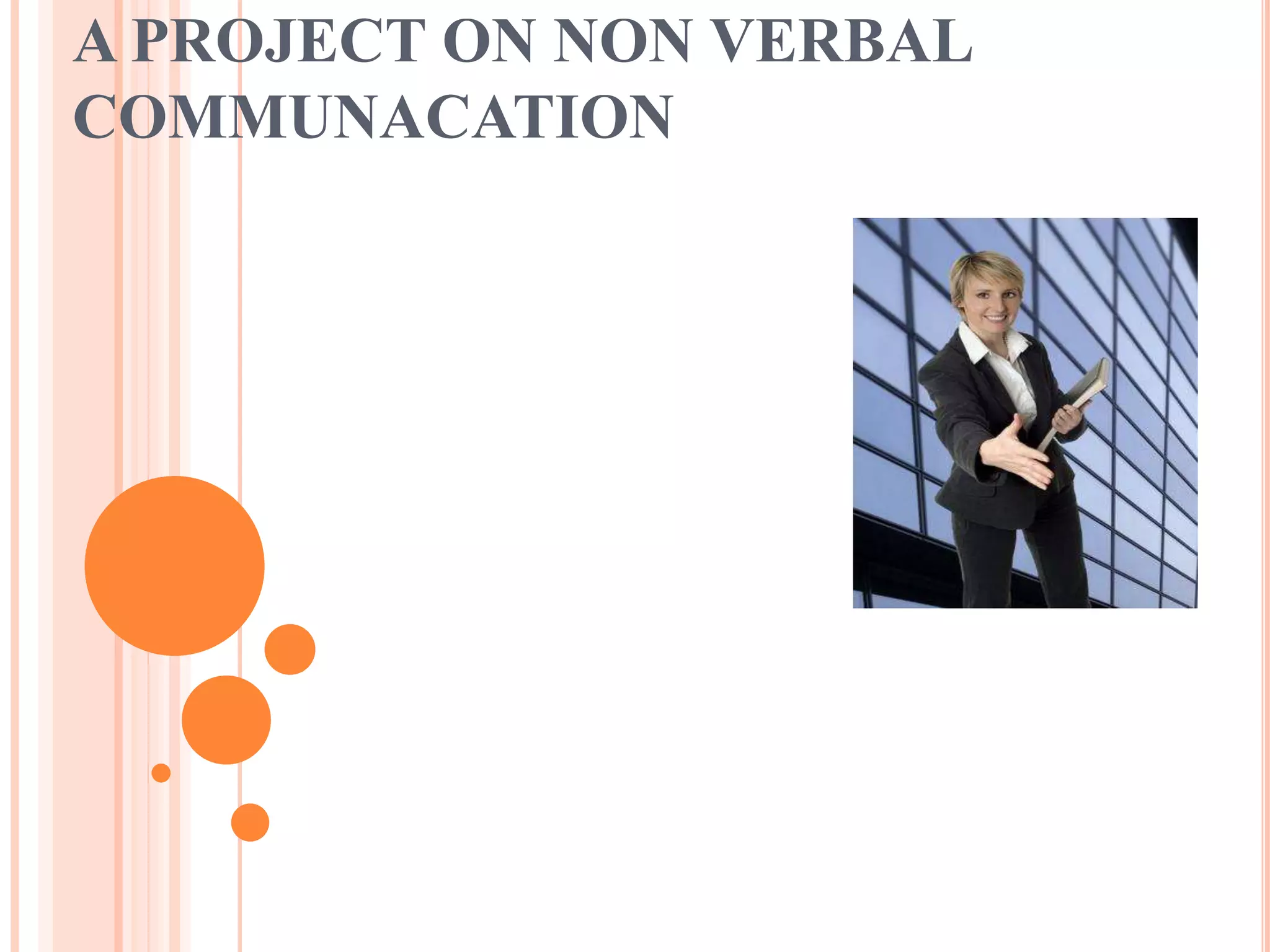


A PROJECT ON NON VERBAL
COMMUNACATION
WHAT IS NON VERBAL
COMMUNACATION?
Non verbal communication is a type of
communication through which people can
send or receive wordless cues, rather we
can say it is a communication without
words. Such as facial expression, apparent
behaviour, gesture & posture.
IMPORTANCE IN CORPORATE WORLD
 Understanding the elements of non verbal
communication in terms of working with
colleagues, competitors, clients etc
 To involve in human interaction.
 To transfer information's.
 To build a positive relationship with
colleagues, co-workers.
TYPES OF NON VERBAL COMMUNICATION
Kinesics (behavior)
Study of body movements to judge
inner state of emotions expressed
through different parts of body
 Facial expressions
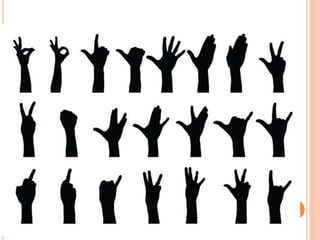
 Gestures
 Postures
KINESICS- FACIAL EXPRESSIONS & EYES
Expressions Interpretation
Eyebrows with upper & lower eyelids
raised
Excitement / surprise
Eyebrows with upper & lower eyelids
closed, with tight lips
Anger, tension, pain, disgust
Sideways glance of eyes Suspicion
Steady eye contact Active listening
No eye contact Disinterested
Half raised eyebrows Worry
Wrinkled eyebrows Stress/ Worry
KINESICS- GESTURES
Pointing fingers Authority
Arms on sides Relaxed
Shrugging shoulders Indifference
Sitting on the edge Interest/ Enthusiasm
Foot tapping Hostile disposition
Arms crossed Defensive
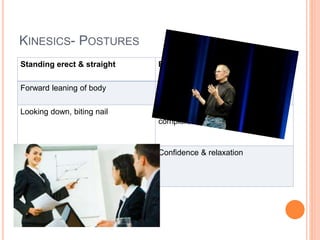
KINESICS- POSTURES
Standing erect & straight Enthusiasm & confidence
Forward leaning of body Intimacy, nearness
Looking down, biting nail Nervousness, inferiority
complex,anxiety
Sitting expansively with streched out
legs in front
Confidence & relaxation
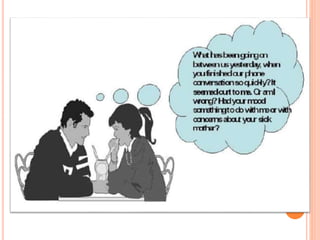
META – COMMUNICATION
 Studying the implied meaning of a message often called
‘reading between the lines’.
 e.g.:- ‘you are late’ suggests a single incident while ‘you
are late again’ refers to the fact of habitual tardiness,
casual approach.
 It can be used as a tool for sense making, or for better
understanding events, places, people, relationships, etc..
PHYSICAL CONTEXT
 neat & tidy room indicates discipline.
 room colours indicate the temperament of the person.
 decorative items indicate attitude and belief of a person
of person.
e.g.:- photographs of gods/goddesses indicate religious
temperament of person.
TOUCH (HAPTICS)
 Tactile Communication
 guided by such factors like status, age, gender,
location, hence, requires controlled and cautions
use.
 Handshake, putting on the back etc.
 Leaves on impact.
 Reflects one’s personality.
TIME (CHRONEMICS)
 Time is extremely important in monochromic
culture where one task is done at a time , values
time.
 Being punctual can reflect a positive image like:
Respectful, sincere, obedient etc.
 Tardiness may reflect a negative image like:
Disrespectful, disorganized, casual, not
serious etc.
CHROMATICS (COLORS)
In communication by color, colors have psychological
effect. Light colors should be sophisticated while shiny
colors are said to be indicative of aggressive, passionate
persons.
Examples-
 Black for death
 White for purity
 Red for danger
 Green for safety
OCULESICS(EYE CONTACT)
 Eye contact is plays communication between face to
face.
 Eye contact adds impact to one’s words.
 Good use of eye contact will reflect a positive image of
one’s personality.
 Eye rolling is considered to be insulting, looking down
upon somebody.
 Eye contact shows that the person are listening.
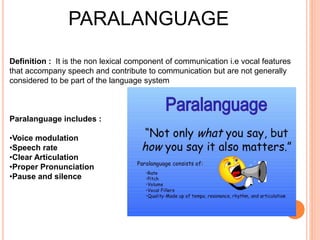
PARALANGUAGE
Definition : It is the non lexical component of communication i.e vocal features
that accompany speech and contribute to communication but are not generally
considered to be part of the language system
Paralanguage includes :
•Voice modulation
•Speech rate
•Clear Articulation
•Proper Pronunciation
•Pause and silence
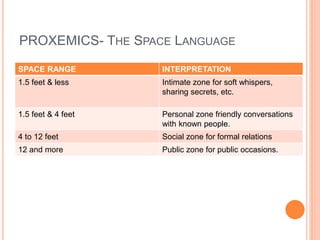
PROXEMICS- THE SPACE LANGUAGE
SPACE RANGE INTERPRETATION
1.5 feet & less Intimate zone for soft whispers,
sharing secrets, etc.
1.5 feet & 4 feet Personal zone friendly conversations
with known people.
4 to 12 feet Social zone for formal relations
12 and more Public zone for public occasions.
THANK YOU

Project on non verbal communication

  • 1.
    A PROJECT ONNON VERBAL COMMUNACATION
  • 2.
    WHAT IS NONVERBAL COMMUNACATION? Non verbal communication is a type of communication through which people can send or receive wordless cues, rather we can say it is a communication without words. Such as facial expression, apparent behaviour, gesture & posture.
  • 3.
    IMPORTANCE IN CORPORATEWORLD  Understanding the elements of non verbal communication in terms of working with colleagues, competitors, clients etc  To involve in human interaction.  To transfer information's.  To build a positive relationship with colleagues, co-workers.
  • 4.
    TYPES OF NONVERBAL COMMUNICATION Kinesics (behavior) Study of body movements to judge inner state of emotions expressed through different parts of body  Facial expressions  Gestures  Postures
  • 5.
    KINESICS- FACIAL EXPRESSIONS& EYES Expressions Interpretation Eyebrows with upper & lower eyelids raised Excitement / surprise Eyebrows with upper & lower eyelids closed, with tight lips Anger, tension, pain, disgust Sideways glance of eyes Suspicion Steady eye contact Active listening No eye contact Disinterested Half raised eyebrows Worry Wrinkled eyebrows Stress/ Worry
  • 6.
    KINESICS- GESTURES Pointing fingersAuthority Arms on sides Relaxed Shrugging shoulders Indifference Sitting on the edge Interest/ Enthusiasm Foot tapping Hostile disposition Arms crossed Defensive
  • 7.
    KINESICS- POSTURES Standing erect& straight Enthusiasm & confidence Forward leaning of body Intimacy, nearness Looking down, biting nail Nervousness, inferiority complex,anxiety Sitting expansively with streched out legs in front Confidence & relaxation
  • 8.
    META – COMMUNICATION Studying the implied meaning of a message often called ‘reading between the lines’.  e.g.:- ‘you are late’ suggests a single incident while ‘you are late again’ refers to the fact of habitual tardiness, casual approach.  It can be used as a tool for sense making, or for better understanding events, places, people, relationships, etc..
  • 9.
    PHYSICAL CONTEXT  neat& tidy room indicates discipline.  room colours indicate the temperament of the person.  decorative items indicate attitude and belief of a person of person. e.g.:- photographs of gods/goddesses indicate religious temperament of person.
  • 10.
    TOUCH (HAPTICS)  TactileCommunication  guided by such factors like status, age, gender, location, hence, requires controlled and cautions use.  Handshake, putting on the back etc.  Leaves on impact.  Reflects one’s personality.
  • 11.
    TIME (CHRONEMICS)  Timeis extremely important in monochromic culture where one task is done at a time , values time.  Being punctual can reflect a positive image like: Respectful, sincere, obedient etc.  Tardiness may reflect a negative image like: Disrespectful, disorganized, casual, not serious etc.
  • 12.
    CHROMATICS (COLORS) In communicationby color, colors have psychological effect. Light colors should be sophisticated while shiny colors are said to be indicative of aggressive, passionate persons. Examples-  Black for death  White for purity  Red for danger  Green for safety
  • 13.
    OCULESICS(EYE CONTACT)  Eyecontact is plays communication between face to face.  Eye contact adds impact to one’s words.  Good use of eye contact will reflect a positive image of one’s personality.  Eye rolling is considered to be insulting, looking down upon somebody.  Eye contact shows that the person are listening.
  • 14.
    PARALANGUAGE Definition : Itis the non lexical component of communication i.e vocal features that accompany speech and contribute to communication but are not generally considered to be part of the language system Paralanguage includes : •Voice modulation •Speech rate •Clear Articulation •Proper Pronunciation •Pause and silence
  • 15.
    PROXEMICS- THE SPACELANGUAGE SPACE RANGE INTERPRETATION 1.5 feet & less Intimate zone for soft whispers, sharing secrets, etc. 1.5 feet & 4 feet Personal zone friendly conversations with known people. 4 to 12 feet Social zone for formal relations 12 and more Public zone for public occasions.
  • 16.