Interim Fixed
Restorations
Definition
 Fixed Dental Prosthesis designed to enhance
esthetics stabilization and or function for a limited period
of time after which it is to be replaced by a
Definitive Fixed Dental Prosthesis
 The interim fixed must satisfy important needs of the patient and the dentist
 Should not be casually fabricated on the basis of an expected short term of
use
preparation Interim Restoration
Trimming excess
Cemented restoration
A) BIOLOGIC REQUIREMENTS
 PULP PROTECTION ;
- during tooth preparation the dentinal tubulues are exposed
- must seal and insulate the prepared tooth surface from the oral environment
to prevent sensitivity and further irritation to the pulp
 PERIODONTAL HEALTH ;
- to facilitate plaque removal it must have
a good marginal fit,
- proper contour and
- a smooth surface specially when crown
margin is placed apical to gingival
margin
 PREOPERATIVE POLYCARBOXYLATE PROVISIONAL
GINGIVAL HEALING AFTER 2 MONTHS
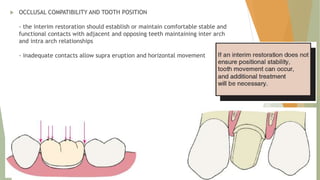
 OCCLUSAL COMPATIBILITY AND TOOTH POSITION
- the interim restoration should establish or maintain comfortable stable and
functional contacts with adjacent and opposing teeth maintaining inter arch
and intra arch relationships
- inadequate contacts allow supra eruption and horizontal movement
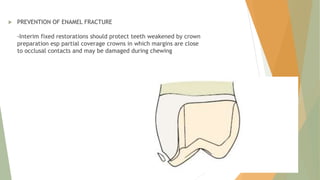
 PREVENTION OF ENAMEL FRACTURE
-Interim fixed restorations should protect teeth weakened by crown
preparation esp partial coverage crowns in which margins are close
to occlusal contacts and may be damaged during chewing
B) MECHANICAL REQUIREMENT
 FUNCTIONAL
-it should provide good compressive and flexural strength
-is always much lower than the definitive restoration
material
-greatest stressed occur during chewing
 LOSS OF RETENTION
-It should have close adaptation to the prepared tooth
surface to prevent displacement and recementation,
which will increase patient visits.
 REMOVAL AND REUSE
-provisional restoration may need to be removed and recemented aften
- if they are well fabricated with adequate thickness and cemented with weak
cement the can be removed without breakage
 PROVISIONAL CROWN can be used to assess axial
and occlusal reduction
Esthetic Requirement
 It should match the shae size color and texture of the restored tooth
especially in the anterior region
 Colour stability is also important if the provisional are to function for a
prolonged period
 It also serves as a guide to achieve esthetics of the final restoration
This interim dental prosthesis was used to establish anterior
guidance, incisal edge position, proper phonetics, and function before
work on the definitive prostheses began!!
DO WE NEED TO GIVE PROVISIONAL / INTERIM
CROWN/BRIDGE ON A “ROOT-TREATED”
TOOTH???
YES!!
Classification
 ACCORDING TO FABRICATION METHOD
A) Preformed
B) Custom Made
 ACCORDING TO MATERIAL USED
A)RESIN
-Preformed (polycarbonate,cellulose acetate)
-Custom Made (acrylics,bis-acryl composite)
B)METALS
-Preformed (aluminum,tinsilver,nickel chromium)
-Custom Made (cast metal alloy)
 ACCORDING TO DURATION OF USE
a)short term
b)long term
 ACCORDING TO TECHNIQUE OF FABRIGATION
a) Direct Technique
b) Indirect Technique
Provisional Restoration Materials Ideal
Requirements
 Adequate strength and wear resistance
 Biocompatible
 Good dimensional stability
 Easy to contour and polish
 Odourless and Non irritating
 Chemically compatible with luting cement
 Esthetically acceptable
 Adequate working and setting time
 Easy to repair
Provisional Restoration
Preformed
Metal
Resin
Custom Made
Direct
Technique
Indirect
Technique
Indirect
Direct
Technique
Polymethyl Methacrylate
Advantages
 Low cost
 Good wear resistance
 Good asthetics
 High polishability
 Good color stability
Disadvantages
 Significant amount of heat given
off by exothermic reaction
 High degree of shrinkage(aprx 8%)
 Strong objectionable odour
 Short working time
 Hard to repair
 Radiolucent
BIS-ACRYL COMPOSITES
Advantages
 Less shrinkage than acrylics
 Minimal heat generation
 Minimal odour
 Excellent asthetics
 Most products use automix delivery
 Can be repaired or characterized
using resin composite
 Easy to trim
 Good color stability
 Radioopaque
Disadvantages
 Greater cost than acrylics
 Viscosity cannot be altered
 Sticky surface layer present after
polymerization
 More brittle than acrylics
POLY-R METHACRYLATE
Advantages
 Low cost
 Less exothermic heat and
shrinkage than PMMA
 Extended working time
Disadvantages
 Less esthetic
 Poor wear-resistamce
 Poor color stability
 Strong objectionable odour
 Hard to repair
 Radiolucent
PREFORMED RESIN BASED RESTORATION
 CELLOLUSE ACCETATE
 POLYCARBONATE
 POLYMETYL METHACRYLATE
 POLY-R METHACRYLATE
 MICROFILLED COMPOSITE
 URETHAE DIMETHACRYLATE
PREFORMED METAL PROVISIONAL
RESTORATION
 ALUMINIUM
 NICKEL-CHROMIUM
 TIN-SILVER
POLYCARBONATE
 Combine microglass fibers with polycarbonate
plastic material
 Used as matrix material around a prepared tooth
 High impact strength,abrasion resistance
 Best esthetics among preformed crowns
 Available in shape of incisor canine and premolar
 Available in varying size
Cellulose Acetate
 Thin soft transparent scaffold material
 Available in all tooth shape and different sizes
 Doesnot bond to relining resin
 Approximate size of this crown is selected from a mould
guide and filled with autopolymerizing resin of appropriate shade
 Inserted over the lubricated prepared tooth
ALUMINIUM
 Limited to posteriors for esthetic reasons
 Available as simple shell
 They provide good adaptation due to softness and difficulty of
material but can also promote rapid wear resulting in perforation
 They may be relined with resin to obtain better fit and rigidity
then luted to the prepared tooth
NICKEL CHROMIUM
 Indicated for use in children with damaged primary teeth
 They need not to reline with resin
 They are trimmed contoured and adapted to the tooth
 Strong cements are used for luting ( long term use )
Types of
PREFORMED
Interim Crowns
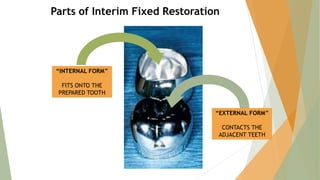
Parts of Interim Fixed Restoration
“INTERNAL FORM”
FITS ONTO THE
PREPARED TOOTH
“EXTERNAL FORM”
CONTACTS THE
ADJACENT TEETH
FITTING TECHNIQUE for PRE-FABRICATED CROWN
PRE-FABRICATED/READY MADE CROWN
EXTERNAL FORM IS READY INTERNAL FORM NEEDS
MODIFICATION (e.g. RELINE) TO
IMPROVE FIT
DONE AT CHAIR-SIDE
Example:
FITTING OF A POLYCARBONATE CROWN
ASSESSING THE DIMENSIONS ADJUSTING THE EXTERNAL FORM DIMENSIONS
ADJUSTING THE INTERNAL FORM FIT by
RELINING with self-cure resin
The shell is filled with resin and is
seated when the resin does not slump
after a peak is formed with the tip of an
explorer.
Excess resin is
immediately removed
after the crown has been
positioned.
When the resin has reached the rubbery stage, the crown is removed and
placed in warm water (40°C). Hot water must not be used because it increases
resin shrinkage
FINISHING, POLISHING and CEMENTATION
Major adjustments done outside the mouth!
Minor adjustments done inside the mouth! (post
cementation)
Techniques
of
Fabrication
Custom
Interim
Fixed
Restoration
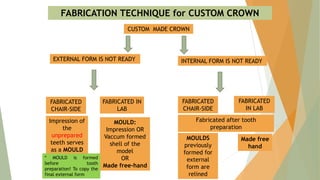
CUSTOM MADE CROWN
EXTERNAL FORM IS NOT READY INTERNAL FORM IS NOT READY
FABRICATED
CHAIR-SIDE
FABRICATION TECHNIQUE for CUSTOM CROWN
FABRICATED
CHAIR-SIDE
FABRICATED IN
LAB
FABRICATED
IN LAB
Impression of
the
unprepared
teeth serves
as a MOULD
MOULD:
Impression OR
Vaccum formed
shell of the
model
OR
Made free-hand
Fabricated after tooth
preparation
MOULDS
previously
formed for
external
form are
relined
Made free
hand
* MOULD is formed
before tooth
preparation! To copy the
final external form
FABRICATION OF MOULD for EXTERNAL FORM
FABRICATION OF INTERNAL FORM
CHAIR-SIDE
LAB
FABRICATION OF INTERNAL FORM
Direct Technique
DIRECT INTERIM RESTORATION
 Patients prepared tooth is used (elimination all the intermediate laboratory
procedure)
 Made intraorally
 Convineint
 Time saving
 Lesser appointments
 However has significant disadvantages like potential tissue trauma from
polymerizing resin and inherently poorer marginal fit
Procedure
 Place acrylic tooth in place of missing tooth and make an alginate impression/putty index
 Prepare teeth for FPD in usual manner
 Lubricate prepared teeth and adjacent gingivae with petrolleun jelly
 Reseat index(alginate/putty)
 Mix material and load index at dough stage into index
 Place into patients mouth
 Remove and reseat restoration until it sets
 Finish polish and cement
Indirect Technique
Indirect Provisional Restoration
 Fabrigation outside the mouth
 No contact of free monomer with the prepared teeth or gingival tissues which
might cause tissue damage and an allergic reaction or sensitization
 Superior marginal fit
 Increased time
 More appointments
 But lesser chairside time
Procedure
 On diagnostic cast place acrylic tooth in missing tooth area and seal with carding wax
 Make a silicone putty index
 Prepare patients teeth for FPD in the usual manner
 Make an impression of prepared teeth and adjacent structures
 Pour a cast
 Lubricate cast and Mix provisional restorative material
 Load index and seat on cast
 Try in provisional on cast and intraorally
 Finish Polish and cement
Indirect Direct Technique
Indirect-Direct Interim Restoration
 Combination indirect and direct technique, chair time can be reduced , since the provisional shell is
fabricated before the patients appointment
 Enhanced control over restoration contours minimizes the time required for chair side adjustments
 Smaller amount of acrylic resin will polymerize in contact with the prepared abutment,resulting in
decreased heat generation,chemicak exposure and polymerization shrinkage compared to the direct
technique
 Needs a lab phase before tooth preparation and adjustments that are frequently needed to seat the
shell completely on the prepared tooth
Procedure
 On diagnostic cast place acrylic tooth in missing tooth area and seal with carding wax
 Lubricate cast and make an impression alginate/putty
 Remove acrylic tooth from cast and prepare abutments on cast ( more conservative than the eventual
tooth preparation )
 Lubricate cast and mix provisional restorative material, and load index
 Reseat on prepared diagnostic cast
 When set finish the restoration (should be paper thin)
 Prepare the patients teeth for FPD in usual manner
 Try in preformed restoration and reline to perfect internal fit
 Finish polish and cement
SUMMARY: FABRICATION TECHNIQUES CUSTOM INTERIMS
Cementation of Provisional
Restoration
Ideal Properties of Cement
 Ability to seal against leakage of oral fluid
 Strength consist with intentional removal
 Low solubility
 Chemical compatibility with provisional polymer
 Ease of eliminating excess
 Adequate working time and short setting time
Provisional Cements used
 Zinc oxide eugenol
 Reinforced zinc oxide eugenol
 Non eugenol Based Cements
zinc phosphate zinc polycarboxalte and GIC are not used because their
comparatively high strength makes intentional removal difficult
TEMP BOND
CONTD..
 Most commonly used is zinc oxide eugenol
 Non eugenol based provisional cements are used to bond temporaries to
preparations for all ceramic restorations and veneers to avoid interference
with bonding of resin cements
 If eugenol based is used eugenol residues should be removed with water and
pumice
Limitations of Provisional Restoration
 Lack of adequate strength- fracture of provisional is possible in long span FPDs,
patient with bruxism and reduced interocclusal clearance
 Inadeqaute marginal adaptation
 Poor asthetic in long term provisional restoration
 Plaque retention due to poor surface characteristics
 Compromised bonding characteristics
 Mild to Moderate tissue irritation
preparation Intaglio surface Interim
Trimming excess
Cemented restoration
Interim Fixed Restorations.pptx

Interim Fixed Restorations.pptx

  • 1.
  • 2.
    Definition  Fixed DentalProsthesis designed to enhance esthetics stabilization and or function for a limited period of time after which it is to be replaced by a Definitive Fixed Dental Prosthesis  The interim fixed must satisfy important needs of the patient and the dentist  Should not be casually fabricated on the basis of an expected short term of use
  • 3.
    preparation Interim Restoration Trimmingexcess Cemented restoration
  • 5.
    A) BIOLOGIC REQUIREMENTS PULP PROTECTION ; - during tooth preparation the dentinal tubulues are exposed - must seal and insulate the prepared tooth surface from the oral environment to prevent sensitivity and further irritation to the pulp  PERIODONTAL HEALTH ; - to facilitate plaque removal it must have a good marginal fit, - proper contour and - a smooth surface specially when crown margin is placed apical to gingival margin
  • 6.
     PREOPERATIVE POLYCARBOXYLATEPROVISIONAL GINGIVAL HEALING AFTER 2 MONTHS
  • 7.
     OCCLUSAL COMPATIBILITYAND TOOTH POSITION - the interim restoration should establish or maintain comfortable stable and functional contacts with adjacent and opposing teeth maintaining inter arch and intra arch relationships - inadequate contacts allow supra eruption and horizontal movement
  • 8.
     PREVENTION OFENAMEL FRACTURE -Interim fixed restorations should protect teeth weakened by crown preparation esp partial coverage crowns in which margins are close to occlusal contacts and may be damaged during chewing
  • 9.
    B) MECHANICAL REQUIREMENT FUNCTIONAL -it should provide good compressive and flexural strength -is always much lower than the definitive restoration material -greatest stressed occur during chewing  LOSS OF RETENTION -It should have close adaptation to the prepared tooth surface to prevent displacement and recementation, which will increase patient visits.
  • 10.
     REMOVAL ANDREUSE -provisional restoration may need to be removed and recemented aften - if they are well fabricated with adequate thickness and cemented with weak cement the can be removed without breakage  PROVISIONAL CROWN can be used to assess axial and occlusal reduction
  • 11.
    Esthetic Requirement  Itshould match the shae size color and texture of the restored tooth especially in the anterior region  Colour stability is also important if the provisional are to function for a prolonged period  It also serves as a guide to achieve esthetics of the final restoration
  • 12.
    This interim dentalprosthesis was used to establish anterior guidance, incisal edge position, proper phonetics, and function before work on the definitive prostheses began!!
  • 13.
    DO WE NEEDTO GIVE PROVISIONAL / INTERIM CROWN/BRIDGE ON A “ROOT-TREATED” TOOTH??? YES!!
  • 14.
    Classification  ACCORDING TOFABRICATION METHOD A) Preformed B) Custom Made  ACCORDING TO MATERIAL USED A)RESIN -Preformed (polycarbonate,cellulose acetate) -Custom Made (acrylics,bis-acryl composite) B)METALS -Preformed (aluminum,tinsilver,nickel chromium) -Custom Made (cast metal alloy)  ACCORDING TO DURATION OF USE a)short term b)long term  ACCORDING TO TECHNIQUE OF FABRIGATION a) Direct Technique b) Indirect Technique
  • 15.
    Provisional Restoration MaterialsIdeal Requirements  Adequate strength and wear resistance  Biocompatible  Good dimensional stability  Easy to contour and polish  Odourless and Non irritating  Chemically compatible with luting cement  Esthetically acceptable  Adequate working and setting time  Easy to repair
  • 16.
  • 17.
    Polymethyl Methacrylate Advantages  Lowcost  Good wear resistance  Good asthetics  High polishability  Good color stability Disadvantages  Significant amount of heat given off by exothermic reaction  High degree of shrinkage(aprx 8%)  Strong objectionable odour  Short working time  Hard to repair  Radiolucent
  • 18.
    BIS-ACRYL COMPOSITES Advantages  Lessshrinkage than acrylics  Minimal heat generation  Minimal odour  Excellent asthetics  Most products use automix delivery  Can be repaired or characterized using resin composite  Easy to trim  Good color stability  Radioopaque Disadvantages  Greater cost than acrylics  Viscosity cannot be altered  Sticky surface layer present after polymerization  More brittle than acrylics
  • 19.
    POLY-R METHACRYLATE Advantages  Lowcost  Less exothermic heat and shrinkage than PMMA  Extended working time Disadvantages  Less esthetic  Poor wear-resistamce  Poor color stability  Strong objectionable odour  Hard to repair  Radiolucent
  • 20.
    PREFORMED RESIN BASEDRESTORATION  CELLOLUSE ACCETATE  POLYCARBONATE  POLYMETYL METHACRYLATE  POLY-R METHACRYLATE  MICROFILLED COMPOSITE  URETHAE DIMETHACRYLATE
  • 21.
    PREFORMED METAL PROVISIONAL RESTORATION ALUMINIUM  NICKEL-CHROMIUM  TIN-SILVER
  • 22.
    POLYCARBONATE  Combine microglassfibers with polycarbonate plastic material  Used as matrix material around a prepared tooth  High impact strength,abrasion resistance  Best esthetics among preformed crowns  Available in shape of incisor canine and premolar  Available in varying size
  • 23.
    Cellulose Acetate  Thinsoft transparent scaffold material  Available in all tooth shape and different sizes  Doesnot bond to relining resin  Approximate size of this crown is selected from a mould guide and filled with autopolymerizing resin of appropriate shade  Inserted over the lubricated prepared tooth
  • 24.
    ALUMINIUM  Limited toposteriors for esthetic reasons  Available as simple shell  They provide good adaptation due to softness and difficulty of material but can also promote rapid wear resulting in perforation  They may be relined with resin to obtain better fit and rigidity then luted to the prepared tooth
  • 25.
    NICKEL CHROMIUM  Indicatedfor use in children with damaged primary teeth  They need not to reline with resin  They are trimmed contoured and adapted to the tooth  Strong cements are used for luting ( long term use )
  • 26.
  • 27.
    Parts of InterimFixed Restoration “INTERNAL FORM” FITS ONTO THE PREPARED TOOTH “EXTERNAL FORM” CONTACTS THE ADJACENT TEETH
  • 28.
    FITTING TECHNIQUE forPRE-FABRICATED CROWN PRE-FABRICATED/READY MADE CROWN EXTERNAL FORM IS READY INTERNAL FORM NEEDS MODIFICATION (e.g. RELINE) TO IMPROVE FIT DONE AT CHAIR-SIDE
  • 29.
    Example: FITTING OF APOLYCARBONATE CROWN
  • 30.
    ASSESSING THE DIMENSIONSADJUSTING THE EXTERNAL FORM DIMENSIONS
  • 31.
    ADJUSTING THE INTERNALFORM FIT by RELINING with self-cure resin The shell is filled with resin and is seated when the resin does not slump after a peak is formed with the tip of an explorer. Excess resin is immediately removed after the crown has been positioned.
  • 32.
    When the resinhas reached the rubbery stage, the crown is removed and placed in warm water (40°C). Hot water must not be used because it increases resin shrinkage
  • 33.
    FINISHING, POLISHING andCEMENTATION Major adjustments done outside the mouth! Minor adjustments done inside the mouth! (post cementation)
  • 34.
  • 35.
    CUSTOM MADE CROWN EXTERNALFORM IS NOT READY INTERNAL FORM IS NOT READY FABRICATED CHAIR-SIDE FABRICATION TECHNIQUE for CUSTOM CROWN FABRICATED CHAIR-SIDE FABRICATED IN LAB FABRICATED IN LAB Impression of the unprepared teeth serves as a MOULD MOULD: Impression OR Vaccum formed shell of the model OR Made free-hand Fabricated after tooth preparation MOULDS previously formed for external form are relined Made free hand * MOULD is formed before tooth preparation! To copy the final external form
  • 36.
    FABRICATION OF MOULDfor EXTERNAL FORM
  • 37.
    FABRICATION OF INTERNALFORM CHAIR-SIDE LAB
  • 38.
  • 39.
  • 40.
    DIRECT INTERIM RESTORATION Patients prepared tooth is used (elimination all the intermediate laboratory procedure)  Made intraorally  Convineint  Time saving  Lesser appointments  However has significant disadvantages like potential tissue trauma from polymerizing resin and inherently poorer marginal fit
  • 42.
    Procedure  Place acrylictooth in place of missing tooth and make an alginate impression/putty index  Prepare teeth for FPD in usual manner  Lubricate prepared teeth and adjacent gingivae with petrolleun jelly  Reseat index(alginate/putty)  Mix material and load index at dough stage into index  Place into patients mouth  Remove and reseat restoration until it sets  Finish polish and cement
  • 44.
  • 45.
    Indirect Provisional Restoration Fabrigation outside the mouth  No contact of free monomer with the prepared teeth or gingival tissues which might cause tissue damage and an allergic reaction or sensitization  Superior marginal fit  Increased time  More appointments  But lesser chairside time
  • 47.
    Procedure  On diagnosticcast place acrylic tooth in missing tooth area and seal with carding wax  Make a silicone putty index  Prepare patients teeth for FPD in the usual manner  Make an impression of prepared teeth and adjacent structures  Pour a cast  Lubricate cast and Mix provisional restorative material  Load index and seat on cast  Try in provisional on cast and intraorally  Finish Polish and cement
  • 49.
  • 50.
    Indirect-Direct Interim Restoration Combination indirect and direct technique, chair time can be reduced , since the provisional shell is fabricated before the patients appointment  Enhanced control over restoration contours minimizes the time required for chair side adjustments  Smaller amount of acrylic resin will polymerize in contact with the prepared abutment,resulting in decreased heat generation,chemicak exposure and polymerization shrinkage compared to the direct technique  Needs a lab phase before tooth preparation and adjustments that are frequently needed to seat the shell completely on the prepared tooth
  • 52.
    Procedure  On diagnosticcast place acrylic tooth in missing tooth area and seal with carding wax  Lubricate cast and make an impression alginate/putty  Remove acrylic tooth from cast and prepare abutments on cast ( more conservative than the eventual tooth preparation )  Lubricate cast and mix provisional restorative material, and load index  Reseat on prepared diagnostic cast  When set finish the restoration (should be paper thin)  Prepare the patients teeth for FPD in usual manner  Try in preformed restoration and reline to perfect internal fit  Finish polish and cement
  • 54.
  • 55.
  • 56.
    Ideal Properties ofCement  Ability to seal against leakage of oral fluid  Strength consist with intentional removal  Low solubility  Chemical compatibility with provisional polymer  Ease of eliminating excess  Adequate working time and short setting time
  • 57.
    Provisional Cements used Zinc oxide eugenol  Reinforced zinc oxide eugenol  Non eugenol Based Cements zinc phosphate zinc polycarboxalte and GIC are not used because their comparatively high strength makes intentional removal difficult TEMP BOND
  • 58.
    CONTD..  Most commonlyused is zinc oxide eugenol  Non eugenol based provisional cements are used to bond temporaries to preparations for all ceramic restorations and veneers to avoid interference with bonding of resin cements  If eugenol based is used eugenol residues should be removed with water and pumice
  • 59.
    Limitations of ProvisionalRestoration  Lack of adequate strength- fracture of provisional is possible in long span FPDs, patient with bruxism and reduced interocclusal clearance  Inadeqaute marginal adaptation  Poor asthetic in long term provisional restoration  Plaque retention due to poor surface characteristics  Compromised bonding characteristics  Mild to Moderate tissue irritation
  • 60.
    preparation Intaglio surfaceInterim Trimming excess Cemented restoration