ANKITA GUPTA
TEMPORIZATION
INTRODUCTION
Temporization is a
important step while
preparing fixed partial
dentures(fpd).
Also known as provisional
restoration.
Provisional means for the
time being till
the permanent
arrangement can be made.
This step is done after the
tooth preparation on the
same day.
IDEAL REQUIREMENTS:
Biological Mechanical Aesthetic
BIOLOGICAL REQUIREMENTS:
Protect the pulp of freshly
prepared tooth
Maintain periodontal
health
Occlusal
compatibility/harmony:it is
the most crucial part to get
the balanced occlusion
MECHANICAL
REQUIREMENT:
• Function: Restoration should function like a beam in
which substantial occlusal forces can be transmitted.
• Displacement: There should be no displacement
while mastication it can only be achieved by proper
tooth preparation and proper seating of temporary
restoration
• Removal for reuse:if removal of the restoration is
require then it should be removed in one piece
damage should be prevented so that it can be
reused. Damage can only be prevented if the luting
agent is weak.
MATERIAL
REQUIREMENT:
• FOR AESTHETIC REQUIREMENT MATERIAL IS VERY
IMPORTANT.
• Material requirement
1. Convenient handling
2. Adequate working time ,non toxic,non exothermic
3. Dimensionally stable
4. Easy to contour and polish
5. Adequate strength and abrasion resistance,good
aesthetics,patient acceptance,chemical compatibility
TYPES OF
PROVISIONAL
RESTORATION:
• Classified as :
1. Based on the method of fabrication
2. Based on the material used
3. Duration of use
4. Technique for fabrication
BASED ON THE
METHOD OF
FABRICATION
• Custom made provisional restorations- fabricated to
reproduce the original contours of the tooth.
• In this method impression is taken of a prepared tooth and
a cast is poured
• The prepared tooth on the cast is waxed up and carved to
reproduce a original contours.
• Performed provisional restorations- these type of
restorations are commercially available in different type of
sizes and colours.
• Operator choose the material and size tha would be best
for the patient and placed it as a provisinal restoration.
• Before cementation restoration is modified.
MATERIAL
AVAILABLE FOR
PERFORMED
CROWNS-
1. Polycarboxylate-natural appearance
• Available in single shade
• Available for canine incisors ,premolars
2. Cellulose acetate-available for all tooth
• It is a thin transparent material
3. Aluminium and tin silver-for posterior
teeth.
• Automatically shaped occlusal and axial
surfaces.
4. Nickel chromium-used for children.
• Cannot be altered with resin
• Can be easily recontoured.
BASED ON THE
DURATION OF
USE-
1. Short term temporary restorations: used
when prosthesis is to be used for maximum two
weeks
Indicated in fixed partial dentures.
They are either custom made resins or availaable as
performed crowns.
2. Long term temporary restorations: usually
made of cast metals.strength is average ,history of
frequent breakage.
Indicated for long span posterior fixed partial
dentures.
Prolonged treatment plan.
BASED ON
TECHNIQUE OF
FABRICATION
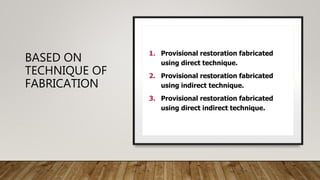
1. Provisional restoration fabricated
using direct technique.
2. Provisional restoration fabricated
using indirect technique.
3. Provisional restoration fabricated
using direct indirect technique.
PROVISIONAL
RESTORATION
FABRICATED
USING DIRECT
TECHNIQUE-
1. Stock tray is used to make an alginate
impression of the prepared tooth.
2. Cast is poured using dental plaster.
3. Then ,the crown size is selected using a mould
guide.
4. Selected crown is tried in patients mouth and
the excess is marked using a marking
pencil(excess height is reduced gingivally )
5. Excess gingival length that extends beyond the
mark is trimmed off.
6. Corrected crown is tried again and compared
with the adjacent tooth.
7. prepared area and adjacent portion of the plaster
cast are painted using separating medium.
8. performed crown filled with acrylic resin is placed
on the plaster cast on the prepared tooth.
9. gingival excess are trimmed expressed by acrylic.
10. Occlusion is checked with articulating paper.
11. Polishing is done with white polishing
compound.
12. During cementation ,excess cement is removed
from the gingival margin.
FABRICATION OF
COMPOSITE
PROVISIONAL
RESTORATION
BY DIRECT
TECHNIQUE
Bis-acryl composites exhibits less heat and polymerization shrinkage hence
they can be use for making provisional restoration by direct technique.
• First the overimpression is taken by using additional silicone after that tooth preparation is carried
out.
• Prepared tooth is coated with petrolatum or with any separating medium,after that both catalyst
base of the composite resin are mixed together and loaded in the overimpression.
• Before the composite polymerizzed overimpression is reseated in the patients mouth and
is allowed to polumerised for 10minutes.
• After 10 minutes overimpression is removed and polymerised composite is carefully checked out,
• If voids re present then they are repaired by adding additional material after that restoration is
finished,polished and cemented.
PROVISIONAL
RESTORATION
FABRICATED
USING A INDIRECT
TECHNIQUE
In this method restoration is completely fabricated in a lab.
Method of fabrication:-
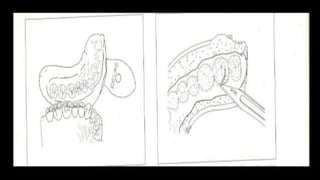
A primary impression of patients mouth is taken and a diagnostic cast is poured.after
that cast is checked properly if any defects are present foreg.,missing cusp then the
defects are corrected by using the utility wax
After correcting the defects an overimpression is made by using a alginate from a
diagnostic cast.thin edges of gingival area are cut away in the overimpression.
After making the overimpression tooth preparation is carried out and impression of a
prepared tooth is taken by using alginate.
Untrimmed quick set plaster is poured into the impression
After that plaster cast of prepared tooth is
trimmed neatly before processing the temporary
restoration.
The cast is tried in the over impression
before processing,separating medium is applied
on the plaster cast.
Acrylic resin is placed in the over impression and
the cast is sealed firmly in the overimpression by
using a rubber elastic band.
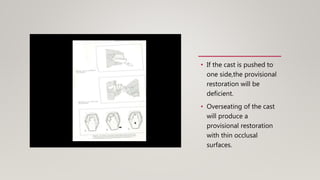
• If the cast is pushed to
one side,the provisional
restoration will be
deficient.
• Overseating of the cast
will produce a
provisional restoration
with thin occlusal
surfaces.
The cast can be broken
while removing the
provisional restoration.
Any plaster material in
provisional restoration is
removed.
Then the restoration is
finished polished and
cemented in the patients
mouh.
PROVISIONAL
RESTORATION
USING DIRECT
INDIRECT
TECHNIQUE
• A performed crown is checked for external fit
and finished in the patients mouth.
• Tissue surface of the performed crown is
customized for the patient the lab .
• The impression of the prepared tooth surface
is take and poured.
• The altered performed crown is then placed on
the cast and the tissue surface is contoured
using resins.
• Than the final restoration is customized.
LIMITATIONS OF
PROVISIONAL
RESTORATIONS
• LACK OF INHERENT STRENGTH.
• POOR MARGINAL ADAPTATION.
• POOR COLOUR STABILITY.
• POOR WEAR PROPERTIES.
• DETECTABLE ODOUR.
• POOR TISSUE RESPONSE.
THANKYOU

Temporization/provisional restoration

  • 1.
  • 2.
    INTRODUCTION Temporization is a importantstep while preparing fixed partial dentures(fpd). Also known as provisional restoration. Provisional means for the time being till the permanent arrangement can be made. This step is done after the tooth preparation on the same day.
  • 3.
  • 4.
    BIOLOGICAL REQUIREMENTS: Protect thepulp of freshly prepared tooth Maintain periodontal health Occlusal compatibility/harmony:it is the most crucial part to get the balanced occlusion
  • 5.
    MECHANICAL REQUIREMENT: • Function: Restorationshould function like a beam in which substantial occlusal forces can be transmitted. • Displacement: There should be no displacement while mastication it can only be achieved by proper tooth preparation and proper seating of temporary restoration • Removal for reuse:if removal of the restoration is require then it should be removed in one piece damage should be prevented so that it can be reused. Damage can only be prevented if the luting agent is weak.
  • 6.
    MATERIAL REQUIREMENT: • FOR AESTHETICREQUIREMENT MATERIAL IS VERY IMPORTANT. • Material requirement 1. Convenient handling 2. Adequate working time ,non toxic,non exothermic 3. Dimensionally stable 4. Easy to contour and polish 5. Adequate strength and abrasion resistance,good aesthetics,patient acceptance,chemical compatibility
  • 7.
    TYPES OF PROVISIONAL RESTORATION: • Classifiedas : 1. Based on the method of fabrication 2. Based on the material used 3. Duration of use 4. Technique for fabrication
  • 8.
    BASED ON THE METHODOF FABRICATION • Custom made provisional restorations- fabricated to reproduce the original contours of the tooth. • In this method impression is taken of a prepared tooth and a cast is poured • The prepared tooth on the cast is waxed up and carved to reproduce a original contours. • Performed provisional restorations- these type of restorations are commercially available in different type of sizes and colours. • Operator choose the material and size tha would be best for the patient and placed it as a provisinal restoration. • Before cementation restoration is modified.
  • 9.
    MATERIAL AVAILABLE FOR PERFORMED CROWNS- 1. Polycarboxylate-naturalappearance • Available in single shade • Available for canine incisors ,premolars 2. Cellulose acetate-available for all tooth • It is a thin transparent material 3. Aluminium and tin silver-for posterior teeth. • Automatically shaped occlusal and axial surfaces. 4. Nickel chromium-used for children. • Cannot be altered with resin • Can be easily recontoured.
  • 10.
    BASED ON THE DURATIONOF USE- 1. Short term temporary restorations: used when prosthesis is to be used for maximum two weeks Indicated in fixed partial dentures. They are either custom made resins or availaable as performed crowns. 2. Long term temporary restorations: usually made of cast metals.strength is average ,history of frequent breakage. Indicated for long span posterior fixed partial dentures. Prolonged treatment plan.
  • 11.
    BASED ON TECHNIQUE OF FABRICATION 1.Provisional restoration fabricated using direct technique. 2. Provisional restoration fabricated using indirect technique. 3. Provisional restoration fabricated using direct indirect technique.
  • 12.
    PROVISIONAL RESTORATION FABRICATED USING DIRECT TECHNIQUE- 1. Stocktray is used to make an alginate impression of the prepared tooth. 2. Cast is poured using dental plaster. 3. Then ,the crown size is selected using a mould guide. 4. Selected crown is tried in patients mouth and the excess is marked using a marking pencil(excess height is reduced gingivally ) 5. Excess gingival length that extends beyond the mark is trimmed off. 6. Corrected crown is tried again and compared with the adjacent tooth.
  • 13.
    7. prepared areaand adjacent portion of the plaster cast are painted using separating medium. 8. performed crown filled with acrylic resin is placed on the plaster cast on the prepared tooth. 9. gingival excess are trimmed expressed by acrylic. 10. Occlusion is checked with articulating paper. 11. Polishing is done with white polishing compound. 12. During cementation ,excess cement is removed from the gingival margin.
  • 14.
    FABRICATION OF COMPOSITE PROVISIONAL RESTORATION BY DIRECT TECHNIQUE Bis-acrylcomposites exhibits less heat and polymerization shrinkage hence they can be use for making provisional restoration by direct technique. • First the overimpression is taken by using additional silicone after that tooth preparation is carried out. • Prepared tooth is coated with petrolatum or with any separating medium,after that both catalyst base of the composite resin are mixed together and loaded in the overimpression. • Before the composite polymerizzed overimpression is reseated in the patients mouth and is allowed to polumerised for 10minutes. • After 10 minutes overimpression is removed and polymerised composite is carefully checked out, • If voids re present then they are repaired by adding additional material after that restoration is finished,polished and cemented.
  • 15.
    PROVISIONAL RESTORATION FABRICATED USING A INDIRECT TECHNIQUE Inthis method restoration is completely fabricated in a lab. Method of fabrication:- A primary impression of patients mouth is taken and a diagnostic cast is poured.after that cast is checked properly if any defects are present foreg.,missing cusp then the defects are corrected by using the utility wax After correcting the defects an overimpression is made by using a alginate from a diagnostic cast.thin edges of gingival area are cut away in the overimpression. After making the overimpression tooth preparation is carried out and impression of a prepared tooth is taken by using alginate. Untrimmed quick set plaster is poured into the impression
  • 17.
    After that plastercast of prepared tooth is trimmed neatly before processing the temporary restoration. The cast is tried in the over impression before processing,separating medium is applied on the plaster cast. Acrylic resin is placed in the over impression and the cast is sealed firmly in the overimpression by using a rubber elastic band.
  • 18.
    • If thecast is pushed to one side,the provisional restoration will be deficient. • Overseating of the cast will produce a provisional restoration with thin occlusal surfaces.
  • 19.
    The cast canbe broken while removing the provisional restoration. Any plaster material in provisional restoration is removed. Then the restoration is finished polished and cemented in the patients mouh.
  • 20.
    PROVISIONAL RESTORATION USING DIRECT INDIRECT TECHNIQUE • Aperformed crown is checked for external fit and finished in the patients mouth. • Tissue surface of the performed crown is customized for the patient the lab . • The impression of the prepared tooth surface is take and poured. • The altered performed crown is then placed on the cast and the tissue surface is contoured using resins. • Than the final restoration is customized.
  • 21.
    LIMITATIONS OF PROVISIONAL RESTORATIONS • LACKOF INHERENT STRENGTH. • POOR MARGINAL ADAPTATION. • POOR COLOUR STABILITY. • POOR WEAR PROPERTIES. • DETECTABLE ODOUR. • POOR TISSUE RESPONSE.
  • 22.