Introduction to Insects
Phylum Arthropoda
(jointed appendages, exoskeleton, etc.)
• Class Insecta (most numerous and
diverse group of organisms)
• Class Arachnida
• Class Crustacea
• Etc. (centipedes, millipedes, etc.)
Spiders – often beneficial as predators
Mites – some plant pests, some predators
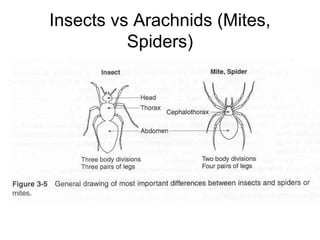
Insects vs Arachnids (Mites,
Spiders)
Insect Life Cycles
• 1. Simple metamorphosis
• 2. Complete metamorphosis
• 3. Some exceptions
• #1 and #2 apply to most agricultural pests
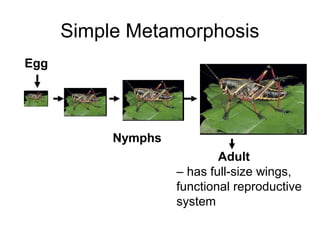
Simple Metamorphosis
Egg
Nymphs
Adult
– has full-size wings,
functional reproductive
system
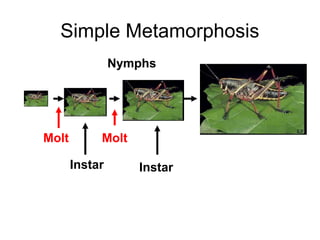
Simple Metamorphosis
Nymphs
InstarInstar
Molt Molt
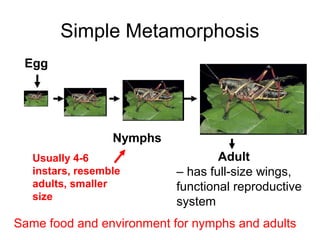
Simple Metamorphosis
Egg
Nymphs
Adult
– has full-size wings,
functional reproductive
system
Usually 4-6
instars, resemble
adults, smaller
size
Same food and environment for nymphs and adults
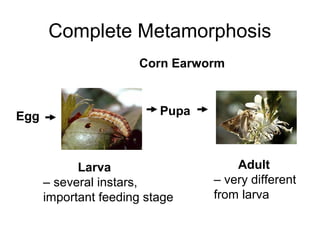
Complete Metamorphosis
Egg Pupa
Larva
– several instars,
important feeding stage
Adult
– very different
from larva
Corn Earworm
Complete Metamorphosis
• Life stages are important because
ecology, food habits, and management of
different stages can be different
• Example: butterflies and moths
• Larva – feeds as damaging caterpillar
• Adult – beneficial as plant pollinator
Survey of insects – Major groups
(orders) of ag pests or beneficial
predators and parasites
• Beneficial insects:
• Predators, parasites
• Pollinators
• Recyclers of OM
Survey of insects – Major groups
(orders) of ag pests or beneficials
• Dragonflies
• Orthoptera and relatives (mantids, roaches)
• Thrips
• True bugs (Hemiptera)
• Piercing-sucking insects (Homoptera)
• Beetles
• Nerve-winged insects (Neuroptera)
• Butterflies and moths
• Bees, wasps, and ants
• Flies
• Etc.
Survey of Insects
• Dragonflies --- beneficial predators of
flying insects
• Praying mantids --- beneficial predators
• Roaches --- recycling in some ag systems
• Grasshoppers, Crickets --- can be serious
ag pests
Tawny Mole Cricket
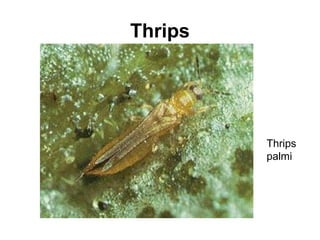
Thrips
Thrips
palmi
Thrips
• Almost microscopic in size, fringed wings
• Beneficial pollination in flowers
• Most are plant pests
• Some carry plant viruses
Virus Vectors
• Vector = carrier of virus
• Viruses in plants
• Transmitted by insects, etc.
• Vector feeds on infected plant acquires
virus feeds and passes virus to other
plants
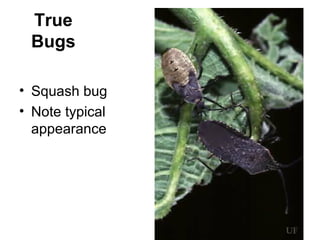
True
Bugs
• Squash bug
• Note typical
appearance
True Bugs
• Piercing-sucking mouthparts
• Some important pests, e.g., stink bugs
• Some predators
Piercing-Sucking Insects
• Piercing-sucking mouthparts to feed on
plants
• Formerly Homoptera, often included with
true bugs
• Many important plant pests
• Some transmit viruses
• Aphids, cicadas, whiteflies, scale insects,
leafhoppers, etc…
Green Peach Aphid
• Very abundant as plant pests
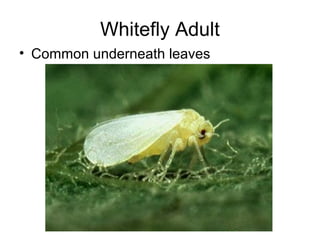
Whitefly Adult
• Common underneath leaves
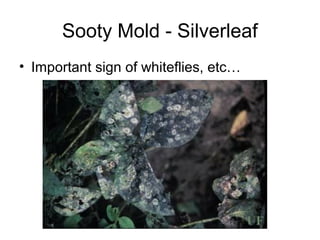
Sooty Mold - Silverleaf
• Important sign of whiteflies, etc…
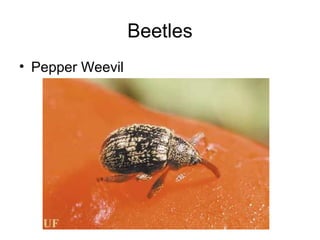
Beetles
• Pepper Weevil
Beetles
• Very many species
• Many pests – weevils, larvae of some
types are grubs or wireworms
• Many beneficials – Lady beetles, ground
beetles, tiger beetles
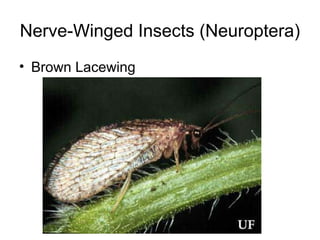
Nerve-Winged Insects (Neuroptera)
• Brown Lacewing
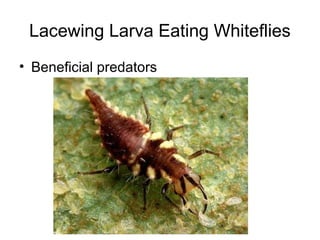
Lacewing Larva Eating Whiteflies
• Beneficial predators
Butterflies and Moths
• Pests – many kinds of caterpillars
• Beneficial as pollinators
Bees, Wasps, Ants
• Beneficial as pollinators
• Many are important as predators and
parasites
• Many different kinds of wasps, most nearly
microscopic
• Parasitoids – microscopic wasps, lay
eggs in body of pest (e.g., caterpillar), or
even in egg
Flies
• Many different kinds, difficult to distinguish
– different flies do different things:
• Important pests of livestock
• Beneficial as pollinators
• Beneficial as predators
• Some are parasitoids
• Some are plant pests (leaf miners)
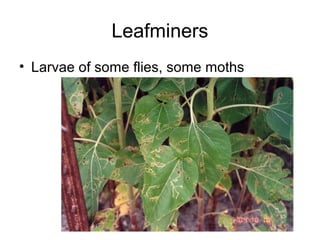
Leafminers
• Larvae of some flies, some moths
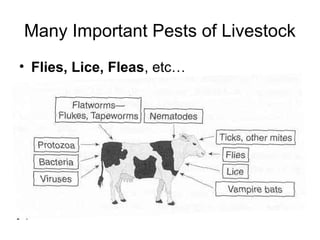
Many Important Pests of Livestock
• Flies, Lice, Fleas, etc…
Important Insect Relatives
• Mites -- some beneficial predators
• Mites – some livestock pests
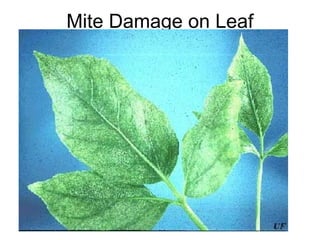
• Mites – some plant pests
• Spiders – Very important as predators
(much underrated) in agroecosystems
Mite Damage on Leaf
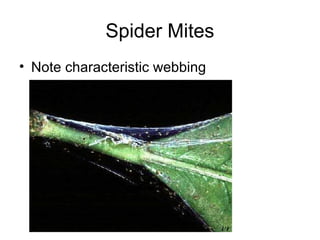
Spider Mites
• Note characteristic webbing
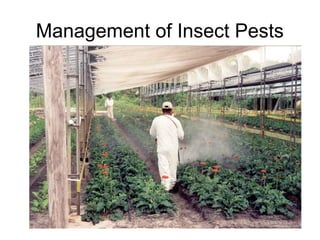
Management of Insect Pests
Insecticides and Acaricides
• +++ effective, detailed knowledge of pest
biology not needed
• +++ reliable, fast-acting
• +++ quick response to emergency
situations
• - - - non target effects
• - - - $ and energy costs
• - - - high expectations
Biological Control
• Control by living organism or natural
product of living organism
• Hyperparasitism
Caterpillar Tachinid fly Parasitoid Wasp
Biological Control
-- Two Approaches
• Introduced = add control agents to
ecosystem (many good examples with
introduced pests)
• Introduced: classical (new agent) vs
augmentation (agent already present)
• Natural = favor increase of naturally
occurring control agents (manipulate
environment, cropping systems)
Biological Control
Many possible organisms:
• Predators (often not specific)
• Parasites
• Diseases (parasites)
Fungi
Bacteria
Viruses
Parasitoids (often highly specific)
Entomopathogenic nematodes
Host Plant Resistance
• Interfere with host finding, feeding, pest
nutrition, timing of life cycles, etc…
• Hairs on leaves, sticky, etc.
• Alkaloids in plants deter insects
• Crop cultivars/genotypes selected for
resistance to pests
What is Biological Control
and What Is Not ???
What is Biological Control?
• Predators
• Parasites
• Diseases
What is Biological Control?
• Predators
• Parasites
• Diseases
• Bacterial disease of insects caused by
Bacillus thuringiensis (BT)
What is Biological Control?
• Bacterial disease of insects caused by
Bacillus thuringiensis (BT)
• Allow bacteria to produce spores with
toxin in lab, isolate BT toxin, and spray it
on pests
What is Biological Control?
• Bacterial disease of insects caused by
Bacillus thuringiensis (BT)
• Allow bacteria to produce spores with
toxin in lab, isolate BT toxin, and spray it
on pests
• Transgenic plants that produce BT toxin
(Bt corn, Bt cotton)
What is Biological Control?
• Resistant plants as biological control
agents
• Plants with alkaloids
• Pyrethrum = natural plant alkaloid
What is Biological Control?
• Resistant plants as biological control
agents
• Plants with alkaloids
• Pyrethrum = natural plant alkaloid
• Isolate pyrethrum from plants and use it
What is Biological Control?
• Resistant plants as biological control agents
• Plants with alkaloids
• Pyrethrum = natural plant alkaloid
• Isolate pyrethrum from plants and use it
• Make synthetic pyrethrum
• Pyrethroid = pyrethrum analog, similar chem
structure
Environmental Heterogeneity
• Crop genetics (uniform genotypes vs mix)
• Vegetation diversity vs pest dispersal
• Vegetation diversity as reservoir for
natural enemies
Plant Health
• +++ Healthy plant can withstand some
insect damage
• - - - High N can increase insect growth
and reproduction
Attractants and Repellents
• Attractant, e.g., pheromone (sex or
aggregation) useful for:
• Sampling and monitoring (important use
for quarantine detection, regional
monitoring)
• Attracting insects to traps
• Confusing normal life processes and
patterns
Cultural Practices
• Crop Rotation
• Weed control of virus hosts
• Sanitation and cleanup of crop residues
(affected overwintering of boll weevil)
• Timing of planting dates (winter wheat,
Hessian fly)
• Others (sterile males, etc.)
For most effective insect
management, usually need
to know biology and habits
of individual insect pests
References
• Text: Ch 10, pp. 201-208; Ch.11, pp. 219-222.
• Metcalf C.L., W.P. Flint, and R.L. Metcalf. 1962.
Destructive and Useful Insects. McGraw-Hill,
NY.
• Metcalf, R.L., and W.H. Luckmann. 1994.
Introduction to Insect Pest Management. John
Wiley & Sons, NY.
• Images from UF Dept. Entomology &
Nematology – Featured Creatures:
• http://creatures.ifas.ufl.edu

Als 3153 Class 15

  • 1.
  • 2.
    Phylum Arthropoda (jointed appendages,exoskeleton, etc.) • Class Insecta (most numerous and diverse group of organisms) • Class Arachnida • Class Crustacea • Etc. (centipedes, millipedes, etc.) Spiders – often beneficial as predators Mites – some plant pests, some predators
  • 3.
    Insects vs Arachnids(Mites, Spiders)
  • 4.
    Insect Life Cycles •1. Simple metamorphosis • 2. Complete metamorphosis • 3. Some exceptions • #1 and #2 apply to most agricultural pests
  • 5.
    Simple Metamorphosis Egg Nymphs Adult – hasfull-size wings, functional reproductive system
  • 6.
  • 7.
    Simple Metamorphosis Egg Nymphs Adult – hasfull-size wings, functional reproductive system Usually 4-6 instars, resemble adults, smaller size Same food and environment for nymphs and adults
  • 8.
    Complete Metamorphosis Egg Pupa Larva –several instars, important feeding stage Adult – very different from larva Corn Earworm
  • 9.
    Complete Metamorphosis • Lifestages are important because ecology, food habits, and management of different stages can be different • Example: butterflies and moths • Larva – feeds as damaging caterpillar • Adult – beneficial as plant pollinator
  • 10.
    Survey of insects– Major groups (orders) of ag pests or beneficial predators and parasites • Beneficial insects: • Predators, parasites • Pollinators • Recyclers of OM
  • 11.
    Survey of insects– Major groups (orders) of ag pests or beneficials • Dragonflies • Orthoptera and relatives (mantids, roaches) • Thrips • True bugs (Hemiptera) • Piercing-sucking insects (Homoptera) • Beetles • Nerve-winged insects (Neuroptera) • Butterflies and moths • Bees, wasps, and ants • Flies • Etc.
  • 12.
    Survey of Insects •Dragonflies --- beneficial predators of flying insects • Praying mantids --- beneficial predators • Roaches --- recycling in some ag systems • Grasshoppers, Crickets --- can be serious ag pests
  • 13.
  • 14.
  • 15.
    Thrips • Almost microscopicin size, fringed wings • Beneficial pollination in flowers • Most are plant pests • Some carry plant viruses
  • 16.
    Virus Vectors • Vector= carrier of virus • Viruses in plants • Transmitted by insects, etc. • Vector feeds on infected plant acquires virus feeds and passes virus to other plants
  • 17.
    True Bugs • Squash bug •Note typical appearance
  • 18.
    True Bugs • Piercing-suckingmouthparts • Some important pests, e.g., stink bugs • Some predators
  • 19.
    Piercing-Sucking Insects • Piercing-suckingmouthparts to feed on plants • Formerly Homoptera, often included with true bugs • Many important plant pests • Some transmit viruses • Aphids, cicadas, whiteflies, scale insects, leafhoppers, etc…
  • 20.
    Green Peach Aphid •Very abundant as plant pests
  • 21.
  • 22.
    Sooty Mold -Silverleaf • Important sign of whiteflies, etc…
  • 23.
  • 24.
    Beetles • Very manyspecies • Many pests – weevils, larvae of some types are grubs or wireworms • Many beneficials – Lady beetles, ground beetles, tiger beetles
  • 25.
  • 26.
    Lacewing Larva EatingWhiteflies • Beneficial predators
  • 27.
    Butterflies and Moths •Pests – many kinds of caterpillars • Beneficial as pollinators
  • 28.
    Bees, Wasps, Ants •Beneficial as pollinators • Many are important as predators and parasites • Many different kinds of wasps, most nearly microscopic • Parasitoids – microscopic wasps, lay eggs in body of pest (e.g., caterpillar), or even in egg
  • 29.
    Flies • Many differentkinds, difficult to distinguish – different flies do different things: • Important pests of livestock • Beneficial as pollinators • Beneficial as predators • Some are parasitoids • Some are plant pests (leaf miners)
  • 30.
    Leafminers • Larvae ofsome flies, some moths
  • 31.
    Many Important Pestsof Livestock • Flies, Lice, Fleas, etc…
  • 32.
    Important Insect Relatives •Mites -- some beneficial predators • Mites – some livestock pests • Mites – some plant pests • Spiders – Very important as predators (much underrated) in agroecosystems
  • 33.
  • 34.
    Spider Mites • Notecharacteristic webbing
  • 35.
  • 36.
    Insecticides and Acaricides •+++ effective, detailed knowledge of pest biology not needed • +++ reliable, fast-acting • +++ quick response to emergency situations • - - - non target effects • - - - $ and energy costs • - - - high expectations
  • 37.
    Biological Control • Controlby living organism or natural product of living organism • Hyperparasitism Caterpillar Tachinid fly Parasitoid Wasp
  • 38.
    Biological Control -- TwoApproaches • Introduced = add control agents to ecosystem (many good examples with introduced pests) • Introduced: classical (new agent) vs augmentation (agent already present) • Natural = favor increase of naturally occurring control agents (manipulate environment, cropping systems)
  • 39.
    Biological Control Many possibleorganisms: • Predators (often not specific) • Parasites • Diseases (parasites) Fungi Bacteria Viruses Parasitoids (often highly specific) Entomopathogenic nematodes
  • 40.
    Host Plant Resistance •Interfere with host finding, feeding, pest nutrition, timing of life cycles, etc… • Hairs on leaves, sticky, etc. • Alkaloids in plants deter insects • Crop cultivars/genotypes selected for resistance to pests
  • 41.
    What is BiologicalControl and What Is Not ???
  • 42.
    What is BiologicalControl? • Predators • Parasites • Diseases
  • 43.
    What is BiologicalControl? • Predators • Parasites • Diseases • Bacterial disease of insects caused by Bacillus thuringiensis (BT)
  • 44.
    What is BiologicalControl? • Bacterial disease of insects caused by Bacillus thuringiensis (BT) • Allow bacteria to produce spores with toxin in lab, isolate BT toxin, and spray it on pests
  • 45.
    What is BiologicalControl? • Bacterial disease of insects caused by Bacillus thuringiensis (BT) • Allow bacteria to produce spores with toxin in lab, isolate BT toxin, and spray it on pests • Transgenic plants that produce BT toxin (Bt corn, Bt cotton)
  • 46.
    What is BiologicalControl? • Resistant plants as biological control agents • Plants with alkaloids • Pyrethrum = natural plant alkaloid
  • 47.
    What is BiologicalControl? • Resistant plants as biological control agents • Plants with alkaloids • Pyrethrum = natural plant alkaloid • Isolate pyrethrum from plants and use it
  • 48.
    What is BiologicalControl? • Resistant plants as biological control agents • Plants with alkaloids • Pyrethrum = natural plant alkaloid • Isolate pyrethrum from plants and use it • Make synthetic pyrethrum • Pyrethroid = pyrethrum analog, similar chem structure
  • 49.
    Environmental Heterogeneity • Cropgenetics (uniform genotypes vs mix) • Vegetation diversity vs pest dispersal • Vegetation diversity as reservoir for natural enemies
  • 50.
    Plant Health • +++Healthy plant can withstand some insect damage • - - - High N can increase insect growth and reproduction
  • 51.
    Attractants and Repellents •Attractant, e.g., pheromone (sex or aggregation) useful for: • Sampling and monitoring (important use for quarantine detection, regional monitoring) • Attracting insects to traps • Confusing normal life processes and patterns
  • 52.
    Cultural Practices • CropRotation • Weed control of virus hosts • Sanitation and cleanup of crop residues (affected overwintering of boll weevil) • Timing of planting dates (winter wheat, Hessian fly) • Others (sterile males, etc.)
  • 53.
    For most effectiveinsect management, usually need to know biology and habits of individual insect pests
  • 54.
    References • Text: Ch10, pp. 201-208; Ch.11, pp. 219-222. • Metcalf C.L., W.P. Flint, and R.L. Metcalf. 1962. Destructive and Useful Insects. McGraw-Hill, NY. • Metcalf, R.L., and W.H. Luckmann. 1994. Introduction to Insect Pest Management. John Wiley & Sons, NY. • Images from UF Dept. Entomology & Nematology – Featured Creatures: • http://creatures.ifas.ufl.edu