LIVING BEINGS
What living beings do you know? LIVING BEINGS
Plants     Example Animals     Example Fungi   Example Microorganisms  Bacteria  (example in foods, diseases, floor)  Yeast (type of fungi)  Protozoa Some can been seen with the naked eye while others require a microscope! LIVING BEINGS
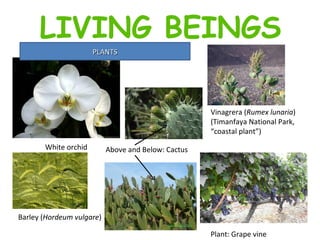
Vinagrera ( Rumex lunaria ) (Timanfaya National Park, “coastal plant”)  Plant: Grape vine White orchid PLANTS Barley ( Hordeum vulgare ) Above and Below: Cactus LIVING BEINGS
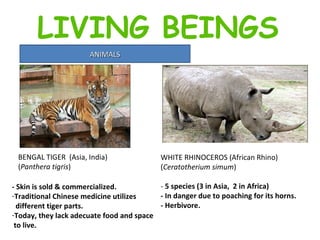
ANIMALS BENGAL TIGER  (Asia, India) ( Panthera tigris ) WHITE RHINOCEROS (African Rhino)  ( Ceratotherium simum )  -  5 species (3 in Asia,  2 in Africa)  - In danger due to poaching for its horns.  - Herbivore. - Skin is sold & commercialized. Traditional Chinese medicine utilizes different tiger parts. Today, they lack adecuate food and space to live.  LIVING BEINGS
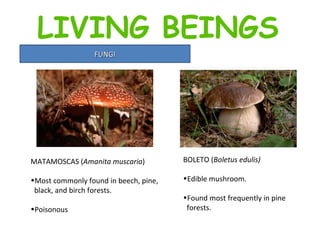
FUNGI MATAMOSCAS ( Amanita muscaria ) Most commonly found in beech, pine, black, and birch forests. Poisonous BOLETO ( Boletus edulis)  Edible mushroom.  Found most frequently in pine  forests.  LIVING BEINGS
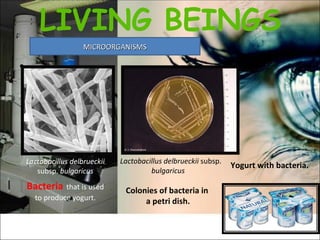
MICROORGANISMS Yogurt with bacteria. LIVING BEINGS Lactobacillus delbrueckii  subsp.  bulgaricus Bacteria   that is used to produce yogurt. Lactobacillus delbrueckii  subsp.  bulgaricus Colonies of bacteria in  a petri dish.
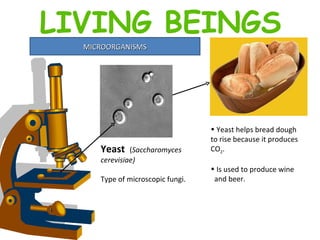
MICROORGANISMS Yeast  ( Saccharomyces cerevisiae) Type of microscopic fungi. Yeast helps bread dough to rise because it produces CO 2 . Is used to produce wine and beer. LIVING BEINGS
What is a living being?   LIVING BEINGS
Common characteristics that define living beings.   LIVING BEINGS
Nutrition   -  Processes in order to: *  Obtain energy   * To produce their own matter LIVING BEINGS
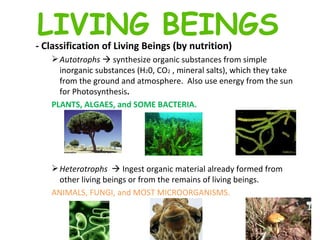
- Classification of Living Beings (by nutrition) Autotrophs    synthesize organic substances from simple inorganic substances (H 2 0, CO 2  , mineral salts), which they take from the ground and atmosphere.  Also use energy from the sun for Photosynthesis .   PLANTS, ALGAES, and SOME BACTERIA. Heterotrophs    Ingest organic material already formed from other living beings or from the remains of living beings.  ANIMALS, FUNGI, and MOST MICROORGANISMS.  LIVING BEINGS
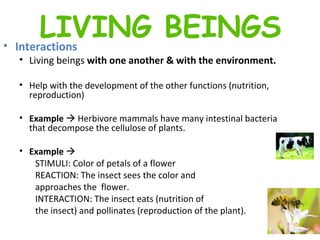
Interactions  Living beings  with one another & with the environment. Help with the development of the other functions (nutrition, reproduction)  Example    Herbivore mammals have many intestinal bacteria that decompose the cellulose of plants.  Example     STIMULI: Color of petals of a flower  REACTION: The insect sees the color and  approaches the  flower.  INTERACTION: The insect eats (nutrition of  the insect) and pollinates (reproduction of the plant).   LIVING BEINGS
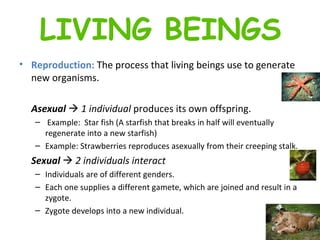
Reproduction:  The process that living beings use to generate new organisms.  Asexual     1 individual   produces its own offspring. Example:  Star fish (A starfish that breaks in half will eventually regenerate into a new starfish) Example: Strawberries reproduces asexually from their creeping stalk. Sexual     2 individuals interact   Individuals are of different genders. Each one supplies a different gamete, which are joined and result in a zygote. Zygote develops into a new individual.  LIVING BEINGS
2.  Chemical Composition of Living Beings LIVING BEINGS
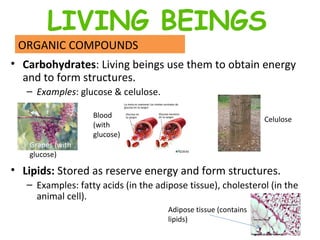
Carbohydrates : Living beings use them to obtain energy and to form structures.  Examples : glucose & celulose. Lipids:  Stored as reserve energy and form structures. Examples: fatty acids (in the adipose tissue), cholesterol (in the animal cell). ORGANIC COMPOUNDS Celulose Grapes (with  glucose) Blood (with glucose) Adipose tissue (contains lipids) LIVING BEINGS
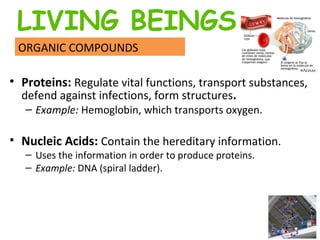
Proteins:  Regulate vital functions, transport substances, defend against infections, form structures .   Example:  Hemoglobin, which transports oxygen.  Nucleic Acids:  Contain the hereditary information.  Uses the information in order to produce proteins. Example:  DNA (spiral ladder).   ORGANIC COMPOUNDS LIVING BEINGS
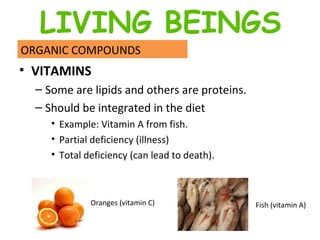
VITAMINS  Some are lipids and others are proteins.  Should be integrated in the diet  Example: Vitamin A from fish.  Partial deficiency (illness) Total deficiency (can lead to death).  ORGANIC COMPOUNDS Oranges (vitamin C) Fish (vitamin A) LIVING BEINGS
3.  Cellular Composition of Living beings LIVING BEINGS
The Cellular Theory  of M. J. Schleiden and T. Schwann : Living beings are formed of one or more cells.  The cell is the smallest living unit with the ability to  feed itself, interact, and reproduce . All cells come from the division of other cells.  Cells are the structural and functional units of all living beings. LIVING BEINGS
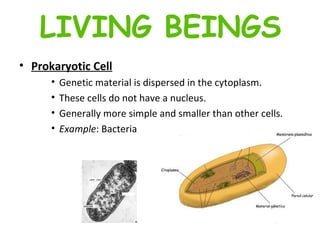
Prokaryotic Cell   Genetic material is dispersed in the cytoplasm.  These cells do not have a nucleus.  Generally more simple and smaller than other cells.  Example : Bacteria   LIVING BEINGS
4. Animal and Plant Cells ( Eukaryotic Cells) LIVING BEINGS
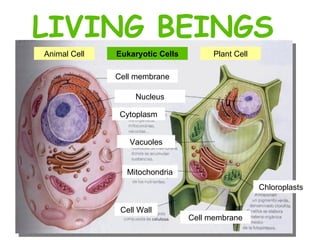
LIVING BEINGS Animal Cell Plant Cell Cell membrane Nucleus Cytoplasm Vacuoles Mitochondria Cell Wall Cell membrane Chloroplasts Eukaryotic Cells
5.   Unicellular and Pluricellular Organisms LIVING BEINGS
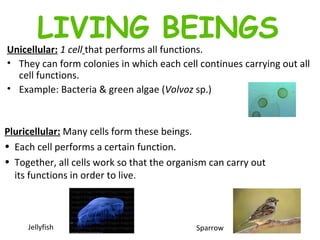
Unicellular:   1 cell   that performs all functions.  They can form colonies in which each cell continues carrying out all cell functions.  Example: Bacteria & green algae ( Volvoz  sp.) LIVING BEINGS Pluricellular:   Many cells form these beings.  Each cell performs a certain function. Together, all cells work so that the organism can carry out its functions in order to live. Jellyfish Sparrow
Levels of Organization - Pluricellular organisms are organized into distinct levels of organization. -   A level of organization represents one organic structure.  Thus, a higher level of organization is more complex tissues < organs < systems < aparatos LIVING BEINGS
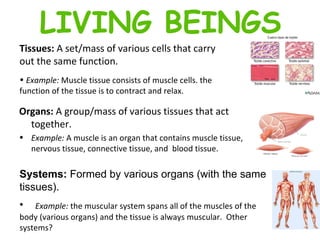
Tissues:  A set/mass of various cells that carry out the same function.  Example:  Muscle tissue consists of muscle cells. the function of the tissue is to contract and relax. LIVING BEINGS Organs:  A group/mass of various tissues that act together.  Example:  A muscle is an organ that contains muscle tissue, nervous tissue, connective tissue, and  blood tissue. Systems:  Formed by various organs (with the same tissues).  Example:  the muscular system spans all of the muscles of the body (various organs) and the tissue is always muscular.  Other systems?
6. Classification of Living Beings LIVING BEINGS
CLASSIFICATION OF LIVING BEINGS   Diversity of Living Beings  Size, shape, manner of eating, reproduction  The study of diversity  means indentifying, grouping, & organizing living beings: classifying them!   The science of classifiation is called TAXONOMY: It establishes a classification hierarchy that places living beings in groups  Each group includes smaller subgroups.  Each group or subgroup is called a  TAXON or  a TAXONOMIC CATEGORY LIVING BEINGS
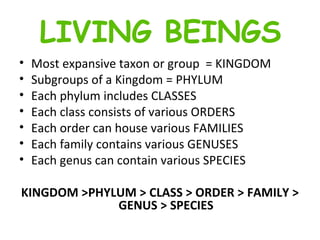
Most expansive taxon or group  = KINGDOM Subgroups of a Kingdom = PHYLUM Each phylum includes CLASSES Each class consists of various ORDERS Each order can house various FAMILIES Each family contains various GENUSES Each genus can contain various SPECIES KINGDOM >PHYLUM > CLASS > ORDER > FAMILY > GENUS > SPECIES LIVING BEINGS
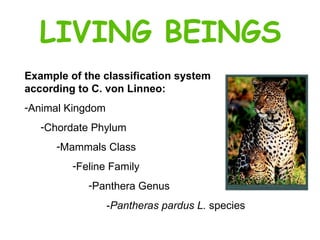
LIVING BEINGS Example of the classification system according to C. von Linneo: Animal Kingdom Chordate Phylum Mammals Class Feline Family Panthera Genus - Pantheras pardus L.  species
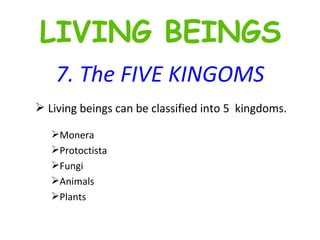
7. The FIVE KINGOMS Living beings can be classified into 5  kingdoms. Monera Protoctista  Fungi Animals Plants LIVING BEINGS
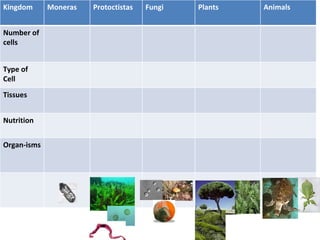
Kingdom Moneras Protoctistas Fungi Plants Animals Number of cells Type of Cell Tissues Nutrition Organ-isms
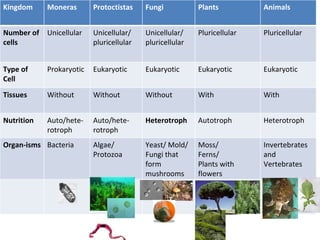
Kingdom Moneras Protoctistas Fungi Plants Animals Number of cells Unicellular Unicellular/ pluricellular Unicellular/ pluricellular Pluricellular Pluricellular Type of Cell Prokaryotic Eukaryotic Eukaryotic Eukaryotic Eukaryotic Tissues Without Without Without With With Nutrition Auto/hete-rotroph Auto/hete-rotroph Heterotroph Autotroph Heterotroph Organ-isms Bacteria Algae/ Protozoa Yeast/ Mold/ Fungi that form mushrooms Moss/ Ferns/ Plants with flowers Invertebrates  and Vertebrates

Living Beings

  • 1.
  • 2.
    What living beingsdo you know? LIVING BEINGS
  • 3.
    Plants  Example Animals  Example Fungi  Example Microorganisms Bacteria (example in foods, diseases, floor) Yeast (type of fungi) Protozoa Some can been seen with the naked eye while others require a microscope! LIVING BEINGS
  • 4.
    Vinagrera ( Rumexlunaria ) (Timanfaya National Park, “coastal plant”) Plant: Grape vine White orchid PLANTS Barley ( Hordeum vulgare ) Above and Below: Cactus LIVING BEINGS
  • 5.
    ANIMALS BENGAL TIGER (Asia, India) ( Panthera tigris ) WHITE RHINOCEROS (African Rhino) ( Ceratotherium simum ) - 5 species (3 in Asia, 2 in Africa) - In danger due to poaching for its horns. - Herbivore. - Skin is sold & commercialized. Traditional Chinese medicine utilizes different tiger parts. Today, they lack adecuate food and space to live. LIVING BEINGS
  • 6.
    FUNGI MATAMOSCAS (Amanita muscaria ) Most commonly found in beech, pine, black, and birch forests. Poisonous BOLETO ( Boletus edulis) Edible mushroom. Found most frequently in pine forests. LIVING BEINGS
  • 7.
    MICROORGANISMS Yogurt withbacteria. LIVING BEINGS Lactobacillus delbrueckii subsp. bulgaricus Bacteria that is used to produce yogurt. Lactobacillus delbrueckii subsp. bulgaricus Colonies of bacteria in a petri dish.
  • 8.
    MICROORGANISMS Yeast ( Saccharomyces cerevisiae) Type of microscopic fungi. Yeast helps bread dough to rise because it produces CO 2 . Is used to produce wine and beer. LIVING BEINGS
  • 9.
    What is aliving being? LIVING BEINGS
  • 10.
    Common characteristics thatdefine living beings. LIVING BEINGS
  • 11.
    Nutrition - Processes in order to: * Obtain energy * To produce their own matter LIVING BEINGS
  • 12.
    - Classification ofLiving Beings (by nutrition) Autotrophs  synthesize organic substances from simple inorganic substances (H 2 0, CO 2 , mineral salts), which they take from the ground and atmosphere. Also use energy from the sun for Photosynthesis . PLANTS, ALGAES, and SOME BACTERIA. Heterotrophs  Ingest organic material already formed from other living beings or from the remains of living beings. ANIMALS, FUNGI, and MOST MICROORGANISMS. LIVING BEINGS
  • 13.
    Interactions Livingbeings with one another & with the environment. Help with the development of the other functions (nutrition, reproduction) Example  Herbivore mammals have many intestinal bacteria that decompose the cellulose of plants. Example  STIMULI: Color of petals of a flower REACTION: The insect sees the color and approaches the flower. INTERACTION: The insect eats (nutrition of the insect) and pollinates (reproduction of the plant). LIVING BEINGS
  • 14.
    Reproduction: Theprocess that living beings use to generate new organisms. Asexual  1 individual produces its own offspring. Example: Star fish (A starfish that breaks in half will eventually regenerate into a new starfish) Example: Strawberries reproduces asexually from their creeping stalk. Sexual  2 individuals interact Individuals are of different genders. Each one supplies a different gamete, which are joined and result in a zygote. Zygote develops into a new individual. LIVING BEINGS
  • 15.
    2. ChemicalComposition of Living Beings LIVING BEINGS
  • 16.
    Carbohydrates : Livingbeings use them to obtain energy and to form structures. Examples : glucose & celulose. Lipids: Stored as reserve energy and form structures. Examples: fatty acids (in the adipose tissue), cholesterol (in the animal cell). ORGANIC COMPOUNDS Celulose Grapes (with glucose) Blood (with glucose) Adipose tissue (contains lipids) LIVING BEINGS
  • 17.
    Proteins: Regulatevital functions, transport substances, defend against infections, form structures . Example: Hemoglobin, which transports oxygen. Nucleic Acids: Contain the hereditary information. Uses the information in order to produce proteins. Example: DNA (spiral ladder). ORGANIC COMPOUNDS LIVING BEINGS
  • 18.
    VITAMINS Someare lipids and others are proteins. Should be integrated in the diet Example: Vitamin A from fish. Partial deficiency (illness) Total deficiency (can lead to death). ORGANIC COMPOUNDS Oranges (vitamin C) Fish (vitamin A) LIVING BEINGS
  • 19.
    3. CellularComposition of Living beings LIVING BEINGS
  • 20.
    The Cellular Theory of M. J. Schleiden and T. Schwann : Living beings are formed of one or more cells. The cell is the smallest living unit with the ability to feed itself, interact, and reproduce . All cells come from the division of other cells. Cells are the structural and functional units of all living beings. LIVING BEINGS
  • 21.
    Prokaryotic Cell Genetic material is dispersed in the cytoplasm. These cells do not have a nucleus. Generally more simple and smaller than other cells. Example : Bacteria LIVING BEINGS
  • 22.
    4. Animal andPlant Cells ( Eukaryotic Cells) LIVING BEINGS
  • 23.
    LIVING BEINGS AnimalCell Plant Cell Cell membrane Nucleus Cytoplasm Vacuoles Mitochondria Cell Wall Cell membrane Chloroplasts Eukaryotic Cells
  • 24.
    5. Unicellular and Pluricellular Organisms LIVING BEINGS
  • 25.
    Unicellular: 1 cell that performs all functions. They can form colonies in which each cell continues carrying out all cell functions. Example: Bacteria & green algae ( Volvoz sp.) LIVING BEINGS Pluricellular: Many cells form these beings. Each cell performs a certain function. Together, all cells work so that the organism can carry out its functions in order to live. Jellyfish Sparrow
  • 26.
    Levels of Organization- Pluricellular organisms are organized into distinct levels of organization. - A level of organization represents one organic structure. Thus, a higher level of organization is more complex tissues < organs < systems < aparatos LIVING BEINGS
  • 27.
    Tissues: Aset/mass of various cells that carry out the same function. Example: Muscle tissue consists of muscle cells. the function of the tissue is to contract and relax. LIVING BEINGS Organs: A group/mass of various tissues that act together. Example: A muscle is an organ that contains muscle tissue, nervous tissue, connective tissue, and blood tissue. Systems: Formed by various organs (with the same tissues). Example: the muscular system spans all of the muscles of the body (various organs) and the tissue is always muscular. Other systems?
  • 28.
    6. Classification ofLiving Beings LIVING BEINGS
  • 29.
    CLASSIFICATION OF LIVINGBEINGS Diversity of Living Beings Size, shape, manner of eating, reproduction The study of diversity means indentifying, grouping, & organizing living beings: classifying them! The science of classifiation is called TAXONOMY: It establishes a classification hierarchy that places living beings in groups Each group includes smaller subgroups. Each group or subgroup is called a TAXON or a TAXONOMIC CATEGORY LIVING BEINGS
  • 30.
    Most expansive taxonor group = KINGDOM Subgroups of a Kingdom = PHYLUM Each phylum includes CLASSES Each class consists of various ORDERS Each order can house various FAMILIES Each family contains various GENUSES Each genus can contain various SPECIES KINGDOM >PHYLUM > CLASS > ORDER > FAMILY > GENUS > SPECIES LIVING BEINGS
  • 31.
    LIVING BEINGS Exampleof the classification system according to C. von Linneo: Animal Kingdom Chordate Phylum Mammals Class Feline Family Panthera Genus - Pantheras pardus L. species
  • 32.
    7. The FIVEKINGOMS Living beings can be classified into 5 kingdoms. Monera Protoctista Fungi Animals Plants LIVING BEINGS
  • 33.
    Kingdom Moneras ProtoctistasFungi Plants Animals Number of cells Type of Cell Tissues Nutrition Organ-isms
  • 34.
    Kingdom Moneras ProtoctistasFungi Plants Animals Number of cells Unicellular Unicellular/ pluricellular Unicellular/ pluricellular Pluricellular Pluricellular Type of Cell Prokaryotic Eukaryotic Eukaryotic Eukaryotic Eukaryotic Tissues Without Without Without With With Nutrition Auto/hete-rotroph Auto/hete-rotroph Heterotroph Autotroph Heterotroph Organ-isms Bacteria Algae/ Protozoa Yeast/ Mold/ Fungi that form mushrooms Moss/ Ferns/ Plants with flowers Invertebrates and Vertebrates