Amino Acids
Amino Acids are the building units of proteins. Proteins are
polymers of amino acids linked together by Peptide bond.
There are about 300 amino acids occur in nature. Only 20 of
them occur in proteins.
Structure of amino acids:
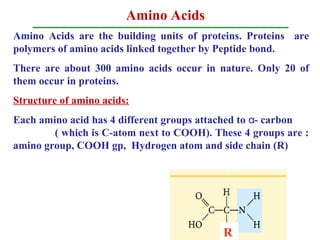
Each amino acid has 4 different groups attached to - carbonα
( which is C-atom next to COOH). These 4 groups are :
amino group, COOH gp, Hydrogen atom and side chain (R)
R
Classification of amino acids
I- Chemical classification: According to number of COOH and
NH2 groups i.e. according to net charge on amino acid.
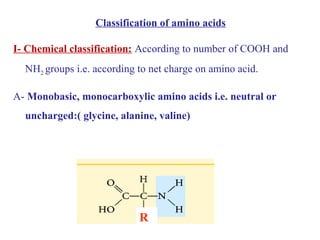
A- Monobasic, monocarboxylic amino acids i.e. neutral or
uncharged:( glycine, alanine, valine)
R
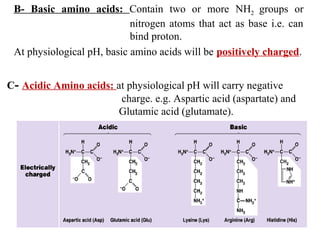
B- Basic amino acids: Contain two or more NH2 groups or
nitrogen atoms that act as base i.e. can
bind proton.
At physiological pH, basic amino acids will be positively charged.
C- Acidic Amino acids: at physiological pH will carry negative
charge. e.g. Aspartic acid (aspartate) and
Glutamic acid (glutamate).
II- Classification according to polarity of side chain (R):
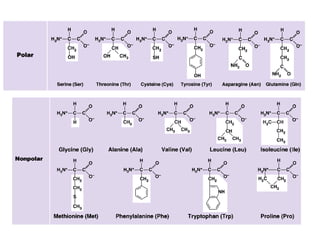
A- Polar amino acids: in which R contains polar hydrophilic group so
can forms hydrogen bond with H2O. In those amino acids, R may
contain:
1- OH group : as in serine, threonine and tyrosine
2- SH group : as in cysteine
3- amide group: as in glutamine and aspargine
4- NH2 group or nitrogen act as a base (basic amino acids ): as lysine,
arginine and histidine
5- COOH group ( acidic amino acids): as aspartic and glutamic .
B- Non polar amino acids:
R is alkyl hydrophobic group which can’t enter in hydrogen bond
formation.
9 amino acids are non polar ( glycine, alanine, valine, leucine,
isoleucine, phenyl alanine, tryptophan, proline and methionine)
III- Nutritional classification:
1- Essential amino acids: These amino acids can’t be formed in the
body and so, it is essential to be taken in diet. Their deficiency
affects growth, health and protein synthesis.
2- Semiessential amino acids: These are formed in the body but not
in sufficient amount for body requirements especially in children.
Summary of essential and semiessential amino acids:
V= valine i= isoleucine l= lysine l= leucine
A = arginine* H= histidine* M= methionine
T= tryptophan Th= threonine P= phenyl alanine
*= arginine and histidine are semiessential
3- Non essential amino acids: These are the rest of amino acids that
are formed in the body in amount enough for adults and children.
They are the remaining 10 amino acids.
IV- Metabolic classification: according to metabolic or degradation
products of amino acids they may be:
1- Ketogenic amino acids: which give ketone bodies . Lysine and
Leucine are the only pure ketogenic amino acids.
2- Mixed ketogenic and glucogenic amino acids: which give both
ketonbodies and glucose.These are: isoleucine, phenyl alanine, tyrosine
and tryptophan.
3- Glucogenic amino acids: Which give glucose. They include the rest
of amino acids. These amino acids by catabolism yields products that
enter in glycogen and glucose formation.
Properties of Amino Acid
• Physical properties:
• Solubility: most of the amino acids are soluble in water and insoluble in
inorganic solvent:
• Melting point: amino acids are generally melt at higher temperature , often
above 200°C
• Taste : amino acids may be sweet (Gly, Ala, Val), tasteless (Leu) or bitter (Arg,
ILe).
• Monosodium Glutamate is used as flavouring agent in food industry, chinese
foood to increase taste and flavour.
Zwitter ions or dipolar ion
• The name Zwitter derived from the German word which mean hybrid.
• Zwitter ion is a hybrid molecule containing positive and negative ionic
group.
• The amino acids rarely exists in a neutral form with free carboxylic
(-COOH ) and free amino (-NH2) groups.
• In strongly acidic pH the amino acid are positively charged,
• in strongly alkaline pH it is negatively charged.
• Each amino acid has a characteristics pH at which it carries both positive
and negative charge and Exist as Zwitterions.
Isoelectric pH
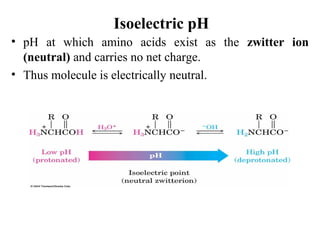
• pH at which amino acids exist as the zwitter ion
(neutral) and carries no net charge.
• Thus molecule is electrically neutral.
Chemical properties
• Reaction due to –COOH group
1. Amino acid form salts (-COONa) with base, and Ester (-COOR) with
alcohol.
2. Decarboxylation: Amino acid undergo deacarboxylation to produce
amines.
this reaction assumes significance in the living cell due to the formation of
many biologically important amine. These include histamine, tyramine,
γ-amino butyric acid from the amino acid histidine, tyrosine and glutamate
respectively.
3. Reaction with ammonia: the carboxyl group of dicarboxylic amino acid
reacts with NH3 to form amide.
Aspartic acid + NH3 Aspargine
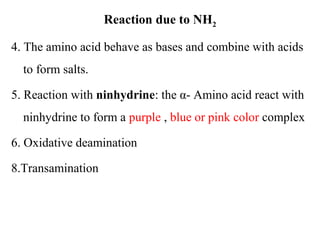
Reaction due to NH2
4. The amino acid behave as bases and combine with acids
to form salts.
5. Reaction with ninhydrine: the α- Amino acid react with
ninhydrine to form a purple , blue or pink color complex
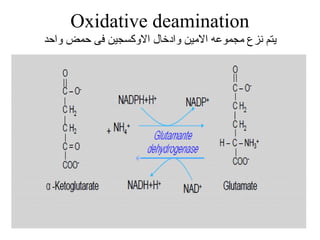
6. Oxidative deamination
8.Transamination
Oxidative deamination
‫واحد‬ ‫حمض‬ ‫فى‬ ‫الوكسجين‬ ‫وادخال‬ ‫اليمين‬ ‫يمجموعه‬ ‫نزع‬ ‫يتم‬
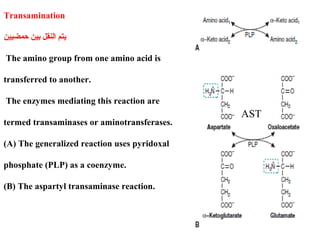
Transamination
‫حمضيين‬ ‫بين‬ ‫النقل‬ ‫يتم‬
The amino group from one amino acid is
transferred to another.
The enzymes mediating this reaction are
termed transaminases or aminotransferases.
(A) The generalized reaction uses pyridoxal
phosphate (PLP) as a coenzyme.
(B) The aspartyl transaminase reaction.
AST
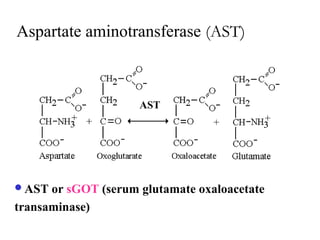
Aspartate aminotransferase (AST)
AST or sGOT (serum glutamate oxaloacetate
transaminase)
AST
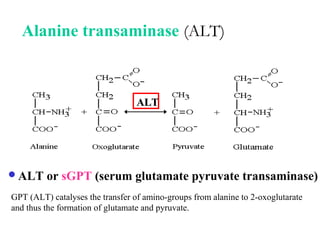
Alanine transaminase (ALT)
ALT or sGPT (serum glutamate pyruvate transaminase)
ALTALT
GPT (ALT) catalyses the transfer of amino-groups from alanine to 2-oxoglutarate
and thus the formation of glutamate and pyruvate.
Denaturation and Coagulation
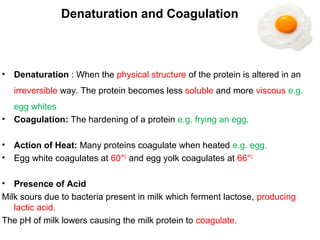
• Denaturation : When the physical structure of the protein is altered in an
irreversible way. The protein becomes less soluble and more viscous e.g.
egg whites
• Coagulation: The hardening of a protein e.g. frying an egg.
• Action of Heat: Many proteins coagulate when heated e.g. egg.
• Egg white coagulates at 60°C
and egg yolk coagulates at 66°C
• Presence of Acid
Milk sours due to bacteria present in milk which ferment lactose, producing
lactic acid.
The pH of milk lowers causing the milk protein to coagulate.
Peptides and Proteins
20 amino acids are commonly found in protein.
These 20 amino acids are linked together through “peptide bond
forming peptides and proteins (what’s the difference?).
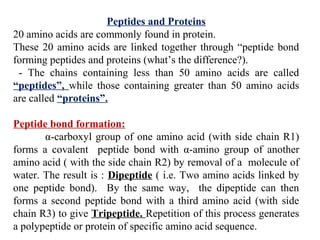
- The chains containing less than 50 amino acids are called
“peptides”, while those containing greater than 50 amino acids
are called “proteins”.
Peptide bond formation:
α-carboxyl group of one amino acid (with side chain R1)
forms a covalent peptide bond with α-amino group of another
amino acid ( with the side chain R2) by removal of a molecule of
water. The result is : Dipeptide ( i.e. Two amino acids linked by
one peptide bond). By the same way, the dipeptide can then
forms a second peptide bond with a third amino acid (with side
chain R3) to give Tripeptide. Repetition of this process generates
a polypeptide or protein of specific amino acid sequence.
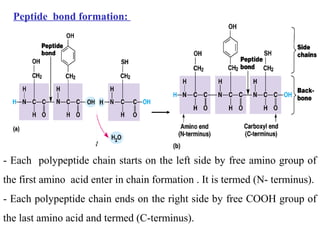
Peptide bond formation:
- Each polypeptide chain starts on the left side by free amino group of
the first amino acid enter in chain formation . It is termed (N- terminus).
- Each polypeptide chain ends on the right side by free COOH group of
the last amino acid and termed (C-terminus).
Examples on Peptides:
1- Dipeptide ( two amino acids joined by one peptide bond):
Example: Aspartame which acts as sweetening agent being used in
replacement of cane sugar. It is composed of aspartic acid and phenyl
alanine.
2- Tripeptides ( 3 amino acids linked by two peptide bonds).
Example: Glutathione (GSH) which is formed from 3 amino acids:
glutamic acid, cysteine and glycine. It helps in absorption of amino
acids, protects against hemolysis of RBC by breaking H2O2 which
causes cell damage.
3- octapeptides: (8 amino acids)
Examples: Two hormones; oxytocine and vasopressin (ADH).
4- polypeptides: 10- 50 amino acids: e.g. Insulin hormone
Protein structure:
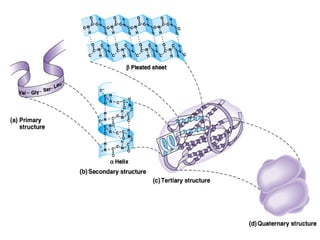
There are four levels of protein structure (primary,
secondary, tertiary and quaternary)
Primary structure:
• The primary structure of a protein is its unique
sequence of amino acids.
– Lysozyme, an enzyme that attacks bacteria, consists
of a polypeptide chain of 129 amino acids.
– The precise primary structure of a protein is
determined by inherited genetic information.
– At one end is an amino acid with a free amino
group the (the N-terminus) and at the other is an
amino acid with a free carboxyl group
(the C-terminus).
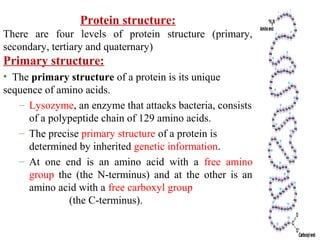
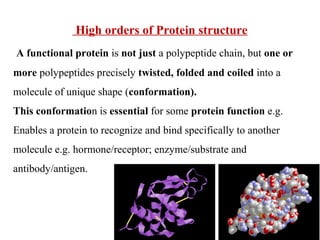
High orders of Protein structure
A functional protein is not just a polypeptide chain, but one or
more polypeptides precisely twisted, folded and coiled into a
molecule of unique shape (conformation).
This conformation is essential for some protein function e.g.
Enables a protein to recognize and bind specifically to another
molecule e.g. hormone/receptor; enzyme/substrate and
antibody/antigen.
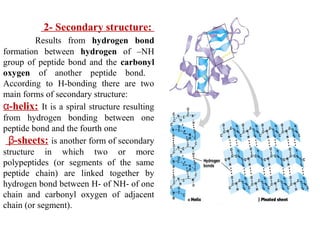
2- Secondary structure:
Results from hydrogen bond
formation between hydrogen of –NH
group of peptide bond and the carbonyl
oxygen of another peptide bond.
According to H-bonding there are two
main forms of secondary structure:
-helix:α It is a spiral structure resulting
from hydrogen bonding between one
peptide bond and the fourth one
-sheets:β is another form of secondary
structure in which two or more
polypeptides (or segments of the same
peptide chain) are linked together by
hydrogen bond between H- of NH- of one
chain and carbonyl oxygen of adjacent
chain (or segment).
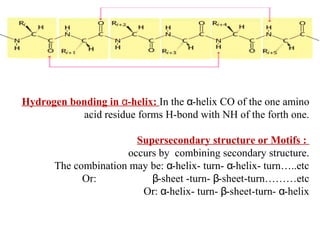
Hydrogen bonding in α-helix: In the α-helix CO of the one amino
acid residue forms H-bond with NH of the forth one.
Supersecondary structure or Motifs :
occurs by combining secondary structure.
The combination may be: -helix- turn- -helix- turn…..etcα α
Or: -sheet -turn- -sheet-turn………etcβ β
Or: -helix- turn- -sheet-turn- -helixα β α
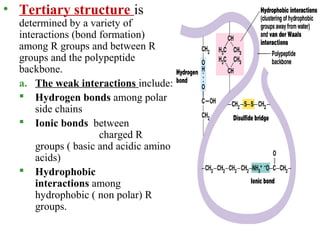
• Tertiary structure is
determined by a variety of
interactions (bond formation)
among R groups and between R
groups and the polypeptide
backbone.
a. The weak interactions include:
 Hydrogen bonds among polar
side chains
 Ionic bonds between
charged R
groups ( basic and acidic amino
acids)
 Hydrophobic
interactions among
hydrophobic ( non polar) R
groups.
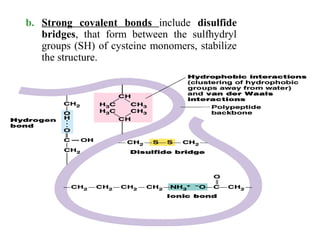
b. Strong covalent bonds include disulfide
bridges, that form between the sulfhydryl
groups (SH) of cysteine monomers, stabilize
the structure.
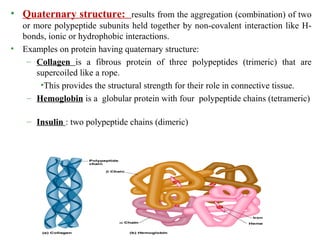
• Quaternary structure: results from the aggregation (combination) of two
or more polypeptide subunits held together by non-covalent interaction like H-
bonds, ionic or hydrophobic interactions.
• Examples on protein having quaternary structure:
– Collagen is a fibrous protein of three polypeptides (trimeric) that are
supercoiled like a rope.
•This provides the structural strength for their role in connective tissue.
– Hemoglobin is a globular protein with four polypeptide chains (tetrameric)
– Insulin : two polypeptide chains (dimeric)
Classification of proteins
I- Simple proteins:
i.e. on hydrolysis gives only amino acids
Examples:
1- Albumin and globulins: present in egg, milk and blood
They are proteins of high biological value i.e. contain all essential
amino acids and easily digested.
Types of globulins:
α1 globulin: e.g. antitrypsin:
α2 globulin: e.g. hepatoglobin: protein that binds hemoglobin to
prevent its excretion by the kidney
β-globulin: e.g. transferrin: protein that transport iron
γ-globulins = Immunoglobulins (antibodies) : responsible for
immunity.
Conjugated proteins
i.e. On hydrolysis, give protein part and non protein part and
subclassified into:
1- Phosphoproteins: These are proteins conjugated with phosphate
group. Phosphorus is attached to OH group of serine or threonine.
e.g. Casein of milk.
2- Lipoproteins: These are proteins conjugated with lipids.
Functions: a- help lipids to transport in blood
b- Enter in cell membrane structure helping lipid soluble.
substances to pass through cell membranes
3- Glycoproteins:
proteins conjugated with sugar (carbohydrate)
e.g. – Mucin
- Some hormones such as erythropoeitin
- present in cell membrane structure
- blood groups.
4- Nucleoproteins: These are basic proteins ( e.g. histones) conjugated
with nucleic acid (DNA or RNA).
e.g. a- chromosomes: are proteins conjugated with DNA
b- Ribosomes: are proteins conjugated with RNA
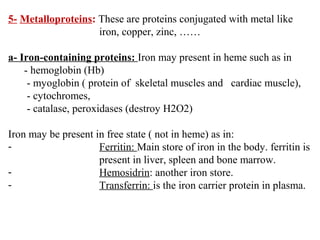
5- Metalloproteins: These are proteins conjugated with metal like
iron, copper, zinc, ……
a- Iron-containing proteins: Iron may present in heme such as in
- hemoglobin (Hb)
- myoglobin ( protein of skeletal muscles and cardiac muscle),
- cytochromes,
- catalase, peroxidases (destroy H2O2)
Iron may be present in free state ( not in heme) as in:
- Ferritin: Main store of iron in the body. ferritin is
present in liver, spleen and bone marrow.
- Hemosidrin: another iron store.
- Transferrin: is the iron carrier protein in plasma.
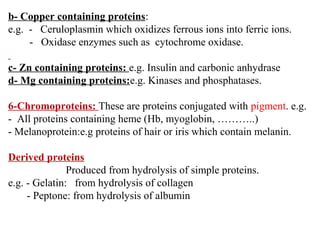
b- Copper containing proteins:
e.g. - Ceruloplasmin which oxidizes ferrous ions into ferric ions.
- Oxidase enzymes such as cytochrome oxidase.
c- Zn containing proteins: e.g. Insulin and carbonic anhydrase
d- Mg containing proteins:e.g. Kinases and phosphatases.
6-Chromoproteins: These are proteins conjugated with pigment. e.g.
- All proteins containing heme (Hb, myoglobin, ………..)
- Melanoprotein:e.g proteins of hair or iris which contain melanin.
Derived proteins
Produced from hydrolysis of simple proteins.
e.g. - Gelatin: from hydrolysis of collagen
- Peptone: from hydrolysis of albumin
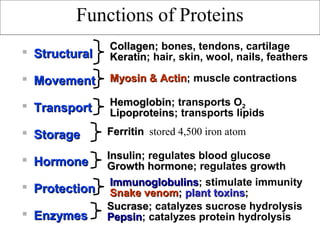
 StructuralStructural
 MovementMovement
 TransportTransport
 StorageStorage
 HormoneHormone
 ProtectionProtection
 EnzymesEnzymes
CollagenCollagen; bones, tendons, cartilage
KeratinKeratin; hair, skin, wool, nails, feathers
Myosin & ActinMyosin & Actin; muscle contractions
HemoglobinHemoglobin; transports O2
LipoproteinsLipoproteins; transports lipids
FerritinFerritin  stored 4,500 iron atom
InsulinInsulin; regulates blood glucose
Growth hormoneGrowth hormone; regulates growth
ImmunoglobulinsImmunoglobulins; stimulate immunity
Snake venomSnake venom;; plant toxinsplant toxins;
SucraseSucrase; catalyzes sucrose hydrolysis
PepsinPepsin; catalyzes protein hydrolysis
Functions of Proteins

03 amino acids and protein

  • 1.
    Amino Acids Amino Acidsare the building units of proteins. Proteins are polymers of amino acids linked together by Peptide bond. There are about 300 amino acids occur in nature. Only 20 of them occur in proteins. Structure of amino acids: Each amino acid has 4 different groups attached to - carbonα ( which is C-atom next to COOH). These 4 groups are : amino group, COOH gp, Hydrogen atom and side chain (R) R
  • 2.
    Classification of aminoacids I- Chemical classification: According to number of COOH and NH2 groups i.e. according to net charge on amino acid. A- Monobasic, monocarboxylic amino acids i.e. neutral or uncharged:( glycine, alanine, valine) R
  • 3.
    B- Basic aminoacids: Contain two or more NH2 groups or nitrogen atoms that act as base i.e. can bind proton. At physiological pH, basic amino acids will be positively charged. C- Acidic Amino acids: at physiological pH will carry negative charge. e.g. Aspartic acid (aspartate) and Glutamic acid (glutamate).
  • 4.
    II- Classification accordingto polarity of side chain (R): A- Polar amino acids: in which R contains polar hydrophilic group so can forms hydrogen bond with H2O. In those amino acids, R may contain: 1- OH group : as in serine, threonine and tyrosine 2- SH group : as in cysteine 3- amide group: as in glutamine and aspargine 4- NH2 group or nitrogen act as a base (basic amino acids ): as lysine, arginine and histidine 5- COOH group ( acidic amino acids): as aspartic and glutamic . B- Non polar amino acids: R is alkyl hydrophobic group which can’t enter in hydrogen bond formation. 9 amino acids are non polar ( glycine, alanine, valine, leucine, isoleucine, phenyl alanine, tryptophan, proline and methionine)
  • 6.
    III- Nutritional classification: 1-Essential amino acids: These amino acids can’t be formed in the body and so, it is essential to be taken in diet. Their deficiency affects growth, health and protein synthesis. 2- Semiessential amino acids: These are formed in the body but not in sufficient amount for body requirements especially in children. Summary of essential and semiessential amino acids: V= valine i= isoleucine l= lysine l= leucine A = arginine* H= histidine* M= methionine T= tryptophan Th= threonine P= phenyl alanine *= arginine and histidine are semiessential 3- Non essential amino acids: These are the rest of amino acids that are formed in the body in amount enough for adults and children. They are the remaining 10 amino acids.
  • 7.
    IV- Metabolic classification:according to metabolic or degradation products of amino acids they may be: 1- Ketogenic amino acids: which give ketone bodies . Lysine and Leucine are the only pure ketogenic amino acids. 2- Mixed ketogenic and glucogenic amino acids: which give both ketonbodies and glucose.These are: isoleucine, phenyl alanine, tyrosine and tryptophan. 3- Glucogenic amino acids: Which give glucose. They include the rest of amino acids. These amino acids by catabolism yields products that enter in glycogen and glucose formation.
  • 8.
    Properties of AminoAcid • Physical properties: • Solubility: most of the amino acids are soluble in water and insoluble in inorganic solvent: • Melting point: amino acids are generally melt at higher temperature , often above 200°C • Taste : amino acids may be sweet (Gly, Ala, Val), tasteless (Leu) or bitter (Arg, ILe). • Monosodium Glutamate is used as flavouring agent in food industry, chinese foood to increase taste and flavour.
  • 9.
    Zwitter ions ordipolar ion • The name Zwitter derived from the German word which mean hybrid. • Zwitter ion is a hybrid molecule containing positive and negative ionic group. • The amino acids rarely exists in a neutral form with free carboxylic (-COOH ) and free amino (-NH2) groups. • In strongly acidic pH the amino acid are positively charged, • in strongly alkaline pH it is negatively charged. • Each amino acid has a characteristics pH at which it carries both positive and negative charge and Exist as Zwitterions.
  • 10.
    Isoelectric pH • pHat which amino acids exist as the zwitter ion (neutral) and carries no net charge. • Thus molecule is electrically neutral.
  • 11.
    Chemical properties • Reactiondue to –COOH group 1. Amino acid form salts (-COONa) with base, and Ester (-COOR) with alcohol. 2. Decarboxylation: Amino acid undergo deacarboxylation to produce amines. this reaction assumes significance in the living cell due to the formation of many biologically important amine. These include histamine, tyramine, γ-amino butyric acid from the amino acid histidine, tyrosine and glutamate respectively. 3. Reaction with ammonia: the carboxyl group of dicarboxylic amino acid reacts with NH3 to form amide. Aspartic acid + NH3 Aspargine
  • 12.
    Reaction due toNH2 4. The amino acid behave as bases and combine with acids to form salts. 5. Reaction with ninhydrine: the α- Amino acid react with ninhydrine to form a purple , blue or pink color complex 6. Oxidative deamination 8.Transamination
  • 13.
    Oxidative deamination ‫واحد‬ ‫حمض‬‫فى‬ ‫الوكسجين‬ ‫وادخال‬ ‫اليمين‬ ‫يمجموعه‬ ‫نزع‬ ‫يتم‬
  • 14.
    Transamination ‫حمضيين‬ ‫بين‬ ‫النقل‬‫يتم‬ The amino group from one amino acid is transferred to another. The enzymes mediating this reaction are termed transaminases or aminotransferases. (A) The generalized reaction uses pyridoxal phosphate (PLP) as a coenzyme. (B) The aspartyl transaminase reaction. AST
  • 15.
    Aspartate aminotransferase (AST) ASTor sGOT (serum glutamate oxaloacetate transaminase) AST
  • 16.
    Alanine transaminase (ALT) ALTor sGPT (serum glutamate pyruvate transaminase) ALTALT GPT (ALT) catalyses the transfer of amino-groups from alanine to 2-oxoglutarate and thus the formation of glutamate and pyruvate.
  • 17.
    Denaturation and Coagulation •Denaturation : When the physical structure of the protein is altered in an irreversible way. The protein becomes less soluble and more viscous e.g. egg whites • Coagulation: The hardening of a protein e.g. frying an egg. • Action of Heat: Many proteins coagulate when heated e.g. egg. • Egg white coagulates at 60°C and egg yolk coagulates at 66°C • Presence of Acid Milk sours due to bacteria present in milk which ferment lactose, producing lactic acid. The pH of milk lowers causing the milk protein to coagulate.
  • 18.
    Peptides and Proteins 20amino acids are commonly found in protein. These 20 amino acids are linked together through “peptide bond forming peptides and proteins (what’s the difference?). - The chains containing less than 50 amino acids are called “peptides”, while those containing greater than 50 amino acids are called “proteins”. Peptide bond formation: α-carboxyl group of one amino acid (with side chain R1) forms a covalent peptide bond with α-amino group of another amino acid ( with the side chain R2) by removal of a molecule of water. The result is : Dipeptide ( i.e. Two amino acids linked by one peptide bond). By the same way, the dipeptide can then forms a second peptide bond with a third amino acid (with side chain R3) to give Tripeptide. Repetition of this process generates a polypeptide or protein of specific amino acid sequence.
  • 19.
    Peptide bond formation: -Each polypeptide chain starts on the left side by free amino group of the first amino acid enter in chain formation . It is termed (N- terminus). - Each polypeptide chain ends on the right side by free COOH group of the last amino acid and termed (C-terminus).
  • 20.
    Examples on Peptides: 1-Dipeptide ( two amino acids joined by one peptide bond): Example: Aspartame which acts as sweetening agent being used in replacement of cane sugar. It is composed of aspartic acid and phenyl alanine. 2- Tripeptides ( 3 amino acids linked by two peptide bonds). Example: Glutathione (GSH) which is formed from 3 amino acids: glutamic acid, cysteine and glycine. It helps in absorption of amino acids, protects against hemolysis of RBC by breaking H2O2 which causes cell damage. 3- octapeptides: (8 amino acids) Examples: Two hormones; oxytocine and vasopressin (ADH). 4- polypeptides: 10- 50 amino acids: e.g. Insulin hormone
  • 21.
    Protein structure: There arefour levels of protein structure (primary, secondary, tertiary and quaternary) Primary structure: • The primary structure of a protein is its unique sequence of amino acids. – Lysozyme, an enzyme that attacks bacteria, consists of a polypeptide chain of 129 amino acids. – The precise primary structure of a protein is determined by inherited genetic information. – At one end is an amino acid with a free amino group the (the N-terminus) and at the other is an amino acid with a free carboxyl group (the C-terminus).
  • 22.
    High orders ofProtein structure A functional protein is not just a polypeptide chain, but one or more polypeptides precisely twisted, folded and coiled into a molecule of unique shape (conformation). This conformation is essential for some protein function e.g. Enables a protein to recognize and bind specifically to another molecule e.g. hormone/receptor; enzyme/substrate and antibody/antigen.
  • 23.
    2- Secondary structure: Resultsfrom hydrogen bond formation between hydrogen of –NH group of peptide bond and the carbonyl oxygen of another peptide bond. According to H-bonding there are two main forms of secondary structure: -helix:α It is a spiral structure resulting from hydrogen bonding between one peptide bond and the fourth one -sheets:β is another form of secondary structure in which two or more polypeptides (or segments of the same peptide chain) are linked together by hydrogen bond between H- of NH- of one chain and carbonyl oxygen of adjacent chain (or segment).
  • 24.
    Hydrogen bonding inα-helix: In the α-helix CO of the one amino acid residue forms H-bond with NH of the forth one. Supersecondary structure or Motifs : occurs by combining secondary structure. The combination may be: -helix- turn- -helix- turn…..etcα α Or: -sheet -turn- -sheet-turn………etcβ β Or: -helix- turn- -sheet-turn- -helixα β α
  • 25.
    • Tertiary structureis determined by a variety of interactions (bond formation) among R groups and between R groups and the polypeptide backbone. a. The weak interactions include:  Hydrogen bonds among polar side chains  Ionic bonds between charged R groups ( basic and acidic amino acids)  Hydrophobic interactions among hydrophobic ( non polar) R groups.
  • 26.
    b. Strong covalentbonds include disulfide bridges, that form between the sulfhydryl groups (SH) of cysteine monomers, stabilize the structure.
  • 27.
    • Quaternary structure:results from the aggregation (combination) of two or more polypeptide subunits held together by non-covalent interaction like H- bonds, ionic or hydrophobic interactions. • Examples on protein having quaternary structure: – Collagen is a fibrous protein of three polypeptides (trimeric) that are supercoiled like a rope. •This provides the structural strength for their role in connective tissue. – Hemoglobin is a globular protein with four polypeptide chains (tetrameric) – Insulin : two polypeptide chains (dimeric)
  • 29.
    Classification of proteins I-Simple proteins: i.e. on hydrolysis gives only amino acids Examples: 1- Albumin and globulins: present in egg, milk and blood They are proteins of high biological value i.e. contain all essential amino acids and easily digested. Types of globulins: α1 globulin: e.g. antitrypsin: α2 globulin: e.g. hepatoglobin: protein that binds hemoglobin to prevent its excretion by the kidney β-globulin: e.g. transferrin: protein that transport iron γ-globulins = Immunoglobulins (antibodies) : responsible for immunity.
  • 30.
    Conjugated proteins i.e. Onhydrolysis, give protein part and non protein part and subclassified into: 1- Phosphoproteins: These are proteins conjugated with phosphate group. Phosphorus is attached to OH group of serine or threonine. e.g. Casein of milk. 2- Lipoproteins: These are proteins conjugated with lipids. Functions: a- help lipids to transport in blood b- Enter in cell membrane structure helping lipid soluble. substances to pass through cell membranes
  • 31.
    3- Glycoproteins: proteins conjugatedwith sugar (carbohydrate) e.g. – Mucin - Some hormones such as erythropoeitin - present in cell membrane structure - blood groups. 4- Nucleoproteins: These are basic proteins ( e.g. histones) conjugated with nucleic acid (DNA or RNA). e.g. a- chromosomes: are proteins conjugated with DNA b- Ribosomes: are proteins conjugated with RNA
  • 32.
    5- Metalloproteins: Theseare proteins conjugated with metal like iron, copper, zinc, …… a- Iron-containing proteins: Iron may present in heme such as in - hemoglobin (Hb) - myoglobin ( protein of skeletal muscles and cardiac muscle), - cytochromes, - catalase, peroxidases (destroy H2O2) Iron may be present in free state ( not in heme) as in: - Ferritin: Main store of iron in the body. ferritin is present in liver, spleen and bone marrow. - Hemosidrin: another iron store. - Transferrin: is the iron carrier protein in plasma.
  • 33.
    b- Copper containingproteins: e.g. - Ceruloplasmin which oxidizes ferrous ions into ferric ions. - Oxidase enzymes such as cytochrome oxidase. c- Zn containing proteins: e.g. Insulin and carbonic anhydrase d- Mg containing proteins:e.g. Kinases and phosphatases. 6-Chromoproteins: These are proteins conjugated with pigment. e.g. - All proteins containing heme (Hb, myoglobin, ………..) - Melanoprotein:e.g proteins of hair or iris which contain melanin. Derived proteins Produced from hydrolysis of simple proteins. e.g. - Gelatin: from hydrolysis of collagen - Peptone: from hydrolysis of albumin
  • 34.
     StructuralStructural  MovementMovement TransportTransport  StorageStorage  HormoneHormone  ProtectionProtection  EnzymesEnzymes CollagenCollagen; bones, tendons, cartilage KeratinKeratin; hair, skin, wool, nails, feathers Myosin & ActinMyosin & Actin; muscle contractions HemoglobinHemoglobin; transports O2 LipoproteinsLipoproteins; transports lipids FerritinFerritin  stored 4,500 iron atom InsulinInsulin; regulates blood glucose Growth hormoneGrowth hormone; regulates growth ImmunoglobulinsImmunoglobulins; stimulate immunity Snake venomSnake venom;; plant toxinsplant toxins; SucraseSucrase; catalyzes sucrose hydrolysis PepsinPepsin; catalyzes protein hydrolysis Functions of Proteins