Chapter # 21
XII FDC Prepared by: Sidra Javed
PROTEINSPrepared by: Sidra Javed
PROTEINS
• The Molecules which yields amino acids upon
hydrolysis are called proteins.
• Proteins are natural polymer of amino acids.
• The number of amino acids in a protein
molecule may range from two to several
thousands.
• Protein molecules contain Nitrogen, Carbon,
Hydrogen and Oxygen.
Prepared by: Sidra Javed
PROTEINS
• Proteins are the basis for the major structural
components of animal and human tissue.
• They act as biological catalysts (Enzymes),
form structural parts of organisms, participate
in different cell reactions, act as molecules of
immunity and also provide fuel.
Prepared by: Sidra Javed
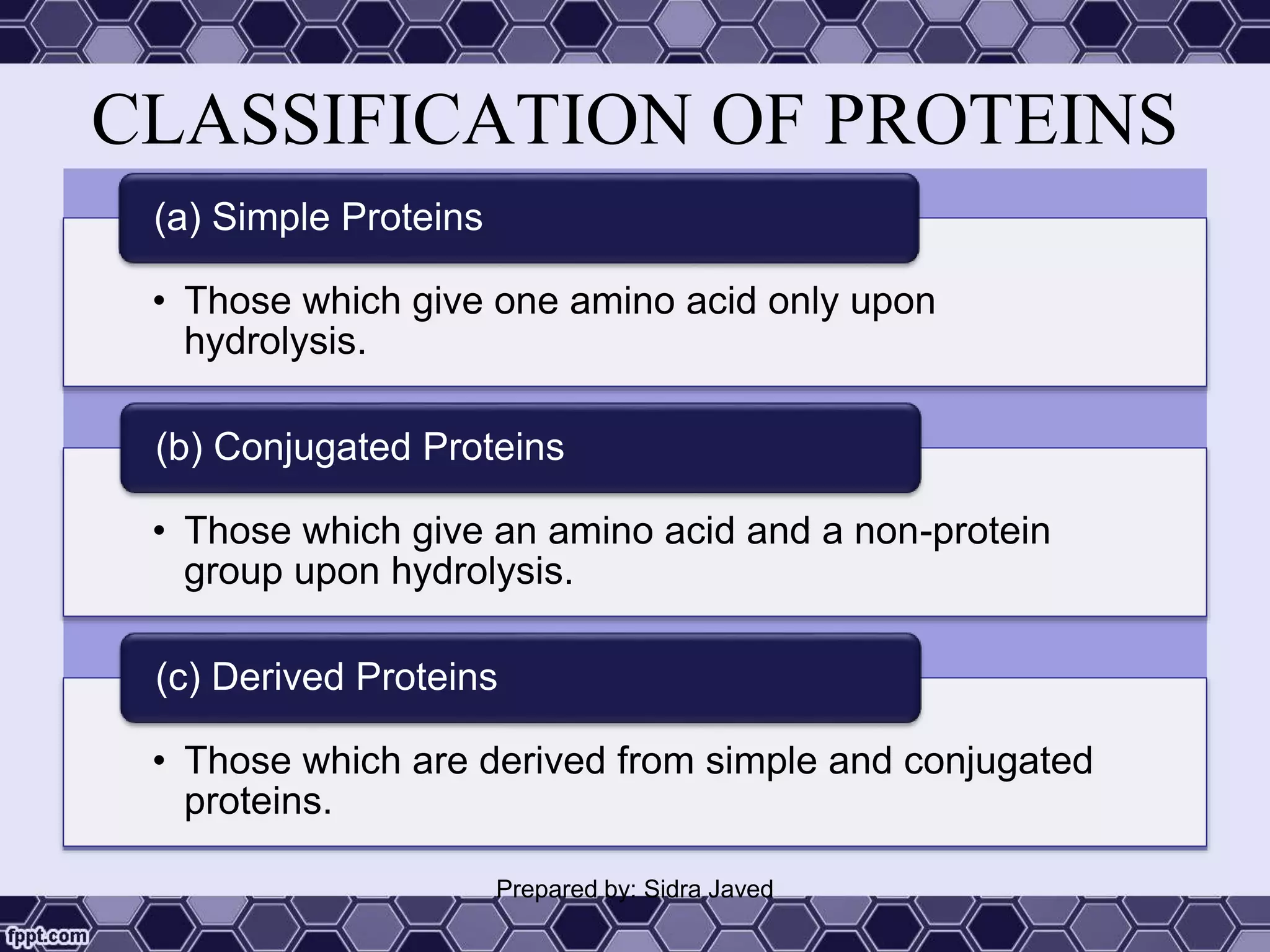
CLASSIFICATION OF PROTEINS
• Those which give one amino acid only upon
hydrolysis.
(a) Simple Proteins
• Those which give an amino acid and a non-protein
group upon hydrolysis.
(b) Conjugated Proteins
• Those which are derived from simple and conjugated
proteins.
(c) Derived Proteins
Prepared by: Sidra Javed
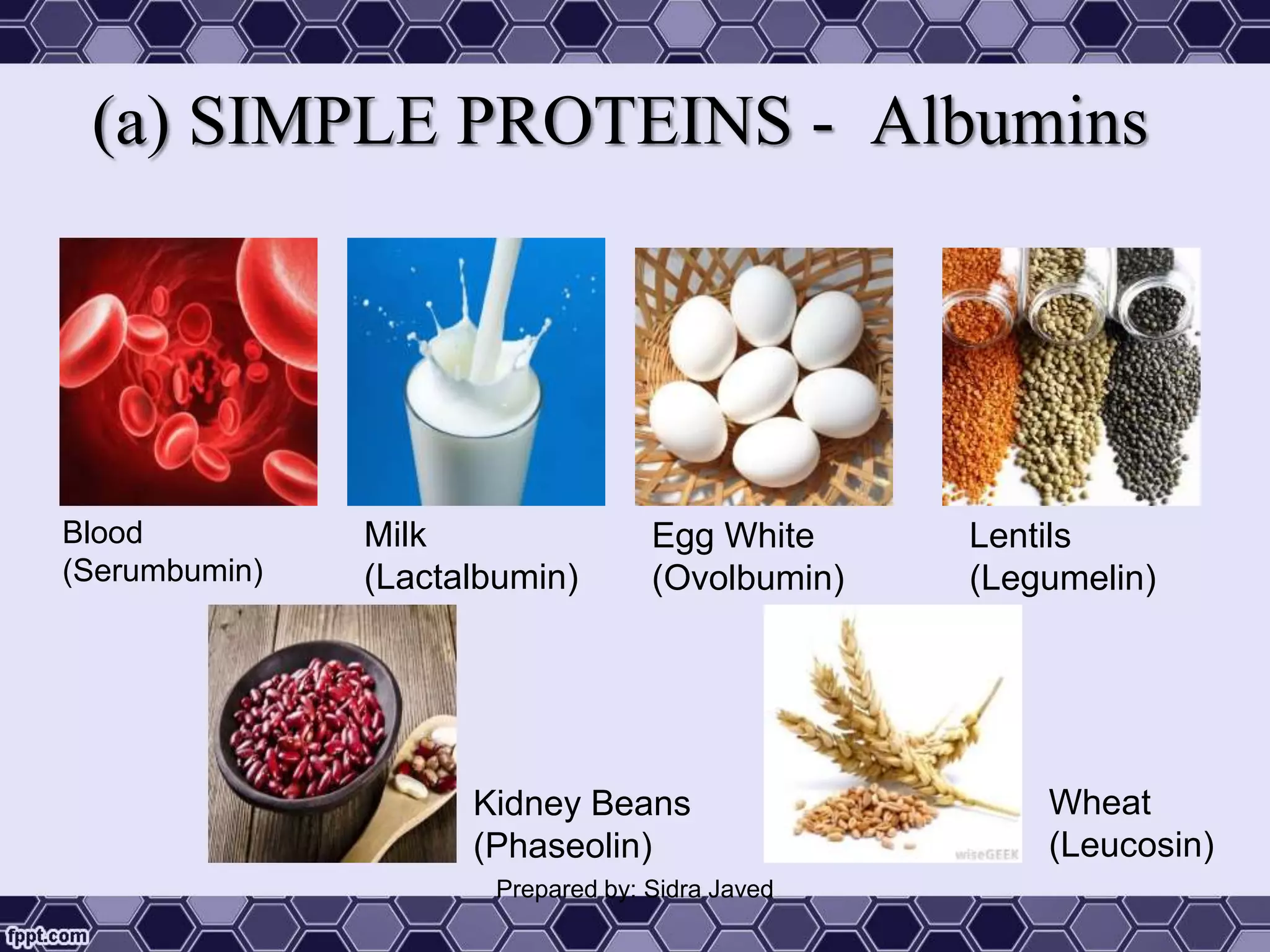
(a) SIMPLE PROTEINS - Albumins
Blood
(Serumbumin)
Milk
(Lactalbumin)
Egg White
(Ovolbumin)
Lentils
(Legumelin)
Kidney Beans
(Phaseolin)
Wheat
(Leucosin)
Prepared by: Sidra Javed
• Globular protein is insoluble in water and
dilute salt solution.
• Precipitated by saturation with (NH4)2SO4
solution.
• Coagulated by heat.
• Found in plant and animal tissue.
(a) Simple Proteins - Albumins
Prepared by: Sidra Javed
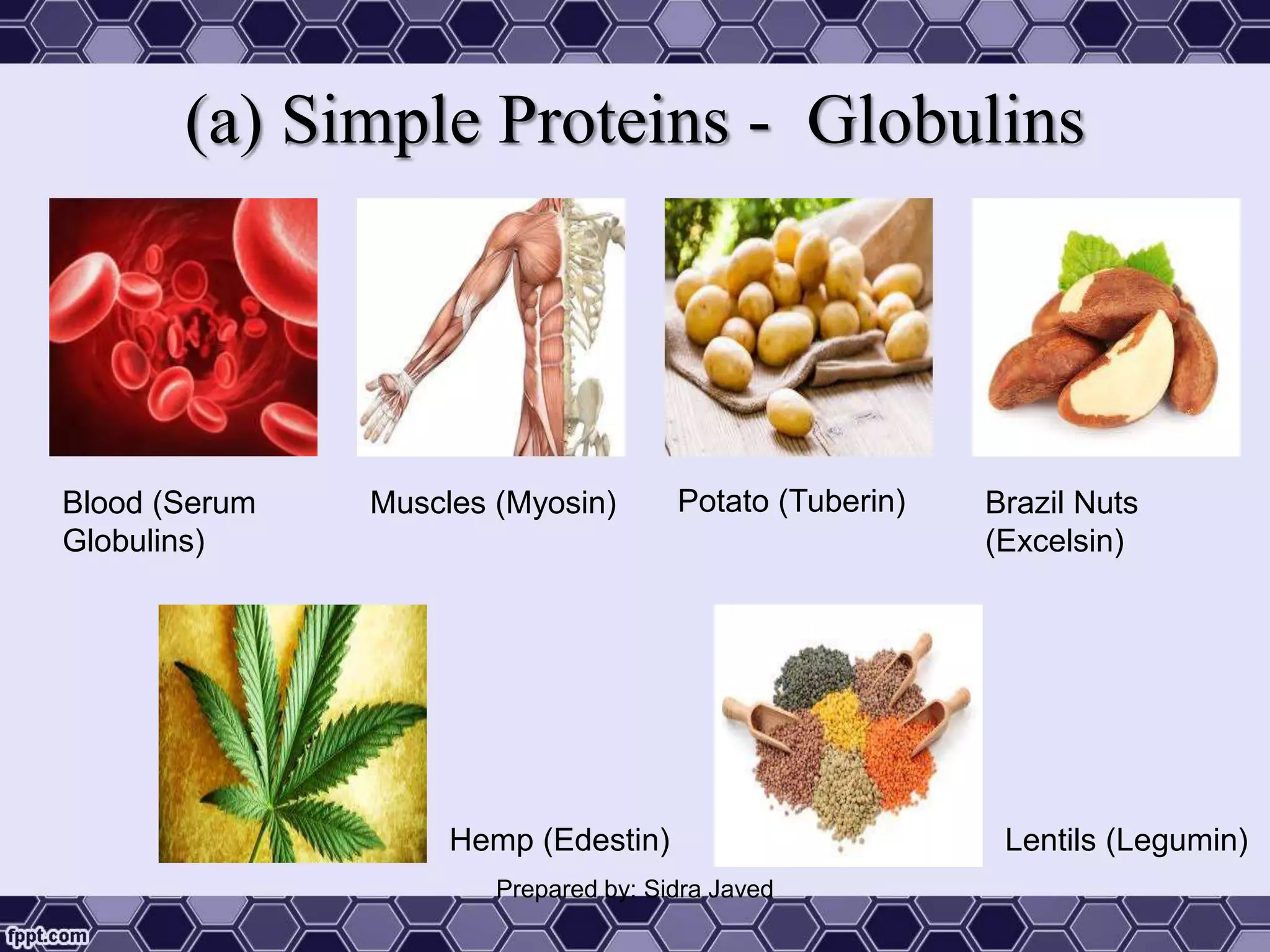
(a) Simple Proteins - Globulins
Blood (Serum
Globulins)
Muscles (Myosin) Potato (Tuberin) Brazil Nuts
(Excelsin)
Hemp (Edestin) Lentils (Legumin)
Prepared by: Sidra Javed
• Globular Protein is sparingly soluble in
water and neutral solutions.
• Precipitated by dilute Ammonium
Sulphate.
• Coagulated by Heat.
• Distributed in both plant and animal
tissues.
(a) Simple Proteins - Globulins
Prepared by: Sidra Javed
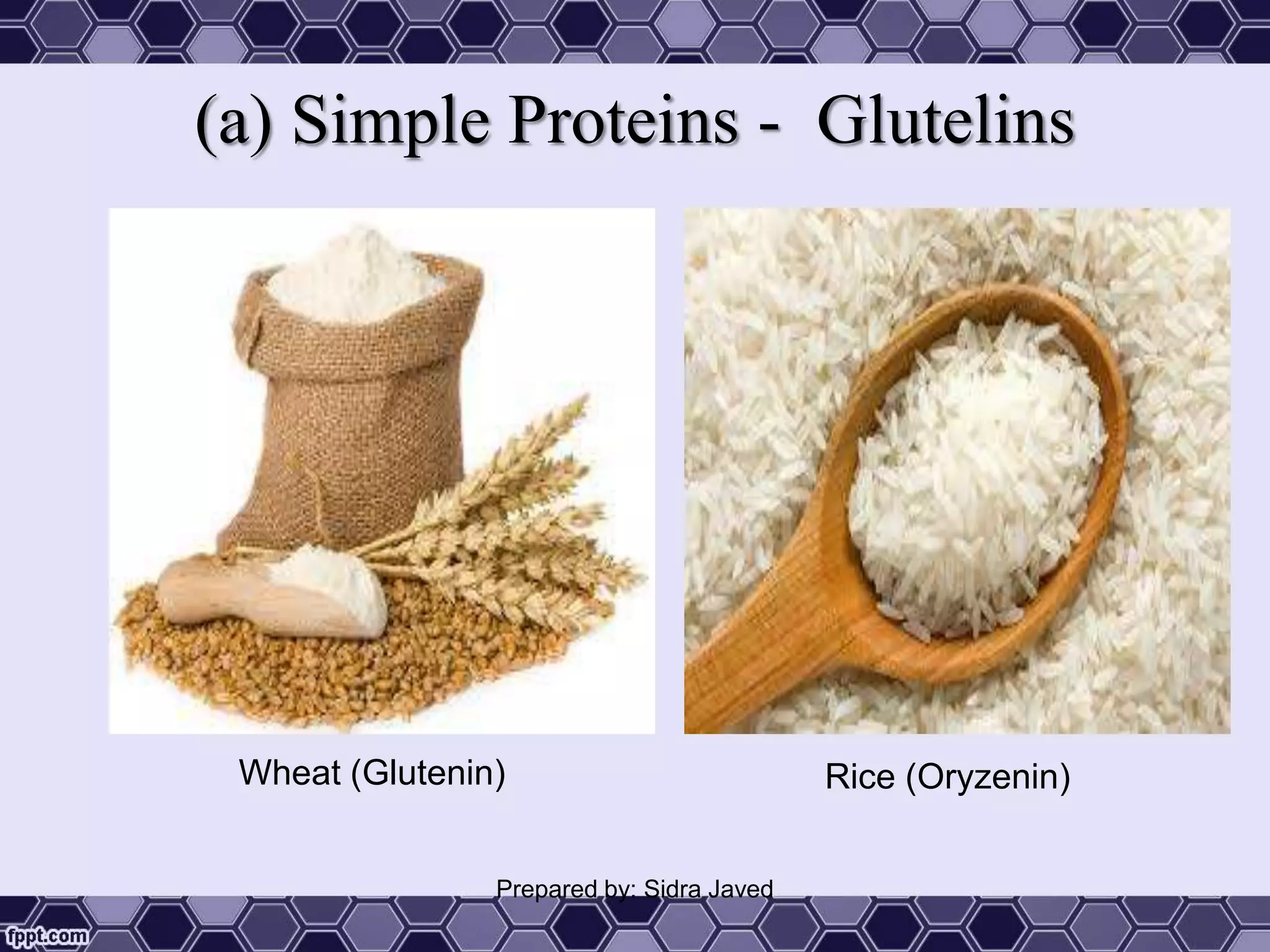
(a) Simple Proteins - Glutelins
Wheat (Glutenin) Rice (Oryzenin)
Prepared by: Sidra Javed
• Insoluble in water and dilute salt solutions.
• Soluble in dilute acids.
• Found in grains & cereals.
(a) Simple Proteins - Glutelins
Prepared by: Sidra Javed
• Thymus Gland, Pancrease and
Nucleoproteins (Nucleohistones).
• Soluble in water, salt solutions & dilute
acids.
• Insoluble in Ammonium Hydroxide.
• Yeilds large amount of Lysine & arginine.
• Combined with nucleic acids within cells.
(a) Simple Proteins - Histones
Prepared by: Sidra Javed
• Thymus Gland, Pancrease and
Nucleoproteins (Nucleohistones).
• Soluble in water, salt solutions & dilute
acids.
• Insoluble in Ammonium Hydroxide.
• Yeilds large amount of Lysine & arginine.
• Combined with nucleic acids within cells.
(a) Simple Proteins - Histones
Prepared by: Sidra Javed
• Connective tissues and hard tissues.
• Fibrous protein is insoluble in all solvents.
• Resistant to digestion.
(a) Simple Proteins - Scleroproteins
Prepared by: Sidra Javed
(a) Conjugated Proteins - Nucleoproteins
Cytoplasm of Cells
(Ribonucleoprotein)
Nucleus of Chromosomes &
Ribosomes
(Deoxyribonucleoprotein)
Viruses &
Bacteriophage
Prepared by: Sidra Javed
• It contains nucleic acids, nitrogen and
phosphorus.
• It is present in chromosomes and in all
living forms as a combination of protein
with either DNA or RNA.
(a) Conjugated Proteins - Nucleoproteins
Prepared by: Sidra Javed
(b) Conjugated Proteins - Mucoprotein
• Saliva (Mucin) and Egg white
(Ovomucoid).
• Proteins combined with amino sugars,
sugar acids and sulfates.
Prepared by: Sidra Javed
(b) Conjugated Proteins - Glycoproteins
• Bones (Osseomucoid), Tendons
(Tendomucoid) and Cartilage
(Chondromucoid).
• Containing more than 4% Hexosamine,
mucoproteins; if less than 4%, then
Glycoproteins.
Prepared by: Sidra Javed
(b) Conjugated Proteins – Phosphoproteins
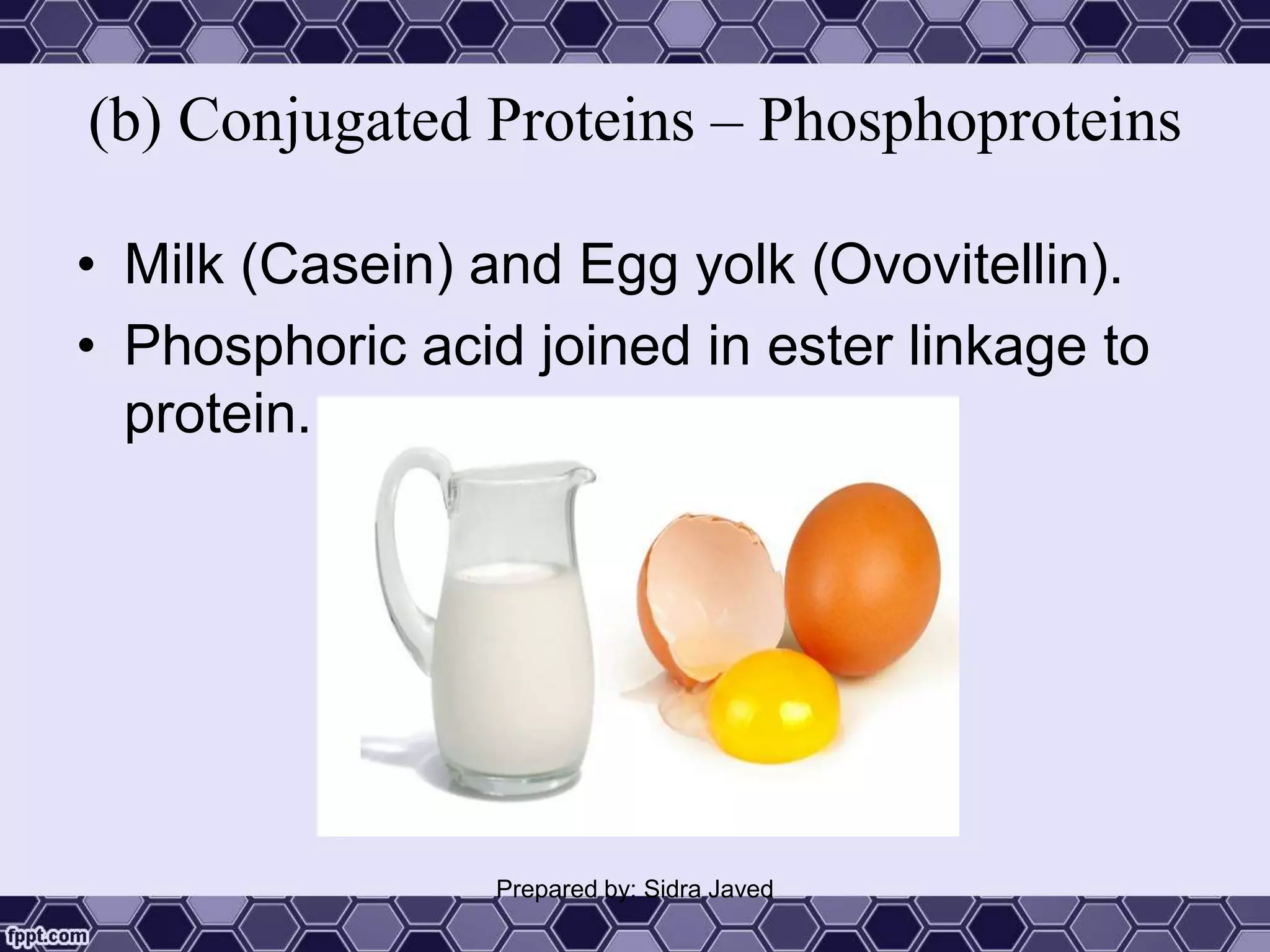
• Milk (Casein) and Egg yolk (Ovovitellin).
• Phosphoric acid joined in ester linkage to
protein.
Prepared by: Sidra Javed
(c) Derived Proteins - Proteans
• Edestan ( from Elastin) and Myosin
(Myosin).
• It results from short action of acids or
enzymes
• Insoluble in water.
Prepared by: Sidra Javed
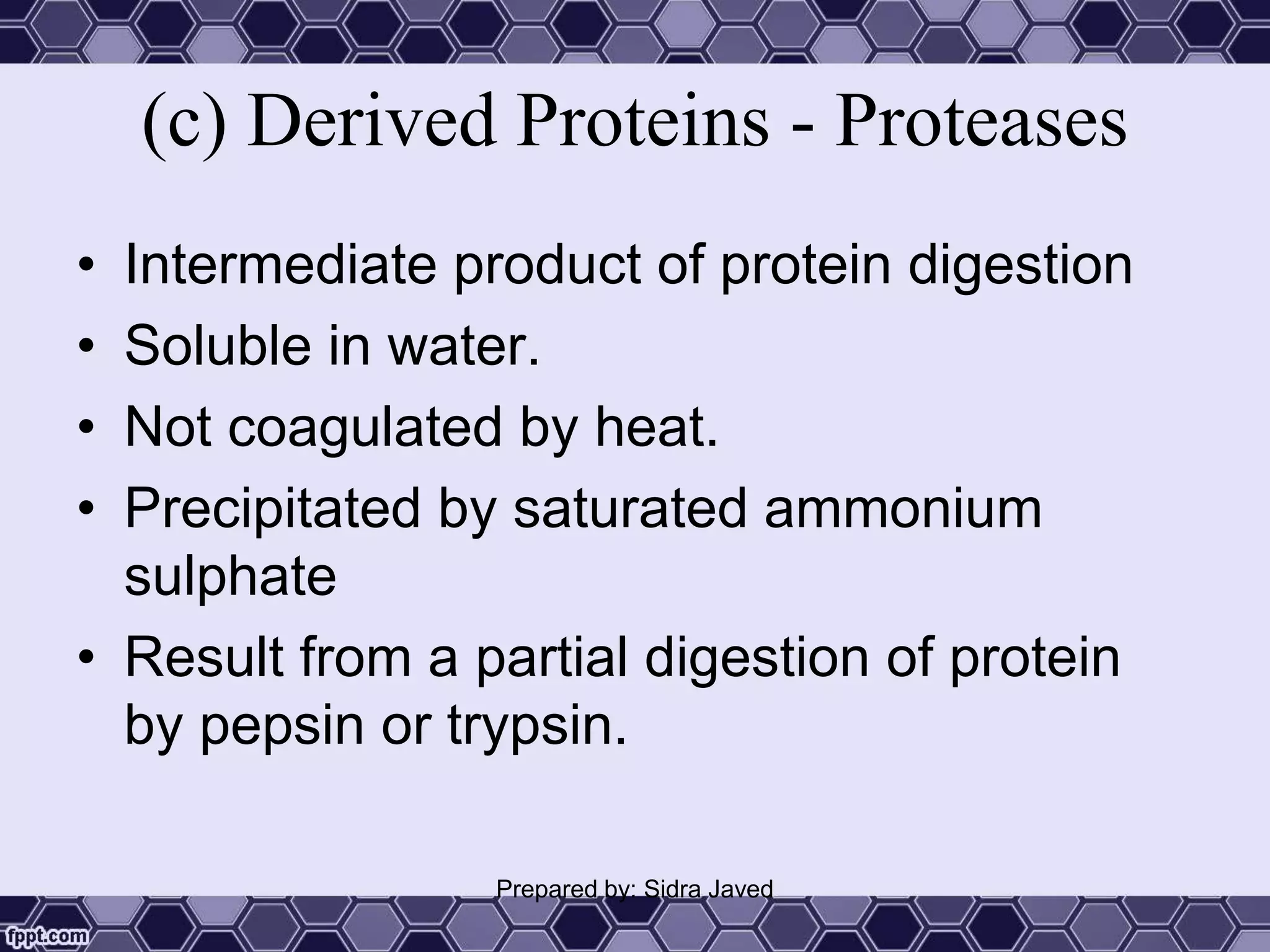
(c) Derived Proteins - Proteases
• Intermediate product of protein digestion
• Soluble in water.
• Not coagulated by heat.
• Precipitated by saturated ammonium
sulphate
• Result from a partial digestion of protein
by pepsin or trypsin.
Prepared by: Sidra Javed
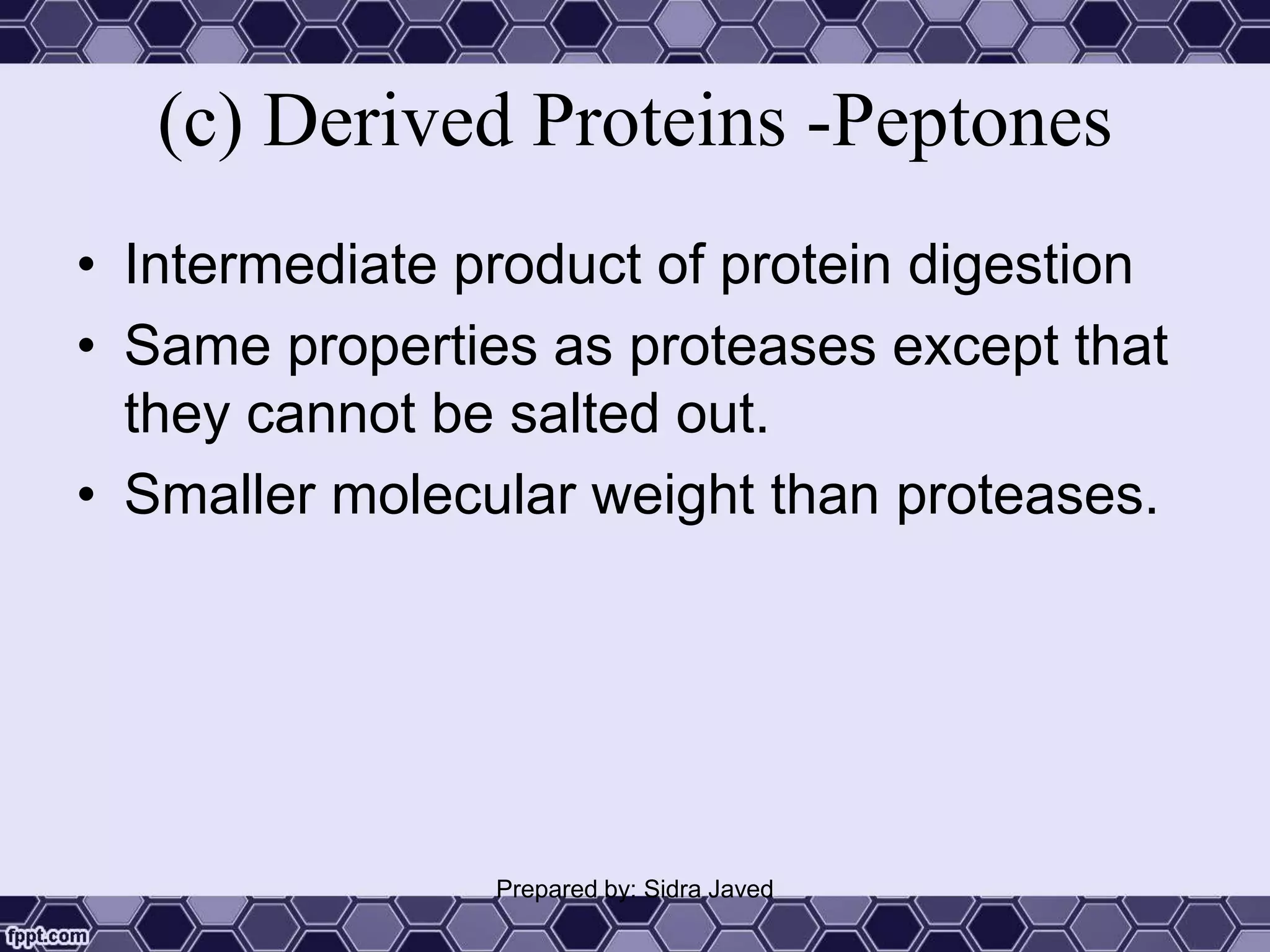
(c) Derived Proteins -Peptones
• Intermediate product of protein digestion
• Same properties as proteases except that
they cannot be salted out.
• Smaller molecular weight than proteases.
Prepared by: Sidra Javed
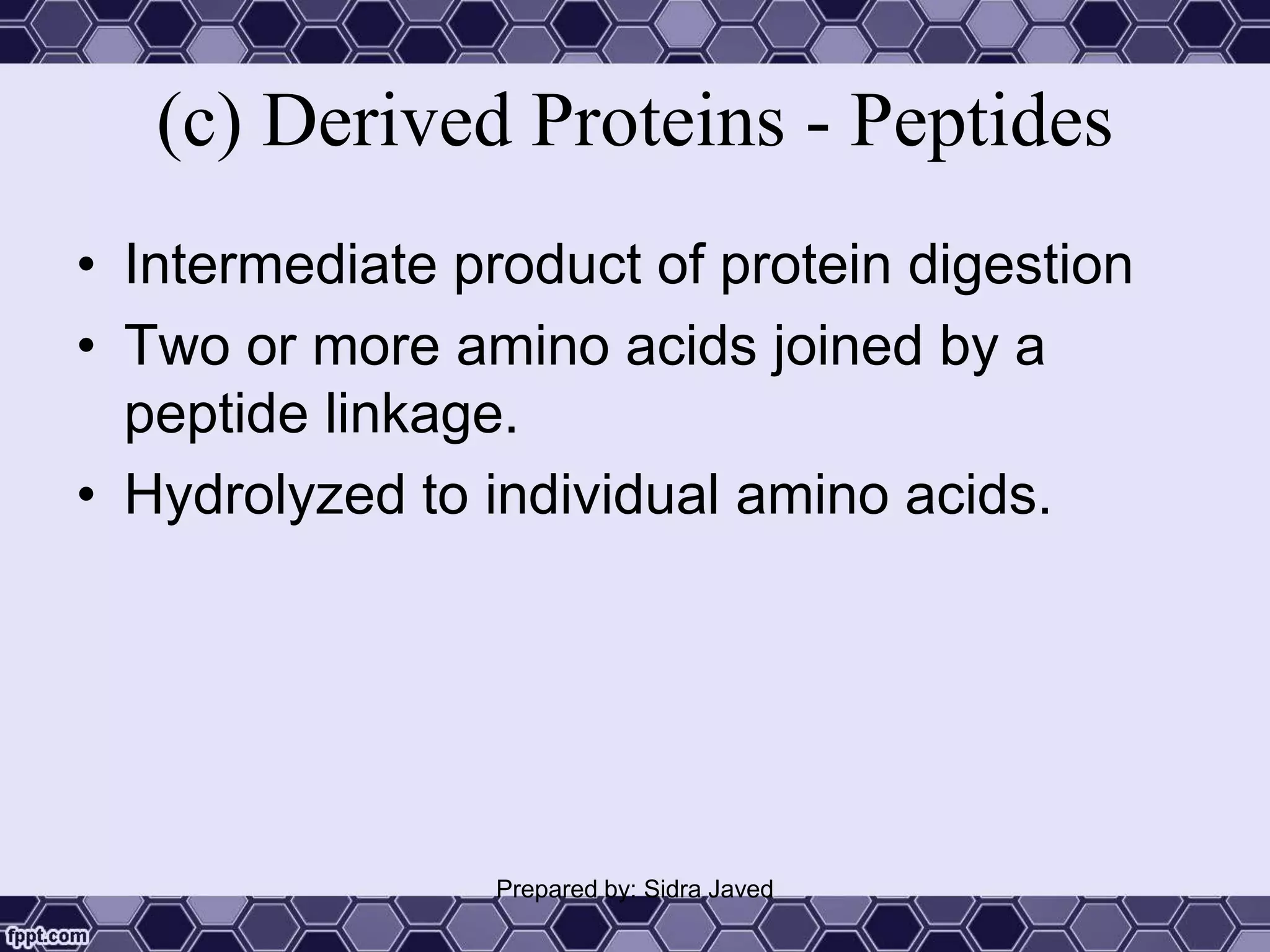
(c) Derived Proteins - Peptides
• Intermediate product of protein digestion
• Two or more amino acids joined by a
peptide linkage.
• Hydrolyzed to individual amino acids.
Prepared by: Sidra Javed
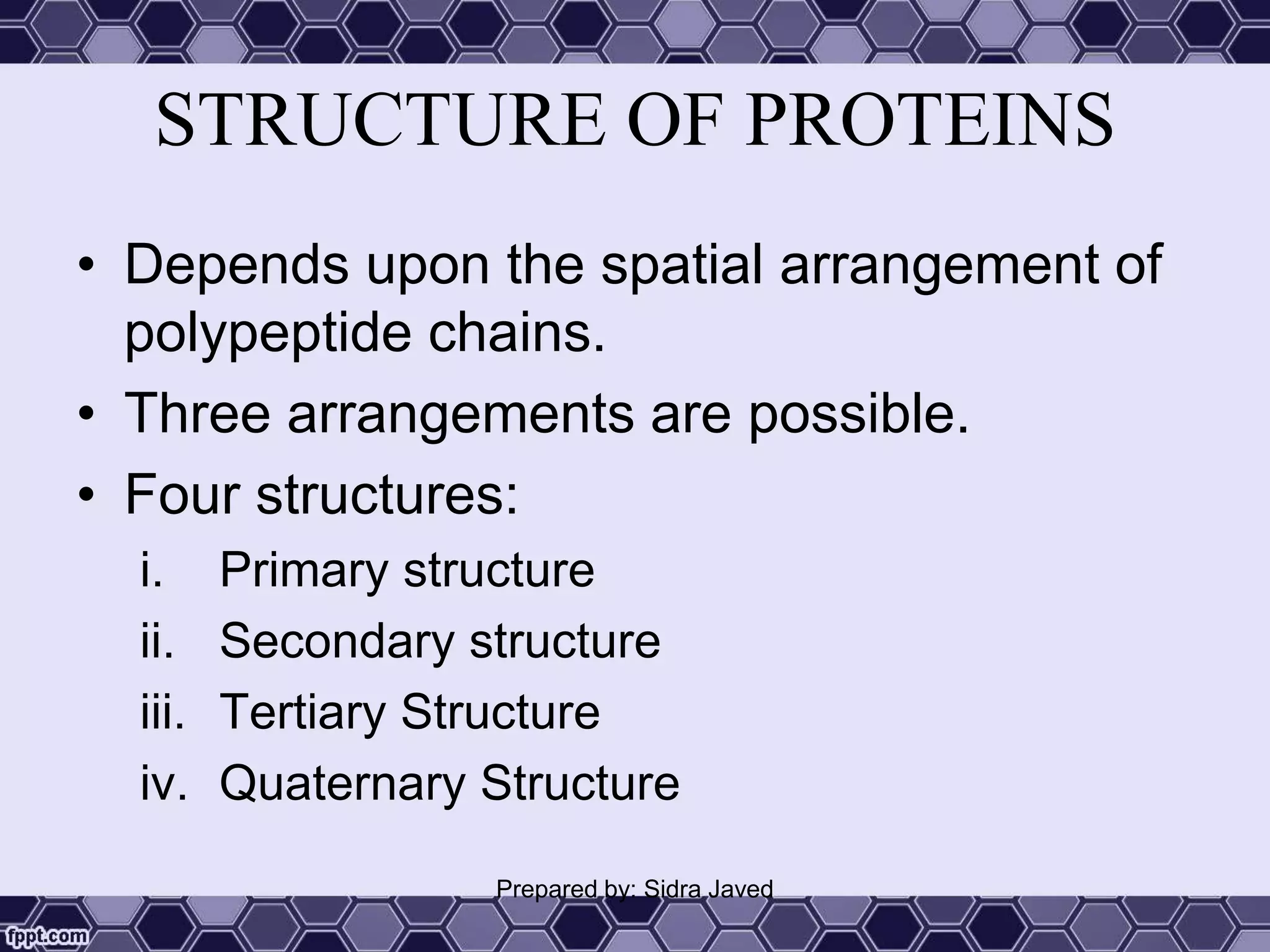
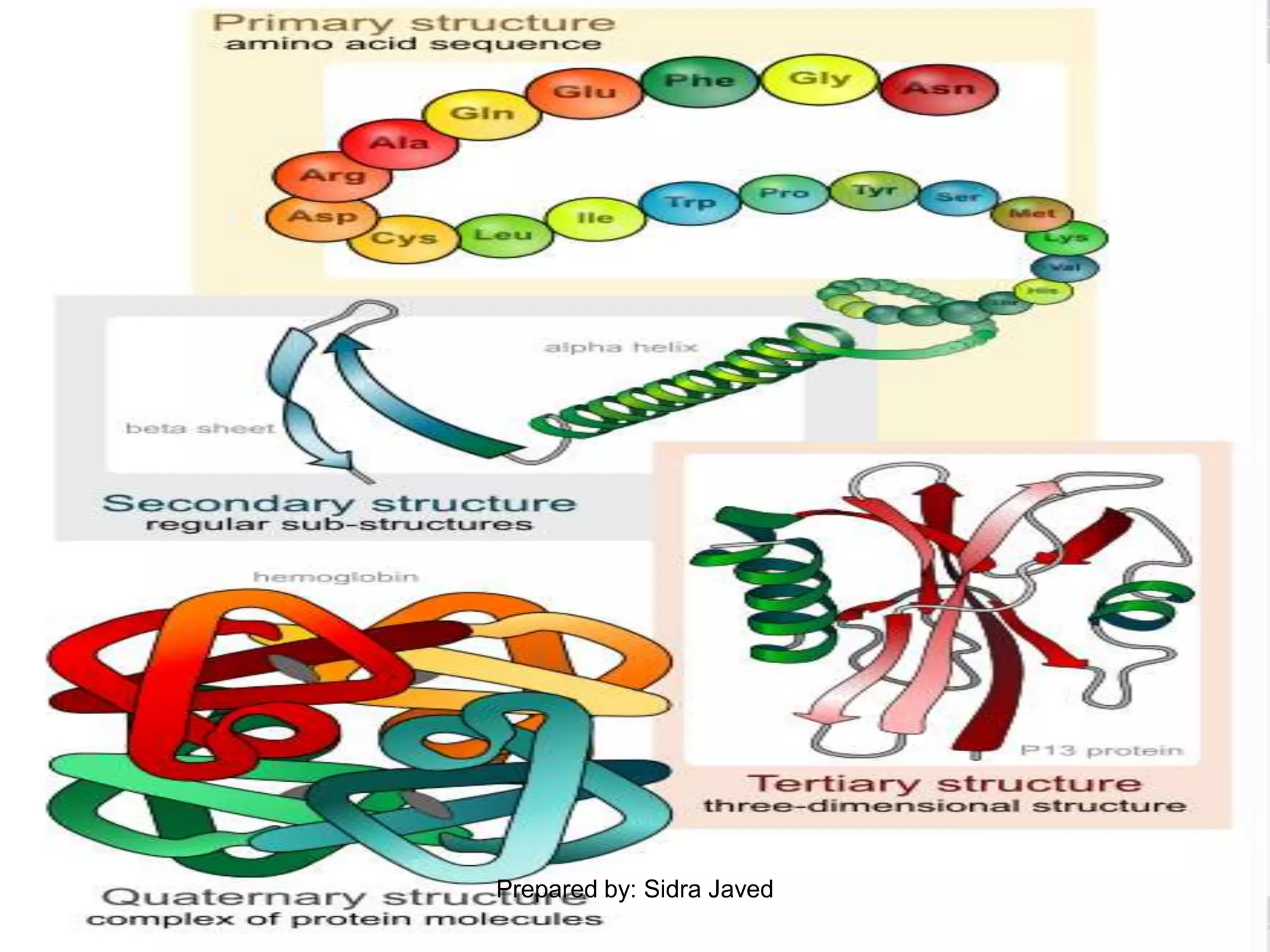
STRUCTURE OF PROTEINS
• Depends upon the spatial arrangement of
polypeptide chains.
• Three arrangements are possible.
• Four structures:
i. Primary structure
ii. Secondary structure
iii. Tertiary Structure
iv. Quaternary Structure
Prepared by: Sidra Javed
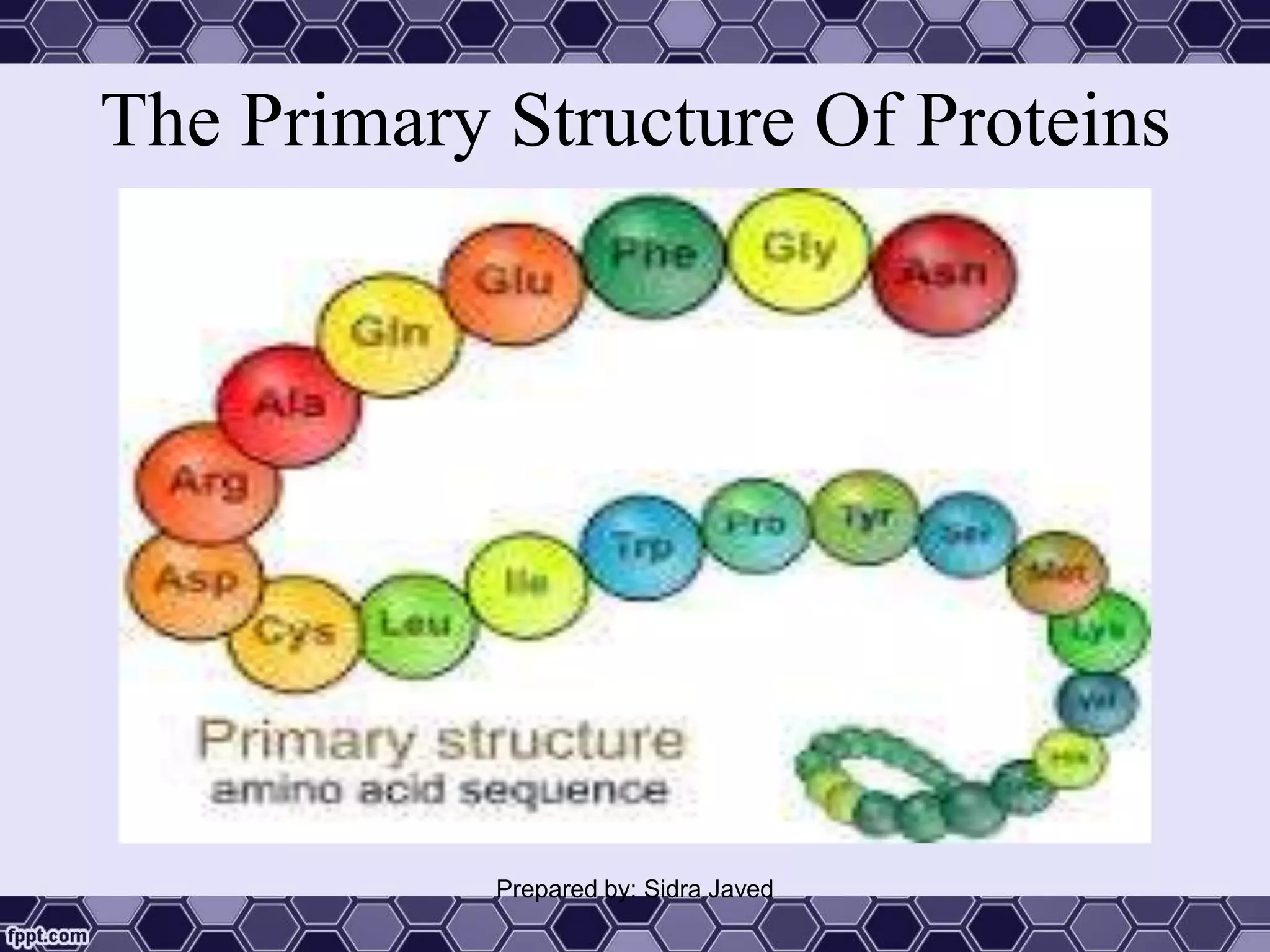
The Primary Structure Of Proteins
• The sequence of amino acids in a
polypeptide chain is called a primary
structure.
• Amino Acids are linked with one another
through peptide bonds.
Prepared by: Sidra Javed
The Primary Structure Of Proteins
Prepared by: Sidra Javed
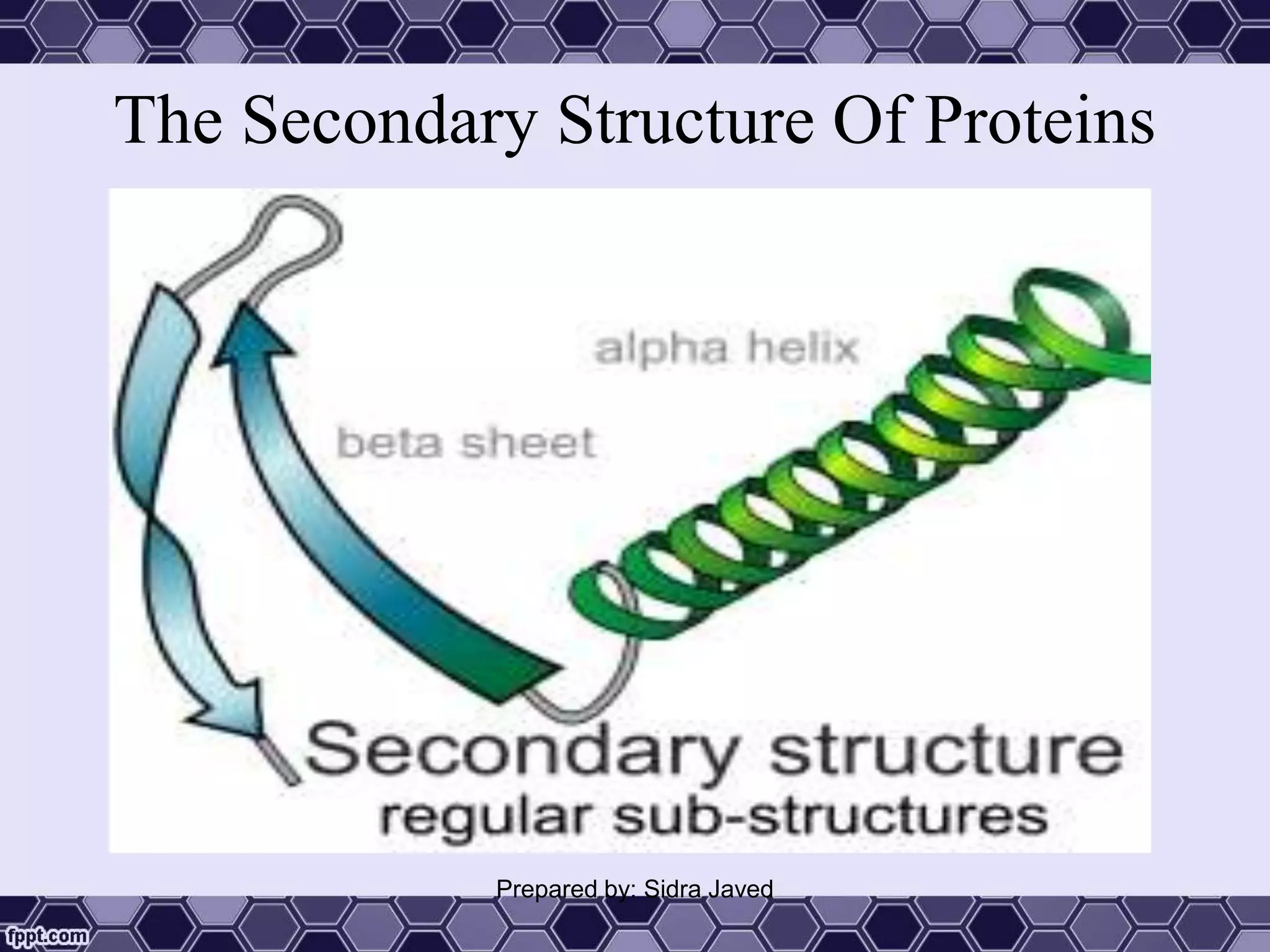
The Secondary Structure Of Proteins
• Peptide chains may acquire spiral shape
or may be present in a zig zig manner.
• This coiling of peptide chains is called the
secondary structure of proteins.
• It is due to Hydrogen bonding.
Prepared by: Sidra Javed
The Secondary Structure Of Proteins
Prepared by: Sidra Javed
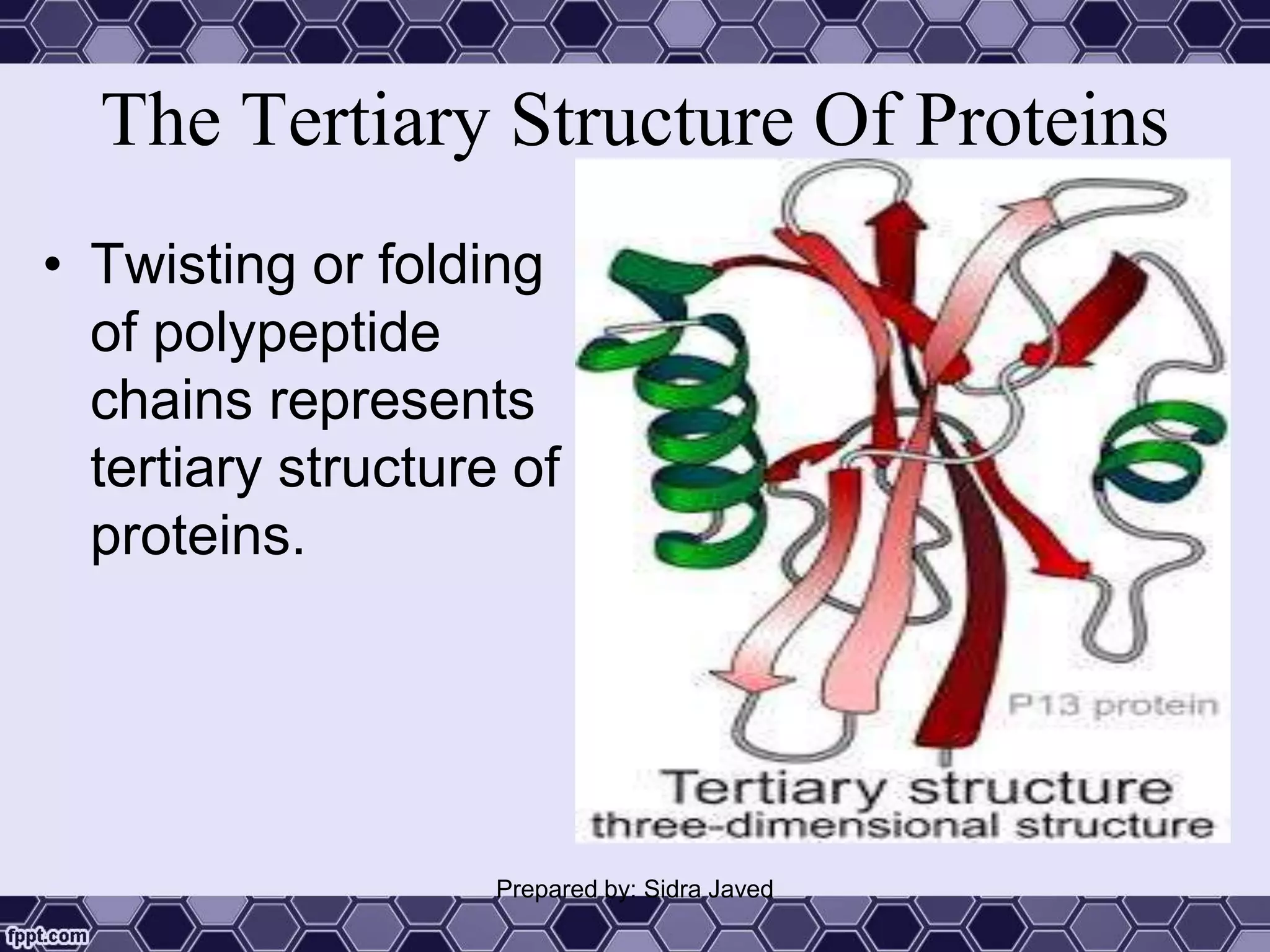
The Tertiary Structure Of Proteins
• Twisting or folding
of polypeptide
chains represents
tertiary structure of
proteins.
Prepared by: Sidra Javed
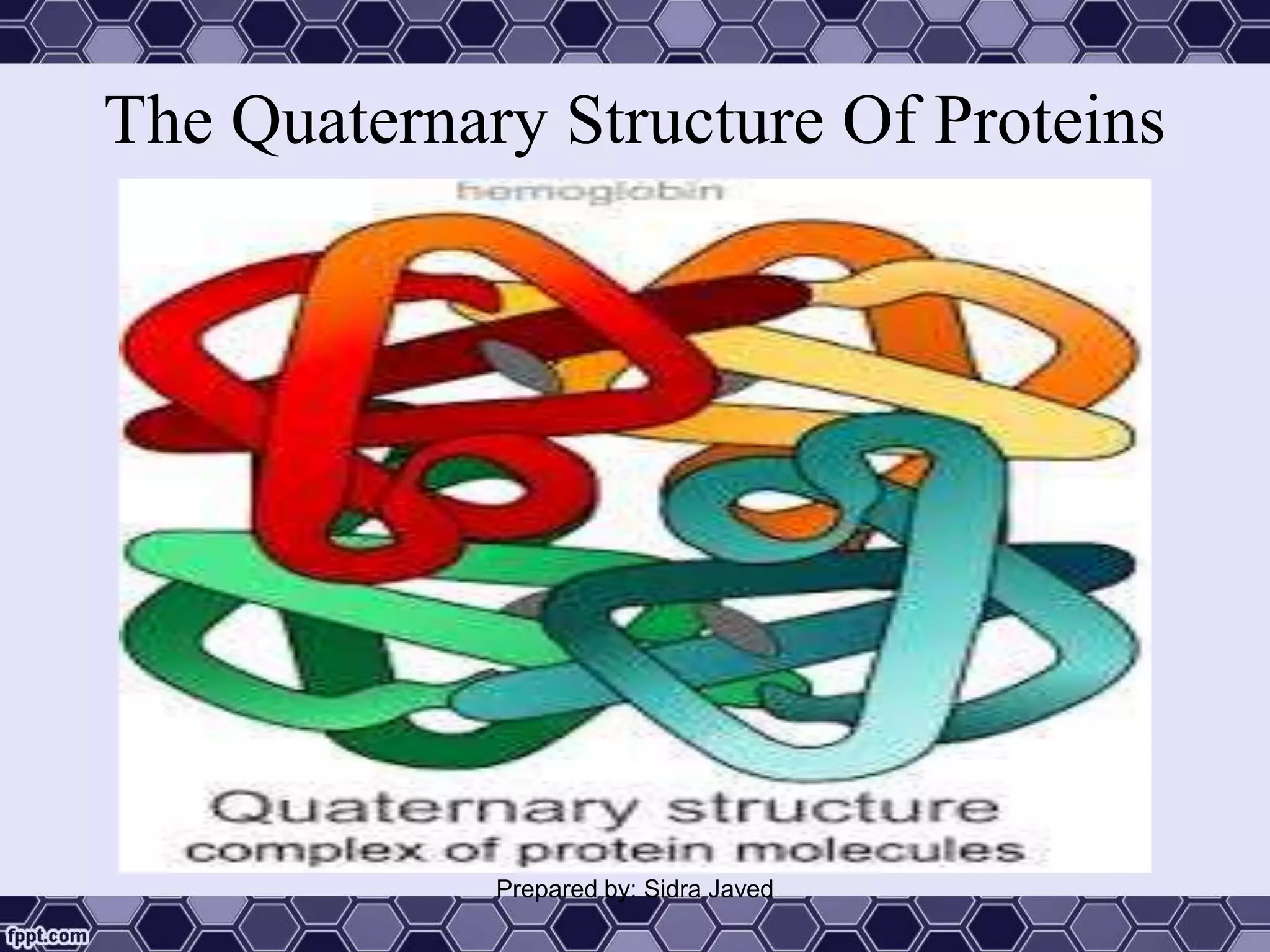
The Quaternary Structure Of Proteins
• Quaternary means four.
• It is the arrangement of multiple folded
protein or coiling protein molecules in a
multi-subunit complex.
• A variety of bonding interactions including
Hydrogen bonding, salt bridges and
disulfide bonds holds the various chains
into a particular geometry.
Prepared by: Sidra Javed
The Quaternary Structure Of Proteins
Prepared by: Sidra Javed
Properties Of Proteins
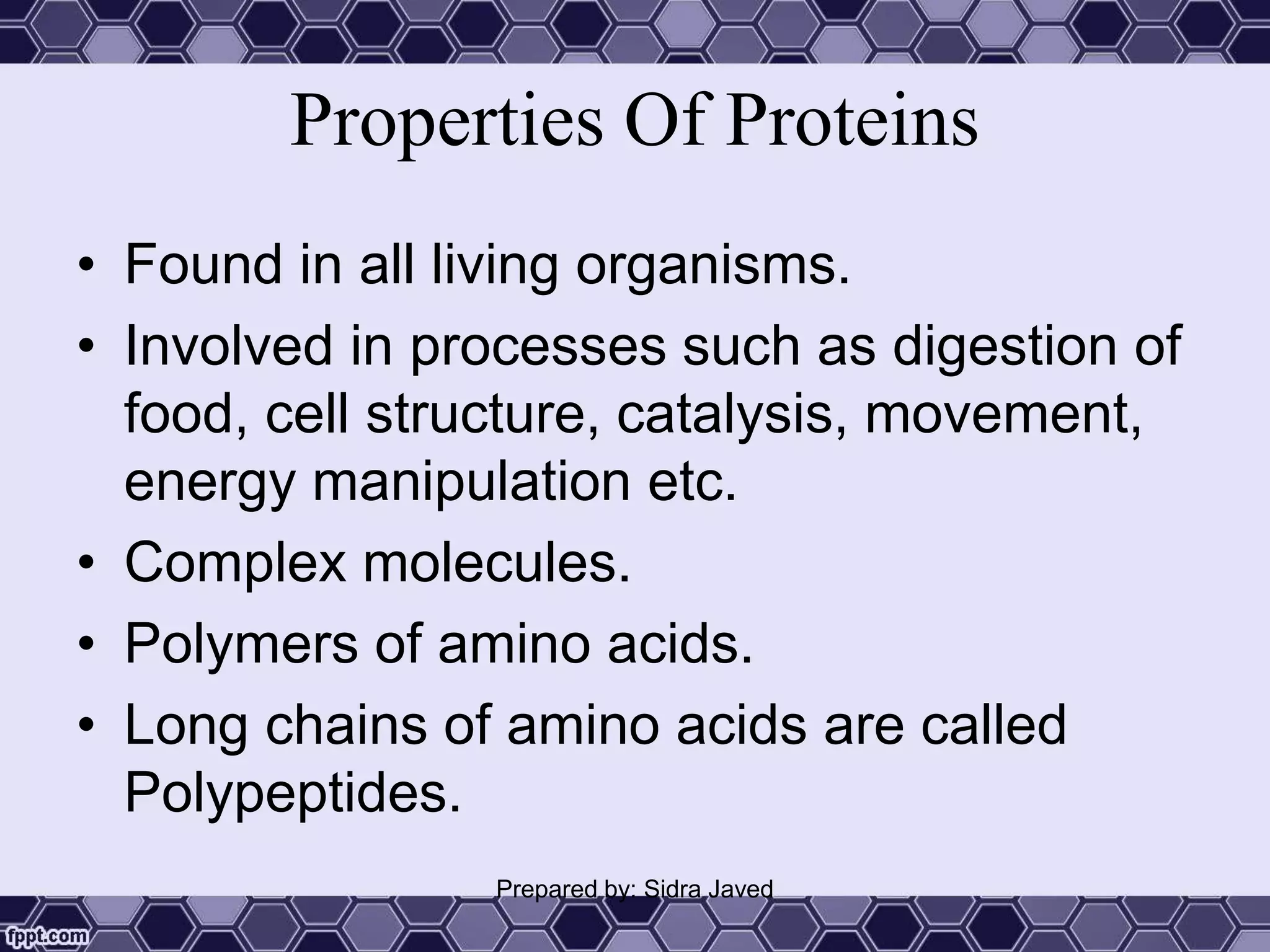
• Found in all living organisms.
• Involved in processes such as digestion of
food, cell structure, catalysis, movement,
energy manipulation etc.
• Complex molecules.
• Polymers of amino acids.
• Long chains of amino acids are called
Polypeptides.
Prepared by: Sidra Javed
Importance of Proteins
• Proteins play an important role in
formation of protoplasm.
Prepared by: Sidra Javed
Importance of Proteins
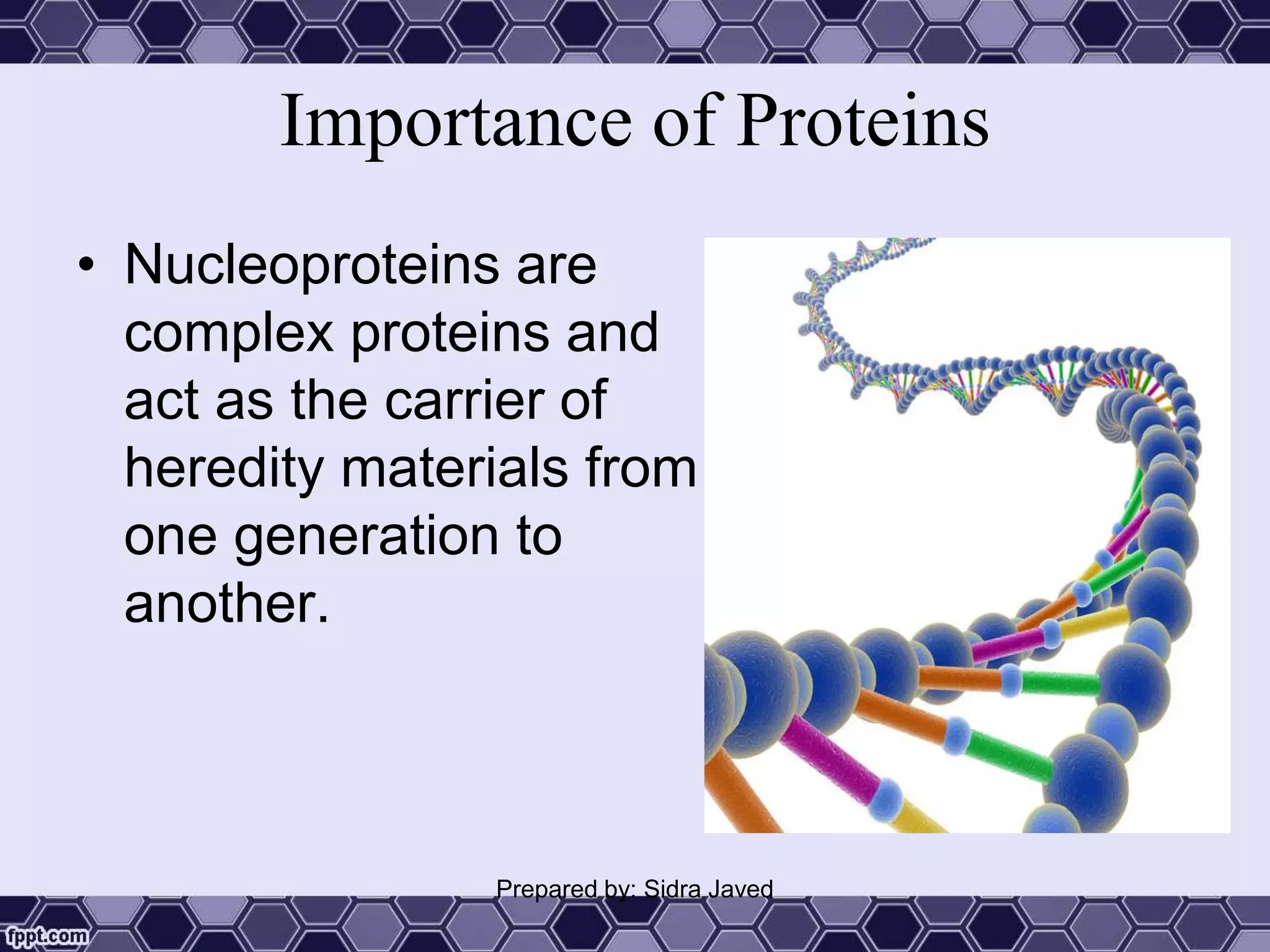
• Nucleoproteins are
complex proteins and
act as the carrier of
heredity materials from
one generation to
another.
Prepared by: Sidra Javed
Importance of Proteins
• Enzymes are the biological catalyst and
they are also proteins
Prepared by: Sidra Javed
Importance of Proteins
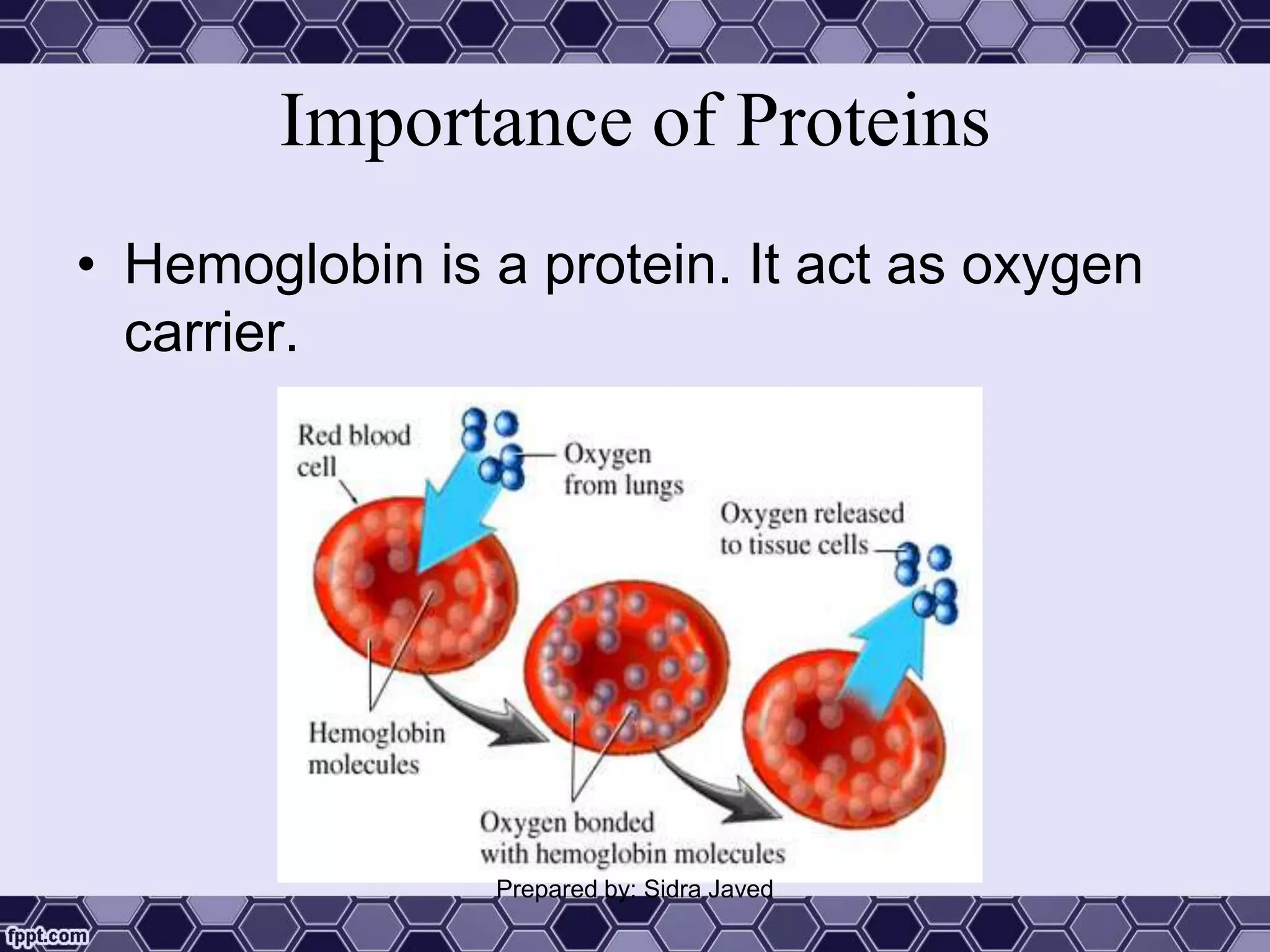
• Hemoglobin is a protein. It act as oxygen
carrier.
Prepared by: Sidra Javed
Importance of Proteins
• Tanning of hides is actually precipitation of
proteins by tannic acid.
Prepared by: Sidra Javed
Importance of Proteins
• Gelatin is obtained by heating bones,
skins and tendons in water. It is used in
bakery goods.
Prepared by: Sidra Javed
Importance of Proteins
• Casein is another protein used in
manufacture of buttons and buckles.
• Proteins obtained from soya bean are
used for manufacture of plastics.
Prepared by: Sidra Javed
Prepared by, Sidra Javed

Proteins

  • 1.
    Chapter # 21 XIIFDC Prepared by: Sidra Javed
  • 2.
  • 3.
    PROTEINS • The Moleculeswhich yields amino acids upon hydrolysis are called proteins. • Proteins are natural polymer of amino acids. • The number of amino acids in a protein molecule may range from two to several thousands. • Protein molecules contain Nitrogen, Carbon, Hydrogen and Oxygen. Prepared by: Sidra Javed
  • 4.
    PROTEINS • Proteins arethe basis for the major structural components of animal and human tissue. • They act as biological catalysts (Enzymes), form structural parts of organisms, participate in different cell reactions, act as molecules of immunity and also provide fuel. Prepared by: Sidra Javed
  • 5.
    CLASSIFICATION OF PROTEINS •Those which give one amino acid only upon hydrolysis. (a) Simple Proteins • Those which give an amino acid and a non-protein group upon hydrolysis. (b) Conjugated Proteins • Those which are derived from simple and conjugated proteins. (c) Derived Proteins Prepared by: Sidra Javed
  • 6.
    (a) SIMPLE PROTEINS- Albumins Blood (Serumbumin) Milk (Lactalbumin) Egg White (Ovolbumin) Lentils (Legumelin) Kidney Beans (Phaseolin) Wheat (Leucosin) Prepared by: Sidra Javed
  • 7.
    • Globular proteinis insoluble in water and dilute salt solution. • Precipitated by saturation with (NH4)2SO4 solution. • Coagulated by heat. • Found in plant and animal tissue. (a) Simple Proteins - Albumins Prepared by: Sidra Javed
  • 8.
    (a) Simple Proteins- Globulins Blood (Serum Globulins) Muscles (Myosin) Potato (Tuberin) Brazil Nuts (Excelsin) Hemp (Edestin) Lentils (Legumin) Prepared by: Sidra Javed
  • 9.
    • Globular Proteinis sparingly soluble in water and neutral solutions. • Precipitated by dilute Ammonium Sulphate. • Coagulated by Heat. • Distributed in both plant and animal tissues. (a) Simple Proteins - Globulins Prepared by: Sidra Javed
  • 10.
    (a) Simple Proteins- Glutelins Wheat (Glutenin) Rice (Oryzenin) Prepared by: Sidra Javed
  • 11.
    • Insoluble inwater and dilute salt solutions. • Soluble in dilute acids. • Found in grains & cereals. (a) Simple Proteins - Glutelins Prepared by: Sidra Javed
  • 12.
    • Thymus Gland,Pancrease and Nucleoproteins (Nucleohistones). • Soluble in water, salt solutions & dilute acids. • Insoluble in Ammonium Hydroxide. • Yeilds large amount of Lysine & arginine. • Combined with nucleic acids within cells. (a) Simple Proteins - Histones Prepared by: Sidra Javed
  • 13.
    • Thymus Gland,Pancrease and Nucleoproteins (Nucleohistones). • Soluble in water, salt solutions & dilute acids. • Insoluble in Ammonium Hydroxide. • Yeilds large amount of Lysine & arginine. • Combined with nucleic acids within cells. (a) Simple Proteins - Histones Prepared by: Sidra Javed
  • 14.
    • Connective tissuesand hard tissues. • Fibrous protein is insoluble in all solvents. • Resistant to digestion. (a) Simple Proteins - Scleroproteins Prepared by: Sidra Javed
  • 15.
    (a) Conjugated Proteins- Nucleoproteins Cytoplasm of Cells (Ribonucleoprotein) Nucleus of Chromosomes & Ribosomes (Deoxyribonucleoprotein) Viruses & Bacteriophage Prepared by: Sidra Javed
  • 16.
    • It containsnucleic acids, nitrogen and phosphorus. • It is present in chromosomes and in all living forms as a combination of protein with either DNA or RNA. (a) Conjugated Proteins - Nucleoproteins Prepared by: Sidra Javed
  • 17.
    (b) Conjugated Proteins- Mucoprotein • Saliva (Mucin) and Egg white (Ovomucoid). • Proteins combined with amino sugars, sugar acids and sulfates. Prepared by: Sidra Javed
  • 18.
    (b) Conjugated Proteins- Glycoproteins • Bones (Osseomucoid), Tendons (Tendomucoid) and Cartilage (Chondromucoid). • Containing more than 4% Hexosamine, mucoproteins; if less than 4%, then Glycoproteins. Prepared by: Sidra Javed
  • 19.
    (b) Conjugated Proteins– Phosphoproteins • Milk (Casein) and Egg yolk (Ovovitellin). • Phosphoric acid joined in ester linkage to protein. Prepared by: Sidra Javed
  • 20.
    (c) Derived Proteins- Proteans • Edestan ( from Elastin) and Myosin (Myosin). • It results from short action of acids or enzymes • Insoluble in water. Prepared by: Sidra Javed
  • 21.
    (c) Derived Proteins- Proteases • Intermediate product of protein digestion • Soluble in water. • Not coagulated by heat. • Precipitated by saturated ammonium sulphate • Result from a partial digestion of protein by pepsin or trypsin. Prepared by: Sidra Javed
  • 22.
    (c) Derived Proteins-Peptones • Intermediate product of protein digestion • Same properties as proteases except that they cannot be salted out. • Smaller molecular weight than proteases. Prepared by: Sidra Javed
  • 23.
    (c) Derived Proteins- Peptides • Intermediate product of protein digestion • Two or more amino acids joined by a peptide linkage. • Hydrolyzed to individual amino acids. Prepared by: Sidra Javed
  • 24.
    STRUCTURE OF PROTEINS •Depends upon the spatial arrangement of polypeptide chains. • Three arrangements are possible. • Four structures: i. Primary structure ii. Secondary structure iii. Tertiary Structure iv. Quaternary Structure Prepared by: Sidra Javed
  • 25.
    The Primary StructureOf Proteins • The sequence of amino acids in a polypeptide chain is called a primary structure. • Amino Acids are linked with one another through peptide bonds. Prepared by: Sidra Javed
  • 26.
    The Primary StructureOf Proteins Prepared by: Sidra Javed
  • 27.
    The Secondary StructureOf Proteins • Peptide chains may acquire spiral shape or may be present in a zig zig manner. • This coiling of peptide chains is called the secondary structure of proteins. • It is due to Hydrogen bonding. Prepared by: Sidra Javed
  • 28.
    The Secondary StructureOf Proteins Prepared by: Sidra Javed
  • 29.
    The Tertiary StructureOf Proteins • Twisting or folding of polypeptide chains represents tertiary structure of proteins. Prepared by: Sidra Javed
  • 30.
    The Quaternary StructureOf Proteins • Quaternary means four. • It is the arrangement of multiple folded protein or coiling protein molecules in a multi-subunit complex. • A variety of bonding interactions including Hydrogen bonding, salt bridges and disulfide bonds holds the various chains into a particular geometry. Prepared by: Sidra Javed
  • 31.
    The Quaternary StructureOf Proteins Prepared by: Sidra Javed
  • 32.
  • 33.
    Properties Of Proteins •Found in all living organisms. • Involved in processes such as digestion of food, cell structure, catalysis, movement, energy manipulation etc. • Complex molecules. • Polymers of amino acids. • Long chains of amino acids are called Polypeptides. Prepared by: Sidra Javed
  • 34.
    Importance of Proteins •Proteins play an important role in formation of protoplasm. Prepared by: Sidra Javed
  • 35.
    Importance of Proteins •Nucleoproteins are complex proteins and act as the carrier of heredity materials from one generation to another. Prepared by: Sidra Javed
  • 36.
    Importance of Proteins •Enzymes are the biological catalyst and they are also proteins Prepared by: Sidra Javed
  • 37.
    Importance of Proteins •Hemoglobin is a protein. It act as oxygen carrier. Prepared by: Sidra Javed
  • 38.
    Importance of Proteins •Tanning of hides is actually precipitation of proteins by tannic acid. Prepared by: Sidra Javed
  • 39.
    Importance of Proteins •Gelatin is obtained by heating bones, skins and tendons in water. It is used in bakery goods. Prepared by: Sidra Javed
  • 40.
    Importance of Proteins •Casein is another protein used in manufacture of buttons and buckles. • Proteins obtained from soya bean are used for manufacture of plastics. Prepared by: Sidra Javed
  • 41.