Protein
Maria gul
Lecturer
Jips, Lahore
Protein
Proteins and Amino acids: Chemistry,
Classification of proteins and amino acids,
Reactions of proteins and amino acids,
Organizational levels, Macromolecular nature
of proteins, Biological and pharmaceutical
importance of proteins and amino acids.
COMPOSITION OF PROTEINS
• Amino acids: Protein molecules are very large molecules with a high
molecular weight ranging from 5000 to 25,00,000. Protein can be
broken down into smaller units by hydrolysis.
• These small units the monomers of proteins are called as amino
acids. Proteins are made up from, 20 such standard amino acids in
different sequences and numbers. So an indefinite number of
proteins can be formed and do occur in nature.
• Thus proteins are the unbranched polymers of L- α-amino acids.
importance
• Proteins are the main structural components of the cytoskeleton. They
are the sole source to replace Nitrogen of the body.
• Biochemical catalysts known as enzymes are proteins.
• Proteins known as immunoglobulins(ig A,D,E,G,M) serve as the first line
of defense against bacterial and viral infections.
• Several hormones are protein in nature e.g insulin
• Structural proteins furnish mechanical support and some of them like
actin and myosin are contractile proteins help in the movement of muscle
fibre, microvilli, etc.
• Some proteins present in cell membrane, cytoplasm and nucleus of the
cell act as receptors.
• The transport proteins carry out the function of transporting
specific substances either across the membrane or in the
body fluids. Hb carry O2 in blood.
• Storage proteins bind with specific substances and store
• them, e.g. iron is stored as ferritin.
• Few proteins are constituents of respiratory pigments
(hemoglobin) and occur in electron transport chain or
respiratory chain, e.g. cytochromes, hemoglobin.
• Under certain conditions proteins can be catabolized to
supply energy.
• Proteins by means of exerting osmotic pressure help in
maintenance of electrolyte and water balance in body.
• In 1839 Dutch chemist GJ Mulder while investigating substances such
as those found in milk, egg found that they could be coagulated on
heating and were nitrogenous compounds. Swedish scientist JJ
Berzelius suggested to Mulder that these substances should be called
proteins.
• The term is derived from Greek word Proteios means “primary”, or
“holding first place” or “pre-eminent” because Berzelius thought
them to be most important of biological substances. And now we
know that proteins are fundamental structural components of the
body. They are nitrogenous “macromolecules” composed of many
amino acids.
•R is called a side chain and can be a hydrogen,
aliphatic, aromatic or heterocyclic group. Each
amino acid has an amino group –NH2, a
carboxylic acid group – COOH and a hydrogen
atom each attached to carbon located next to the
– COOH group. Thus the side chain varies from
one amino acid to the other.
At a physiologic pH of 7.4, the amino group on these amino acids
carries a positive charge, and the carboxylic acid group is
negatively charged.
• The form of an amino acid that has both a positive and a
negative charge is called a zwitterion. Because these charged
chemical groups can form hydrogen bonds with water
molecules, all of these amino acids are water soluble at
physiologic pH.
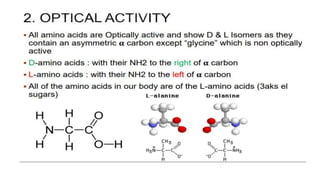
• In all of the amino acids but glycine, the -carbon is an asymmetric
carbon atom that has four different substituents and can exist in
either the D or L configuration. The amino acids in mammalian
proteins are all L-amino acids represented with the amino group to
the left if the carboxyl group is at the top of the structure.
• Properties of amino acids
• They are colourless, crystalline substances, more soluble in water
than in polar solvents. Tyrosine is soluble in hot water. They have high
melting point usually more than 200°C
Acidic and basic amino acids
Classification of amino acids
New amino acid
• A. Selenocysteine - 21st amino acids
• B. Pyrrolysine - 22nd amino acid
Classification
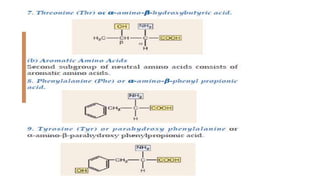
Aliphatic OH
containing
Aromatic Sulpher
containing
acidic basic
glycin serine phenylalani
n
aspartate lysine
alanin threonine tyrosine methionine glutamate arginine
leucin tryptophan cysteine histidine
isoleucin aspargine
valine glutamine
Imino acid proline
Non standard amino acid
• β-alanine:
• Ornithine and citrulline:
• Thyroxine (T4) and Tri-iodo Thyronine (T3.
• γ-aminobutyric acid (GABA):
• β-amino isobutyric acid: These are end product of pyrimidine
metabolism.
• δ-aminolaevulinic acid (δ-ALA): These are intermediate in haem
synthesis.
• 3, 4-dihydroxy phenyl alanine (DOPA): A precursor of mela nine
pigment.
Classification of proteins
II. On the basis of functional properties:
• Defense proteins: Immunoglobulins involved in defense mechanisms.
• Contractile proteins: Proteins of skeletal muscle involved in muscle
contraction and relaxation.
• Respiratory proteins: Involved in the function of respiration, like
hemoglobin, myoglobin, cytochromes.
• Structural proteins: Proteins of skin, cartilage, nail
• Enzymes: Proteins acting as enzymes.
• Hormones: Proteins acting as hormones
I. On the basis of shape and size
• Fibrous proteins: When the axial ratio of length: width of a
protein molecule is more than 10, it is called a fibrous protein.
• Fibrous proteins are elongated strand-like structures whose
helical strand often form fibers or sheet.
• These are insoluble in water
• Examples: α-keratin from hair, collagen, elastin.(tendone ,
cartilage and bone)
• Globular protein: When the axial ratio of length: width of a
protein molecule is less than 10, it is called as globular protein.
These globular proteins have a spheroid or ovoid shape.
• Examples: Myoglobin, hemoglobin, ribonuclease, etc
III. On the basis of solubility and physical
properties:
• A. Simple proteins: These are proteins which on
complete hydrolysis yield only amino acids.
• B. Conjugated proteins: These are proteins which in
addition to amino acids contain a non-protein group
called prosthetic group in their structure.
• C. Derived proteins: These are the proteins formed from
native protein by the action of heat, physical forces or
chemical factors.
A. Simple Proteins
• A. Simple proteins: These are proteins which on complete hydrolysis yield
only amino acids.
• 1. Albumins
• These are proteins which are soluble in water and in dilute salt solutions.
• They are coagulated by heat .
• The albumins may be precipitated (salted out) of by full saturating the
solution with ammonium sulphate.
• Albumins have low isoelectric pH ( pI 4.7) and therefore they are acidic
proteins at the pH 7.4. They are generally deficient in glycine
• Examples: Plant albumins: Legumelin in legumes, leucosin in cereals.
• Animal source: Ovalbumin in egg, Lactalbumin in milk.
2.Globulins
• Globulins are insoluble in water but soluble in dilute neutral salt
solutions.
• They are also heat coagulable.
• Vegetable globulins coagulate rather completely.
• They are precipitated (salted out) by half saturation with
ammonium sulphate or by full saturation with sodium chloride
called salting out.
• Globulins bind with metals, e.g. transferrin (bind to iron),
ceruloplasmin (cupper containing protein) and with carbohydrates,
e.g. immunoglobulins.
• Examples: Ovoglobulin in eggs, lactoglobulin in milk, legumin from
legumes.
3.Globin
• These are rich in histidine
• They unite with heme to form hemoglobin
• Hemoglobin of different species differ with respect to globin
4. Prolamin:
• Rich in proline.
• These are soluble in 70 to 80% ethanol
• In suloble in in water and absolute ethanol
• Gliadin of wheat and zein of maiz
5.Histones
• These are basic proteins, rich in arginine and histidine, with
alkaline isoelectric pH.
• They are soluble in water, dilute acids and salt solutions but
insoluble in ammonia.
• They do not readily coagulate on heating.
• They form conjugated proteins with nucleic acids (DNA) and
porphyrins.
• They act as repressors of template activity of DNA in the synthesis
of RNA.
• The protein part of hemoglobin, globin is an atypical histone
having a predominance of histidine and lysine instead of arginine.
6. Protamines
• These are small molecules.
• soluble in water, dilute acids and alkalies and dilute ammonia
• Non coagulable by heat.
• They do not contain cysteine, tryptophan and tyrosine but are rich in
arginine.
• Their isoelectric pH is around 7.4 and they exist as basic proteins in
the body.
• They combine with nucleic acids to form nucleoproteins.
• Examples: fish (sperms) and testes.
Scleroproteins or Albuminoids
• These are fibrous proteins with great stability and very low solubility
form supporting structures of animals.
• In this group is found keratins (nail, hair, hoof and horn), collagens
and elastins.
(a) Keratins:
• These are characteristic constituents of chidermal tissue such as horn,
hair, nails, wool, hoofs and feathers. It give strength.
• Insoluble in water, organic solvents.
• All hard keratins on hydrolysis yield as part of their amino acids,
histidine, lysine and arginine in the ratio of 1:4:12.
• The soft or pseudokeratins such as those occurring in the outermost
layers of the skin do not have these amino acids in the same ratio.
• In neurokeratin the ratio is 1:2:2. (myelin sheath)
• Human hair has a higher content of cysteine than that of other
species it is called α-keratin.
• β-keratins are deficient in cysteine and, rich in glycine and alanine.
• They are present in spider’s web, silk and reptilian scales.
(b) Collagen:
• A protein found in connective tissue and, cornea, sclera, tendon, bone as
long, thin, partially crystalline substance.
• It resist to digestion by trypsin and pepsin.
• 25-35% of body protein.
• Major protein of extracellular contents
• Collagen fibers are strong than steel of same diameter.
• .
• Is converted into a tough, hard substance on treatment with tannic acid.
This is the basis of tanning process.
• Collagen can be easily converted to gelatin by boiling by splitting off some
amino acids.
Gelatin
• Collagen is converted into gelatin on boiling with acid water.
• is highly soluble and easily digestible protein.
• It forms a gel on cooling and is provided as diet for invalids and
• convalescents.
• It is not a complete protein as it lacks an amino acid which is an
essential amino acid.
Abnormalities of collagen
1. Osteogenesis imperfect; abnormal bone formation
Result from replacement of glycine by cysteine
2. Loose joints : serine replace glycine is called EHLER-DANLOS
syndrome
3. Marfan syndrome ( Marfan tend to be tall and thin, with long arms,
legs, fingers and toes)
(c) Elastins:
• These are the proteins present in yellow elastic fibre of the
connective tissue, ligaments and tendons and arteries.
• Elastic tissue is mixture of elastin, collagen, carbohydrate containing
protein elastomucin.
• They are rich in non-polar amino acids such as alanine, leucine, valine
and proline.
• They do not contain cysteine, methionine, 5-hydroxylysine and
histidine.
• They are formed in large amount in the uterus during pregnancy.
• Elastins are hydrolysed by pancreatic elastase enzyme.
Conjugated proteins
• Conjugated proteins are simple proteins combined with
• a non-protein group called prosthetic group. Protein part is called
apoprotein, and entire molecule is called holoprotein.
• 1. Nucleoproteins
• The nucleoproteins are compounds made up of simple basic proteins
such as protamine or histone with Nucleic Acids as the prosthetic
group.
• They are proteins of cell nuclei and apparently are the chief
constituents of chromatin. They are most abundant in tissues having
large proportion of nuclear material such as yeast, thymus, other
glandular organs and sperm.
2. Glycoproteins
• Glycoproteins are the proteins with carbohydrate moiety as the
prosthetic group.
• These proteins carry a small amount of carbohydrates <4 per
• cent such as serum albumin and globulin.
• Glycoproteins include mucins, immunoglobulins, and many enzymes
3.Lipoproteins
• The lipoproteins are formed in combination with lipids as their
prosthetic group
• VLDL, LDL, HDL.
• 4.Metalloproteins
• As the name indicates, they contain a metal ion as their prosthetic
group. Several enzymes contain metallic elements such as
• Ferritin Fe,
• carbonic anhydrase Zn,
• ceruloplasmin Cu,
• 5. Chromoproteins
• These are proteins that contain coloured substance as the prosthetic
group.
• (a) Haemoproteins: All hemoproteins are chromoproteins which carry
haem as the prosthetic group which is a red coloured pigment found in
these proteins.
• Haemoglobin: Respiratory protein found in RB Cells.
• Cytochromes: These are the mitochondrial enzymes of the respiratory
chain.
• Catalase: This is the enzyme that decomposes H2O2 to water and O2.
• Peroxidase: It is an oxidative enzyme.
6.Phosphoproteins
• These are the proteins with phosphoric acid as organic phosphate but
not the phosphate containing substances such as nucleic acids and
phospholipids.
• (a) Casein and
• (b) Ovovitellin are the two important groups of
• phosphoproteins found in milk, egg-yolk respectively.
Primary derived proteins
• (a) Primary derived proteins: Denatured or coagulated
proteins are placed in this group. Their molecular weight is the
same as native protein, but they differ in solubility,
precipitation and crystallization.
• Heat, X-ray, UV rays, vigorous shaking, acid, alkali cause
denaturation and give rise to primary derived proteins.
• There is an intramolecular rearrangement leading to changes
in their properties such as solubility.
• Primary derived proteins are synonymous with denatured
proteins in which peptide bonds remain intact.
• 1. Proteans
• These are insoluble products formed by the very dilute acids and enzymes.
• They are predominantly formed from certain globulins.
• Example:
• Myosan: From myosin, Edestan: From elastin and
• Fibrin: From fibrinogen.
• 2. Metaproteins: They are formed from further action of acids and alkalies on
proteins.
• They are generally soluble in dilute acids and alkalies but insoluble in neutral
solvents,e.g. acid and alkali.
• 3. Coagulated proteins: The coagulated proteins are insoluble products formed by
the action of heat or alcohol on native proteins.
• Examples: include cooked meat, cooked egg albumin and alcohol precipitated
proteins.
(b) Secondary derived proteins
• These are the proteins formed by the progressive hydrolysis of
proteins at their peptide linkages.
• They represent a great complexity with respect to their size and
amino acid composition. They are roughly called as proteoses,
peptones and peptides according to relative average molecular size.
• 1. Proteoses or albumoses: These are the hydrolytic products of
proteins which
• are soluble in water
• are coagulated by heat and
• are precipitated from their solution by saturation with
Ammonium Sulphate.
• 2. Peptones: These are the hydrolytic products of proteoses.
• They are soluble in water,
• not coagulated by heat and
• not precipitated by saturation with Ammonium sulphate.
• They can be precipitated by phosphotungstic acid.
• Examples: Protein products obtained by the enzymatic digestion
of proteins.
• 3. Peptides: Peptides are composed of only a small number
of amino acids joined as peptide bonds. They are named
according to the number of amino acids present in them.
• • Dipeptides—made up of two amino acids,
• • Tripeptides—made of three amino acid, etc.
• Peptides are water soluble and are not coagulated by heat,
are not salted out of solution and can be precipitated by
phosphotungstic acid.
• Hydrolysis: The complete hydrolytic decomposition of a
• protein generally follows the stages given below:
Scheme of derived proteins
proteins
• The 20 amino acids commonly found in proteins are
joined together by peptide bonds. The linear
sequence of the linked amino acids contains the
information necessary to generate a protein molecule
with a unique three-dimensional shape. The
complexity of protein structure is best analyzed by
considering the molecule in terms of four
organizational levels, namely, primary, secondary,
tertiary, and quaternary.
PRIMARY STRUCTURE OF PROTEINS
•The sequence of amino acids in a protein is called the
primary structure of the protein. Understanding the
primary structure of proteins is important because many
genetic diseases result in proteins with abnormal amino
acid sequences, which cause improper folding and loss or
impairment of normal function. If the primary structures
of the normal and the mutated proteins are known, this
information may be used to diagnose or study the
disease.
• This also include determination of
• Number of amino acid
• Whether peptide chain is open or cyclic or branched
• Numbering of amino acid start with amino acid that free NH2 group
Abnormal Hemoglobin found in sickle cell anemia
• Hb-s has valine instead of glutamic acid at no 6 in beta hb chain.
• Insulin 51
• Glucagon 29
• Ribonuclease 124
• Calcitonin 32
• Alpha chain 141 and beta chain 146 of hemoglobin
SECONDARY STRUCTURE OF PROTEINS
The polypeptide backbone does not assume a
random three-dimensional structure, but instead
generally forms regular arrangements of amino
acids that are located near to each other in the
linear sequence. These arrangements are termed
the secondary structure of the polypeptide.
examples of secondary structures
•α-helix,
•β-sheet, and
•β-bend (β-turn)
α-helix,
•It is a spiral structure, consisting of a tightly packed, coiled
polypeptide backbone core, with the side chains of the
component amino acids extending outward from the central
axis to avoid interfering sterically with each other .
•Fibrous, keratins
• globular, myoglobin,
•They are a major component of tissues such as hair and
skin, and their rigidity is determined by the number of
disulfide bonds between the constituent polypeptide
chains.
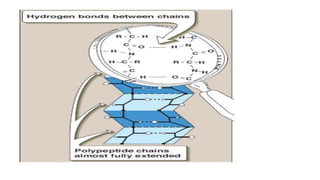
• Hydrogen bonds:
•An α-helix is stabilized by extensive hydrogen bonding
between the peptide-bond carbonyl oxygens and amide
hydrogens that are part of the polypeptide backbone.
The hydrogen bonds extend up and are parallel to the
spiral from the carbonyl oxygen of one peptide bond to
the – NH – group of a peptide linkage four residues
ahead in the polypeptide.
2. Amino acids per turn: Each turn of an α-helix contains
3.6 amino acids. Thus, amino acid residues spaced three
or four residues apart in the primary sequence are
spatially close together when folded in the α-helix.
•3. Amino acids that disrupt an α-helix: Proline disrupts
an α-helix because its secondary amino group is not
geometrically compatible with the right-handed spiral of
the α-helix. Instead, it inserts a kink in the chain, which
interferes with the smooth, helical structure. Large
numbers of charged amino acids
• β-Sheet
• The β-sheet is another form of secondary structure in
which all of the peptide bond components are
involved in hydrogen bonding. The surfaces of β-
sheets appear “pleated,” and these structures are,
therefore, often called “β-pleated sheets.”
• Parallel and antiparallel sheets:
• A β-sheet can be formed from two or more separate polypeptide
chains or segments of polypeptide chains that are arranged either
antiparallel to each other (with the N-terminal and C-terminal ends
of the β-strands alternating), or
• parallel to each other (with all the N-terminal of the β-strands
together). When the hydrogen bonds are formed between the
polypeptide backbones of separate polypeptide chains, they are
termed interchain bonds.
• A β-sheet can also be formed by a single polypeptide chain folding
back on itself. In this case, the hydrogen bonds are intrachain bonds.
In globular proteins, β-sheets always have a right-handed curl, or
twist, when viewed along the polypeptide backbone.
•β-Bends (reverse turns, β-turns)
•β-Bends were given this name because they often connect
successive strands of antiparallel β-sheets. β-Bends are
generally composed of four amino acids, one of which may
be proline—the amino acid that causes a “kink” in the
polypeptide chain. Glycine, the amino acid with the
smallest R-group, is also frequently found in β-bends. β-
Bends are stabilized by the formation of hydrogen and ionic
bonds.
•LOOP
•Loop also connect adjacent region of secondary structure
but have large number amino acid residues than bends
Supersecondary structures (motifs)
• Globular proteins are constructed by combining secondary structural two
β-sheets are connected to each other by α- helix.
• Also seen where two α- helix are connected to eachother by β-sheets
.These form primarily the core region—that is, the interior of the molecule.
• They are connected by loop regions (for example, β-bends) at the
• surface of the protein. Supersecondary structures are usually produced
• by packing side chains from adjacent secondary structural
• elements close to each other. Thus, for example, α-helices and
• β-sheets that are adjacent in the amino acid sequence are also usually
• (but not always) adjacent in the final, folded protein
TERTIARY STRUCTURE OF GLOBULAR
PROTEINS
• The primary structure of a polypeptide chain determines its tertiary
• structure. “Tertiary” refers both to the folding of domains (the basic
units of structure and function, and to the final arrangement of
domains in the polypeptide.
• Hydrophobic side chains are buried in the interior, whereas
hydrophilic groups are generally found on the surface of the
molecule.
Domains
• Domains are the fundamental functional and three-dimensional
structural units of polypeptides. Polypeptide chains that are greater
than 200 amino acids in length generally consist of two or more
domains. The core of a domain is built from combinations of
Supersecondary structural elements (motifs).
• Folding of the peptide chain within a domain usually occurs
independently of folding in other domains. Therefore, each domain
has the characteristics of a small, compact globular protein that is
structurally independent of the other domains in the polypeptide
chain.
Interactions stabilizing tertiary structure
• Disulfide bonds
• Hydrophobic interactions
• Hydrogen bonds
• Ionic interactions
QUATERNARY STRUCTURE OF PROTEINS
• Many proteins consist of a single polypeptide chain, and are defined
as monomeric proteins. However, others may consist of two or more
polypeptide chains that may be structurally identical or totally
unrelated. The arrangement of these polypeptide subunits is called
the quaternary structure of the protein. Subunits are held together by
noncovalent interactions (for example, hydrogen bonds, ionic bonds,
and hydrophobic interactions). Subunits may either function
independently of each other, or may work cooperatively, as in
hemoglobin, in which the binding of oxygen to one subunit of the
tetramer increases the affinity of the other subunits for oxygen

Protein 26 32

  • 1.
  • 2.
    Protein Proteins and Aminoacids: Chemistry, Classification of proteins and amino acids, Reactions of proteins and amino acids, Organizational levels, Macromolecular nature of proteins, Biological and pharmaceutical importance of proteins and amino acids.
  • 3.
    COMPOSITION OF PROTEINS •Amino acids: Protein molecules are very large molecules with a high molecular weight ranging from 5000 to 25,00,000. Protein can be broken down into smaller units by hydrolysis. • These small units the monomers of proteins are called as amino acids. Proteins are made up from, 20 such standard amino acids in different sequences and numbers. So an indefinite number of proteins can be formed and do occur in nature. • Thus proteins are the unbranched polymers of L- α-amino acids.
  • 4.
    importance • Proteins arethe main structural components of the cytoskeleton. They are the sole source to replace Nitrogen of the body. • Biochemical catalysts known as enzymes are proteins. • Proteins known as immunoglobulins(ig A,D,E,G,M) serve as the first line of defense against bacterial and viral infections. • Several hormones are protein in nature e.g insulin • Structural proteins furnish mechanical support and some of them like actin and myosin are contractile proteins help in the movement of muscle fibre, microvilli, etc. • Some proteins present in cell membrane, cytoplasm and nucleus of the cell act as receptors.
  • 5.
    • The transportproteins carry out the function of transporting specific substances either across the membrane or in the body fluids. Hb carry O2 in blood. • Storage proteins bind with specific substances and store • them, e.g. iron is stored as ferritin. • Few proteins are constituents of respiratory pigments (hemoglobin) and occur in electron transport chain or respiratory chain, e.g. cytochromes, hemoglobin. • Under certain conditions proteins can be catabolized to supply energy. • Proteins by means of exerting osmotic pressure help in maintenance of electrolyte and water balance in body.
  • 7.
    • In 1839Dutch chemist GJ Mulder while investigating substances such as those found in milk, egg found that they could be coagulated on heating and were nitrogenous compounds. Swedish scientist JJ Berzelius suggested to Mulder that these substances should be called proteins. • The term is derived from Greek word Proteios means “primary”, or “holding first place” or “pre-eminent” because Berzelius thought them to be most important of biological substances. And now we know that proteins are fundamental structural components of the body. They are nitrogenous “macromolecules” composed of many amino acids.
  • 9.
    •R is calleda side chain and can be a hydrogen, aliphatic, aromatic or heterocyclic group. Each amino acid has an amino group –NH2, a carboxylic acid group – COOH and a hydrogen atom each attached to carbon located next to the – COOH group. Thus the side chain varies from one amino acid to the other.
  • 10.
    At a physiologicpH of 7.4, the amino group on these amino acids carries a positive charge, and the carboxylic acid group is negatively charged. • The form of an amino acid that has both a positive and a negative charge is called a zwitterion. Because these charged chemical groups can form hydrogen bonds with water molecules, all of these amino acids are water soluble at physiologic pH.
  • 11.
    • In allof the amino acids but glycine, the -carbon is an asymmetric carbon atom that has four different substituents and can exist in either the D or L configuration. The amino acids in mammalian proteins are all L-amino acids represented with the amino group to the left if the carboxyl group is at the top of the structure.
  • 14.
    • Properties ofamino acids • They are colourless, crystalline substances, more soluble in water than in polar solvents. Tyrosine is soluble in hot water. They have high melting point usually more than 200°C
  • 20.
    Acidic and basicamino acids
  • 21.
  • 22.
    New amino acid •A. Selenocysteine - 21st amino acids • B. Pyrrolysine - 22nd amino acid
  • 26.
    Classification Aliphatic OH containing Aromatic Sulpher containing acidicbasic glycin serine phenylalani n aspartate lysine alanin threonine tyrosine methionine glutamate arginine leucin tryptophan cysteine histidine isoleucin aspargine valine glutamine Imino acid proline
  • 29.
    Non standard aminoacid • β-alanine: • Ornithine and citrulline: • Thyroxine (T4) and Tri-iodo Thyronine (T3. • γ-aminobutyric acid (GABA): • β-amino isobutyric acid: These are end product of pyrimidine metabolism. • δ-aminolaevulinic acid (δ-ALA): These are intermediate in haem synthesis. • 3, 4-dihydroxy phenyl alanine (DOPA): A precursor of mela nine pigment.
  • 31.
    Classification of proteins II.On the basis of functional properties: • Defense proteins: Immunoglobulins involved in defense mechanisms. • Contractile proteins: Proteins of skeletal muscle involved in muscle contraction and relaxation. • Respiratory proteins: Involved in the function of respiration, like hemoglobin, myoglobin, cytochromes. • Structural proteins: Proteins of skin, cartilage, nail • Enzymes: Proteins acting as enzymes. • Hormones: Proteins acting as hormones
  • 32.
    I. On thebasis of shape and size • Fibrous proteins: When the axial ratio of length: width of a protein molecule is more than 10, it is called a fibrous protein. • Fibrous proteins are elongated strand-like structures whose helical strand often form fibers or sheet. • These are insoluble in water • Examples: α-keratin from hair, collagen, elastin.(tendone , cartilage and bone) • Globular protein: When the axial ratio of length: width of a protein molecule is less than 10, it is called as globular protein. These globular proteins have a spheroid or ovoid shape. • Examples: Myoglobin, hemoglobin, ribonuclease, etc
  • 33.
    III. On thebasis of solubility and physical properties: • A. Simple proteins: These are proteins which on complete hydrolysis yield only amino acids. • B. Conjugated proteins: These are proteins which in addition to amino acids contain a non-protein group called prosthetic group in their structure. • C. Derived proteins: These are the proteins formed from native protein by the action of heat, physical forces or chemical factors.
  • 34.
    A. Simple Proteins •A. Simple proteins: These are proteins which on complete hydrolysis yield only amino acids. • 1. Albumins • These are proteins which are soluble in water and in dilute salt solutions. • They are coagulated by heat . • The albumins may be precipitated (salted out) of by full saturating the solution with ammonium sulphate. • Albumins have low isoelectric pH ( pI 4.7) and therefore they are acidic proteins at the pH 7.4. They are generally deficient in glycine • Examples: Plant albumins: Legumelin in legumes, leucosin in cereals. • Animal source: Ovalbumin in egg, Lactalbumin in milk.
  • 35.
    2.Globulins • Globulins areinsoluble in water but soluble in dilute neutral salt solutions. • They are also heat coagulable. • Vegetable globulins coagulate rather completely. • They are precipitated (salted out) by half saturation with ammonium sulphate or by full saturation with sodium chloride called salting out. • Globulins bind with metals, e.g. transferrin (bind to iron), ceruloplasmin (cupper containing protein) and with carbohydrates, e.g. immunoglobulins. • Examples: Ovoglobulin in eggs, lactoglobulin in milk, legumin from legumes.
  • 36.
    3.Globin • These arerich in histidine • They unite with heme to form hemoglobin • Hemoglobin of different species differ with respect to globin 4. Prolamin: • Rich in proline. • These are soluble in 70 to 80% ethanol • In suloble in in water and absolute ethanol • Gliadin of wheat and zein of maiz
  • 37.
    5.Histones • These arebasic proteins, rich in arginine and histidine, with alkaline isoelectric pH. • They are soluble in water, dilute acids and salt solutions but insoluble in ammonia. • They do not readily coagulate on heating. • They form conjugated proteins with nucleic acids (DNA) and porphyrins. • They act as repressors of template activity of DNA in the synthesis of RNA. • The protein part of hemoglobin, globin is an atypical histone having a predominance of histidine and lysine instead of arginine.
  • 38.
    6. Protamines • Theseare small molecules. • soluble in water, dilute acids and alkalies and dilute ammonia • Non coagulable by heat. • They do not contain cysteine, tryptophan and tyrosine but are rich in arginine. • Their isoelectric pH is around 7.4 and they exist as basic proteins in the body. • They combine with nucleic acids to form nucleoproteins. • Examples: fish (sperms) and testes.
  • 39.
    Scleroproteins or Albuminoids •These are fibrous proteins with great stability and very low solubility form supporting structures of animals. • In this group is found keratins (nail, hair, hoof and horn), collagens and elastins.
  • 40.
    (a) Keratins: • Theseare characteristic constituents of chidermal tissue such as horn, hair, nails, wool, hoofs and feathers. It give strength. • Insoluble in water, organic solvents. • All hard keratins on hydrolysis yield as part of their amino acids, histidine, lysine and arginine in the ratio of 1:4:12. • The soft or pseudokeratins such as those occurring in the outermost layers of the skin do not have these amino acids in the same ratio. • In neurokeratin the ratio is 1:2:2. (myelin sheath) • Human hair has a higher content of cysteine than that of other species it is called α-keratin. • β-keratins are deficient in cysteine and, rich in glycine and alanine. • They are present in spider’s web, silk and reptilian scales.
  • 41.
    (b) Collagen: • Aprotein found in connective tissue and, cornea, sclera, tendon, bone as long, thin, partially crystalline substance. • It resist to digestion by trypsin and pepsin. • 25-35% of body protein. • Major protein of extracellular contents • Collagen fibers are strong than steel of same diameter. • . • Is converted into a tough, hard substance on treatment with tannic acid. This is the basis of tanning process. • Collagen can be easily converted to gelatin by boiling by splitting off some amino acids.
  • 42.
    Gelatin • Collagen isconverted into gelatin on boiling with acid water. • is highly soluble and easily digestible protein. • It forms a gel on cooling and is provided as diet for invalids and • convalescents. • It is not a complete protein as it lacks an amino acid which is an essential amino acid.
  • 43.
    Abnormalities of collagen 1.Osteogenesis imperfect; abnormal bone formation Result from replacement of glycine by cysteine 2. Loose joints : serine replace glycine is called EHLER-DANLOS syndrome 3. Marfan syndrome ( Marfan tend to be tall and thin, with long arms, legs, fingers and toes)
  • 44.
    (c) Elastins: • Theseare the proteins present in yellow elastic fibre of the connective tissue, ligaments and tendons and arteries. • Elastic tissue is mixture of elastin, collagen, carbohydrate containing protein elastomucin. • They are rich in non-polar amino acids such as alanine, leucine, valine and proline. • They do not contain cysteine, methionine, 5-hydroxylysine and histidine. • They are formed in large amount in the uterus during pregnancy. • Elastins are hydrolysed by pancreatic elastase enzyme.
  • 45.
    Conjugated proteins • Conjugatedproteins are simple proteins combined with • a non-protein group called prosthetic group. Protein part is called apoprotein, and entire molecule is called holoprotein. • 1. Nucleoproteins • The nucleoproteins are compounds made up of simple basic proteins such as protamine or histone with Nucleic Acids as the prosthetic group. • They are proteins of cell nuclei and apparently are the chief constituents of chromatin. They are most abundant in tissues having large proportion of nuclear material such as yeast, thymus, other glandular organs and sperm.
  • 46.
    2. Glycoproteins • Glycoproteinsare the proteins with carbohydrate moiety as the prosthetic group. • These proteins carry a small amount of carbohydrates <4 per • cent such as serum albumin and globulin. • Glycoproteins include mucins, immunoglobulins, and many enzymes
  • 47.
    3.Lipoproteins • The lipoproteinsare formed in combination with lipids as their prosthetic group • VLDL, LDL, HDL. • 4.Metalloproteins • As the name indicates, they contain a metal ion as their prosthetic group. Several enzymes contain metallic elements such as • Ferritin Fe, • carbonic anhydrase Zn, • ceruloplasmin Cu,
  • 48.
    • 5. Chromoproteins •These are proteins that contain coloured substance as the prosthetic group. • (a) Haemoproteins: All hemoproteins are chromoproteins which carry haem as the prosthetic group which is a red coloured pigment found in these proteins. • Haemoglobin: Respiratory protein found in RB Cells. • Cytochromes: These are the mitochondrial enzymes of the respiratory chain. • Catalase: This is the enzyme that decomposes H2O2 to water and O2. • Peroxidase: It is an oxidative enzyme.
  • 49.
    6.Phosphoproteins • These arethe proteins with phosphoric acid as organic phosphate but not the phosphate containing substances such as nucleic acids and phospholipids. • (a) Casein and • (b) Ovovitellin are the two important groups of • phosphoproteins found in milk, egg-yolk respectively.
  • 50.
    Primary derived proteins •(a) Primary derived proteins: Denatured or coagulated proteins are placed in this group. Their molecular weight is the same as native protein, but they differ in solubility, precipitation and crystallization. • Heat, X-ray, UV rays, vigorous shaking, acid, alkali cause denaturation and give rise to primary derived proteins. • There is an intramolecular rearrangement leading to changes in their properties such as solubility. • Primary derived proteins are synonymous with denatured proteins in which peptide bonds remain intact.
  • 51.
    • 1. Proteans •These are insoluble products formed by the very dilute acids and enzymes. • They are predominantly formed from certain globulins. • Example: • Myosan: From myosin, Edestan: From elastin and • Fibrin: From fibrinogen. • 2. Metaproteins: They are formed from further action of acids and alkalies on proteins. • They are generally soluble in dilute acids and alkalies but insoluble in neutral solvents,e.g. acid and alkali. • 3. Coagulated proteins: The coagulated proteins are insoluble products formed by the action of heat or alcohol on native proteins. • Examples: include cooked meat, cooked egg albumin and alcohol precipitated proteins.
  • 52.
    (b) Secondary derivedproteins • These are the proteins formed by the progressive hydrolysis of proteins at their peptide linkages. • They represent a great complexity with respect to their size and amino acid composition. They are roughly called as proteoses, peptones and peptides according to relative average molecular size.
  • 53.
    • 1. Proteosesor albumoses: These are the hydrolytic products of proteins which • are soluble in water • are coagulated by heat and • are precipitated from their solution by saturation with Ammonium Sulphate. • 2. Peptones: These are the hydrolytic products of proteoses. • They are soluble in water, • not coagulated by heat and • not precipitated by saturation with Ammonium sulphate. • They can be precipitated by phosphotungstic acid. • Examples: Protein products obtained by the enzymatic digestion of proteins.
  • 54.
    • 3. Peptides:Peptides are composed of only a small number of amino acids joined as peptide bonds. They are named according to the number of amino acids present in them. • • Dipeptides—made up of two amino acids, • • Tripeptides—made of three amino acid, etc. • Peptides are water soluble and are not coagulated by heat, are not salted out of solution and can be precipitated by phosphotungstic acid. • Hydrolysis: The complete hydrolytic decomposition of a • protein generally follows the stages given below:
  • 55.
  • 56.
    proteins • The 20amino acids commonly found in proteins are joined together by peptide bonds. The linear sequence of the linked amino acids contains the information necessary to generate a protein molecule with a unique three-dimensional shape. The complexity of protein structure is best analyzed by considering the molecule in terms of four organizational levels, namely, primary, secondary, tertiary, and quaternary.
  • 57.
    PRIMARY STRUCTURE OFPROTEINS •The sequence of amino acids in a protein is called the primary structure of the protein. Understanding the primary structure of proteins is important because many genetic diseases result in proteins with abnormal amino acid sequences, which cause improper folding and loss or impairment of normal function. If the primary structures of the normal and the mutated proteins are known, this information may be used to diagnose or study the disease.
  • 58.
    • This alsoinclude determination of • Number of amino acid • Whether peptide chain is open or cyclic or branched • Numbering of amino acid start with amino acid that free NH2 group Abnormal Hemoglobin found in sickle cell anemia • Hb-s has valine instead of glutamic acid at no 6 in beta hb chain. • Insulin 51 • Glucagon 29 • Ribonuclease 124 • Calcitonin 32 • Alpha chain 141 and beta chain 146 of hemoglobin
  • 59.
    SECONDARY STRUCTURE OFPROTEINS The polypeptide backbone does not assume a random three-dimensional structure, but instead generally forms regular arrangements of amino acids that are located near to each other in the linear sequence. These arrangements are termed the secondary structure of the polypeptide. examples of secondary structures •α-helix, •β-sheet, and •β-bend (β-turn)
  • 60.
    α-helix, •It is aspiral structure, consisting of a tightly packed, coiled polypeptide backbone core, with the side chains of the component amino acids extending outward from the central axis to avoid interfering sterically with each other . •Fibrous, keratins • globular, myoglobin, •They are a major component of tissues such as hair and skin, and their rigidity is determined by the number of disulfide bonds between the constituent polypeptide chains.
  • 62.
    • Hydrogen bonds: •Anα-helix is stabilized by extensive hydrogen bonding between the peptide-bond carbonyl oxygens and amide hydrogens that are part of the polypeptide backbone. The hydrogen bonds extend up and are parallel to the spiral from the carbonyl oxygen of one peptide bond to the – NH – group of a peptide linkage four residues ahead in the polypeptide.
  • 63.
    2. Amino acidsper turn: Each turn of an α-helix contains 3.6 amino acids. Thus, amino acid residues spaced three or four residues apart in the primary sequence are spatially close together when folded in the α-helix. •3. Amino acids that disrupt an α-helix: Proline disrupts an α-helix because its secondary amino group is not geometrically compatible with the right-handed spiral of the α-helix. Instead, it inserts a kink in the chain, which interferes with the smooth, helical structure. Large numbers of charged amino acids
  • 64.
    • β-Sheet • Theβ-sheet is another form of secondary structure in which all of the peptide bond components are involved in hydrogen bonding. The surfaces of β- sheets appear “pleated,” and these structures are, therefore, often called “β-pleated sheets.”
  • 66.
    • Parallel andantiparallel sheets: • A β-sheet can be formed from two or more separate polypeptide chains or segments of polypeptide chains that are arranged either antiparallel to each other (with the N-terminal and C-terminal ends of the β-strands alternating), or • parallel to each other (with all the N-terminal of the β-strands together). When the hydrogen bonds are formed between the polypeptide backbones of separate polypeptide chains, they are termed interchain bonds. • A β-sheet can also be formed by a single polypeptide chain folding back on itself. In this case, the hydrogen bonds are intrachain bonds. In globular proteins, β-sheets always have a right-handed curl, or twist, when viewed along the polypeptide backbone.
  • 68.
    •β-Bends (reverse turns,β-turns) •β-Bends were given this name because they often connect successive strands of antiparallel β-sheets. β-Bends are generally composed of four amino acids, one of which may be proline—the amino acid that causes a “kink” in the polypeptide chain. Glycine, the amino acid with the smallest R-group, is also frequently found in β-bends. β- Bends are stabilized by the formation of hydrogen and ionic bonds. •LOOP •Loop also connect adjacent region of secondary structure but have large number amino acid residues than bends
  • 69.
    Supersecondary structures (motifs) •Globular proteins are constructed by combining secondary structural two β-sheets are connected to each other by α- helix. • Also seen where two α- helix are connected to eachother by β-sheets .These form primarily the core region—that is, the interior of the molecule. • They are connected by loop regions (for example, β-bends) at the • surface of the protein. Supersecondary structures are usually produced • by packing side chains from adjacent secondary structural • elements close to each other. Thus, for example, α-helices and • β-sheets that are adjacent in the amino acid sequence are also usually • (but not always) adjacent in the final, folded protein
  • 70.
    TERTIARY STRUCTURE OFGLOBULAR PROTEINS • The primary structure of a polypeptide chain determines its tertiary • structure. “Tertiary” refers both to the folding of domains (the basic units of structure and function, and to the final arrangement of domains in the polypeptide. • Hydrophobic side chains are buried in the interior, whereas hydrophilic groups are generally found on the surface of the molecule.
  • 71.
    Domains • Domains arethe fundamental functional and three-dimensional structural units of polypeptides. Polypeptide chains that are greater than 200 amino acids in length generally consist of two or more domains. The core of a domain is built from combinations of Supersecondary structural elements (motifs). • Folding of the peptide chain within a domain usually occurs independently of folding in other domains. Therefore, each domain has the characteristics of a small, compact globular protein that is structurally independent of the other domains in the polypeptide chain.
  • 72.
    Interactions stabilizing tertiarystructure • Disulfide bonds • Hydrophobic interactions
  • 73.
    • Hydrogen bonds •Ionic interactions
  • 74.
    QUATERNARY STRUCTURE OFPROTEINS • Many proteins consist of a single polypeptide chain, and are defined as monomeric proteins. However, others may consist of two or more polypeptide chains that may be structurally identical or totally unrelated. The arrangement of these polypeptide subunits is called the quaternary structure of the protein. Subunits are held together by noncovalent interactions (for example, hydrogen bonds, ionic bonds, and hydrophobic interactions). Subunits may either function independently of each other, or may work cooperatively, as in hemoglobin, in which the binding of oxygen to one subunit of the tetramer increases the affinity of the other subunits for oxygen