Presented by:-
Ajay kr. Chandra
BT/02/09
5th semester
•What is Protein Targeting?
•Why protein is targeted?
•Where it occurs?
signal sequences
• First by Gunter Blobel (1970) ,won the Nobel Prize (1999) for his
work on protein targeting.
• Directs a protein to its appropriate location after synthesis.
• Signals vary from 13 to 36 amino acid residues.
a. About 10 to 15 hydrophobic amino acid residues.
b. One or more positively charged residues near N-terminus.
c. A short cleavage sequence often including(polar A.A) Ala.
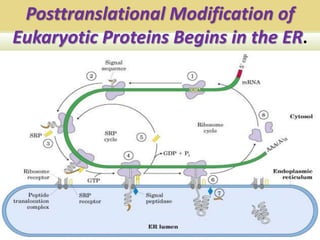
Posttranslational Modification of
Eukaryotic Proteins Begins in the ER.
Glycosylation Plays a Key Role in
Protein Targeting.
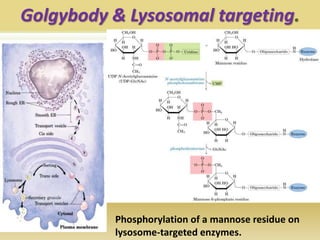
Golgybody & Lysosomal targeting.
Phosphorylation of a mannose residue on
lysosome-targeted enzymes.
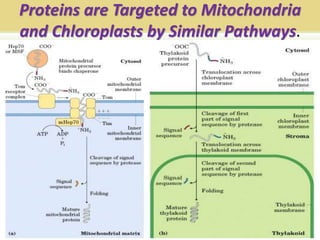
Proteins are Targeted to Mitochondria
and Chloroplasts by Similar Pathways.
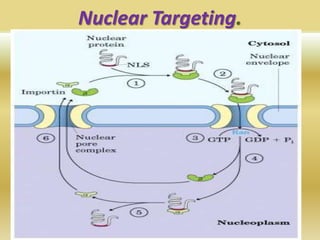
Nuclear Targeting.
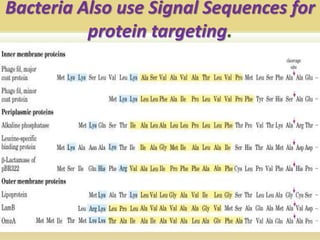
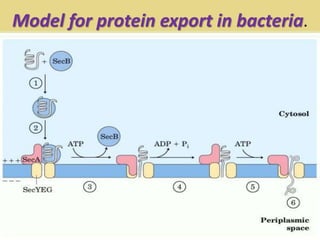
Bacteria Also use Signal Sequences for
protein targeting.
Model for protein export in bacteria.
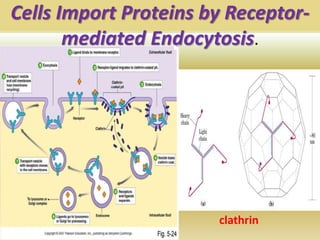
Cells Import Proteins by Receptor-
mediated Endocytosis.
clathrin
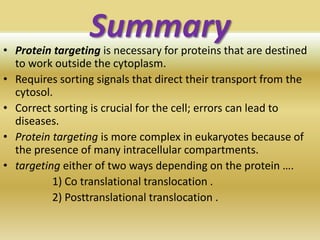
Summary• Protein targeting is necessary for proteins that are destined
to work outside the cytoplasm.
• Requires sorting signals that direct their transport from the
cytosol.
• Correct sorting is crucial for the cell; errors can lead to
diseases.
• Protein targeting is more complex in eukaryotes because of
the presence of many intracellular compartments.
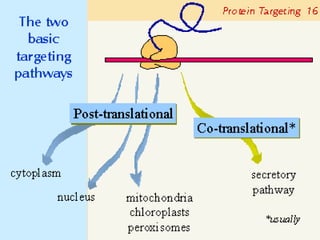
• targeting either of two ways depending on the protein ….
1) Co translational translocation .
2) Posttranslational translocation .
References
• Wikipedia… www.google.co.in.
• LEHNINGER :- principles of Biochemistry ; Cox and Nelson ;
5th edition ; page no.= 1100-1107.
• Molecular cell Biology:- Lodish and Berk et al ; 5th edition ;
page no.= 657-739.
Thanks

Protein targeting ajay

  • 1.
    Presented by:- Ajay kr.Chandra BT/02/09 5th semester
  • 2.
    •What is ProteinTargeting? •Why protein is targeted? •Where it occurs?
  • 4.
    signal sequences • Firstby Gunter Blobel (1970) ,won the Nobel Prize (1999) for his work on protein targeting. • Directs a protein to its appropriate location after synthesis. • Signals vary from 13 to 36 amino acid residues. a. About 10 to 15 hydrophobic amino acid residues. b. One or more positively charged residues near N-terminus. c. A short cleavage sequence often including(polar A.A) Ala.
  • 5.
  • 6.
    Glycosylation Plays aKey Role in Protein Targeting.
  • 7.
    Golgybody & Lysosomaltargeting. Phosphorylation of a mannose residue on lysosome-targeted enzymes.
  • 8.
    Proteins are Targetedto Mitochondria and Chloroplasts by Similar Pathways.
  • 9.
  • 10.
    Bacteria Also useSignal Sequences for protein targeting.
  • 11.
    Model for proteinexport in bacteria.
  • 12.
    Cells Import Proteinsby Receptor- mediated Endocytosis. clathrin
  • 13.
    Summary• Protein targetingis necessary for proteins that are destined to work outside the cytoplasm. • Requires sorting signals that direct their transport from the cytosol. • Correct sorting is crucial for the cell; errors can lead to diseases. • Protein targeting is more complex in eukaryotes because of the presence of many intracellular compartments. • targeting either of two ways depending on the protein …. 1) Co translational translocation . 2) Posttranslational translocation .
  • 14.
    References • Wikipedia… www.google.co.in. •LEHNINGER :- principles of Biochemistry ; Cox and Nelson ; 5th edition ; page no.= 1100-1107. • Molecular cell Biology:- Lodish and Berk et al ; 5th edition ; page no.= 657-739.
  • 15.