Jimma University
Institute of Health Sciences
Department of Biomedical Science
Course Title: Basics of Genetics
Seminal Presentation on:- non-histone proteins
By;- Bikila Belay…RM0435/15-0
Submitted to:-Prof,Kumaresan Ramanathan
June 2023
Jimma,Ethiopa
CONTENTS:
• Definition of non histone proteins.
• Types of non-histone proteins.
• Non-histone Chromosomal Proteins.
• Roles of non histone in chromosomal structure.
Definition of non histone proteins
Is a DNA-binding nuclear protein expressed throughout the cell cycle in proliferating cells, but
not in quiescent (G0) cells.
The non-histone proteins, are a large group of heterogeneous proteins that play a role
in organization and compaction of the chromosome into higher order structures.
Non-histone proteins are those proteins in chromatin that
persist after the removal of the histones.
The chromosome is organized and compacted into higher-order
structures by a wide group of heterogeneous proteins known as
non-histone proteins.
Nonhistone proteins
Hundreds of other proteins that make up chromatin and are not histones
200 – molecules of each kind of no histone protein.
Large variety of functions
-Structural role – chromosome scaffold .
-Chromosome replication – e.g. DNA polymerases.
-Chromosome segregation – e.g. kinetochore proteins .
Cont…..
-Active in transcription –
-largest group the motor proteins of kinetochores help
during mitosis and meiosis.
-By interacting with DNA, influence when, where, and at what rate
genes give rise to their protein products.
- Non histone proteins are not a part of a nucleosome.
- Non histone proteins are not conserved across species.
- Non histone proteins are not involved in gene expression regulation.
Types of non-histone proteins
-Scaffold proteins,
- Heterochromatin Protein 1,
-DNA polymerase,
-Polycomb, etc. are some types of non histones and
-other motor proteins, which are essential
for cell organization.
Non-histone Chromosomal Proteins:
- Relatively low in abundance compared to the histones
- They include:
1) proteins for transcription (SSB DNA poly etc.
- RNA polymerases
- activators and repressors (later disc.)
(Transcription Factors)
• 2) DNA polymerase for replication.
• 3) High Mobility Group (HMG) proteins.
- moderately abundant ( average
1 HMG/nucleosome)
- role in transcription
-Structural?
- Functional?
- later disc.
• 4) Other structural proteins (Topoisomerase, etc.)
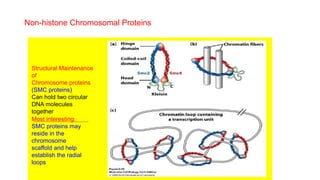
Non-histone Chromosomal Proteins
Structural Maintenance
of
Chromosome proteins
(SMC proteins)
Can hold two circular
DNA molecules
together
Most interesting:
SMC proteins may
reside in the
chromosome
scaffold and help
establish the radial
loops
Non-histone Chromosomal Proteins:
• They play vital roles in:-
-regulating processes like nucleosome remodeling,
- DNA replication,& DNA damage repair.
- RNA synthesis and processing,
- nuclear transport,/ signal transduction
- steroid hormone action and
- interphase/mitosis transition.
-autophagy and metabolism.
• The main function of non histone proteins is the compaction of chromatin in
chromosomes and organization of chromosomes inside the nucleus
Roles of non histone in chromosomal structure:
Non histone protein helps maintain chromosome
structure:
-The assembly of non histone proteins and the
structural integrity of vertebrate mitotic chromosomes
depend on condensin.
Reference:
• Woodcock, C.L.; Ghosh, R.P. Chromatin Higher-order Structure and
Dynamics. Gold Spring Harb. Perspect. Biol. 2010, a000296. [Google
Scholar] [CrossRef] [PubMed]
• Bekhor, I., Kung, G.M. & Bonner, J. (1969). Sequence-specific interaction of DNA and
chromosomal protein. J. Mol. Biol. 39, 351– 364
• Bhorjee, J.S. & Pederson, T. (1972). Nonhistone chromosomal proteins in synchronized
HeLa cells. Proc. Natl. Acad. Sci. U.S.A. 69, 3345– 3349
• Curtis Seubert. “The Difference Between Histone & Nonhistone.” Sciencing. Leaf
Group, 24 Apr. 2017. Web. 15 May 2017.

Non-Hisatone Pro,seminar,.pptx

  • 1.
    Jimma University Institute ofHealth Sciences Department of Biomedical Science Course Title: Basics of Genetics Seminal Presentation on:- non-histone proteins By;- Bikila Belay…RM0435/15-0 Submitted to:-Prof,Kumaresan Ramanathan June 2023 Jimma,Ethiopa
  • 2.
    CONTENTS: • Definition ofnon histone proteins. • Types of non-histone proteins. • Non-histone Chromosomal Proteins. • Roles of non histone in chromosomal structure.
  • 3.
    Definition of nonhistone proteins Is a DNA-binding nuclear protein expressed throughout the cell cycle in proliferating cells, but not in quiescent (G0) cells. The non-histone proteins, are a large group of heterogeneous proteins that play a role in organization and compaction of the chromosome into higher order structures. Non-histone proteins are those proteins in chromatin that persist after the removal of the histones. The chromosome is organized and compacted into higher-order structures by a wide group of heterogeneous proteins known as non-histone proteins.
  • 4.
    Nonhistone proteins Hundreds ofother proteins that make up chromatin and are not histones 200 – molecules of each kind of no histone protein. Large variety of functions -Structural role – chromosome scaffold . -Chromosome replication – e.g. DNA polymerases. -Chromosome segregation – e.g. kinetochore proteins .
  • 5.
    Cont….. -Active in transcription– -largest group the motor proteins of kinetochores help during mitosis and meiosis. -By interacting with DNA, influence when, where, and at what rate genes give rise to their protein products. - Non histone proteins are not a part of a nucleosome. - Non histone proteins are not conserved across species. - Non histone proteins are not involved in gene expression regulation.
  • 6.
    Types of non-histoneproteins -Scaffold proteins, - Heterochromatin Protein 1, -DNA polymerase, -Polycomb, etc. are some types of non histones and -other motor proteins, which are essential for cell organization.
  • 7.
    Non-histone Chromosomal Proteins: -Relatively low in abundance compared to the histones - They include: 1) proteins for transcription (SSB DNA poly etc. - RNA polymerases - activators and repressors (later disc.) (Transcription Factors) • 2) DNA polymerase for replication. • 3) High Mobility Group (HMG) proteins. - moderately abundant ( average 1 HMG/nucleosome) - role in transcription -Structural? - Functional? - later disc. • 4) Other structural proteins (Topoisomerase, etc.)
  • 8.
    Non-histone Chromosomal Proteins StructuralMaintenance of Chromosome proteins (SMC proteins) Can hold two circular DNA molecules together Most interesting: SMC proteins may reside in the chromosome scaffold and help establish the radial loops
  • 9.
    Non-histone Chromosomal Proteins: •They play vital roles in:- -regulating processes like nucleosome remodeling, - DNA replication,& DNA damage repair. - RNA synthesis and processing, - nuclear transport,/ signal transduction - steroid hormone action and - interphase/mitosis transition. -autophagy and metabolism. • The main function of non histone proteins is the compaction of chromatin in chromosomes and organization of chromosomes inside the nucleus
  • 10.
    Roles of nonhistone in chromosomal structure: Non histone protein helps maintain chromosome structure: -The assembly of non histone proteins and the structural integrity of vertebrate mitotic chromosomes depend on condensin.
  • 11.
    Reference: • Woodcock, C.L.;Ghosh, R.P. Chromatin Higher-order Structure and Dynamics. Gold Spring Harb. Perspect. Biol. 2010, a000296. [Google Scholar] [CrossRef] [PubMed] • Bekhor, I., Kung, G.M. & Bonner, J. (1969). Sequence-specific interaction of DNA and chromosomal protein. J. Mol. Biol. 39, 351– 364 • Bhorjee, J.S. & Pederson, T. (1972). Nonhistone chromosomal proteins in synchronized HeLa cells. Proc. Natl. Acad. Sci. U.S.A. 69, 3345– 3349 • Curtis Seubert. “The Difference Between Histone & Nonhistone.” Sciencing. Leaf Group, 24 Apr. 2017. Web. 15 May 2017.