PROTEIN
PURIFICATION
By Inder Ishwarlal Gohri
What is Purification ?
01.
Why their is a Need of
Purification ?
02.
.
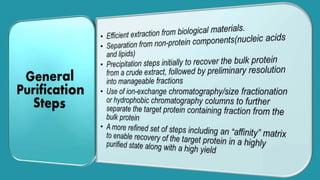
03. General purification steps.
04. Preparation of Source.
05. Biopharmaceuticals
06. Protein Tags
07. Quantification of Proteins
(Assay Methods)
08. Monitoring the activity of
purification
Topics
What is Protein Purification?
 Protein purification is a series of processes intended to isolate one or a
few protein from a complex mixture usually cell ,tissues or whole
organisms.
 Protein purification is vital for the characterization of the function, structure
and interactions of the protein of interest.
 Purification should yield a sample of protein containing only a particular
type of molecule, the protein in which the biochemist is interested.
 Separation steps usually exploit differences in protein size, physico-
chemical properties, binding affinity and biological activity.
 The pure result may be termed protein isolate.
Why there is need of protein
purification ?
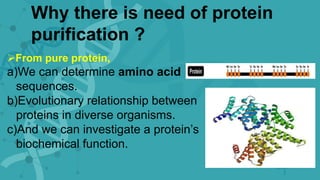
From pure protein,
a)We can determine amino acid
sequences.
b)Evolutionary relationship between
proteins in diverse organisms.
c)And we can investigate a protein’s
biochemical function.
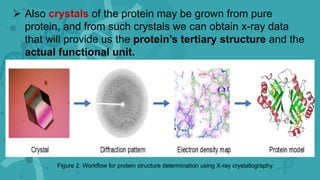
 Also crystals of the protein may be grown from pure
protein, and from such crystals we can obtain x-ray data
that will provide us the protein’s tertiary structure and the
actual functional unit.
Figure 2. Workflow for protein structure determination using X-ray crystallography.
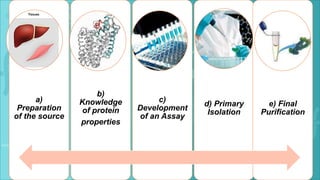
a)
Preparation
of the source
b)
Knowledge
of protein
properties
c)
Development
of an Assay
d) Primary
Isolation
e) Final
Purification
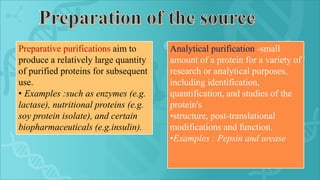
Preparative purifications aim to
produce a relatively large quantity
of purified proteins for subsequent
use.
• Examples :such as enzymes (e.g.
lactase), nutritional proteins (e.g.
soy protein isolate), and certain
biopharmaceuticals (e.g.insulin).
Analytical purification -small
amount of a protein for a variety of
research or analytical purposes,
including identification,
quantification, and studies of the
protein's
•structure, post-translational
modifications and function.
•Examples : Pepsin and urease
Biopharmaceuticals
Biopharmaceuticals are medical drugs – proteins,
antibodies and nucleic acids that are produced using
biotechnology and are used for therapeutic or in vivo
diagnostic purposes.
The first biopharmaceutical agent was insulin that was
approved for human use in 1982.
Today, over 160 biopharmaceutical agents are approved
in the USA
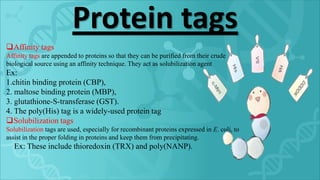
Protein tags
Affinity tags
Affinity tags are appended to proteins so that they can be purified from their crude
biological source using an affinity technique. They act as solubilization agent
Ex:
1.chitin binding protein (CBP),
2. maltose binding protein (MBP),
3. glutathione-S-transferase (GST).
4. The poly(His) tag is a widely-used protein tag
Solubilization tags
Solubilization tags are used, especially for recombinant proteins expressed in E. coli, to
assist in the proper folding in proteins and keep them from precipitating.
Ex: These include thioredoxin (TRX) and poly(NANP).
Chromatography tags
Chromatography tags are used to alter chromatographic properties of the protein to afford
different resolution across a particular separation technique. Often, these consist of
polyanionic amino acids.
Epitope tags
Epitope tags are short peptide sequences which are chosen because high-affinity antibodies
can be reliably produced in many different species. These are usually derived from viral
genes, which explain their high immunoreactivity
Ex.Includes V5-tag, c-myc-tag, and HA-tag.
Fluorescence tags
Fluorescence tags are used to give visual readout on a protein.
Ex.GFP and its variants are the most commonly used fluorescence tags.
Quantification of Proteins
• A method of determining in a quantitative fashion the amount of a particular
activity present is
Assay methods:
• If the protein is an enzyme, the assay of choice measures that protein‘s ability to
convert a substrate to a product, where, for signal-to-noise reasons, appearance
of product is preferred over disappearance of substrate.
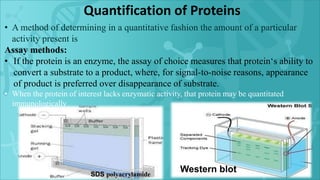
• When the protein of interest lacks enzymatic activity, that protein may be quantitated
immunologically
SDS polyacrylamide
Western blot
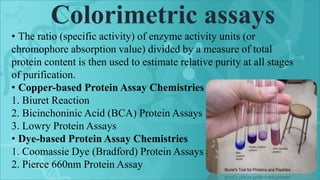
• The ratio (specific activity) of enzyme activity units (or
chromophore absorption value) divided by a measure of total
protein content is then used to estimate relative purity at all stages
of purification.
• Copper-based Protein Assay Chemistries
1. Biuret Reaction
2. Bicinchoninic Acid (BCA) Protein Assays
3. Lowry Protein Assays
• Dye-based Protein Assay Chemistries
1. Coomassie Dye (Bradford) Protein Assays
2. Pierce 660nm Protein Assay
Colorimetric assays
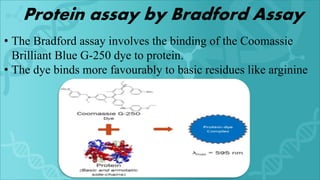
• The Bradford assay involves the binding of the Coomassie
Brilliant Blue G-250 dye to protein.
• The dye binds more favourably to basic residues like arginine
Protein assay by Bradford Assay
Total protein mg/mL
• Quantity of protein present in the fraction
Total activity (units of activity)
• Use a portion of sample to determine activity.
• Multiply activity by total volume to determine
total activity.
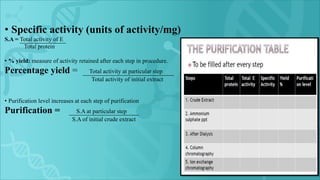
• Specific activity (units of activity/mg)
S.A = Total activity of E
Total protein
• % yield: measure of activity retained after each step in procedure.
Percentage yield = Total activity at particular step
Total activity of initial extract
• Purification level increases at each step of purification
Purification = S.A at particular step
S.A of initial crude extract
REFERENCE :
1.https://www.slideshare.net/PradeepNarwat/purifi
cation-of-proteins-purification-of-enzymes
2.https://youtu.be/PVvpEKeOzEM
Protein purification

Protein purification

  • 1.
  • 2.
    What is Purification? 01. Why their is a Need of Purification ? 02. . 03. General purification steps. 04. Preparation of Source. 05. Biopharmaceuticals 06. Protein Tags 07. Quantification of Proteins (Assay Methods) 08. Monitoring the activity of purification Topics
  • 3.
    What is ProteinPurification?  Protein purification is a series of processes intended to isolate one or a few protein from a complex mixture usually cell ,tissues or whole organisms.  Protein purification is vital for the characterization of the function, structure and interactions of the protein of interest.  Purification should yield a sample of protein containing only a particular type of molecule, the protein in which the biochemist is interested.  Separation steps usually exploit differences in protein size, physico- chemical properties, binding affinity and biological activity.  The pure result may be termed protein isolate.
  • 4.
    Why there isneed of protein purification ? From pure protein, a)We can determine amino acid sequences. b)Evolutionary relationship between proteins in diverse organisms. c)And we can investigate a protein’s biochemical function.
  • 5.
     Also crystalsof the protein may be grown from pure protein, and from such crystals we can obtain x-ray data that will provide us the protein’s tertiary structure and the actual functional unit. Figure 2. Workflow for protein structure determination using X-ray crystallography.
  • 7.
    a) Preparation of the source b) Knowledge ofprotein properties c) Development of an Assay d) Primary Isolation e) Final Purification
  • 8.
    Preparative purifications aimto produce a relatively large quantity of purified proteins for subsequent use. • Examples :such as enzymes (e.g. lactase), nutritional proteins (e.g. soy protein isolate), and certain biopharmaceuticals (e.g.insulin). Analytical purification -small amount of a protein for a variety of research or analytical purposes, including identification, quantification, and studies of the protein's •structure, post-translational modifications and function. •Examples : Pepsin and urease
  • 9.
    Biopharmaceuticals Biopharmaceuticals are medicaldrugs – proteins, antibodies and nucleic acids that are produced using biotechnology and are used for therapeutic or in vivo diagnostic purposes. The first biopharmaceutical agent was insulin that was approved for human use in 1982. Today, over 160 biopharmaceutical agents are approved in the USA
  • 10.
    Protein tags Affinity tags Affinitytags are appended to proteins so that they can be purified from their crude biological source using an affinity technique. They act as solubilization agent Ex: 1.chitin binding protein (CBP), 2. maltose binding protein (MBP), 3. glutathione-S-transferase (GST). 4. The poly(His) tag is a widely-used protein tag Solubilization tags Solubilization tags are used, especially for recombinant proteins expressed in E. coli, to assist in the proper folding in proteins and keep them from precipitating. Ex: These include thioredoxin (TRX) and poly(NANP).
  • 11.
    Chromatography tags Chromatography tagsare used to alter chromatographic properties of the protein to afford different resolution across a particular separation technique. Often, these consist of polyanionic amino acids. Epitope tags Epitope tags are short peptide sequences which are chosen because high-affinity antibodies can be reliably produced in many different species. These are usually derived from viral genes, which explain their high immunoreactivity Ex.Includes V5-tag, c-myc-tag, and HA-tag. Fluorescence tags Fluorescence tags are used to give visual readout on a protein. Ex.GFP and its variants are the most commonly used fluorescence tags.
  • 12.
    Quantification of Proteins •A method of determining in a quantitative fashion the amount of a particular activity present is Assay methods: • If the protein is an enzyme, the assay of choice measures that protein‘s ability to convert a substrate to a product, where, for signal-to-noise reasons, appearance of product is preferred over disappearance of substrate. • When the protein of interest lacks enzymatic activity, that protein may be quantitated immunologically SDS polyacrylamide Western blot
  • 13.
    • The ratio(specific activity) of enzyme activity units (or chromophore absorption value) divided by a measure of total protein content is then used to estimate relative purity at all stages of purification. • Copper-based Protein Assay Chemistries 1. Biuret Reaction 2. Bicinchoninic Acid (BCA) Protein Assays 3. Lowry Protein Assays • Dye-based Protein Assay Chemistries 1. Coomassie Dye (Bradford) Protein Assays 2. Pierce 660nm Protein Assay Colorimetric assays
  • 14.
    • The Bradfordassay involves the binding of the Coomassie Brilliant Blue G-250 dye to protein. • The dye binds more favourably to basic residues like arginine Protein assay by Bradford Assay
  • 15.
    Total protein mg/mL •Quantity of protein present in the fraction Total activity (units of activity) • Use a portion of sample to determine activity. • Multiply activity by total volume to determine total activity.
  • 16.
    • Specific activity(units of activity/mg) S.A = Total activity of E Total protein • % yield: measure of activity retained after each step in procedure. Percentage yield = Total activity at particular step Total activity of initial extract • Purification level increases at each step of purification Purification = S.A at particular step S.A of initial crude extract
  • 17.